ISSN(Online): 2319-8753 ISSN (Print): 2347-6710
I
nternational
J
ournal of
I
nnovative
R
esearch in
S
cience,
E
ngineering and
T
echnology
(A High Impact Factor, Monthly, Peer Reviewed Journal) Visit: www.ijirset.com
Vol. 8, Issue 6, June 2019
Identification of DOS attack Identification in
Distributed Environment using Deep Learning
Vaishnavi Dande , Dr.Mrs.A.M. Deshmukh
Savitribai Phule Pune University, Pune, India
ABSTRACT : As the complexity of Internet is scaled up, it is likely for the Internet resources to be exposed to Distributed Denial of Service (DDoS) flooding attacks on TCP-based Web servers. There has been a lot of related work which focuses on analyzing the pattern of the DDoS attacks to protect users from them. However, none of these studies takes all the flags within TCP header into account, nor do they analyze relationship between the flags and the TCP packets. To analyze the features of the DDoS attacks, therefore, this paper presents a network traffic analysis mechanism which computes the ratio of the number of TCP flags to the total number of TCP packets. In this work we propose a system DDOS identification system using deep learning approach. This work initially carried out NS2 has design vitreous cluster network, each cluster having a cluster head as well as some cluster members. Each cluster number should we generate or sense random data and send to cluster head. Here we need to check each packet flow with packetfeatures. Basically kddcup99 data set is the well-known intrusion detection data set to detect the malicious activity based on the DOS attack. Around seven sub types has been categorized in proposed system. The system contains training phase it is already holds some background knowledge as well as policy under the network security for system. Recurrent neural network (RNN) as used to generate the runtime weight between received data by cluster head with background policies. According to generator distance system will decide the desired packet is normal or abnormal. In experimental analysis we had shown various type of dos attack with accuracy rate in network simulator-2 environment.
KEYWORDS: DDOS, Deep Learning, Recurrent Neural Network, Malicious Network environment, NIDS, HIDS
I. INTRODUCTION
To understand the options of DDoS attacks, we have a tendency to introduce the analysis mechanism of the DDoS attacks in 2 settings: the traditional internet server with none attack and also the Web server with the DDoS attacks. In these settings, we have a tendency to live TCP flag rates, which ar expressed in terms of the quantitative relation of variety of TCP flags to the entire number of TCP packets. as an example, the quantity of SYNs drastically will increase just in case of SYN flooding attacks that is that the commonest DDoS attacks. In consequence, the increasing variety of SYNs indicates the chance of the DDoS attacks. Our analysis mechanism calculates the TCP flag rates and provides the premise of the DDoS attacks detection in a very TCP-based network surroundings.
ISSN(Online): 2319-8753 ISSN (Print): 2347-6710
I
nternational
J
ournal of
I
nnovative
R
esearch in
S
cience,
E
ngineering and
T
echnology
(A High Impact Factor, Monthly, Peer Reviewed Journal) Visit: www.ijirset.com
Vol. 8, Issue 6, June 2019
II. LITERATURE SURVEY
According to Tariq Ahamad et. Al. [1] Large amounts of research have been conducted to improve IDS using artificial neural networks. The research proved that the network data traffic can be filtered and modeled more efficiently using artificial neural networks. Using artificial neural network proved itself as more advantageous as it take a thorough conscientious, perfect and accurate training, validation and top level testing phases before it is applied to the networks to detect malicious data and network attacks. Neural network (also known as artificial neural network) is an information processing model that is based and inspired from the human nervous system like the human brain does for humans by Z. F. Chen in [2]. The most important characteristic feature of this model is its unique structure of the system that processes the information. It consists of numerous exceptionally interconnected processing nodes (neurons) that work simultaneously to solve the specified problems which are defined by I. F. Akyildiz and I. H. Kasimoglu in [3].
According to N. Bulusu et. Al. [4] System also shows the real mathematical form of a neural network neuron. Neural networks, like humans do, learn by examples. Neural network is configured for a particular application, such as data classification or recognizing patterns through a learning process. The learning process in humans requires synaptic connections adjustments between the neurons and same is the case with neural networks as well. With the extra ordinary character of deriving meaning from complex and indefinite data, neural networks can be used to recognize and detect the patterns that are exceptionally complicated to be even observed or detected by humans and even by computer techniques proposed by E. Shih et. Al. in [5]. According to Tariq Ahamad, Abdullah Aljumah [6] the modern network world suffer due to security and threat vulnerabilities despite being from different origin or manufacturer or for different purpose and on the ground level, it is truly difficult technically and economically not feasible as far as both creating and maintaining such systems and to ensure that both the network and the associated systems are not susceptible to threats and attacks [6].
IDS is a special security tool that is being used by the network experts to keep the network safe and secure from network attacks which can come from many different sources by Abdulaziz Aldaej and Tariq Ahamad in [7]. It has emerged as one of the basic and powerful tool in order to deal with data security and availability issues over the communication networks. These attacks have a major influence of the networks and the systems as they include network performance, data security, loss of intellectual property by K. K Gupta and et. El. In [8] and a real liability for the compromised notes or networks data and that is why need a powerful IDS illustrates the architecture of IDS. The data packets received from the internet is forwarded to the processing unit where the format of the data is changed in order to make it compatible with the associated IDS and eventually the data packets are categorized as an attack or normal [9] which is defined by Tariq Ahamed Ahanger.
According to M. A. Pérez del Pino et. Al. The normal data packet re allowed to pass through but the attack data packets as identified as attack type and are kept in the attack table and the alarm is raised and the defense procedure is invoked [10]. After training process, a neural network can be treated as an expert one in the class or group information that has
been given for analysis. This expert system can answer ―what ifǁ questions. There are other advantages of neural
networks which include Adaptive learning, Self organization, Real time operation, redundant information coding, etc. by Eugene Y et. Al. in [11]. Neural networks learn by examples and cannot be programmed to accomplish any specific job [12] by A. D. Wood and J. A. Stankovic. These examples need to be selected correctly and delicately otherwise the precious time of the system will get wasted or the network might work improperly
III. PROPOSED SYSTEM
ISSN(Online): 2319-8753 ISSN (Print): 2347-6710
I
nternational
J
ournal of
I
nnovative
R
esearch in
S
cience,
E
ngineering and
T
echnology
(A High Impact Factor, Monthly, Peer Reviewed Journal) Visit: www.ijirset.com
Vol. 8, Issue 6, June 2019
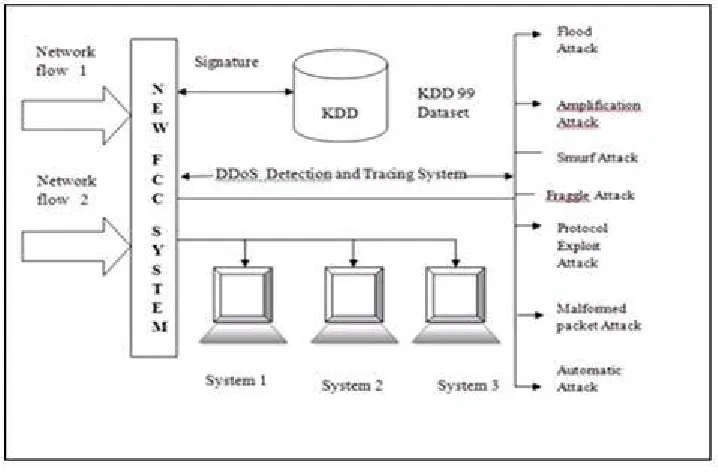
attacks in theory. Also our novel tracing system is used to trace the sources of the DDoS attack .It will detect the subtypes of DDoS attack such as flood attack, amplification attack, smurf, fraggle attack etc.
Figure 1: Proposed system architecture diagram
In the proposed system figure 1 shows the proposed system architecture, here we used runtime flash based attack generation technique which will runtime generate thousand of null packets and post in victims port. Our proposed classification based RNN algorithm will detect such malicious behavior ip as well as packets, and eliminate such connection.
Algorithm Design
Recurrent Neural Network
Input : Training Rules Tr[], Test Instances Ts[], Threshold T.
Output : Weight w=0.0
Step 1 : Read each test instance from (TsInstnace from Ts)
Step 2 : = { … }
Step 3 : Read each train instance from (TrInstnace from Tr)
Step 4 : = {A … … A }
Step 5 : w = WeightCalc(TsIns, TrIns)
Step 6 : if (w >= T)
Step 7 : Forward feed layer to input layer for feedback FeedLayer[] {Tsf,w}
ISSN(Online): 2319-8753 ISSN (Print): 2347-6710
I
nternational
J
ournal of
I
nnovative
R
esearch in
S
cience,
E
ngineering and
T
echnology
(A High Impact Factor, Monthly, Peer Reviewed Journal) Visit: www.ijirset.com
Vol. 8, Issue 6, June 2019
Step 9 : Return Cweight
Dataset Description
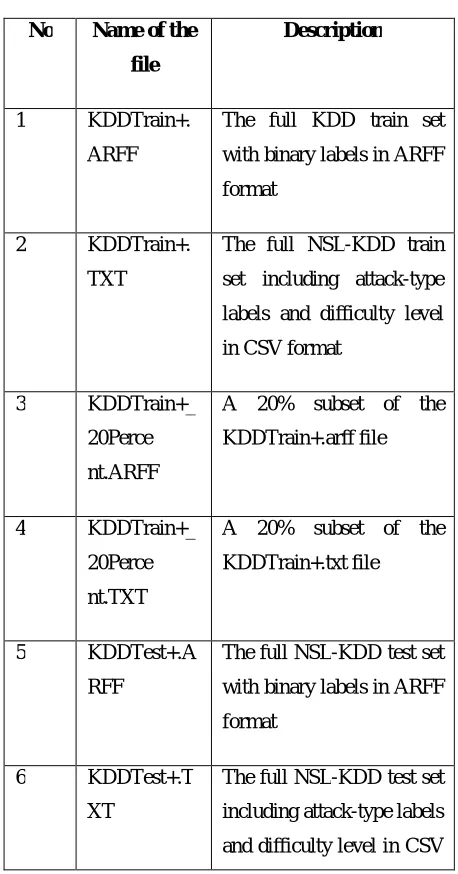
The inherent drawbacks in the KDD cup 99 dataset [4] has been revealed by various statistical analyses has affected the detection accuracy of many IDS modeled by researchers. It contains essential records of the complete KDD data set. There are a collection of downloadable files at the disposal for the researchers.
Table 1: Dataset Description
No Name of the
file
Description
1 KDDTrain+. ARFF
The full KDD train set with binary labels in ARFF format
2 KDDTrain+. TXT
The full NSL-KDD train set including attack-type labels and difficulty level in CSV format
3 KDDTrain+_ 20Perce nt.ARFF
A 20% subset of the KDDTrain+.arff file
4 KDDTrain+_ 20Perce nt.TXT
A 20% subset of the KDDTrain+.txt file
5 KDDTest+.A RFF
The full NSL-KDD test set with binary labels in ARFF format
6 KDDTest+.T XT
ISSN(Online): 2319-8753 ISSN (Print): 2347-6710
I
nternational
J
ournal of
I
nnovative
R
esearch in
S
cience,
E
ngineering and
T
echnology
(A High Impact Factor, Monthly, Peer Reviewed Journal) Visit: www.ijirset.com
Vol. 8, Issue 6, June 2019
format 7
KDDTest-21.ARFF
A subset of the KDDTest+.arff file which does not include records with difficulty level of 21 out of 21
8 KDDTest-21.TXT
A subset of the KDDTest+.txt file which does not include records with difficulty level of 21 out of 21
IV. RESULTS
In this section we present the evaluation of proposed system as well as existing system. After describing our experimental setup, we quantitatively evaluate the analysis with respect to the different parameter used such as throughput, packet delivery ratio, cost, and time. We run our experiments in NS2 simulator version 2.35 that has shown to produce realistic results. NS simulator runs TCL code, but here use both TCL and C++ code for header input. In our simulations, we use Infrastructure based network environment for communication. For providing access to the wireless network at anytime used for the network selection. WMN simulate in NS2 .TCL file show the simulation of all over architecture which proposed. For run .TCL use Eval Vid Framework in NS2 simulator it also help to store running connection information message using connection pattern file us1. NS2 trace file .tr can help to analyze results. It supports filtering, processing and displaying vector and scalar data. The results directory in the project folder contains us.tr file which is the files that store the performance results of the simulation. Based on the us.tr file using xgraph tool we execute graph of result parameters with respect to x and y axis parameters. Graphs files are of .awk extensions and are executable in xgarph tool to plot the graph.
ISSN(Online): 2319-8753 ISSN (Print): 2347-6710
I
nternational
J
ournal of
I
nnovative
R
esearch in
S
cience,
E
ngineering and
T
echnology
(A High Impact Factor, Monthly, Peer Reviewed Journal) Visit: www.ijirset.com
Vol. 8, Issue 6, June 2019
Figure 2: DOS attack detection accuracy with various threshold
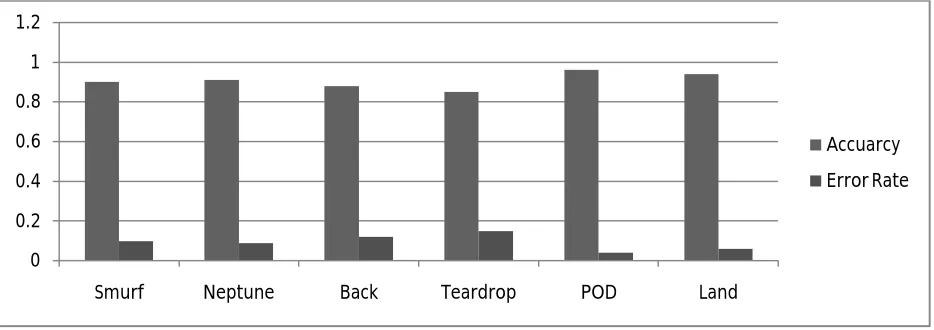
The below figure 3 shows the each sub attack detection accuracy of dos attack, most of sensor nodes generates empty packets and sent it to receiver continuously, this event can be generated flash attack which is sometime having some malicious contents which will be harmful fall victim machine. In below figure 3 it illustrates detection accuracy for each sub attack under the DOS.
Figure 3: DOS subtype detection accuracy of proposed system
V. CONCLUSION
As Internet is a wide network used to combine different sectors. It carries number of information services and resources which exchange large amount of traffic over the Internet every day. All these services should be maintained properly so that user can access it as per their requirement. If all these services not maintained properly, definitely it will create problems. As the numbers of Internet users are increasing, the threats to it are also increasing. So protection against different software attacks and threats is one of the key challenges to maintain data integrity and privacy. Among them, Distributed Denial of Service (DDoS) and Flash Crowd attacks are the two major events. To maintain security and stability, it is very important to differentiate DDoS attack from flash crowd and trace the sources of the attack in large amount of traffic in network.
0 0.2 0.4 0.6 0.8 1
Th=0.50 Th=0.60 Th=0.70 Th=0.75
Accuarcy
Error Rate
0 0.2 0.4 0.6 0.8 1 1.2
Smurf Neptune Back Teardrop POD Land
Accuarcy
ISSN(Online): 2319-8753 ISSN (Print): 2347-6710
I
nternational
J
ournal of
I
nnovative
R
esearch in
S
cience,
E
ngineering and
T
echnology
(A High Impact Factor, Monthly, Peer Reviewed Journal) Visit: www.ijirset.com
Vol. 8, Issue 6, June 2019
VI. FUTURE WORK
To implement the proposed system with another network defense mechanism in real time environment as well as need to do who proposed experiment in various network data sets like ISCX, Botnet, WSNTrace etc.
REFERENCES
[1] Tariq Ahamad, Abdullah Aljumah," Hybrid Approach Using Intrusion Detection System", International Journal of Engineering Research & Technology, Vol. 3 Issue 2, February - 2014.
[2] Z. F. Chen, P. D. Qian and Z. F. Chen, ―Application of PSO-RBF Neural Network in Network Intrusion Detectionǁ, 2009 3rd International
Symposium on Intelligent Information Technology Application, pp.362- 364, 2009
[3] I. F. Akyildiz and I. H. Kasimoglu, ―Wireless sensor and actor networks: research challenges,ǁ to be published Ad Hoc Networks, 2004. [4] N. Bulusu, D. Estrin, L. Girod and J. Heidemann, ―Scalable coordination for wireless sensor networks: self-configuring localization systems International Symposium on Communication Theory and Applications (ISCTA), Ambleside, UK, July 2001.
[5] E. Shih, S. Cho, N. Ickes, R. Min, A. Sinha, A. Wang and A. Chandrakasan, ―Physical layer driven protocol and algorithm design for energy -efficient wireless sensor networks,ǁ Proceedings of ACM MobiCom, Italy, pp:272-286, July 2001.
[6] Tariq Ahamad, Abdullah Aljumah,"Detection and Defense Mechanism against DDoS in MANET", Indian Journal of Science and Technology, Vol 8, No. 33, Dec 2015.
[7] Abdulaziz Aldaej and Tariq Ahamad, ―AAODV (Aggrandized Ad Hoc on Demand Vector): A Detection and Prevention Technique for Manetsǁ
International Journal of Advanced Computer Science and Applications(IJACSA), 7(10), 2016. http://dx.doi.org/10.14569/IJACSA.2016.071018 .
[8] K. K Gupta, B. Nath, and R. Kotagiri,―Layered Approach Using Conditional Random Fields for Intrusion Detection,ǁ IEEE Transactions on Dependable and Secure Computing, Vol. 7, No. 1, pp. 35-49, Jan 2010.
[9] Tariq Ahamed Ahanger," An Effective Approach of Detecting DDoSUsing Artificial Neural Networks", IEEE international Conference on Wireless Communications, Signal Processing and Networking March 2017.
[10 M. A. Pérez del Pino, P. García Báez, P. Fernández López, and C. P. Suárez Araújo, ―Towards Self-Organizing Maps based Computational Intelligent System for Denial of Service Attacks Detectionǁ, INES2010, 14th International Conference on Intelligent Engineering Systems, pp. 151-157, Spain, May 5–7, 2010.
[11] Eugene Y. Vasserman and Nicholas Hopper, ―DOS flooding: Draining Life from Wireless Ad Hoc Sensor Networksǁ, IEEE Transactions on mobile computing, Vol. 12, No. 2, February 2013.