Piping Without Digging a Trench-A Case
Study
Niranjan Gaikwad1, Samyak Jagtap1, Rugved Shinde1, Prerna More1, Dr. V.G. Sayagavi2
UG Student, Department of Civil Engineering, Mahatma Gandhi Mission’s College of Engineering and Technology,
Kamothe, Navi Mumbai, India 1
Professor, Department of Civil Engineering, Mahatma Gandhi Mission’s College of Engineering and Technology,
Kamothe, Navi Mumbai, India 2
ABSTRACT: “Piping without digging a trench “ is a technology for installation , maintenance and renewal of underground pipelines ,ducts and cables precluding any kind of excavation. .This mutated trend of usage of trenchless methods in piping projects has helped to satisfy the ever enhancing demands of better infrastructure and its maintenance made by the communities and the regulators. Preventing excavation averts the socio-economical and environmental damage and on the top of it provides an effective alternative to the traditional open trenching method of excavation. Trenchless technology offers a feasible solution to the pessimistic effects of open trenching. Depending upon a particular scenario, trenchless methods often prove to be cost effective than the mundane open trenching method. The indirect cost of environmental degradation, social disturbance and health hazards caused due to pollution facilitated by open excavation pile up with the total estimate of open trenching. This paper briefly highlights the cost comparison of Trenchless method of Horizontal Directional Drilling for a project in Kalyan City, Thane District ,Maharashtra.
KEYWORDS: Excavation, Trenchless technology, open excavation, open trenching , environmental degradation,
social disturbance , Horizontal Directional Drilling.
I. INTRODUCTION
II. RELATED WORKS
The below given flow chat describes all the methods enlisted under trenchless technology
Fig 1. Classification of trenchless technology .
NEW INSTALLATION: The following method is most likely adopted for new installation due to the ease in its operation and economy. Maximum projects in India adopt HDD method.
HORIZONTAL DIRECTIONAL DRILLING (HDD)
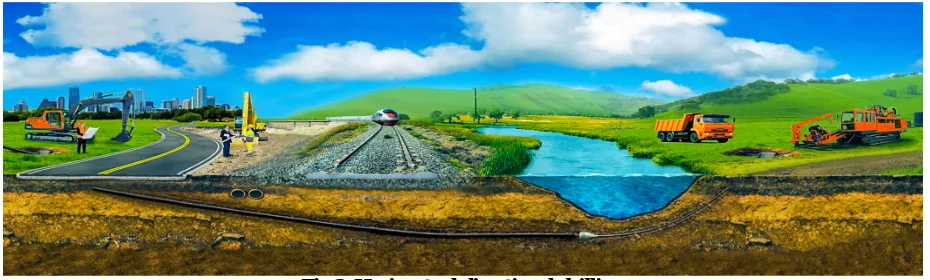
HDD is a minimal impact trenchless method of installing underground pipes, conduits, or cables in a relatively shallow arc or radius, along a prescribed underground bore path, using a surface-launched drilling rig.
Fig 2. Horizontyal directional drilling
Often, the term ‘directional boring’ is referred for mini/small sized drilling rigs, having small diameter bores, and crossing length of hundreds of feet; while, the term ‘Horizontal Directional Drilling (HDD)’ is referred for large/maxi sized drilling rigs, having large diameter bores, and crossing length of thousands of feet. Directional Boring and HDD being similar in process are quite different from the directional drilling associated with the oil industry.
HDD is generally accomplished in three principle phases. First, a small diameter pilot hole is drilled along the pre-determined path from one point to another. Next, the bore created by pilot hole drilling is enlarged to a diameter that will facilitate the installation of new pipeline. Lastly, the pipeline is pulled into the enlarged hole.
The technique has extensive use in urban areas for developing subsurface utilities as it helps in avoiding extensive open cut trenches. The use requires that the operator have complete information about existing utilities so that they can plan the alignment to avoid damaging those utilities. Since uncontrolled drilling can lead to damage, different agencies/government authorities owning the urban right-of-way or the utilities have rules for safe work execution. For standardization of the techniques, different trenchless technology promoting organizations have developed guidelines for this technique.
Horizontal Directional Drilling Process
There are 4 Stages in the Horizontal Directional Drilling Process
Stage 1 – Drilling the Pilot Hole
Stage 2 – Pre-Reaming the horizontal boring Stage 3 – Pullback Operations
Stage 4 – Installation of Conduits
Stage 1 of the Horizontal Directional Drilling Process – Drilling the Pilot Hole
The first stage of a successful Horizontal Directional Drilling Process is drilling a pilot hole. A pilot hole is horizontally drilled and continues under and across the obstacle along a predetermined design path. An electronic transmitter is placed in a housing which is directly behind the directional drilling cutting head. The transmitter sends a signal to the surface which is read by the receiver, which then transmits the information back to the directional drill rig operator. The directional driller then, by using the relayed information, can steer the bore pathany desired direction.
Fig 3. Drilling the Pilot Hole
Stage 2 of the Horizontal Directional Drilling Process – Prereaming the Horizontal Boring
Fig 4. Pre-reaming
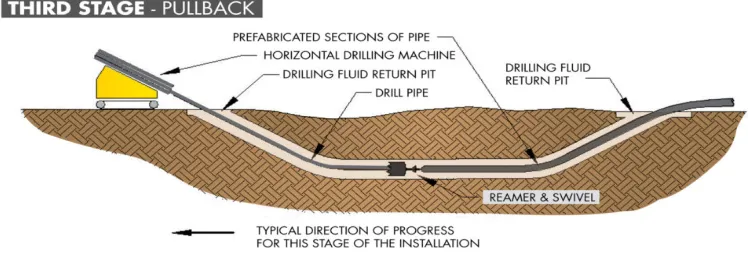
Stage 3 of the Horizontal Directional Drilling Process – Pullback Operations
Once the directionally drilled hole is enlarged, the conduit can be pulled through it. The pipeline is prefabricated at the end of the bore opposite the drill rig. A reamer is attached to the drill string, and then connected to the product by a pulling head and swivel. The swivel allows for the reamer to turn without the product turning. The directional drilling rig then begins the pullback operation, rotating and pulling on the drill string as well as circulating drilling fluids. The pullback continues until the reamer exits the bore path by the directional drill rig and the pipeline is in place.
Fig 4. Pullback
Stage 4 of the Horizontal Directional Drilling Process – Installation of Conduits
If the horizontally bored conduit is to carry power lines, fibre optic cable, or some other product, an aircraft cable is inserted into the pipe prior to pulling into position. After the pipe installation, the directional drill rig is used to pull the product into position within the pipe. This final step in the Horizontal Directional Drilling Process includes pressure testing to ensure the integrity of the pipe.
III. CASE STUDY
Project Name: Horizontal Directional Drilling (HDD)
Client: M/s. Reliance Jio Infocom ltd. Mumbai
Name of work: Laying Optical fibre cable in KDMC Area.
Requirement: Installation of 60mm diameter optical fibre cable to supply 4G line.
Pit Size: 4m × 1.5m
Constraints: This project carried out in KDMC area. Main constraints of this project was that information about underground utilities was not available from some part of the city. Due to this small survey was carry out to identify underground utilities.
General
Kalyan is heavily crowded city and traffic flow is high on main roads. So installing/laying of optical fibre cable by open trench method is not possible. Open trench method is so much time & cost consuming method and create obstacle to flow of traffic. So to avoid this problem Horizontal Directional Drilling method is adopted to install optical fibre.
Objective To install optical fibre line in Kalyan city without any disruption to traffic and in minimum cost and time.
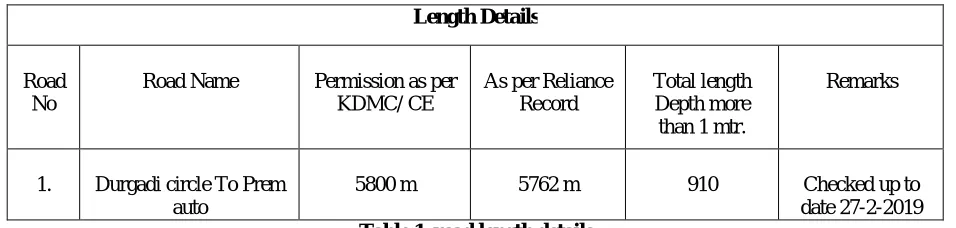
Length Details
Road No
Road Name Permission as per KDMC/ CE
As per Reliance Record
Total length Depth more than 1 mtr.
Remarks
1. Durgadi circle To Prem auto
5800 m 5762 m 910 Checked up to
date 27-2-2019
Table 1. road length details
Starting Point: Durgadi Circle
End Point: Prem Auto
Distance: 5.8 Km
Ground Condition: Rock Strata
Installation Time: 34 days
Installation Date: 5th January 2018
Start Pit Location: Durgadi Circle
End Pit location: Prem Auto Bridge
Pipe Material: HDPE (High Density Polyethylene) Pipe
Pipe Diameter :100 mm
Cable Diameter: 60 mm
Machine name: XZ320D
Machine Pull Capacity: 60 tonne
Machine Operating Fuel: Diesel
Final Inspection Date by Government Agency: 18th November 2018
4.3.1Open trench method:
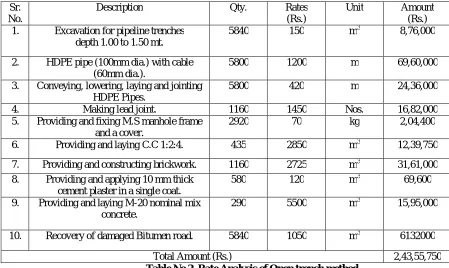
Total Length of Laying Pipeline = 5800m Total Depth of Excavation = 1.5m Total width of Excavation = 0.8m Total duration of work = 18 Months
Sr. No.
Description Qty. Rates
(Rs.)
Unit Amount (Rs.) 1. Excavation for pipeline trenches
depth 1.00 to 1.50 mt.
5840 150 m3 8,76,000
2. HDPE pipe (100mm dia.) with cable (60mm dia.).
5800 1200 m 69,60,000
3. Conveying, lowering, laying and jointing HDPE Pipes.
5800 420 m 24,36,000
4. Making lead joint. 1160 1450 Nos. 16,82,000
5. Providing and fixing M.S manhole frame and a cover.
2920 70 kg 2,04,400
6. Providing and laying C.C 1:2:4. 435 2850 m3 12,39,750
7. Providing and constructing brickwork. 1160 2725 m3 31,61,000 8. Providing and applying 10 mm thick
cement plaster in a single coat.
580 120 m3 69,600
9. Providing and laying M-20 nominal mix concrete.
290 5500 m3 15,95,000
10. Recovery of damaged Bitumen road. 5840 1050 m3 6132000
Total Amount (Rs.) 2,43,55,750
Table No 2. Rate Analysis of Open trench method
Add 10% Contractor’s Profit = Rs.24,35,575
Add 5% Contingencies and work charged establishment = Rs.12,17,787.5 Total Amount = Rs.2,80,09,113
A) Total estimated cost of Bitumen Road to be resurfaced is Rs.6132000 + Extra materials, transportation charges, etc.
B) Here, road warning signboard charges, if traffic congestion is there then vehicles fuel cost, loss of space for shops and buildings charges, etc. all charges are considered in the Open cut method.
C) So, If OFC network laying by Open cut method then the total cost is Rs.28009112.5 + extra cost ≅ 2.85 Crore and cost of work is Rs.4915 per meter.
Estimated cost of OFC network laying by HDD method:
Total length of pipeline = 5800m Pit size= 4m * 1.5m
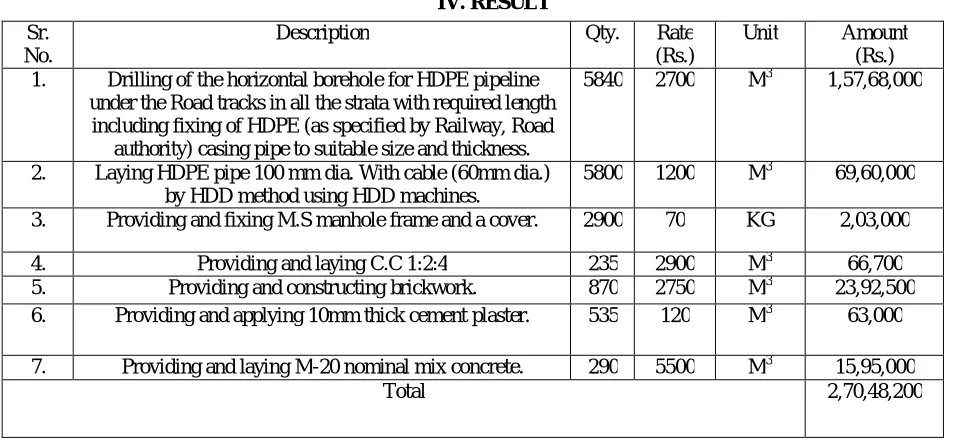
Table No 3. Rate Analysis of HDD
10% Contractor’s Profit = Rs27,04,820 5% Contengiencies= Rs 13,52,410 Total Amount (Rs.) = Rs 3,11,05,430 Therefore,Cost per metre= Rs 5380
IV. RESULT
The following table presents the final rates per metre by open trenching and HDD method.
Sr No Open trenching HDD
Cost per metre length Rs 4915 Rs 5380
Table No 4. Result
V. CONCLUSION
Lastly, we conclude with the proper understanding of trenchless technology bolstered by a case study rate analysis. Time duration for Open cut laying of pipeline in selected area is 18 months compared to 3 months for trenchless
technology which outworks the cost benefits by open cut method.
For small scale project work of laying pipeline by trenchless technology is costly but for large area of work trenchless technology is beneficial both in project cost and time as compared to open cut method
Furthermore we know that excavation initiates air and noise pollution. Air pollution is wholly responsible for diseases like asthamaetc and noise pollution can cause hearing aids. Indirectly these costs get add up to open excavation and hence the cost of the project is going to increase.
To encapsulate, the life span of pipes laid by trenchless technology is three times as compared to normal laid pipes as normal excavation is done upto 2 metres approximately while trenchless technology lays pipes upto 5 to 6 metres depth increasing the life of the pipeline. Hence the cost of open trenching should be taken thrice if we need to make comparison with trenchless technology.
Sr. No.
Description Qty. Rate
(Rs.)
Unit Amount (Rs.) 1. Drilling of the horizontal borehole for HDPE pipeline
under the Road tracks in all the strata with required length including fixing of HDPE (as specified by Railway, Road
authority) casing pipe to suitable size and thickness.
5840 2700 M3 1,57,68,000
2. Laying HDPE pipe 100 mm dia. With cable (60mm dia.) by HDD method using HDD machines.
5800 1200 M3 69,60,000
3. Providing and fixing M.S manhole frame and a cover. 2900 70 KG 2,03,000
4. Providing and laying C.C 1:2:4 235 2900 M3 66,700
5. Providing and constructing brickwork. 870 2750 M3 23,92,500 6. Providing and applying 10mm thick cement plaster. 535 120 M3 63,000
7. Providing and laying M-20 nominal mix concrete. 290 5500 M3 15,95,000
For ideal situations like repairing of pipelines very near to building foundations, excavation may cause sliding of foundation and hence to avoid that sheet piling needs to be done and hence the expenses of sheet piling also add up to the project unlike trenchless technology.
Initiation and encouraging such new technologies is very essential in developing countries like India and as the project work highlights, trenchless technology clearly outweighs open trenching.
REFERENCES
1. Adedapo, A. A.. Pavement deterioration and PE pipe behavior resulting from open-cut and HDD pipeline installation techniques. Waterloo, (2007)
2. Atalah, A.. Ground movement in hard rock conditions related to Pipe bursting., Retrieved from ASCE database, ., ASCE Pipelines 2004 3. Cody, R. Learning SAS by Examples: A programmer’s guide. Cary SAS Institute, North Carolina. (2007).
4. Hashemi, B., and Najafi, M. U.S. sanitary and storm sewer systems survey. Trenchless Technology Magazine. Vol. 15, page 34-38. October, 2007.
5. Howard, A. Pipeline Installation. Relativity Publishing., Lake Wood, Colorado. (1996).
6. Huet, S., Bouvier, A., Poursat, M. A., and Jolivet, E Regression Modeling Strategies: with application to linear models, logistic regression, andsurvival analysis. Spring-Verlag New York, Inc., New York. . (2003).
7. Jung, Y., Sinha, S. Evaluation of Trenchless Technology Methods for Municipal Infrastructure System. Journal of Infrastructure Systems, Vol.13, No. 2, pp. 144-156. . (2007)
8. Lee H., Najafi, M., & Matthys, JCost comparison of pipeline asset replacement: open-cut and pipe-bursting. Proceedings of ASCE International Pipeline 2007 Conference, Boston, Massachusetts. . (2007).
9. Swarup, Niranjan. Trenchless technology – an overview. “Trenchless Technology in India.” Trenchless Australasia 7 (June) 40.
10. Ariaratnam, S.T. and E.N. Allouche.. “Suggested Practices for Installations Using Horizontal Directional Drilling.” Practice Periodical on Structural Design and Construction, 5 (November) 2000.
11. Onkar K. Chothe1 , V.S. Kadam :Comparative Study of traditional method and innovative method for Trenchless Technology: A Review October 10, 2008..