| INVESTIGATION
Structure and Origin of the
White Cap
Locus and Its
Role in Evolution of Grain Color in Maize
Bao-Cai Tan,* Jiahn-Chou Guan,†Shuo Ding,* Shan Wu,†Jonathan W. Saunders,†Karen E. Koch,†
and Donald R. McCarty†,1
*Key Laboratory of Plant Cell Engineering and Germplasm Innovation, Ministry of Education, School of Life Sciences, Shandong
University, Jinan, Shandong 250100, China and†Plant Molecular Cellular Biology Program and Genetics Institute, Horticultural
Sciences Department, University of Florida, Gainesville, Florida 32611 ORCID ID: 0000-0001-8694-5117 (D.R.M.)
ABSTRACTSelection for yellow- and white-grain types has been central to postdomestication improvement of maize. While genetic
control of carotenoid biosynthesis in endosperm is attributed primarily to the Yellow1(Y1) phytoene synthase gene, less is known about the role of the dominant white endosperm factorWhite Cap(Wc). We show that theWclocus contains multiple, tandem copies
of aCarotenoid cleavage dioxygenase 1(Ccd1) gene that encodes a carotenoid-degrading enzyme. A survey of 111 maize inbreds and
landraces, together with 22 teosinte accessions, reveals thatWcis exclusive to maize, where it is prevalent in white-grain (y1) varieties. Moreover,Ccd1copy number varies extensively amongWcalleles (from 1 to 23 copies), and confers a proportional range ofCcd1 expression in diverse organs. We propose that this dynamic source of quantitative variation inCcd1expression was created in maize shortly after domestication by a two-step,Tam3Ltransposon-mediated process. First, a chromosome segment containingCcd1and several nearby genes duplicated at a position 1.9 Mb proximal to the progenitorCcd1rlocus on chromosome 9. Second, a subsequent interaction ofTam3Ltransposons at the new locus created a 28-kb tandem duplication, setting up expansion ofCcd1copy number by unequal crossing over. In this way, transposon-mediated variation in copy number at theWclocus generated phenotypic variation that provided a foundation for breeding and selection of white-grain color in maize.
KEYWORDScopy number variation; macro-transposition; maize domestication; transposon rearrangement
S
TRUCTURAL rearrangements and gene copy numbervar-iation are important components of genetic diversity in plant genomes (Springeret al.2009; DeBolt 2010; Hardigan et al.2016). Although the sources of structural variation are not fully understood, transposons are a potent mechanism of genome remodeling in maize (Fu and Dooner 2002), includ-ing novel genotypes associated with domestication (Studer et al.2011). In particular,Ac/Dstransposons belonging to the hAT(Hobo-Activator-Tam3) superfamily of DNA transposons (Kempken and Windhofer 2001) have been shown to medi-ate a rich repertoire of chromosome rearrangements in maize (Ralstonet al.1989; Zhang and Peterson 1999; Huang and
Dooner 2008; Zhanget al.2013, 2014). The potential of the Ac/Dselements for generating gene duplications, transposi-tions, deletransposi-tions, and inversions is attributable to three essen-tial features of theAc/Dssystem: (1) transposition typically occurs during DNA replication; (2) Ac/Ds elements often transpose to sites that are near the donor site in the genome; and (3) compatible ends of nearby elements readily inter-act to form macro-transposons. Macro-transposition events can produce a range of structural outcomes depending on (i) relative orientation of the interacting elements, (ii) rela-tive orientation of transposon ends at the insertion site, and (iii) position of the insertion site and interacting elements relative to nearby replication forks at the time of transposi-tion (Ralstonet al.1989; Huang and Dooner 2008; Zhang et al. 2014). While, thus far, the Ac/Ds system has been studied extensively in maize, the broad distribution of hAT transposons in plant and other eukaryotic genomes (Kempken and Windhofer 2001) indicates that the mech-anisms demonstrated may be a widespread source of struc-tural variation.
Copyright © 2017 by the Genetics Society of America doi:https://doi.org/10.1534/genetics.116.198911
Manuscript received December 1, 2016; accepted for publication January 22, 2017; published Early Online February 3, 2017.
Available freely online through the author-supported open access option.
Supplemental material is available online atwww.genetics.org/lookup/suppl/doi:10. 1534/genetics.116.198911/-/DC1.
1Corresponding author: University of Florida, Gainesville, FL 32611. E-mail: drm@ufl.
Carotenoid content of the endosperm is a key trait that affects both the nutritional and aesthetic qualities of the maize grain (Brink 1930; Buckneret al.1990, 1996). Both yellow-and white-endosperm varieties are agronomically important (Poneleit 2001). The white endosperm typical of teosinte grain is presumed to be the ancestral phenotype (Palaisa et al.2004). In maize, carotenoid biosynthesis in endosperm requires dominant alleles of theY1gene that confer expres-sion of phytoene synthase in both seed and plant tissues. In contrast, recessivey1alleles have low phytoene synthase in endosperm, and produce a white-grain phenotype (Buckner et al.1996). Association-genetic studies indicate that human selection for a dominantY1allele occurred during domesti-cation of yellow-grain maize (Buckner et al. 1990; Palaisa et al. 2003, 2004; Zhuet al. 2008). However, at least two genes determine whitevs.yellow endosperm. In addition to the recessivey1, a white endosperm can result from domi-nant alleles ofWhite Cap(Wc). The dominant nature ofWc, which has been known for at least a century (White 1917; Brink 1930), implies a mechanism for negative regulation of carotenoid accumulation in the developing maize kernel.Wc occurs in commercially important white and sweet corn varieties (Hannah and McCarty 1991).
The genetic map location ofWcon the long-arm of chro-mosome 9 (Stinard 1995) is near the Carotenoid cleavage dioxygenase 1 (Ccd1) gene (Vogel et al.2008) in the B73 reference genome (Schnableet al.2009). The CCD1 enzyme is a broad-specificity 9,10 (99,109) carotenoid dioxygenase that catalyzes cleavage of diverse carotenoids to their corre-sponding apo-carotenoid products (Tan et al. 1997, 2003; Sunet al.2008; Vogelet al.2008). In animals, apo-carotenoid signaling molecules such as retinoids and vitamin A are de-rived from specific cleavage of carotenoids (Giguere et al. 1987; Schwartz et al.1997). In plants, apo-carotenoids are precursors for two important hormones, abscisic acid and stri-golactone (Zeevaartet al.1989; Schwartzet al.1997; Tanet al. 1997; Gomez-Roldanet al.2008; Umeharaet al.2008).
Here we show that theWclocus, which confers a white-endosperm phenotype, contains multiple tandem copies of the Ccd1 gene. Alleles of Wc can have between 1 and 23 copies of a 28-kb repeat that contains Ccd1 and down-stream glutamyl tRNA acyl transferase (Tglu) and cyto-chrome P450 (P450)genes. Wefind thatCcd1mRNA levels in diverse tissues of Wcinbreds vary in direct proportion to Ccd1copy number. Our analyses ofWcstructure and distri-bution based on bac- and whole-genome-sequence (wgs) data indicate that the Wc locus was created by separate macro-transposition and gene amplification events–both me-diated by interactions between closely spaced Tam3-like (Tam3L) transposons. First, a pair ofTam3Lelements formed a macro-transposon that duplicated and transposed a chromo-some segment containingCcd1and several nearby genes to a position 1.9 Mb proximal to the progenitorCcd1locus (Ccd1r). Next, a subsequent interaction ofTam3Ltransposons at the new locus formed a 28-kb tandem duplication. This in turn initiated further expansion of repeat copy number by
un-equal crossing over. Although the Wc phenotype is most dramatic in the endosperm of yellow-grained,Y1genotypes, Wc occurs most often in y1 varieties lacking capacity for carotenoid biosynthesis in endosperm. We suggest thatWc intensifies the white-grain phenotype of recessive y1, thus providing a basis for human selection of theWc y1genotype. Our results indicate that variation inCcd1copy number and expression due to Wc enriched the genetic foundation for breeding and selection of grain color during postdomestication improvement of maize.
Materials and Methods
Genetic stocks
The Wc-ref Y1stock (MGS 14545) was obtained from the Maize Cooperation Genetics Stock Center (Urbana, IL). The recessivewcline used as a reference in Figure 1 was extract-ed from the heterozygousWc-ref stock (MGS 14545) pro-vided by the Maize Coop Genetic Stock Center. The six diverse inbred stocks were a gift from J. Messing, Waksman Institute, Rutgers University. The Silver Queen hybrid sweet corn harboring a dominant white allele was obtained from L. C. Hannah at the University of Florida. Teosinte (Zea mays spp.parviglumisandZea maysspp.Mexicana) accessions and the maize accessions listed in Table 2 were obtained from the United States Department of Agriculture North Central Re-gional Plant Introduction Station in Ames, IA. Maize lines were grown at the University of Florida field station in Citra, FL.
Nucleic acid methods
DNA extraction, Southern analysis, sequence determination, and other routine molecular biology methods were conducted as previously described (Tan et al. 1997, 2003). TheCcd1 genomic DNA region was cloned via construction and screen-ing of a lambda phage genomic library prepared from aWc wc heterozygote as previously described (Tan et al. 1997). Briefly, genomic DNA was digested withBamHI and resolved through 10–35% sucrose gradient centrifugation at 26,0003g for 24 hr at 4°. The fraction enriched in 6.5-kb fragments was purified and ligated to lambda-ZAPII vector (Stratagene, La Jolla, CA). The library was screened using a 1.1-kbCcd1partial cDNA (EST CSU453) as a probe. The genomic sequence was extended by PCR amplification of a 2-kb fragment fromWc genomic DNA that included the presumptive translation start.
Cloning of Ccd1 cDNA and partial genomic clones from maize and teosinte
cloned by construction and screening of l-phage libraries. Briefly, genomic DNA was digested with appropriate DNA restriction enzymes and fractionated via a 15–40% sucrose gradient centrifuged at 25,0003gat 4°for 24 hr in a swing bucket rotor. Selected DNA fractions were ligated into phage cloning vectors (l-ZAP II orl-ZAP Express, Stratagene) and packaged according to the manufacturer’s instructions. The library was screened and positive clones were isolated and converted into phagemid byin vivoexcision.
BAC library construction and sequencing
A custom bac library was constructed from genomic DNA of the homozygousWcreference stock and screened with aCcd1 cDNA probe by the Bio S&T (Montreal, Canada). Two posi-tive clones (19F and H10) were identified. The BAC clones were characterized by restriction mapping and partial se-quencing of selected subcloned restriction fragments. Of the two clones, H10 extended farthest into the Wc locus, and was selected for complete sequencing and assembly us-ing a combination of circular-consensus and linear long for-mat reads from the PacBiosystems instrument. Trimmed circular-consensus sequence reads (.5000 bp) were assem-bled into contigs using CAP3 (Huang and Madan 1999) and linear long reads were assembled using CANU (Korenet al. 2016). The contigs were further evaluated and assembled
manually to obtain an assembly (Genbank accession KX760165) that was consistent with the bac restriction map, bac end sequences, wgs analysis, and subclone sequences.
Quantitative real-time RT- PCR
Total RNA was extracted using RNeasy (QIAGEN, Germany) and treated with RNase-free DNase. The complete removal of DNA was verified by a quantitative real-time RT-PCR analysis without reverse transcription. The conditions used are as described in detail previously (Tanet al.2003). For TacMan qPCR primers used forCcd1were forward (59-GGGAAGAGGGT GATGAAGTTGT-39) and reverse (59-TGATATCCATTCACCTTGTC CAAA-39), and the probe was 59-CTCATTACCTGCCGCCTTGAG AATCCA-39. The probe was labeled withfluorescent reporter dye 6-carboxyfluorescein (FAM) at 59and 6-carboxy-N,N,N9,N9 -tetramethylrhodamine (TAMRA) at 39. The standard curve was derived with a plasmid containingCcd1cDNA. Reactions were carried out in the GeneAmp 5700 Sequence Detection (Perkin-Elmer, Norwalk, CT). The transcript abundance was normalized as copy number per nanogram of total RNA. qPCR of pericarp tissue was performed as described by Sun et al. (2008) using 59-CTGCTGTGGATTTTCCTCGTG-39and 59-TAT GATGCCAGTCACCTTCGC-39as forward and reverse primers, respectively. Relative expression levels were calculated from E2DCtvalues setting the mean of the B73 wc control to one.
Figure 1 White Cap(Wc), a dominant inhibitor of carotenoid accumulation in maize endosperm encodes a
macro-transposon that contains 1–23 tandem
copies of Ccd1 (Carotenoid cleavage
dioxygenase-1) causing elevated expres-sion in diverse tissues. (a). Kernels on a
self-pollinated ear of aWc wc
heterozy-gote in aY1 Y1background segregate
four classes of yellow pigmentation
dis-tinguished byWcdosage in the triploid
endosperm. Kernels with three doses of
Wc(25% of kernels) have a fully white
phenotype whereas zero doses (25% of kernels) conditions a normal yellow
phe-notype. IntermediateWcdosage classes
have pale yellow phenotypes. (b).
Dia-gram comparingWc (maize) and
non-Wc(maize and teosinte) chromosomes.
TheCcd1rreference locus is presumed
to be present in all maize and teosinte
haplotypes (see Table 3). In Wcmaize,
a macro-transposon insertion carrying from 1 to 23 tandem copies of the
Ccd1gene is located 1.9 Mb proximal
to Ccd1r. The transposed chromosome
segment includesCcd1(red), and
neigh-boring genesTglu(purple),P450(light
turquoise), andRpl21(blue). Supporting
evidence is described herein (see also
subsequent figures). (c). Quantification
of Ccd1copies per genome in the Wc
reference allele (Wc Wc), a Wc hetero-zygote from a Silver Queen B73 F1
hy-brid, several non-Wc inbreds, andwc, a control that is homozygous for the recessive allele segregating in theWc-ref stock. (d) Expression ofCcd1during
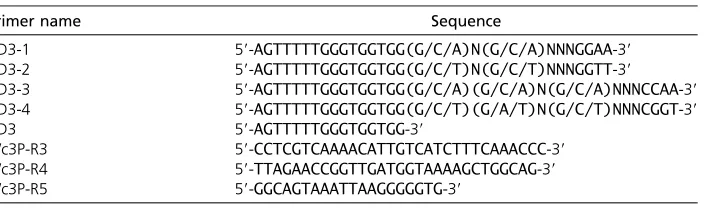
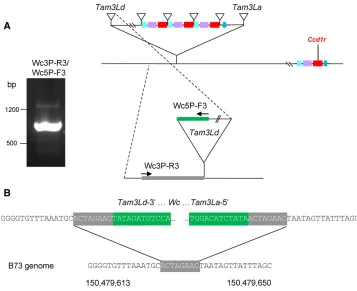
Identification of the Tam3Ld left junction sequence To identify the left border sequence of theWcmacro-transposon, we employed a modified TAIL-PCR protocol that used four AD3 primers (AD3-1 to 4), each of which contains an AD3 primer fused with an arbitrary degenerate primer (Liu and Chen 2007). Three nested primers based on the predictedTam3Ld flanking sequence (Wc3P-R3, Wc3P-R4, and Wc3P-R5) were used with the AD3 primers (Table 1). Following three rounds of TAIL-PCR fragments were sequenced and analyzed to iden-tify products that containedTam3L-39termini. The sequences were in turn used to design aTam3L-specific primer (Wc3P-R5), which was then used with Wc3P-R3 to amplify the left border of the Tam3Ld candidate sequence. The resulting Tam3Ld-39flanking sequence contained an 8-bp target site duplication (GTTCTAGT) that matched the right junction of Tam3Laconfirming the macro-transposon hypothesis.
Quantification of Ccd1 copy number in the Wc reference allele
Real-time quantitative PCR was used to determine the gene copy number ofCcd1in each DNA sample. A single-copy gene Vp14(Tanet al.1997) was used as an internal standard. In addition, the inbred line B73, which was confirmed to con-tain a single copy ofCcd1by hybridization and sequencing, was used as a standard to normalize theCcd1probe. To in-crease the accuracy of real-time quantitative PCR, genomic DNA samples were digested withEcoRI to completion, gen-eratingVp14andCcd1fragments in a 6- to 7-kb size range. The DNAs were further purified by a Turbo genomic DNA purification kit (Qbiogene, Carlsbad, CA). The concentration of the DNAs was determined spectrophotometrically. Equal amounts of DNA were analyzed by real-time quantitative PCR. The analysis conditions were the same as the real-time quantitative RT-PCR described above except without reverse transcription.Ccd1primers and probe were the same as above. The Vp14primers are forward (59 -GCTGGCTTGGCTTGTATACTCTG-T-39) and reverse (59-CCATCAGTCATATACTGTGAACAAATGT-39), and the gene-specific probe is (59-CACGCACCGATAGCCACAGG GAA-39) labeled with FAM and TAMRA at 59and 39, respectively.
Copy number estimation in maize genomes by analysis of k-mer frequencies
Frequencies of 22-mers in the B73 reference genome were profiled using JELLYFISH (Marçais and Kingsford 2011). The resulting database was then queried with 22-mers from 39,424 genes in the maizefiltered gene set (gramene.org) to identify a subset of genic 22-mers that were single-copy in the B73 genome. Frequencies of the resulting set of 124 mil-lion single-copy, genic 22-mers were in turn profiled in wgs sequence data obtained from the Sequence Read Archive (ncbi.nlm.nih.gov) for each of 102 maize and teosinte acces-sions in the HapMap2 collection (Chiaet al.2012). Gene copy numbers in each genome were then estimated by normaliz-ing the average frequency of snormaliz-ingle-copy 22-mers fromCcd1r to the average frequency of 124 M genic single-copy 22-mers
in wgs data for each inbred. The estimated effective sequence coverage of each genome is listed in Supplemental Material, Table S1.
Analysis of Wc and Ccd1r allele-specific features in maize genomes
The wgs data from HapMap2 genomes was searched for sequence reads that contained diagnostic features of theWc locus andCcd1ralleles using the Global search Regular Ex-pression Print (GREP) utility. Simple text searches were made in both orientations using 18–22 base sequences that were unique to transposon insertion sites and other characteristic features ofWcorCcd1ralleles. Sequence reads identified by text searches were then validated by full-length blastn align-ment to the Wc bac assembly and B73 reference genome (Schnableet al.2009) sequences.
Data availability
TheWc Ccd1genomic and cDNA sequences are deposited in Genbank (accessions: DQ100348, DQ100347, and cDNA DQ100346). The Wc bac sequence is Genbank accession KX760165. Genetic strains used in this study are available by request.
Results
Wc contains a Ccd1 gene cluster that confers high Ccd1 expression
In aY1genetic background, which leads to biosynthesis of yellow carotenoids in the endosperm, the dominantWcallele confers a dosage-dependent white-endosperm phenotype (Figure 1a). In the triploid endosperm, kernels that have a single dose ofWchave a pale yellow or white crown, reflect-ing a partial inhibition of carotenoid accumulation. In con-trast, kernels with three doses of Wc have a nearly white endosperm. A gradation of yellow to white-kernel pheno-types can thus be discerned on a self-pollinated ear of aWc wc Y1 Y1heterozygote consistent with the four expected gene dosage classes (Figure 1a).
To quantify Ccd1 copy number in Wc and non-Wc (wc) genotypes (Figure 1c), we developed a gene-specific, real-time PCR assay. As a single-copy, internal control, we used the well-characterizedVp14gene (Tanet al.1997). Consis-tent with the Southern blot results, PCR data indicate that genomes of B73 and other yellow inbreds carry a single copy ofCcd1. We attribute this singleCcd1to Ccd1r. In contrast, plants homozygous for theWcreference allele are estimated to have 23.9 (62.0) copies per genome. In agreement with this estimate, heterozygotes carrying a Wcallele extracted from “Silver Queen” sweet corn (Hannah and McCarty 1991) have an estimated 13.5 (62.4) copies. This is an expected value for a heterozygote carrying 24 copies on one chromosome and one copy on the other [(24 + 1)/2 = 12.5 copies per genome].
Based on these results, we reasoned that amplification of Ccd1 copy number at the Wc locus could account for the dominant white phenotype by elevating expression of the CCD1 enzyme in endosperm. Enhanced carotenoid cleavage would result from activity of the broad-specificity CCD1 9,10 carotenoid dioxygenase (Vogelet al.2008). As shown in Figure 1d, relative expression of Ccd1 mRNA is indeed markedly higher throughout development ofWckernels com-pared to isogenic non-Wc and B73 inbreds. InWc kernels, Ccd1expression peaks during midgrainfill at 18 days after pollination (DAP) then declines gradually toward maturity. In addition,Wc causes elevatedCcd1 expression in diverse tissues including silks and pericarp.
Structure of the Wc locus
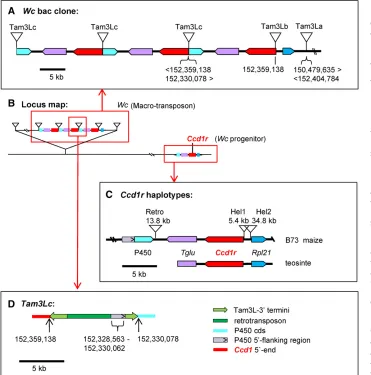
To determine the structure of theWclocus, we constructed a bac library from theWcreference stock and isolated a 106-kb bac clone that spanned one boundary of theCcd1gene cluster. The bac sequence assembly diagrammed in Figure 2a was confirmed by (1) restriction mapping, (2) sequencing of bac-ends and selected subclones, (3) genomic Southern blot data (Table 2, Figure S2, a and b inFile S1), (4) consistency with whole-genome-sequence (wgs) data from diverseWc in-breds (Table 3), and (5) by mapping and partial sequencing of a second overlapping bac clone (data not shown). To aid in-terpretation of the Wcassembly, the bac sequence was then aligned to the region surrounding the single-copyCcd1rgene in the B73 reference genome (Figure 2, b and c). In addition,
we cloned and sequenced a 12-kb region containing theCcd1r gene from the teosinte (Z. mays spp. parviglumis) genome (Figure 2c and Figure S2b in File S1). The 106-kb Wc bac sequence includes three tandem copies of Ccd1arranged in direct orientation. Each Ccd1 copy is embedded in a 28-kb direct repeat that also includes a glu-tRNA acyltransferase (Tglu, GRMZM2G057491) and a cytochrome P450 (GRMZM2G057514) gene,P450. TheTgluandP450genes are located downstream of Ccd1r in the B73 reference ge-nome (Figure 2, b and c). The rightmost Ccd1 copy in the bac sequence contains a 4460-bp, Tam3-liketransposon in-sertion (Tam3Lb) near its 59-prime end. As expected,Tam3Lb
isflanked by an 8-bp, host site duplication typical of thehAT
transposon family. Although multipleTam3Lcopies are de-tected in the B73 genome (data not shown), theTam3L trans-poson family has not previously been characterized in maize.
Wc contains a Tam3L macro-transposon
In the bac sequence, a 6573-bp region to the right ofTam3Lbis colinear with genomic sequence upstream of Ccd1r in the teosinte genome (Figure 2c). This region includes a copy of a neighboring gene,Ribosomal-large-subunit-protein-21 (Rpl21, GRMZM2G089421). This region of colinearity with the ancestralCcd1rhaplotype is bordered on the right by a second Tam3L element (Tam3La). Although the Tam3La transposon is intact, two features of itsflanking sequences indicated thatTam3Lalikely forms one boundary of a macro-transposon. First, Tam3La is not flanked by an 8-bp direct duplication. Second, sequences on the left and right sides ofTam3Laare not contiguous in the B73 reference genome. Instead, sequence to the right ofTam3Laaligns to a position 1.9 Mb proximal to theCcd1rlocus in the B73 genome.
On this basis, we hypothesized that the other boundary of theWc locus would be delimited by another Tam3L trans-poson (Tam3Ld). We further anticipated thatTam3Ldwould have a leftflanking sequence that (1) was contiguous in the reference genome with sequence flanking the right side of Tam3La (Figure 2a), and (2) shared a matching 8-bp host site duplication with Tam3La. As hypothesized, we were indeed able to identify the predictedTam3Ld junction se-quence that defines the 39 (with respect to the Tam3La transposase coding sequence) boundary of theWc macro-transposon in genomic DNA ofWcplants. We amplified the Table 1 Primers used to identify theTam3Ld-39junction
Primer name Sequence
AD3-1 59-AGTTTTTGGGTGGTGG(G/C/A)N(G/C/A)NNNGGAA-39
AD3-2 59-AGTTTTTGGGTGGTGG(G/C/T)N(G/C/T)NNNGGTT-39
AD3-3 59-AGTTTTTGGGTGGTGG(G/C/A)(G/C/A)N(G/C/A)NNNCCAA-39
AD3-4 59-AGTTTTTGGGTGGTGG(G/C/T)(G/A/T)N(G/C/T)NNNCGGT-39
AD3 59-AGTTTTTGGGTGGTGG-39
Wc3P-R3 59-CCTCGTCAAAACATTGTCATCTTTCAAACCC-39
Wc3P-R4 59-TTAGAACCGGTTGATGGTAAAAGCTGGCAG-39
Tam3Ld-39junction using a combination of TAIL-PCR and PCR with primers specific for the 39arm ofTam3Land for the expectedflanking sequence (Figure 3). In addition, we detected theTam3Ld-39junction sequence in wgs data from multipleWcinbreds (Table 3).
Wc repeats are punctuated by a composite Tam3L sequence
Each 28-kb repeat is bordered by a 9980-bp transposon-like sequence (Tam3Lc) that has twoTam3L-39termini with two unrelated sequence fragments sandwiched between them (Figure 2d and Figure S3 inFile S1). The leftward Tam3L-39 terminal fragment is 2058 bp long and right arm is 1582 bp. One of the two internal sequences is a 4835-bp fragment of an uncharacterized retrotransposon. The other is a 1508-bp segment that aligns to genomic sequence immediately up-stream ofP450in the B73 reference genome. Sequence de-rived from theP450flanking region is nearly contiguous with the right junction ofTam3Lc, except for a deletion of 16 bp at the insertion site. These features are consistent with an abor-tive transposition that inserted a singleTam3Lend upstream
ofP450. The right end ofTam3Lchas several polymorphisms in common withTam3La-39(Figure S2 inFile S1) that dis-tinguish it from Tam3Lb-39, whereas the opposite end of Tam3Lcis derived from the 39-terminus ofTam3Lb.
Creation of Wc by macro-transposition and gene amplification
The structural features described above indicated that the Wc locus was created by interactions betweenTam3L ele-ments that (1) transposed a copy of the Ccd1r locus to a position 1.9 Mb upstream of the progenitor locus, and (2) initiated amplification of a 28-kb segment of the transposed copy. A proposed series of events that account for the struc-ture depicted in Figure 2 is outlined in Figure S4 inFile S1. In this scenario, creation of the Wc locus was preceded by a series ofTam3Linsertions in the ancestralCcd1rlocus. This resulted in a pair ofTam3Lelements thatflanked a region containing Ccd1r and neighboring Rpl21, Tglu, and P450 genes. As a replication fork moved through this segment, Tam3Ld-39andTam3La-59then formed a macro-transposon that inserted at an unreplicated site 1.9 Mb proximal to the Figure 2 Structure of theWc locusand
Ccd1rhaplotypes of maize and teosinte.
(a) Sequencing and assembly of a bac
clone containing one border of theWc
locus revealed two complete and one partial copy of a 28-kb repeat that
in-cluded copies ofCcd1(red) and nearby
Tglu(purple) andP450(turquoise) genes.
The repeats are punctuated by a
compos-iteTam3L-like sequence (Tam3Lc), which
is shown in greater detail in part d. The
rightmost copy ofCcd1is bordered by an
intactTam3Ltransposon (Tam3Lb) with a
flanking 8-bp host site duplication. The
10-kb segment betweenTam3Lband a
secondTam3Ltransposon (Tam3La) is
co-linear with the region upstream ofCcd1r
in the B73 reference and teosinte
ge-nomes that includesRpl21(blue, see part
c). The 13.5-kb sequence that extends
from Tam3La to the right end of the
bac clone (abridged for clarity) aligns to sequence located 1.9 Mb proximal to
Ccd1rin the B73 reference. Consequently,
Tam3Lais notflanked by an 8-bp host site
duplication. (b) Location of Wc relative to
the Ccd1r progenitor locus on the long
arm of chromosome 9 (see Figure 1b). (c)
Comparison of Ccd1r haplotypes found
in maize (B73 reference) and teosinte
(data on distributions ofCcd1rhaplotypes
in maize and teosinte are summarized in Table 3). The teosinte structure was de-termined by sequencing a 12-kb region
containingCcd1rinZ. maysspp.
parviglu-mis. Gray box with arrow inset, position
and orientation ofP45059-flanking
se-quence included in Tam3Lc. (d).
Struc-ture of Tam3Lc, a composite transposon-like element that punctuates the Wc 28-kb repeats. Numbers in parts a and d indicate coordinates of
Ccd1r locus. We suggest that a subsequent interaction of Tam3Lelements at the new locus duplicated a segment con-tainingCcd1, thus enabling expansion of repeat-number by unequal crossing over. In some configurations,Acis capable of creating tandem duplications by initiating rolling-circle replication or rereplication (Ralston et al. 1989; Zhang et al.2014). In instances whereAchas induced rereplication of DNA, Zhang et al.(2014) observed that stalling of the replication fork prevented extensive rolling-circle replication. While a similar mechanism may have created the initial tan-dem repeat inWc, the precise origin of the compositeTam3Lc element is unclear. The incorporation of an interior sequence derived from the upstreamflanking region of theP450gene suggests thatTam3Lcwas formed in part by an abortive trans-position that inserted one arm of a transposon–possibly de-rived fromTam3La-39–upstream ofP450. One speculative possibility is that a macro-transposition involvingTam3La-39
andTam3Lb-59aborted during replication, resulting in a frac-tured chromosome with one or more double-stranded breaks. Formation of Tam3Lcby repair reactions that fused nearby Tam3La-39 and Tam3Lb-39 fragments could plausibly have created a circular template that initiated transient rereplica-tion ofCcd1.
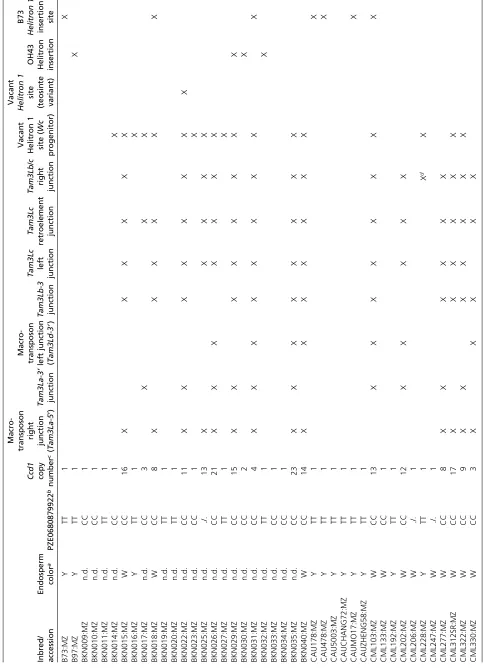
Independent diversification of Ccd1r and the Wc locus Subsequent to creation ofWc, theCcd1rprogenitor andWc continued along separate paths of evolution and diversifica-tion (Figure 2c). Comparison of the Ccd1rsequences from B73 and ancestral teosinte revealed that the B73 haplotype contains helitron transposon insertions near the transcription start sites of both theCcd1randRpl21 genes. The helitron insertions displaced upstream flanking sequences of both genes, potentially altering their regulation. A search of wgs data detected the B73Hel1junction sequence in at least 13 of 83 maize inbreds and one of 19 teosinte accessions (Table 3). At least fourWcinbreds also carriedHel1(B73 type)Ccd1r alleles. As shown in Figure 2a, the progenitor ofWclacked theHel1insertion. As expected, thisHel1-free promoter variant is detected in the majority ofWcinbreds. Its presence in at least eight non-Wcmaize inbreds and eight of 19 teosinte accessions further indicates thatCcd1ralleles resembling theWc progeni-tor exist in both maize and teosinte. Evidence of a second, in-dependent helitron insertion located in a similar position upstream of Ccd1rwas detected in OH43 (data not shown). The OH43 promoter variant was found in at least 11 of 83 maize accessions, but in none of the teosinte accessions (Table 3).
Wc alleles account for extensive Ccd1 copy number variation in maize
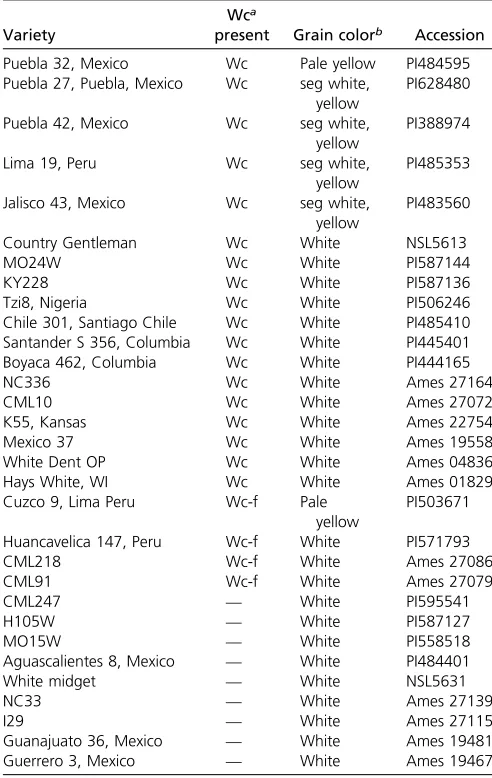
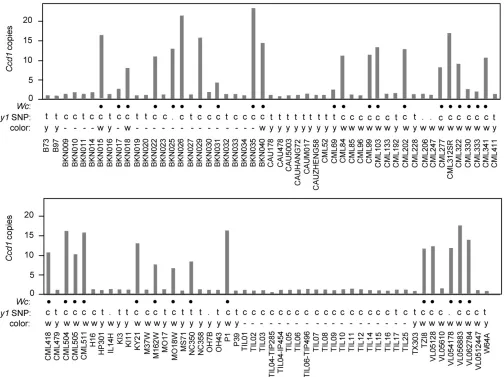
To evaluateCcd1copy number variation in maize, we ana-lyzed k-mer frequencies in wgs data from 102 maize and teosinte genomes represented in the HapMap2 resource (Chia et al. 2012). We adapted JELLYFISH (Marçais and Kingsford 2011) for this purpose.Ccd1copy number per ge-nome was estimated by determining the frequencies ofCcd1 -specific 22-mers in each data set. The counts ofCcd122-mers in wgs data were normalized to a set of control 22-mers. The control set consisted of 124 M, single-copy 22-mers derived from the B73filtered gene set (gramene.org). Effective depth of coverage obtained for each genome is summarized inTable S1. Of the 83 maize genomes represented in the HapMap2 collection, 36 (43%) had an estimatedCcd1copy number of two or greater (Table 3, rounding to nearest integer). The highest copy number detected, 23 copies per genome in land-race accession BKN035, was comparable to the qPCR-based estimate of 24 copies in theWcreference stock (Figure 1c). All accessions contained at least one Ccd1 copy, which we attributed to theCcd1rlocus. In contrast, with one exception, all maize genomes that had two or moreCcd1copies were also confirmed to carry a suite of sequence features specific to theWclocus (Table 3). The exception was landrace BKN030, which had an estimated two copies of Ccd1, but no evi-dence ofWc-specific features. Therefore, in nearly all cases Table 2 Distribution ofWcin white-maize inbreds and landraces
Variety
Wca
present Grain colorb Accession
Puebla 32, Mexico Wc Pale yellow PI484595
Puebla 27, Puebla, Mexico Wc seg white,
yellow
PI628480
Puebla 42, Mexico Wc seg white,
yellow
PI388974
Lima 19, Peru Wc seg white,
yellow
PI485353
Jalisco 43, Mexico Wc seg white,
yellow
PI483560
Country Gentleman Wc White NSL5613
MO24W Wc White PI587144
KY228 Wc White PI587136
Tzi8, Nigeria Wc White PI506246
Chile 301, Santiago Chile Wc White PI485410
Santander S 356, Columbia Wc White PI445401
Boyaca 462, Columbia Wc White PI444165
NC336 Wc White Ames 27164
CML10 Wc White Ames 27072
K55, Kansas Wc White Ames 22754
Mexico 37 Wc White Ames 19558
White Dent OP Wc White Ames 04836
Hays White, WI Wc White Ames 01829
Cuzco 9, Lima Peru Wc-f Pale
yellow
PI503671
Huancavelica 147, Peru Wc-f White PI571793
CML218 Wc-f White Ames 27086
CML91 Wc-f White Ames 27079
CML247 — White PI595541
H105W — White PI587127
MO15W — White PI558518
Aguascalientes 8, Mexico — White PI484401
White midget — White NSL5631
NC33 — White Ames 27139
I29 — White Ames 27115
Guanajuato 36, Mexico — White Ames 19481
Guerrero 3, Mexico — White Ames 19467
aWc genotype was determined by Southern blots probed withCcd1for presence of
an intense 6.1-kb Bam HI fragment. Wc-f indicates presence of a faint band consistent with a low-copy number Wc allele.
examined, presence of additional Ccd1 copies in maize in-breds could be attributed to theWclocus.
Wc is not detected in teosinte
Each of the 19 teosinte genomes represented in the wgs collection show 22-mer frequencies indicative of a single-copy Ccd1at the progenitorCcd1rlocus (Table 3). In addition, no Wc-specific sequence features were detected in teosinte ge-nomes. In line with these data, Southern blot analysis detected only a singleCcd1copy in twoZ. maysspp.parviglumis acces-sions and one accession ofZ. maysspp. Mexicana(Figure S2 in File S1). Together these results suggest that theWclocus is unique to maize.
Structural heterogeneity in Wc alleles
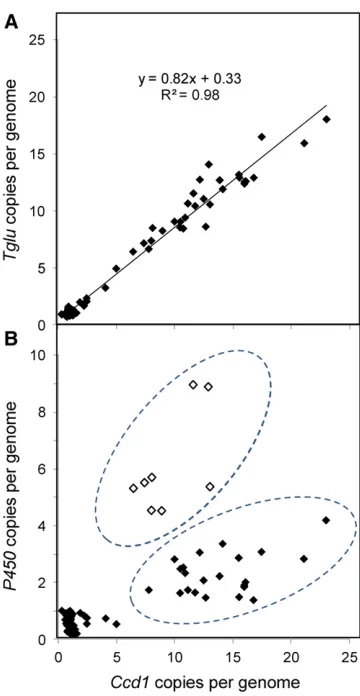
Our model for theWclocus predicts thatCcd1andTglucopy number should vary amongWcalleles in a constant ratio. We found that Ccd1andTglu copies were indeed highly corre-lated (R2= 0.98; Figure 4a), though the average ratio ofTglu toCcd1copies was somewhat less than the expected 1:1 ratio (0.82:1). This could be explained if the initial tandem dupli-cation depicted in Figure S4d inFile S1ended between the Ccd1andTglugenes. On that basis, subtracting one copy of Ccd1gives an average ratio inWcinbreds of 1.0660.05 [i.e. Tglu copies/(Ccd1copies 21) = 1.06] as predicted if the terminal repeat is truncated.
In contrast to the uniformTglu:Ccd1copy number ratio, the P450:Ccd1ratio varied amongWcalleles, indicating structural heterogeneity in theWcrepeats (Figure 4b). We postulate that
alleles with higherP450:Ccd1ratios (open symbols in Figure 4b) have a high proportion of repeats with a canonical struc-ture (as delineated in Figure 2a), whereas alleles with lower P450:Ccd1ratios include a subset of repeats lacking most or all of theP450sequence. The exact structure of the truncated re-peat could not be determined from these data.
The limited variation ofTgluandP450copy number de-tected in non-Wc accessions is evident in Figure 4, a and b as tight clustering of copy number values in lines that have
1 Ccd1 copy. These data indicate that Wc accounts for nearly all of the copy number variation for these genes as well asCcd1.
Ccd1 expression is directly proportional to Ccd1 copy number
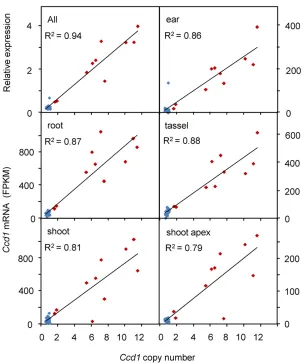
To determine whether the extensive copy number variation at Wcis correlated with gene expression, we analyzed RNAseq data from the 27 diverse nested association mapping (NAM) inbreds (Yuet al.2008) available at the QTELLER.org data-base. Based on our analysis (Table 3), 10 inbreds in the NAM collection carryWcalleles withCcd1copy numbers ranging from 2 to 12 copies per genome. As shown in Figure 5,Ccd1 mRNA levels are highly correlated withCcd1copy number in root, ear, tassel, shoot, and shoot apex transcriptomes. Nearly linear relationships are revealed for each of the diverse tis-sues analyzed (R2values ranging from 0.79 to 0.88 within tissues;R2= 0.94 for relative expression normalized over all tissues). By contrast, expression of the adjacent Tglu gene shows no discernible relationship to gene dosage despite Figure 3 Identification of the Tam3Ld insertion marking the proximal border
of the Wc macro-transposon. (a) PCR
amplification of theTam3Ld-39junction
from Wc plants. Candidate Tam3L-39
junction sequences were amplified by
TAIL-PCR anchored by locus-specific
pri-mers in the predicted location of
Tam3Ld (see Materials and Methods).
The TAIL-PCR sequences were used to
design a pair of sequence-specific
pri-mers, Wc3P-R3 and Wc3P-F3, that
ampli-fied a 794-bp junction fragment (agarose
gel electrophoresis image). The locations
of sequence-specific primers are
dia-gramed on the right. Green indicates transposon sequence. The 8-bp target
site duplication is gray. (b) Confirmation
of the Wc macro-transposon insertion
site. The Tam3Ld junction sequence
aligned to the B73 reference genome at a position that was contiguous with
the sequence flanking Tam3La-59 and
included a matching 8-bp target site
du-plication (gray). The Tam3Ld and
Tam3La 12-base inverted terminal
having a copy number range comparable to that of Ccd1 (R2= 0.05 for relative expression overall, data not shown).
Wc is often associated with recessive y1 in white-grain maize
The presence ofWcin“Silver Queen”sweetcorn (Figure 1), inbred A188 (Figure S2 inFile S1), and other white inbreds (Stinard 2010) indicates thatWcoften occurs in modern in-breds that also carry recessivey1alleles.A priori,Wcwould not be expected to have an obvious phenotype in y1 endo-sperm due to a low capacity for synthesis of CCD1 substrates. However, evidence indicates thatWccan enhance the white-endosperm phenotype ofy1in backgrounds that carry dom-inant alleles ofBrown aleurone-1(Bn1) (Stinard 2010 and Figure S6 inFile S1). A Southern blot survey of inbreds and landraces from diverse geographical locations (Table 2)
con-firms thatWcis present in the majority of white accessions
(16 of 25, 64%).Wcis not limited to white-kernel maize. At least six yellow or mixed-color landraces from Central and South America contain Wc alleles. Grain color phenotype data were available for an additional 65 maize inbreds in the HapMap2 collection (Figure 6). Consistent with survey results in Table 2, at least 26 of 36 white-grain accessions (72%) contain Wc alleles, whereas only two of 29 yellow-grain inbreds carry Wc. The two exceptions are CML69 (twoCcd1copies) and NC350 (eightCcd1copies). In addi-tion, we noted that within this set of 65 inbreds, white- and yellow-grain color phenotypes, respectively, correlate with C and T variants of SNP PZE0680879922 (Chia et al.2012). PZE0680879922 is located upstream of they1gene, indicat-ing that it could be used as a marker for they1genotype. On that basis, we infer that as many as 31 of 35Wcaccessions (89%) in the HapMap2 collection carry both Wcand a re-cessivey1allele (Table 3).
Discussion
Our results indicate that aCcd1gene cluster at theWclocus is the basis for a dominant white-endosperm phenotype that has likely contributed to human selection for grain color (Fig-ure 1). Diversity among theWcalleles accounts for the ex-tensive Ccd1 copy number variation observed in maize. We show that theWclocus was created by aTam3L macro-transposon that duplicated a chromosome segment containing Ccd1and several nearby genes. Subsequent tandem duplica-tion ofCcd1at the new locus likely set up further expansion and variation ofCcd1copy number inWcalleles through un-equal crossing over. Remarkably, transcriptome data indicate thatCcd1expression in diverse maize tissues is directly pro-portional toCcd1copy number over a range of at least 1–12 copies per genome. While Wc is thus far detected only in maize, its broad geographic distribution is consistent with cre-ation of the locus prior to dispersal of maize from its center of origin in Central Mexico. Interestingly, in diverse landraces as well as modern inbreds,Wcis most often found in white-grain varieties that are also homozygous for recessive alleles ofy1 that have little capacity for carotenoid biosynthesis in the endosperm. We suggest thatWccontributed to human selec-tion for grain color by enhancing they1white-endosperm phenotype.
hAT transposons are a potent source of structural diversity in the maize genome
TheWclocus illustrates the potency ofhATfamily transposable elements in generating novel structural-genetic variation in the maize genome. Our model (Figure 2 and Figure S4 inFile S1) for the creation ofWcand amplification ofCcd1builds on previous analyses of theAc/Dssystem in maize (Ralstonet al. 1989; Zhang and Peterson 1999; Huang and Dooner 2008; Zhanget al.2013, 2014). These studies document a variety of chromosome rearrangements arising from interactions be-tween compatible ends of nearbyAc/Dselements. The capacity for macro-transposition in theAc/Dssystem is augmented by Figure 4 Structural heterogeneity inWcrepeats. (a)Ccd1andTglucopy
number vary uniformly inWcalleles.Ccd1andTglucopy numbers were
estimated using k-mer frequency analysis. The line was determined by
linear regression with the equation andR2value indicated. (b) Variation in
P450copy number relative toCcd1reveals structural heterogeneity inWc
repeats. Gene copy number was estimated as described inMaterials and
Methods. Two groups ofWcalleles that differ inP450:Ccd1copy number
ratio are indicated by the dashed ovals. Open symbols, alleles having
(1) preferential transposition ofAcduring DNA replication and (2) the propensity for elements to transpose to nearby sites. Our results indicate thatTam3Lhas similar characteristics. The macro-transposon structure is confirmed by wgs data and PCR. These results together confirm presence ofTam3La-59and Tam3Ld-39junctions that share a matching 8-bp host site duplication (Figure 3). The mechanism responsible for tandem duplication ofCcd1atWcis less clear. While pre-viously documented mechanisms forAc-induced DNA rere-plication (Zhanget al.2014) do not account for all aspects of theWcstructure, presence of repeats punctuated by the composite Tam3Lc sequence implicates Tam3L transpo-sons in their formation. Once formed, a partial duplication of the 28-kbp sequence (e.g., Figure S4d inFile S1) would have enabled expansion of copy number by unequal re-combination of Wc alleles. Overall, the Wc repeats are highly uniform indicating a relatively young age. However, variation in the Ccd1:P450 copy number ratio indicates thatWcalleles contain at least two classes of repeats that have diverged through partial or complete loss of P450 (Figure 4). Hence, the relatively young Wc complex will likely continue to evolve toward greater structural hetero-geneity as individual repeats diverge in ways that may affect dynamics of recombination.
Quantitative variation in Ccd1 expression is proportional to copy number
Our results indicate that copy number variation atWccauses proportional quantitative variation in Ccd1 expression. Re-markably, the gene dosage response is linear up to at least 12 copies per genome (Figure 5). By contrast, the adjacent gene in theWcrepeatTglushowed no correlation between expression and gene dosage. Clearly, gene amplification alone is not sufficient to produce a stable, proportional dos-age response. While the basis for this intriguing, qualitative difference in dosage dependence of theCcd1andTglugenes is unclear, we speculate that theTam3Linsertion at the 59 -end results in more or less constitutive expression of Ccd1 gene copies. In any case,Wcoffers a unique opportunity for investigating the effects of tandem duplication on chromatin structure and gene expression.
Haplotype diversity at Wc and selection for grain color
TheWclocus most likely originated shortly after the domes-tication of maize from teosinte, but prior to dispersal of maize from its center of origin in Mexico. In modern maize, theWc locus is broadly distributed in white-grain inbreds and land-races from North, Central and South America as well as Africa Figure 5 Gene expression is proportional toCcd1
copy number. The relationship betweenCcd1copy
number and gene expression infive tissues (root,
shoot, ear, tassel, and shoot apex as indicated) was determined for the 27 inbred parents of the NAM
population (Yu et al. 2008) using RNAseq data
obtained from QTELLER.org. The top left panel shows the correlation of copy number with relative expression averaged over all tissues using values normalized to the means of each tissue. Lines
andR2values were determined by linear
regres-sion. Red diamonds, inbreds that have theWc
(Tables 2 and 3). In contrast, the locus is not detected in any of the 22 teosinte accessions (19Z. maysspp.parviglumisand 3 Z. maysspp.mexicana) surveyed in this study (Figure 6).
The parallel and independent diversification of multi-copy Wc and single-copyCcd1rhaplotypes in maize is intriguing because the variation at these loci would potentially support selection for yellow- as well as white-grained maize. On the one hand, in ay1background, selection for increasedCcd1 copy number atWcpotentially contributed to breeding of white-endosperm varieties. Conversely, helitron insertions in B73 and OH43 haplotypes that displace or disrupt upstream regulatory sequences ofCcd1rwould possibly enhance carotenoid accumu-lation by attenuating carotenoid turnover in yellow endosperm. The B73 and OH43 variants together show evidence of enrich-ment in yellow inbreds relative to white inbreds (x2,P= 0.0065). Although the striking dominant white phenotype ofWcin yellow maize (Y1) was reported a century ago (White 1917), its contribution to selection and breeding of both traditional and modern white-grain maize has been largely
unappreci-ated. Homozygousy1progeny obtained from crossing white (y1) and yellow (Y1) inbreds often have off-white (“dingy”) phenotypes due to the presence of residual pigment (Poneleit 2001; Stinard 2010). The off-color phenotype is attributable, at least in part, toBrown aleurone-1(Bn1, on chromosome 7), which causes accumulation of an unidentified yellow-brown pigment in aleurone (Stinard 2010). In aBn1 y1background, Wc alleles inhibit accumulation of the yellow-brown pig-ment, thus producing a more intense white-endosperm pheno-type (Stinard 2010; Figure S6 inFile S1). The broad-spectrum CCD1 activity could conceivably degrade the product of the Bn1pathway.
Persistence of Wc in yellow maize
Wcis also occasionally found in yellow-grain maize (Y1 back-ground). Examples include two modern inbreds, NC350 (eightCcd1copies) and CML69 (twoCcd1copies), as well as landraces from Peru and Central Mexico (Table 2). The ma-jority of these landraces segregate a mixture of white- and Figure 6 Ccd1copy number variation in maize and teosinte populations. K-mer frequency analysis of wgs data (seeMaterials and Methods) was used to estimate CCD1 gene copy number in genomes of diverse maize landraces, inbreds, and teosinte accessions represented in the HapMap2 collection
(Chia et al.2012). Blackfilled circles, accessions that contain at least two sequence features that are specific to theWc locus (Table 3).y1SNP:
yellow-grain phenotypes. Other historically important groups ofWc Y1maize include“White Cap Yellow Dent”and similar open-pollinated varieties that were grown widely in North America in the 19th and early 20th centuries (Brink 1930). The term“white-cap”was also widely applied toflint landraces grown by Native Americans in Northeastern United States and Eastern Canada (Brink 1930). While these varie-ties were not included in our survey, the long history of the
“white-cap”phenotype implies that Wc Y1 genotypes have been utilized through centuries of human cultivation.
The relative rarity of Wc Y1in modern yellow inbreds is likely due at least in part to active selection against Wcin breeding maize hybrids. Brink (1930) cited two explicit sour-ces of bias against usingWc Y1genotypes during formative years of the hybrid seed industry. First, by 1930Wc Y1“White Cap Yellow Dent”varieties were known to have reduced pro-vitamin A content relative to yellow-dent (wc Y1) maize af-fecting their value as livestock feed (Russel 1930). Second, obtaining a uniform endosperm color in the grain harvested from hybrid plants was an important breeding objective. In promoting utilization and marketing of hybrids, uniform color was highlighted as a contrast with the variation typical of competing, open-pollinated varieties. Achieving uniform color in double-cross hybrids common at that time required that the four inbred parents all be eitherWcor non-Wc.
Where Wc occurs in yellow maize, an increased rate of carotenoid turnover in endosperm is likely. This in turn could increase production of apo-carotenoid compounds that often contribute to grain quality. Notably, apo-carotenoid products of CCD1 are important determinants of food taste and aroma (Vogel et al. 2008). Some CCD1 products have also been implicated in other biological processes including formation of mycorrhizal symbioses in roots (Sunet al.2008). The rel-ative importance of aromatic/taste phenotypes ofWcwould likely depend on how the maize crop was utilized. Peak ex-pression ofCcd1during midgrainfill could lead to production of volatiles with potential to increase quality of kernels harvested early for fresh consumption (e.g., sweet corn or Mexican etole). In New England, the preferred maize for preparation of“johnny cakes”is“Rhode Island White Cap,”a modern descendant of Native American white cap landraces (Thomas 1911). Because CCD1 protein is localized to the cytosol (Tan et al. 2003) the enzyme in vivo would nor-mally be expected to have limited access to carotenoids that are located primarily in plastid membranes. However, substrate availability would likely increase as cells in the endosperm undergo desiccation during seed maturation, thus accounting for late onset of visible whitening in the Wcphenotype. As a result, the potential for apo-carotenoid production is likely to be comparatively high in freshly harvested grain. Together these considerations indicate a rich potential for interactions betweenWcgenotypes and the diverse cultural practices and culinary customs built around maize.
The agricultural genomics of Wc presented here shows how creation of this unusual locus provided a foundation for
human selection of white- and yellow-grain maize. Molecular dissection of the Wc locus reveals a striking example of transposon remodeling that has altered a genome in a way historically important to humankind.
Acknowledgments
We thank Daniel Ngu and Patrick Schnable (Iowa State University) for permission to use NAM inbred RNAseq data deposited at QTELLER.ORG. We are grateful to Phil Stinard and Marty Sachs at the Maize Cooperation Genetics Stock Center for drawing our attention to the interaction between Wc and Bn1, stimulating discussions, permission to cite Maize Genetics Newsletter notes, and provision of genetic stocks. This work was supported by National Science Foun-dation grants IOS:1116561 (D.R.M. and K.E.K.) and IOS:152100 (J.-C.G., K.E.K., and D.R.M.), United States De-partment of Agriculture Institute of Food and Agriculture grant 2011-67003-30215 (D.R.M. and K.E.K.), and Natural Science Foundation of China (91435201, BCT).
Literature Cited
Brink, R. A., 1930 Some problems in the utilization of inbred strains of corn (Zea mays). Am. Nat. 64: 525–539.
Buckner, B., T. L. Kelson, and D. S. Robertson, 1990 Cloning of they1 locus of maize, a gene involved in the biosynthesis of carotenoids. Plant Cell 2: 867–876.
Buckner, B., P. S. Miguel, D. Janick-Buckner, and J. L. Bennetzen, 1996 The Y1 gene of maize codes for phytoene synthase. Genetics 143: 479–488.
Chia, J.-M., C. Song, P. J. Bradbury, D. Costich, N. de Leonet al., 2012 Maize HapMap2 identifies extant variation from a genome influx. Nat. Genet. 44: 803–807.
DeBolt, S., 2010 Copy number variation shapes genome diversity in Arabidopsis over immediate family generational scales. Ge-nome Biol. Evol. 2: 441–453.
Fu, H., and H. K. Dooner, 2002 Intraspecific violation of genetic colinearity and its implications in maize. Proc. Natl. Acad. Sci. USA 99: 9573–9578.
Giguere, V., E. S. Ong, P. Segui, and R. M. Evans, 1987 Identi-fication of a receptor for the morphogen retinoic acid. Nature 330: 624–629.
Gomez-Roldan, V., S. Fermas, P. B. Brewer, V. Puech-Pagès, E. A. Dunet al., 2008 Strigolactone inhibition of shoot branching. Nature 455: 189–194.
Han, F., J. C. Lamb, W. Yu, Z. Gao, and J. A. Birchler, 2007 Centromere function and nondisjunction are indepen-dent components of the maize B chromosome accumulation mechanism. Plant Cell 19: 524–533.
Hannah, L. C., and D. R. McCarty, 1991 The sweet corn“Silver Queen” contains two genes conditioning white seed. Maize Genet. Coop. News Lett. 65: 62.
Hardigan, M. A., E. Crisovan, J. P. Hamilton, J. Kim, P. Laimbeer
et al., 2016 Genome reduction uncovers a large dispensable genome and adaptive role for copy number variation in asexually propagated Solanum tuberosum. Plant Cell 28: 388–405.
Huang, X., and A. Madan, 1999 CAP3: a DNA sequence assembly program. Genome Res. 9: 868–877.
Kempken, F., and F. Windhofer, 2001 The hAT family: a versatile transposon group common to plants, fungi, animals, and man. Chromosoma 110: 1–9.
Koren, S., B. P. Walenz, K. Berlin, J. R. Miller, and A. M. Phillippy, 2016 Canu: scalable and accurate long-read assembly via adaptive k-mer weighting and repeat separation. bioRxiv doi: https://doi.org/10.1101/071282.
Liu, Y. G., and Y. Chen, 2007 High-efficiency thermal asymmetric interlaced PCR for amplification of unknown flanking se-quences. Biotechniques 43: 649–656.
Marçais, G., and C. A. Kingsford, 2011 A fast, lock-free approach for efficient parallel counting of occurrences of k-mers. Bioinfor-matics 27: 764–770.
Palaisa, K. A., M. Morgante, M. Williams, and A. Rafalski, 2003 Contrasting effects of selection on sequence diversity and linkage disequilibrium at two phytoene synthase loci. Plant Cell 15: 1795–1806.
Palaisa, K., M. Morgante, S. Tingey, and A. Rafalski, 2004 Long-range patterns of diversity and linkage disequilibrium surround-ing the maizeY1gene are indicative of an asymmetric selective sweep. Proc. Natl. Acad. Sci. USA 101: 9885–9890.
Poneleit, C. G., 2001 Breeding white endosperm corn, pp. 235– 274 in Specialty Corns, Ed. 2, edited by A. R. Hallauer. CRC, Boca Raton, FL.
Ralston, E., J. English, and H. K. Dooner, 1989 Chromosome-breaking structure in maize involving a fractured Acelement. Proc. Natl. Acad. Sci. USA 86: 9451–9455.
Russel, W. C., 1930 The vitamin A content of yellow and white-capped yellow dent corn. J. Nutr. 2: 265–268.
Schnable, P. S., D. Ware, R. S. Fulton, J. C. Stein, F. Weiet al., 2009 The B73 maize genome: complexity, diversity, and dy-namics. Science 326: 1112–1115.
Schwartz, S. H., B. C. Tan, D. A. Gage, J. A. Zeevaart, and D. R. McCarty, 1997 Specific oxidative cleavage of carotenoids by VP14 of maize. Science 276: 1872–1874.
Springer, N. M., K. Ying, Y. Fu, T. Ji, C. T. Yehet al., 2009 Maize inbreds exhibit high levels of copy number variation (CNV) and presence/absence variation (PAV) in genome content. PLoS Genet. 5: e1000734.
Stinard, P. S., 1995 Three-point linkage data forWc1 Bf1 bm4on 9L. Maize Genet. Coop. News Lett. 69: 130.
Stinard, P. S., 2010 Isolation and characterization of a dominant inhibitor ofBn1. Maize Genet. Coop. News Lett. 84: 42–43.
Studer, A., Q. Zhao, J. Ross-Ibarra, and J. Doebley, 2011 Identi-fication of a functional transposon insertion in the maize domes-tication genetb1. Nat. Genet. 43: 1160–1163.
Sun, Z., J. Hans, M. H. Walter, R. Matusova, J. Beekwilderet al., 2008 Cloning and characterisation of a maize carotenoid cleavage dioxygenase (ZmCCD1) and its involvement in the biosynthesis of apocarotenoids with various roles in mutualistic and parasitic interactions. Planta 228: 789–801.
Tan, B. C., S. H. Schwartz, J. A. Zeevaart, and D. R. McCarty, 1997 Genetic control of abscisic acid biosynthesis in maize. Proc. Natl. Acad. Sci. USA 94: 12235–12240.
Tan, B. C., L. M. Joseph, W. T. Deng, L. Liu, Q. B. Li et al., 2003 Molecular characterization of the Arabidopsis 9-cis
epoxycarotenoid dioxygenase gene family. Plant J. 35: 44– 56.
Thomas, E. K., 1911 Corn and its uses. J. Education. 74: 327. Umehara, M., A. Hanada, S. Yoshida, K. Akiyama, T. Arite et al.,
2008 Inhibition of shoot branching by new terpenoid plant hormones. Nature 455: 195–200.
Vogel, J. T., B. C. Tan, D. R. McCarty, and H. J. Klee, 2008 The carotenoid cleavage dioxygenase 1 enzyme has broad substrate specificity, cleaving multiple carotenoids at two different bond positions. J. Biol. Chem. 283: 11364–11373.
White, O. E., 1917 Inheritance of endosperm color in maize. Am. J. Bot. 4: 396–406.
Yu, J. M., J. B. Holland, M. D. McMullen, and E. S. Buckler, 2008 Genetic design and statistical power of nested associa-tion mapping in maize. Genetics 178: 539–551.
Zeevaart, J. A., T. G. Heath, and D. A. Gage, 1989 Evidence for a universal pathway of abscisic acid biosynthesis in higher plants from 18O incorporation patterns. Plant Physiol. 91:
1594–1601.
Zhang, J., and T. Peterson, 1999 Genome rearrangements by non-linear transposons in maize. Genetics 153: 1403–1410. Zhang, J., T. Zuo, and T. Peterson, 2013 Generation of tandem
direct duplications by reversed-ends transposition of maize ac elements. PLoS Genet. 9: e1003691.
Zhang, J., T. Zuo, D. Wang, and T. Peterson, 2014 Transposition-mediated DNA re-replication in maize. eLife 3: e03724. Zhu, C., S. Naqvi, J. Breitenbach, G. Sandmann, P. Christouet al.,
2008 Combinatorial genetic transformation generates a library of metabolic phenotypes for the carotenoid pathway in maize. Proc. Natl. Acad. Sci. USA 105: 18232–18237.