ISSN(Online): 2319-8753 ISSN (Print): 2347-6710
I
nternational
J
ournal of
I
nnovative
R
esearch in
S
cience,
E
ngineering and
T
echnology
(A High Impact Factor, Monthly, Peer Reviewed Journal)
Visit: www.ijirset.com
Vol. 7, Issue 6, June 2018
Beating the Plastic Pollution – A Review
Prem Kumar Dara*1, Abiyot Mamo Terfa2 , Bol Puoch Deng2
Professor, Dept. of NaRM, Gambella University, Gambella, Ethiopia 1*
Lecturers, Dept. of NaRM, Gambella University, Gambella, Ethiopia2
ABSTRACT: The motivation for writing this paper is the theme of this year’s 2018, World environment Day, “Beating the plastic”. Plastic, one of the most preferred materials in today’s industrial world is posing serious threat to environment and consumer’s health in many direct and indirect ways. By 2020,the worldwide annual production of plastics will surpass 700 million tons. Disposal of plastic waste which are major cause of environment pollution becomes carcinogenic to human, birth defects, impaired immunity, endocrine disruption, development and reproductive effect. In addition to dumping of plastic material into oceans, a large number of species are known to be harmed or killed which could jeopardize their survival, especially since many are already endangered by other forms of anthropogenic activities.
Recycling is one of the most convenient and easiest ways. Smarter segregation, energy efficient ways, developing biodegradable plastics and research to develop certain microbes which feeds on conventional plastics are some of the present era needs. Source reduction (Reduce and Reuse) can occur by altering the design, manufacture or reusing and reduced the use of plastic products.
KEYWORDS: Plastic, World environmental Day, Recycling, Reduce, Reuse.
I. INTRODUCTION
Plastics are pivotal materials in modern life, public health, and medicine. Owing to their resistance to chemical, physical, and biological degradation, human society relies heavily on plastics. Plastics are polymers. The simplest definition of a polymer is something made up of many units. Polymers are chains of molecules. Each link of the chain is usually made of carbon, hydrogen, oxygen, and/or silicon. To make the chain, many links, are hooked, or polymerized, together.To create polymers, petroleum and other products are heatedunder controlled conditions and broken down into smallermolecules called monomers. These monomers are the building blocks for polymers (U.S. EPA,2000). The structure of these repeating units and types of atoms play the main role in determining the characteristics of the plastic. These long carbon chains are well packed together by entanglements and Van der Waals forces forming a strong, usually ductile solid material (GreenMuze ,2008). Also, additives are usually added when manufacturing of commercial plastics is carried on, in order to improve the strength, durability or grant the plastic specific characteristics. Many of the controversies associated with plastics are associated with the additives (Elias HG ,2005).
Plastics have become a vital asset for humanity, often providing functionality that cannot be easily or economically replaced by other materials. Plastic products have brought benefits to society in terms of economic activity, jobs and quality of life. Most plastics are robust and last for hundreds of years. They have replaced metals in the components of most manufactured goods, including for such products as computers, car parts and refrigerators, and in so doing have often made the products cheaper, lighter, safer, stronger. Plastics have taken over from paper, glass and cardboard in packaging, usually reducing cost and also providing better care of the items(Vipan Koushal, et al.,2014).
ISSN(Online): 2319-8753 ISSN (Print): 2347-6710
I
nternational
J
ournal of
I
nnovative
R
esearch in
S
cience,
E
ngineering and
T
echnology
(A High Impact Factor, Monthly, Peer Reviewed Journal)
Visit: www.ijirset.com
Vol. 7, Issue 6, June 2018
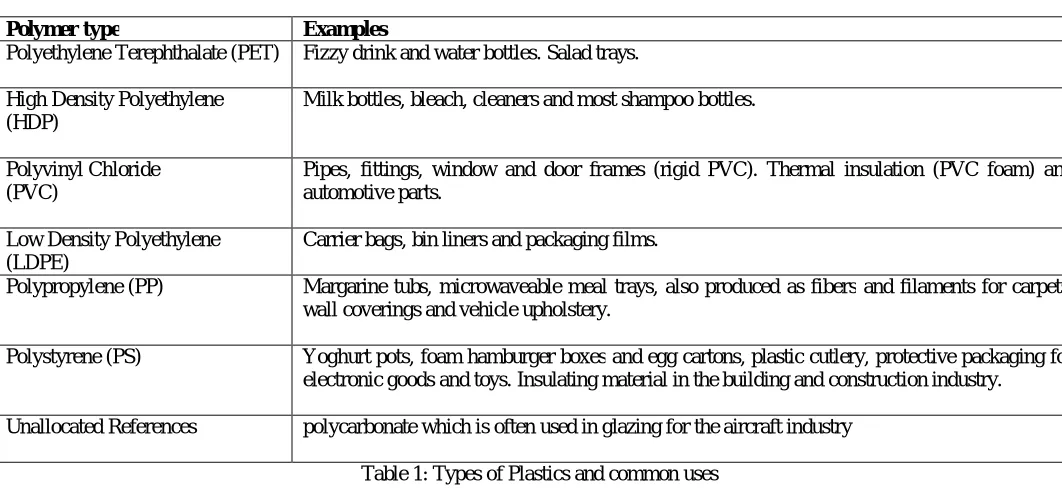
Polymer type Examples
Polyethylene Terephthalate (PET) Fizzy drink and water bottles. Salad trays.
High Density Polyethylene (HDP)
Milk bottles, bleach, cleaners and most shampoo bottles.
Polyvinyl Chloride (PVC)
Pipes, fittings, window and door frames (rigid PVC). Thermal insulation (PVC foam) and automotive parts.
Low Density Polyethylene (LDPE)
Carrier bags, bin liners and packaging films.
Polypropylene (PP) Margarine tubs, microwaveable meal trays, also produced as fibers and filaments for carpets,
wall coverings and vehicle upholstery.
Polystyrene (PS) Yoghurt pots, foam hamburger boxes and egg cartons, plastic cutlery, protective packaging for
electronic goods and toys. Insulating material in the building and construction industry.
Unallocated References polycarbonate which is often used in glazing for the aircraft industry
Table 1: Types of Plastics and common uses
II.THE CAUSE AND EFFECTS OF THE USE OF DISPOSAL PLASTICS
The durable, lightweight and easy to go of the non-biodegradable plastic bags and water bottles are becoming unavoidable to use in many day-to-day activities of the societies of developing countries like Ethiopia, and of which is often re-used many times and discarded causing problems for human, animal and the environments where it deposited. Some of the major sources of environmental problems like Ethiopia include sewage and run-off related plastics, materials from recreational/social gathering users, and materials disposed of at open landfills from each household activity.
Plastic materials originating from each source is either transported by wind, flood and human drains toward water bodies, or is mixed with the farm (agricultural) lands. In developed countries, poor awareness of societies on plastic materials, poor collection of waste materials and their treatments, high run-off and floods due to rain are important pointed sources of plastic materials, namely plastic bags and water bottles, from/to the environment (agricultural farmlands, surface waters) which undermines soil and water qualities and threatens human and biodiversity (P. Pavani et al.,2014).
III. REGULATIONS OF PLASTICS IN ETHIOPIA
The Federal Democratic Republic of Ethiopia has ratified several international conventions that have meaningful implication to solid waste management in the country (Forumfor Environment 2010). The solid waste management proclamation (Solid waste managementproclamation 2007) gives emphasis of its essential in community participation in order to prevent the adverse effects and to enhance the benefits resulting from solid wastes.
Article 8, sub-article (2) of the proclamation indicates that it shall be unlawful to put on the market any plastic bag that is not labeled to how whether it is biodegradable or not.
ISSN(Online): 2319-8753 ISSN (Print): 2347-6710
I
nternational
J
ournal of
I
nnovative
R
esearch in
S
cience,
E
ngineering and
T
echnology
(A High Impact Factor, Monthly, Peer Reviewed Journal)
Visit: www.ijirset.com
Vol. 7, Issue 6, June 2018
IV.ENVIRONMENTAL IMPACTS
Environmental impacts are wide ranging and can be both direct and indirect. Direct impacts occur when marine life is physically harmed by marine debris through ingestion or entanglement (e.g., a turtle mistakes a plastic bag for food) or marine debris physically alters a sensitive ecosystem (e.g., a fishing net is dragged along the ocean floor by strong ocean currents and breaks and smothers a coral reef). Environmental impacts can also be indirect, such as when a marine debris cleanup results in ecological changes.
4.1 Direct Environmental Impacts
a. Ingestion: Seabirds, sea turtles, fish, and marine mammals often ingest marine debris that they mistake for food. Ingesting marine debris can seriously harm marine life. For example, whales and sea turtles often mistake plastic bags for squid, and birds often mistake plastic pellets for fish eggs. Moreover, a study of 38 green turtles found that 61 percent had ingested some form of marine debris including plastic bags, cloth, and rope or string (Bugoni et al., 2001).
b. Entanglement: Marine life can become entangled in marine debris causing serious injury or death. Entanglement
can lead to suffocation, starvation, drowning, increased vulnerability to predators, or other injury. Marine debris can constrict an entangled animal's movement which results in exhaustion or development of an infection from deep wounds caused by tightening material (2008 ICC Report, Ocean Conservancy).
c. Ecosystem Alteration: The direct impacts of marine debris not only effects pants, animals but effects the whole sensitive ecosystems. Coral reefs can be damaged by derelict fishing gear that breaks or suffocates coral. The ocean floor ecosystems can be damaged and altered by the movement of an abandoned vessel or other marine debris.
4.2 Indirect Environmental Impacts
a. Ecosystem Alteration: Efforts to remove marine debris can be harmful to aquatic vegetation, nesting birds, sea turtles, and other types of aquatic life and beach ecosystems. Beach raking also can contribute to beach erosion and disturbance of natural vegetation when the raking is conducted too close to a dune.
b. Invasive Species: Marine debris can contribute to the transfer and movement of invasive species. Floating marine
debris can carry invasive species from one location to another. Invasive species use the marine debris as a type of "raft" to move from one body of water to another. In a study performed by the British Antarctic Survey in 2002, it was estimated that man-made debris found in the oceans has approximately doubled the number of different species found in the subtropics (Barnes, D.K., 2002).
4.3 Economic Impacts
Marine debris can harm three important components of our economy: tourism, fishing, and navigation. Economic impacts are felt through loss in tourism dollars and catch revenue, as well as costly vessel repairs (L.A. County Boards of Supervisors Staff Report, 2007).
4.5 Harm to Marine Wildlife
ISSN(Online): 2319-8753 ISSN (Print): 2347-6710
I
nternational
J
ournal of
I
nnovative
R
esearch in
S
cience,
E
ngineering and
T
echnology
(A High Impact Factor, Monthly, Peer Reviewed Journal)
Visit: www.ijirset.com
Vol. 7, Issue 6, June 2018
species, 44% of all seabird species, and 43% of all marine mammal species (Laist, 1997). The problem may be highly underestimated as most victims are likely to go undiscovered over vast ocean areas, as they either sink or are eaten by predators (Wolfe, 1987).
V. IMPACT ON HUMANS
The harmful effects of plastic on aquatic life are devastating, and accelerating. The impacts of plastic waste on our health and the environment are only just becoming apparent.There are several chemicals within plastic material itself that have been added to give it certain properties such as Bisphenol A, phthalates and flame retardants. These all have known negative effects on human and animal health, mainly affecting the endocrine system. There are also toxic monomers, which have been linked to cancer and reproductive problems. The actual role of plastic waste in causing these health impacts is uncertain. This is partly because it is not clear what level of exposure is caused by plastic waste, and partly because the mechanisms by which the chemicals from plastic may have an impact on humans and animals are not fully established. The most likely pathway is through ingestion, after which chemicals could bio accumulate up the food chain, meaning that those at the top could be exposed to greater levels of chemicals (Science for Environment Policy,2011).
The harmful effects of chemicals additives in plastics are also pronounced in newborns via mothers exposed to these toxins during their pregnancy. The second vulnerable groups are young children exposed directly to these chemicals. Since many of these chemicals (BPA and phthalates) can cross the placenta, resulting in growth retardation and neurological harm. There are also evidences to suggest hormonal derangements and cancers in children (Zaman ,2012).
VI. IMPACT OF SINGLE USE PLASTICS
The single use plastics (drinking water bottles/ packing food stuff) are another issue surrounding the toxicity. Phthalates and Bisphenol A (BPA) are the two most notorious toxin which leach from plastics into food or water and when these plastic wastes are discarded improperly, they often end up in water bodies where they continue to leach these harmful chemical for a very long time (Vipin Koushal, et al.,2014).
Phthalates have been found to deposit in the fatty tissues of the body, and also causative factors of human diseases like male reproductive dysfunction, breast growth and testicular cancers (Jobling S et al., 1995). BPA is often found in the food grade plastic known as polycarbonates, used in hospital disposables, has been found to have an estrogenic side effect. It is found to have detrimental effects on human placental tissues leading to premature birth, intrauterine growth retardation, preeclampsia and still birth (Benachour N, Aris A ,2009). Studies have shown that BPA may also lead to insulin resistance and diabetes as well (Magdalena AP et al., 2009).
VII. PREVENTIVE MEASURES
7.1 Recycling
Among the existing solutions recycling is one of the most convenient and easiest ways. As consumers, the recycling only requires one easy step of putting plastic wastes in right bins for disposal. Separating the plastic waste from other waste will prevent plastics to be land filled and will allow it to be recycled with other plastics of the same kind.
Recent reports of discovery of certain fungi and bacteria that hasten degradation of conventional plastics have received a lot of scientific attention. In this process, the byproducts of this natural way of decomposition are safe for the environment and there are no hidden adverse consequences of this approach.
7.2 Reduced use of plastics
ISSN(Online): 2319-8753 ISSN (Print): 2347-6710
I
nternational
J
ournal of
I
nnovative
R
esearch in
S
cience,
E
ngineering and
T
echnology
(A High Impact Factor, Monthly, Peer Reviewed Journal)
Visit: www.ijirset.com
Vol. 7, Issue 6, June 2018
plastic.Source reduction (Reduce and Reuse) can occur by altering the design, manufacture, or use of plastic products and materials.
7.3 Chemical decomposing
Chemical decomposing is otherwise a very effective solution to plastic pollution, since the non-biodegradable property of plastic is the main cause of plastic pollution. However, no technology has been developed yet to set up an economical and effective large-scale plastic decomposing facility. But chemical decomposing is still a field that has a great potential to develop in the future.
There are mainly two ways to decompose conventional plastics. Decomposing plastics by microorganisms is one of them. Daniel Burd, a Canadian high school student, found out that there are three kinds of microorganisms in the earth from a landfill that can break down the molecules of plastic bags. However, since this is a relatively new discovery, it is not applied industrially yet.
Another way to decompose plastics is by combustion. This is a relatively easy and inexpensive way compared to using microorganisms, however, odor and toxic gases produced during combustion is a big problem. Currently, some companies have already applied this method, and Wheelabrator Technologies Inc. is one of them [20].
VII. ALTERNATIVE SOLUTIONS
8.1 Biodegradable Plastics (BDP)
This is one of the options to the conventional plastics. One of the common constituents of BDP is polyhydroxyalkanoate (PHA). The BDP are similar to conventional plastics in all aspects with the additional quality of being able to naturally decompose and break into natural and safe byproducts.
However, the technologies to manufacture BDPs are relatively new and not widely prevalent, the production cost is higher. Therefore, further research in areas of more cost effective and energy efficient manufacturing methods for biodegradable plastics is the call of the hour (Begam Z, 2010).
8.2 Bioplastics: A bioplastic is a plastic that is made partly or wholly from polymers derived from biological sources such as sugar cane, potato starch or the cellulose from trees, straw and cotton. Some bioplastics degrade in the open air, others are made so that they compost in an industrial composting plant, aided by fungi, bacteria and enzymes. Hence, further research should focus on developing bioplastics that are both biodegradable and also energy efficient to produce.
8.3 Polymer Blended Bitumen Roads:It is one of the innovative idea of using plastic waste.The non-wetting property
of plastics is also being implemented successfully in road construction business. When polymer (plastic waste) is coated over aggregate, the coating reduces its affinity for water due to non-wetting nature of the polymer, thereby obstructing the penetration of water. Polymers also shows higher softening temperature, thereby reduce the bleeding of bitumen during the summers (Materials and Plastic Waste Management, 2012).
IX. BEST TIPS TO BEAT PLASTICS IN DAILY USE
We require a big leap towards tomorrow’s cleaner and healthier environment is the need of the hour. As Ian Connacher, the director of the film “Addicted to Plastics,” once said in an interview with GreenMuze: “I don’t think the material is to blame. I think it is our misuse of the material as consumers, the ineffective recycling policies and lack of producer (GreenMuze,2008). These are some of the tips we can follow as individuals to minimize the use of plastics.
Use paper or cloth bags instead of plastic bags.
Reuse plastic bags for many times to reduce consumption, and hence curbing the production.
Avoid plastic bottled water.
ISSN(Online): 2319-8753 ISSN (Print): 2347-6710
I
nternational
J
ournal of
I
nnovative
R
esearch in
S
cience,
E
ngineering and
T
echnology
(A High Impact Factor, Monthly, Peer Reviewed Journal)
Visit: www.ijirset.com
Vol. 7, Issue 6, June 2018
Don’t buy convenience foods packages in plastic.
Reduce the use of plastic-wrapped products.
Bring your own cloth bags while shopping.
Do not buy plastic toys for children instead replace them with toys made of natural materials
Strictly avoid the disposal single use plastic plates, cups etc.
Use glass containers for storing vegetables or other items.
Discourage plastic bags production by imposing heavy taxes or fines.
Compliance with proper criteria and standards on the production of plastic bags as per law.
Avoid use plastic bottles for feeding babies.
Avoid buying products using plastic packing.
Choose the products that can be reused and recycled.
Segregate your waste at home and Compost your trash;
X. CONCLUSIONS
The major issue with plastic waste reduction is the lack of public responsibility. There is urgent need to cultivate community awareness and change the attitude of people towards plastic use, as this is fundamental to minimize the impacts of plastics on environment and on human health. The scientific community needs to come up with new types of materials which can replace plastics.
REFERENCES
1. http://www.merriam-webster.com/dictionary/polymer. 2. Greenmuze (2008) Addicted to plastics.
3. Elias HG (2005) Plastics, General Survey. Ullmann’s Encyclopedia of Industrial Chemistry.
4. Callister WD, Rethwisch DG (2008) Fundamentals of Materials Science and Engineering: An Integrated Approach (3rdedn).
5. Li N, Mahat D, Park S (2009) Reduce Reuse and Replace: A Study on Solutions to Plastic Wastes. An Interactive Qualifying Project Submitted to the faculty of Worcester Polytechnic Institute.
6. Ryan PG, Moore CJ, Franeker JA, Moloney CL (2009) Monitoring the abundance of plastic debris in the marine environment. Philos Trans R SocLond B BiolSci B 364: 1999-2012.
7. Derraik JGB (2002) The pollution of the marine environment by plastic debris: a review. Marine Pollution Bulletin 44: 842-852.
8. Gregory MR (2009) Environmental implications of plastic debris in marine settings-entanglement ingestion smothering hangers-on hitch-hiking and alien invasions. Philos Trans R SocLond B Biol Sci. 364: 2013-2025.
9. Science for Environment Policy (2011) Plastic Waste: Ecological and Human Health Impacts. In-depth Reports. 10. Schuler K (2008) Smart Plastics Guide: Healthier Food Uses of Plastics. Minneapolis Minnesota.
11. Zaman T (2010) The Prevalence and Environmental Impact of Single Use Plastic Products.
12. Jobling S, Reynolds T, White R, Parker MG, Sumpter JP (1995) A variety of environmentally persistent chemicals including some phthalate plasticizers are weakly estrogenic. Environ Health Perspect 103: 582-587.
13. Benachour N, Aris A (2009) Toxic effects of low doses of Bisphenol-A on human placental cells. ToxicolApplPharmacol 241: 322-328. 14. Magdalena AP, Morimoto S, Ripoll C, Fuentes E, Nadal A (2006) The estrogenic effect of bisphenol A disrupts pancreatic beta-cell function in
vivo and induces insulin resistance. Environ Health Perspect 114: 106-112.
15. Tammemagi HY (1999) The Waste Crisis: Landfills Incinerators and the Search for a Sustainable Future. Oxford University Press New York. 16. Narayan P (2001) Analyzing Plastic Waste Management in India: Case study of Polybags and PET bottles|| published by IIIEE. Lund
University Sweden 24-25.
17. Shah P (2001) The Plastic Devil: Ecological Menace.
18. Chaturvedi B (2002) The source of this information is a press release of No Plastics in the Environment (Nope) Imports Versus Surplus: A Glut of Plastics in India Today. Chintan Environmental Organization.
19. Begum Z (2010) Plastics and environment. Dissemination Paper for the Ministry of Environment and Forest. Government of India. 20. Wheelabrator Technologies Inc (2009) About Us.
21. Material on Plastic Waste Management (2012) Central Pollution Control Board India.