
Data Security in Proactive Network using
Secret Sharing Mechanism
Himanshu Gupta
1, Vasudha Arora
2M. Tech Scholar, Dept. of CSE, Manav Rachna International University, Faridabad, India1 Assistant Professor, Dept. of CSE, Manav Rachna International University, Faridabad, India2
ABSTRACT: For most of the cryptosystems, using a single master key system is not enough to protect important documents, there is a need of many encryption and decryption keys for this purpose. A Secret Sharing Scheme is the method which divides the secret into several parts and distributes them among the specific communicating entities in such a way that only these participants can reconstruct the secret by poling there share. Hence, unauthorised entity cannot reconstruct the secret. The best way to implement such a system is in cloud environment.
Shamir’s(t, n) threshold scheme is one of the most well-known and widely used example of secret sharing systems.
KEYWORDS: Secret Sharing; Shamir’s secret sharing scheme; shared key; secret key; I. INTRODUCTION
Security is concerned with the ability of a system to prevent it from unauthorized access to information and services. Confidentiality, Integrity and Authenticity are fundamental objectives of security. Many group-oriented applications require communication confidentiality, means that the information of a group should not be exposed to any outsider, but the question is whom to trust. There are many examples when even well-established trusted entities also become malicious. One solution to such a problem is instead of placing trust in just one party to distribute the trust among a group of trusted entities.
There are several known cryptographic concepts that address the question for distribution of secret. Some of them are secret sharing schemes, verifiable secret sharing schemes, and multiparty computation [1].
Although a well-known term within the cryptographic community, secret sharing might be a bit misleading for an outsider [2]. It does not mean two or more people sharing one secret. It means two or more people are having shares of the secret. One secret is split into n different shares. Ideally, it should be impossible to gain any information about the secret with less than n shares.
To provide fundamental objectives of security one-time session keys need to be shared among communication entities to encrypt and authenticate secrets. Thus, before exchanging communication messages, a key establishment protocol needs to issue a one-time secret session keys to all participating entities. The key establishment protocol also needs to provide confidentiality and authentication for session keys. There are two types of key establishment protocols: key transfer protocols and key agreement protocols. Key transfer protocols rely on a mutually trusted key generation centre (KGC) to select session keys. KGC sends the session keys to all other shareholders of the original secret. In key agreement protocols, all communication entities are involved to determine session keys [5].
In cryptography, secret sharing refers to any method for distributing a secret among a group of participants, eachparticipant will have a share of that. The secret can be reconstructed only when the shares are combined together; individual shares are of no use. To implement such a scheme the most simple and commonly used technique is Shamir’s secret sharing scheme.
Secret sharing schemes can be used in equivalent situations, or perhaps to safely increase data availability, just to name two examples. Secret sharing is not only an interesting information-theoretical concept, but it also has several practical applications.
II. RELATED WORK
In [13], author conclude that in multi cloud data is replicated so the data is available even if the cloud is fail, they also conclude that the Shamir’s secret sharing mechanism has a variety of advantages such as security and client side aggregation etc.
In [14] the author proposed a very important concept in cloud computing is Self-Destructing data. In shared data an item if they are available for a long time it will considerably decrease the security and also increases the complexity of managing the files. Hence, in this Self –Destructing system the data files are automatically be deleted if they are not needed any more.
In [8] the author introduces a method to increase the efficiency of DES. In this scheme the data is encrypted using DES used with secret key and this data is send only to a group of trusted entities and KGC is shared between sender and receiver. This data can only be decrypted with KGC.
In [10] the authors have discussed about various secret sharing mechanisms.
In [15] it is shown that owing to the distributed nature of cloud, information dispersal is more secure and optimal approach for data outsourcing.
III.SHAMIR’S SECRET SHARING
Shamir’s Secret Sharing is a scheme in which a secret is divided into several parts giving each part to corresponding trusted participants in a group where some of the parts or all the parts are needed to reconstruct the secret. A threshold scheme is used in order to reconstruct the secret where K is any number of sufficient parts needed to reconstruct the secret as it may be impractical to have all the parts at the time of reconstruction. This threshold scheme is based on Lagrange Polynomial Interpolation method.
A. Sharing Protocol
Goal: To share a secret S among 𝐸1 , 𝐸2, … … … … . , 𝐸𝑛 , number of trusted entities.
1. Suppose we want to use a (K, n) threshold scheme to share our secret S, without loss of generality assumed to be an element in a finite field F of size P where 0 < 𝐾 ≤ 𝑛 < 𝑃; 𝑆 < 𝑃 0 and P is a prime number.
2. Choose at random K - 1positive integers a1,……..aK-1with ai< P, and let a0 = S. Build the polynomial
𝑓 𝑥 = 𝑎0+ 𝑎1𝑥 + 𝑎22𝑥2+ 𝑎3𝑥3… … … + 𝑎𝐾−1𝑥𝐾−1
3. Construct n random distinct evaluation points = 1 … … . . 𝑛 : 𝑋𝑗 ≠ 0 and secretly distributes the shares to
corresponding trusted entity𝐸𝑗.
𝑠𝑎𝑟𝑒𝑗 𝑠 = (𝑋𝑗, 𝑓 𝑋𝑗 ); 𝑗 = 1 … … . 𝑛
B. Reconstruction Protocol
Goal:to reconstruct the secret from K out of n shares:
1. Use Lagrange Interpolation to find unique polynomial 𝑓(𝑥) such that 𝑑𝑒𝑔𝑟𝑒𝑒 𝑓 𝑥 < 𝐾 and 𝑓 𝑗 = 𝑠𝑎𝑟𝑒𝑗(𝑆) for 𝑗 = 1,2 … … . 𝑡.
2. Calculate 𝑓(0) = the reconstructed secret.
Lagrange interpolation:𝑓 𝑥 = 𝑓 𝑖 ∗ 𝐿𝑖 𝑥 ; 𝑤𝑒𝑟𝑒 𝐿𝑖 𝑥 =
(𝑥−𝑥𝑗) 𝑗 ≠1
(𝑥𝑖−𝑥𝑗) 𝑗 ≠1 𝑡
𝑡=1 is the Lagrange polynomial which has
Fig 1(a):Shares of Degree-2 Polynomial
Fig 1(b): A Degree-2 Ploynomial
IV.PROACTIVE SECRET SHARING
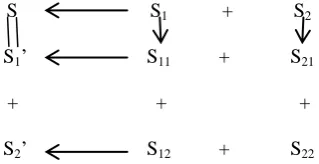
which will make it more difficult for attacker to get the secret. The secret remains confidential if less than t servers are compromised from the start of one PSS to the end of the next PSS.
The basic methodology used to renew shares is given below:
S S1 + S2
S1’ S11 + S21
+ + +
S2’ S12 + S22
Fig 2: Method used to Renew Shares
A. Basic Share Renewal Protocol
The goal here is to renew the shares without changing the secret. The shareholders should agree on a new polynomial with the same secret S. At the end, each shareholder/entity will have a new share on the newpolynomial of degree 𝑡 − 1. Every share holder/entity must remember its original share.
The protocol at the beginning is as follows:
1. Everyithentity𝑖 ∈ [1 … . 𝑛]randomly picks 𝑡 − 1numbers from a finite field. These numbers define a polynomial
Pi(X) of degree 𝑡 − 1whose free coefficient is zero𝑃𝑖 0 = 0.
2. Using VSS Each ithentity distributes the shares of Pi(X) among the participating entities.
3. Everyithentity receives the following shares:𝑃1 𝑖 , … … . . , 𝑃𝑛(𝑖) including his own made share 𝑃𝑖(𝑖)and
calculates its new share by adding its old share- 𝑓(𝑖)to the sum of the new n shares. Mathematically speaking: 𝑖 = 𝑓 𝑖 + 𝑛𝑐=1𝑃𝑐 𝑖 .
4. Everyithentity erases his/her old share –𝑓(𝑖).
B. Detection of Corrupted Shares
In this secret sharing scheme each participating entity wants to be sure that shares of other entities is not corrupted or revealed. There are many reasons that shares are not available such as disk crash, server crash, any hacker attacked one of the shares, now the question is how we would know that the share is attacked by a hacker. One solution to this problem is periodical secure broadcast to compare shares. One should save some traces of shares for this purpose.
This can be done as follows:
1. Do Verifiable Secret Sharing (VSS), so the encryption of each share is saved at each entity site.
2. Each ith entity updates his shares using homomorphic property for every j as:𝐸 𝑖 = 𝐸(𝑓 𝑖 ) × 𝐸(𝑃𝑚 𝑗 )
𝑛
𝑚 =1 .
C. Reconstruction of Corrupted Share
Reconstruction is the most important phase of this scheme. The algorithm for reconstructing the corrupted share is given below:
1. Everyithentity𝑖 ∈ 1 … . . 𝑟 − 1 , [𝑟 + 1 … … 𝑛]) randomly chooses a polynomial 𝑃𝑖 𝑋 of degree 𝑡 − 1 where
𝑃𝑖 𝑟 = 0 and 𝑃𝑖 0 ≠ 0.
2. Everyithentity distributes shares of 𝑃𝑖 𝑋 : 𝑃𝑖 1 … … 𝑃𝑖 𝑛 using VSS among the shareholders.
3. Now, every ith entity has 𝑃𝑖, … … . , 𝑃𝑟 −1 𝑖 , 𝑃𝑟 +1 𝑖 , … . . , 𝑃𝑛(𝑖) and calculates its updated new share for r:
𝑖 = 𝑓 𝑖 + 𝑟−1𝑐=1𝑃𝑐(𝑖)+ 𝑛𝐾=𝑟+1𝑃𝑘(𝑖) and sent it to r.
4. Now, the rthentity decrypts all these shares and recovers𝑓(𝑟) by using interpolating property of Lagrange’s theorem. Here it has a new polynomial which has value equal to the old corrupted share i.e. 𝑟 = 𝑓 𝑟 .
V. SIMULATION AND RESULTS
depending on the requirements, and available machines on the cloud. Each CloudSim configuration maps to a constellation, which are collections of multiple virtual machines running together. The key provided from AWS is the token that allow CloudSim to access AWS on behalf of the AWS user. Figure 3 below shows how the key first is divided into several shares and then it is recombined to regenerate the secret.
Fig 3: Snapshot of Key Division and Regeneration
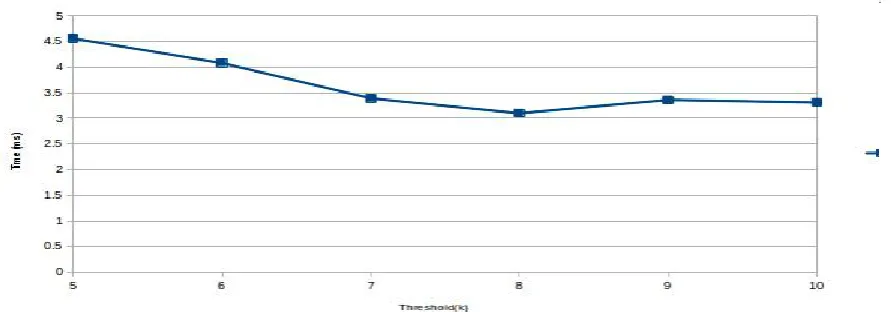
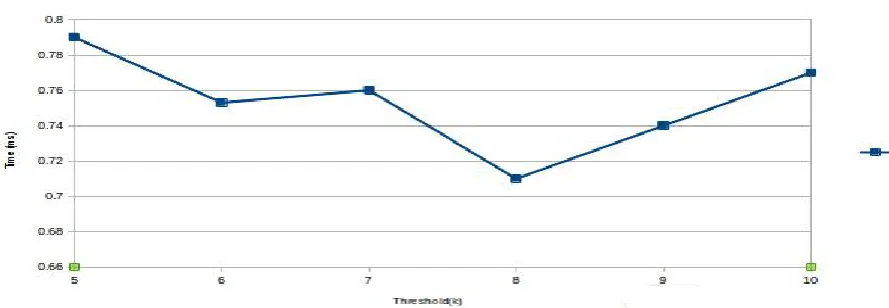
Below the Figure 4 and Figure 5 shows the graph for Key Division and Key Regeneration from shares for a 128 bit key with n = 10.
Fig 5: Key Regeneration from Shares for 128 bit key with n= 10
VI.CONCLUSION
This research showed a very important cryptographic concept – Secret Sharing Scheme which is given by Adi Shamir. In a Secret Sharing Scheme generally we have a secret which is divided among several trusted entities. The secret shared can only be recovered by these trusted entities. This scheme is very useful and efficient in safeguarding cryptographic keys. It is based on Lagrange Polynomial Interpolation Theorem to design several groups or classes of secret sharing. This scheme also has some useful properties such as homomorphic and a multiplicative property which makes it suitable for threshold based cryptography. So, we conclude that it is an efficient scheme where the secret is shared in a group because the unauthorised or outside entity cannot get the access to the information shared in a group without having at least threshold number of shares of the decryption key used to encrypt the information.
REFERENCES
1. Fredrik Olsson, “A Lab System for Secret Sharing”, 2004.
2. N. Ferguson & B. Schneier, “Practical Cryptography”, 2003, pp. 358-360 3. A.Shamir,” How to share a Secret”,Comm ACM, Vol.22, no.11, pp.612-613, 1979.
4. LeinHarn and Changlu Lin, “Authenticated Group Key Transfer Protocol Based on Secret Sharing” IEEE transactions on computers, vol, 59,No.6, June 2010 IEEE.
5. W.G.Tzeng. “ A Secure Fault-Tolerant Conference Key Agreement Protocol,” IEEE Trans.Computer, Vol.51,no.4,pp.373-379,Apr.2002
6. LeinHarn and Changlu Lin, “ Authenticated Group Key Transfer Protocol Based on Secret Sharing”, IEEE Trans. Computers, Vol .59, No.6,pp.842-846, June2010.
7. Saria Islam, A. S. M MahmudulHasan, “Implementation of Shamir’s Secret Sharing on Proactive Network”, International Journal of Applied Information Systems(AJAIS) , Foundation of Computer Science FCS, New York, USA, Vol.06, No. 02, pp. 17-22, September 2013.
8. YaminiIndla, M. Sampat Kumar, “Extended Group Key Transfer Protocol for Authentication Using DES based on Secret Sharing in Cloud” International Journal of Emerging Technology and Advanced Engineering(IJETAE), Vol. 02, Issue 11, pp.541-551, November 2012.
9. Mrs.Komal Ate, Prof. S. D Potdukhe, “Data Sharing in Cloud Storage with Key-Aggregate Cryptosystem”, International Journal of Engineering Research and General Science(IJERGS), Vol. 02, Issue 06, pp. 882-886, October-November 2014.
10. DnyaneshewarSupe, AmitSrivastav, Dr. Rajesh S. Prasad, “Review of Methods for Secret Sharing in Cloud Computing”, International Journal of Advanced Research in Computer Engineering and Technology(IJARCET), Vol. 02, Issue 1, pp. 11-17, January 2013.
11. K. Ren, C. Wang, and Q. Wang, “Security Challenges for the Public Cloud,” IEEE Internet Computing, vol. 16, no. 1, pp. 69–73, 2012. 12. B. Wang, B. Li, and H. Li, “Oruta: Privacy-Preserving Public Auditing for Shared Data in the Cloud,” in IEEE Cloud, June 2012, pp. 295–302.
13. Swapnila S. Mirajkar, Santosh Kumar Biradar, “Using Ssecret Sharing Algorithm for Improving Security in Cloud Computing”, International Journal of Advanced Research in Computer Science and Technology(IJARCST), Vol 02, Issue 02, Ver. 03, pp. 395-398, April-June 2014.
14. Ranjith. K, P.G. Kathiravan, “A Self-Destructing System for Dynamic Group Data Sharing in Cloud”, International Journal of Research in Engineering and Technology(IJRET), Vol. 03, Special Issue 07,pp. 265-270, May 2014.

![Improvements for Kosovo's spatial planning system / [presentation given in May 2011]](data:image/gif;base64,R0lGODlhAQABAIAAAP///wAAACH5BAEAAAAALAAAAAABAAEAAAICRAEAOw==)