Load Balancing Using Cloudsim Simulator In Cloud
Computing
Jyoti Prakash Mishra, Snigdha Rani Panda
Abstract : Cloud computing has appeared as a well-liked result for offering effortless accessibility for the resources from external source. Cloud computing provides benefit to many organizations for maintaining their applications. The concept of virtualization is its biggest positive which leads to its extensive application. In cloud computing concept, for offering services to the users the server machines require energy. So, for considering the resource allocation to various servers, we need Cloud simulation and modeling tool for creating the cloud as per necessity in cloud computing. CloudSim and Cloud report are utilized for investigating through simulation of cloud for enhanced study of cloud environment.
Keywords: CloudSim, Virtual Machine, Cloud computing, Simulation, Cloud Reports.
————————————————————
1
INTRODUCTION
Cloud Computing is a concept in which an association of servers is hosted on the Internet/Intranet for storing, managing, and data processing instead of a personal computer or a local server. The cloud system is the requirement based condition which occupies free of cost for up fronting and pay-per-use system with unlimited, flexible resource utilization. Virtual Machine, CPU resource, Memory etc. are various resources present in a cloud environment situated in the datacenter. Cloud computing concept is used for describing a mixture of computing concepts which involves huge no. of hosts linked by the communiqué media like Internet. Cloud computing is valuable in distributed computing over the network with a capacity for executing a program or application in numerous linked computers concurrently. This is likewise submitted to network-based services that may be supplied through real server hardware which can be served by virtual hardware or simulated via software executing in single or multiple systems.
2 RELATED WORK
For modeling the Grid based environments, various simulators were proposed earlier. But, for the multilayer service generalizations, the existing tool kits are incapable of segregating the (SaaS, PaaS, and IaaS) which is required by the Cloud computing environments. For modeling the virtualized environment, no support is actually provided. So, CloudSim toolkit is a suitable platform for modeling the virtualized cloud environment, which contains the elements used to generate data centers, hosts, brokers, virtual machines along with the service requests [1].For modeling and simulation, CloudSim is generally utilized in Cloud computing systems. Various models are estimated by CloudSim with the values obtained corresponding to response time along with cost saving by utilizing a variety of configurations [2].
CloudSim even permits multiple Data Centers simulation for facilitating a summary on federation with related policies regarding self-utilization of applications and immigration of virtual machines (VMs) used for improving reliability [3]. It maintains system as well as behavior modeling of Cloud system components like data centers, VMs with resource stipulating policies. It employs basic application stipulating methods which may be expanded with simplicity and restricted efforts. This toolkit holds modeling along with simulation of Cloud computing settings comprising with sole as well as networked cloud environments [4]. CloudSim toolkit is created for simulating large scale Cloud environment and verifying cloud environment with different deployment platforms with configurations. For simulating distributed computing environments, Cloud Reports is a graphic tool based on the Cloud Computing environment. Cloud Reports can also be described as a graphical form of CloudSim with accessible environment, repeatability and customizability [5].
3 OBJECTIVE OF CLOUD COMPUTING
Resource allocation takes a vital role in cloud computing environment. If the resources are improperly allocated, then some servers may have high loads and other servers may have low loads which may guide for extra energy utilization. So, resource allocation is a major issue as the cloud can be scaled starting from only two servers to thousands number of servers which are impossible for deploying and testing the cloud. Thus, the essentiality of simulators occurs for testing the cloud as per the requirement which can consume less time, cost and energy.
4 REQUIREMENT FOR CLOUD SIMULATOR
In cloud computing environment, for verifying the allocation of resources that is scalable up to large number of servers, Cloud simulation and modeling tool is needed for taking care of the cloud with requirement basis. CloudSim along with Cloud Reports are utilized for proper allocation of the resource in the Virtual machines that is demonstrated in this paper. For providing dependable, safe, fault-tolerant, sustainable and expandable computational services, Cloud computing appeared as an important equipment that is available with Software, Infrastructure, or Platform as services. In an environment where various tests will be performed, the use of simulation tools provide an opportunity for evaluating the
_________________
Jyoti Prakash Mishra, Department of Computer Science and Engineering, Gandhi Institute for Education and Technology, Baniatangi, Khurda,
mail-id: [email protected]
Snigdha Rani Panda, Department of Computer Science and Engineering, Gandhi Institute for Education and Technology, Baniatangi, Khurda,
proposition before the software development. Exclusively in Cloud computing environments, the simulation-based approaches provides noteworthy advantages where utilizing the infrastructure acquires pay-as-you use process. It also permits the Cloud customers for testing the services in recurring and controlling environment with no charges, for improving the performance blocks prior to deploy it in actual Clouds [2]. Simulation environment permits assessment of various kinds leasing of resources, situations with various loads along with pricing allocations in the side of the cloud provider. It guides the providers for reducing the resource utilization pricing keeping in mind increasing the returns. The Cloud clients and suppliers will rely on theoretical with vague evaluations on hit and trial approaches which may cause reduction of service performances in the absence of simulation platforms. By utilizing CloudSim, the developers may concentrate on precise system design concerns which need to be tested instead of worrying with the ground level data associated to Cloud- based infrastructures along with the services [6].
5 CLOUD SIMULATOR
For experimenting in the cloud computing environment, CloudSim is simulation software for enabling the developers. It is an application that provides flawless modeling and simulation along with testing of application and cloud computing services. As a result of the issues that the accessible distributed system simulators are invalid to the cloud computing environment, the evaluation of the result of cloud stipulating regulatory, application workload, services and representations with resources result models under a system, user configurations with the needs is hard for attaining. So, CloudSim can be utilized in order to crossover these issues [4]. CloudSim too provides support system with behavior modeling of cloud system components like data centers, virtual machines (VMs) and resource allotment regulatory [4]. CloudSim employs basic application stipulating methods which may enlarge without any difficulty in partial attempts. In the CloudSim architecture that is described in Fig. 1, the datacenter that is the major part of cloud that contains set of host(s), virtual machine(s).
Fig.1. Various parts of CloudSim connections
5.1 Features of CloudSim tool
The subsequent are some of the characteristics of CloudSim tool.
1. It supports modeling and simulation in large scale Cloud computing data centers.
2. It supports modeling and simulation of energy-aware computational resources.
3. It supports modeling and simulation of data center network topologies and message-passing applications.
4. It supports modeling and simulation of united clouds.
5. It supports dynamic insertion of simulation elements, stop and resume of simulation. 6. It supports user-defined planning for allocation of
hosts to virtual machines and planning to give host resources to virtual machines results.
5.2 Various elements of CloudSim tool
The 4 primary elements that exists in CloudSim tool are 1. Datacenter
2. Virtual Machine 3. Broker
4. Cloudlet
The datacenters in CloudSim hold various resources for providing it to the clients or users. The job of virtual machines is to virtually allot the resources to the clients or users. The job of broker is to facilitate the available resources to the clients. The cloudlets are to customize the tasks of the cloud providers.
5.3 Source code of CloudSim tool
2775
5.4 Cloud Reports
In Cloud computing, Cloud Reports supply various analyses to the analysts for playing the job of users and service providers. The potential of each user is determined by the no. of virtual machines owned by the individual user. The broker is accountable for supplying the virtual machines and resource utilization methods which sets the quantity of computational nodes (hosts) and its resource arrangement. The resource arrangement comprises processing capability, quantity of RAM, existing bandwidth, resource usage with implementation period. Prior to letting the services to the users, this cloud report facilitates the service providers for estimating its cloud environment. CloudSim operates as the simulation engine and offers an effortless interface, report creation characteristics with generation of extensions for the Cloud reports. The application is able to simulate an Infrastructure as a Service (IaaS) provider along with random no. of datacenters. Every datacenter may be modified according to the necessity. The customer is able to effortlessly put the quantity of computational nodes (hosts) with its resource configuration that comprises of processing capability, quantity of RAM, existing bandwidth, power utilization with the scheduling methods [7]. Client is able to put the no. of virtual machines, where a broker is accountable for providing these virtual machines with resource allotment methods. Every virtual machine possesses its arrangement which comprises of its hypervisor, image size, scheduling algorithms for various tasks (cloudlets) with necessary processing capacity, RAM [8].
6 EXPERIMENTAL RESULTS
Fig. 2. Cloud reports environment simulation
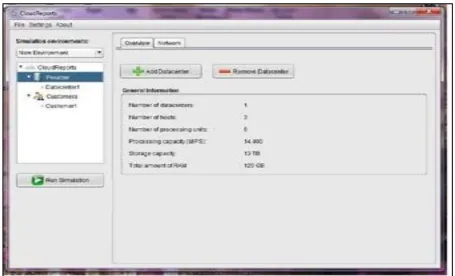
The user is able to generate data center, number of hosts along with capability (MIPS), RAM in Cloud report which is illustrated in Fig.2. In addition, Cloud reports generate HTML reports of every simulation and raw data files which can be effortlessly introduced by third party
applications like Octave [9]. The users are able to generate simulation environment that consists of data center, number of hosts, RAM of preferred arrangement in cloud report illustrated in Fig.3.
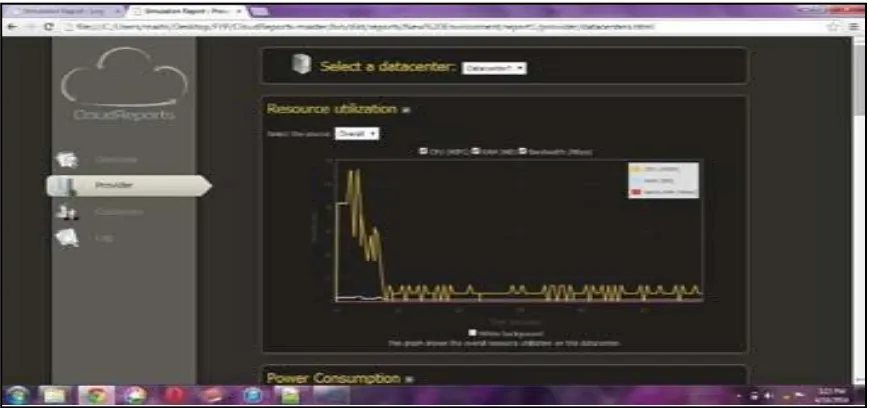
2777 The cloud resource utilization graph for different
resources is provided in Fig. 4. In the resource utilization graph, it shows the type of data center with the cloud
provider data. It also shows the amount of power consumption by the cloud provider through the different data centers [10].
Fig. 4. Cloud reports resource utilization Graph
7 CONCLUSION
Cloud computing occupies huge no. of systems linked by a real-time communiqué network. Cloud computing environment can be expandable, so requirement of simulation occurs in response to allotment of resources in requirement basis. Various resources like Virtual Machine, CPU and Memory etc. are needed to allot appropriately so as to minimize the consumption of energy. As infrastructure requirement is sometimes rising and shrinking, so it consumes time, cost and manpower usage at the time of actual deployment of cloud that is unfavorable. CloudSim is an ideal key to model the cloud alongside expanding in and expanding out of the infrastructure necessity. Cloud reports are ideal way out for costing of infrastructure, resource usage, and power utilization of modified environment.
REFERENCES
[1] Calheiros, R. N., Ranjan, R., Beloglazov, A., De Rose, C. A. and Buyya, R., CloudSim : A Toolkit for Modeling and Simulation of Cloud Computing Environments and Evaluation of Resource Provisioning Algorithms, Software: Practice and Experience, 41(1): 2350, Wiley,January (2011).
[2] Buyya, R., Ranjan, R. and Calheiros, R. N., Modeling and Simulation of Scalable Cloud Computing Environments and the CloudSim Toolkit: Challenges and Opportunities, 7th High Performance Computing and Simulation Conference (HPCS) IEEE Computer Society, 2009, 1-11, (2009).
[3] Pakize, S. R., Khademi, S. M., Gandomi , A., Comparison Of CloudSim, CloudAnalyst and CloudReports Simulator in Cloud Computing, International journal of Computer Science & Network Solutions May.2014, 2(5), (2014).
[4] Calheiros, R. N., Ranjan, R., Anton Beloglazov, César A. F., Buyya, R.CloudSim: A Toolkit for the Modelingand Simulation of Cloud Resource Management and Application Provisioning Techniques.,(1995).
[5] Vincent, A. K., Senthil, M. N. and Jaiganesh, M. Optimization of Cloud Resource Service Adaptability using Genetic Algorithms.International Conference on IT and Intelligent Systems (ICITIS'2013) August 28-29, (2013). [6] Kanniga Devi , R., Sujan, S., A Survey on
Application of Cloudsim Toolkit in Cloud Computing. International Journal of Innovative Research in Science, Engineering and
Technology, 3(6), (2014).
[7] Colheiro R. N., Cloud Report: A CloudSim - based Tool for Modelling and Analysis of Large Scale Cloud Computing Environments, MEDC Project by Rajkumar Buyya project supervisor Report, (2013).
[8] Liu, Y., Chen, L., Xu, K., Zhang, Y., Application Modes, Architecture and Challenges for Cloud Educational System, Computer Research and Development, (2010).
[9] Zhou Y, Liu X, Wang X, Xue L, Liang X, Liang S. 'Business process centric platform-as-a-service model and technologies for cloud enabled industry solutions.' Proceedings of the 3rdlnternationalConference on Cloud Computing; Miami, Florida (USA), 534-537, (2010).