297
Volume 64 34 Number 1, 2016
http://dx.doi.org/10.11118/actaun201664010297
MANAGEMENT OF RESOURCE POLICY:
HOW MONGOLIA PASSES THE TEST
Jiří Mičánek
1, Petr Blizkovsky
2*1 Úvoz 84, 602 00 Brno, Czech Republic
2 General Secretariat Council of the EU, rue de la Loi 185, Brussels, 1048, Belgium
Abstract
MIČÁNEK JIŘÍ, BLIZKOVSKY PETR. 2016. Management of Resource Policy: How Mongolia Passes the Test. Acta Universitatis Agriculturae et Silviculturae Mendelianae Brunensis, 64(1): 297–305.
Mongolia is quickly changing nowadays. This is also thanks to discoveries of enormous mineral wealth. Copper, coal, iron ore and gold in particular are responsible for an amazing growth performance that Mongolia continues to demonstrate over the last decade. As literature demonstrates, large windfalls in natural resources revenues o en turn into a curse in the long run, inspiring the term ‘resource curse’. Resource abundant countries are o en confronted with negative economic, social and political outcomes. Poor management of resource revenues is o en the core of this problem.
The article looks at the case of Mongolia. It runs eight tests related to competitiveness, to quality of institutions, to GDP and to growth rate determined by global mineral prices. The results are mixed: tests of institutional quality and volatility of prices has proved the hypothesis, however, the GDP growth and terms of trade tests haven’t shown any negative infl uence.
The results off er a mixed picture (6 tests supporting and 2 tests not-supporting the hypothesis). At this stage, in overall, Mongolia is not yet facing the resource curse. Policy recommendations concern much needed stabilisation of the economy, improvement of institutional quality through legal reforms, and diversifi cation of the economy.
Keywords: Mongolia, resource curse, institutions, diversifi cation, governance, economic growth, economic development, Dutch disease
INTRODUCTION
Debates on resource curse in Mongolia are not yet well established and lack any hard evidence about this phenomenon as mining boom is still quite recent. Research of this topic will thus be particularly interesting and important. Mongolia has a potential to become one of the world’s top mineral producers, especially in terms of copper. It is still young democracy with enormous development potential. If it will use its wealth properly, it can set an example for other resource-rich developing countries. However, to transform this potential into stable economic development which could provide opportunities for future generations, much
more than just high growth rates is needed. Strong institutional foundations and diverse economy are two pillars of such future. Today, Mongolia is strongly dependent on natural resources and so far, lack of social pressure and lack of investments in its non-mining sectors will likely prolong this dangerous dependence.
The main objective of this paper is to fi nd out whether Mongolia is facing the resource curse thanks to its dependence. By the resource curse we understand a situation where a high dependence on natural resources in terms of percentage of minerals on total exports has a negative eff ect on country’s socio-economic development. The paper aims at providing analysis of the resource curse
phenomenon in both theoretical and practical dimensions and at understanding the channels and extent of the possible resource curse in Mongolia.
The research hypothesis to be tested by the paper is that natural resource abundance has negative infl uence on socioeconomic development in Mongolia. Eight sub-tests will be run. These can be divided into four categories:
1) Natural resource abundance causes declining terms of trade and loss of competitiveness of non-mining sectors;
2) Natural resource abundance has negative eff ects on social capital and quality of institutions; 3) Natural resource abundance has negative eff ects
on GDP growth rates;
4) GDP growth rates of Mongolia are determined by global mineral prices.
The paper also provides policy recommendations to avoid negative outcomes of resource abundance.
LITERATURE OVERVIEW
It is generally accepted over contemporary literature that resource-rich developing countries o en fail to achieve long term economic development – phenomenon that is referred to as the resource curse.
The resource curse itself is a puzzling condition as production of natural resources a) has been the primary source of most development, b) provides almost instant source of foreign exchange, c) attracts foreign investments, skills and technology, d) supply domestic economy with raw materials and market for manufactured products (Mikesell, 1997). However, most of resource abundant developing countries tend to struggle to use these advantages eff ectively.
From the beginning the harmful infl uence of natural resources on country’s development seemed to be essentially of an economic nature. Specifi cally, it was suggested that natural resource exporters experienced declining terms of trade, volatile commodity prices, narrowing structure of national economy or a ‘Dutch disease’. The Dutch Disease theory was formed to explain the economic diffi culties of Netherlands in 1970s a er the discovery of natural gas in the North Sea (Philippot, 2010). Surprising result of this discovery was that local manufacturing sector experienced a steep decline. Since then, several countries had followed the similar pattern – rapid rise in the value of natural resource exports led to appreciation in the real exchange rate, which hinders conditions for exporting non-natural commodities and manufactured products (Humphreys, Sachs and Stiglitz, 2007). These countries therefore miss out on benefi ts of export-led growth from which many other developing countries managed to gain (Murshed, 2004). Extensive research indeed shows that there is a signifi cant negative relationship between high dependence on natural resource exports to Gross Domestic Products (GDP) and
economic growth rates (Sachs, Warner, 1995). Almost all of the resource abundant countries have stagnated since the early 1980s, inspiring the term ‘curse of natural resources’.
However, later political and institutional perspective of this problem gained more attention. Now there seems to be an agreement that the curse comes from causations that are more of political and/or institutional nature (Rosser, 2006). Resource windfalls tend to trigger harmful activities such as corruption and rent seeking of government offi cials (Ross, 1999). Others have suggested that dependence on resource funds leads to emergence of “rentier” states that lose the institutional capacity to supervise the economy and increases the possibility that a country will be forcefully integrated into global economy (Frankel, 2010). Many scholars have stated that the resource curse is a general tendency rather than an iron law.
The most dramatic and o en cited example of this phenomenon is Nigeria (Van Der Ploeg, 2011). Oil revenues in Nigeria increased from USD 33 per capita in 1965 to USD 325 in 2000. However, income per capita has been at the same values since Nigeria’s independence in 1960 at around USD 1100 in PPP terms which makes Nigeria one of the fi een world’s poorest countries. The share of population which survives with less than USD 1 per day has grown from 26 percent to almost 70 percent between 1970 and 2000 (Van Der Ploeg, 2011). Income inequality has also worsened in this period.
Another example of negative infl uence of resource endowments can be the deindustrialization and disappointing growth experience of South Africa following the boom in gold prices (Van Der Ploeg, 2011). OPEC countries as a whole also experienced negative growth during the last few decades, while their resource-poor counterparts with comparable GNP per capita enjoyed growth. Bad institutional development can be observed in the oil-rich Azerbaijan which is notorious for its high rates of corruption when it comes to utilising resource revenues.
Nevertheless, there are also positive examples of large resource endowments in developing countries, such as Botswana or Chile. Over 40 percent of Botswana’s GDP comes from diamonds which is a very dangerous dependence; however, it seems that Botswana managed to beat the resource curse (Iimi, 2007). It has used its diamond rents to support rapid growth that has made Botswana the most prosperous country in mainland Africa. It has one of the world’s highest rate of public spending on education. Good level of institutions is believed to be one of the crucial factors of Botswana’s success as well (Arezki, Gylfason and Sy, 2011). The Corruption Perceptions Index by Transparency International ranks Botswana 30th from 177 countries which is by
far the highest rank out of all African countries. In The World Bank’s “Ease of Doing Business” 2014 index it is ranked 5th in Sub–Saharan Africa. Chile,
of successful resource economy based its growth on copper exports (Arezki, Gylfason and Sy, 2011). Key factor of Chile’s success is diversifi cation. It has not chosen the way of industrial exporter unlike, for example, Malaysia and Indonesia. However, it has developed into a dynamic and more diversifi ed commodity exporter, with a focus on high-value primary-based products (Gylfason, 2004). Crucial element has been its successful countercyclical fi scal policy, using the savings from high copper price periods to stabilize the economy when the price drops.
Looking at Mongolia, in the course of the last 20 years it has transformed itself from a socialist country to a vibrant democracy with booming economy, mostly based on its mining sector (The World Bank, 2014). Thanks to its enormous natural wealth, Mongolia, which until recently attracted only little attention of foreign investors, has quickly become exceptionally attractive for the mining and fi nancial giants of the world.
Since the exploitation of its vast resource wealth Mongolia is on the path of major transformation driven by the booming mining sector. The estimated value of total resource supply is about USD 1.3 trillion (Oxford Business Group, 2014). Commodity exports increased dramatically and it is supposed to remain the main driving force. This is caused by a rise in trade with the People’s Republic of China (PRC) due to its hunger for Mongolia’s minerals and energy fuels which feed China’s roaring economy
Mongolia’s exports remain strongly concentrated in just few items. About 84 percent of all exports are related to mining and the main impetus behind Mongolia’s mining boom so far has been coal. It comprises for more than 50 percent of total exports. Mongolia has exported above 21 million tons of coal in 2011 with value over USD 2.2 billion (IMF, 2014). It has increased its production of coal almost sevenfold since 2006. With new mining operations being built, this number is expected to rise.
Copper accounts for more than 22 percent of total exports, however, this share is expected to steeply rise a er Oyu Tolgoi – one of the world’s largest copper mines will be fully operational. Iron ore is also one of the commodities with high importance to Mongolia. Iron ore mining commenced in 2007 and is continuously increasing in recent years in order to supply domestic metallurgical plants and to feed the expansion of steel production in China (Oxford Business Group, 2014).
Today, the share of mining in GDP is above 20 percent (The World Bank, 2014), however, it reached staggering 44 percent in 2011 and with new operations working, this number is expected to rise again.
Concerning the institutional environment which is needed in order to sustain such development – Mongolia is on an instutional borderline (Isakova, Plekhanov, Zettelmeyer, 2012). It has entered the mining boom with relatively solid institutions. According to The World Bank’s Worldwide
Governence Index (WGI), it has scored well above the two post-Soviet resource-rich countries Azerbaijan and Kazahstan. Nevertheless, when compared to the advanced resource-rich economies such as Chile or Botswana institutional quality in Mongolia is rather low. Since 2002 the World Bank Governance Indicators (WGI) have been gradually declining. The largest decrease occurred in Control of Corruption and Rule of Law, indices no less than critical for avoiding the institutional resource curse.
The World Bank’s Doing Business Survey indicates that there is a lot of space for improvements in this area. In Doing Business 2014 report, Mongolia ranked 72nd out of 189 countries which
is below both post-Soviet resource-rich countries Azerbaijan and Kazakhstan (The World Bank, 2014). Considering that in 2010 Mongolia ranked 52nd from
178 countries, the results are even more worying. The value of exports has decreased in two consecutive years. Market prices of Mongolia’s primary export commodities (Coal, Copper, Iron ore) are experiencing continuous decrease since 2011. Considered that these three commodities make up to around 80 percent of Mongolia’s exports such development should be considered alarming. In 2015, weak commodity market situation will most likely continue (The World Bank, 2014).
METHODOLOGY
Quantitative data are used to evaluate to what extent the natural resource abundance can be harmful for Mongolia, and to what extent it is facing a resource curse. Eight tests are run to examine the following correlation between natural resource dependence and recent socio-economic development in Mongolia:
1) declining terms of trade and loss of competitiveness in non-mining sectors (Dutch disease);
2) deteriorating quality of social and institutional capital;
3) less growth than countries less dependent on natural resources; I’ve also chosen to add the indicator of
4) external volatility based on global mineral prices. Selected period of time for this research is 1996 to 2013.
All the indicators used in research will be tested for a correlation with the ‘Share of mining on exports (%)’ indicator from the National Statistical Offi ce of Mongolia.
the volatility hypothesis, indicator of GDP growth (%) will be used instead of ‘Share of mining on exports (%), prices of the following export minerals will then used to determine dependence between these variables: Copper (USD/mt), Coal (USD/mt), Iron ore (USD/mt). All these variables come from The World Bank.
RESULTS AND DISCUSSION
First two tests relates to trade/FDI and domestic non-mining (agriculture) production.
Test 1 analysed whether the rising dependence on mineral exports has negative eff ects on Mongolia’s terms of trade as it had on diff erent countries in history. Fig. 1 shows that over the period 1996–2013, Mongolia has not decreased value of its exports in overall terms. The same applies for FDI. This test thus not supports the research hypothesis.
Test 2 analysed whether there is a relation between rising mining exports and agricultural output. The reason behind this test is that historically countries dependent on mineral revenues o en suff ered from a decline of other sectors of the economy. From Fig. 2 it is clear that the agricultural output decreased steadily with growing mineral exports (correlation coeffi cient r = −0.75 indicates strong
negative infl uence). This test supports the research hypothesis.
Four following tests were formed in order to analyse the institutional development in Mongolia. As several other resource-rich developing countries suff ered from bad institutional development throughout the history it is important to emphasise this area.
Test 3 analysed whether there is a relation between mining exports and voice and accountability which captures perception of the extent to which a country’s citizens are able to participate in selecting their government, as well as freedom of expression, freedom of association and a free media. From Fig. 3 we can clearly observe that with increasing dependence on mining exports, this index decreased signifi cantly (correlation coeffi cient r = 0.82). We can conclude that the increase in mineral exports correlates negatively with voice and accountability quality. This test supports the research hypothesis.
Test 4 analysed whether there is a relation between mining exports and government eff ectiveness which captures perceptions of the quality of public services, the quality of the civil service, the quality of government policies, their implementation and commitment. From Fig. 4 it is again quite
1: Mineral dependence, Exports and FDI
Source: National Statistical Offi ce, 2014; The World Bank, 2014
2: Mineral dependence and agricultural sector
clear that this index decreased steadily with rising mineral exports (correlation coeffi cient r = −0.89). We can conclude that the increase in mineral exports correlates negatively with the government eff ectiveness. This test supports the research hypothesis.
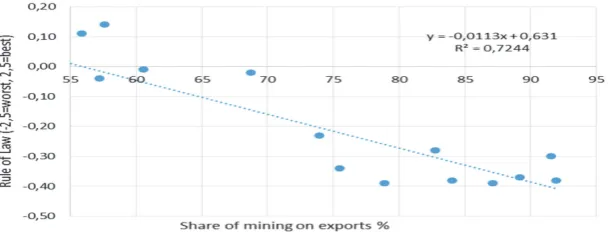
Test 5 analyses whether there is a negative link between increasing mineral exports and rule of law which captures perceptions of the extent to which subjects have confi dence in and obey the rules of society. Fig. 5 implies strong negative relation between those two (correlation coeffi cient r = −0.85). This test again supports research hypothesis.
Test 6 examines whether the rising mineral exports has an infl uence on corruption in Mongolia. Control of corruption captures perception of the extent to which public power is exercised for private gain, including both petty and grand forms of corruption. Fig. 6 shows that the control
of corruption indicator experienced a strong drop with rising mineral exports (correlation coeffi cient r = −0.79). We can thus conclude that the mineral exports correlate negatively with the control of corruption. This test supports research hypothesis.
Test 7 analyses whether there is a link between mineral exports and GDP growth rates. In some resource-rich development countries we can fi nd a clear negative link between these two. However, Fig. 7 shows that GDP growth rates experienced an averagely positive development with rising mineral exports. We can conclude that mineral exports do not have negative infl uence on GDP growth. Research hypothesis is thus not supported in this case.
Test 8 analyses whether there is a link between economic performance (measured by GDP growth) and world market prices of the main export commodities. The aim is to illustrate to what extent 3: Mineral dependence and Voice and Accountability
Source: National Statistical Offi ce, 2014; The World Bank, 2014
4: Mineral dependence and Government Effectiveness
Source: National Statistical Offi ce, 2014; The World Bank, 2014
5: Mineral dependence and Rule of Law
is Mongolia’s performance related to external volatilities. Fig. 8 clearly illustrates that GDP growth rates strongly correlate with market prices of the main export commodities. These results illustrate how vulnerable to external volatilities Mongolia is thanks to its resource abundance. We can conclude that Mongolia’s GDP growth is determined by the market prices of these commodities.
In summary, the results of the 8 tests are mixed (Tab. I), thus the tested hypothesis was not approved. Mongolia is not facing the resource curse. However, in some sub-tests, such as the ones related to institutional parameters support the tested hypothesis.
The results as presented call for a discussion. Institutional Quality/Social Capital test provided interesting results regarding current development in Mongolia. Unfortunately, most of the indicators that are important when dealing with large resource windfalls (e.g. Rule of Law, Corruption and Government Eff ectiveness) deteriorated signifi cantly. Our hypothesis implying that natural abundance has negative eff ects on Social capital and Institutional quality appears to be valid in case of Mongolia. In overall, all of the World Governance Indicators experienced a decrease and some of them quite strong one (Voice and Accountability, Government Eff ectiveness, Rule of Law, Control of Corruption), unfortunately these are the most 6: Mineral dependence and Control of Corruption
Source: National Statistical Offi ce, 2014; The World Bank, 2014
7: Mineral dependence and GDP growth
Source: National Statistical Offi ce, 2014; The World Bank, 2014
8: Mineral dependence and volatility
important for avoiding the resource curse in Mongolia. Question, however, is if the institutional quality deteriorates under the pressure of resource revenues or if it is natural development within the Mongolian society. It is a young democracy with 70 years history of socialist rule. Post-communist countries generally share bad institutional quality with corruption rooted in the society. On the other hand, Mongolia could become one of the countries so o en mentioned in the literature concerning resource curse – countries with low initial institutional quality which has further worsened under the pressure of resource windfalls.
There are certain limitations to accuracy of this research. First one is the horizon of time. Mining boom in Mongolia is still very recent and it is basically happening as this thesis is being written. Mongolia has enjoyed relatively high growth rates for almost a decade now; however, the beginning of the mining boom is attributed mainly to production from the Oyu Tolgoi mine which has shipped its fi rst shipment of copper concentrate only in 2013. Although Mongolia’s mineral exports are bringing massive windfalls into the country, the ‘best’ is yet to come when the Oyu Tolgoi will be fully operational (it is expected to account for a one third of Mongolia’s GDP). It will be interesting to carry a further research how such a massive increase in mining revenues will infl uence socio-economic development in the near future.
In terms of policy recommendations, the results presented in this thesis clearly indicate that several problems linked to the resource dependence are already showing signs in Mongolia. The central problem of Mongolia is that its economic growth is solely based on mineral revenues, moreover, strongly volatile revenues. Mongolia simply needs to diversify. Improved institutional quality is another prerequisite for successful socioeconomic development.
The fi rst and probably the most crucial recommendation is stabilizing the economy. The Volatility test has clearly illustrated the extent of cohesion between mineral prices and economic
growth. Thanks to relatively high commodity prices in the last decade, Mongolia experienced a solid economic growth; however, future price drops can have devastating eff ects on the economy. In June 2010 the Mongolian Parliament adopted the Fiscal Stability Law which creates a ceiling for public debt, structural defi cit and annual expenditure growth (Isakova, Plekhanov, Zettelmeyer, 2012). However, it has not been used eff ectively so far. For future economic development it is vital to improve utilisation of such frameworks in order to mitigate the high vulnerability to external factors.
Second recommendation has to be diversifi cation of the economy. It is another central prerequisite for achieving a long-term economic development. Government need to create business environment where new business, SME in particular, can fl ourish and thus start the economic development in the long term. The government recognises the need to bring light industry back if it is going to fi ght off the Dutch disease. Mongolian government also recognises the fact that much of the value of its resources is going overseas. To improve this condition, heavy industry related to resources is seen as the future which would enhance the position of Mongolia in the global commodity chain.
Third recommendation is to counter rising inequality and improve redistribution of the mining boom benefi ts. First step in this direction is the Human Development Fund (HDF) which has been set up in 2009 a er completion of Oyz Tolgoi negotiations (Isakova, Plekhanov, Zettelmeyer, 2012). The fund should include cash handouts, payment of tuition fees and fi nancing other social benefi ts. Utilisation of this fund is again quite controversial as it has mostly been used for populist purposes; nevertheless, it has a lot of development potential.
Last but certainly not the least important is uprooting corruption and ineffi cient government practices. This is the basis for a development of the SME sector which is fundamental for diversifi cation. Reforms of institutions and legal system are needed as well as policies increasing the engagement of I: Results of the 8 sub-tests
Sub-test
number Sub-test name
Hypothesis confi rmed
A Trade/FDI and loss of competitiveness of non-mining sectors tests (Dutch disease)
1 Trade/FDI No
2 Agricultural production Yes
B Institutional quality tests
3 Voice and accountability Yes
4 Government eff ectiveness Yes
5 Rule of law Yes
6 Corruption Yes
C 7 Economic grow test No
D 8 Volatility test Yes
REFERENCES
AREZKI, R. and SY, A. N. R. 2011. Beyond the Curse: Policies to Harness the Power of Natural Resources. Washington, D.C.: International Monetary Fund.
FRANKEL, J. A. 2010. The natural resource curse: a survey. No. 15836. National Bureau of Economic Research.
GYLFASON, T. 2004. Natural resources and economic growth: From dependence to diversifi cation. In: BROADMAN, H. G., PAAS, T. citizens in business and politics. This requires
making the management and distribution of windfalls transparent and accountable. To increase the transparency of natural resource management, in 2006 Mongolia signed up to the Extractive
Industries Transparency Initiative1 and in 2010 it
became the fourth country to reach full compliance status, together with Ghana, Azerbaijan, Liberia and Timor-Leste (EITI, 2014). However, much more progress is needed in this area.
1 EITI is Oslo-based voluntary nongovernmental organization supported by most OECD states. Its principle is that investors in mining industry publish all payments they make in any given country and host government publish all payments they receive.
CONCLUSION
The paper has aimed to determine if natural resource abundance is harmful for Mongolia; to what extent is Mongolia vulnerable to the resource curse and how the government is trying to fi ght it. The paper tested the hypothesis that natural resource abundance has negative infl uence on socioeconomic development in Mongolia. The results of the 8 tests are mixed and we conclude that the tested hypothesis was not approved. Mongolia is not facing the resource curse. However, in some sub-tests, such as the ones related to institutional parameters support the tested hypothesis. Two tests which proved the hypothesis were linked to the institutional quality and volatility of prices. GDP growth test disproved the hypothesis. The Dutch disease test consisted of one test proving the hypothesis (Agriculture sector) and one disproving it (Terms of trade/FDI).
Increasing dependence on mineral exports has been followed by a major decrease of the agricultural sector, deteriorating quality of institutions, rising infl ation, unemployment and external debt. Mongolia also shows signs of strong vulnerability to external volatilities. On the other hand, increasing dependence on mineral exports has been followed by an increase in exports, domestic and foreign investment, and service sector, public spending on social care and welfare, and GDP growth rates. Public spending on education and health care, and manufacturing sector has been increasing, however, in relative terms to Mongolia’s growing GDP, they experienced a decrease.
Policy recommendations concern the need for stabilizing the economy which should be the top priority for Mongolia. Improvement of institutional quality through legal reforms is essential for any future development as well. Diversifi cation of the economy through manufacturing sector and development of heavy industry connected to resources is also recommended in order to assume a better position in global commodity chains. Mongolian government seems fully aware of measures that it has to undertake to overcome the resource curse. However, not much of its eff orts have materialized yet. The share of mining on total exports has been growing continuously over the examined period indicating that any noteworthy diversifi cation has not taken place yet. FDI is fl owing almost solely into the extractive industry, thus increasing this dependence. Also Mongolia’s sovereign resource funds have not been utilised eff ectively so far. Only about two percent of GDP has been saved into fi scal stabilisation fund which is not enough to serve fund’s purpose – stabilising the economy in case of mineral price fl uctuations. Human Development Fund on the other hand, has so far been used mostly for populist purposes.
In overall, Mongolia is not yet facing the resource curse. Specifi cally, resource abundance has not contributed to low growth rates in Mongolia, as much of the literature would suggest. However, such argument is valid in short-term only. The resource curse phenomenon must be comprehended in broader terms than just economic growth, which is the case in great share of the literature. Economic development, in form of diversifi cation is fundamental. Becoming competitive on global scale through industries that attract FDI in various sectors is fundamental part of economic development. To avoid the resource curse, economic growth itself is not suffi cient.
Contact information Jiří Mičánek: [email protected]
and WELFENS, P. J. J. (eds.), Economic liberalization and integration policy: options for Eastern Europe and Russia. Berlin: Springer, 201–231.
HUMPHREYS, M., SACHS, J. and STIGLITZ, J. E. 2007. Escaping the resource curse. New York: Columbia University Press.
IIMI, A. 2007. Escaping from the Resource Curse: Evidence from Botswana and the Rest of the World. IMF Staff Papers, 54(4): 663–699.
ISAKOVA, A., PLEKHANOV, A. and ZETTELMEYER, J. 2012. Managing Mongolia’s resource boom. Working Paper 138. European Bank for Reconstruction and Development, Offi ce of the Chief Economist.
MIKESELL, R. F. 1997. Explaining the resource curse, with special reference to mineral-exporting countries. Resources Policy, 23(4): 191–199.
MURSHED, S. M. 2004. When does natural resource abundance lead to a resource curse? EEP Discussion Paper 04-01. London: International Institute for Environment and Development.
NATIONAL STATISTICAL OFFICE. 2014. Mongolian Statistical Information Service. [Online]. Available at: http://www.1212.mn/en/. [Accessed: 2014, December 30].
OXFORD BUSINESS GROUP. ©2014. Countering the cycle: Spending mineral revenues to build up local manufacturing capacity. In: The Report, Mongolia2014. [online]. Available at: http://www.
oxfordbusinessgroup.com/overview/countering- cycle-spending-mineral-revenues-build-local-manufacturing-capacity. [Accessed: 2014-12-20]. PHILIPPOT, L.-M. 2010. Natural resources and economic
development in transition economies. Working paper. PRES deClermont University.
ROSS, M. L. 1999 The political economy of the resource curse. World politics, 51(2): 297–322. ROSSER, A. 2006. Escaping the Resource Curse.
Review Essay. New Political Economy, 11(4): 557–570. SACHS, J. D. and WARNER, M. A. 1995. Natural
resource abundance and economic growth. Working paper 5398. Cambridge: National Bureau of Economic Research.
OXFORD BUSINNESS GROUP. 2014. Top earner: Addressing challenges to maximise long-term benefi ts. [Online]. Available at: http://www. oxfordbusinessgroup.com/overview/top-earner- addressingchallenges-maximise-long-term-benefi ts. [Accessed: 2014, December 8].
VAN DER PLOEG, F. 2011. Natural Resources: Curse or Blessing? [Online]. Journal of Economic Literature, 49(2): 366–420.
WORLD BANK GROUP. ©2014. Mongolia Overview.
In: The World Bank. [Online]. Available at: http:// www.worldbank .org/en/country/mongolia/ overview. [Accessed: 2014-11-01].