The Extended Codebook (XCB) Mode of Operation
David A. McGrew and Scott Fluhrer Cisco Systems, Inc.
170 West Tasman Drive San Jose, CA 95032 {mcgrew,sfluhrer}@cisco.com
October 25, 2004
Abstract
We describe a block cipher mode of operation that implements a ‘tweakable’ (super) pseu-dorandom permutation with an arbitrary block length. This mode can be used to provide the best possible security in systems that cannot allow data expansion, such as disk-block encryp-tion and some network protocols. The mode accepts an addiencryp-tional input, which can be used to protect against attacks that manipulate the ciphertext by rearranging the ciphertext blocks.
Our mode is similar to a five-round Luby-Rackoff cipher in which the first and last rounds do not use the conventional Feistel structure, but instead use a single block cipher invocation. The third round is a Feistel structure using counter mode as a PRF. The second and fourth rounds are Feistel structures using a universal hash function; we re-use the polynomial hash over a binary field defined in the Galois/Counter Mode (GCM) of operation for block ciphers. This choice provides efficiency in both hardware and software and allows for re-use of imple-mentation effort. XCB also has several useful properties: it accepts arbitrarily-sized plaintexts and associated data, including any plaintexts with lengths that are no smaller than the width of the block cipher.
Contents
1 Introduction 1
2 Specification 2
2.1 Notation . . . 2
2.2 Definition . . . 3
2.3 Multiplication inGF(2128) . . . 5
3 Security 6
1
Introduction
There are several scenarios in whichlength-preserving, deterministic encryption is useful. An en-cryption method is length-preserving if the ciphertext has exactly the same number of bits as does the plaintext. Such a method must be deterministic, since it is impossible to accommodate ran-dom data (such as an initialization vector) within the ciphertext. In some cases, deterministic length-preserving encryption exactly matches the requirements. For example, in some encrypted database applications, determinism is essential in order to ensure a direct correspondence between plaintext values being looked up and previously stored ciphertext values.
In some other cases, there is a length-preservation requirement that makes it impossible to pro-vide all of the security services that are desired. Length-preserving algorithms cannot propro-vide message authentication, since there is no room for a message authentication code, and they cannot meet strong definitions of confidentiality [2]. Essentially, these algorithms implement a codebook; repeated encryptions of the same plaintext value with the same key result it identical ciphertext values. An adversary gains knowledge about the plaintext by seeing which ciphertext values match, and which do not match. Despite these limitations, in many scenarios it may be desirable to use length-preserving encryption because other methods are unworkable. Length-preservation may allow encryption to be introduced into data processing systems that have already been im-plemented and deployed. Many network protocols have fixed-width fields, and many network systems have hard limits on the amount of data expansion that is possible. One important exam-ple is that of disk-block encryption, which is currently being addressed in the IEEE Security in Storage Working Group [5].
Given the limitation of length-preservation, the best security that we can provide isnon-malleable encryption. Informally, a cipher is non-malleable if changing a single bit of a ciphertext value affects all of the bits of the corresponding plaintext. More formally, we require our cipher to be apseudorandom permutation; it is indistinguishable from a permutation on the set of messages to a computationally bounded adversary. Because we want our cipher to handle plaintexts whose size may vary, we require the cipher to be a pseudorandomarbitrary lengthpermutation: for each of the possible plaintext lengths, the cipher acts as a pseudorandom permutation. To provide as much flexibility as possible, we allow the plaintext lengths to vary even for a single fixed key.
In some cases, some additional data can be associated with the plaintext. By using this data as an input, we can provide better security, by letting each distinct associated data value ‘index’ a pseudorandom permutation. That is, we require the cipher to be apseudorandom arbitrary-length permutation with associated data: for each plaintext length and each value of the associated data, the cipher acts as a pseudorandom permutation. For maximum flexibility, we allow the length of the associated data field to vary even for a single fixed key. In the disk block example, we can use the block number as the associated data value. This will prevent some attacks which rely on the codebook property, since identical plaintext values encrypted with distinct associated data values give unrelated ciphertext values.
security goal follows that of the latter work, with the distinction that we allow the associated data to have an arbitrary length.
The extended codebook (XCB) mode of operation for block ciphers implements a pseudorandom arbitrary-length permutation with associated data. XCB is defined so that it can use any block cipher, but we provide test data only for AES-128. This mode is amenable to implementation in both hardware and software, and it has a computational cost that is relatively low (compared to similar modes): it only requiresn+ 1block cipher invocations and2nmultiplications inGF(2w), where wis the number of bits in the block cipher inputs and outputs. The mode also has sev-eral useful properties: it accepts arbitrarily-sized plaintexts and associated data, including any plaintexts with lengths of at leastwbits. This property allows XCB to protect short data, like the common 20-byte G.729 voice codec in Secure RTP [1].
There are several other block cipher modes of operation that also implement psedurandom arbitrary-length permutations. Most notable is the EME mode of Halevi and Rogaway [4], which is also efficient and accepts associated data.
In the following, we define XCB (Section 2) and analyze its security (Section 3). Test data for XCB mode for the Advanced Encryption Standard with 128 bit keys (AES-128) [9] is provided in AppendixA.
2
Specification
This section contains the complete normative specification for XCB for use with 128-bit block ciphers. In order to use XCB with other block cipher widths, it is necessary to define a finite field of the appropriate size.
2.1 Notation
The two main functions used in XCB are block cipher encryption and multiplication over the field
GF(2128). The block cipher encryption of the valueXwith the keyK is denoted ase(K, X), and the block cipher decryption is denoted asd(K, X). (Note that we reserve the symbolsEandDto denote XCB encryption and decryption, respectively.) The number of bits in the inputs and outs of the block cipher is denoted asw. For the Advanced Encryption Standard (AES),w = 128. The multiplication of two elementsX, Y ∈GF(2128)is denoted asX·Y, and the addition ofXandY
is denoted asX⊕Y. Addition in this field is equivalent to the bitwise exclusive-or operation, and the multiplication operation is defined in Section2.3.
athroughbofS. The symbol{}denotes the bit string with zero length.
2.2 Definition
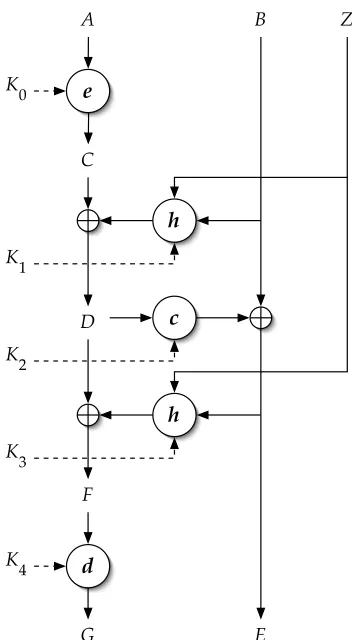
The XCB encryption and decryption operations are defined in Algorithms 1and2, respectively, and he encryption operation is illustrated in Figure 1. These algorithms use the block cipher encryption functionseandd, as well as the hash function hand the pseudorandom function c. The round keysK0, K1, K2, K3, K4could be stored between evaluations of these algorithms1.
Algorithm 1The XCB encryption operation. Given a keyK ∈ {0,1}k, a plaintextP ∈ {0,1}m
wherem ∈ [w,239], and associated dataZ ∈ {0,1}nwhere n ∈ [0,239], returns a ciphertextC ∈
{0,1}m.
K0 ←e(K,0w),K1←e(K,0w−1k1),K2 ←e(K,0w−2k1k0),
K3←e(K,0w−2k12),K4 ←e(K,0w−3k1k02)
A←P[0;w−1]
B ←P[w;len(P)−1]
C←e(K0, A)
D←C⊕h(K1, B,Z)
E ←B⊕c(K2, D)
F ←D⊕h(K3, E, Z)
G←d(K4, F) returnGkE
Algorithm 2 The XCB decryption operation. Given a keyK ∈ {0,1}k, a ciphertext C ∈ {0,1}m
wherem ∈ [w,239], and associated data Z ∈ {0,1}n wheren ∈ [0,239], returns a plaintextP ∈
{0,1}m.
K0 ←e(K,0w),K1←e(K,0w−1k1),K2 ←e(K,0w−2k1k0),
K3←e(K,0w−2k12),K4 ←e(K,0w−3k1k02)
G←C[0;w−1]
E ←C[w;len(P)−1]
F ←e(K4, G)
D←F ⊕h(K3, E,Z)
B ←E⊕c(K2, D)
C←D⊕h(K1, B, Z)
A←d(K0, C) returnAkB
The functionc : {0,1}k× {0,1}w → {0,1}0:239
generates an arbitrary-length output by running
A B
C
G E
Z
e
d
h
c
D
h
F K0
K4 K2 K1
K3
Figure 1: The XCB encryption operation.
the block cipherein counter mode, using its input as the initial counter value. Its definition is
c(K, W) =E(K, W)kE(K,incr(W)k. . .kMSBt(E(K,incrn−1(W)), (1)
wheren =dl/weis the number of blocks in the output andt = lmodwis number of bits in the trailing block. Here incr:{0,1}w→ {0,1}w is the increment function that is used to generate
suc-cessive counter values. This function treats the rightmost 32 bits of its argument as a nonnegative integer with the least significant bit on the right, increments this value modulo232. More formally,
incr(X) =X[0;w−33]k(X[w−32;w−1] + 1 mod 232), (2)
where we rely on the implicit conversion of bit strings to integers.
h(H, A, C) =Xm+n+1, where the variablesXi ∈ {0,1}w fori= 0, . . . , m+n+ 1are defined as
Xi =
0 fori= 0
(Xi−1⊕Ai)·H fori= 1, . . . , m−1
(Xm−1⊕(A∗mk0w−v))·H fori=m
(Xi−1⊕Ci−m)·H fori=m+ 1, . . . , m+n−1
(Xm+n−1⊕(Cn∗k0w−u))·H fori=m+n
(Xm+n⊕(len(A)klen(C)))·H fori=m+n+ 1.
(3)
Here we letAidenote thew-bit substringA[(i−1)w;iw−1], and letCi denoteC[(i−1)w;iw−
i]. In other words, Ai andCi are the ith blocks ofA andC, respectively, if those bit strings are
decomposed into w-bit blocks. This function is identical to GHASH, the universal hash that is used as a component of the Galois/Counter Mode (GCM) of Operation [8], except that GHASH requiresw= 128, as is the case for AES [9].
2.3 Multiplication inGF(2128)
The multiplication operation is defined as an operation on bit vectors in order to simplify the specification; it allows us to keep finite field mathematics out of the normative definition of the algorithm. Background information on this field and its representation, and strategies for efficient implementation, is provided in the GCM specification [8, Sections 3 and 4]. This definition of multiplication corresponds to the polynomial basis with the field polynomial off = 1 +α+α2+
α7+α128.
Each field element is a vector of 128 bits. Theithbit of an elementXis denoted asXi. The leftmost
bit is X0, and the rightmost bit isX127. The multiplication operation uses the special element
R = 11100001k0120 , and is defined in Algorithm3. The function rightshift()moves the bits of its
Algorithm 3Multiplication inGF(2128). ReturnsZ =X·Y, whereX, Y, Z ∈GF(2128).
Z ←0,V ←X
fori= 0to 127do ifYi = 1then
Z ←Z⊕V
end if
ifV127 = 0then
V ←rightshift(V) else
V ←rightshift(V)⊕R
end if end for returnZ
3
Security
We provide a proof sketch for the security of XCB in the concrete security model introduced by Bellare et. al. [3]. We can show that XCB is a secure pseudorandom arbitrary-length permutation with associated data (ALPA), using only the assumption that eis a securew-bit pseudorandom permutation, as follows. We start by showing that a pseudorandom arbitrary-length function with associated data (ALFA) is nearly indistinguishable from an arbitrary-length PRP with associated data, as long as the number of invocations of the function is bounded. We then show that XCB is nearly indistinguishable from a pseudorandom ALFA, as long as the number of queries to the oracle representing e is bounded. Tying these two facts together shows that XCB is a pseudo-random ALPA when these bounds are respected. The number of invocations of the XCB encrypt and decrypt functions is less than the number of block cipher encryptions and decryptions used during those invocations. This fact ensures that the security degradation due to our viewing XCB as a PRF is small.
We next sketch how to show that XCB is a secure pseudorandom ALFA against either adaptive chosen plaintext attacks or adaptive chosen ciphertext attacks. (We defer consideration of attacks in which an adversary is allowed to adaptively choosebothplaintexts and ciphertexts until later.) The basic idea behind this proof is that the ciphertext value d(K4, F)k(B ⊕c(K2, D))returned from an encryption query is indistinguishable from random as long as the values of the variables
DandF do not repeat across different invocations of that function, and the functionscandeare indistinguishable from random. Similarly, the plaintext valuese(K0, C)k(E⊕c(K2, D))returned from a decryption query are indistinguishable from random as long as the values ofDandCdo not repeat. The proof that counter mode is secure is standard [2], as is the effectiveness of a block cipher as a pseudorandom function. The probable uniqueness of the variablesC,DandF across all invocations follows from the properties of the functionh, which is-almost xor universal [6]. A detailed treatment requires consideration of the probability that no collision on those variables occurs on theithquery, given that no collision occurred on any of the previousi−1queries.
Security against attacks in which the adversary can adaptively choose both ciphertexts and plain-texts can be proven using a method similar to that outlined above. We give the adversary access to ALFA encryption and decryption oracles, and allow herq queries in total. We assume without loss of generality that the adversary never repeats a query, and never asks for the decryption of a ciphertext value returned by a previous encryption query, and never asks for the encryption of a plaintext value returned by a previous decryption query.
As above, we rely on the absence of collisions for the variablesC,D, andF, but in this case we need to more carefully define what a collision means. More precisely, we can show that, if an eventΓoccurs, then XCB cannot be effectively distinguished from a random ALFA. This event is defined as the conjunctionΓ = Γ0∩Γ1∩Γ2∩Γ3of the events defined as follows:
Γ0 is the event that bothDi 6=Dj andFi 6=Fjfor each pair of distinct encryption queries(i, j).
Γ1 is the event that bothDi 6=Dj andCi 6=Cifor each pair of distinct decryption queries(i, j).
Γ2 is the event that both Di 6= Dj and Fi 6= Fj for each pair(i, j) of queries consisting of an
Γ3 is the event that bothDi 6= Dj and Ci 6= Cj for each pair (i, j) of queries consisting of an
encryption queryiand a decryption queryj, wherej > i.
EventsΓ1 andΓ2 correspond to security against chosen plaintext and chosen ciphertext attacks, respectively. Event Γ3 takes into account that an adversary can attempt to force an encryption query to cause a collision onDorFwith a previous decryption query. EventΓ4takes into account that an adversary can attempt to force a decryption query to cause a collision onC orDwith a previous encryption query. Of course, an adversary can easily cause a collision on theC-values with two encryption queries that use the sameA-values, but this fact is irrelevant because it does not lead to a method of distinguishing XCB from a random ALFA. Similarly, collisions onF-values from two decryption queries are possible but irrelevant.
References
[1] M. Baugher , D. McGrew, M. Naslund, E. Carrara, K. Norrman. “The Secure Real-time Transport Protocol,”IETF RFC 3711, March 2004.
[2] M. Bellare, A. Desai, E. Jokipii, and P. Rogaway. “A concrete security treatment of sym-metric encryption,” InProceedings of the 38th FOCS, IEEE Computer Society Press, 1997.
[3] M. Bellare, J. Kilian, P. Rogaway, “The Security of the Cipher Block Chaining Message Authentication Code,”J. Comput. Syst. Sci.61(3). pg. 362-399 (2000).
[4] S. Halevi and P. Rogaway, A Parallelizable Enciphering Mode,2004 RSA Conference Cryp-tography Track, LNCS, Springer-Verlag, 2004.
[5] IEEE Security in Storage Working Group, Web page.http://siswg.org.
[6] H. Krawczyk, “LFSR-based hashing and authentication,” In Y. Desmedt, editor,CRYPTO ’94, LNCS, Springer-Verlag, Aug. 1994.
[7] M. Liskov, R. Rivest and D. Wagner. Tweakable Block Ciphers. CRYPTO ’02, LNCS, Springer-Verlag, 2002.
[8] D. McGrew and J. Viega, “The Galois/Counter Mode of Operation (GCM),” Sub-mission to NIST Modes of Operation Process, January, 2004. Available online at http://csrc.nist.gov/CryptoToolkit/modes/proposedmodes.
[9] U.S. National Institute of Standards and Technology. The Advanced Encryption Standard. Federal Information Processing Standard(FIPS) 197, 2002.
A
Test Data
In this section we provide detailed test data for AES-128 XCB. The variables are as defined above. The variableXi corresponds to the invocation ofhthat uses the keyK1, whileXi0 corresponds to
the invocation with the keyK3. The variableYi denotes the ith counter block, that is, the value
incri−1(W) from Equation1. The variable Ci denotese(K2, Wi). All values are in hexadecimal,
and values that are larger than 128 bits in length are continued on the following lines.
All data correspond to a single test case in which the plaintextPis 512 bytes long and the associ-ated dataZis 16 bytes long.
Input Value
K 000102030405060708090a0b0c0d0e0f
P 00000000000000000000000000000000
Input Value
C 55d00a317ddff00d731e03cdadaa6d81
Variable Value
K0 c6a13b37878f5b826f4f8162a1c8d879
K1 c6bbf34fdff071c1631dadcbfcebdcfc
K2 5329a0a02908652c64781aee28f06a9e
K3 10b1898d04e239bfa49e17ebe95a9197
K4 5c91f36ade782c2690fab5e6f321eb51
A 00000000000000000000000000000000
B 00000000000000000000000000000000
00000000000000000000000000000000 00000000000000000000000000000000 00000000000000000000000000000000 00000000000000000000000000000000 00000000000000000000000000000000 00000000000000000000000000000000 00000000000000000000000000000000 00000000000000000000000000000000 00000000000000000000000000000000 00000000000000000000000000000000 00000000000000000000000000000000 00000000000000000000000000000000 00000000000000000000000000000000 00000000000000000000000000000000 00000000000000000000000000000000 00000000000000000000000000000000 00000000000000000000000000000000 00000000000000000000000000000000 00000000000000000000000000000000 00000000000000000000000000000000 00000000000000000000000000000000 00000000000000000000000000000000 00000000000000000000000000000000 00000000000000000000000000000000 00000000000000000000000000000000 00000000000000000000000000000000 00000000000000000000000000000000 00000000000000000000000000000000 00000000000000000000000000000000 00000000000000000000000000000000
Variable Value
X1 5c6b03bab0976b641124560ed4ba2408
X2 55867ce090a7597c4d3044ec6fbebac7
X3 f991a437ce4192088d4b57d32ce81c46
X4 10baacdf9eac69a95653ffd45fd9d878
X5 6cc344dfbbe84e3489dbc61896bed197
X6 49083f5790ba45227a6b6772ea9216a8
X7 2077f91d78c8530c27ade9df22003d6b
X8 38a02d2382aad97a0d05d652129e5854
X9 c5682e43025bcf8d92a3351c08c3ee1f
X10 6ba34cd6156cec249192e4e01c095d2e
X11 406788525af56f7a0ef2b2951287529d
X12 826dd62ed7d6bd6e4864460ad0564446
X13 a4975e7da5e0d7496b33bbe0681f5733
X14 bcc4009a8cda15f5755c81d95c15c3ba
X15 e15a3b86f0e989bb45a2c05e1301d521
X16 9b597090e3e4966607d3a35466c8161e
X17 c6c383271c7d3a8dfa35f2bbf2364659
X18 ab4e4468163fbd1a1dd2a0eee6a23cdb
X19 fe44881cd2b9f743335c8537e780734b
X20 94ff616e3fa2a49c2093af246f6cfbb0
X21 2763b47eaebb44cc3b16075e9963f9d6
X22 11112b53a1d3d249ec7a7a93ddb9a434
X23 8503d52c54254fc5f1485309b614d29d
X24 c35357d50432baa88721bfaee63705eb
X25 c80b2f88d2f04a6eb8ddefca35efb09f
X26 ed9afb52d66bef5fed7427e92b951e2c
X27 47fdc11c4e6bd38eae07bc47bcd2c2c6
X28 7117b6431e2781c6193d631151ab9363
X29 0cefcbff686d397807f0c77bb6848ca6
X30 5c915e9ea63ae07c06607e26347305df
X31 758c0f79743a569ed49521dc3e50e490
X32 dcdee25acacf602586f93555e2d61a0c
X33 4889f1e2ab1c9c9586e45dbfcb799ffb
Variable Value
Y1 64de7e9b8cb5d54633f5f3307de8da3d
C1 0d683b183a3e178ced28c7340175c7b6
Y2 64de7e9b8cb5d54633f5f3307de8da3e
C2 7611cf25eb0e9a2318b798c643d9815c
Y3 64de7e9b8cb5d54633f5f3307de8da3f
C3 723422504806dcf4d7892ca280d9c63b
Y4 64de7e9b8cb5d54633f5f3307de8da40
C4 b4230e84ff29ef575b525b82fabe023e
Y5 64de7e9b8cb5d54633f5f3307de8da41
C5 59cb9441d39a146aeee0c41bee6f51ea
Y6 64de7e9b8cb5d54633f5f3307de8da42
C6 dceba56600a6c503a611a201543758f1
Y7 64de7e9b8cb5d54633f5f3307de8da43
C7 2553571570f61b93a5e88f6044e8b49d
Y8 64de7e9b8cb5d54633f5f3307de8da44
C8 854aca2c455cf37a26bb56a81b736998
Y9 64de7e9b8cb5d54633f5f3307de8da45
C9 fca69195940476076bc4fdbedfa55cb8
Y10 64de7e9b8cb5d54633f5f3307de8da46
C10 46632a0fd4ab01b29a8e40519ffc476b
Y11 64de7e9b8cb5d54633f5f3307de8da47
C11 e992de544e435b33c8664e5e05281a0c
Y12 64de7e9b8cb5d54633f5f3307de8da48
C12 8ce8ffeb1f54d9cd13a4523caace820d
Y13 64de7e9b8cb5d54633f5f3307de8da49
C13 c07cc362b234989295f1384dedad9a37
Y14 64de7e9b8cb5d54633f5f3307de8da4a
C14 4ebe9cb3b9bb68f6bca463b13d2f128b
Y15 64de7e9b8cb5d54633f5f3307de8da4b
C15 3548cd1b1683e2aba097cc288dfe3bd1
Y16 64de7e9b8cb5d54633f5f3307de8da4c
Variable Value
Y17 64de7e9b8cb5d54633f5f3307de8da4d
C17 d5e7683acee2bf39818d6a774935ae0e
Y18 64de7e9b8cb5d54633f5f3307de8da4e
C18 609cc97a21174b9f8543d2836b813ba6
Y19 64de7e9b8cb5d54633f5f3307de8da4f
C19 3d6c9778a076c71613a2da9cf857f73a
Y20 64de7e9b8cb5d54633f5f3307de8da50
C20 b02558a3f064861e7872c2889167cc78
Y21 64de7e9b8cb5d54633f5f3307de8da51
C21 d219f41fae7b511ea2b00aa219101678
Y22 64de7e9b8cb5d54633f5f3307de8da52
C22 6573424b1aa608e4188e053d708e5fc9
Y23 64de7e9b8cb5d54633f5f3307de8da53
C23 22462845bf932ef4995f25905fbfbace
Y24 64de7e9b8cb5d54633f5f3307de8da54
C24 79ff8398153e287f991946786ec33d38
Y25 64de7e9b8cb5d54633f5f3307de8da55
C25 bd5535a3f9be795ec9536907b76c0885
Y26 64de7e9b8cb5d54633f5f3307de8da56
C26 2554a62b304dcbc83ea60ac13d7571fd
Y27 64de7e9b8cb5d54633f5f3307de8da57
C27 15414a7d2bb6770b86434bc779f08285
Y28 64de7e9b8cb5d54633f5f3307de8da58
C28 f2a16a17d43a844b2e607ec26eb4e4e2
Y29 64de7e9b8cb5d54633f5f3307de8da59
C29 3b6547782ea97975315a0c835f2f8b99
Y30 64de7e9b8cb5d54633f5f3307de8da5a
C30 49ffa58d04d8c7e218609e817f737a8d
Y31 64de7e9b8cb5d54633f5f3307de8da5b
Variable Value
E 0d683b183a3e178ced28c7340175c7b6
Variable Value
X10 bd709877bb44def9c17f4b9660e79034
X20 66c14200e418c1936df177c74423493c
X30 bd26575d4893af055501b42350f2b0f5
X40 8274c32c7a049c5f70155debd2b2ed7e
X50 a0c41b5a0a67e85b2392866ff644fbc3
X60 f866e6420f413c04bd45e2dd46c83773
X70 5f62d84a09dc7b03cfdf8c2960ae0414
X80 1ea481d9622affe26557e9ca47471a69
X90 d82dd0c6b5e34a3226bae62d3e6801b5
X100 5533a34ab8ab1af066f0e437fa276a45
X110 cfb7c995d32bfba53870bb803a3ff65a
X120 6c4531e73ae2ff2cc940c200651bd3a4
X130 f90a7a6e97ffe3d53568f27bb62ec8e4
X140 a2bb4aa5cf51c1e7f5feb183ecd0bd93
X150 d75694eac2af04fae8a18b4d45b982f7
X160 df8e6ac581e260667bc484882550c648
X170 a80c69989248e3d6e854753f0b3cb1e2
X180 c02911dfd11caed7a7e9bb80a87b0cbb
X190 6823ad9ff0dab54bbac6e8df27c09ea5
X200 c11f218b8a65e7a9c88485ea15b9b9dd
X210 bd5af3c996f5b885d10703475f0c11b8
X220 f2384e75b35b5515892b8a38ba876b49
X230 1aab27da4a9c150d3b0c170413fbfbbb
X240 439fcad79c17bf851a9383e0587f99e7
X250 8f7df83c4bee76ea74d408231f5c12d4
X260 44b577aee0f4c3297776c2f02792320a
X270 cfa2a342c1fe946bc027411f394caf57
X280 acf7cc8fe0e668e5f45bfd853ca2192e
X290 3777aa7734a8c140464d9c694455ce40
X300 d62049b32602c8dc4bb5a527b80e5d04
X310 35206767f2ba76b1fc25f177120492b9
X320 aea61a18ebc0895948da42447afbbd15
X330 46cba0b362da628d86d8ea2f16503476
F 2215de28ee6fb7cbb52d191f6bb8ee4b