COMPREHENSIVE DESIGN AND DEVELOPMENT OF TIME
EFFICIENCY SPEAKER RECOGNITION MODEL FROM
FRONT END TO BACK END
'Abdul Manan Ahmad and 2Loh Mun YeeFaculty of Computer Science and Information Systems
University Teknologi Malaysia
81300 Skudai, Johor
Email: I [email protected]. [email protected]
Abstract: The rapid development of the forensic science technologies has been evolved
speaker recognition to becoming one of the research topics. However, pattern classification
from speech signal remains as challenging problem encountered in general speaker
recognition system, including speaker verification and speaker identification. Conventional
speaker recognition researches are almost directed towards accuracy problems, not time
processing problems. Due to the needs of reduction time processing of speaker recognition
system, this research focuses on develop a comprehensive design of speaker recognition
model from front end to back end which able to process speaker data in short time limit. In
the front end process, we introduce some pre-processing techniques to enhance the speech
signal. Whereas, for the back end process, we propose a decision function by using vector
quantization techniques to decrease the training model for GMM in order to reduce the
processing time. Experimental result shows that our hybrid VQ/GMM method always
yielded better improvements in accuracy and bring almost 30% reduce in time processing. In
this paper, a new, robust and simplicity computation method of pattern classification
technique for speaker identification system is proposed. Consequently, this research is
intended to develop a fully optimize ways speaker identification approach from hybrid
modeling.
Keywords: Speaker Identification System, Gaussian Mixture Model, Vector Quantization,
Hybrid Vector Quantization/Gaussian Mixture Model
64
1. INTRODUCTION
Speaker recognition is a process where a person is recognized on the basis of his/her voice '
signals [I]. Speaker recognition can be further broken into two categories: speaker identification and speaker verification. Identification takes the speech signal from an
unknown speaker and compares this with a set of valid users. The best match is then used to .
identify the unknown speaker. Similarly, in verification the unknown speaker first claims
identity, and the claimed model is then used for identification. If the match is above a
predefined threshold, the identity is accepted. A complete speaker recognition system
consists of front end and back end process. The front end which contain preprocessing and
feature extraction while the back end which contain pattern classification techniques.
Feature extraction plays as a crucial part in speaker recognition component chain.
The goal of this stage is to extract speaker dependent information from speech signal and
represent it by a set of vectors called feature. Since this stage is the first component in the
chain, the quality of this stage will strongly affect the quality of other components (speaker
modeling and pattern matching).
The problem of speaker recognition belongs to a much broader topic in scientific and
engineering so called pattern classification. The goal of pattern classification is to classify
objects of interest into a number of categories or classes. The objects of interest are
generically called patterns and in our case are sequences of acoustic vectors that are extracted
from an input speech. The classes here refer to individual speakers [2]. Pattern classification
plays as a crucial part in speaker modeling component chain. The result of pattern
classification will strongly affect the speaker recognition engine to decide whether to accept
or reject a speaker.
Many research efforts have been done in speaker recognition pattern classification.
There are Dynamic Time Warping (DTW) [3], Vector Quantization (VQ) [4], Hidden Markov
Models (HMM) [5], Gaussian mixture model (GMM) [6] and so forth. There are some
weaknesses in these techniques. Consequently, Support Vector Machine (SVM) was
introducing as an alternative classifier for speaker verification [7]. SVM, which are based on
the principle of structural risk minimization, consist of binary classifiers that maximize the
margin between two classes. The power of SVM lies in their ability to transform data to a
higher dimensional space and to construct a linear binary classifier in this space. It sounds efficient and useful to speaker recognition application, but they cannot easily deal with the
dynamic time structure of sounds, since they are constrained to work with fixed-length
vectors [8]. When working with audio signals, each signal frame is converted into a feature
vector of a given size, the whole acoustic event is represented by a sequence of feature
vectors, which shows variable length. However, SVM which only work with fixed-length
vectors means that it only can accept text dependent for training and testing data.
Despite the extensive research has been performed in speaker recognition area over
the last few years, it still remain a great challenge in managing and process huge speaker data
sets in a short time limit. Conventional speaker recognition researches are almost directed
towards accuracy problems, not time processing problems. Due to the needs of reduction time
processing of speaker recognition system, this research focuses on develop a comprehensive
design of speaker recognition model from front end to back end which able to process speaker
data in short time limit. In the front end process, we introduce some pre-processing
techniques to enhance the speech signal. Whereas, for the back end process, we propose a
decision function by using vector quantization techniques to decrease the training model for
GMM in order to reduce the processing time.
In the work reported in this paper, we also concerns on comparison of DTW, VQ,
GMM, SVM and our hybrid pattern classifier for speaker recognition. The emphasis of the
experiments is on the performance of the models under incremental amounts of training data
in an attempt to identify the best approach for speaker recognition in order to improve the
problem as just stated as paragraph above.
This paper is organized as follows. In Section 2, reviews the propose speaker recognition
structure. In Section 3, discusses the methods which use for preprocessing signal and section
4 shows the feature extraction techniques. Section 5 discusses how we construct DTW, VQ,
GMM, SVM and our hybrid method for speaker recognition. Section 6 shows the
experimental result for these 5 techniques. Finally, section 7 concludes our work.
2. OUR SPEAKER RECOGNITION FRAMEWORK
In this section, we generally reviews our propose speaker recognition structure. Our Speaker
recognition system involves two main stages, the enrolment stage and the verification stage.
These phases involve three main parts:
• Pre-Processing.
• Feature Extraction.
• Pattern Classification.
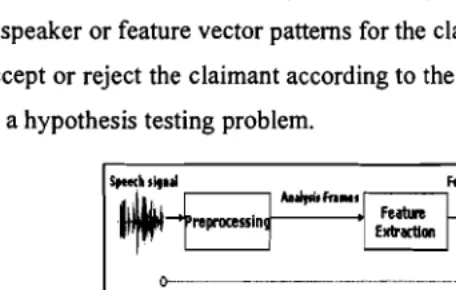
A block diagram of this procedure is shown in Figure 1. At the time of enrollment,
speech sample is acquired in a controlled and supervised manner from the user. The speaker
recognition system has to process the speech signal in order to extract speaker discriminatory
information from it. This discriminatory information will form the speaker model. At the
time of verification a speech sample is acquired from the user. The recognition system has to
extract the features from this sample and compare it against the models already stored before
hand. This is a pattern matching or classification task.
Feature extraction maps each interval of speech to a multidimensional feature space.
This sequence of feature vectors Xi is then compared to speaker models by pattern classification. This results in a match score 2, for each vector or sequence of vectors .: The
match score measures the similarity of the computed input feature vectors to models of the
claimed speaker or feature vector patterns for the claimed speaker. Last, a decision is made to
either accept or reject the claimant according to the match score or sequence of match scores,
which is a hypothesis testing problem.
, Stochastic /lode Is
>G/I/I
. Tl!lIlplall /lodels 'DlW • Diia;minnve Hodels
,5'/1 DC offset nomoval
/lFCC , 51lenDl Removal
'P~mphlSls , Windo.lng
Figure 1. Speaker Recognition Framework
3. PRE-PROCESSING
All speech data will perform in a discrete-time speech signal because of recorded by sampling
the input. Therefore, we need some pre-processing techniques to make the discrete-time
speech signal more flexible for the processes that follow. There are 4 pre-processing
techniques that we before feature extraction. These include DC offset removal, silence
removal, pre-emphasis and windowing.
3.1 DC Offset Removal
Speech data are discrete-time speech signal, it often carry some redundant constant offset
called DC offset [9]. These DC offset will effect quality of the information extracted from the
speech signal. Consequently, we calculating the average value of the speech signal and
subtracting this from itself.
3.2 Silence Removal
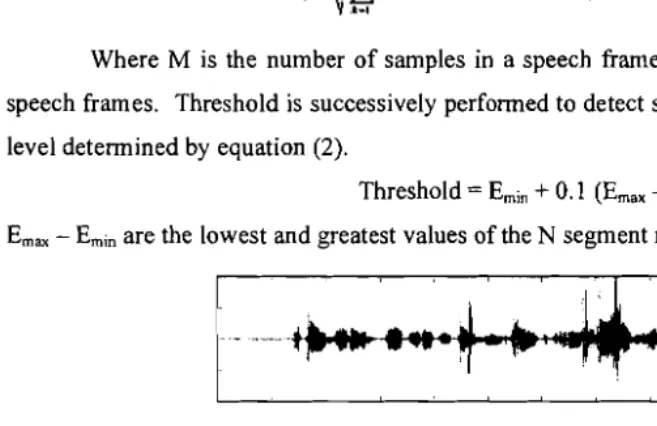
This process is performed to discard silence periods from the speech containing silence
frames. So, the signal becomes more compact as shown in the Figure 3. Silence frames are
audio frames of background noise with a low energy level with respect to voice segments.
The signal energy in each speech frame is evaluated by equation (I).
M
E, =
L>.(k)'
>.,
(1)
Where M is the number of samples in a speech frame and N is the total number of
speech frames. Threshold is successively performed to detect silence frames with a threshold
level determined by equation (2).
Threshold = E min + 0.1 (E ma• - Em;n) (2)
Em ax - E min are the lowest and greatest values of the N segment respectively.
Figure 2. Speech Signal before Silence Removal
Figure 3. Speech Signal after Silence Removal
3.3 Pre-em phasizing
Pre-emphasis is a technique used in speech processing to enhance high frequencies of the
signal. The main purpose of pre-emphasizing is to spectrally flatten the speech signal that is
to increase the relative energy of its high-frequency spectrum.
There are two important factors driving the need for pre-emphasis. Firstly, the speech
signal generally contains more speaker specific information in the higher frequencies [10].
Secondly, as the speech signal energy decreases the frequency increases. This allows the
feature extraction process to focus on all aspects of the speech signal. Pre-emphasis is
implemented as a first-order Finite Impulse Response (FIR) filter defined as:
H(Z)
=
1-0.95 Z-I (3)Figure 4 shows the speech signal before pre-emphasizing process and Figure 5 shows
the speech signal after pre-emphasizing process
Figure 4. Speech Signal before Pre-emphasizing
~I
Figure 5. Speech Signal after Pre-emphasizing
3.4 Windowing
The next step in the processing is to window each individual frame so as to minimize the
signal discontinuities at the beginning and end of each frame. A windowing function is used
on each frame to smooth the signal and make it more amendable for spectral analysis. The
concept here is to minimize the spectral distortion by using the window to taper the signal to
zero at the beginning and end of each frame. If we define the window as, where N is the
number of samples in each frame, then the result of windowing is the signal.
y/(n) = x (n)w(n), 0 ~ n ~ N-I (4)
Typically the Hamming Window is used, which is of the form
w(n) = 0.54 - 0.46 cos ( 2m ), 0
s
n~
N-I (5)N-I
4.0 FEATURE EXTRACTION
After Davis and Mermelstein reported that Mel-frequency cepstral coefficients (MFCC)
provided better performance than other features in 1980 [11], MFCC has been widely used as
the feature parameter for automatic speaker recognition. In our implementation, we will use
MFCC technique[21] to extract the speech feature in order to obtain the best result for pattern
classification. Figure 6 shows an outline of the process ofMFCC.
MFCC start with dividing the speech signal into short frame and windowing each
frame to discard the effect of discontinuities at edges of the frames. In fast fourier transform
(FFT) phase, it convert the signal to frequency domain and after that Mel scale filter bank is
applied to the resulting frames. After Mel frequency warping the frames, logarithm of the
signal is passed to the inverse DFT function converting the signal back to time domain. As a
Jumal Teknologi Maklumat
Frame blocking
!v!el.frequency FFT wrapplllg
Calculatrna ,. :·.IFCCD~,!
1(1 ~"fFCCD~iFCC FCC Iupm
speech
5.1 Four Major Speaker Recognition Pattern Classification Techniques
As the output of feature extraction phase, vectors in 12 dimensions are obtained for
each frame. These vectors are used in pattern matching/classification technique for compare
and match the feature sets against the model already stored before hand.
Jilid 20, Bil. 4 (Disember 2008)
5.0 PATTERN CLASSIFICATION
Figure 6. Outline of the process ofMFCC
The pattern classification task of speaker recognition involves computing a match score,
which is a measure of the similarity of the input feature vectors to some model. Speaker
models are constructed from the features extracted from the speech signal. To enroll users
into the system, a model of the voice, based on the extracted features, is generated and stored
(possibly on an encrypted smart card). Then, to authenticate a user, the matching algorithm
compares/scores the incoming speech signal with the model of the claimed user.
In our experiment, four major speaker recognition pattern classification techniques
has been chosen and a comparison of the performance with proposed technique has made.
These techniques are DTW, GMM, YQ and SYM.
5.1.1 Dynamic Time Warping
Dynamic time warping is an algorithm for measuring similarity between two sequences which
may vary in time or speed. In our experiment, we use the DTW techniques which propose by
Sadaoki Furui at years 1981[12]. According to Furui teory, the training data are used as a
initial template, and the testing data is time aligned by DTW. DTW is a method that allows a
computer to find an optimal match between two given sequences. The average of the two
patterns is then taken to produce a new template to which a third utterance is time aligned. result of the final step, 13 coefficients named MFCC for each frame are obtained. The Oth
coefficient is not used because it represents the average energy in the signal frame and
Test signel
5.1.2 Gaussian Mixture Models
(6)
Jurnal Teknologi Maklumat Legal search
region
Jilid 20, Bil, 4 (Disember2008)
Here mUj, I. i represent the mean an d covariance of the ith mixture. Given the
training data XI, Xz ... Xn, and the number of mixture M, the parameters Pt, I. i , at is learn using expectation maximization. During recognition, the input speech is again used extract a
sequence of features x., Xz ... XL. the distance of the given sequence from the model is
obtained by computing the log likehood of given sequence given the data. The model that
provies most highest likelihood score will verify as the identity of the speaker. A detailed
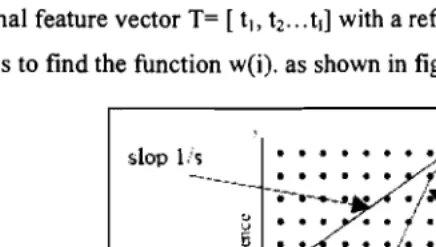
discussion on applying GMM to speaker modeling can be found in [6]. Figure 7. IdeaofDTW
Figure 8 shows a process flow for GMM approach in speaker identification training
phase and testing phase. In GMM training phase, an MFCC output will return as GMM input
after compute signal Mel-frequency cestrum coefficients. For speaker identification, each
speaker is represented by a GMM and is referred to by his/her speaker model. GMM
classification engine will calculate log likelihood score for all training speaker data and save
it into a speaker model.
The Gaussian mixture model (GMM) is a density estimator and is one of the most commonly
used types of classifier. In this method, the distribution of the feature vector x is modeled
clearly using a mixture of M Gaussians.
The idea of the DTW technique is to match a test input represented by a multi
dimensional feature vector T= [tJ, tz... td with a reference template R= [rl, rz... rJ] . While aim
of DTW is to find the function wei). as shown in figure 7.
This process is repeated until all the training utterances have been combined into a single
While in testing phase, a comparison about training speaker and testing speaker will be
done. GMM classification engine will make a decision followed by maximum posteriori
probability. The model that provides highest likelihood score will verify as the identity of the
speaker,
TRAINGPHASE. ~.Compute·MFCC.' I}--. Executed·GMlvI. ¢>-..Each-speaker-is:
repres ented:by-a-GMlvI.' ~-.. Calculate-log-likelihoad
score. '
¢>-. saving into-speaker'
TESTING PHASE.
e., Compute-MFCC.' ¢>.... Executed-GMM~
--+¢>... Comparing-test-end
train·sp eaker-mo del.' ¢>... Find-maximum-a
posteriori-probability ¢>... Decision"
Figure 8. A process flow of GMM in training and testing phase for speaker identification
system.
5.1.3 Vector Quantization
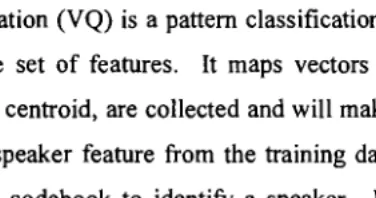
Vector Quantization (VQ) is a pattern classification technique applied to speech data to form
a representative set of features. It maps vectors to smaller regions called cluster. These cluster's center, centroid, are collected and will make up a codebook. The VQ codebook will
represents the speaker feature from the training data. The speaker identification engine are
depends on the codebook to identify a speaker. Figure 9 shows the speaker identification
process flow for VQ in training and testing phase.
lRAING PHASE·'
10-.... Compute·MFCC.'
¢>.... executedVQ<'
¢>.... compute·nearest· neighb our.'
l}.... find-centroids-and:
createc0deb aok-'
---+
TESTING- PHASE..
¢>-.. Compute·MFCC·'
¢>.... Compute·nearest·
neighbour
l}...Find·minimum· distanc eo-' ¢>...
Decision-Figure 9. A process flow of VQ in training and testing phase for speaker identification
system.
In VQ training phase, Vector Quantization is executed using MFCC as input. Later
on, the speaker identification engine will run the nearest-neighbour search to find the
codeword in the current code book that is closest and assign that vector to the corresponding
cell. Then, its find centroids and update for each speech signal and the codebooks are created.
•
•
•
•
••
•
•
••
•
•
In testing phase, a function will computes the Euclidean distance between training data and
testing data. The system will identify which calculation yields the lowest value and checks
this value against a constraint threshold. If the value is lower than the threshold, the system
outputs an answer.
5.1.4 Support Vector Machines
SVM is a binary classification method that finds the optimal linear decision surface based on,
the concept of structural risk minimization. The decision surface is a weighted combination '
of elements of a training set. These elements are called support vectors, which characterize
the boundary between the two classes. Let the two classes of the binary problem be labeled
+1 and -1.
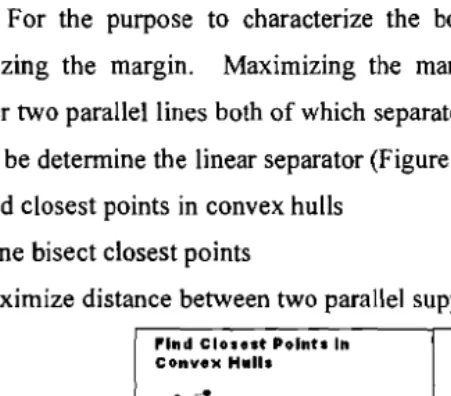
For the purpose to characterize the boundary between the two classes, we need
maximizing the margin. Maximizing the margin are the process find the "middle-line" ,
consider two parallel lines both of which separate the two classes without error.
need to be determine the linear separator (Figure lOa, lOb, 1Oc) :
• Find closest points in convex hulls
• Plane bisect closest points
• Maximize distance between two parallel supporting planes
find Clot ••t Points In
Convex Hull'
·
._..
·
•• 0
,
.•
0
0 0"0
• • d_
·
·
'.
•
•
•
•
a
a••t Lln••r Sep .rator:
Supporting Plan. Mothod
·
·.
.
..
.
o. W.mQidlslanc: 0 . _.. twopa,
·
'.
0 r. IU~D""liIplan81
·
.
..
•
••
• • Otstlirl~a"'N.ll·IIll
=
••
•
•
j ; j ,Plane . . . . ct Clos.st Points
...
.'
.
0
.
. 0o
0 • edt .
.
,.
•
.
' 0.
.•
•.
••
-'.
(b)
(e)
Figure 10. Steps for Binary Linear Decision Boundary
During speaker recognition process, classifying the feature which derived from the
transformation of feature extraction directly will not immediately works when using SVM .
[13]. It is because SVM only can process fixed-length input, whereas speech signals are non- ,
stationary. Therefore, we need to categorizes the feature and scaling them.
SVM requires that each data instance is represented as a vector of real numbers.
Hence, if there are categorical attributes, we first have to convert them into numeric data. We
recommend using m numbers to represent an m-category attribute. Only one of the m
numbers is one, and others are zero. For example, a two-category attribute such as {speaker,
imposter} can be represented as (0, I) and (1,0).
Scaling them before applying SVM is very important. The main advantage is to
avoid attributes in greater numeric ranges dominate those in smaller numeric ranges. Another
advantage is to avoid numerical difficulties during the calculation. Because kernel values
usually depend on the inner products of feature vectors, e.g. the linear kernel and the
polynomial kernel, large attribute values might cause numerical problems. We recommend
linearly scaling each attribute to the range [-I, +I] or [0, I].
5.2 Motivation of Hybrid Model
The result of pattern classification will strongly affect the speaker recognition engine to
decide whether to accept or reject a speaker. Early pattern classification is produced by
Dynamic Time Warping and Hidden Markov Models. These techniques are not really
efficient for real time application due to characteristic of text dependent recognition. As an
alternative to solve text dependent problem, Vector Quantization (VQ), Gaussian mixture
model (GMM) and Support Vector Machine was introduced for speaker recognition. GMM
was a focus of research after Douglas Reynolds proves its effective performed in text
independent speaker identification [6].
Besides, GMM are base on probabilistic framework, it provide high-accuracy
recognition. For speaker identification task using GMM approach, each speaker data is
modeled by a GMM; during testing phase, each GMM is calculated independently to estimate
the parameters and compare with other GMM to find the best match score.
Although the GMM technique of pattern classification appears to have many
advantages, however, in practice the process does not always produce satisfied result due to
the long time processing. Consequently, alternative methods must be sought in order to
reduce time processing problem. In these circumstances, pattern classification engine for
speaker recognition should capable to manage and process huge speaker data sets in a short
time limit. Meanwhile, current works for the production of speaker recognition are almost
directed towards accuracy problems, not time processing problems. Therefore, it is
encouraging if a speaker recognition task can be conducted in a "good" pattern classification
machine.
In this paper, we propose a decision function by using vector quantization techniques
to decrease the training model for GMM in order to reduce the processing time. VQ and
GMM are widely applied to the speaker verification, but both have some disadvantages. To
74
overcome those shortages, we introduce a new hybrid VQ/GMM model. Although in
baseline form, the VQ-based solution is less accurate than the GMM, but it offers simplicity
in computation. Therefore, we hope to make use of their merits via a hybrid VQ/GMM
classifier.
5.3 Review of Previous VQI GMM Hybrid Methods
Previous studies have shown that the Vector Quantization techniques is insufficient to provide
a high accuracy classification rate for speaker identification system if compare Gaussian
mixture model. Nevertheless, VQ gain a good reputation of it simplicity and fast computation
process. Consequently, most of the optimization speaker recognition systems use VQ
technique to improve their baseline system.
There are many forms of GMM and other pattern classification techniques adaptation
in the past. In hybrid VQ/GMM, most of them use VQ as optimization function to reduce the
Expectation Maximization algorithm in order to improve the training speed [14]. Besides,
some researchers use GMM as a post-processor after VQ cluster the speech signal into
regions [J5].
Gurmeet Singh et al. [16] introduced the use of two Vector Quantization algorithms,
namely Linde, Buzo, Gray (LBG) and K-means algorithm for training Gaussian mixture
speaker models as a replacement for Expectation Maximization algorithm to reduce
computational complexity. However, if the speaker data become large, it still faces the time
consuming problem.
Tomi Kinnunen et al. [17] presented another approach to optimizing vector
quantization (VQ) based speaker identification. They do the pre-quantizing process to
pruning out unlikely speakers; the best variants are then generalized to GMM based
modeling. Based on their pruning idea, we propose using VQ techniques to make a decision
rules before testing speaker data.
5.4Vector Quantization Decision Rules for Gaussian Mixture Modeling
Text independent speaker identification system requests a classifier that can classify a
numbers of different data for input text by different speaker for testing phase. But usually, a
big amount of training data and the difference of data, classified among varied classes take a Our pre
long time processing. For GMM pattern classifier, it characteristic is to represent each
speaker data into different GMM to generate a speaker model for training and testing. Even
though it gain high accuracy rates, but it request a complex computation phase and, long
processing time.
Jumal Teknologi Maklumat
ClassiliCOOOll·Plklse·2.'
\'...
_--..
y
~--)Classlflcillto/l·PlklSe·lti
MfCC·
Feaueo
Extr~.
Figure. I 1. Our propose method, speaker identification system based on vector quantization
decision rules for Gaussian mixture modeling.
!npld
-speech-Jilid 20, Bi!. 4 (Disember2008)
For VQ, the primary factor is the codebook sizes [18], an experiment done by Kin Yu
et al indicate that the optimum size is not dependent on the amount of training data. When a
codebook is generated, its only remains the centroid which can represent the whole cluster.
The amount of data is significantly less, since the number of centroids is at least ten times
smaller than the number of vectors in the original sample. This will reduce the amount of
computations needed when comparing in later stages. In fact, VQ based solution is less
accurate than the GMM. Because VQ model and GMM model each one has advantages and
disadvantages, in this paper, we make use of their merits, establishes VQ and the GMM
mixture model for pattern classifier. In our proposed hybrid modeling, we take the
superiority of VQ, which is simplicity computation to distinguish between male and female
speaker. The purpose of this process is to divide the speaker into smaller subgroup.
The overall structure of our hybrid system is depicted in figure 11. After MFCC
feature extraction process, the speech signal will transform to a feature vector form. For the
phase 1 of the classification, VQ classifier clustering the speaker model into two sub-groups by decision tree structure. It is the male subgroup and the female subgroup. In phase 2
classification, we utilize dominance of GMM model to get the accuracy rates. GMM process
will just applied in the particular subgroup to identify the speaker identity. GMM
classification engine will calculate log likelihood score for subgroup training speaker data and
save it into a speaker model. While in testing phase, a comparison about training speaker and
testing speaker will be done. GMM classification engine will make a decision followed by
maximum posteriori probability. On account of the GMM model just need to train speaker
data in the subgroup instead training all speaker data, the computation time will decrease.
6.0 EXPERIMENTAL SETUP & RESULTS
It
In this section, we describe the experiments carried out in order to test the different
recognizers as stated as above and make a comparison result with our hybrid technique.
Experiments are conducted on a clean condition. In orders to get a fair comparison between 5
types of classifier, for each of then we have properly selected the same datasets and done
some pro-processing for enhanced the feature data through a set of preliminary experiments.
6.1 Dataset Description
We performed our evaluation on the TIMIT speech database. The TIMIT corpus of read
speech has been designed to provide speech data for development and evaluation of automatic
speech recognition systems. However, the large number of distinct speakers present in the
system also makes it suitable for evaluation speaker recognition system as well. TIMIT
contains a total of 6300 sentences, 10 sentences spoken by 630 speakers from 8 major dialect
regions of United Stated. Out of this large set, we chose 5 utterances of 10 distinct users to
evaluate our system.
6.2 DTW System Evaluation
The first method evaluated uses DTW as pattern classification techniques. To evaluate the
system, each sample utterance of the user was compared with the rest of the utterances inthe
database. For each comparison, the distance measure was calculated. A lower distance
measure indicates a higher similarity. It is also of interest to see the effect increasing the number of speakers on the accuracy results besides comparison classifier performance. The
first set of experiments; we use the TIMIT corpus only for these results increasing the number
of speakers from 10 to 50. G
Figure 12 shows the effect of increasing the speakers on performance of the DTW
speaker identification system. Accuracy starts off highly 92% as would be expected, and
slowly declines to approximately 80%. These results serve to show with increasing amounts
of training data, the DTW distance measure become hard to calculated due to the
progressively information of speaker.
80
TO
60 50
10 50
Figure 12. Performance of the DTW Speaker Identification System
6.3 GMM System Evaluation
The second method evaluated uses GMM as pattern classification techniques. Given training
speech from a speaker's voice, the goal of this speaker model training is to estimate the
parameter ofGMM, which in some sense best matches the distribution of the training feature
vector. We use maximum likelihood (ML) estimation in our experiment. The aim ofML is
to find the model parameters, which maximize the likelihood of the GMM given the training
data. Therefore, the testing data which gain a maximum score will recognize as speaker.
The second set of experiments; we use the TIMIT corpus only for these results
increasing the number of speakers from 10 to 50. Figure 13 shows the effect of increasing the
speakers on performance of the GMM speaker identification system. Accuracy starts off
highly 98% as would be expected, and slowly declines to approximately 83%, which is
congruent with accuracy results found by Reynolds [6]. As can be observed, even GMM
speaker verification accuracy rate has decrease when the training data increase, but it still
obtain the better result if compare with DTW.
GMM based Speaker J:lentification Performance
i
100i
90~
GI ~80
Do. Cf
~ ... 70
g
u 60 u
4( 50
10 20 30 40 50
-+-AYG result (5 run
Number of Speaker
times)
Figure 13. Performance of the GMM Speaker Identification System
6.4 SVM System Evaluation
The third method evaluated uses SVM as pattern classification techniques. An SVM is
essentially a binary classifier trained to estimated whether an input vector x belongs to a class
1 (the desired output would be theny=+ I) or to a class 2 (y=-l) where class 1 is verify as speaker and class 2 is verify as imposter.
The third set of experiments; we use the TIMIT corpus only for these results
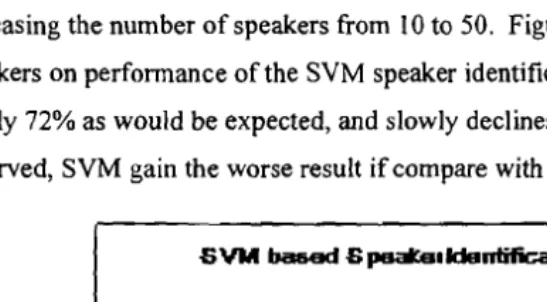
increasing the number of speakers from 10 to 50. Figure 14 shows the effect of increasing the
speakers on performance of the SVM speaker identification system. Accuracy starts off
highly 72% as would be expected, and slowly declines to approximately 60%. As can be
observed, SVM gain the worse result if compare with DTW and GMM.
-GYM based -G peakslldllntificatianPamrmance
----_.._._---."---_.. -- ~ 100
I
l
90 80;
I~
...
i10
i
•
60~
50
i
10 20 30 40 50
N ••1I8r
or
Spsal8lI--AVG
result (5 RlJEI. Times)Figure 14. Performance ofthe SVM Speaker Identification System
6.5
VQ System EvaluationH
VQ maps vectors to smaller regions called cluster. These cluster's center, centroid, are
collected and will make up a codebook. The speaker identification engine are depends on the 100
cookbook to identify a speaker. The fourth set of experiments; we use the TIMIT corpus only 90
80 for these results increasing the number of speakers from 10 to 50. Figure 15 shows the effect
70
of increasing the speakers on performance of the VQ speaker identification system. Accuracy
60
starts off highly 96% as would be expected, and slowly declines to approximately 82%. As 5C
can be observed, VQ gain the worse result if compare GMM but still better then DTW and
SVM.
VQ based Speaker :tIentification Perfonnance
8.
100 ~ 90II
I::!
II ~80
a. ~
e- '-'
70I!!
u
=
60 u50
'"
10 20 30 40 50
--+-AVG r-esu l t
Number of Speaker
times}
Figure 15. Performance of the VQ Speaker Identification System
6.6 Hybrid Vector Quantization/Gaussian Mixture Model System Evaluation
The last method evaluated uses hybrid VQ/GMM as pattern classification techniques. This is
the new hybrid pattern classification as we proposed for speaker identification system. Here,
we classified speaker by two phase of classification which the first phase we distinguish the
male and female speakers using VQ decision approach and in the second phase of
classification, GMM is applied into the subgroup of speaker. Figure 16 shows the effect of
increasing the speakers on performance of the hybrid VQ/GMM speaker identification system
for speakers from 10 to 50. Accuracy starts off highly 98.56%, and slowly declines to
approximately 92.23%.
As can be observed, even hybrid VQ/GMM speaker identification accuracy rate has
decrease when the training data increase, but it still obtain the better result if compare with
other pattern classification method. Besides, it seems more stable to handle the large data set.
Hybrid VQ I GMM Based Speaker i1entification Perfonnance
100
90 '. .
I
80 . '
70
"'.'
60
.. . ' .." I
50
10 20 30 40 50
Number of Speaker - - AV(; r ••ul t (5 run times)
Figure 16. The performance of our propose method, hybrid vector quantization/Gaussian
mixture model based speaker identification on increasing speaker data from 10-50.
6.7 Result for Processing Time
The result of time processing for 10 speakers by using GMM, VQ, DTW, SVM and hybrid
VQ/GMM shows in table 1. We report that the GMM need 62.49 seconds for the whole
. , inistry of S
training and testing process, VQ needs 38.7Isec, DTW needs 54.l2sec and SVM needs
~ps,the au
96.13sec whereas our hybrid VQ/GMM just need 41.76 seconds. Thus, our implementation
are gratefu can categorized as more simplified version for classification techniques in speaker
the facilitic identification system. Obviously, a significant improvement compared to the baseline system
is reported, a reduction in identification times up to 30% is reached.
Table I. Comparison of time processing between 5 methods
Algorithm GMM VQ DTW SVM VQ/GMM
Time 62.49sec 38.71sec 54.21sec 96.13sec 41.76sec
Number of speaker 10 10 10 10 10
6.8 Discussion
Results from experiments shows GMM likelihood function and VQ are well understood
statistical model whereas DTW suitable due with small fixed vocabulary system. As can be
observed, SVM gain the worse result among 4 types of classifier. This is due to the drawback
of SVM when dealing with audio data is their restriction to work with fixed-length vectors.
Obviously, the functions we choose for fixed-length vectors affect the performance of the
SVM directly. However, among 5 types ofpattem classification techniques, our hybrid
techniques gain the best result in term of the accuracy rates and the processing time. Thus,
our method provides an alternative way for real time identification system which time is the
important issue.
"Robust
7. CONCLUSION AND FUTURE WORK
In this paper, we have presented a model that is suitable for handle large datasets of speaker
for speaker recognition system. Overall, the experiments have shown that the combination
algorithm perform very efficiently and competitively on dataset under consideration. The
algorithm compares well with published approaches and it is relatively easy to implement.
Besides that, there is still a lot of enhancement can be make towards to this algorithm so that
it can provide better outcomes. In conclusion, we have successfully improved the
computation, approximation quality and accuracy of the speaker recognition system in this
research.
ACKNOWLEDGEMENTS
This work was jointly supported by IRPA e-Science Fund 79087. The authors would like to
thank the Ministry of Science, Technology & Innovation (MOST!) of Malaysia for without the sponsorships, the authors could not have materialized our ideas and visions. In addition,
the authors are grateful to University Technology of Malaysia (UTM Skudai, Johor) for
providing all the facilities and equipments throughout the entire course and the project.
REFERENCES
[1] Campbell, J.P., "Speaker Recognition: A Tutorial", Proc. of the IEEE, vol. 85,no. 9,
1997, pp. 1437-1462.
[2] Sadaoki Furui., "Recent advances in speaker recognition", Pattern Recognition
Letters. 1997,18 (9): 859-72.
[3] Sakoe, Rand Chiba, S., "Dynamic programming algorithm optimization for spoken
word recognition", Acoustics, Speech, and Signal Processing, IEEE Transactions on Volume
26, Issue I, Feb 1978 Page 43 - 49.
[4] Lubkin, J. and Cauwenberghs, G., "VLSI Implementation of Fuzzy Adaptive
Resonance and Learning Vector Quantization", Int. J. Analog Integrated Circuits and Signal
Processing, vol. 30 (2), 2002,pp. 149-157.
[5] Lawrence R. Rabiner., "A Tutorial on Hidden Markov Models and Selected
Applications in Speech Recognition", Proceedings of the IEEE, 77 (2), 1989, p. 257-286.
[6] Reynolds, D. A. and Rose, R. C. "Robust text-independent speaker identification
using Gaussian mixture speaker models. IEEE Trans. Speech Audio Process. 3, 1995, pp 72
83.
[7] Solera, U.R., Martin-Iglesias, D., Gallardo-Antolfn, A., Pelaez-Moreno, C. and Diaz
de-Marfa, F, "Robust ASR using Support Vector Machines", Speech Communication,
Volume 49 Issue 4, 2007.
[8] Temko, A.; Monte, E.; Nadeu, C., "Comparison of Sequence Discriminant Support
Vector Machines for Acoustic Event Classification", ICASSP 2006 Proceedings, 2006 IEEE
International Conference on Volume 5, Issue, 14-19 May 2006 Page 721-724.
[9] Shang, S.; Mirabbasi, S.; Saleh, R., "A technique for DC-offset removal and carrier
phase error compensation in integrated wireless receivers Circuits and Systems", ISCAS
apos;03. Proceedings of the 2003 International Symposium onVolume I, Issue, 25-28 May
2003 Page 1-173 - 1-176 vol. 1
"
82
[10] Vergin, R.; Oapos;Shaughnessy, D., "Pre-emphasis and speech recognition Electrical
and Computer Engineering", Canadian Conference on Volume 2, Issue , 5-8 Sep 1995 Page
1062 - 1065 vol.2
[11] Davis, S. B. and Mennelstein,P., "Comparison of parametric representations for
monosyllabic word recognition in continuously spoken sentences", IEEE Trans. on Acoustic,
Speech and Signal Processing, ASSP-28, 1980, No.4.
[12] Sadaoki Furui., "Cepstral analysis technique for automatic speaker verification",
IEEE Trans. ASSP 29, 1981,pages 254-272.
[13] W.M. Campbell, J.P. Campbell, D.A. Reynolds, and E. Singer, "Support vector
machines for speaker and language recognition," Computer Speech Lang., vo1.20, no.2-3,
April 2006, pp.21 0-229.
[14] J. Pelecanos, S. Myers, S. Sridharan and V. Chandran, Vector Quantization Based
Gaussian Modeling for Speaker Verification, 15th International Conference on Pattern
Recognition, Volume 3, 2000,p. 3298.
[15] Qiguang Lin, Ea-Ee Jan, ChiWei Che, Dong-Suk Yuk and Flanagan, J, Selective use
of the speech spectrum and a VQGMM method for speaker identification, Fourth
International Conference on Spoken Language, Vol 4, 1996, Pg:2415 - 2418.
[16] Singh, G.; Panda, A.; Bhattacharyya, S.and Srikanthan, T. , Vector quantization
techniques for GMM based speaker verification, IEEE International Conference on Acoustics,
Speech, and Signal Processing, Volume 2, Issue, 6-10 April 2003, Page(s): 11-65-8.
[17] Kinnunen, Karpov and Franti, Real-Time Speaker Identification and Verification,
IEEE Trans. On Audio, Speech and Language Processing, Vol. 14, No. 1,2006.
[18] Yu, K., Mason, J., Oglesby, J., "Speaker recognition using hidden Markov models,
dynamic time warping and vector quantization" Vision, Image and Signal Processing, lEE
Proceedings, Oct 1995.
[19] Loh Mun Vee, Abdul Manan Ahmad and Fatimah Bte Moharnad, "Speaker
Classification Optimization Design by Vector Quantization Decision Rule", ICTS 2008, 4th
International Conference on Information & Communication Technology and Systems 2008 (Technical support by IEEE Indonesia Section), August 5th, 2008 in Surabaya, Indonesia.
[20] Loh Mun Vee and Abdul Manan Ahmad, "Text-Independent Speaker Identification
Using Hybrid Vector Quantization / Gaussian Mixture Models Pattern Classifier ",ICCAS
2008; IEEE Computer Society Press in the Proceedings of the International Conference on
Control, Automation and Systems 2008, Oct. 14-17,2008 in Seoul, Korea.
[21] Loh Mun Vee, Abdul Manan Ahmad and Cheang Soo Vee, "Selecting Appropriate
Feature Extraction Techniques For Hybrid Pattern Classification Speaker Identification
Modeling",ICPE-3 2008, 3rd International Conference On Postgraduate Education, December
16-17,2008, Gurney Hotel, Penang, Malaysia, in press.
Fac
Ems