International Journal of Mathematics and Mathematical Sciences Volume 2012, Article ID 134653,11pages
doi:10.1155/2012/134653
Research Article
A Rapid Numerical Algorithm to Compute Matrix
Inversion
F. Soleymani
Department of Applied Mathematics, School of Mathematical Sciences, Ferdowsi University of Mashhad, Mashhad, Iran
Correspondence should be addressed to F. Soleymani,[email protected]
Received 22 March 2012; Revised 1 June 2012; Accepted 1 June 2012
Academic Editor: Taekyun Kim
Copyrightq2012 F. Soleymani. This is an open access article distributed under the Creative
Commons Attribution License, which permits unrestricted use, distribution, and reproduction in any medium, provided the original work is properly cited.
The aim of the present work is to suggest and establish a numerical algorithm based on matrix multiplications for computing approximate inverses. It is shown theoretically that the scheme possesses seventh-order convergence, and thus it rapidly converges. Some discussions on the choice of the initial value to preserve the convergence rate are given, and it is also shown in numerical examples that the proposed scheme can easily be taken into account to provide robust preconditioners.
1. Introduction
Let us consider the square matrixAN×Nwith real or complex elements which is nonsingular.
It is well known that its inverse is available and could be found by the direct methods such as LU or QR decompositions, see for example1. When the matrix inverse is computed, the method of choice should be probably Gaussian elimination with partial pivotingGEPP. The resulting residual bounds and possible backward errors may be much smaller in this case, see 2 subsection on the “Use and abuse of the matrix inverse”.
An effective tool to compute approximate inverses of the matrixAis to use iteration-type methods for this purpose which are based on matrix multiplications and are of great interest and accuracy when implementing on parallel machines. In fact, one way is to construct iterative methods of high order of convergence to find matrix inversion numerically for all types of matricesespecially for ill-conditioned ones.
A clear use of such schemes is that one may apply them to findA−1 and then, by an
easy matrix-vector multiplication, compute the solution of the linear system of the equations
a very robust approximate preconditioner can easily be constructed using one, two, or three steps of such iterative methods, and the resulting left preconditioned systems would be
Axb, 1.1
whereinAP−1A,bP−1b, andP−1 ≈A−1.
Such obtained approximate inverse preconditioners could be robust competitors to the classical or modern methods such as AINV or FAPINV; see for example 3, 4. The approximate inverseAINVand the factored approximate inverseFAPINVare two known algorithms in the field of preconditioning of linear systems of equations. Both of these algorithms compute a sparse approximate inverse of matrixAin the factored form and are based on computing two sets of vectors which areAbiconjugate.
In this paper, in order to challenge with very ill-conditioned matrices or to find the preconditionerP−1 in less number of iterations and having high accuracy, we will propose
an efficient iterative method for findingA−1numerically. Theoretical analysis and numerical
experiments show that the new method is more effective than the existing ones in the case of constructing approximate inverse preconditioners.
The rest of the paper is organized as follows. Section2is devoted to a brief review of the available literature. The main contribution of this paper is given in Section 3. Subsequently, the method is examined in Section4. Finally, concluding remarks are presented in Section5.
2. Background
Several methods of various orders were proposed for approximatingrectangular or square matrix inverses, such as those according to the minimum residual iterations 5 and Hotelling-Bodewig algorithm6.
The Hotelling-Bodewig algorithm6is defined as
Vn 1 Vn2I−AVn, n0,1,2, . . . , 2.1
whereIis the identity matrix. Note that throughout this paper we consider matrices of the same dimension unless it is stated obviously.
In 2011, Li et al. in7presented the following third-order method:
Vn 1Vn3I−AVn3I−AVn, n0,1,2, . . . , 2.2
and also proposed another third-order iterative method for approximatingA−1as comes next
Vn 1
I 1
4I−VnA3I−VnA
2
Vn, n0,1,2, . . . . 2.3
As an another method from the existing literature, Krishnamurthy and Sen suggested the following sixth-order iteration method8for the above purpose:
Vn 1Vn2I−AVn3I−AVn3I−AVnI−AVnI−AVn
VnI I−AVnI I−AVnI I−AVnI I−AVnI I−AVnI I−AVn,
2.4
wheren0,1,2, . . . .
For further reading refer to9,10.
3. An Accurate Seventh-Order Method
This section contains a new high-order algorithm for findingA−1numerically. In order to deal with very ill-conditioned linear systems, to find efficient preconditioners rapidly, or to find robust approximate inverses, we suggest the following matrix multiplication-based iterative method:
Vn 1
1
16Vn120I AVn−393I AVn735I AVn−861I
AVn 651I AVn−315I AVn93I AVn−15I AVn,
3.1
for anyn 0,1,2, . . ., whereinIis the identity matrix, and the sequence of iterates{Vn}nn∞0
converges toA−1for a good initial guess.
Theorem 3.1. Assume thatA ai,jN×N be an invertible matrix with real or complex elements. If
the initial guessV0satisfies
I−AV0<1, 3.2
then the iteration3.1converges toA−1with at least seventh convergence order.
Proof. In order to prove the convergence behavior of3.1, we assume thatI −AV0 < 1,
E0I−AV0, andEnI−AVn. We then have
En 1I−AVn 1
I−A
1
16Vn120I AVn−393I AVn735I AVn−861I AVn651I AVn−315I
AVn93I AVn−15I AVn
I−A
1 16Vn
93AVn6−15AVn7 AVn8
− 1
16−4I AVn
2−I AVn7
1
163I I−AVn
2I−AV n7
1
163I En
2En7
1
16
9I 6En E2n
En7
1
16
E9
n 6E8n 9E7n
.
3.3
Hence, it is now and according to the above simplifications easily to have
En 1 ≤
1 16
E9
n 6En8 9En7
≤ 1 16
En9 6En8 9En7. 3.4
Furthermore, sinceE0<1, andE1 ≤ E07 <1, we get that
En 1 ≤ En7≤ En−17
2
≤ · · · ≤ E07n 1<1, 3.5
where3.5tends to zero whenn → ∞. That is to say
I−AVn−→0, 3.6
whenn → ∞, and thus for3.6, we obtain
Vn−→A−1, as n−→ ∞. 3.7
We must now illustrate the seventh order of convergence for3.1due to the obtained theoretical discussions that 3.1converges under the assumption made in Theorem 3.1to
A−1. To do this aim, we denoteεn Vn−A−1, as the error matrix in the iterative procedure
3.1. We have
I−AVn 1 1
16
I−AVn9 6I−AVn8 9I−AVn7. 3.8
AA−1−V n 1
1
16
A9A−1−V n
9
6A8A−1−Vn 8
9A7A−1−Vn
7
, 3.9
A−1−V n 1
1 16
A8A−1−V n
9
6A7A−1−Vn8 9A6A−1−Vn7
. 3.10
Using3.10, we attain
εn 1
1 16
A8ε
n9−6A7εn8 9A6εn7
, 3.11
which simplifies by taking norm from both sides
εn 1 ≤
1
16 A
8ε9
n 6A7ε8n 9A6ε7n
, 3.12
and consequently
εn 1 ≤
1 16 9A
6 6A7εn A8εn2εn7. 3.13
This shows that the method3.1converges toA−1with at least seventh order of convergence.
This concludes the proof.
Remark 3.2. For the above Theorem3.1, we can conclude some points as follows.
1From3.4, one knows that the condition3.2may be weakened. In fact, we only need that the spectral radius of AV0 be less than one for the convergence of the above new method3.1. In this case, the choice ofV0may be obtained according to the estimate formulas for the spectral radiusρAV0 see, e.g.,11
2In some experiments and to reduce the computational cost, we may solve the matrix multiplications, based on the vector and parallel processors.
3Finally, for the choice ofV0, there exist many of different forms. We will describe this problem after Theorem3.3based on some literatures.
We now give a property about the scheme3.1. This property shows that{Vn}nn∞0 of 3.1may be applied to not only the left preconditioned linear systemVnAxVnbbut also to the right preconditioned linear systemAVnyb, whereyVnx.
Theorem 3.3. Let againA ai,jN×Nbe a nonsingular real or complex matrix. If
AV0V0A, 3.14
is valid, then, for the sequence of{Vn}nn∞0 of 3.1, one has that
AVnVnA, 3.15
Proof. The mathematical induction is taken into account herein. First, sinceAV0 V0A, we have
AV1A
1
16V0120I AV0−393I AV0735I AV0−861I AV0651I
AV0−315I AV093I AV0−15I AV0
1
16V0A120I V0A−393I V0A735I V0A−861I V0A651I
V0A−315I V0A93I V0A−15I V0A
1
16V0120I V0A−393I V0A735I V0A−861I V0A651I
V0A−315I V0A93I V0A−15I V0AA
V1A.
3.16
Equation3.16shows that whenn 1,3.15is true. At the moment, suppose thatAVn VnAis true, and then a straightforward calculation using3.16shows that, for alln≥1,
AVn 1A
1
16Vn120I AVn−393I AVn735I AVn−861I AVn651I
AVn−315I AVn93I AVn−15I AVn
1
16VnA120I VnA−393I VnA735I VnA−861I VnA651I
VnA−315I VnA93I VnA−15I VnA
Vn 1A.
3.17
This concludes the proof.
Note that according to the literatures 7, 9, 12, 13 and to find an initial value V0 to preserve the convergence order of such iterative methods, we need to fulfill at least the condition given in Remark3.2. or Theorem3.1. We list some ways for this purpose in what follows.
WAY 1 If a matrix is strictly diagonally dominant, then choose V0 as V0 diag1/a11,1/a22, . . . ,1/ann, whereaiiare the diagonal elements ofA.
WAY 2 For the matrix A, choose V0 as V0 AT/A1 A∞, wherein T stands for transpose,A1maxj{Σni1|aij|}andA∞maxi{Σnj1|aij|}.
4. Numerical Testing
In this section, experiments are presented to demonstrate the capability of the suggested method. For solving a square linear system of equations of the general formAxb, wherein
A ∈ CN×N, we can now propose the following efficient algorithm:xn 1 Vn 1bwhilen
0,1,2, . . . .
The programming package MATHEMATICA 8,14,15, has been used in this section. For numerical comparisons, we have used the methods2.1,2.2, the sixth-order method of Krishnamurthy and Sen2.4, and the new algorithm3.1.
As noted in Section1, such high order schemes are so much fruitful in providing robust preconditioners to the linear systems. In fact, we believe that only one full iteration of the scheme3.1for even large sparse systems and by defining SparseArraymatto reduce the computational load of matrix multiplications is enough to find acceptable preconditioners to the linear systems. Anyhow, using parallel computations with simple commands for this purpose in MATHEMATICA 8 may reduce the computational burden much more.
Test Problem 1
Consider the linear systemAxb, whereinAis the large sparse complex matrix defined by
n = 1000;
A = SparseArray[{Band[{1, 120}] -> -2., Band[{950, 1}] -> 2. - I,
Band[{-700, 18}] -> 1., Band[{1, 1}] -> 23.,
Band[{1, 100}] -> 0.2, Band[{214, -124}] -> 1.,
Band[{6, 800}] -> 1.1},{n, n}, 0.].
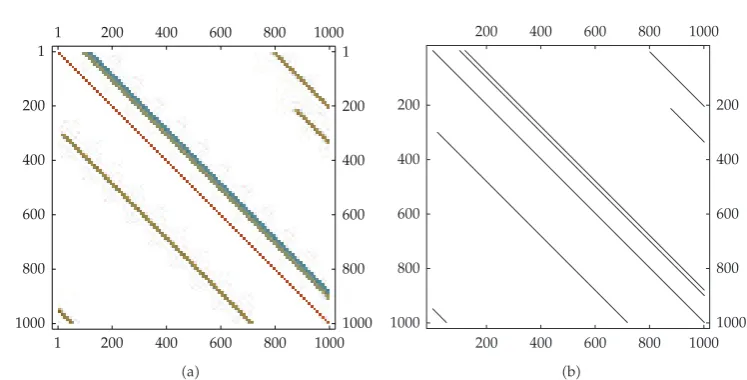
The dimension of this matrix is 1000 with complex elements in its structure. The right hand side vector is considered to beb 1,1, . . . ,1T. Although page limitations do not allow us to provide the full form of such matrices, the structure of such matrices can easily be drawn. Figure1illustrates the plot and also the array plot of this matrix.
Now, we expect to find robust approximate inverses for Ain less iterations by the high-order iterative methods. Furthermore, as we described in the previous sections, the approximate inverses could be considered for left or right preconditioned systems.
Table1clearly shows the efficiency of the proposed iterative method3.1in finding approximate inverses by manifesting the number of iterations and the obtained residual norm. When working with sparse matrices, an important factor which affects clearly on the computational cost of the iterative method is the number of nonzeros elements. The considered sparse complex matrix A, in test problem 1, has 3858 nonzero elements at the beginning. We list the number of nonzero elements for different iteration matrix multiplication-based schemes in Table 1. It is obvious that the new scheme is much better than2.1and2.2, but when comparing to2.4its number of nonzero elements are higher; however, this is completely satisfactory due to the better numerical results we have obtained for the residual norm. In fact, if one let the2.4to cycle more in order to reach the residual norm which is correct up to seven decimal places, then the obtained nonzero elements will be more than the corresponding one of3.1.
1 200 400 600 800 10001000 1
200
400
600
800
1000
1 200 400 600 800 1000
1
200
400
600
800
a
200 400 600 800 1000
1000 200
400
600
800
1000
200 400 600 800 1000
200
400
600
800
[image:8.600.106.480.87.277.2]b
Figure 1: The matrix plotaand the array plotbof the coefficient complex matrix in test problem 1.
Table 1: Results of comparisons for the test problem 1.
Iterative methods 2.1 2.2 2.4 3.1
Number of iterations 3 2 1 1
Number of nonzero elements 126035 137616 65818 119792
Residual norm 3.006×10⁻⁷ 2.628×10⁻⁷ 1.428×10⁻⁵ 9.077×10⁻⁷
low condition number using the LinearSolve command. Note that the written code in order to implement the test problem 1 for the method3.1is given as follows:
b = SparseArray[Table[1,{k, n}]];DA = Diagonal[A];
B = SparseArray[Table[(1/DA[[i]]),{i, 1, n}]];
Id = SparseArray[{{i , i } -> 1},{n, n}];
X = SparseArray[DiagonalMatrix[B]];
Do[X1 = SparseArray[X];AV = Chop[SparseArray[A.X1]];
X = Chop[(1/16) X1.SparseArray[(120 Id +AV.(-393 Id
+AV.(735 Id +AV.(-861 Id +AV.(651 Id +AV.(-315 Id
AV.(93 Id + AV.(-15 Id + AV))))))))]];
Print[X];L[i] = Norm[b - SparseArray[A.(X.b)]];
Print["The residual norm of the linear system solution is:"
Column[{i}, Frame -> All, FrameStyle -> Directive[Blue]]
Column[{L[i]}, Frame -> All, FrameStyle -> Directive[Blue]]];
, {i, 1}].
[image:8.600.96.505.333.384.2]1
10
20
30
40
1 10 20 30 40
1
10
20
30
40
1 10 20 30 40
a
10 20 30 40
10
20
30
40
10
20
30
40
10 20 30 40
[image:9.600.125.475.95.277.2]b
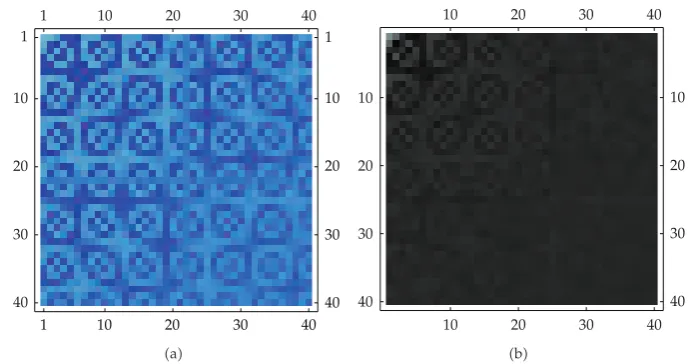
[image:9.600.97.506.331.383.2]Figure 2: The matrix plotaand the array plotbof the coefficient complex matrix in test problem 2.
Table 2: Results of comparisons for the test problem 2 with condition number 18137.2.
Iterative methods 2.1 2.2 2.4 3.1
Number of iterations 29 18 11 10
The condition number ofVnA 1.00135 1.01234 1.01780 1.00114
Residual norm 6.477×10⁻⁷ 5.916×10⁻⁶ 8.517×10⁻⁶ 5.482×10⁻⁷
Test Problem 2
Consider the linear systemAxb, whereinAis the dense matrix defined by
n = 40;
A = Table[Sin[(x∗y)]/(x + y) - 1.,{x, n},{y, n}].
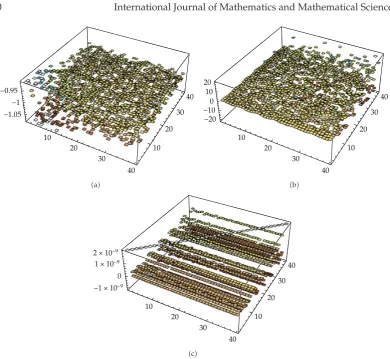
The right hand side vector is again considered to beb 1,1, . . . ,1T. Figure2illustrates the plot and array plot of this matrix. Due to the fact that, for dense matrices, such plots will not be illustrative, we have drawn the 3-D plots of the coefficient dense matrix using the zero-order interpolation in test problem 2, alongside its approximate inverse obtained from the method3.1after 11 iterations in Figure3. We further expect to have a similar identity-like behavior for the multiplication of A to its approximate inverse, and this is clear in partcof Figure3.
Table2shows the number of iterations and the obtained residual norm for different methods in order to reveal the efficiency of the proposed iteration. There is a clear reduction in computational steps for the proposed method3.1in contrast to the other existing well-known methods of various orders in the literature. Table2further confirms the use of such iterative inverse finders in order to find robust approximate inverse preconditioners again. Since, the condition number of the coefficient matrix in Test Problem 2 is 18137.2, which is quite high for a 40×40 matrix. But as can be furnished in Table2, the obtained condition number of the preconditioned matrix after the specified number of iterations is very small.
−1 40 30
20
10
−0.95
−1.05
40 30 20 10
30
20
10 20
10
a
40 30
20
10
40 30 20 10 20
10 0
−10
−20
b
40 30
20
10
40 30 20 10 0 2×10⁻⁹
1×10⁻⁹
−1×10⁻⁹
[image:10.600.105.496.72.431.2]c
Figure 3: The 3D plot of the structure of the coefficient matrixain the Test Problem 2, its approximate
inversebby the method3.1and their multiplication to obtain a similar output to the identity matrix
c.
to this we have not listed them herein. For the second test proplem, we have used V0
AT/A 1A∞
5. Concluding Remarks
Acknowledgments
The author would like to take this opportunity to sincerely acknowledge many valuable suggestions made by the two anonymous reviewers and especially the third suggestion of reviewer 1, which have been made to substantially improve the quality of this paper.
References
1 T. Sauer, Numerical Analysis, Pearson, 2nd edition, 2011.
2 N. J. Higham, Accuracy and Stability of Numerical Algorithms, Society for Industrial and Applied
Mathematics, 2nd edition, 2002.
3 D. K. Salkuyeh and H. Roohani, “On the relation between the AINV and the FAPINV algorithms,”
International Journal of Mathematics and Mathematical Sciences, vol. 2009, Article ID 179481, 6 pages,
2009.
4 M. Benzi and M. Tuma, “Numerical experiments with two approximate inverse preconditioners,”
BIT, vol. 38, no. 2, pp. 234–241, 1998.
5 E. Chow and Y. Saad, “Approximate inverse preconditioners via sparse-sparse iterations,” SIAM
Journal on Scientific Computing, vol. 19, no. 3, pp. 995–1023, 1998.
6 G. Schulz, “Iterative berechnung der reziproken matrix,” Zeitschrift f ¨ur Angewandte Mathematik und
Mechanik, vol. 13, pp. 57–59, 1933.
7 H.-B. Li, T.-Z. Huang, Y. Zhang, V.-P. Liu, and T.-V. Gu, “Chebyshev-type methods and
precondition-ing techniques,” Applied Mathematics and Computation, vol. 218, no. 2, pp. 260–270, 2011.
8 E. V. Krishnamurthy and S. K. Sen, Numerical Algorithms—Computations in Science and Engineering,
Affiliated East-West Press, New Delhi, India, 1986.
9 G. Codevico, V. Y. Pan, and M. V. Barel, “Newton-like iteration based on a cubic polynomial for
structured matrices,” Numerical Algorithms, vol. 36, no. 4, pp. 365–380, 2004.
10 W. Li and Z. Li, “A family of iterative methods for computing the approximate inverse of a square
matrix and inner inverse of a non-square matrix,” Applied Mathematics and Computation, vol. 215, no. 9, pp. 3433–3442, 2010.
11 H. B. Li, T. Z. Huang, S. Shen, and H. Li, “A new upper bound for spectral radius of block iterative
matrices,” Journal of Computational Information Systems, vol. 1, no. 3, pp. 595–599, 2005.
12 V. Y. Pan and R. Schreiber, “An improved Newton iteration for the generalized inverse of a matrix,
with applications,” SIAM Journal on Scientific and Statistical Computing, vol. 12, no. 5, pp. 1109–1130, 1991.
13 K. Moriya and T. Nodera, “A new scheme of computing the approximate inverse preconditioner for
the reduced linear systems,” Journal of Computational and Applied Mathematics, vol. 199, no. 2, pp. 345– 352, 2007.
14 S. Wagon, Mathematica in Action, Springer, 3rd edition, 2010.
Submit your manuscripts at
http://www.hindawi.com
Hindawi Publishing Corporation
http://www.hindawi.com Volume 2014
Mathematics
Journal ofHindawi Publishing Corporation
http://www.hindawi.com Volume 2014
Hindawi Publishing Corporation http://www.hindawi.com
Differential Equations
International Journal of
Volume 2014
Applied MathematicsJournal of
Hindawi Publishing Corporation
http://www.hindawi.com Volume 2014
Hindawi Publishing Corporation
http://www.hindawi.com Volume 2014
Hindawi Publishing Corporation
http://www.hindawi.com Volume 2014
Mathematical PhysicsAdvances in
Complex Analysis
Journal ofHindawi Publishing Corporation
http://www.hindawi.com Volume 2014
Optimization
Journal ofHindawi Publishing Corporation
http://www.hindawi.com Volume 2014
Combinatorics
Hindawi Publishing Corporation
http://www.hindawi.com Volume 2014
International Journal of
Hindawi Publishing Corporation
http://www.hindawi.com Volume 2014
Journal of
Hindawi Publishing Corporation
http://www.hindawi.com Volume 2014
Function Spaces
Abstract and Applied Analysis Hindawi Publishing Corporation
http://www.hindawi.com Volume 2014
International Journal of Mathematics and Mathematical Sciences
Hindawi Publishing Corporation http://www.hindawi.com Volume 2014
The Scientific
World Journal
Hindawi Publishing Corporation
http://www.hindawi.com Volume 2014
Hindawi Publishing Corporation
http://www.hindawi.com Volume 2014
Discrete Dynamics in Nature and Society
Hindawi Publishing Corporation
http://www.hindawi.com Volume 2014
Hindawi Publishing Corporation
http://www.hindawi.com Volume 2014
Discrete Mathematics
Journal ofHindawi Publishing Corporation
http://www.hindawi.com Volume 2014
Hindawi Publishing Corporation
http://www.hindawi.com Volume 2014