International Journal of Emerging Technology and Advanced Engineering
Website: www.ijetae.com (ISSN 2250-2459,ISO 9001:2008 Certified Journal, Volume 4, Issue 7, July 2014)
949
Securing Smartphone Data by Offloading Computation on
Cloud.
Bhavya Sareen
1, Sugandha Sharma
2, Mayank Arora
31,2
CSE Department, CGC, Gharuan, Mohali, Punjab (India).
3CSE Department, CCET, Punjab University, Chandigarh (India).
Abstract—Smartphone is a phone that is smart enough to
provide all the facilities to consumer which laptop and personal computer provides. Despite of that it lacks resources and battery backup as the usage of Smartphone’s is getting prioritize coz of their portability and easy to access features all the applications can be installed and then accessed it also provide storage which is somehow limited but for all that resources should be abundant and enough battery backup is needed to perform all the tasks. Cloud Computing is the model that offers the scalable and reliable storage and resources by combining it with Smartphone’s their efficiency increases. That is Mobile Cloud computing which offloads the heavy tasks from mobile to cloud to decrease its CPU utilization and battery consumption. With this approach being advantage for Smartphone’s is also making Smartphone’s vulnerable in terms of security as mobile device contain private data which cannot be disclosed to unauthorized third party so as to the Cloud service provider.
Keywords— Mobile Cloud Computing, Security, Cloud
Computing, Computation Offloading.
I. INTRODUCTION
Cloud Computing is the model that provides IT services on the pay per use basis consumer can rent services on lease by the help of this model which gives three types of services which are Software as a service (SaaS) service which provides software to consumer, Platform as a service (PaaS) development and compilation is done by taking this service, Infrastructure as a service (IaaS) [16] need of resources like CPU and storage can be held by this service. Cloud Service Provider is the one by whom these services can be taken. These are the three service models of Cloud Computing which are further deployed by the help of three deployment models of Cloud Technology which is In Private Cloud, the services can be used by a single organization by limited number of users. In Public Cloud services are there for public use hosted by Service Provider. In Community Cloud Community of similar organizations shares the services. In Hybrid Cloud it links the services of Public and Private Cloud together.
IDC Cloud research shows that spending on IT Cloud services will expected to be near about $107 billion by 2017 and IT cloud service will have the annual compound growth rate (CAGR)of 23.5% [1].
Smartphone’s are different Nowdays than the traditional mobile devices which provides the facility of browsing menu and already installed applications in it which are typically calculator, alarm clock ,calendar and so on .And web browsing is very difficult on these phones as the screen was not large enough to handle internet and touch technology was also missing . In contrary to which Smartphone’s in present provides all the lacking facilities they are large in size have touch technology and web browsing is easy and fast and increased storage and they have applications which can be downloaded from internet and then installed on Smartphone’s. All the Smartphone’s companies have their own market place from which application can be tracked out easily and installed on the phones like Android Phones have Google Play store, Nokia Ovi Store is market place for Nokia Symbian Phones,
Apple iPhones Have App Store. With all these facilities
Smartphone’s are now considered as equal to the laptops and personal computers being portable and store data but with these benefits Smartphone’s also have risks of security for data and financial transaction done thorough internet can disclose your credit or debit card details. And with the increased usage of Smartphone’s the battery consumption is also increased due to presence of less resources.
International Journal of Emerging Technology and Advanced Engineering
Website: www.ijetae.com (ISSN 2250-2459,ISO 9001:2008 Certified Journal, Volume 4, Issue 7, July 2014)
950
II. GENERAL BACKGROUND
Mobile Cloud Computing is an emerging area according to the recent research done by ABI Research the 240 million businesses will take advantage of Cloud services
through mobile devices by 2015. ABI Research also
predicts that cloud platforms will obtain $3.6 billion in mobile enterprise application revenue by 2019 and cloud deployment will grow faster with the compound growth
rate (CAGR) of 42.5% in between 2014 and 2019 [4] what
it does is storing the data outside the device and data processing is also done on an infrastructure which is on the Cloud. Mobile applications are designed which by installing in the mobile device helps transferring the computing task and storage on to the Cloud which are accessed by the help of internet. Hence making mobile device to do all another computation work which can only be done on mobile devices which increases CPU speed and memory capacity.
The Mobile Cloud Computation done by offloading the computation task to the cloud to perform the resource intensive computation task CloneCloud and MAUI are the two major projects which do the offloading task automatically [3].
CloneCloud [17] allows applications to offload the execution parts to the Cloud server from the mobile device. By optimizing the execution time and battery usage of mobile devices the offloading decision is made. On the other hand MAUI modifies the applications on the coding level to increase the energy saving of the mobile devices. For the Mobile Cloud Storage the data of mobile devices is stored on Cloud Servers this can also not be done manually so to store the data on the cloud synchronization between the mobile devices and cloud is done and operating system of Smartphone’s have to implant synchronization feature with the cloud like Google Drive stores the multimedia data of the android phones, ICloud do storage for iPhones, Skydrive for windows phone .Moreover , efforts are being made for secure storage of the individuals data on the centralized Cloud server [18] optimal intrusion system is designed which on detecting any misbehavior take necessary actions to prevent that attack.
Cloud Security and Mobile Security are the two different aspects and in Mobile Cloud Computing both are considered Mobile Security is to secure the data present in the mobile device and no malware attack can be done through any infectious channel where on the other side Cloud security is to protect the data present on Cloud server.
Risks Associated with Smartphone’s are Data Leakage, Phishing Attack, Unintensional Disclosure of Data, Withdrawal Smartphone Attack.
Cloud security threats are violation of security which can harm the privacy of user’s data present on cloud. The threats related to cloud security are Traffic Eavesdropping, malicious agent, virtualization attack, denial of service attack, inadequate authorization and overlapping trust boundaries resources aiming to compromise the data and resources having same trust boundaries outcome of which will be the resources can be used against other clients using the service of cloud by an malicious Client sharing trust boundaries with those clients.
III. RELATED WORK
A. Security Risks
In [5] Gartner defined seven security risks which should be paid attention by an organization before opting Cloud services
1. Client should spend some time to know about the
Cloud service providers from whom services can be taken and emphasis on their regulations before taking any trivial service from them.
2. Client should be accountable for the security of their
data so they can choose between Cloud service providers allow audits from the third party organization to check the security level and the cloud service providers which do not provide it.
3. Cloud service providers made some contracts
according to which client will not get any idea about where their data is been located or stored under which country and jurisdiction.
4. Data of different organisations is stored in same hard
disk in an encrypted form to segregate these data some mechanism is to be used.
5. Cloud service providers should have the provision to
recover client’s data from disaster and store it in safe place.
6. If Client sense any fraud activity from the Cloud
service provider side investigation process should be started immediately taking no longer time.
7. Cloud service provider should give long term viability
International Journal of Emerging Technology and Advanced Engineering
Website: www.ijetae.com (ISSN 2250-2459,ISO 9001:2008 Certified Journal, Volume 4, Issue 7, July 2014)
951 B. Offloading techniques
To reduce power consumption and enhance performance of Smartphone offloading is used to transfer the processing
power on the Cloud Eric Y. Chen and Mistutaka Itoh [6]
defined a framework which will create virtual image of Smartphone over Cloud and Smartphone can only be used as a thin Client which will only install the application and send the request to create virtual image and all processing will be done on that virtual image created on Cloud this framework is called virtual Smartphone over IP its design contains
I. Front End which will receive the entire service request to create, configure and destroy virtual image
II. Network File System (NFS) is there which will store the file for virtual images,
III. Virtual Smartphone Farm hosts the virtual image present in the farm each of which belongs to the Smartphone user
IV. The last component on the design is Management Server which manages the virtual Smartphone Farm and creates the virtual images in bulk and then performs troubleshooting for the individual images.
In 2009 Byung-Gon Chun and Petros Maniatis gives the proposal of Augmented Smartphone Applications Through Clone Cloud execution [7] through this augmented applications are being executed on the cloud which is accomplished by using a clone Smartphone which is a virtual system running on the Cloud it only executes the compute intensive applications of the Smartphones and while the execution is being going on the Cloud Smartphone by then do all other executions which does not consumes more power and resources and when the execution on the Clone Cloud completed it gives the result back to the Smartphone and then Smartphone by receiving those results present it to the user as output.
C. Security Measures
In 2013 Piotr K. Tysowski and M. Anwarul Hasan [8] proposed a protocol for securing data on the cloud this protocol authorize the user on the basis of certain attributes and then access is granted Cloud provider will also not get able to read that data without permission of the authorised user this protocol is efficient for user needed resources for mobile devices and this can be done through transferring that computation over Cloud in secure way without losing data.
In 2011 Lakshmi Subramanian et.al [9] proposed an architecture which is used to secure the data of mobile phone on Cloud and processing also in this architecture a replica of Smartphone is created on the cloud by the help of virtualization which is then synchronized with physically present Smartphone.
Then that replica will provide security services to Smartphone by controlling the traffic coming and going out from the Smartphone and security provided to the Smartphone by the Cloud server where the virtual system resides.
In 2011 Zhibin Zhou et.al [10] defined a mobile cloud data processing framework is described which contains three components : Trust management gives control to the user to access data by authenticating the identity of the individual ,Multi-tenant secure data management manages the data in two form one is normal data which is secured by the cloud data encrypting key generated by the cloud storage service provider and another is critical data secured by the key generated by user only and ESSI data Processing model show the data flow and then the normal data is sent to the public cloud storage directly but critical data is kept in the secure storage .
Piotr K. Tysowski and M. Anwarul Hasan [11] described a model for key encryption based on the dynamic re-encryption on the Cloud which is secure, efficient and scalable and these keys are managed by the client only and re-encryption is done by the Cloud service provider and it minimize the key redistribution which reduce the communication cost on the mobile device
IV. PROPOSED ARCHITECTURE
International Journal of Emerging Technology and Advanced Engineering
Website: www.ijetae.com (ISSN 2250-2459,ISO 9001:2008 Certified Journal, Volume 4, Issue 7, July 2014)
952
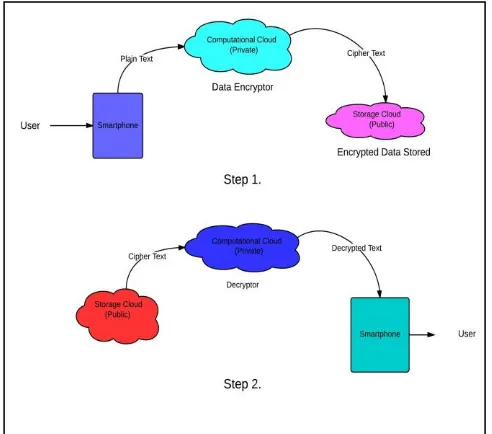
[image:4.612.50.296.253.470.2]Basic idea of this architecture is to take data from the Smartphone offload it to computational Cloud [12] show how the computational offloading can help saving energy for mobile devices where the text and image is being encrypted and after encryption the cipher text is generated that offloaded to the public cloud where it is stored and in an encrypting format it is of no use for Cloud Provider and third party using services of the Public Cloud decryption of that cipher text can only be done by the one who have the key for decryption.
Figure 1. Security Architecture for Smartphones
A. Components in the architecture are
1.) Smartphone – From which the data in plain text or image is being offloaded to Cloud for encryption and then further for storage. Offloading will save energy of mobile devices as compute intensive applications need many resources fulfilling which consumes all the battery of mobile device. Thus, Mobile Cloud Computing [13] is used so that the applications needs plenty of resources to complete its task can be processed on the Mobile Cloud and the results are displayed back to the mobile device.
2.) Computational Cloud – Computational Cloud which is a private Cloud will receive the data and apply encryption scheme on the data which convert the plain text into cipher text which can only be decrypted by the decryption key. An application is made with the help of which encryption is done AES is the encryption scheme used to secure the data. Services from the Computational cloud are only used for encrypting the text or image.
It will then send the cipher text to the Public Cloud where it is stored no storage is done on the Computational Cloud.
3) Storage Cloud – Cipher text is stored in this Cloud which is a public Cloud provides storage services only. The data is then in non readable form cannot be accessed by the unauthorized party or Cloud service provider. When the client wants to access data the cipher text is taken from the Public Cloud and then decrypted on the computational cloud and the text is then displayed on the Smartphone as plain text readable to the Client.
B. Block Diagram
The block diagram explained here is divided into chunks so as to explain the working of architecture in detail it will show how these chunks will work on the Smartphone and on the Computational Cloud.
Smartphone Computational Cloud
Figure 2. Block Diagram of Proposed Architecture
1.) Working Units on Smartphone side: -
User Interaction – it will interact with user by taking the data which user wants to store on the mobile device. After which encryption is done on the device by the help of application which will calculate the time taken by the application for encryption. By utilizing all the resources present in the Smartphone which will take battery consumption. To execute the operation.
Offload Unit – This unit will help to transfer the data from the mobile device to the Computation Cloud. It manages communication between them so as to synchronize their tasks of transferring data from the mobile unit. By getting it from the user and sending it on the other end which is Cloud. After receiving data from user, Cloud will then process that data out from the user’s premises by taking resources from its pool where several resources resides. These resources perform the task of encryption and decryption. After successful execution results will be again offloaded back to the Smartphone. Results are received through offload unit present in the device.
User Interaction
Offload Unit
Encryption or Decryption
Security Administrator
Offloading Administrator
[image:4.612.340.541.326.455.2]International Journal of Emerging Technology and Advanced Engineering
Website: www.ijetae.com (ISSN 2250-2459,ISO 9001:2008 Certified Journal, Volume 4, Issue 7, July 2014)
953 Encryption or Decryption – This unit is present to decide whether to perform encryption on the data entered or to perform decryption. The time taken will depend on the size of data entered to encrypt or decrypt. As the file is of large size the process will slow down. Then decryption of data (text, images) is done so as to analyze the application again the same amount of time will be consumed which Results in exhausted resources. The scheme used for performing encryption and decryption is AES. AES takes not much time to encrypt or decrypt. But for Smartphone to execute more than one application simultaneously will make a pressure on device and battery efficiency.
2.) Working units On Computational Cloud:-
Security Administrator- the work of security administrator is to maintain the integrity of data sent from the Smartphone towards Computational Cloud and then accept the data.
Offloading Administrator - it will communicate with the Smartphone on receiving request for providing services to it. By making mobile device more powerful to execute as many operations it wants. It maintains the co-ordination between the Smartphone and the Cloud. Provide services to the user when needed and make all the resources ready to serve the user’s request. So as to retain the speed and obtain rapidly increasing results.
Encryption or Decryption- This unit here is assigned with the task of securing data when to send over on the storage Cloud .User requests for encryption to convert the plain text or image into cipher text or encrypted image. Thorough which data will not get visible to unauthorized party when the user belongs to that data wants to access it. Then decrypted text is delivered to him through Computation Cloud. By receiving which it is then displayed on the Smartphone so that user can access it.
V. IMPLEMENTATION AND EVALUATION
To implement the proposed architecture an application is developed in Eclipse IDE using Java and it is designed for Android OS version 2.3. The test application is executed on the mobile device Samsung Galaxy Y duos having 800MHz processor with 1300Mah battery and 384MB RAM. The work of this Application is to encrypt the data (text, image) on the mobile device where the time consumed and resource consumed are calculated using certain inbuilt features as well as external application. PowerTutor is used as external Application which shows the power consumed by the resources like CPU, display, Wifi, GPS.
PowerTutor gives the idea about the power consumption done by these resources while executing application. By the help of this tool the power consumption can be calculated on the basis of results it evaluates. By measuring the power exhausted by each resource individually. When an application is running or any data is being processed. It gives a fair idea to developers about the software designed that how much power efficient is the designed software. The data supplied by the PowerTutor have a ratio if time, in seconds of the Power being dissipated in milliwatts. Analyzing the power consumed by the Smartphone it is encountered that encryption will take a lot of CPU utilization and LCD Display and memory present in the device is also absorbed. These are the major contributors here which consume energy. However, the Control over the LCD display cannot be maintained it will take energy needed to show the display the brightness can be reduced. But still does not make a considerable difference when only display is concerned. On the other hand CPU utilization will always be done as it does all the work to execute the application and also to measure the power consumption. So , CPU should be alive [14]. But to reduce the load some of its work can be offloaded to Cloud. As memory management is considered it also have a limitation assigned to it.
Now, to solve the problem faced by application on Smartphone the Application will offload the data (image, text) on Computational Cloud[19] . This Cloud will perform Encryption after receiving the data and then the encrypted data is being transferred to the Public Cloud. By using Cloud the problem of CPU utilization and memory is solved because as all the processing is done on the Cloud. Energy Consumed by the CPU on the Smartphone is reduced. It will now have to inspect the other components. Like, Observing power consumption and process the results received from Cloud. As all the major computation is done by the Cloud, RAM of the Smartphone is also not used. Processing of Cloud is fast so the power consumption of mobile device turns down. LCD running time is also reduced as the running time of application reduces. Results
in the reduction of total power consumption.
International Journal of Emerging Technology and Advanced Engineering
Website: www.ijetae.com (ISSN 2250-2459,ISO 9001:2008 Certified Journal, Volume 4, Issue 7, July 2014)
954
In Mobile Computing environment there are limitations over resources and work assigned to the mobile devices have fixed amount of memory assigned to it. CPU has limited processing power. So to store data and perform operation on it will consume additional time as well as battery which results in battery dissipation. While executing one or two application meant to perform heavy operations to enhance the efficiency of mobile device Mobile Cloud Computing is used. This model by the help of virtualization creates Virtual device on which the data is processed and stored.
By the help of virtualization the Computational Cloud is created on which compute intensive application will run. Virtualization refers to abstraction of the computer resources. It provides integrated operating platform for users and applications. Hypervisor [20] is the main part of virtualized system which maintains isolation between the virtual machine and resources management of hardware. It allow to create more than one operating system (virtual machine) acting as a guest on the single host hardware. It manages the resource allocation to these operating systems to make sure that they do not interrupt each other. Hypervisors are of two types TYPE I and TYPE II.
1.) TYPE I
[image:6.612.333.538.131.307.2]
Figure 3.Type I Hypervisor
Hypervisor run on the host hardware and manage the guest operating system. Guest operating system run above the hypervisor which maintains the co-ordination between guest operating system and host hardware
2.) TYPE II
[image:6.612.52.274.406.571.2]Type II hypervisor run on the above the host operating system installed on the host hardware which made the guest operating system on the third level above the host hardware. Host operating system helps hypervisor by providing virtualization services like memory management and I/O device support.
Figure 4. Type II Hypervisor
We are using Type II Hypervisor to create our Virtual system. The aim of this evaluation is to compare time taken for encryption process and sending the cipher text to public Cloud on Smartphone and on the architecture using Cloud Hypervisor i.e. Oracle VM Virtual Machine on the Toshiba Satellite C660 having 2.6 GHz dual core processor and 4GB of RAM .
Another application is designed which will offload the data i.e. image or text from Smartphone to the Private Cloud which will perform computing task of encryption. The encryption scheme used here is AES which is a symmetric block cipher uses one key for encryption and decryption. AES is used because of it is more secure and faster as it uses symmetric key encryption and does not support non-repudiation. Thus, to decide which party does the encryption or decryption is not possible if more than one party is involved in keeping the possession of key. AES can only accept block size of 128 bits with the choices of three keys i.e. 128 bits, 192 bits and 256 bits. Through which the name of AES standard is modified as AES-128, AES-192 and AES 256.Data block here are being processed in parallel throughout each round using substitutions and permutations. AES parameters can be identified on the basis of key size like if it 128 then the rounds will be 10 same as for 192 and 256 key sizes the rounds will be 12 and 14 . The main features of AES are its Simplicity, speed and compactness of code over a broad range of platforms. And it also works as resistance against the attacks.
Working of AES algorithm is defined as it has four stages for encryption and decryption. Four stages of encryption are substitute byte SubBytes(), ShiftRows(), MixColumns() and AddRoundKey(). The First four stages are to create Confusion and Diffusion.
TYPE I
Operating System Operating System
Hypervisor
Host Hardware
Application Application
TYPE II
Operating System Operating System
Application Application
Hypervisor
Operating System
International Journal of Emerging Technology and Advanced Engineering
Website: www.ijetae.com (ISSN 2250-2459,ISO 9001:2008 Certified Journal, Volume 4, Issue 7, July 2014)
955
The last Stage performs encryption. For Decryption inverse of these stages is done InvShiftRows(),
InvSubBytes(), and InvMixColumns() except
AddRoundKey() because it does not require inverse function as it perform the XOR operation to the state with subkey.
So by encrypting the data using this scheme is beneficial as it provide more secure data than other present schemes like DES and 3-DES.Since the data is not stored in plain text it is of no use to anybody not to another Client and also to the Cloud service provider.
VI. RESULTS EVALUATION
A. Encryption done on Data
[image:7.612.340.545.281.421.2]By comparing the application results one on the Smartphone and another on the Computation Cloud. Table I here shows the Comparison of time between Smartphone and Security Architecture. Time taken is evaluated by the application executed on standalone mobile device. Simultaneously, time taken by the architecture is shown. The application designed to evaluate time will take the data from the phone then it will encrypt the data and then shows the time taken for encryption and decryption. Here the table shows the time in milliseconds so as to give accurate results.
TABLE I
Time Taken By Smartphone And Security Architecture While Encrypting The Data.
Data To be Encrypted
Smartphone
(millisecond)
Security Architecture
(millisecond)
Hello(text) 17 4
1234-2345-3456- 4567-5678-6789-6790-1235-1267(Text)
36 9
Portability storage space and battery life are the main characteristics of smartphone’s (Text)
56 14
Image(600KB) 8643 647
Image(1.5 MB) 15654 894
Image(3MB) 38760 1295
Image(4 MB) 43968 2364
In the above shown table it can be observed that it will take less time on the security Architecture where as on the Smartphone it take more time to do the encryption. Sizes of Files taken here ranges from 4KB to 4MB. On the basis of time taken speed up can be analyzed as it time taken to encrypt text ―Hello‖ which of 4KB is 17ms on Smartphone and 4 ms on the security architecture the almost 4x speedup is achieved. When image of 600KB is encrypted it will achieve 13x speedup and in the end when the image of size 4MB is considered the speedup observed is 19x. Graph here in the figure 5. Shows the time taken for the execution of texts of different sizes and speed up achieved.
17 36
56
4 9
14
0 10 20 30 40 50 60
Text 4KB
Text 8KB
Text 10 KB
T
im
e
T
a
k
e
n
F
o
r
E
n
c
r
y
p
ti
o
n
(i
n
m
il
li
se
c
o
n
d
s)
Input Size
Smartphone
Security Architecture
Figure 5. Execution Time taken by Smartphone and Security Architecture for Encrypting Text.
[image:7.612.34.295.464.691.2]International Journal of Emerging Technology and Advanced Engineering
Website: www.ijetae.com (ISSN 2250-2459,ISO 9001:2008 Certified Journal, Volume 4, Issue 7, July 2014)
[image:8.612.52.275.122.302.2]956
Figure 6. Execution Time taken by Smartphone and Security Architecture for Encrypting Image.
B. Decryption done on the data
[image:8.612.317.567.163.473.2] [image:8.612.316.568.169.458.2]After encryption Table II here shows the results obtained from the decryption to remotely access the encrypted text present on the Public Cloud which was decrypted by the Computational Cloud so as to give the data to user in an unencrypted form. Comparison of Time taken here is to evaluate that how much time it takes on the Smartphone to decrypt the data (Text, Image) and on the other side on the Security Architecture. From the below shown results in the table the time taken for decryption is more on Smartphone and less on the Architecture as for decrypting the text of size 4KB ―hello‖ it will take 7 ms whereas on the architecture it takes 1 ms which is less as compared to the Smartphone by which the speed up ratio for decrypting the data on the security architecture is 7x. When an image is being decrypted of size 4MB it will take 8978 sec for decryption on Smartphone and 712 on the Security Architecture here in this case speed up achieved is 12x. These results here shows that to Smartphone is not capable to execute compute intensive applications simultaneously as it will utilize all the resources and all the battery get exhausted by executing a single application. So Cloud is the solution which executes the compute intensive problem showing results faster as compared to Smartphone.
TABLE II
Time Taken By Smartphone And Security Architecture While Decrypting The Data
Data To Be Decrypted
Smartphone
(Milliseconds)
Security Architecture (Milliseconds)
Hello(Text) 7 1
1234-2345-3456- 4567-5678-6789- 6790-1235-1267(Text)
11 1
Portability Storage Space And Battery Life Are The Main Characteristics Of Smartphone’s(Text)
12 2
Image(600KB) 1240 87
Image(1.5 MB) 2543 213
Image(3MB) 7649 357
Image(4 MB) 8978 712
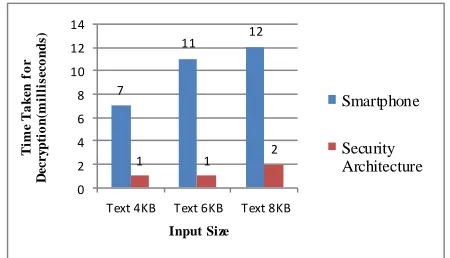
The time taken to get the decrypted text displayed back to the Smartphone where decryption is done on the Computational Cloud is shown in the figure 7. Below where text of variable size is encrypted.
7
11 12
1 1 2
0 2 4 6 8 10 12 14
Text 4KB Text 6KB Text 8KB
Ti
m
e
Ta
ke
n
fo
r
D
ecry
pt
io
n(
m
il
li
seco
nd
s)
Input Size
Smartphone
Security Architecture
[image:8.612.331.556.516.645.2]International Journal of Emerging Technology and Advanced Engineering
Website: www.ijetae.com (ISSN 2250-2459,ISO 9001:2008 Certified Journal, Volume 4, Issue 7, July 2014)
957
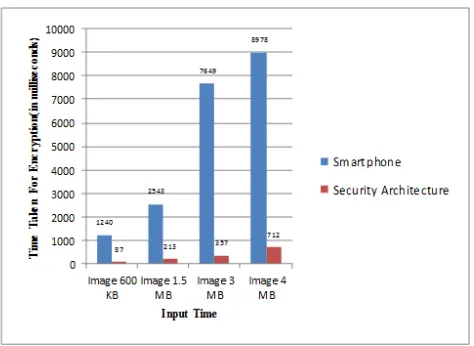
When text of 6KB is decrypted it takes 11 ms on the Smartphone and 1 ms on the security architecture getting 11x speed up ratio .when the image of size 8KB is decrypted it takes 12 ms on the Smartphone and 2ms on the security architecture getting 6x speed up. To find out how much time it takes to decrypt an image so that it can be shown to the user requested to access the data is shown in figure 8. Where the x axis shows the input size and the y axis shows the time taken for decryption operation on the images having different sizes. As the input size increases the time taken on the Smartphone increases but on the Security architecture it is takes less time with increased speed and utilizing all the resources taken here the values of data is also displayed to show the observation here
[image:9.612.50.287.300.473.2]
Figure 8. Execution Time taken by Smartphone and Security Architecture for Decrypting Image.
When image size of 600 KB is decrypted it takes 1240 ms to encrypt image and 87 ms on the security architecture implemented by the help of Computational Cloud achieving 14 x speeds up. For decrypting image of size 3MB it takes 7649 ms on Smartphone and 357 ms on the Security Architecture by achieving 21 x speed up this shows as the size of file increases the speed up also increases.
VII. CONCLUSION AND FUTURE WORK
This paper concludes results from security architecture to show that how Cloud can be used to secure your own data privately. After securing which that data can be stored publically on the storage cloud. This proposed work is performed by using Type II Cloud hypervisor so in future if in the place of Type II hypervisor Type I hypervisor is used which helps Guest operating system to directly run on the Host Hardware.
It can be assumed that the speed up and the performance enhancement will be increased to 20 times more than it is in the observed results in this paper. Especially if large chunks of data needs to be encrypted or decrypted for securing the data from being attacked.
REFERENCES
[1] IDC Cloud Research Area,
http://www.idc.com/prodserv/FourPillars/Cloud.
[2] Ramgovind S, Eloff MM, Smith E ―The Management of Security in Cloud Computing ‖ School of Computing, University of South Africa, Pretoria, South Africa.
[3] Dijiang Huang, Tianyi Xing, and Huijun Wu ―Mobile Cloud Computing Service Models:A User-Centric Approach ‖, Arizona State University, IEEE Network • September/October 2013 . Pg no. 6-11.
[4] ABI Research predictions for cloud and mobile devices, www.abiresearch.com/press/cloud-application-development-and-management-platf .
[5] J. Brodkin(2008,Jun) . ―Gartner :Seven Cloud Computing Security Risks ― available :http://www.infoworld.com/d/security-central /gartner-seven-cloudcomputingsecurity-risks-853 page=0,1[Mar. 13,2009].
[6] Eric Y. Chen , Mistutaka Itoh ―Virtual Smartphone Over IP‖ NTT Information Sharing Platform Laboratories, NTT Corporation 3-9-11 Midori-cho, Musashino-shi, Tokyo, 180-8585, Japan.
[7] Byung-Gon Chun, Petros Maniatis ―Augmented Smartphone Applications Through Clone Cloud Execution‖ Intel Research BerkeleyPg No. 1-5, 2009.
[8] Piotr K. Tysowski and M. Anwarul Hasan, Senior Member, IEEE ―Hybrid Attribute- and Re-Encryption-Based Key Management for Secure and Scalable Mobile Applications in Clouds‖ IEEE Transactions On Cloud Computing, Vol. 1, No. 2, JULY-DECEMBER 2013 pg No. 172-186.
[9] Lakshmi Subramanian , Gerald Q. Maguire Jr.,Philipp Stephanow ―An Architecture To Provide Cloud Based Security Services For Smartphones‖ 2011 KTH Royal Institute Of Technology Stockholm,Sweden
[10] Dijang Huang ,Zhibin Zhou, Le Xu,Tianyi Xing ,Yunji Zhong ―Secure Data Processing Framework For Mobile Cloud Computing‖ Arizona State University , IEEE INFOCOM 2011 Workshop on Cloud Computing.
[11] Piotr K. Tysowski and M. Anwarul Hasan ―Re-Encryption-Based Key Management Towards Secure and Scalable Mobile Applications in Clouds‖ Dept. of Electrical & Computer Engineering University of Waterloo, Ontario, Canada.
[12] Karthik Kumar and Yung-Hsiang Lu ―Cloud Computing for Mobile Users: Can Offloading Computation Save Energy?‖ Purdue University0018-9162/$26.00 © 2010 IEEE pg no 1-14.
International Journal of Emerging Technology and Advanced Engineering
Website: www.ijetae.com (ISSN 2250-2459,ISO 9001:2008 Certified Journal, Volume 4, Issue 7, July 2014)
958 [14] Chanmin Yoon, Dongwon Kim, Wonwoo Jung, Chulkoo Kang,
Hojung Cha ―AppScope: Application Energy Metering Framework for Android Smartphones using Kernel Activity Monitoring‖ Dept. of Computer Science, Yonsei University, Korea.
[15] Niroshinie Fernando, Seng W. Loke, Wenny Rahayu‖ Mobile cloud computing: A survey‖ www.elsevier.com/locate/fgcs June 2012 85-106.
[16] Mell Peter, Grance Timothy ―The NIST Definition of Cloud Computing‖ NIST Special Publication 800-145 in September 2011.
[17] Byung-Gon Chun, Sunghwan Ihm, Petros Maniatis, Mayur Naik Ashwin Patti ―CloneCloud: Elastic Execution between Mobile Device and Cloud‖ EuroSys’11, April 10–13, 2011, Salzburg, Austria 2011 ACM 978-1-4503-0634-8/11/04.
[18] Amir Houmansadr, Saman A. Zonouz, and Robin Berthier ―A Cloud-based Intrusion Detection and Response System for Mobile Phones‖ University of Illinois at Urbana-Champaign.
[ 1 9 ] Mayank Arora, Mala Kalra and Dr. Sarabjeet Singh. ―ACOF:
Autonomous Computation Offloading Framework for Android using Cloud‖, In proc of IEEE 2nd International Conference on Information Management in the Knowledge Economy, 2013.