International Journal of Emerging Technology and Advanced Engineering
Website: www.ijetae.com (ISSN 2250-2459,ISO 9001:2008 Certified Journal, Volume 4, Issue 6, June 2014)
614
Performance Improvement of IEEE 802.11 WLAN-OFDM
using 16-QAM Modulation and Moving Average Filtering
Shaikh Imran Shahid Ab. Rashid
1, Prof. Shrikant Lade
21M-Tech Research Scholar, 2HOD, Department of Information Technology RKDF IST, Bhopal
Abstract - IEEE 802.11 is wireless local area network standard, and most popular in current era of communication and information sharing between numerous of devices like smart phones, tablets, laptops & computers etc., there is need to make it more robust and reliable so that it will be efficient near to leased line in information sharing without distortions. In this paper we have simulated WLAN-OFDM system with four modulation techniques and moving average filter (MAF) with iterative structure. During simulations it has been observed that more the iteration betters the performance of the system.
Keywords-- OFDM, WLAN, MAF, Iterative Structure BPSK, QPSK, and M-QAM.
I. INTRODUCTION
Wireless technology has helped to simplify networking by enabling multiple computer users to simultaneously share resources in a home or business without additional or intrusive wiring. These resources may include a broadband connection, network printers, data archives, and even streaming audio and video. This type of resource sharing has become more prevalent as computer users have changed their habits from using single, stand-alone computers to work on networks with many computers, each with potentially different operating systems and varying peripheral hardware. Modern U.S. Robotics wireless networking goods offer a variety of solutions to impeccably integrate with computers peripherals, and data.
Wireless networking enables the same capabilities and comparable speeds of a wired 10BASE-T network without the difficulties associated with laying wire, drilling into walls, or may be stringing Ethernet cables throughout an office building or home. Laptop users have the freedom to go anywhere in the office building or home without having to hunt down a connector cable or available jack. Every room in a wireless residence and office can be “connected” to the network, so therefore adding more users and growing a network can be as simple as installing a new wireless network adapter.
Reasons to choose wireless networking than traditional wired networks include:
• Running additional wires or drilling new holes in a home or office could be prohibited (because of rental regulations), impractical (infrastructure limitations) or too exclusive.
• Flexibility of location & data ports is requisite. • Roaming capability is desired; for example
maintaining the connectivity from almost anywhere inside a home or business
• Network access is desired outdoors; for example outside a home or office building
WLAN for Office:
An 802.11 network is the ideal solution for a network administrator in many respects. No longer is it a requirement that every workstation and conference room be wired up to hubs and switches with cables in hard-to-reach areas. Wireless networking allows for impromptu meetings in cafeterias, hallways, courtyards, or wherever inspiration strikes while providing real-time LAN connectivity for business applications such as sending e-mail, working on spreadsheets on shared drives, and conducting market res earch.
WLAN for Home:
Wireless networking has become commonplace, and with the prices reduced to a fraction of what they had, it is no wonder that wireless networking products have transitioned from the office and the home. Used for the home user, a wireless network provides freedom in convenience and lifestyle to exchange words, data, and music video with any computer – across the Internet, or may be around the world. Home users can create a wireless network out of an existing wired network and wirelessly extend the reach of the Internet throughout the home on many computers, doing it more convenient for everyone to get online.
II. IEEE802.11WIRELESS LANARCHITECTURE
International Journal of Emerging Technology and Advanced Engineering
Website: www.ijetae.com (ISSN 2250-2459,ISO 9001:2008 Certified Journal, Volume 4, Issue 6, June 2014)
615
• Station(STA) • Access Point (AP) • Wireless Medium • Basic service set (BSS) • Distribution System(DS) • Extended service set(ESS)
IEEE 802.11 architecture defines nine services. These services can be divided into two groups which are STAs services and distribution services. STAs services contain authentication and de-authentication, Privacy, and delivery of the data and distribution services consist of association, the re-association, the disassociation, distribution and integration.
Stations:
The Station is basic components of the wireless network which is used to connect wireless network medium. In the other hand it does not provide access to a distribution system. Stations are computing device that contain IEEE 802.11 specification MAC and PHY interface to wireless network. Generally the 802.11 functions are implemented either software or hardware of Network adapter or network interface card (NIC). Station may be work stations, laptops, and mobiles.
Access Point (AP):
An Access Point is a device provides the point of interconnection wireless station to the wired network or wireless network at the same time or either. Access point performs so many functions but bridging function is the most important function. Access point functions were put into standalone devices, although various newer products are dividing the 802.11 protocol between "thin" access point and AP controllers [7].
Wireless Medium:
Wireless Medium is used to move frame from one station to another station. There are multiple physical layers is to develop to support the 802.11 MAC. [8]
Basic service set (BSS):
[image:2.612.358.527.136.281.2]The BSS is a collection of Stations that able to communicate with each other within 802.11 wireless local area network then they form a BSS. BSS is also called a cell. There should be at least two stations, if all stations in the BSS are mobile stations and there is no any connectivity to wired LAN network, the BSS called an Independent BSS (IBSS).Independent BSS is also called ad-hoc network.
Figure 2.1: Basic Service Set [7]
IBSS does not support relay function. IBSS stations directly communication one and another (peer to peer) and unable to connect with any BSS. Sometime it is possible that each every mobile station may not communicate with each other because of limitation of coverage area all mobile stations should be within a range to communicate. While a BSS includes an access point and a station, the BSS is not an Independent. It is called an infrastructure BSS or simply as BSS.
Figure 2.2: Independent Basic Service Set [7]
Distribution System (DS):
[image:2.612.342.543.413.551.2]International Journal of Emerging Technology and Advanced Engineering
Website: www.ijetae.com (ISSN 2250-2459,ISO 9001:2008 Certified Journal, Volume 4, Issue 6, June 2014)
616
Extended Service Set (ESS):
Extended service set(ESS) consists of multiple IEEE 802.11 BSSs forming single subnet work where the access point communicate each other to forward traffic from one BSS to another and provide facility to move mobile stations from one BSS to other.
[image:3.612.373.517.122.500.2]ESS configuration is a collection of multiple BSS cells that can be connected by either wired LAN or wireless LAN and used the same channel. The access point performs this communication through the distribution system [10].
Figure 2.3: extended service set [16]
III. PROPOSED METHODOLOGY
The proposed Methodology is explained in details in this section and the block diagram and flow chart of it is also shown in below figures. In Fig. 3.1 The wireless system with estimation method is shown.
[image:3.612.66.271.276.424.2]Fig. 3.1 Block diagram of Proposed Methodology
Fig. 3.2: Flow chart of Proposed Methodology
IV. SIMULATION RESULTS
IEEE 802.11 WLAN system based on OFDM which is a great improvement in the wireless communication, and it significantly enhances the bandwidth and performance of the system. The WLAN system is implemented with BPSK, QPSK, 16-QAM and 64-QAM to compare performance with different iteration techniques. The results of simulation are shown in below figures.
In Fig. 4.1 performance of WLAN -OFDM system is shown in terms of BER which is calculated for different values of signal to noise ratio (SNR). From the figure it is observed that for higher values of SNR 64-QAM is the better technique to use with the system and it should be repeated 100 times.
Input Data
Encodi ng
Modulati on
IFFT
Adding Cyclic Prefix
AWGN (Noise) Channel
Remove Cyclic Prefix FFT
Demodulat ion And Decoding
Moving Average Filter
Output Data
Start
Initialize Environmental Variables
Signal Generation
Apply OFDM Modulation Modulate Signal BPSK / QPSK / 16-
QAM/ 64 QAM
Transmit Through AWGN Channel
OFDM Demodulation
Moving Average Filter
Calculate BER Demodulate Signal BPSK / QPSK /
16- QAM/ 64 QAM
[image:3.612.48.290.522.634.2]International Journal of Emerging Technology and Advanced Engineering
Website: www.ijetae.com (ISSN 2250-2459,ISO 9001:2008 Certified Journal, Volume 4, Issue 6, June 2014)
[image:4.612.63.274.136.311.2]617
Fig. 4.1 BER Performance of WLAN-OFDM system using BPSK, QPSK, 16-QAM and 64-QAM with Moving Average Filtering and 100
Iterations
And for lower SNR region BPSK will perform nice than other modulation schemes. Now comparatively here BPSK outperforms over other techniques.
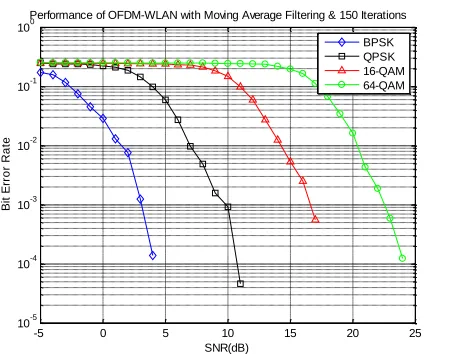
Fig. 4.2 BER Performance of WLAN-OFDM system using BPSK, QPSK, 16-QAM and 64-QAM with Moving Average Filtering and 150
Iterations
[image:4.612.332.546.138.312.2]In Fig. 4.2 performance of WLAN -OFDM system is shown in terms of BER which is calculated for different values of signal to noise ratio (SNR). From the figure it is observed that for higher values of SNR 64-QAM is the better technique to use with the system and it should be repeated 150 times. And for middle SNR region QPSK will perform nice than other modulation schemes. Now comparatively here QPSK outperforms over other techniques.
Fig. 4.3 BER Performance of WLAN-OFDM system using BPSK, QPSK, 16-QAM and 64-QAM with Moving Average Filtering and 200
Iterations
Fig. 4.4 BER Performance of WLAN-OFDM system using BPSK, QPSK, 16-QAM and 64-QAM with Moving Average Filtering and 400
Iterations
In Fig. 4.3 performance of WLAN -OFDM system is shown in terms of BER which is calculated for different values of signal to noise ratio (SNR). From the figure it is observed that all the techniques perform approximately equivalent but for lower values of SNR BPSK again wins the game. Condition should be repeated 200 times. And for middle SNR region QPSK will perform nice than other modulation schemes. Now comparatively here QPSK outperforms over other techniques. One more thing adding advantage to the system that is when we increase the repetitions performance of the system improves.
-5 0 5 10 15 20 25
10-5 10-4 10-3 10-2 10-1 100
Performance of OFDM-WLAN with Moving Average Filtering & 100 Iterations
SNR(dB)
Bi
t
Er
ro
r
R
a
te
BPSK QPSK 16-QAM 64-QAM
-5 0 5 10 15 20 25
10-5 10-4 10-3 10-2 10-1 100
Performance of OFDM-WLAN with Moving Average Filtering & 150 Iterations
SNR(dB)
Bi
t
Er
ro
r
R
a
te
BPSK QPSK 16-QAM 64-QAM
-5 0 5 10 15 20 25
10-4 10-3 10-2 10-1 100
Performance of OFDM-WLAN with Moving Average Filtering & 200 Iterations
SNR(dB)
Bi
t
Er
ro
r
R
a
te
BPSK QPSK 16-QAM 64-QAM
-5 0 5 10 15 20 25
10-5 10-4 10-3 10-2 10-1 100
Performance of OFDM-WLAN with Moving Average Filtering & 400 Iterations
SNR(dB)
Bi
t
Er
ro
r
R
a
te
[image:4.612.331.549.365.535.2] [image:4.612.61.291.396.573.2]International Journal of Emerging Technology and Advanced Engineering
Website: www.ijetae.com (ISSN 2250-2459,ISO 9001:2008 Certified Journal, Volume 4, Issue 6, June 2014)
618
In Fig. 4.4 performance of WLAN -OFDM system is shown in terms of BER which is calculated for different values of signal to noise ratio (SNR). From the figure it is observed that for higher values of SNR 64-QAM is the better technique to use with the system and it should be repeated 400 times. And for lower SNR region BPSK will perform not better but quite good compare to other modulation schemes because SNR is lower. Now comparatively here 64-QAM outperforms over other techniques.
V. CONCLUSION AND FUTURE SCOPE
All the simulations are done with different system conditions and the outcomes says that the 64-QAM is the technique which will cover the most common area of communication and perform better than other techniques. It is complex than other but system can handle such processing speed to reach QoS. As we reach the lower SNR levels of the system less complex modulation techniques performs better which is in the order 16-QAM, QPSK and the optimum performance BPSK with significant iterations between 100 and 150.
In future more complex modulation techniques give better results but increases complexity also but by the time evolution of processing speed complex operations can be performed in less time. So we shall always look forward for better quality of services.
REFERENCES
[1] Rusty O. Baldwin, N. J. Davis, Scott F. Midkiff, “A Real-Time
Medium Access Control Protocol for Ad hoc Wireless Local Area Networks”, Year of Publication: 1999, ISSN: 1559-1662.
[2] Ramjee Prasad “OFDM for Wireless Communications Systems”
Year of publication 2004, ISSN 1-58053-796-0, page # 150-160.
[3] Bernhard H.Walke, Stefan Mangold, Lars Berlemann,"IEEE 802
Wireless Systems", ISBN: 978-0-470-01439-4, Page No. 4-5.
[4] Sorin M. SCHWARTZ “FHSS vs. DSSS”, page 1 of 16.
[5] White paper 802.11g-WP104-R www.54g.orgvisited 10 November
2009.
[6] Bob O'Hara, Al Petrick, “IEEE 802.11 handbook: a designer's
companion” page # 5-6.
[7] Matthew S. Gast , “802.11 wireless networks: the definitive guide”,
ISBN 0-596-10052-3, page #12-16 .
[8] William Stallings, “Data and Computer Communications” , 7th
Edition page 525-540.
[9] Kaveh Pahlavan, Allen H. Levesque “Wireless information
networks”,2nd Edition, page # 682-687,
[10] Plamen Nedeltchev,Felicia Brych, “ Wireless Local Area Networks
and the 802.11 Standard”.
[11] Shinsuke Hara, Ramjee Prasad “Multicarrier techniques for 4G
mobile communications”, ISBN 1-28953-482-1 page #27-30.
[12] Mohammad Boulmalf, Amine.s, Shakil Aktar,"Physical layer
performance of 802.11g WLAN”,college of information technology UAE University.
[13] Stuart Kerry, Chair of the IEEE 802.11 Working Grou3.
[14] 3. Chatzimisios, A. C. Boucouvalas,V. Vitsas , “ Performance
analysis of the IEEE 802.11 MAC protocol for wireless LANs”, Published online 2 June 2005 in Wiley InterScience .
[15] 3.Nicopolitidis, “Wireless networks” ISBN 0470 845295,page #
245-250 .
[16] Henry Haojin, “Wang Packet broadband network handbook”, ISBN
0-07-137006-4, pages 224- 230.
Author's Profile
Shaikh Imran Shahid Ab. Rashid is research
scholar is research scholar at RKDF Institute of Science and Technology under Rajiv
Gandhi Proudyogiki Vishwavidyalaya,
![Figure 2.2: Independent Basic Service Set [7]](https://thumb-us.123doks.com/thumbv2/123dok_us/8713871.882578/2.612.358.527.136.281/figure-independent-basic-service-set.webp)