International Journal of Emerging Technology and Advanced Engineering
Website: www.ijetae.com (ISSN 2250-2459,ISO 9001:2008 Certified Journal, Volume 4, Issue 7, July 2014)
134
Face Recognition Using Holistic Based Approach
Vandana S. Bhat
1, Dr. Jagadeesh D. Pujari
21Research Scholar, 2Professor, Department of Information Science and Engineering, SDM CET, Dharwad
Abstract- Face recognition is the highest generous method for identification of an individual. Principal Component Analysis (PCA) is an efficient technique to identify a face from a given image. For a static image holistic based approach uses the entire raw face image as input and feature based method is based on extracting local facial features, and geometric, appearance properties. To recognize a face two image processing steps are available. In the first step face detection process is carried out using Viola Jones face detector. In the second phase it describes how to build a simple, yet a complete face recognition system using Principal Component Analysis, a Holistic approach. Linear projection is applied to the original image space to achieve dimensionality reduction and the functionality in executed out by projecting face images onto a feature space that spans the significant variations among known face images. Next step is to project the extracted face image on to a set of face space that represents significant variations among the known face images. Face will be categorized as known or unknown face after matching with the stored database. Evaluation performance of various parameters such as distance classifier used, applying histogram equalization and selecting the number of eigenfaces, we propose a system which combines these above mentioned features into one face recognition system. Thus it helps a learning mechanism to recognize new faces in an unsupervised manner.
Keywords- Face, PCA, Holistic, face detection, face recognition.
I. INTRODUCTION
Biometric deals with identifying individual with the help of their biological data. Human face recognition is a potential method of biometric authentication. Face is a primary focus of attention in social intercourse, playing a major role in conveying identity and emotion. The human ability to recognize faces is remarkable. People can recognize thousands of faces learned throughout their lifetime and identify familiar faces at a glance even after years of separation. This skill is quite robust, despite large changes in the visual stimulus due to viewing conditions, expression, aging, and distractions such as glasses, beards or changes in hair style etc. Face recognition is used in many applications such as security systems, credit card verification and criminal identification. Due to numerous potential applications face recognition has become a very active research area.
A face technology which explains new information processing technology which shows a generic frame work for a face recognition system and the variants that are frequently encountered by the face recognizer[1] Advantages of using these traits for identification are that they cannot be forgotten or lost. These are unique features of a human being which is being used widely [2].Face recognition is an interdisciplinary research area, involving researchers from pattern recognition, computer vision, and graphics, image processing/ understanding, statistical computing and machine learning [3].
An automated face recognition system needs to overcome several problems. One of the big problems is the ability to identify a person whose picture is not taken straight on. That means the face may not be frontal. It is not easy to make a system capable to recognize a person with a rotated face. Besides, size of the image would affect the recognition result because some approach requires a standard size images. And small size image makes the revolution of the image not clear enough for recognition. Another problem for face recognition is an appearance of a person may change drastically over a short period of time. For examples, day-to-day facial differences due to glasses, makeup and head hair style. All these changes may make face recognition of a person difficult.
Face recognition is an integral part of biometrics. In biometrics basic traits of human is matched to the existing data and depending on result of matching identification of a human being is traced. Facial features are extracted and implemented through algorithms which are efficient and some modifications are done to improve the existing algorithm models. Computers that detect and recognize faces could be applied to a wide variety of practical applications including criminal identification, security systems, etc. Face detection and recognition is used in many places nowadays, in websites hosting images and social networking sites.
International Journal of Emerging Technology and Advanced Engineering
Website: www.ijetae.com (ISSN 2250-2459,ISO 9001:2008 Certified Journal, Volume 4, Issue 7, July 2014)
135
In surveillance system if an unknown face appears more than one time then it is stored in database for further recognition. In general, face recognition techniques can be divided into two groups based on the face representation they use appearance-based, which uses holistic texture features and is applied to either whole-face or specific regions in a face image and feature-based, which uses geometric facial features (mouth, eyes, brows, cheeks etc), and geometric relationships between them. Face recognition is the art that compares the similarities of a face under test and the database image based on biometric features that are constant throughout the life of an individual irrespective of age and environmental conditions.
Organization of the paper is as follows. Section II of this paper is on literature survey. Section III & IV is the mathematical study of algorithm carried out for face recognition. System design is explained in Section V. The experiments are performed on MATLAB. Two datasets are use, face database ORL database is made use of and acquired images followed by the results are explained in Section V1. Finally the conclusion is drawn in section VII.
II. LITERATURE SURVEY
The aspect of face recognition is featured with n number of parameters and a combination of these parameters can be exploited as scaling measure for face detection. The approaches that deals with the face recognition is based on features which are in relation described by priori to recognize local features of face. Alternatively, the general approaches that are employed for recognition of face focus on detecting local and significant geometries of face that corresponds with the local features of a face image
Face recognition has been an active research area in the pattern recognition and computer vision domains. A number of methods have been proposed in the last decades [Chellapa, Wilson and Sirohey, 1995]. In the field of face recognition, the dimension of the facial images is very high and require considerable amount of computing time for classification. The classification and subsequent recognition time can be reduced by reducing dimension of the image data. Principal component analysis (PCA) [Turk and Pentland, 1991] is one of the popular methods used for feature extraction and data representation. It not only reduces the dimensionality of the image, but also retains some of the variations in the image data and provides a compact representation of a face image.
The key idea of the PCA method is to transform the face images into a small set of characteristics feature images, called eigenfaces, which are the principal components of the initial training set of the face images. PCA yields projection directions that maximize the total scatter across all classes, i.e., across all face images. In recognition process a test image is projected into the lower-dimension face space spanned by the eigenfaces and then classified either by using statistical theory or a classifier. The PCA method was developed in 1991 [Turk and Pentland, 1991]. In [Belhumeur, Hespanha and Kriegman, 1997], the PCA method is used for dimension reduction for linear discriminate analysis (LDA), generating a new paradigm, called fisher face. The fisher face approach is more insensitive to variations of lighting, illumination and facial expressions. However, this approach is more computationally expensive than the PCA approach.
An improved face recognition technique based on modular PCA approach and compared with conventional PCA method under varying conditions and achieved better results compared to conventional PCA. A comparative study of face recognition with PCA and cross correlation technique is also available. They applied a different technique of face recognition on different test samples and got better results. [4].Face recognition has drawn attention of the research community. Face identification from a single image is a challenging task because of variable factors like alterations in scale, location, pose, facial expression, occlusion, lighting conditions and overall appearance of the face. With the synergy of efforts from researchers in diverse fields including computer engineering, mathematics, neuroscience and psychophysics, different frameworks have evolved for solving the problem of face recognition.
Some of the approaches in face recognition are based on features which are in relation mentioned by priori method to recognize the local features of face. Most of the old concept for the researchers is a subject of experimentation to explore pattern recognition, machine learning, image processing, computer visions [6], [7]. Automated face recognition has number of desirable properties as biometric technology to attract the researchers into practical techniques [8].
International Journal of Emerging Technology and Advanced Engineering
Website: www.ijetae.com (ISSN 2250-2459,ISO 9001:2008 Certified Journal, Volume 4, Issue 7, July 2014)
136
General approaches that are suggested for the recognition of face image include locating the features within the face. [9] Face identification from a single image is a challenging task because of variable factors like alterations in scale, location, pose, facial expression, occlusion, lighting conditions and overall appearance of the face. Earliest methods treated faces as points in very high dimensional space and calculated the Euclidean distance between them.
Dimensional reduction techniques including Principal Component Analysis (PCA) have now been successfully applied to the problem, thus reducing complexity of the recognition process. A human being is a very sophisticated information system, partly because he possesses a superior pattern recognition capability.
In the literatures, face recognition problem can be formulated as given static or video images of a scene identify or verify one or more persons in the scene by comparing with faces stored in a database. When comparing person verification to face recognition, there are several aspects which differ. Two reasons account for such a change. Firstly it is the wide range of commercial and law enforcement applications, and the second being the availability of feasible technologies Even though machine recognition systems are available their success is limited by the conditions imposed by many real applications. Recognition of face images acquired in an outdoor environment with changes in illumination and/or pose remains a largely unsolved problem. Thus it could be precisely said that recognition systems are still far away in terms of capability human perception system.
The two motivations to write this paper, firstly is to provide an up-to-date review of the existing literature, and the second is to make a detail study of machine recognition of faces. In this paper the main objective is to implement face recognition in an optimum way in terms of run time onto the embedded system. PCA algorithm Using Eigenface approach and methodologies are studied and hardware resources planning have been done to achieve the goal. This kind of face recognition embedded system can be widely used in our daily life in different sectors. The main aim is to recognize a sample face from a set of given faces and use a simple approach for recognition and compare it with Eigenface approach. Testing has been done using Matlab and user friendly GUI has also been designed for the operation of the application.
III. FACE REGONITION ALGORITHMS
A. Pre-processing Module
The pre-processing is early vision technique for enhancing image to improve recognition performance. The steps which are carried out are basic alterations to image under test such as Normalization of the image size, Histogram Equalization, Median Filtering, High-Pass Filtering, Background Removal, Translational and Rotational Normalization and Illumination Normalization.
B. Algorithms -Viola–Jones object detection framework As proposed by Paul Viola and Michael Jones in 2001for real time applications, face detector is made use of as the the first object detection framework to provide competitive object detection rates. It can be used to identify a variety of different objects based upon its features. Thus we can have an accurate working function based on this which will enable us to determine the presence of the object in the scenario as well as candidate faces.
C. Principal Component Analysis (PCA) A holistic method The facial features are extracted using the PCA method. When the obtained data have some redundancy PCA is a variable reduction procedure which is useful and will result into reduction of variables into smaller number of variables which are called Principal Components. This accounts for the variance occurrence in the observed variable. One technique which has been used in image recognition a statistical method is PCA under the broad title of factor analysis. The main objective of PCA is to reduce the large dimensionality of the data space in the observed variables to the smaller intrinsic dimensionality of feature space that is independent variables, which describes the data economically. When there is a strong correlation between observed variables this can be useful.
International Journal of Emerging Technology and Advanced Engineering
Website: www.ijetae.com (ISSN 2250-2459,ISO 9001:2008 Certified Journal, Volume 4, Issue 7, July 2014)
137
IV. MATHEMATICAL FORMULATIONS OF MODELS
A. Computation of Eigenvectors from Training Samples Suppose the dimension of training samples represented by n, and the class number of training samples by L. N1,N2,NL, denotes the number of training samples
with different class respectively, and denotes the total number of all the training samples. Sample set with class is denoted by Xc = {Xc1,Xc2,…XNC},where Xci €Rn,and
expresses the number of class c.
The set of all the training samples is shown by X= {X1,X2, XL}.
Within-class average face with class c is defined as
(1)
Here, within-class average face is utilized to normalize all the training samples with class c.
(2)
Then, the covariance matrix can be defined as
(3)
Where Vci expresses the normalized vector of training
samples, and Q€Rnxn. The eigenvectors chosen correspond to the m largest eigen values of matrix Q, and are denoted by Wi, i=1,2…m Thus eigenface space matrix W is formed,
expressed by W=[W1,W2, Wm], where W€Rnxm and m<n .
B. Training Samples projected into Eigen Face Space. The same average face is required while training samples and testing samples are normalized, so that they can be compared under the same circumstances. The average face of all the training samples is defined as
(4)
Where Xci represents training samples with class c. Then
training samples with this average face are normalized as
(5)
Each training sample with class c is projected into the eigenface space, and the projected features are obtained as follows
(6)
Where Yci expresses the projected features of training
samples Xci and Yci€R
C. Testing Samples projected into the Eigenface Space Suppose a testing sample denoted by Xtest, where
Xtest€Rn. At first, this testing sample is normalized, and
then projected into the eigenface space. Therefore, the projected features are acquired as follows
(7)
Where Ytestexpresses the projected features of testing
sample Xtest, and Ytest € Rn.
D. Testing Samples- Classification
Euclidean Norm is utilized to compute the distance difference between testing sample features Ytest and
training sample features Yci that is
(8)
V. SYSTEM DESIGN
A. Conceptual Description of the Model
Recognized
or
Not recognized
Fig: No. 1 Conceptual Model
InputImage
Face Detection
Dete cted Face s
International Journal of Emerging Technology and Advanced Engineering
Website: www.ijetae.com (ISSN 2250-2459,ISO 9001:2008 Certified Journal, Volume 4, Issue 7, July 2014)
138
The Proposed Model has four phases which include Input Image, face Detection, face Recognition and database. Input Image is taken and the face is detected from the image and the detected faces undergo face recognition module where the face is compared with images stored in the database. If the image is present the face is said to be recognised else not recognised.
B. Flow Chart
[image:5.612.358.532.219.312.2]Fig. No. 2 Steps in Face recognition system
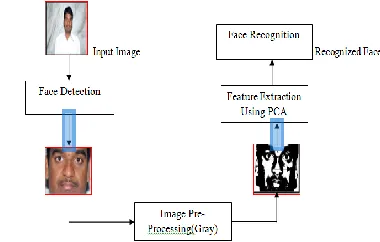
The images stored in the database are read and the Facial features are extracted and the face is detected. If the Input is from the camera then the image is captured first then stored in the database. The detected face is converted to gray scale Image and is an input for Face Recognition module where Feature exaction is done Principal Component Analysis (PCA) and Euclidean distances of the face are calculated and matched with that of test image. If the Input image and test Image gets matched then the face is said to be recognized else not recognized.
C. Architecture of the proposed system:
Fig. No.3 Architecture of Face Recognition
VI. EXPERIMENTAL SETUP
A. Acquired Images
Testing was carried out on the acquired face images and a training set of ORL face databases. A grey scale images are easier for computational techniques in image processing thus a colored image is converted to grey scale image.
[image:5.612.54.279.223.427.2]Fig. No. 4A colored face image
When input image of a face for a face recognition may be of different size, a grey scale face image is scaled for a particular pixel size as 250x250.
Fig.No.5Grey Scale Face Image
B. ORL Face Database
[image:5.612.336.547.361.447.2]Database for different set of conditions is maintained. Ten different expressions for ten different people thus creating a 10x10 that is equal to 100 different set of face images. Rotated images in left and right direction and different illumination conditions are also considered while making the training set.
Fig. No.6 Single Face Image for different expression
Expression- When an expression of a person is changed the orientation of face organs are changed according to it thus changing the feature vectors accordingly. Therefore changed expressions alter the recognition procedure.
Read image from stored database
Read image from stored database
Feature Extraction by PCA Feature Extraction by PCA
Recognized Test Image Successfully ?
Results- Recognized faces
Not found
Stop
[image:5.612.364.522.544.622.2] [image:5.612.68.258.584.705.2]International Journal of Emerging Technology and Advanced Engineering
Website: www.ijetae.com (ISSN 2250-2459,ISO 9001:2008 Certified Journal, Volume 4, Issue 7, July 2014)
139
Illumination- Different intensity of light on face may change the recognition just as bright light causes image saturation.
Size variation- If the size of image is varied the recognition may alter accordingly.
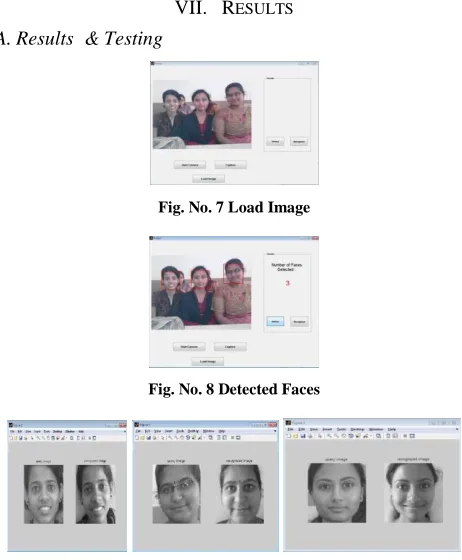
VII. RESULTS
[image:6.612.375.516.133.222.2]A. Results & Testing
Fig. No. 7 Load Image
Fig. No. 8 Detected Faces
Fig. No.9. Faces Recognized from the database
[image:6.612.51.282.211.491.2]For Faces not present in the database:
Fig. No.10.Load Image
Fig. No. 11 Detected faces
Fig.No.12. Faces Not matching
B. Testing- Verification and Validation
The system meets all the following requirements specified such as identification, recognition of a person and categorization.
The system is said to be reliable as PCA technique is being adopted which adapts to the different various face recognition and functions to complete user’s requirements. System is usable by the user and is user friendly.
Validation
[image:6.612.327.559.365.519.2]1. Test case to detect the face: Table No I Test case to detect the face
Test Case/Input
Expected Results
Observed Results
Remarks/Analysis
Loading an image from a saved file
Face to be detected from the loaded image
If any of feature is not detected then it is displayed as “ not detected”
No. of Faces is figured and detected
2. Test case to detect the face from a web camera: Table no. II
Test case for face Detection
Test Case/Input
Expected Results
Observed Results
Remarks/Analysis
Loading an image from a web cam
Face to be detected when image is clicked
Face is not detected when there is no proper illumination and contrast.
[image:6.612.121.215.521.681.2]International Journal of Emerging Technology and Advanced Engineering
Website: www.ijetae.com (ISSN 2250-2459,ISO 9001:2008 Certified Journal, Volume 4, Issue 7, July 2014)
140
[image:7.612.322.564.126.252.2]3. Test case for recognition : Table No: III Test case for recognition
Evaluation:
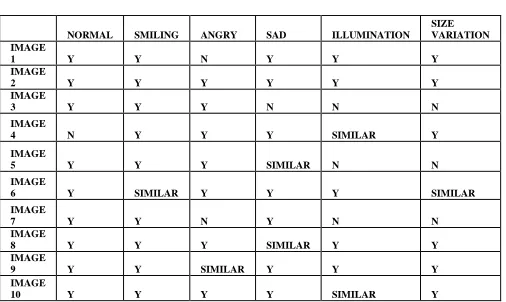
To classify the face as known or unknown a threshold value of the test face image to Eigen face space which is Euclidean distance is taken as 5.9 is taken.
Six different images for each mentioned condition were taken to test for ten different people. Light intensity is tried to keep low. Size variation of a test image is not altered to much extent.
We can observe that normal expressions are recognized as face efficiently because facial features are not changed much in that case and in other cases where facial features are changed efficiency is reduced in recognition.
Table No. IV
[image:7.612.51.286.161.354.2]Comparison between different conditions
Fig No:13 Output for different expressions and conditions
VIII. CONCLUSION
Face recognition is a challenging problem in the field of image analysis and computer vision that has received a great deal of attention over the last few years because of its many applications in various domains. Research has been conducted vigorously in this area for the past four decades or so and though huge progress has been made, encouraging results have been obtained.
Current face recognition systems have reached a certain degree of maturity when operating under constrained conditions however they are far from achieving the ideal of being able to perform adequately in all the various situations that are commonly encountered by applications utilizing these techniques in practical life. The ultimate goal of researchers in this area is to enable computers to emulate human vision system. The proposed system is working well for images of face with expression, size variation and illumination. Results achieved were accurate for recognizing faces.
REFERENCES
[1] Shang-Hung Lin “An Introduction to face recognition technology ,” Informing Science Special Issue on Multimedia Informing Technologies- Part -2 , Vol-3,2000.
[2] Rajkiran Gottumukkal, Vijayan K. Asari, “An improved face recognition based on modular PCA approach “, Pattern recognition letter in Elsevier pp.429-436, 2004.
[3] Ahonen, T., Hadid, A., & Pietikainen, M. (2006). Face description with local binary patterns: Application to face recognition. Pattern Analysis and Machine Intelligence, IEEE Transactions on, 28(12), 2037-2041.
[4] Srinivasulu Asadi, Dr. D.V. Subba Rap , V.Saikrishna, “ A comparative study of face recognition with principal component Analysis and cross relation technique,” International Journal of Computer Applications, Vol. 10, Nov 2010.
[5] Sunita Kumari, Pankaj K. Sa, and Banshidhar Majhi. Gender classification by principal component analysis and support vector machine. In ACM International Conference on Communication, Computing & Security, ICCCS 2011, pages 339 – 342, Rourkela, India, February 2011.
NORMAL SMILING ANGRY SAD ILLUMINATION SIZE VARIATION IMAGE
1 Y Y N Y Y Y
IMAGE
2 Y Y Y Y Y Y
IMAGE
3 Y Y Y N N N
IMAGE
4 N Y Y Y SIMILAR Y
IMAGE
5 Y Y Y SIMILAR N N
IMAGE
6 Y SIMILAR Y Y Y SIMILAR
IMAGE
7 Y Y N Y N N
IMAGE
8 Y Y Y SIMILAR Y Y
IMAGE
9 Y Y SIMILAR Y Y Y
IMAGE
[image:7.612.43.296.531.682.2]International Journal of Emerging Technology and Advanced Engineering
Website: www.ijetae.com (ISSN 2250-2459,ISO 9001:2008 Certified Journal, Volume 4, Issue 7, July 2014)
141
[6] Dong-Ju Kim, Sang-Heon Lee and Myoung-Kyu Sohn, “Face Recognition via Local Directional Pattern” International Journal of Security and Its Applications, Vol. 7, No. 2, March, 2013
[7] Divyarajsinh N. Parmar, Brijesh B. Mehta, “Face Recognition Methods & Applications” Int. J. Computer Technology & Applications, Vol 4 (1),84-86. ISSN: 2229-6093.
[8] Andrew W. Senior and Ruud M. Bolle, “Face Recognition and Its
Applications” IBM T.J.Watson Research Center,
http://www.andrewsenior.com/ papers/SeniorB02FaceChap.pdf. [9] Craw, I., Tock, D. & Bennett, A. (1992), Finding Face Features, in