International Journal of Emerging Technology and Advanced Engineering
Website: www.ijetae.com (ISSN 2250-2459, ISO 9001:2008 Certified Journal, Volume 5, Issue 2, February 2015)
204
Face Detection and Recognition Using Recorded Video’s
Prof. D. K Shah
1, Vishal B. Mokashi
21Professor in Department of Electronics Engineering at PREC, LONI, India 2
Department of Electronics Engineering at PREC, LONI, India Abstract—The goal of paper is to described the recorded
video face detection by manipulating the machine and image processing. This Platform is differentiating in three main parts. First is that representing the image by integrating the image or face. The second is learning, algorithm based on Paul Viola and Michael Jones, which is method for combining increasingly more complex classifiers in a “cascade” which allows background regions of the image to be quickly discarded while spending more computation on promising object-like regions [1].The third way is extract the small number of critical recorded video features from the numbers of set and submit extremely well ordered classifiers. The serial (cascade) can be viewed as an object or face particular focus mechanism which is different from previous parts address the surety that removable regions are unlikely to contain the object of interest. In that the sub part of face detection the system provides the detection rates or values comparable to the best previous systems. It use in Real Time application and also Non Real Time applications, simultaneously the detector runs at 15 frames per second without differencing image or its skin color detection.
Keywords— Face/Object Detection, video surveillance, Image processing, Cascade classifier, Arm 7(LPC 2148).
I. INTRODUCTION
It is concluded from study papers of , viola and Jones explain and showed the very fast method for finding faces in images ,group images or video (recorded or real time).This method is fast ,around the achieve 15 frames / second on a conventional 700 MHz and it is accurate. It work only with the information that appeared in a single grey scale image. To achieve the higher frame rates, the information also be integrated with system. One of the major contributions of their works is the use of cascade of classifiers to continuously speed up run time classification. The use cascade is a general thing and could be applied to a large class of detection problems, but it is most useful when the number of expected detections is less or small as compared to the total number of samples.
There are three main methods of our object detection formation. We will introduce each of these concepts briefly as follow and then describe them in details in subsequent segmentation.
The first method of this paper is a new image representation called an integral image it allow for fast feature evaluation The first contribution of this paper is a new image representation called an integral image that allows for very fast feature evaluation. Motivated in part by the work of Papageorgiouetal. Our detection system does not work directly with image intensities [1]. As follows estimate these features very fast at more scale we introduce the integral image representation for images. By the operations of per pixel we can computed the integral images. Now at any location in constant time we could be computed, any one of these Harr like feature.
The second big method of this paper is system for combining successively more complex classifiers in a cascade structure which dramatically increases the speed of the detector by focusing attention on promising regions of the image. The notion behind focus of attention approaches is that it is often possible to rapidly determine where in an image an object might occur [1]. The complex processing is reserved only for this promising region. ―False negative‖ rate of the intentional process is the key for such an approaches. Then object is selected by attention filter.
International Journal of Emerging Technology and Advanced Engineering
Website: www.ijetae.com (ISSN 2250-2459, ISO 9001:2008 Certified Journal, Volume 5, Issue 2, February 2015)
205
II. BLOCK DIAGRAM
[image:2.612.367.586.129.614.2]
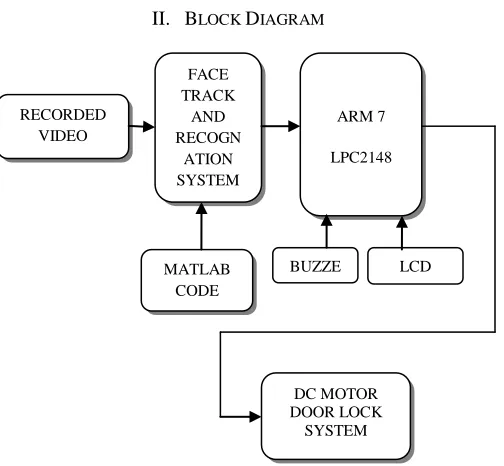
Figure No: 2.1 Functional block diagram of system
As shown in figure no: 2.1, we take the recorded videos, in that the faces should be visible clearly. Then synchronized those videos with Matlab code by image processing. In image processing the Faces from the videos are recognize and detect by the cascade classifier. The process of the image detect is to subtract the background data and the only face is detectable, it work on added layer by layers. Now in our system we use the ARM 7 LPC2148 controller which is 32 bit Microcontroller with high performance speed. It has on chip 512 KB ROM and 32 KB RAM.
Then we use other peripherals to enhance our system. We use the BUZZER, LCD and DC Motor. Buzzer is use for alarm purpose; LCD is use for display the notifications and DC motor is for the DOOR LOCK system. We described the brief process of this system in Flow chart.
III. FLOW CHART
YES
NO
Figure No: 3.1 Face Tracking Algorithms
RECORDED VIDEO
FACE TRACK
AND RECOGN
ATION SYSTEM
ARM 7
LPC2148
MATLAB CODE
DC MOTOR DOOR LOCK
SYSTEM LCD BUZZE
R
START
RECORDED VIDEO
FRAME GENERATION
BUZZER ON
DOOR OPEN DELAY DOOR
AUTO CLOSE DETECT FACES
STOP DOOR REMAIN CLOSED
OBJECT SEGMENTATION
ASSIGN TRACKER
FRAME PREPROCESSING
FRAME ENHANCEMENT
DATABASE
IT IS AUTHORIZED
PERSON
?
[image:2.612.49.301.132.365.2]International Journal of Emerging Technology and Advanced Engineering
Website: www.ijetae.com (ISSN 2250-2459, ISO 9001:2008 Certified Journal, Volume 5, Issue 2, February 2015)
206 The figure no 3.1, show the Flow chart of our surveillance system. First recorded video are added in PC then extract it with Matlab. To generate the frames we use Matlab functions. 1) Frame Generation: To capture an image for generation of frame we use this coding:
F=getframe(gcf); .image(F.cdata) colormap(F.colormap)
2) Frame processing: Now frame go for pre-processing in that we set up all the function that would be applied for any particular frame. Visualization should be including in function. The function is that must be handle to function that should be called for each frame. This function only takes the one input logic, frame number. If we want to take the more logics, then we use anonymous function. Now in the video player we saw the frames. 3) Frame Enhancement: Increase the frame development and quantity. We add some extra function in frame enhancement. 4) Object segmentation: Object or image segmentation is the process that dividing the object or image into multiple parts. This step is mostly used for identify the object or any other information in the digital image. 5) Tracker: It means that tracking or link the particles, consist of in rebuilding the trajectories of one or several particles as they move along time. Position of the particle address at each frame. 6) Detect Face: To detect the face we use the cascade object detector from the viola-Jones detection algorithm and a trained classification model for detection. But some limitation on use this algorithm like when the head get tilt slightly then face cannot be detect promptly. For that we use Kanade-Lucas-Tomasi (KLT) algorithm. Now the KLT algorithm tracks a set of feature point around the video frames. Once the face is detected, we identified the feature point that can be securely tracked. With this identified feature points, to track them we can use the Vision. Point Tracker system object. For each point in the previous frame, the point tracker attempts to find the corresponding point in the current frame. Then to estimate the translation, rotation and scale between the old points the new point we use the estimateGeometricTransform function. Now we applied this transformation to the bounding box around the face. To display video frames we create a video player. Track the points from frame to frame, and use estimateGeometricTransform function to estimate the motion of the face. 7) Database: We store the all data like videos, images, all programming, and commands in database.
Now we explain the how our system should be work.
Here is condition that IT IS THE PERSON
AUTHORIZED? If YES then our system scan from database and want to match with faces, if the face are matched then buzzer become on automatically, then door get open after some delay for person or persons entering, door get automatically closed, and simultaneously it become stop the process. Here we applied the another condition that person is not authorized in this condition system scan all database which is save by us, then want to match with the person but as our condition person is not matched then buzzer is on and door remain closed only. We studied and estimate that another one condition arise that if both type of persons(authorized and unauthorized) is come at one time then what should be do for that? Then we conclude that we on the buzzer and manual open the door by calling the security guard.
[image:3.612.324.577.348.590.2]IV. HARDWARE
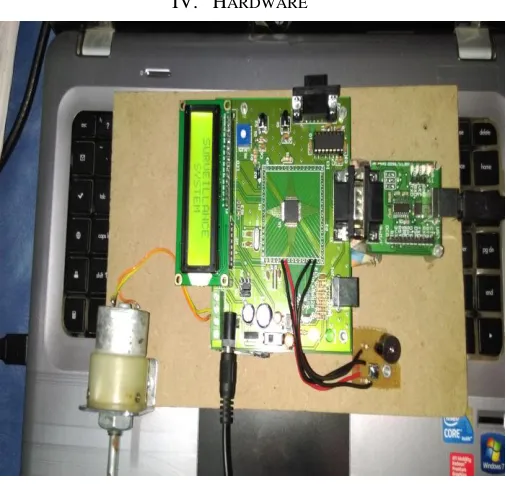
Figure No:4.1 Hardware of security system
A. Lcd module:
International Journal of Emerging Technology and Advanced Engineering
Website: www.ijetae.com (ISSN 2250-2459, ISO 9001:2008 Certified Journal, Volume 5, Issue 2, February 2015)
207 B. DC Motor:
Servos are DC motors with built in gearing and feedback control loop circuitry
.
The DC motor requires a DC supply of 4.8 V to 6 V. 10RPM T0 1000RPM 12V DC geared motors for robotics applications. No-load current = 60 mA(Max), Load current = 300 mA(Max) .C. Serial com port:
In computing, a serial port is a serial communication physical interface through which information transfers in or out one bit at a time. While such interfaces as Ethernet, FireWire, and USB all send data as a serial stream, the term "serial port" usually identifies hardware more or less compliant to the RS-232 standard, intended to interface with a modem or with a similar communication device.
D. Power supply:
For this circuit we apply the 5 volt DC power supply. It deliver the up to 1.5 A of current. For better performance we use IC 7805 for voltage regulator.
[image:4.612.358.539.108.276.2]
Figure No: 4.2 System Development Flow Diagrams.
V. IMAGE INTEGRAL
By using an intermediate representation for the image which we call the integral image, Rectangle feature can be computed very rapidly. The integral images are location x, y, contains the sum of the pixels above and to the left of x, y, inclusive:
ii(x,y)
= ∑
i(x',y'),
x' ≤ x, y' ≤ y
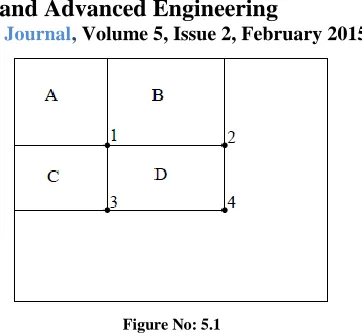
Figure No: 5.1
Figure no. 5.1 shows the total sum of pixel in the rectangle D can be calculate with four array references. The value of the integral image at location 1 is the sum of the pixels in rectangle A. The value at location 2 is A+B, at location 3 is A+C, and at location 4 is A+B+C+D. The sum with D can be computed as 4+1-(2+3).
Where i(x,y). Is the integral image and i(x,y) _ is the original Image. Using the following pair of recurrences:
s( x,y ) = s( x,y-1 ) + i( x,y )_______(1) ii( x,y ) = ii( x-1,y ) + s( x,y )______(2)
(where s( x,y ) _ is the cumulative row sum s( x,-1 ) = 0, And ii(-1,y ) = 0 ) the integral image can be computed in one pass over the original image[1]. By using the integral image rectangular sum can be calculated in four array references as show in figure 4.1. Clearly the difference between two rectangular total can be calculated in eight references. There for the two rectangle features defined above involve adjacent rectangular sums they can be calculated in six array references, eight in the case of the three-rectangle features, and nine for four-rectangle features.
A. Feature Discussion
Rectangle features are somewhat primitive when compared with alternatives such as steerable filters [2, 3]. For the deep analysis of borders, image compression and analysis of texture, steerable filters, and their relative are excellent. In variation of rectangle features, when the sensitive to the presence of edges, bars and other simple image composition, are little crass. The bunch of rectangle features provides a high image representation which supports effective learning. Apart from steerable filters the only orientations support are diagonal, horizontal and vertical. The synthesis of integral image, the capability of rectangle feature set provide much retrieval for their limited flexibility.
Matlab coding (Software)
Complier
[image:4.612.26.270.376.534.2]International Journal of Emerging Technology and Advanced Engineering
Website: www.ijetae.com (ISSN 2250-2459, ISO 9001:2008 Certified Journal, Volume 5, Issue 2, February 2015)
208
VI. IMAGE PROCESSING
The difference of an image sub window must be estimate promptly by using a pair of integral image. To compute the integral image we use the following equation:
σ²= m²- 1/N ∑ ϰ²,
σ – Standard deviation
m – Mean
ϰ – pixel value within sub-window
The mean of sub window can be computed using the integral image [1]. Summation of squared pixels is estimated by using an integral image in scanning process. When the scanning is in progress the effect of image normalization can be achieved not by the pre-multiplying the pixel, but only by the post-multiplying the feature value.
VII. RESULT
The system has been integrated and tested to function properly. The hardware and software interfacing is synchronized properly and also checked. System can work as it is made by us. Apart from this, we got result in technical part also that given below.
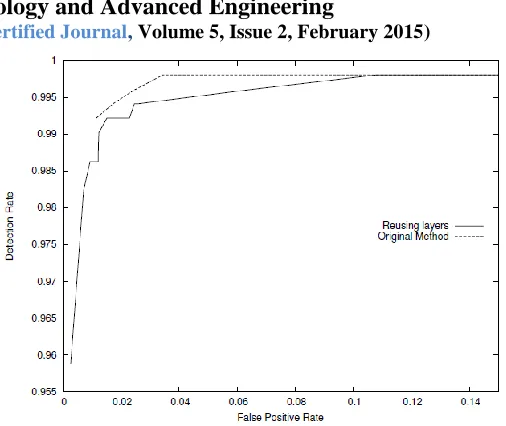
In our system we compare the two different classifier trained on the same face detection database with the same parameters, here we take two different rates of detection first is False positive rate and fixed detection rate. Then we examine them separately. Then result is that first layer in both classifiers are same (No any variations). Now in the second layer, both classifier result are different they produce a four way Adaboost ensemble (Matching). We use the first layer as the best weak classifier in the set. The new method is starting to show improvement over the original layer, from the third layer is on. The number of steps in each layer of an 8 layer classifier for new method is :[2;4;12;30;60;9;157;2], and the original method is:[2;4;13;86;58;484;1452].
[image:5.612.330.583.109.322.2] [image:5.612.324.564.381.535.2]The ROC curve for each classifier is very similar and is shown in Figure 6.1.
Figure No: 7.1 Comparing ROC curves between the original method and one which reuses previous layers as weak classifiers.
Now we put the output of system that the persons are authorized and we show them image composition.
Figure No: 7.2 Detectable and authorized faces.
We already work that the person who is authorized can be entering through the door. For other door cannot open, if the in condition that both type of persons want to enter in to the door, then in that condition we should contact the security guard.
International Journal of Emerging Technology and Advanced Engineering
Website: www.ijetae.com (ISSN 2250-2459, ISO 9001:2008 Certified Journal, Volume 5, Issue 2, February 2015)
209
VIII. CONCLUSION
We have concluded that an approach for face detection system and it is time consuming to achieve high accuracy to detect the face. Our method is quite general and can apply to any classification problem by using cascade classifier. From our implementation our system can work as security purpose, the system is stop for the unauthorized person or that face we not save in our database else it allow authentication for only right person whose database has been save in system. After all design we computed that our system is use in Real time or Non Real time condition.
REFERENCES
[1] Paul Viola and Michael Jones. Rapid object detection using a boosted cascade of simple features. In Computer Vision and Pattern Recognition, volume I, pages 511.518. IEEE Computer Society, 2001.
[2] William T. Freeman and Edward H. Adelson. The design and use of steerable filters. IEEE Transactions on Pattern Analysis and Machine Intelligence, 13(9):891–906, 1991
[3] H. Greenspan, S. Belongie, R. Gooodman, P. Perona, S. Rakshit, and C. Anderson. Over complete steerable pyramid filters and rotation invariance. In Proceedings of the IEEE Conference on Computer Vision and Pattern Recognition, 1994.
[4] Yoav Freund and Robert E. Schapire. A decision-theoretic eneralization of on-line learning and an application to boosting. In Computational Learning Theory: Eurocolt ’95, pages 23–37. Springer-Verlag, 1995.
BIOGRAPHIES
Prof. Miss. D.K. Shaha, Department of Electronics Engineering at Pravara Rural Engineering College, Loni, Tal- Rahata, Dist- Ahmednagar .