International Journal of Emerging Technology and Advanced Engineering
Website: www.ijetae.com (ISSN 2250-2459,ISO 9001: 2008 Certified Journal, Volume 5, Issue 3, March 2015)
90
Survey Paper on Structural Behavior of Steel Building with
Concentric and Eccentric Bracings. Using Different Sections at
Different Location.
Lekhraj Pandit
1, R. R. Shinde
21P.G. Student, 2Assistant Professor, Civil Engineering Department, Late G.N. Sapkal College of Engineering, Maharashtra,
India
Abstract-- A Bracing is a system that is provided to minimise the lateral deflection of structure. The members of a braced frame are subjected to tension and compression, so that they are provided to take these forces similar to a truss. Braced frames are always designed of steel members. Use of the braced frames has become very popular in high rise structure and also in seismic design of them. So this paper is aims to investigate the performance of steel Braced Frames for steel frame structure. In these project a steel building model is taken, these model is compared in different aspects such as storey drift, axial force and bending moment in column and story displacement etc. using different section in different locations. Among these numbers of trial which type of bracing at which location is more suitable from the observed results would be selected for the structure.
Keywords-- Axial force in column, Bending moment, Bracing system, Storey displacement, Storey drift.
I. INTRODUCTION
This A Braced Frame is designed primarily to resist wind and earthquake forces in and a structural system. These braced frames are made of steel members. Similar to a truss a braced frame is designed to work in tension and compression. Concentric Most braced frames are mostly used. These members intersect at a node, now here the centroid of each the member passes through the same point. Steel braced frame is the structural systems used to resist lateral loads in the multistoried buildings. Steel bracing are much economical, they are easy to erect, and less space is occupied by them and has flexibility to design for meeting the required strength and stiffness. Lateral loads are often resisted by using braced frame but they can interfere with some architectural components. The steel braces are usually placed in vertically aligned spans. Now this system allows an great increase of stiffness with a small amount of added weight, and thus it is very effective for the existing structure in which the poor lateral stiffness is the main problem.
Bracings are provided to increase stiffness and stability of the structure under lateral loading and also to reduce lateral displacement significantly. Concentric bracings increase the lateral stiffness of the frame and usually decrease the lateral drift. Due to increase in the stiffness it may attract a larger inertia force created due to earthquake. Here onwards, while bracings decrease, the amount of shear forces and bending moments in columns, increase the axial compression in the columns to which they are connected. Due to eccentric bracings there is reduction in the lateral stiffness of the system and improve the energy dissipation capacity. In eccentric connection of the braces to beams, lateral stiffness of system depends upon the flexural stiffness of the beams. Now here in vertical direction components of the bracing forces due to earthquake causes lateral concentrated load on the beams at the point of connection of the eccentric bracings. They have been used because they have a well-established reputation as high-ductility systems and have the potential to offer cost-effective solutions in moderate seismic region. (Viswanath K.G et.al., 2010) The only design loading parameter of importance is the maximum load likely to be experienced in its lifetime (Suresh P et.al., 2012). This study includes the structural behavior of steel building for both braced (including eccentric and concentric type) and unbraced conditions under static and lateral loading. The main aim of study has been to identify the type of bracing which causes minimum storey displacement such contributes to greater lateral stiffness to the structure.
II. SCOPE AND OBJECTIVE
International Journal of Emerging Technology and Advanced Engineering
Website: www.ijetae.com (ISSN 2250-2459,ISO 9001: 2008 Certified Journal, Volume 5, Issue 3, March 2015)
91
III. REVIEW OF LITERARURE
Sr.no. Name of author
Name and year of paper Information of paper
1 Zasiah
Tafheem, Shovona Khusru
Structural behavior of steel building with concentric and eccentric bracing: A comparative study 2013
In this study author has taken a six storied steel building modeled it and then analyzed due to lateral earthquake and wind loading, dead and live load it has been found that the concentric (X) bracing reduces more lateral displacement and thus significantly contributes to greater structural stiffness to the structure. The performance of the building has been evaluated in terms of lateral storey displacement, the storey drift and also axial force and bending moment in columns at different storey level. The effect of various types of steel bracing on the structure has also been investigated. More important is the reduction in lateral displacement has been found out for different types of bracing system in comparison to a building having no bracing. From this study, it is found that the concentric (X) bracing reduces more lateral displacement and thus significantly contributes to greater structural stiffness to the structure.
2 D.C. Rai ,
S.C. Goel
Seismic evaluation and upgrading of chevron braced frames. January 2003
Many Chevron type “ordinary” steel concentric braced frame (OCBF) structures have suffered extensive damage in recent earthquakes which raises concerns about their performance in future earthquakes. Changing the bracing configuration from chevron to 2-story X configuration can avoid the instability and plastic hinging of floor beams. Further improvement can be achieved by redesigning the brace and floor beams to a strong beam system and weak brace, as in Special CBFs. This evolution to SCBFs results in excellent hysteretic response and, with inelastic actions confined to ductile braces, exhibits reasonable distribution of damage over the height of the building.
3 L. Di Sarno,
A.S. Elnashai
Bracing systems for seismic retrofitting of steel frames. February 2008
International Journal of Emerging Technology and Advanced Engineering
Website: www.ijetae.com (ISSN 2250-2459,ISO 9001: 2008 Certified Journal, Volume 5, Issue 3, March 2015)
92
construction and renders MBFs attractive for seismic
retrofitting applications
.
4 Egor P Popov
& Michael D. Engelhardt
Sesmic Eccentrically Braced Frames. 1988
Overview of the design and behavior of sesmic resistant eccentrically braced frame. Effect of link length on both elastic and inelastic response of EBF’s.This paper provides an overview of sesmic resistant eccentrically braced frames with particular emphasis on the behavior and design of shear links. EBFs provide a unique combination of stiffness, strength and ductility, making them a viable lateral load resisting system for steel structures subject to earthquake loads.
5 Jinkoo Kim
and Junhee Park
Seismic behavior factors of buckling-restrained braced frames. August 2009
The seismic behavior of a framed structure with chevron-type buckling restrained braces was investigated and their behavior factors, such as over strength, ductility, and response modification factors, were evaluated. According to the analysis results, the response modification factors turned out to be larger than what is proposed in the provision in low-rise structures, and a little smaller than the code-values in the medium-rise structures. The dual systems, even though designed with smaller seismic load, showed superior static and dynamic performances.
6 Mohsen
Tehranizade, Touraj Taghikhani, Mahdi Kioumarsi, Leila Hajnajafi
The Comparative study about seismic behavior of special concentric braced frames with eccentric braced frames December 2008
In recent earthquakes concentrically braced frames are damaged extensively and thus gave rise to the revision of its design. So especially Concentrically braced frames have been introduced .Under the seismic loads they have significant inelastic deformability. They have less practical detailed problems than Eccentric Braced Frame (EBF).according to the Results frames both in modified concentric braced frames and EBF systems behave in an acceptable manner. The stiffness of EBFs frames is less than SCBF frames and due to it more base shears is caused. The conclusions of investigating some parameters like maximum dissipated inelastic energy and ductility are discussed in this study
IV. METHODOLOGY
A.Problem Definition
In a high rise structure without bracing there is a large amount of deflection along both the directions. This deflection caused in the structure can be reduced by providing the bracings. So for various types of loading such as drifting of storey, axial force and bending moment in coloumn, gravity force etc. using different section in different locations is studied
B.Methodology Of Work
1) Extensive literature survey by referring books,
technical papers or research papers carried out to understand basic concept of topic.
2) Identification of need of research.
3) Formulation of stages in analytical work which is to be
carried out.
4) Data collection.
5) Analytical work of modelling is to be carried out using
software`.
International Journal of Emerging Technology and Advanced Engineering
Website: www.ijetae.com (ISSN 2250-2459,ISO 9001: 2008 Certified Journal, Volume 5, Issue 3, March 2015)
93
V. THEORETICAL CONTENT
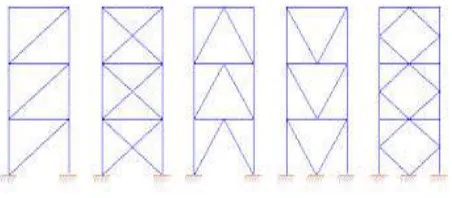
[image:4.612.339.567.146.254.2]A steel building is a metal structure fabricated with steel for the internal support and for exterior, cladding as opposed to the steel frame buildings which generally use other materials for various components such as floors, walls, and external envelope. The Steel buildings are used for a variety of purposes including storage, work spaces and living accommodation. Concentrically Braced Frames are further classified as Ordinary concentric braced frames .They do not have extensive requirements regarding members or connections to them , and are frequently used in low seismic risk areas. OCBF steel frame buildings are firstly used in Chicago and reinforced concrete frames in Germany and France in areas where earthquakes were not an engineering consideration in design. Eccentrically braced frames or Special concentrically braced frame were later developed with extensive design requirements, and are frequently used in areas of high seismic risk. The main aim of the design of concentrically- or eccentrically-braced frame is to ensure adequate ductility. A relatively new lateral force resisting system developed to resist seismic events in a predictable manner are known as eccentrically braced frames (EBFs) properly designed and detailed EBFs reacts in a ductile manner through shear or flexural yielding of a link element. A link is created due to brace eccentricity with the beam midpoint or with the column centerlines. Wide, balanced hysteresis loops produce the ductile yielding that indicates excellent energy dissipation required for high seismic events
[image:4.612.57.283.491.590.2]Figure 1 Concentrically Braced Frames
Figure 2 Eccentrically braced frames
VI. CONCLUDING REMARK
Whenever a structure is provided with Bracings though it may concentric or eccentric then it gives more resistance to lateral deflection and also it suitable in earthquake prone areas. The performance of the building has been evaluated in terms of lateral storey displacement, storey drift as well as axial force and bending moment in columns at different storey level. Improvement can be achieved by redesigning the brace and floor beams to a weak brace and strong beam system, as in Special CBFs. EBFs provide a unique combination of stiffness, strength and ductility, making them a viable lateral load resisting system for steel structures subject to earthquake loads
REFERENCES
[1] Structural behaviour of steel building with concentric and eccentric bracing by Zasiah Tafheem, Shovona Khusru 2013
[2] Seismic evaluation and upgrading of chevron braced frames. by D.C. Rai , S.C. Goel January 2003
[3] Bracing systems for seismic retrofitting of steel frames by L. Di Sarno,A.S. Elnashai February 2008
[4] Sesmic Eccentrically Braced Frames. Egor P Popov & Michael D. Engelhardt 1988
[5] Seismic behavior factors of buckling-restrained braced frames. By Jinkoo Kim† and Junhee Park August 2009
[6] ETABS nonlinear Version 9.1.6, Extended 3D analysis of the building systems, Computer and Structures
International Journal of Emerging Technology and Advanced Engineering
Website: www.ijetae.com (ISSN 2250-2459,ISO 9001: 2008 Certified Journal, Volume 5, Issue 3, March 2015)
94
[8] Optimal Bracing System for Steel Towers. By Jesumi, M.G.
Rajendran April 2013
[9] Secondary bracing systems for diagrid structures in tall buildings By Giovanni Maria Montuori , Elena Mele, Giuseppe Brandonisio, Antonello De Luca April 2014
[10] Out-of-plane buckling and design of X-bracing systems with discontinuous diagonals by Jiho Moona , Ki-Yong Yoonb, Tong-Seok Hanc,,, Hak-Eun Leea, July 2007
[11] Behavior and analysis of bracing connections for steel frames O.S. Bursi a, b , K.H. Gerstle b , A. Sigfusdottir b , J.L. Zitur b 1994 [12] Design of Steel Structures - Duggal S K