A cli e n t fo c u s e d p e r s p e c tiv e of
t h e e ff e c tiv e n e s s of C o u n s e lli n g
fo r D e p r e s si o n (CfD)
Gol d m a n , S, B r e t tl e , AJ a n d M cA n d r ew, S L
h t t p :// dx. d oi.o r g / 1 0 . 1 0 0 2 / c a pr. 1 2 0 8 8
T i t l e A cli e n t fo c u s e d p e r s p e c tiv e of t h e eff e c tiv e n e s s of C o u n s e lli n g fo r D e p r e s s io n (CfD)
A u t h o r s Gol d m a n , S, B r e t tl e, AJ a n d M cA n d r ew, S L
Typ e Ar ticl e
U RL T hi s v e r si o n is a v ail a bl e a t :
h t t p :// u sir. s alfo r d . a c . u k /i d/ e p ri n t/ 4 0 6 1 3 / P u b l i s h e d D a t e 2 0 1 6
U S IR is a d i gi t al c oll e c ti o n of t h e r e s e a r c h o u t p u t of t h e U n iv e r si ty of S alfo r d . W h e r e c o p y ri g h t p e r m i t s , f ull t e x t m a t e r i al h el d i n t h e r e p o si t o r y is m a d e f r e ely a v ail a bl e o nli n e a n d c a n b e r e a d , d o w nl o a d e d a n d c o pi e d fo r n o
n-c o m m e r n-ci al p r iv a t e s t u d y o r r e s e a r n-c h p u r p o s e s . Pl e a s e n-c h e n-c k t h e m a n u s n-c ri p t fo r a n y f u r t h e r c o p y ri g h t r e s t r i c ti o n s .
1
Corresponding author: Stacey Goldman
30 Church Lane, Whitefield, Manchester, M45 7NF
Email: [email protected] Tel: 07729 240000
Professional Role : Counsellor
Other Author(s):Dr. Alison Brettle; Dr. Sue McAndrew.
Institution/Affiliation: University of Salford
Contact details: C/o Dr. Alison Brettle, University of Salford,
1.90 Mary Seacole Building, Frederick Road, Salford, M6 6PU
Email: [email protected], Tel:0161 295 0447
A client focused perspective of the effectiveness of Counselling for Depression (CfD).
Abstract
Background: In the UK only one in four people with a diagnosis of depression receive any form of treatment. To address this, the Improving Access to Psychological Therapies (IAPT) program was established with the main therapeutic approach being cognitive behavioural therapy (CBT). This raised concern regarding client choice, prompting the development of a new evidence-based manualised therapy, namely “Counselling for Depression” [CfD]. To date the client's view of the effectiveness of CfD has not been researched.
2
Methodology: This qualitative study used Interpretative Phenomenological Analysis, the ideographic aspect valuing each individual narrative and the contribution it makes towards a larger account of the phenomenon from a small group of people. Twelve participants receiving CfD completed a Helpful Aspect of Therapy questionnaire after each counselling session, with ten participating in a semi-structured interview post-counselling.
Findings: Four superordinate themes were identified: A helpful process; Client’s view of a counsellor; Gains; and Negative aspects. Participants perceived this model of therapy as helpful; feeling understood by their counsellors and able to work through issues in a safe therapeutic relationship. Negative findings related to counselling being ‘hard work’ and a dislike of the time limitation that curtailed the work.
Implications: Participants believed this type of counselling met their needs, reassuring practitioners that CfD is helpful to their clients.
Keywords: Counselling. Depression. Client Perspective. Effective Therapy. IPA.
Introduction
3 as the main therapeutic approach, as it had the largest evidence base (Butler et al., 2006). This was to the detriment of counselling per se as subsequent NICE guidelines (NICE, 2009) directed counsellors and psychotherapists to discuss with their clients that the evidence base for their way of working was uncertain. However, the benefit of the NICE guidance was an increased interest in research on the part of counsellors. Likewise, publication of the Layard report made counsellors aware of the importance of undertaking research in order to support their way of working and maintain counselling within the NHS.
In the main counselling research either compares therapies (Smith et al.,1980; Wampold et al.,1997; Lambert & Ogles, 2004; Stiles et al., 2008) or it considers counselling from a therapist perspective (Gordon, 2000, McLeod, 2001; Hodgetts & Wright, 2007). Hodgetts and Wright (2007) report the client’s perception has proven to be a rich and useful source of information which is often overlooked. However, significant events research has focused on client-identified important moments in the therapy process where within-session events are delineated and classified into types, either helpful or hindering (Llewellyn,1988; Timulak, 2007; von Below & Werbart 2012). Events include the exploration of responses in the client's moment to moment experiences in session (Henretty et al., 2008), or client's perceptions of change over the period of therapy (Berg, et al., 2008), or a focus on the minutiae of the session with narrative analysis of the spoken word (Levitt & Piazza-Bonin, 2011). Data may be collected during sessions, for example via tape-assisted Interpersonal Process Recall (Elliot, 1986), or through interview or questionnaire, before, during and post session (Lambert, 2007).
4 of treatment, from the interpersonal interactions between therapist and client, suggesting 'what therapists do depends on what clients do' (Stiles, 2013, p.33). However, it is suggested that 'the client perspective is the most direct source of information about client experiences' (Elliott & James ,1989, p.445). Therefore, within the current climate of evidence-based practice, it is important for the clients' voice to be heard to ascertain the strengths and weaknesses of counselling, whether it is effective for them and to better understand how the process helps those experiencing depression.
Historically the Dodo bird verdict has been cited to describe equivalence in terms of
outcomes of different models of psychotherapy (Luborsky et al., 1975), with current research still supporting this view (Barth et al., 2013; Elliott et al., 2013; Linde et al., 2015). However, due to the NHS investment in CBT, counselling was becoming marginalised and this was recognised by the British Association for Counselling and Psychotherapy (BACP). To address this BACP supported the development of Counselling for Depression (CfD) by providing seed-corn research funding and by devising the programme in order to maintain counselling within the NHS (Sanders & Hill, 2014).
CfD is described as a new integrative model for people suffering from depression (Sanders & Hill, 2014). Whilst CfD is an amalgamation of person centered therapy and emotion-focused therapy, its originality lies within the competence framework on which it is built. The
framework was developed by an expert reference group who identified descriptions of best practice from exemplar Randomised Control Trials [RCT's] (Sanders & Hill, 2014).
5 and client goals (Sanders, 2013). Also differing from traditional person centred practice, the focus of CfD is on working briefly, in that CfD is time limited and usually offered in
contracts of up to 20 sessions (Pearce et al., 2012). The framework provides guidance to therapists so there is fidelity to the model. However, critics suggest such fidelity will compromise counsellors using their experience and judgement, resulting in counselling no longer being about the inter-subjective relationship between counsellor and client (Chapman, 2012). Nonetheless, seeing the need to be pragmatic about the position of counselling and the importance of securing its place within the NHS, initially during 2011, a total of 65 counsellors undertook training for CfD with the intention of meeting the competence requirements, this led to the delivery of CfD within the IAPT programme (Pearce et al.,2012).
Aims and Objectives
The aims of the study were two-fold: (1) to explore and evaluate CfD from the perspective of the client, determining what was found to be helpful and unhelpful, thus identifying what they believed to be effective therapy, and (2) to inform the counselling profession of what takes place in this therapy as perceived by the client.
The objectives of the study were:
To explore the client’s experience of receiving CfD therapy. This objective focuses on exploring 'what does it feel like when engaging in the process of receiving CfD?'
To explore the client’s views of specific helpful and unhelpful aspects of CfD.
To discover what clients mean by 'effective' therapy
Method
6 interpretation and an ideographic approach that aims to explore the experiences of
participants from within their socio-cultural and relational contexts (Smith et al., 2009). The use of subjectivity as an instrument of knowing is accepted practice (Wertz, 1995).
Participants
Twelve participants, ten women and two men, aged between 32 and 62, who had received CfD were recruited via their counsellors from NHS counselling services in the North West and the South of England. All the participants had been referred for CfD by their GP's. Counselling was provided by four experienced female counsellors who had successfully completed a training course in CfD and who confirmed they had delivered CfD to these participants. Seven of the participants had had a previous course of CBT prior to their referral. Participants attended for between six and twenty sessions of CfD counselling.
Ethics
Ethical approval for the study was given from both University of Salford and the National Research Ethics Service. All participants signed a consent form indicating they understood the requirements of the study and that they agreed to take part.
Data Collection
The study was designed to have as little interference as possible on the therapeutic
7 question was added 'what do you think makes therapy effective?' This question was added with the hope of eliciting participants' views on effective therapy close to the events taking place on a session by session basis.
On completion of their counselling, participants were invited to attend a semi-structured interview exploring their experiences of CfD counselling. The focus of the interview questions was around asking participants to describe anything that stood out as helpful or unhelpful in their counselling, with a particular question being asked about what they felt made counselling effective. The interviews were audio-taped and carried out by the lead author over a period of 12 months, and ranged in length from 45 to 80 minutes. Ten participants were interviewed and of these, five participants had also completed HAT forms after each session. Two further participants completed HAT forms only, one completing 9 forms and one completing 4 forms. All the data collected was qualitative and analysed as text. Participants selected a pseudonym and these are used with their quotes below.
Data Analysis
Research, like therapy, does have an interpretive aspect and this places the researcher as collaborator with the participant in the co-formation of the results of the analysis (Smith et al., 2009). The main task of analysis is to identify important words/statements within the transcription with consideration being given to descriptive, linguistic and conceptual aspects, and to translating these into themes (Eatough et al., 2008). Emergent themes were identified through the use of post- it notes, a different colour for each participant, (to enable
8 double hermeneutic of 'how is the participant making sense of their experience?' and 'how is the researcher making sense of their making sense?' (Larkin et al., 2006)
As a counsellor in practice the lead author recognises that her belief is that counselling works and is helpful. She is also aware that she is uncomfortable with the positivist absolutes of evidence-based practice where outcome measures are viewed as delivering truth without consideration for validity (Proctor, 2015). Therefore, holding awareness of both these views helped the lead author to approach the study with a curiosity that encouraged a more
neutralising stance because CfD is described as an evidence-based therapy which a priori is felt to be 'troublesome' for humanistic theory (Sanders & Hill, 2014, p.4). There could be no taking for granted that this model of counselling would work because it's principles were very different to the researcher's own learning and beliefs. Awareness of both these different views became a guide in the conduct of the study that helped to mitigate potential bias. Whilst acknowledging that bias can never be ruled out, this stance helped to uncover assumptions which were then examined against the emerging insights as the study progressed.
Findings
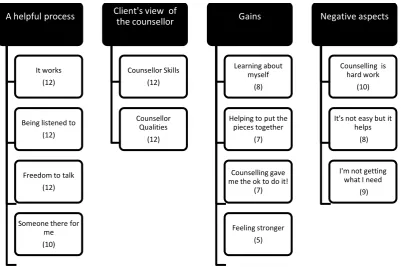
9 Table 1 Superordinate themes supported by subordinate themes
The analysis provided rich, detailed descriptions, giving insights into the participants' experience of CfD, their experience of the counselling process and what they achieved as a result of attending.
A helpful process: The definition of this superordinate theme encompasses the participants' identification that their CfD counselling had been a beneficial undertaking for them. The subordinate themes (as identified in Table 1 above) clarify the components that made it so.
All the participants said their counselling had worked for them, that is in their view it was effective. The participants identify that changes had occurred and there was full consensus that they felt better at the end of their counselling. Sarah described her counselling
"You know it was just so brilliant. It just worked. You know it really worked for me".
Lorraine concurs and states
A helpful process
It works (12)
Being listened to (12)
Freedom to talk (12)
Someone there for me (10)
Client's view of the counsellor Counsellor Skills (12) Counsellor Qualities (12) Gains Learning about myself (8)
Helping to put the pieces together
(7)
Counselling gave me the ok to do it!
(7)
Feeling stronger (5)
Negative aspects
Counselling is hard work
(10)
It's not easy but it helps
(8)
I'm not getting what I need
10
"To be honest it has been life changing."
Similar comments were found in all of the transcripts giving a sense of a remarkably beneficial process with positive results. Such comments are in keeping with the therapeutic stance of CfD being primarily relational, and reflects the care that was taken in developing the meta-competencies of CfD to avoid criticisms that competence-based approaches become reduced to a series of 'rote operations' (Sanders & Hill, 2014, p.29). The CfD competencies are designed to avoid mechanistic practices and a balance is struck between non-directive responding and therapeutic interventions (Sanders & Hill, 2014).
All of the participants valued being listened to. Within the transcripts there was a sense of the counsellor listening with understanding. This was felt to be purposeful listening to ascertain clients' emotions and the personal meanings attributed to what they are discussing in their sessions. The counsellor not pathologising, the absence of someone else's agenda, having uninterrupted time and clearly receiving attention were recognised as positive aspects of the participants’ counselling experience. As Isabel comments:
"The way she was listening to me, she listened very attentively to everything and she would paraphrase it afterwards and things, so I do feel that she heard exactly what I
said and was trying to help me. "
Listening facilitates the building of the therapeutic relationship, as well as identifying the work to be done. Being listened to offers a sense of being valued and is felt to be gratifying. Listening is highlighted here as a prized undertaking, demonstrating the counsellor's
dedicated focus on the client. This links to the Basic CfD competencies, in particular
"Knowledge of the person centred theories of human growth and development and origins of psychological distress" (Sanders & Hill, 2014, p.201). Additionally, the CfD
11 but coherent manner; capacity to adapt interventions in response to client feedback; working with the whole person. These metacompetencies seek to enable a balance between the therapeutic relationship and the therapeutic task (Sanders & Hill, 2014).
The opportunity of having space, time and permission to talk freely appeared to offer participants something unavailable to them elsewhere. This opportunity was very much appreciated and seen as helpful by the participants. The idea of different boundaries in the counselling space, where confidentiality was upheld, meant that internal worlds could be revealed and communicating openly was cathartic in itself. It was summed up by Lily who stated:
"I find it very stressful to admit these thoughts to anyone, even my family. The counsellor is the only one that knows. It was a relief to say it out loud.".
Participants referred to struggling to say what they needed to say to people around them as they did not want to be a burden or they feared hurting the people they loved. Within this theme of "A helpful process" is the intrinsic idea of the counsellor being seen as a stranger; someone outside of family and friends, someone with no connections to anyone in the client's life. The latter was particularly important as there was a fear of being judged if they were to disclose to someone close, possibly resulting in them being viewed negatively or being treated differently. Gillian suggested:
"It was a stranger and I knew she didn’t really know my family or people that I knew.
She didn’t know anybody that I knew and she couldn’t discuss me to other people.
There were no connections".
12 self-expression and also demonstrate delivery of the specific CfD competency of helping clients to 'process their emotional experience and expand their self-awareness' (Sanders &Hill, 2014, p.35). This was achieved through delivery of the specific CfD competencies of; helping clients access and express emotions, articulate emotions, reflect on and develop emotional meanings and lastly, helping clients make sense of experiences that are confusing and distressing.
Having the counsellor there in a supportive relationship contributed to the confirmation that CfD worked. The counsellor is seen as a support as Sarah explains:
"Just being able to articulate and that person being able to hold it for you and be with you in it. It just felt so supportive. Someone just there for you. For that bit of you,
at that time".
The sense of being recognised and validated by a trained, skilled and empathic counsellor was valued by the participants. It is evident that the role the counsellor adopts is one that is not filled elsewhere, and this is determined by the quality and strength of the therapeutic relationship. The work of therapy is underpinned by this relationship and clients feel held and supported within it. Pertinent here are the Basic CfD competencies of the ability to initiate, develop and maintain therapeutic relationships. The context of such therapeutic relationships should be within their fundamental foundation of the Rogerian core conditions of empathy, unconditional positive regard and congruence (Rogers, 1957).
Client's view of the counsellor:
13 their qualities and by their skills. Counsellor "Qualities" were described as innate attributes where the counsellor was seen as a nice person, impartial, calm, genuinely concerned to help, honest and supportive. The collective view being
"She is the right person for me to work with".
The counsellor is seenas a consistent and containing support with whom clients can feel safe.
With regard to Counsellor"Skills", the counsellor was felt to be using these to develop the counselling work. Skills that are specific CfD competencies such as helping clients to access and express emotions, helping clients to articulate emotions, helping clients reflect on and develop emotional meanings and helping clients to make sense of experiences that are confusing and distressing. It was the counsellor’s skills that facilitated the work the participants felt unable to do on their own. Sandra states:
"How I felt about myself and challenging that, that was a big part , I don’t think I
could have done that on my own, because I wasn’t aware of it".
It is due to the counsellor's input, reflecting, clarifying and challenging that this realisation takes place, enabling and empowering the participants to make changes. The skills inherent within CfD competencies reflect the ability of the counsellor to both engage with the client and also work according to the philosophy of the approach (Sanders & Hill, 2014).
Gains:
14 There were clear gains that came from the CfD experience; learning about self, clarifying matters, gaining insights and understanding and being able to make helpful changes. The counselling process was experienced as empowering and helped participants to feel stronger.
CfD was described in superlatives such as: "amazing", "brilliant", "magical". However, the participants reported their counselling worked for them in different ways. For example Steve described how his counselling has changed what he does; he can now tidy his house, whereas for Sarah it has changed how she feels and for Isabel and Joanne, it has enabled them to learn how to do things differently. This reflects a shift in the locus of evaluation and conditions of worth, moving from a state of incongruence at the start of therapy to a point at ending
whereby Steve now feels he is a worthwhile person who deserves to spend time on himself and spend time looking after his environment so it is pleasing to him. For Sarah, although she presents her learning differently, there is still a shift in her locus of evaluation and conditions of worth where she can now allow herself to be who she is instead of adapting to meet the expectations of others. Likewise for Isabel and Joanne, there is a move away from old patterns in response to others and a move toward doing things in a new way that better meets their needs. All of these descriptions highlight a move towards what Rogers would call "self actualisation", replacing the old value system based on distorted introjections and putting in their place an organismic valuing experience (Rogers, 1951).
Ultimately, counselling was felt to be a learning process that resulted in making helpful changes. Lorraine suggested:
"The counselling allows you the space to talk and think and then you can take that away and use it in a positive, productive way."
15 consistent with the Basic CfD competencies in particular those relating to "knowledge of person centred theories of human growth and development of psychological distress" (Sanders & Hill, 2014, p.201).
Negative aspects:
This theme is defined by aspects of the counselling process that distressed or frustrated the participants and compounded their struggle to get what they needed. The unhelpful aspects of therapy that were reported could have been inherent within any model of therapy. For
example being in the process of therapy was felt to be hard work. There was unease and discomfort that was hard to tolerate, looking inward was difficult and the process of change was frightening to contemplate. As Isabel acknowledged:
"I found every week was too gruelling, I use that word but it was too hard on me
because I did feel quite worn out with it as well, you know going through that really
deep, deep emotional stuff."
The level of distress is considerable and reiterated by Steve:
"I sometimes came out and it was where I had to put my dark glasses on because I
had been crying that much."
Feelings surface in a facilitative counselling environment. Within such an environment feelings do not need to be contained and so they flood out, often being experienced as both uncomfortable and cathartic simultaneously.
16 the depth of the work causing them either to pull back leaving some work undone, or because there was insufficient time to complete the work it necessitated an onward referral to another service, a situation less than ideal.
Discussion
The research on CfD is minimal; this is the first study to explore the effectiveness of the model from the client perspective. This study was informed by phenomenological,
hermeneutic and existential approaches that considered the meaning of experiences for clients taking part in CfD. In research, as in therapy, there is an interpretive aspect and therefore it is not possible to be assumption free or to move beyond the influence of experience on
understanding (Hollway & Jefferson, 2000). Researcher influences were acknowledged, in the hope that such self-awareness would allow the themes to be data driven rather than have meanings imposed upon them. Guiding the interpretation was the double hermeneutic of questioning how the participant is making sense of their experience and how I, as the researcher, was making sense of their making sense (Larkin et al., 2006).
Having received CfD each participant is clearly saying their therapy has worked or was effective for them. The effectiveness of counselling has been defined as having an intended outcome "to bring about change in the domains of psychological and behavioural
functioning" (Hill & Brettle, 2005, p.266). From a position whereby clients start therapy defined by Rogers (1951) as incongruent, where conditions of worth prevent organismic valuing, the participants describe their experience of CfD as helping them to live more fully and be more comfortable with who they are. The participants recognised they could work at their own pace on material that was important for them. These findings concur with
17 also report increased awareness, insight, behavioural change, problem solution,
empowerment, relief, emotional experiencing, client involvement and feeling understood.
What was clearly demonstrated in this study is that counselling is inherently unpredictable. It works in different ways for different people and what they take from it differs too. What is being reported here are individual responses to what is ostensibly the same process; CfD derived from a competency framework. This framework is intended to standardise practice, yet it has clearly managed to meet the participants' varying requirements.
In the current climate of evidence-based practice the decision of what is effective therapy rests with NICE (NICE, 2009) and is primarily based on a hierarchy of positivistic research evidence. However, for person centred counselling it is crucial to understand the clients' view of what they believe to be effective therapy. Participants in this study answered a specific question of " What do you feel makes therapy effective?" From their answers a clear definition of what was important to them and what they needed their counselling to deliver was established:
Effective counselling is defined by the participants as:
Having a skilled, accepting counsellor to attentively listen to them in a safe
18 This can be viewed as a client derived definition of effective counselling, based on their CfD experience.
It could be said that the focus of this research was on the core skills of counsellors who deliver CfD but actually the research has done much more than that. It has also been able to report on what the participants experienced and how the therapy worked for them. From this, the research has been able to generate an original definition of what clients feel makes therapy effective based on their experiences of CfD.
Similarly, one may draw the conclusion 'that the counsellors in the study seemed to satisfy their clients', but one cannot set aside their counsellor training in CfD and simply choose to disregard aspects that may impact on practice and ultimately the outcome of this study. The fact that CfD is difficult to see at work apart from good Rogerian / Person-Centred
counselling is to its credit and reflects the capable ability of the counsellors delivering the CfD model and the skill of the developers who have negotiated the tricky task of creating a manualised therapy able to meet individual need. CfD is supported by a research base that meets the criteria of NICE and it also meets the subjective needs of the individual in counselling. This success should not render CfD invisible, but rather be celebrated as very useful approach for helping people in distress.
Limitations
19 randomly selected, but were recruited via the counsellors working with them. This may have had an impact on who was asked to participate. It must be presumed that the clients who agreed to participate were interested in the project. It has been suggested that people
participate for many different reasons in a research study, considering the costs and benefits to themselves and to others (Bourne & Robson, 2013). It could be argued that this form of selection, on the part of therapists and the clients themselves, may have created bias which in turn could have impacted on the findings (Mitchell & Jolley, 2013).
A further limitation was that of using the HAT forms and the poor response rate. Participants reported losing them or throwing them away, and some participants only completed two or three forms rather than one for each session. This meant that the data captured after each particular session was limited.
Implications for practice
At the inception of the competency framework there was concern that it would change the nature of counselling from its non-directive stance to one whereby the ways of working were directed. However, the findings from this study indicate this is not the case. The evidence presented in this study suggests CfD is a vehicle by which clients can have their psychological needs met.
20 key objective of the Layard report (2006) that up to now IAPT has struggled to meet (Pearce et al., 2012).
The definition of what these participants feel makes therapy effective for them is currently the only definition of what clients consider to be effective therapy based on their experience of CfD. Moreover, it stands as a challenge to the medical model of evidence-based practice, as what is presented here is practice-based evidence, defining and articulating what is effective from the very people who have been through the experience.
The findings from this study highlight there are aspects of the counselling experience that participants felt were problematic. Time limited sessions were felt to curtail what could be told and/ or there was not enough time to finish the work. There is evidence that half of clients seen in IAPT services feel the number of sessions are insufficient (BACP, 2014). The profession needs to hear what clients are saying and respond in a way that meets their needs, but in achieving this organisational time restraints will need to be replaced with more flexible ways of working.
Conclusion
21 be construed as a constructive bridge between prizing the subjective needs of the clients and the demand for evidence-based practice. The participants in this study are saying "this counselling is helpful for me, I like it and it effectively meets my needs".
References
Barth, J., Munder, T., Gerger, H., Nüesch, E., Trelle, S., Znoj, H., Jüni, P. & Cuijpers, P. (2013). Comparative efficacy of seven psychotherapeutic
interventions for patients with depression: a network meta-analysis. Public Library of Science Medicine, 10(5): 1–17. doi:10.1371/journal.pmed.1001454
Berg, C., Raminani, S., Greer, J., Harwood, M. & Safren, S. (2008). Participants' perspectives on cognitive-behavioural therapy for adherence and depression in HIV. Psychotherapy Research, 18 (3),271-280. doi: 10.1080/10503300701561537.
Bohart, A. C. (2000). The Client Is the Most Important Common Factor: Clients’ Self-Healing Capacities and Psychotherapy. Journal of Psychotherapy Integration,10(2), 127-149.
Bohart, A. C. & House, R. (2008). Empirically supported/validated
22 Bourne, A.H. & Robson, M.A. (2013). Participants’ reflections on being interviewed about risk and sexual behaviour: implications for collection of qualitative data on sensitive topics.
International Journal of Social Research Methodology, 18 (1), 105-116. doi: 10.1080/13645579.2013.860747
British Association of Counselling and Psychotherapy. (2014). Psychological therapies and parity of esteem: from commitment to reality. Retrieved 29 July, 2015, from
http://www.bacp.co.uk/admin/structure/files/pdf/13801_bacp%20psychological%20therapies %20and%20parity%20of%20esteem.pdf
Butler, A.C., Chapman, J.E., Forman, E.M. & Beck, A.T. (2006). The empirical status of cognitive behavioural therapy: a review of meta-analyses. Clinical Psychology Review, 26,17 – 31.
Chapman, L. (2012). CfD and pseudo-science. Therapy Today, 23(3), 40.
Eatough, V., Smith, J.A. & Shaw, R.L. (2008). Women, anger and aggression: an
interpretative phenomenological analysis. Journal of Interpersonal Violence, 23(12), 1767-1799.
23 Elliot, R. & James, E. (1989). Varieties of client experience in psychotherapy: an analysis of the literature. Clinical Psychology Review, 9 (4), 443-467.
Elliott, R. (2008) Research on client experiences of therapy: Introduction to the special section. Psychotherapy Research, 18(3), 239-242.
doi: 10.1080/10503300802074513
Elliott, R. (2010). Psychotherapy change process research: realising the promise.
Psychotherapy Research, 20(2), 123-135.
Elliott, R., Watson, J., Greenberg, L.S., Timulak, L., & Freire, E. (2013).Research on humanistic-experiential psychotherapies. In M.J. Lambert (Ed.), Bergin & Garfield‘s
Handbook of psychotherapy and behaviour change (6th ed.) (pp. 495-538). New York: Wiley.
Gordon , N. S. (2000). Researching Psychotherapy, the Importance of the Client's View: A Methodological Challenge . The Qualitative Report,4(3). Retrieved 27 October, 2013 from http://www.nova.edu/ssss/QR/QR4-3/gordon.html
Henretty, J.R., Levitt, H.M. & Mathews, S.S. (2008). Clients' experiences of moments of sadness in psychotherapy: a grounded theory analysis. Psychotherapy Research, 18(3),
24 Hill, A. & Brettle, A. (2005). The effectiveness of counselling with older people: Results of a systematic review, Counselling and Psychotherapy Research: Linking research with practice, 5(4), 265-272. doi: 10.1080/14733140500510374
Hodgetts, A. & Wright, J. (2007). Researching clients' experiences: a review of qualitative studies. Clinical Psychology & Psychotherapy 14(3), 157-163.
Hollway, W., & Jefferson T. (2000). Doing qualitative research differently: free association, narrative and the interview method. London: Sage.
Lambert, M. J. & Ogles, B.M. (2004).The efficacy and effectiveness of psychotherapy. In M.J. Lambert (Ed.), Bergin and Garfield'sHandbook of psychotherapy and behaviour change.(5th ed.). (pp.139-193) New York: John Wiley & Sons.
Lambert, P. (2007). Client perspectives on counselling: before, during and after. Counselling and
Psychotherapy Research, 7(2), 106-113.
Larkin, M., Watts, S. & Clifton, E. (2006). Giving voice and making sense in interpretative phenomenological analysis, Qualitative Research in Psychology, 3(2), 102-120.
doi.org/10.1191/1478088706qp062oa
Layard, R., Bell, S., Clark, D. M., Knapp, M., Meacher, M., Priebe, S., ... Wright, B. (2006). The depression report: A new deal for depression and anxiety disorders. Centre for Economic Performance Report, LSE.
25 Levitt, H.M. & Piazza-Bonin, E. (2011). Therapists' and clients' significant experiences underlying psychotherapy discourse. Psychotherapy Research, 21(1),70-85.
doi: 10.1080/10503307.2010.518634.
Linde, K., Sigterman, K., Levente, K. Rucker, G., Jamil,S., Meissner,K. & Schneider, A. (2015). Effective psychological treatments for depressive disorders in primary care systematic review and meta-analysis. Annals of family medicine, 13 (1), 56-68
Llewelyn, S.P. (1988). Psychological therapy as viewed by clients and therapists. British Journal of Clinical Psychology, 27, 223-237.
Luborsky, L., Singer, B., Luborsky, E. (1975). Comparative studies of psychotherapies: is it true that ' Everybody has won and all must have prizes'? Archives of General Psychiatry, 32,
995-1008.
Marzillier, J. (2004). The myth of evidence-based practice. The Psychologist17(7), 392–395.
McLeod, J. (2001). Introduction: research into the client’s experience of therapy. Counselling and psychotherapy research, 1 (1), 41
26 National Institute for Health and Care Excellence (2009) Depression in adults. Retrieved 22 February, 2013 from
http://www.nice.org.uk/guidance/index.jsp?action=download&o=45958
Pearce, P., Sewell, R., Hill, A. & Coles, H. (2012). Counselling for depression. Therapy Today, 23 (1), 20-23.
Proctor, G. (2015). The NHS in 2015. Therapy Today,26(9), 19-25.
Rogers, C.R. (1951). Client centred therapy: Its current practice, implications and theory. London: Constable.
Sanders, P. & Hill, A. (2014). Counselling for depression : a person-centred and experiential approach to practice. London : Sage.
Smith, J.A., Flowers, P. & Larkin, M. (2009). Interpretative phenomenal analysis :theory, method and research. London: Sage.
Smith, M. L., Glass, G. V. & Miller, T.I. (1980). The benefits of psychotherapy. Baltimore: The John Hopkins University Press.
27 Stiles, W.B.(2013). The variables problem and progress in psychotherapy research.
Psychotherapy, 50 (1), 33-41.
Timulak, L. (2007). Identifying core categories of client-identified impact of helpful events in psychotherapy: a qualitative meta-analysis. Psychotherapy Research, 17(3),305-314.
Timulak, L., Belicova, A. & Miler, M. (2010). Client identified significant events in a successful therapy case: the link between significant events and outcome. Counselling Psychology Quarterly, 23(4), 371-386.
von Belowa, C. & Werbart, A. (2012). Dissatisfied psychotherapy patients: A tentative conceptual model grounded in the participants’ view. Psychoanalytic Psychotherapy, 26(3), 211-229.
Wampold, B. E., Mondin, G.W., Moody, M., Stich, F., Benson, K. & Ahn, H. (1997). A meta-analysis of outcome studies comparing bona fide psychotherapies: empirically, 'All Must Have Prizes'. Psychological Bulletin,122 (3), 203-215.
Wampold, B. E. (2001). The great psychotherapy debate: models, methods and findings.
New York: Routledge.
28 World Health Organisation. (2014). Depression is a common illness and people suffering from depression need support and treatment. Retrieved from
http://www.who.int/mediacentre/news/notes/2012/mental_health_day_20121009/en/
Word count: 6361 Biography
Dr. Stacey Goldman is a BACP senior accredited counsellor practising in Manchester and she is registered with UKCP as a Psychotherapeutic Counsellor. She also works as a supervisor and as a counselling skills tutor at the University of Salford. Research interests include the client's perspective of counselling and what makes therapy effective.
Dr. Alison Brettle is a Reader in Evidence Based Practice at the University of Salford. Her background is in library and information science and evidence based practice. She has conducted a large number of systematic reviews and evaluation studies including a number in the counselling domain. She is a member of the Core Working Groups of a number of the BACP’s competency frameworks, with a particular expertise in finding the evidence regarding counselling research. Her research interests include systematic review methods and the roles, effectiveness and impact of librarians and she has published widely. She is currently Director of Post Graduate Research in the School of Nursing, Midwifery, Social Work and Sciences at the University of Salford.
Dr. Sue McAndrew is a Reader in Mental Health at the University of Salford. Her
29 therapeutic engagement and preparation for the emotionality inherent in mental health