Design Science: Choosing an appropriate
methodology for research in BIM.
Kehily, D and Underwood, J
Title
Design Science: Choosing an appropriate methodology for research in
BIM.
Authors
Kehily, D and Underwood, J
Type
Conference or Workshop Item
URL
This version is available at: http://usir.salford.ac.uk/38522/
Published Date
2015
USIR is a digital collection of the research output of the University of Salford. Where copyright
permits, full text material held in the repository is made freely available online and can be read,
downloaded and copied for noncommercial private study or research purposes. Please check the
manuscript for any further copyright restrictions.
Design Science: Choosing an appropriate methodology for
research in BIM
1
Dermot Kehily and
2Jason Underwood
1
School of Surveying and Construction Management
Dublin Institute of Technology, Dublin, Ireland
2School of the Built Environment
University of Salford, Manchester, United Kingdom
E-mail:
1[email protected]
2[email protected]
Abstract ̶ This paper discusses Building Information Modelling (BIM) in relation to proposing design science as a methodology for BIM research. The paper firstly outlines how BIM is changing construction work practices to a more collaborative and integrated set of procedures, facilitated through the application of modelling technologies. The use of traditional research methods for BIM research in the context of developing and subsequently evaluating a BIM process or technology is then questioned. The premise of this rationale is that BIM revolves around new practices and emerging technologies that propose to provide efficiency in delivering constructed assets in the built environment. Traditional academic research methods tend to focus on existing reality, which seeks to explain the existence of phenomenon in the built environment. However, BIM focuses on a new reality through a change in current work practices, thus, a methodology which facilitates an evaluation of this new reality is necessary. A practical approach to research is discussed whereby there is more participation in the research process by the researcher. Design science is a research methodology, which emanates from a practical research philosophy and outlines a formulated process for developing and evaluating a BIM technology or practice. This paper presents a four staged process to design sciences that could be implemented when developing and evaluating a BIM artifact.
Keywords ̶ BIM, building information modelling, design science, artifact, methodology
I I
NTRODUCTIONThis paper describes how BIM is a new approach to construction procurement and a new way of working for construction stakeholders facilitated through virtual technologies [1, 3]. Traditional academic research focuses on describing phenomena in existing reality rather than prescribing a solution that could change this reality [4]. BIM is a different way of thinking, a cultural change and a new approach/transformation to project delivery [3], thus it requires a research design which can facilitate the proposal and evaluation of this new way of working. If BIM research entails developing a new BIM solution, be it through a process or technological change, a practical research design that enables the researcher to develop the BIM solution and then to evaluate it will be necessary. A practical research
design known as ‘design science’ is discussed and is
proposed here as a relevant methodology to carry out BIM research. Design science outlines a cyclical development and evaluation process which can firstly outline an issue in the built environment; propose that a new process or technology could solve this issue and subsequently evaluate if the new solution is successful for its intended users and in its intended environment [5-7].
II BIM
set of procedures that have communication and information management at its core, facilitated with the application of modelling technologies.
Smith [9] and Taylor & Bailey [3] contend that BIM does not simply involve technology/software but rather a different way of thinking, a cultural change and a new approach to project delivery. BIM brings together participants in a collaborative, cooperative and proactive manner around a common source of information [10]. The focus on the model and modelling technology provide the means whereby there is a smooth flow of information throughout the design and construction life cycle, facilitating simultaneous work by multiple design disciplines on common platforms; whereby participants can share work seamlessly [9, 11, 12].
Thus, BIM is both a process focused on information management among participants of the project and a technology representing a digital model, where information about the project can be stored and transferred [11, 13].
Developments in BIM revolve around an innovative technology and the information management process and cultural change that emanate from this new way of working and transformation. Research in BIM can entail a technological development or new piece of software and a methodology is needed to evaluate whether this new development is usable and can affect change in the environment to which it is introduced. Traditional academic research methods deal with the description of an existing phenomena rather than the prescription of a new one, thus, a non-traditional research approach rooted in an applied philosophy is needed [4].
In the context of BIM research, a research approach is required that can be utilised to validate the technological change or process change to the BIM workflow. This paper presents an alternative methodology to traditional research strategies that allows researchers carrying out BIM research to develop and subsequently evaluate a solution to a fieldwork problem that could be addressed by BIM.
III R
ESEARCH PHILOSOPHYOntological arguments have revolved around
whether ‘reality’ is external to individual influence and thought and is not dependent on the views or
actions of the observer (‘realism’), or whether the
cognitive process is part of the knowledge equation,
(‘nominalism’) [14]. It is necessary to discuss the essence of ontological assumptions when researching a specific discipline such as BIM, because these assumptions shape how knowledge is perceived and thus how it is obtained in that discipline [15].
Dawood & Underwood [16] state the failure of a great deal of research arises from the researcher
not firstly understanding their own philosophical assumptions. Cohen et al. [14] state that one of the reasons for this is that researchers automatically
orientate themselves to a ‘realist’ view of the world
because of its traditional dominance in scientific research, even if their research may be better served by a ‘nominalist’ approach [17, 18].This issue can be observed in the built environment where quantitative research is the prevalent methodology [19].
Once the researcher understands the deeper discussion of reality (ontology), they can go about discovering the nature of it (i.e. epistemology) [15]. Any researcher undertaking research will need to convincingly argue how their research contributes to knowledge in a given field [15, 19, 20]. Epistemology deals with the nature of this knowledge and a firm understanding of how others in your field acquired their knowledge is necessary if you are to build upon it [21].
A ‘positivist’ epistemological position
emanates from a realist ontological approach and is the prevailing research philosophy in built environment research [19]. Positivism as outlined in Fellows & Liu [22] and Suanders & Tosey [15] recognise only objects and patterns which can be observed and measured by an observer who remains uninfluenced by the observation and measurement. However, is this philosophy the most appropriate approach for research in BIM where proposing a new technology or different way of working may involve participation by the researcher in the research process?
Chynoweth [17] states that the built environment academic interdicipline and practices within the construction industry are based on relationships, multidiciplinary processes and artificial constructs. BIM is particularly applicable to this ideology as it is an associated set of procedures across the multidiscipline spectrum of the construction supply chain, facilitated with the application of modelling technologies [1]. Fellows & Liu [22] state that understanding in the built environment is better facilitated through an
‘interpretative’approach, which “reveals truth and reality through determining the perspectives of the participants in the process”. This is important from a BIM perspective because BIM brings together participants in a collaborative, cooperative and proactive manner through a common source of information [10] thus, ‘truth and reality’ of these
facilitate, firstly, the development of the new process or technology and then a means to evaluate its effectiveness. Explaining a problem in the built environment through descriptive research is only part of the research equation for BIM researchers. A research design is necessary that can account for a successful solution to the problem [4].
Voordijk [6] states there are a number of other epistemologies that expand the methodological base in favour of alternative more practical approaches. Notable epistemological positions in the context of practical research are outlined by Creswell [20, 23]
as ‘advocacy/participatory’ and ‘pragmatism’.
Creswell [23] proposes that researchers who hold these worldviews feel that positivism and interpretivism do not entirely fit with the goals of their research.
Creswell [23] outlines that an
advocacy/participation position maintains that research should contain an action agenda for reform, that may change the lives of the participants. Robson [24] states that pragmatism focuses on “what works”, combining elements of different methods
from philosophical positions. However, in pragmatism the researcher is not aligned to one system of philosophy but rather uses multiple methods to best answer the research question [23].
Advocacy/participatory and pragmatism resonate with respect to BIM research because traditional approaches tend to study phenomena that have already occurred [25], while developments in BIM create a new reality in a practical setting. Thus, an alternative practical approach to BIM research is worthy of consideration and these philosophies offer a route to develop solutions to fieldwork problems.
IV
R
ELEVANCE OFA
CADEMICR
ESEARCH INP
RACTICEVan Aken [4] and Susman and Evered [26] agree that there is a disconnection between academic research and their practical application. They state that this issue is rooted in the widening gap between sophisticated and complicated research methods in academia and the need for a quick solution in industry. Barrett & Barrett [27] explain that academics spend much of their time paying homage to research methodology, carrying out protracted research and writing up detailed and extensive reports. Barrett and Barrett [27] state that industry is impatient with this type of lengthy research and there is a desire for short solution orientated guides that are easily implemented into practice.
Van Aken [4] outlines an approach to improve the relevance of academic research. She advocates the use of Gibbons et al. [28] ‘mode 2 research products’, which she states, provides a framework for relevant academic research for practice. The difference between mode 1 and mode 2 research
products outlined by Kelemen & Bansal [29] and Voordijk [6] is that mode 1 follows traditional research practices in universities, where problems are defined by the intellectual interests and preoccupations of academics. In contrast, they outline that mode 2 research is driven by the practical applicability of knowledge which is outlined by issues that emerge in industry, in research centres, think-tanks, consultancies, government agencies, laboratories and companies.
Voordijk [6] states that mode 2 knowledge “is less concerned with discipline base but crucially concerned with knowledge as it works in practice in the context of application”. Aram & Salipante, Jr. [30] state that mode 2 knowledge production “results from a convergence of specialised disciplines often working in different institutions in the context of a defined problem”. If this statement is true, mode 2
knowledge production may work well in finding solutions to issues in the built environment inter-discipline through a more integrated approach between disciplines. It may also provide a means
where “practice in the context of application” [6] can be assessed and new knowledge presented as a validated solution.
V D
ESIGNS
CIENCESAn applicable use of mode 2 research is the
approach of ‘design science’, which Van Aken [4]
outlines as a core mission “to develop knowledge that can be used by professionals in the field to design solutions to their field problems”. Kuechler &
Vaishnavi [31] state that design science is gaining prominence as an appropriate research method which can improve the relevance of academic research for practical use. Van Aken [4] and Hevner et al. [7] outline design science as a solution orientated research strategy with a focus on developing knowledge that can be used by professionals in practical contexts. Voordijk [6] also proposes that design science is a knowledge creating activity that corresponds to prescriptive research which he states has a focus on improving aspects of the built environment rather than a descriptive strategy which just explains phenomena in the built environment.
Johannenson & Perjons [5] state in design science a ‘solution’ to a field problem takes the form of what is known as an artificial construct (‘artifact’), “which they describe as an artificial object made by humans to solve practical problems”.
likely to be an idea, practice or partial product rather than a fully realised ready for business ICT solution and thus this is where the difference lies between an artifact and a piece of software.
Applying this principle to research in BIM, the research would not necessarily have to constitute a fully developed BIM interface but rather what Van Aken [4] describes as a ‘technological rule’, which outlines the procedures and workings of the proposed idea or partial system [7]. From this perspective it is a good fit for BIM academic research where the idea could be proposed by a researcher and possibly be implemented by a software vendor in the future.
Johannenson & Perjons [5] and March & Smith [32] state that the research output in design science is not just the artifact itself, but also the affect the artifact has on the environment to which it has been introduced. This is what makes design science more than a usability evaluation of software, where the methodology facilitates introducing the artifact in the work environment or presenting it to potential users. This aligns with an interpretative approach
where a new “reality is revealed through determining the perspectives of the participants”
[22] by exposing them to the artifact.
Hevner et al. [7] states that when carrying out design science research it is important that the process is well defined and articulated, so that if the researcher is interested in developing a ‘means to an end’, ‘a solution’, that there is an explicit phased process to its development and evaluation.
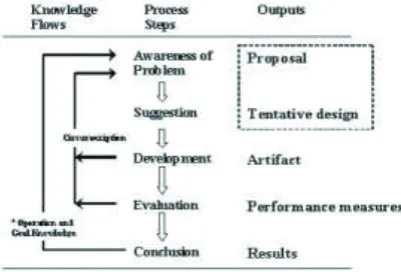
Holmstrom et al. [33], Hervner et al. [7], March & Smith [32], Johannenson & Perjons [5] and Azhar et al. [25] all articulate similar frameworks, albeit using different terminology (Figure 1). These strategies outline four common phases; (a) diagnosing a problem; (b) proposing (developing) a solution; (c) implementing the solution & evaluating the process in action; and (d) specifying learning.
[image:5.595.66.267.585.721.2]The following headings address in more detail the stages outlined in design sciences and comment on the similarities outlined by publications in the field.
Figure 1: General methodology of Design Science
a) Diagnosing the problem
Johannenson & Perjons [5] state that the starting point for the design science researcher is that
“something is not quite right with the world and it has to be changed”. Holmstrom et al. [33] outline the first phase of design science is to address what is
wrong, by “diagnosing the primary research problem”.
Johannenson & Perjons [5] suggest that there may be a need to carry out primary research at this phase to investigate and determine the nature and prevalence of the problem. Alternatively, Azhar et al. [25] state that the research issue could involve self-interpretation through reflection or an initial literature review. Hevner et al. [7] also explains that diagnosing the problem can be achieved through the existing knowledge base by reviewing literature in the field such as academic papers, practice-based publications and industry reports.It may be the case, that the problem has been well reported and published but that a solution has not been addressed. An applicable example in BIM research is an investigation into current work practices where an issue is identified which could be made more efficient by a BIM approach to project delivery. Alternatively, a BIM technology (artifact) could be utilised to automate a process that is complex and long-winded in traditional 2D practices.
b) Proposing (developing a solution concept –‘the
artifact’)
Voordijk [6] and Hervner et al. [7] propose the second step is to develop the ‘technological rule’
(artifact) which will address the practical problem. Hevner et al. [7] state that designing and building this artifact is the process of constructing a solution concept (method or system) for a specific purpose. Constructing a technological solution in design science demonstrates that the process can be automated and enables a change in current work practices [7]. For the solution to be relevant from an academic perspective the process to develop the artifact must be transparent. This requires an explanation of the development process and the decisions that were made as the artifact evolved.
grounding, thus a cyclical process of reflection and action is embedded in design science [4, 6, 7]. This cyclical process is required where the artifact needs to be developed through what Azhar et al. [25] calls self-interpretation. This is a speculative process, proposing a solution that the researcher believes will work prior to any validation by the users [5, 6]. This is not a methodology in itself but a practice that is utilised through this stage of the research prior to implementing the developed solution in action (workplace or simulated workplace). In proposing a BIM technology as a solution to a field problem, the researcher would need to not only outline the developed artifact, but how this artifact was developed and the reflective process/decisions made when developing the final solution. This is outlining
the ‘technological rule’ behind the artifact. This process should give rise to a number of different demonstrated iterations as the solution/technology evolves.
c) Implementing the solution and evaluating in action
Sagor [36] stresses that this is where it must be determined what is accomplished by the change and to carry this out a mechanism for evaluation must be proposed. The utility, quality and efficiency of an artifact must be rigorously demonstrated via well executed evaluation methods [7]. Evaluation requires some way of determining how successful the proposed change is in its environment or simulated environment [5, 7].
Voordijk [37] states that evaluation should start with the development of measurers and criteria which represent the goals of the process, the artifact’s performance is subsequently evaluated
against these criteria. Voordijk [37] states that the criteria are based on the ability to perform the intended task, the ability of actors and organisations to effectively use the method, its efficiency, its effectiveness, its ease of use and its impact on the work environment and its users. Nielsen [38] and Faulkner [39] outline these criteria as the ‘goals’ of
the process which are determined by the system’s
usability.
Voordijk [6] states that methods used to carry out evaluation can be interviews, surveys, case studies and simulation (through empirical testing) with the intended users. Holmstrom et al. [33] and Johannenson & Perjons [5] state that one of the best evaluation methods is empirical evaluation. Through empirical evaluation the artifact can be evaluated to validate that it actually works for its intended users and in its intended environment. Nielsen [38] states that empirical evaluation can be carried out by simulating the process in a lab environment or evaluating the artifact in-use, in the workplace.
Other than stating that empirical evaluation can be used as a method in design science, there is little in design science publications that propose a formulated approach to empirical evaluation. Thus, usability evaluation procedures utilised in software development were investigated to determine if they could be used as an approach to evaluate the design science artifact.
Schneiderman & Plaisant [40] state that design science pays attention to the affect human factors have on computer systems and the affect computer systems have on the user. The concept of Usability Engineering (UE) is an empirical evaluation tool which endeavours to addresses the usability of a system by proposing a process which ensures that the system is fit for purpose for which it was designed [38, 39]. Nielsen [38] and Faulkner [39]
outline what they call a ‘UE life cycle’ which starts
with the evaluation of the user and the task that they will be carrying out and continues on through an iterative process of reflection, change and assessment. The formulated UE life cycle outlined by Faulkner and Nielsen is cognisant of the theoretical grounding in design science methodology, where the process is iterative and includes adherence to a design, evaluation and a redesign cycle.
Assessing a technological solution through usability evaluation is at the centre of the UE life cycle. The method that is proposed in this paper to evaluate a BIM artifact is a usability evaluation method known as Thinking Aloud (TA) [38, 41, 42]. The TA method has a number of variants prescribed
on the basis of the designer’s interaction with the
user [43]. A TA process that involves greater interaction between the researcher and the user is
‘cooperative evaluation’. ‘TA cooperative evaluation’ combines empirical usability evaluation with a qualitative research design by integrating interview type questions into the traditional TA method. This method involves interaction and collaboration, where the user and the evaluator can both ask questions while using the artifact, but it also involves the evaluator steering the participant in the right direction while using the system or process [42].
The TA method is specifically suitable for BIM research as participants using a proposed new BIM interface may not have utilised a similar technology previously and thus will need to be guided on what to do.The objectives regarding the evaluation do not just specifically relate to the BIM product but also include questions on the overarching process of utilising a BIM approach and how this approach could provide efficiencies in their work practices.
Thus the method is both a usability evaluation and a research interview.
Johannenson & Perjons [5] and March & Smith [32] state that the research output in design science is not just the artifact, but also the affect the artifact has on the environment to which it has been introduced. This would instigate a process in BIM research that would entail evaluating a new BIM process or technology but also its ability to affect change and improve practice in a work setting. Herver et al. [7] notes that design science research should contribute to knowledge by applying knowledge in a new or innovative way. They state that this can be achieved on a number of fronts; the artifact/technology itself is demonstrated as a new and innovative product; an existing product is used to solve a practical problem in a different context to which it was designed; the research process can be
defined as a ‘general rule’ that could be applied to a
different problem and another situation and that the process and the artifact can affect change in its environment.
BIM research has the potential to satisfy a number of these criteria. The research may develop a new innovative technology to solve a practical problem or it may constitute an existing technology that is utilised in a manner it was not originally designed for. This gives researchers the potential to design their own solutions or work with existing ideas or technologies in an innovative way. What must be common to both approaches is that the artifact must be evaluated so that its ability to affect change within the environment it has been implemented can be addressed.
VI
C
ONCLUSIONSThis paper outlines a research methodology known as design science and proposes it as a relevant research strategy for research in BIM. Design science emanates from an advocacy/participatory epistemology which resonate with researchers looking to participate in the research process with a view to affect change in a practical setting. Design science proposes a cyclical process of development and evaluation, where learning is specified though the development and evaluation of what is outlined in design science as a ‘technological rule’.It is noted that the technological rule does not have to be a fully operational piece of software but can be a concept that could be engrained in an existing platform or used to develop a new working interface. This is applicable to researchers whom wish to present innovative BIM solutions and evaluate them in a work setting. A formulated research process is presented that provides an outline framework for potential BIM researchers following a design science methodology.
R
EFERENCES[1] C. Eastman, P. Teicholz, R. Sachs, and K. Liston, BIM handbook : A Guide to Building Information Modeling for Owners, Managers, Designers, Engineers and Contractors, 2nd ed. Hoboken, NJ: Wiley, 2011.
[2] W. P. Fung, H. Salleh, and F. A. M. Rahim, "Capability of Building Information Modeling Application in Quantity Surveying Practice," Journal of Surveying, Construction and Property, vol. 5, pp. 1-13, 2014.
[3] S. Taylor and C. Bailey, "Unlocking BIM Data," Questant2011.
[4] J. E. Van Aken, "Management Research as Design Science: Articulating the Research Products of Mode 2 Knowledge Production in
Management," British Journal of
Management, vol. 16, pp. 19-36, 2005. [5] P. Johannesson and E. Perjons, A Design
Science Primer: CreateSpace, 2012.
[6] H. Voordijk, "Construction Management and Economics: The Epistemology of a Multidisciplinary Design Science,"
Construction Management and Economics,
vol. 27, pp. 713-720, 2009.
[7] A. R. Hevner, S. T. March, J. Park, and S. Ram, "Design Science in Information Systems Research," MIS Quarterly, vol. 28, pp. 75-105, 2004.
[8] T. Dzambazova, E. Krygiel, and G. Demchak,
Introducing Revit Architecture 2010, BIM for Beginners. Indianapolis: Wiley Publishing, 2009.
[9] P. Smith, "BIM and the 5D Cost Manager,"
Procedia-Social and Behavioral Sciences,
vol. 119, pp. 475-484, 2014.
[10] B. Outreach, "BIM In Practice," Australian Institute of Architects and Consult Australia, Australia2012.
[11] A. A. Ajibade and S. Venkatesh, "The Rocky Road to BIM adoption: quantity surveyors perspectives," in Joint CIB W055, W065, W089, W118, TG76, TG76, TG78, TG81 & TG84 International Conference on Management of Construction: Research to Practice, Montreal, Canada, 2012.
[12] D. Goucher and N. Thurairajah, "Advantages and Challenges of Using BIM: a Cost Consultant's Perspective," presented at the 49th ASC Annual International Conference, California Polytechnic State University (Cal Poly), San Luis Obispo, California, 2012. [13] J. Underwood and U. Isikdag, Building
Information Modelling and Construction Informatics. Hershey, New York: Information Science Reference, 2010.
[14] L. Cohen, L. Manion, and K. R. B. Morrison,
Abingdon, Oxon. ; New York: Routledge, 2011.
[15] M. Saunders and P. Tosey, "The Layers of Research Design," Rapport, vol. 30, pp. 58-59, 2012.
[16] I. Dawood and J. Underwood, "Research Methodology Explained," presented at the PM-05 - Advancing Project Management for the 21st Century, Concepts Tools & Techniques for Managing Successful Projects, Crete, Greece, 2010.
[17] P. Chynoweth, "The Built Environment Interdiscipline," Structural Survey, vol. Volume 27, p. 10, 2009.
[18] P. Clough and C. Nutbrown, A Students Guide to Methodology - Justifying Enquiry. London: Sage Publication, 2002.
[19] A. Knight and L. Ruddock, Advanced research methods in the built environment. Chichester, West Sussex, United Kingdom ; Ames, Iowa: Wiley, 2008.
[20] J. W. Creswell, Research Design: Qualitative, Quantitive, and Mixed Methods Approaches, 2nd ed. London: Sage, 2009.
[21] J. Grix, The Foundations of Research, 2nd ed. Basingstoke: Palgrave Macmillan, 2010. [22] R. F. Fellows and A. Liu, Research methods
for construction, 3rd ed. Oxford: Blackwell, 2008.
[23] J. W. Creswell, Qualitive Inquiry and Research Design: Choosing Among Five Approaches, 2nd ed. London: Sage, 2007. [24] C. Robson, Real World Research: A Resource
for Users of Social Research Methods in Applied Settings, 3rd ed. West Sussex: Blackwell, 2011.
[25] S. Azhar, I. Ahmad, and M. K. Sein, "Action Research as a Proative Research Method for Construction Engineering and Management,"
Journal of Construction Engineering and Management, vol. 136, pp. 87-98, 2010. [26] G. Susman and R. Evered, "An Assessment of
the Scientific Merits of Action Research,"
Administrative Science Quarterly, vol. 24, pp. 582-603, 1978.
[27] P. Barrett and L. Barrett, "Research as a kaleidoscope on practice," Construction Management and Economics, vol. 21, pp. 755-766, 2003.
[28] M. Gibbons, C. Limoges, H. Nowotny, S. Schwartzman, P. Scott, and M. Trow, The new production of knowledge : the dynamics of science and research in contemporary societies. London: SAGE Publications, 1994. [29] M. L. Kelemen and P. Bansal, "The
Conventions of Management Research and their Relevance to Management Practice,"
British Journal of Management, vol. 13, pp. 97-108, 2002.
[30] J. D. Aram and P. F. Salipante Jr., "Bridging Scholarship in Management Epistemological Reflections," British Journal of Management,
vol. 14, pp. 189-205, 2003.
[31] W. Kuechler and V. Vaishnavi, "The emergence of design research in information systems in North America," Journal of Design Research, vol. 7, pp. 1-16, 2008. [32] S. T. March and G. F. Smith, "Design and
Natural Science Research on Information Technology," Decision Support Systems, vol. 15, pp. 251-266, 1995.
[33] J. Holmstrom, M. Ketokivi, and A. P. Hameri, "Bridging Practice and Theory: A Design Science Approach," Design Sciences, vol. 40, pp. 65-87, 2009.
[34] D. A. Schön, The reflective practitioner : how professionals think in action. Aldershot: Arena, Ashgate, 1991.
[35] J. Dewey, How we think. New York: D.C Heath, 1933.
[36] R. Sagor, The Action Research Guidebook. London: Corwin Press, 2005.
[37] H. Voordijk, "Construction management research at the interface of design and explanatory science," Journal of Engineering, Construction and Architectural Management,
vol. 18, pp. 334-342, 2011.
[38] J. Nielsen, Usabilty Engineering. San Diego: Academic Press, 1993.
[39] X. Faulkner, Usability Engineering. Hampshire, United Kingdom: Palgrave, 2000. [40] B. Shneiderman and C. Plaisant, Designing The User Interface: Strategies For Effective Human Computer Interaction, 4th ed. United States: Addison Wesley, 2005.
[41] A. Holzinger. (2005) Usability Engineering Methods for Software Developers.
Communications of the ACM. 71-74.
[42] A. Monk, P. Wright, J. Harber, and L. Davenport, Improving Your Human-Computer Interface: A Practical Technique. United Kingdom: Prentice Hall International, 1993. [43] E. L. Olmsted-Hawala, E. D. Murphy, S.