2019 International Conference on Computer Science, Communications and Big Data (CSCBD 2019) ISBN: 978-1-60595-626-8
Computer Simulation Study on Microstructure Evolution of Super Alloy
During Tube Extrusion Deformation
Ling-yi WANG
1,*and Zhong-tang WANG
21
College of Information Technology, Shenyang Institute of Technology, Liaoning 113122, China
2
School of Materials Science and Engineering, Shenyang Ligong University, Liaoning 110159, China
*Corresponding author
Keywords: Computer simulation, Super alloy, Tube extrusion, Dynamic recrystallization.
Abstract. In view of the evolution law of the dynamic recrystallization of super alloy IN690 during
tube extrusion forming process, a method of combining finite element software and organization evolution model is put forward to simulate the microstructure evolution of the deformation process. First, a computer simulation geometry model for tube extrusion process of super alloy IN690 is established. Secondly, model of the dynamic recrystallization microstructure evolution and material properties and extrusion process parameters are determined. Thirdly, the functions of the microscopic organization simulation in the calculation software are developed secondly, and the related UGRAIN subroutine is compiled. Finally, the computer simulation of the microstructure evolution in the tube extrusion deformation process is carried out, and the ideal results are obtained, and the influence of process parameters on the dynamic recrystallization and grain size is analyzed. The results show that with the increase of extrusion deformation temperature, the area of fully dynamic recrystallization increases, and the average grain size of the tube increases. With increase of extrusion ratio, the area of fully dynamic recrystallization increases and the average grain size decreases. With increase of extrusion speed, the area of fully dynamic recrystallization decreases and the average grain size increases. The simulation results of the average grain size are in agreement well with the experimental results, and the relative error is less than 12%.
Introduction
Super alloy Inconel 690 (IN690) tube is widely used in industry. While extruding super-alloy IN690 tube, the microstructure and properties of materials are improved. Super-alloy IN690 has good characteristics, such as high strength, good corrosion cracking resistance and good metallurgical stability. It is widely used in equipment of steam engine, pressurized water reactor and other high temperature working environment. Because of the high strength and low plasticity of nickel-based alloy, super alloy IN690 tube is usually processed by multi-pass rolling process after drilling. But this method has low production efficiency and low material utilization. The hot extrusion method has the characteristics of high material utilization, high production efficiency and good product quality. In the process of extrusion deformation of super-alloy tube, the influence of the extrusion process parameters on dynamic recrystallization structure is significant [3]. When extrusion deformation temperature is 1150-1200 ℃, and extrusion speed is 80 mm/s and extrusion ratio is 6-10, super alloy IN690 has good structure and forming properties [4]. The dynamic recrystallization of super-alloy IN690 can take place by adopting reasonable deformation parameters, and the grain distribution is uniform and fine [5]. The effect of strain rate and deformation temperature on flow behavior of super alloy IN 690 is obvious. With increasing of deformation temperature, the activation energy increase and strain rate sensitivity decrease [6].
Geometric Model
The dynamic recrystallization and microstructure evolution of super alloy IN690 during tube extrusion deformation were numerically simulated by using finite element software. Because the deformation zone of extruded tube is axisymmetric, 1/2 of the deformation zone is taken as the research object, and four-node rectangular symmetric element is used to divide the mesh.
The geometric model is as follows: (1) Simplifying the forming process, the model consist of extrusion needle, blank, exterior die and extrusion punch. (2) Gridding, gridding blank and extrusion needle respectively, and gridding near the extrusion outlet. (3) Determining extrusion blank size of tube, with an external diameter of 116.3 mm, an internal diameter of 44.7 mm and length of 151 mm. (4) Determining size of the die, the diameter of the extrusion cylinder is 120 mm, the size of the die hole is 66 mm, and the half cone angle of the die is 60 degree. (5) Determining the extrusion speed, 10 mm/s, 40 mm/s, 100 mm/s, 150 mm/s and 200 mm/s, respectively. (6) The preheating temperature of the die is 350 ℃. (7) The heating temperatures of extruded blanks are 1150℃, 1170℃, 1200℃ and 1230 ℃, respectively. (8) The extrusion ratio is 5. The material parameters of super alloy Inconel 690 are as follows: the contact heat transfer coefficient between material and die is 30W mm2 K-1, and the thermal conductivity of material free surface is 0.35W mm2 K-1. The friction factor is 0.2.
The geometric model of tube extrusion is shown in Fig.1. The extrusion die structure includes extrusion pad 1, extrusion tube blank 2, extrusion needle 5, extrusion cylinder 3 and extrusion die 4. According to the symmetry of tube extrusion, a quarter of finite element model is selected.
Figure 1. Model of computer simulation.
Computing Model
In the process of tube extrusion, dynamic recrystallization is easy to occur during tube extrusion process in high temperature, because the deformed metals are subjected to three-dimensional compressive stress, large deformation and high temperature, which meet the requirements of dynamic recrystallization of metals. In this paper, the microstructural evolution model of dynamic recrystallization mechanism of super alloy IN690 is described by equation (1) and equation (2). Grain size model of dynamic recrystallization is seen as equation (1).
799
15
11150
19499
ln(
)
/
.
)
ln(
d
dyn
Z
T
(1) Percentage of dynamic recrystallization product is seen as equation (2).
134 1044
1
1
..
exp
c s c dynX
(2) In which, c s, Z is Zener-Hollomn parameter, Z exp
Q
RT
; cis the critical strain atThe constitutive relation model of super alloy IN690 is shown in equation (3) [7-8].
) 688641 exp(
] ) 003259 .
0 [sinh( 10
52 .
7 26 7.5325
RT
(3) In which, σ is material flow stress (MPa); is strain rate, s-1; T is deformation temperature, K.
Calculation Block Diagram
The tube extrusion process was simulated by finite element software. The microstructural simulation function of finite element software was redeveloped by fortran language. The UGRAIN subroutine which can predict the dynamic recrystallization process of IN690 was developed.
The complete dynamic recrystallization is defined that when the dynamic recrystallization fraction is greater than 95%, the grain size is dynamic recrystallization grain size, and then the grain size grows. The average grain size dAV is used to characterize the grain size of the non-complete
recrystallization: dAV d0
1Xdyn
ddynXdyn, in which, d0 is original grain size, ddyn is dynamicrecrystallization grain size, Xdyn is volume fraction of dynamic recrystallization.
Simulation Results and Analysis
A Volume Fraction of Dynamic Recrystallization
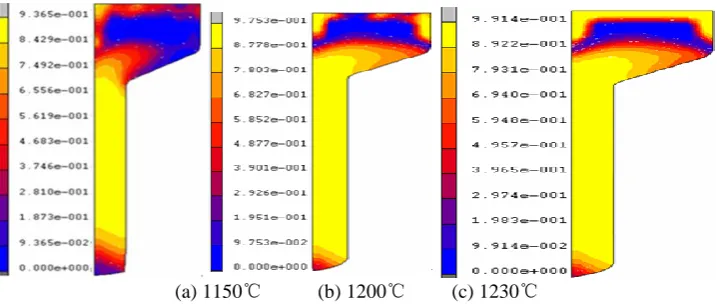
Effect of deformation temperature on volume fraction of dynamic recrystallization is obvious. When extrusion speed is 40 mm/s, the distribution of volume fraction at different deformation temperatures is shown in Fig.2. It can be seen that the volume fraction of dynamic recrystallization increases with the increase of deformation temperature, and the area of complete dynamic recrystallization increases with the increase of deformation temperature, which indicates that the increase of deformation temperature is beneficial to the occurrence of complete dynamic recrystallization.
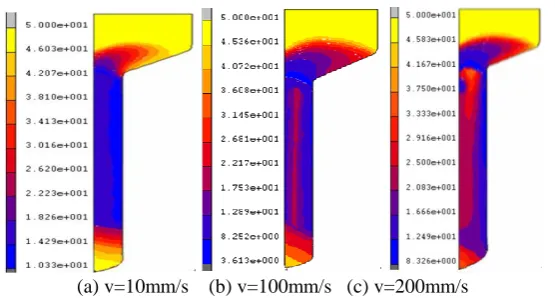
Volume fraction of dynamic recrystallization of extruded tube at different extrusion speeds is shown in Fig.3, which the extrusion temperature is 1200 ℃. It can be seen that with the increase of extrusion speed, the volume fraction of dynamic recrystallization of the tube tends to decrease, and the area of complete recrystallization also decreases. The reason is that the dynamic recrystallization nucleation and growth also take some time in the process at high temperature deformation. In this way, only when the strain rate is low enough, there is sufficient time for nucleation and growth.
[image:3.595.119.478.550.702.2](a) 1150℃ (b) 1200℃ (c) 1230℃
[image:4.595.147.459.72.212.2]
(a)v=10mm/s (b) v=100mm/s (c) v=200mm/s
Figure 3. Volume fraction of dynamic recrystallization at different extruded speed.
B Grain Size of Dynamic Recrystallization
Effect of deformation temperature on grain size and distribution is shown in Fig.4, when extrusion speed is 100 mm/s. It can be seen that the grain distribution is not uniform, the grain size of the outer wall and the inner wall is fine, and the grain size of the middle is coarse.
Effect of extrusion speed on grain size and distribution is shown in Fig.5, when extrusion temperature is 1200 ℃.It can be seen that the uniformity of grain distribution is poor with the increase of extrusion speed.
[image:4.595.173.425.350.493.2](a)1150℃ (b)1200℃ (c)1230℃
Figure 4. Grain size of dynamic recrystallization at different extrusion temperature.
(a) v=10mm/s (b) v=100mm/s (c) v=200mm/s
Figure 5. Grain size of dynamic recrystallization at different extrusion speed.
C Comparison of Simulation Results with Experimental Results
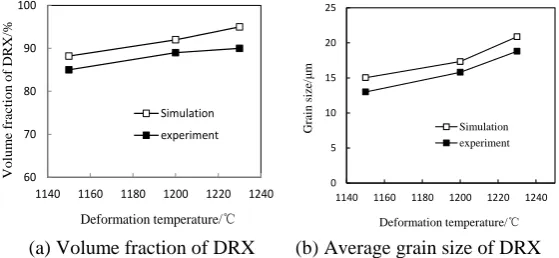
[image:4.595.161.439.515.664.2]experimental results. Fig.7 shows that the relative error between the simulation results and the experimental results is less than 12%.
[image:5.595.123.478.106.255.2]
(a)Volume fraction of DRX (b) The average grain size of DRX Figure 6. Comparison of experimental results and simulation results of microstructure.
60 70 80 90 100
1140 1160 1180 1200 1220 1240
V
ol
um
e
fr
act
ion
of
D
R
X
/%
Deformation temperature/℃
Simulation
experiment
0 5 10 15 20 25
1140 1160 1180 1200 1220 1240
G
rai
n
si
ze/
μm
Deformation temperature/℃ Simulation experiment
(a) Volume fraction of DRX (b) Average grain size of DRX Figure 7. Comparison of experimental results and simulation results.
Conclusions
(1) A computer simulation geometry model for tube extrusion process of super alloy IN690 is established, and model of the dynamic recrystallization microstructure evolution and material properties and extrusion process parameters are determined.
(2) The functions of the microscopic organization simulation in the calculation software are developed secondly, and the related UGRAIN subroutine is compiled.
(3) Computer simulation of the microstructure evolution in the tube extrusion deformation process is carried out, and the ideal results are obtained, and the influence of the process parameters on the dynamic recrystallization and grain size is analyzed.
(4) With the increase of extrusion deformation temperature, the area of fully dynamic recrystallization increases, and the average grain size of the tube increases. With increase of extrusion ratio, the area of fully dynamic recrystallization increases and the average grain size decreases. With increase of extrusion speed, the area of fully dynamic recrystallization decreases and the average grain size increases.
(5) The simulation results of the average grain size are in agreement well with the experimental results, and the relative error is less than 12%.
Acknowledgements
[image:5.595.155.435.283.412.2]Reference
[1] Dong Yi, Gao Zhi-yuan, Development of nuclear power industry and research of alloy Inconel 690 in China, Special Steel Technology. (4) (2004) 45-48.
[2] Shihong Zhang, Zhongtang Wang, Bing Qiao, Research on processing and micro-structural evolution of super-alloy Inconel 718 during hot tube extrusion, Journal of Materials Science and Technology. 21(2) (2005) 175-178.
[3] Peng Haijian, Li Defu, Guo Qingmiao, et al, Effect of deformation conditions on the dynamic recrystallization of GH690 alloy, Rare Metal Materials and Engineering. 41(8) (2012) 1317-1322.
[4] Qi Maishun, Simulation and experiment of nuclear power Inconel 690 pipe extrusion, Forging & Stamping Technology. 35(4) (2010) 116-123.
[5] Lv Ya-chen, Ren Yun-lai, Nie Shao-min, Study on extrusion technology of Inconel690 based on processing map, Journal of Plasticity Engineering. 16(6) (2009) 39-44.
[6] Woei-Shyan Lee, Chen-Yang Liu, Tai-nong Sun, Dynamic impact response and micro-structural evolution of Inconel 690 super-alloy at elevated temperatures, International Journal of Impact Engineering. 32(1-4) (2005) 210-223.
[7] Wang Zhong-tang. Deng Yong-gang, Zhang Shi-hong, Critical conditions of dynamic recrystallization for super-alloy IN690 based on hardening rate, Transactions of Materials and Heat Treatment. 35(7) (2014) 193-197.