2018 International Conference on Applied Mechanics, Mathematics, Modeling and Simulation (AMMMS 2018) ISBN: 978-1-60595-589-6
Resolving Micro-grid Energy Optimization Using Multi-objective Artificial
Bee Colony Algorithm
Jia-hua LI
*, Tung Truong Thanh
and Ming-li SHI
Northeastern University, College of Software, Shenyang, China
*Corresponding author
Keywords: Micro-grid, Multi-objective Artificial Bee Colony Algorithm, Load Dispatch Component.
Abstract. Aiming at the micro-grid energy scheduling, this paper proposes a bio-objective optimization model of the economic and emission dispatch, where two conflicting objectives of the fuel costs and pollution emission are constructed. In order to resolve this model, a multi-objective artificial bee colony (MOABC) algorithm is proposed by using the non-dominated sorting and best-candidate strategies. Especially, an external archive is used to preserve the non-dominated solutions and the best-candidate strategy is to select the best non-dominated solutions to maintain the diversity of Pareto optimal Solutions (PS). An experiment is conducted via comparing IBEA and BC-MOABC on a set of test instances. The results show that the BC-MOABC obtains better results in terms of the convergence on PF. Furthermore, we apply BC-MOABC to resolve the micro-grid energy scheduling optimization problems. Experimental results show that the proposed model and algorithm can reasonably arrange the distributed generations and reduce the system cost and gas emissions.
Introduction
With the rapid development of new energy sources, the micro - grid has become an effective scheme to deal with the disordered and difficult scheduling of the distributed power because of its flexible distributed operations. Accordingly, micro-grid has significant merits of high environmental benefits and low construction cost. In a micro-grid system, the scheduling of distributed generations and energy storages is a significant issue, which plays a key role in the economic, technical and environmental benefits [1]. In particular, in order to meet the demands of large-scale micro-grid system, the energy scheduling schemes should have the ability to accurately access the large-scale distributed power and renewable energy. Generally, the micro-grid energy scheduling problem usually contains large-scale nonlinear, non-deterministic and constrained control variables, essentially being regarded as a complex Multi-Objective Problem (MOP) [2]. As a result, many traditional optimization approaches are ineffective to resolve this problem because they are easy to get trapped into the local optima. Currently, there are many works on multi-objective optimization of micro-grid, which can be classified into two categories [3].
The first approach is to weight the normalization of each sub-object into a single target directly [4]. A typical method is to form a new objective function:
1 2
min([ , (1 ) ])
F F F
(1) whereis the corresponding weight coefficient according to the importance of objective function F1
and objective function F2 .The analytic hierarchy process (AHP) in [5] is used to weight the
sub-objects in the problem to obtain a total single target ,and then it is solved by the improved differential algorithm. However, this method has the subjectivity of the weight of the objective function and has a great influence on the result [6]. Meanwhile, the difference algorithm is easy to cause the population in the intelligent optimization algorithm to lose diversity due to the variation method [7].
the optimal solution can be determined by decision-makers according to the actual demand [11-15]. This method can remedy the first method that cannot provide appropriate tradeoffs between objectives. In [16]an improved particle swarm optimization (PSO) algorithm is developed based on Pareto optimal theory, by combining Monte Carlo simulation to solve multiple objective functions. In order to solve the problem that PSO algorithms may not converge and their parameters are too difficult to be determined, a quantum-behaved PSO algorithm (QPSO) [17] is proposed to optimize the economic and emission dispatch problem. The simulation results validate the superiority of QPSO algorithm, but this model does not consider the pollutant emissions. In addition, a new NSGA-II algorithm [18] is introduced to address the micro-grid energy scheduling problem [19]. The above algorithms still sometimes encounter premature convergence and being easy to fall into the local optima, which causes a slow convergence speed and a poor accuracy.
Artificial bee colony (ABC) [20] algorithm is an effective evolutionary optimization paradigm based on the intelligent foraging behavior of honeybees. In ABC, there are three kinds of honeybees to carry out the global and local search operations, including employed bees, onlooker bees and scout bees. Meanwhile, the ABC has been experimentally validated to have a powerful global search performance in a variety of complex optimization applications. Recently, there are some improvements on AHC to extend it to solve the multi-objective optimization problems [21-24]. For examples, in [21], a two-engine multi-objective artificial bee colony is proposed with reinforcement learning. In [23], a MOABC algorithm based on external archives is proposed for RFID networks planning problem. The above algorithms are mainly based Pareto dominance, which is used to determine the non-dominated solutions. Inspired by the above work, a novel multi-objective artificial bee colony called BC-MOABC is developed using best-candidate, which is inspired by the best-candidate sampling in sampling theory [25].
The contributions of this paper are summarized as follows:
1) We propose mathematical models of distributed generations, and based on these models, construct an economic and environmental energy scheduling model.
2) In order to solve the above model effectively, a multi-objective bee colony algorithm BC-MOABC based on best-candidate strategy is proposed.
Model Formulation
The optimal scheduling model of the micro-grid system includes input, output, scheduling system and optimization module [26], which is optimized by data interaction. In the model, there are many kinds of distributed generations (DGs) in micro-grid system which involves wind turbine (WT), photovoltaic array (PV), diesel engine (DE), micro turbine (MT) and fuel cell (FC). These DGs with different features will be presented in detail in following sections.
Micro-Turbine (MT) Model
Micro-turbine is a kind of newly developed small thermal generator. Compared with traditional generators, micro-turbine has some significant merits of low fuel consumption, low noise, and low emission. It uses hydrogen, natural gas, alcohol, and renewable fuels as fuel. In the cogeneration system, micro-turbine is a promising energy-saving and environment-friendly power supply because of the high integrated thermal efficiency [27].
The mathematical model of MT can be presented as below. Firstly, the heating gains function Cheat
and cooling gains function Ccoolof MT is formulated as follows:
heat h h
C Q K
(2)
cool c c
C Q K
(3) where Kh and Kc are price for heating and cooling, respectively, Qh and Qcare, cooling capacity and
h MT re heat
Q Q K
(4)
c MT re cool
Q Q K
(5) where ηre is residual heat efficiency of the MT, Kheat and Kcool are respectively heating and cooling
coefficients, and the exhaust heat of MT can be presented by the following equation:
(1 )
MT MT MT l MT
Q P
(6) where PMT is the output power of the MT during the calculation period ∆t in kw, ηMT is the power
generation efficiency of the MT, 50%, and ηlis the heat loss coefficient.
Then, the fuel consumption cost of the MT can be defined as:
( ) ( )
MT FUEL FUEL MT FUEL MT
C C L P
(7) where CFUEL is the price of natural gas, 9.7g/kw, and LFUEL is the net calorific value of natural gas, 2.9
¥/m3.
Finally, the operation and maintenance cost of MT can be shown as:
MT OM MT OM MT
C K P
(8) where KMT-OM is the coefficient of operation and maintenance cost of MT, 0.4 ¥/kw.h.
Fuel Cell (FC) Model
The fuel cell is a chemical device that converts the chemical energy of a fuel into electrical energy directly. Considering the energy consumption of the whole device system, the actual power generation efficiency of the whole power generation system can reach 45%~60% [28], and the power generation efficiency of the FC (ηFC) is regarded as 50% in this paper. The fuel consumption cost of
the FC is presented as:
( ) ( )
FC FUEL FUEL FC FUEL FC
C C L P
(9) where PFC is the output power of the FC during the calculation period ∆t in kw.
The operation and maintenance cost of FC can be defined as:
FC OM FC OM FC
C K P
(10) where KFC-OMis the coefficient of operation and maintenance cost of FC, 0.03 ¥/kw.h.
Diesel Engines (DE) Model
The diesel curve is used to describe the corresponding relationship between the power of diesel generator and the fuel consumption [29]. The fuel consumption cost of the DE is simply shown as:
DE FUEL DE FUEL DE DE
C K C P
(11) where KDE-FUEL is fuel consumption rate of DE, CDEis the price of diesel, and PDEis the output power
of the DE during the calculation period ∆t in kw.
The operation and maintenance cost of DE can be defined as:
DE OM DE OM DE
C K P
Optimization Problem Formulation
According to the wind resources, lighting resources and load demand in the scheduling system, as well as the economic indicators related to equipment investment, operation and maintenance costs, the capacity of various distributed power supplies in the system is optimized and designed. And then, two indicators are proposed, i.e., total cost of operation and pollutant emission level within the scheduling cycle. In this approach, the bi-objective optimization model is established, i.e., total operating costs and pollutant emission levels. Under normal conditions, there is a certain contradiction between the total operating cost and the pollutant emission level. That is, if the system pollution discharge is smaller, the more renewable energy is needed, and the less economical. Specifically, the objective function of the micro-grid scheduling is as follows:
For the micro-grid, the operation cost ƒ1 of the system can be descried as
1 FUEL OM EX DC heat cool
f C C C C C C
(13) where CFUEL, COM, CEX, CDC, Cheat, Ccool are, respectively, the fuel consumption cost of the DGs, the
operation and maintenance cost of the DGs, the interaction cost between micro-grid and grid, the depreciation cost of the DGs, the heating gains and cooling gains of micro-grid.
CEX and CDC are described as follows:
EX K GRID
C C P
(14)
max
(C ) ( 8760)
DC install CR DGs CF
C K P K
P (15)
(1 )L (1 )L 1
CR
K d d d
(16) where PGRID is the exchange power between micro-grid and grid, when PGRID is greater than 0, it
means that the micro-grid purchases power from the grid, and Ck is the purchase price of the
micro-grid from the grid. Conversely, when PGRIDis less than 0, it means that the micro-grid sells
power to the grid, and Ck is the price of power sold by the micro-grid to the grid. Pmax is the maximum
output power of DGs, Cinstall is the installation cost of DGs, the unit is (¥/kw.h), KCRis the coefficient
of capital recovery, KCF is the capacity factor, d is the interest rate, 6%, and L is the life of DGs, the
unit is (year ).
Diesel generators employ diesel as the main fuel, and their pollutants include NOx, SO2, CO2.
Meanwhile, wind turbines and photovoltaic cells are clean energy to ensure that their fuel consumption costs and gas emission treatment costs are zero. The emission treatment cost ƒ2 of other
DGs can be expressed as:
3
2 N
j ij i
i j
f a P
(17) where i is the number of DGs, αj is the treatment cost of jth class of pollutions, βij is the emission
coefficient of jth class of pollutions from the DG i, and Piis the output power of DG i in kw.
Proposed Optimization Algorithm
Standard ABC Algorithm
passing a message through dance. When employed bees come back to the hive, they will share information with the onlooker bees about the quality of the food source, which they are exploiting. Then, onlooker bees are responsible for selecting the locations of good food sources to exploit based on the information shared by the employed bees where the higher quality food sources are have a bigger change to be chosen by the onlookers. When the food source is exhausted or cannot be improved in a limited number of cycles, the corresponding employed bee becomes a scout bee. The model of swarm-intelligent forage selection in a honey bee colony can be described as follows [36-38]:
At the initial phase of the foraging process. Firstly, set relevant parameters of the population, which including population number, number of food sources, control parameters, maximum number of cycles and D-dimensional solution space. Then the food sources [i.e., xid= (Xi1, Xi2... Xid)] are
initialized randomly by the following equation:
(0,1)
id d d d
X L rand U L
(18) where i = 1, 2,…, N, d = 1, 2,…, D. N is the population size (the number of solutions). D is the number of variables, Ld and Ud represent the lower upper and upper bounds of the dth variable, respectively.
After finding a food source, the bee becomes an employed bee. They record the relevant information (position, nectar) and share with onlooker bee. For each food source, the foraging route for the employed bee is based on a random selection of neighbor to explore a new food source from the old food source in its memory. Specifically, the new food source is calculated as follows:
, , (-1,1) , ,
i j i j i j k j
V X X X
(19) where Vi,j is the newly produced position by individual i, j is a randomly selected dimension, k is a
randomly selected index represents a neighbor bee which is not equal to i.
In the onlooker bees phase, according to the quality of the source to calculate the probability (Pi)
which as index to guide individual to further mining. Piis computed as:
1
1 (x ) (x )
N
i i j
j
P fit fit
(20)
Proposed BC-MOABC Algorithm
The artificial bee colony algorithm (ABC) has been validated experimentally to perform powerfully in the single-objective optimization problem, with good global search and local search capabilities [39,40]. However, unlike the single-objective optimization, in the multi-objective optimization, there are a set of non-dominated solutions to be found, which are essentially tradeoffs between different objectives. Therefore, the multi-objective algorithm needs to maintain an appropriate balance of even spread and good convergence of the obtained non-dominated solutions. In order to address this issue, the non-dominated sorting technique is usually employing based on the crowing distance strategy. In this approach, the obtained solutions are assigned into several layers according to the domination relation, where individuals in the first layer are non-dominated solutions. And then, the density of an individual's neighbors in each layer is evaluated exactly based on the crowed comparison strategy, which is to maintain the spread of the obtained solutions. To be specific, it calculates the sum of obtained Euclidean distance values corresponding to each objective as the final crowding distance value assigned to the given solution. Given a solution, the density of solutions can be calculated as.
1, 1,
1M
i i j i j
j
D f f
(21) where Di is the crowded distance of the individual i, M is the number of objective functions, and ƒi,j is
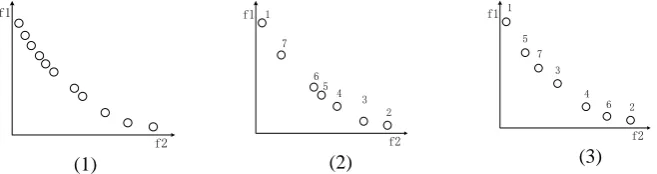
Note that, as the number of objective functions increases, the proportion of non-dominated solutions in the population increases accordingly. This causes a dilemma of being difficult to identify differences between two candidate solutions. In the traditional crowded comparison approach, the important individuals in the dense region will be deleted because they have a smaller crowd distance, which damages the diversity of the Pareto front (PF), as shown in Fig. 1 (2). From this figure, it is obviously shown that the solutions in the high density space have a low chance to be selected, which results a poor spread of PF. Aiming at this issue, many improved crowding comparison strategies are developed [41, 42]. Especially, in [42], a crowding-distance with performance indicators is a simple yet effective approach, exhibiting a promising performance.
In the proposed BC-MOABC, the external archive (EA) mechanism based on the best candidate are deliberately designed to conserve the non-dominated sources during the search process, and inspired by the best-candidate sampling algorithm, we replace the crowding comparison operators to select solution equably [43], comparing with [42], our proposed method can resolve the above problems effectively.
f1
f2
(1)
f1
f2
1
7
6 5
4
2 3
(2)
f1
f2
1
5 7
3
4 6 2
[image:6.595.136.465.273.360.2](3)
Figure 1. Selection operation. (1) Showing the original distribution of the solution. (2) Showing the distribution of the
solution using the crowded comparison operators. (3) Showing the distribution of the solution using best-candidate.
Suppose that we select K best-candidate solutions from N solutions, and the boundary solutions are selected firstly. When a new solution is selected, the best candidate solution in the unselected solutions which is farthest from the selected points is accepted, and the U storages the selected solutions, DIS[X] stores the minimum Euclidean distance that between x and the selected solution, and
dis(x1,x2) represents Euclidean distance between x1 and x2. Specifically, the algorithm steps in
Algorithm 1:
Algorithm 1 Best-Candidate Method
Step 1: The size of population O is N, select K solutions from O,U=Ø, DIS[x]=0
Step 2: Put two extreme solutions (boundary solutions)XU,YL into the U
Step 3: For each x in O-U
[x] argminxd U ( , )
DIS dis x xd
End For
Step 4: For i = 1 to K− |U|
x1arg maxx (OU)(DIS[X])
For each x2in O-U
1 2
2 2
[x ] min( [x ], ( , ))
DIS DIS dis x x ,
1 U U x
End for. End for.
Based on above strategies, this work enriches the classical ABC framework and through elite learning to balance exploration and exploitation, as shown in Algorithm 2.
Algorithm 2 BC-MOABC Algorithm Step 1: Population Initialization
1) Set relevant parameters, including maximum cycles (Cmax), Arch-size, N, D.
2) Initialize EA.
3) Generate N food sources in the search space randomly by (18). Evaluate the fitness of each bee. Iter = 0
Step 2: The stage of Employ bees 1) Generate new solution Vi,j by (19).
3) Get better solution by greedy selection. Add the better solutioninto EA. Step 3: The stage of Onlooker bees
1)Calculated the selection probability Pi by (20).
2)Generate new solution Vi,j by (19).
3)Evaluate f (Vi,j).
4)Get better solution by greedy selection. Add the better solutioninto EA. Step 4: The stage of Scout bees
1)Update solution by (18).
Step 5: If the number of non-dominated solutions in EA is greater than the Arch-size, the overcrowded members are excluded by Algorithm 1.
Iter = Iter +1.
Step 6: If the Iter is greater than Cmax, stop the procedure; otherwise, go to step 2. Step 7: Output archive.
Experiment Results
Experimental Configurations
The base capacity and reference voltage of micro-grid are, respectively, 100kVA and 400V. The WT and PV operate prioritized. The real-time electricity price of the micro-grid with the grid is based on the Shenyang electricity price.
Result and Analysis
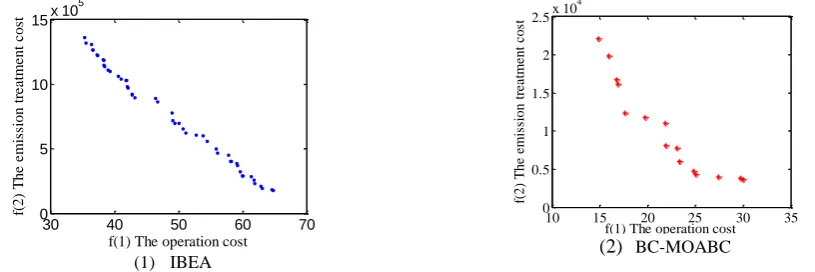
To evaluate the performance of the proposed algorithm BC-MOABC, it has been used to solve the micro-grid energy scheduling problem. The proposed method is compared with the IBEA, the Pareto front of the bi-objective optimization model for economic and environmental operations of the micro-grid systems is shown in Fig. 2.
Comparing with Fig. 2(1) and Fig. 2(2), IBEA has a poor convergence, and the proposed algorithm performs significantly better. It can be seen from Fig. 2(2) that the introduction of external archive in ABC, which stores non-dominated solutions and select elites based on the best-candidate strategy, helps BC-MOABC obtain good convergence and even spread.
30 40 50 60 70 0
5 10 15x 10
5
f(1) The operation cost
f( 2) T he e m is si on tr e a tm e nt c os t (1) IBEA
10 15 20 25 30 35
0 0.5 1 1.5 2 2.5x 10
4
f(1) The operation cost
[image:7.595.88.496.475.611.2]f( 2) T he e m is si on tr ea tm ent c os t (2) BC-MOABC
Figure 2. Pareto front of micro-grid scheduling model use IBEA and BC-MOABC.
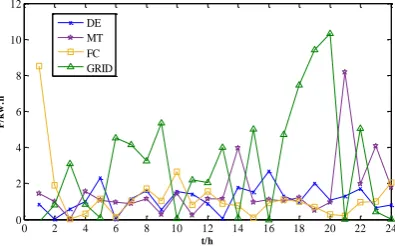
The simulation results for a compromise solution selected from the obtained Pareto front in Fig. 2(2) are shown in Fig. 3. Note that, this solution does not consider the thermal load of the micro-grid. Theoretically, the output of the MT should be prioritized due to its high power generation efficiency and low emissions of polluted gases. Experimentally, we can observe that during the peak period of 13:00-15:00 and 20:00-22:00, because of the large load demand, the output of MT is bigger than that of other distributed generation. Before the off-peak hours of 8 o'clock, the output of MT is relatively stable compared with other DGs.
the downtime costs for the other DGs, FC as a supplementary energy in scheduling system. Due to the high pollution cost of DE, in order to meet the load demand, DE as a smooth output unit during the peak period, meanwhile, in order to avoid the cost of shutdown, DE has low power output during other periods. Because PV is clean energy, it should be prioritized. From Fig.3, at the peak hours of 10:00-14:00 o 'clock, PV is active in the sunlight and other DGs are less active in other peak periods. It can be seen that,PV is prioritized in scheduling system. During the entire scheduling cycle, it is displayed that the micro-grid purchases power from the grid during the peak hours to meet the load demand. It can be seen from the above experimental results that the scheduling system can arrange the output of the DGs reasonably.
0 2 4 6 8 10 12 14 16 18 20 22 24 0
2 4 6 8 10 12
t/h
P
/k
w
.h
[image:8.595.205.403.207.330.2]DE MT FC GRID
Figure 3. Optimization result of multi-objective optimization scheduling by BC-MOABC.
Summary
In this paper, we construct the micro-grid energy scheduling model as a multi-objective optimization problem, which has two objectives of fuel cost and emissions cost. Especially, a micro-grid system consisting of wind turbine (WT), photovoltaic array (PV), diesel engine (DE), micro turbine (MT) and fuel cell (FC) are designed deliberately, and the typical parallel operation control strategy is incorporated into this micro-grid system. Then, in order to solve the proposed model effectively, we develop a novel multi-objective optimizer called BC-MOABC based on the foraging rules of ABC. In this way, a set of tradeoff solutions with good convergence and diversity can be obtained to well meet the scheduling requirements of the micro-grid system. Finally, the proposed model and algorithm have been simulated on a set of test instances. Experimental results show that the proposed micro-grid energy scheduling scheme is effective and the BC-MOABC can arrange the distributed generations efficiently while reduce the system cost and gas emissions. However, the above method does not consider the thermal load of the micro-grid system. This is also the place to be improved in our future work.
Acknowledgement
This work is supported by the National Natural Science Foundation of China under Grant No. 61773103 and 61503373; and Fundamental Research Funds for the Central Universities No. N161705001.
References
[1] Wang C, Wu Z, Li P. Research on Key Technologies of Microgrid[J]. Transactions of China Electrotechnical Society, 2014.
[2] Chiu W Y, Sun H, Poor H V. A Multiobjective Approach to Multimicrogrid System Design[J]. IEEE Transactions on Smart Grid, 2015, 6(5):2263-2272.
[4] Peng L I, Tao L I, Zhang S, et al. Combinatorial optimization of micro-sources in standalone microgrid based on chaotic binary particle swarm optimization algorithm[J]. Electric Power Automation Equipment, 2013, 33(12):33-38.
[5] Wei H, Huang T, Zhou H, et al. Dynamic Economical Dispatch for Microgrid Based on Improved Differential Evolution Algorithm [J]. Automation of Electric Power Systems, 2014, 38(9):211-217.
[6] Qu B Y, Zhu Y S, Jiao Y C, et al. A Survey on Multi-objective Evolutionary Algorithms for the Solution of the Environmental/Economic Dispatch Problems[J]. Swarm & Evolutionary Computation, 2017.
[7] Ela A A E, Abido M, Spea S. Optimal power flow using differential evolution algorithm[J]. Electrical Engineering, 2010, 80(7):878-885.
[8] Gu W, Wu Z, Wang R. Multi-objective optimization of combined heat and power microgrid considering pollutant emission [J]. Automation of Electric Power Systems, 2012, 36(14):177-185.
[9] Ruqi L I , Zhirong L I , Weizhi W , et al. Multi-Objective Reactive Power Optimization Based on Difference Strategy[J]. Power System Technology, 2012.
[10] Zhao J , Qiu X , Ma J , et al. Multi-objective optimization method of microgrid based on fuzzy clustering analysis and model recognition[J]. Power System Technology, 2016.
[11] L. Ma, H. Chen, Y. Zhu, K. Hu. Hierarchical Artificial Bee Colony Algorithm for RFID Network Planning Optimization[J]. Scientific World Journal, vol. 2014, Article ID 941532, 2014.
[12] L. Ma, K. Hu, Y. Zhu, H. Chen. Computational evolution of social behavior in bacterial colony optimization model[J]. Journal of pure and applied microbiology, 2013, 7: 487-493.
[13] Ma L , Li X , Gao T , et al. Indicator-Based Multi-objective Bacterial Foraging Algorithm with Adaptive Searching Mechanism[C]//Bio-inspired Computing-theories & Applications. Springer, Singapore, 2016.
[14] Wang R , Chen S , Ma L , et al. Multi-indicator Bacterial Foraging Algorithm with Kriging Model for Many-Objective Optimization[C]//International Conference on Swarm Intelligence. Springer, Cham, 2018.
[15] H. Jiang, W. Dong, L. Ma, et al. Bacterial Foraging Algorithm Based on Reinforcement Learning for Continuous Optimizations[C]//International Symposium on Intelligence Computation and Applications, 41-52, 2017.
[16] Wu H, Liu X, Ding M . Dynamic economic dispatch of a microgrid: Mathematical models and solution algorithm[J]. International Journal of Electrical Power & Energy Systems, 2014, 63(63):336-346.
[17] Chen H, Kaoshe Z. Micro Grid Scheduling Optimization Based on Quantum Particle Swarm Optimization (PSO) Algorithm[J]. Power System & Clean Energy, 2016.
[18] Deb, Kalyanmoy, Pratap, Amrit, Agarwal, Sameer, et al. A fast and elitist multiobjective genetic algorithm: NSGA-II[J]. IEEE Transactions on Evolutionary Computation, 2002, 6(2):182-197.
[19] Hong B, Li G, Wang C, et al. Model and method of dynamic multi-objective optimal dispatch for microgrid[J]. Electric Power Automation Equipment, 2013, 33(3):100-107.
[20] Karaboga D, Akay B. A comparative study of Artificial Bee Colony algorithm[J]. Applied Mathematics & Computation, 2009, 214(1):108-132.
[22] L. Ma, K. Hu, Y. Zhu, H. Chen, A Hybrid Artificial Bee Colony Optimizer by combining with life-cycle, Powell’s search and crossover, Applied Mathematics and Computation,vol. 252, pp. 133–154, 2015.
[23] Ma L , Wang X , Huang M , et al. Two-Level Master-Slave RFID Networks Planning via Hybrid Multiobjective Artificial Bee Colony Optimizer[J]. IEEE Transactions on Systems Man & Cybernetics Systems, 2017, PP(99):1-20.
[24] Ma L, Hu K, Zhu Y, et al. Cooperative artificial bee colony algorithm for multi-objective RFID network planning[J]. Journal of Network & Computer Applications, 2014, 42:143-162.
[25] Mitchell D P. Spectrally optimal sampling for distribution ray tracing[C]//Conference on Computer Graphics and Interactive Techniques. ACM, 1991:157-164.
[26] Zachar M, Daoutidis P. Microgrid/Macrogrid Energy Exchange: A Novel Market Structure and Stochastic Scheduling[J]. IEEE Transactions on Smart Grid, 2017, PP(99):1-1.
[27] Saha A K, Chowdhury S, Chowdhury S P, et al. Microturbine based distributed generator in smart grid application[C]//International Conference and Exhibition on Electricity Distribution. IET, 2008:1-6.
[28] Singh S, Singh A K, Chanana S. Operation and control of a hybrid photovoltaic-diesel-fuel cell system connected to micro-grid[M]. 2012.
[29] Hountalas D T, Kouremenos A D. Development of a fast and simple simulation model for the fuel injection system of diesel engines[J]. Advances in Engineering Software, 1998, 29(1):13-28.
[30] Ma L , Chen H , Li X, et al. Root system growth biomimicry for global optimization models and emergent behaviors[J]. Soft Computing, 2016, 21(24):1-18.
[31] Ma L B, Wang X W, Huang M, et al. A novel evolutionary root system growth algorithm for solving multi-objective optimization problems[J]. Applied Soft Computing, 2017, 57:379-398.
[32] L. Ma, Y. Zhu, K. Hu. A Novel Plant Root Foraging Algorithm for Image Segmentation Problems[J]. Mathematical Problems in Engineering, 2014, 2014:1-16.
[33] Ma L B, Zhu Y L, Liu Y, et al. A novel bionic algorithm inspired by plant root foraging behaviors[J]. Applied Soft Computing, 2015, 37(C):95-113.
[34] Ma L, Zhu Y, Zhang D, et al. A hybrid approach to artificial bee colony algorithm[J]. Neural Computing and Applications, 2016, 27(2):387-409.
[35] Chen H, Ma L, He M, et al. Artificial Bee Colony Optimizer Based on Bee Life-Cycle for Stationary and Dynamic Optimization[J]. IEEE Transactions on Systems Man & Cybernetics Systems, 2017, 47(2):327-346.
[36] Ma L, Hu K, Zhu Y, et al. Discrete and Continuous Optimization Based on Hierarchical Artificial Bee Colony Optimizer[J]. Journal of Applied Mathematics,2014,(2014-3-17), 2014, 2014(1):1-20.
[37] L. Ma, K. Hu, Y. Zhu, H. Chen. Improved Multi-objective Artificial Bee Colony Algorithm for optimal power flow problem[J]. Journal of Central South University, 2014, 21(11): 4220-4227.
[38] Y. Liu, L. Ma, G. Yang, A Survey of Artificial Bee Colony Algorithm[C]//2017 IEEE 7th Annual International Conference on CYBER Technology in Automation, Control, and Intelligent Systems (CYBER), 2017 :1510-1515.
[40] L. Ma, X. Wang, H. Shen, et al. A Novel Artificial Bee Colony Optimizer with Dynamic Population Size for Multi-level Threshold Image Segmentation[J].International Journal of Bio-Inspired Computation, 2016.cations, 2016:1-18.
[41] Kukkonen S, Deb K. Improved Pruning of Non-Dominated Solutions Based on Crowding Distance for Bi-Objective Optimization Problems[C]//IEEE Congress on Evolutionary Computation, 2006. IEEE, 2006:1179-1186.
[42] Lei Y, Gong M, Zhang J, et al. Resource allocation model and double-sphere crowding distance for evolutionary multi-objective optimization [J]. European Journal of Operational Research, 2014, 234(1):197-208.