2019 International Conference on Computer Science, Communications and Multimedia Engineering (CSCME 2019) ISBN: 978-1-60595-650-3
Performance Study of Light Assembly Operations Considering Time
Pressure and Task Complexity
Wen-zhen HOU, Meng-xin LI
*and Jing-song HUANG
School of Economics and Management, Jiangsu University of Science and Technology, Zhenjiang, China
*Corresponding author
Keywords: Time pressure, Task complexity, Lego model, Light assembly, Performance.
Abstract. Performing tasks of different complexity under different time pressures has different effects on the operator's operational performance. In this paper, the Lego model is used to simulate the actual light assembly production operation, and the light assembly experiment with different complexity and different time pressure is designed. The operator's operational performance indicators are recorded to analyze the impact of task complexity and time pressure on the operational performance of light assembly operators. The results show that the task complexity leads to significant differences in the operator's operational performance. Time pressure does not lead to significant differences in the operator's operational performance. There is an interaction between the two; there are significant differences between the four types of assembly task completion error rates.
Introduction
With the increasing competition in the market and the rapid change of customer demand, in the manufacturing operations dominated by assembly operations, multi-variety and small-batch mixed-flow production helps manufacturing enterprises to effectively achieve rapid response to the market, reduce production costs, and reduce the inventory of work-in-progress etc. It is a high-efficiency, high-quality, flexible production method, which has become the mainstream production method of today's advanced manufacturing enterprises. Multi-variety and small batches increase the complexity of the assembly line. In industrial assembly and assembly production, a large number of products are assembled from the assembly system by assembling various components, and these assembly operations are completed by the first-line assembly staff. Although with the introduction of robots, the traditional assembly line turned to the automatic assembly line, freeing employees from the monotonous, often tight, high-tempo work sequence assembly line. However, there are still many complicated assembly operations, and manual assembly is the most effective solution. With the individualization and complication of products, assembly operations are becoming more and more complex, and manual assembly will still exist in a short period of time. Manual assembly has a higher performance due to its high flexibility.
the design engineers to work longer in design without corresponding cost reduction. Buckert et al. believe that time pressure can increase individual risk by increasing physical stress and increasing adventure of risk.
In the past, the research from the two dimensions of task complexity and time pressure was mainly in the marketing, economics, aviation and other industries. In the light assembly operation based on action skills, there are also problems caused by time pressure, reasonable assessment of the impact of time pressure and task complexity on light assembly operations can guide companies to scientifically develop response measures. In recent years, in the process of scientifically configuring production systems to improve production efficiency, industrial engineers have realized that the “human standard” has gradually become a bottleneck restricting further optimization of production management. The optimization of production management needs to comprehensively consider the human body state and production status information, pay too much attention to the design of production equipment, and ignore the changes in the state of emotion or fatigue in the production process, and the result will affect the external behavior of employees. It is not conducive to the improvement of production efficiency and the optimization of production management, which greatly affects the systematic process of industrial engineering. In the context of manual assembly, workers performing assembly tasks often face different cognitive needs, such as tools, methods, assembly orientation, component batch size, etc., and each of these factors can be relatively easy without time pressure. But when these factors are combined with the triggering of time pressure, it will have an impact on the operator's state, which will affect the operator's behavior and affect performance.
The assembly of electronic products such as mobile phones is a typical representative of light assembly. The LEGO model assembly is the same as the mobile phone assembly process, and can represent light assembly tasks based on motion skills such as electronic products and instrumentation assembly. Therefore, this paper selects the LEGO model as the experimental object, and designs the task complexity (simple; complex) × time pressure (high; low) Lego model to simulate the light assembly experiment, record the operator's operational performance, error rate indicators, analyze the impact of time pressure and task complexity on the operational performance of light assembly operators, understanding the behavior of operators in the production organization, providing a theoretical basis for the company to assign tasks, formulate reasonable production plans, and ensure product quality, so that enterprises can carry out sustainable and efficient production.
Method
Participants
According to the similar experimental paradigm and G-power sample size, 24 students (14 males and 10 females) who were not involved in any model assembly for nearly one year were randomly recruited, aged 21-24, all participants had normal or corrected visual acuity, no color blindness or physical impairment, which met the requirements of light assembly experiments. During the experiment, each participant was randomly assigned to a different experimental task.
Material
experiment before the formal experiment, and then Ta was obtained from the time pressure calculation equation based on the values of Tr and TP, and the experiment time was set by Ta. Time pressure occurs when the time required to perform a task exceeds 70% of the task's available time.
[image:3.595.154.442.253.350.2]
(a) Assembly instruction chart for simple tasks (b) Assembly instruction chart for complex tasks
Figure 1. Assembly task standard operation instruction map.
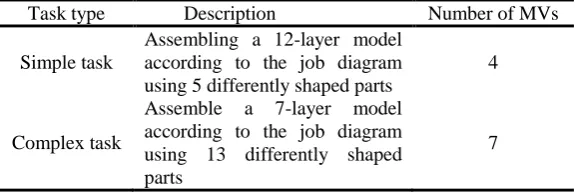
Table 1. Content Description of Different Types of Tasks.
Task type Description Number of MVs
Simple task
Assembling a 12-layer model according to the job diagram using 5 differently shaped parts
4
Complex task
Assemble a 7-layer model according to the job diagram using 13 differently shaped parts
7
Experiment Process
The participants were introduced to the relevant situation of the experiment and the precautions during the experiment. The participants agreed to participate in the experiment, they need to read and sign the informed consent form. After the participants were thoroughly familiar with it, a formal test was conducted. Before the formal experiment, tr was measured by pre-experiment. The low-time pressure of this experiment was set to 0.8, and the high-time pressure was set to 1.1. The experiment was divided into 4 groups. The models of the Lego assembly were consistent in each group. The complexity and time constraints of the experiment are different, with 12 simple tasks and 15 complex tasks.
Experimental Dependent Variable
During the experiment, the average assembly time and error rate of the completed assembly tasks were recorded. The average assembly time of the simple and complex tasks was analyzed by video recording statistical analysis to measure the impact of time pressure on the performance of the assembly task. The error rate refers to the number of layers that are different from the shape, color, direction and order in the standard specification after the participants completes the assembly task, and the ratio of the number of error layers to the total number of layers of the task is calculated.
Data Analysis
Result Analysis
Error Rate
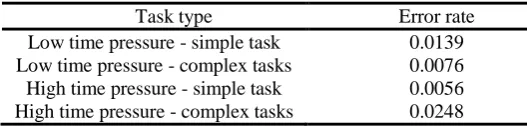
[image:4.595.165.429.216.279.2]The error rates for performing tasks of different complexity at different times are shown in the table2. Kruskal-Wallis test analysis found that there was a significant difference between the four types of assembly task completion error rates (H=11.995, P<0.01). Through Mann-Whitney test analysis, it is found that time pressure has a significant effect on assembly task error rate (U=24, Z=-2.031, P<0.01), and task complexity has a significant effect on assembly task error rate (U=15, Z). =--2.735, P <0.01).
Table 2. Four Types of Assembly Task Completion Error Rates.
Task type Error rate
Low time pressure - simple task 0.0139
Low time pressure - complex tasks 0.0076
High time pressure - simple task 0.0056
High time pressure - complex tasks 0.0248
Average Assembly Time
A paired T-test of the samples revealed that the average assembly time for performing simple tasks at high time pressure (84.633±3.322) was significantly higher than the average assembly time for performing simple tasks at low time pressures (95.267±3.689) (t=-6.066), P=0.004). The average assembly time for performing complex tasks at high time pressure (75.347±8.059) was significantly higher than the average assembly time for performing simple tasks at high time pressure (84.633±3.322) (t=3.878, P=0.018). The average assembly time for performing complex tasks at low time pressures (63.160±7.200) was significantly higher than the average assembly time for performing simple tasks at low time pressures (95.267±3.689) (t=11.441, P<0.01). The average assembly time for performing complex tasks at high time pressure (75.347±8.059) was not significantly different from the average assembly time for performing complex tasks at low time pressures (63.160±7.200) (t=2.236, P=0.089).
In order to evaluate the impact of time pressure and task complexity on task performance, ANOVA analysis is performed on the change of the average assembly time of different complexity tasks under different time pressures. The results show that complexity has a significant effect on task performance (F( 1,16)=60.575, P<0.01), time pressure has no significant effect on task performance (F(1,16)=0.085, P=0.774), there is interaction between them (F(1,16) = 18.410, P = 0.001).
Analysis of Results
Analysis of the four sets of tasks shows that time pressure and task complexity lead to significant changes in assembly task completion error rate and average assembly time. The average assembly time for simple tasks under high time pressure is significantly higher than the average assembly time for simple tasks at low time pressures, while the simple assembly task completion error rate under high time pressure has no significant increase compared with the simple assembly task completion error rate under low time pressure, that is, performing simple tasks under low time pressure has lower production performance. The average assembly time for complex tasks under high time pressure is not significantly increased compared to the average assembly time for complex tasks at low time pressures, while the complex assembly task completion error rate under high time pressure is significantly higher than the complex assembly task completion error rate under low time pressure, that is, performing complex tasks under high time pressure has lower production performance.
Conclusions
Considering the error rate and the average assembly time, enterprises should combine time pressure with task types when scheduling tasks. The better solution is to perform relatively simple tasks under high time pressure, while relatively complex tasks should be completed under low time pressure to reduce error rates and improve production performance.
Task complexity has a major impact on the quality of task completion. There is a significant effect on the complexity of the task and the error rate of the operator. The operator has a higher error rate in completing the task with high complexity. Therefore, the enterprise should pay attention to checking the quality of the task with high task complexity in the production process.
References
[1] Bortolini M, Faccio M, Gamberi M, et al. Multi-objective assembly line balancing considering component picking and ergonomic risk[J]. Computers & Industrial Engineering, 2017, 112: 348-367.
[2] Bley H, Reinhart G, Seliger G, et al. Appropriate Human Involvement in Assembly and Disassembly[J]. CIRP Annals - Manufacturing Technology, 2004, 53(2):487-509.
[3] Battaïa O, Otto A, Sgarbossa F, et al. Future trends in Management and Operation of Assembly Systems: From customized assembly systems to cyber-physical systems[J]. Omega, 2018.
[4] Syrek, C. J., Apostel, E., Antoni, C. H. Stress in Highly Demanding IT Jobs: Transformational Leadership Moderates the Impact of Time Pressure on Exhaustion and Work-Life Balance. Journal Of Occupational Health Psychology, 2013, 18(3): 252-261.
[5] Liu D, Peterson T, Vincenzi D, et al. Effect of time pressure and target uncertainty on human operator performance and workload for autonomous unmanned aerial system[J]. International Journal of Industrial Ergonomics, 2016, 51:52-58.
[6] Wang L, He X, Chen Y. Quantitative relationship model between workload and time pressure under different flight operation tasks[J]. International Journal of Industrial Ergonomics, 2016, 54:93-102.
[7] Everaert P, Bruggeman W. Cost targets and time pressure during new product development[J]. International Journal of Operations & Production Management, 2002, 22(12):1339-1353.
[8] Buckert, Magdalena, et al. "Acute stress affects risk taking but not ambiguity aversion." Frontiers in neuroscience 8 (2014): 82.
[9] Bosch T, Mathiassen S E, Visser B, et al. The effect of work pace on workload, motor variability and fatigue during simulated light assembly work[J]. Ergonomics, 2011, 54(2): 154-68.
[10] Jr C P, Zahabi M, Zhang W, et al. The effects of interruption similarity and complexity on performance in a simulated visual-manual assembly operation[J]. Applied Ergonomics, 2017, 59(Pt A): 94-103.
[11] Zheng G, Yang Y, Zhu X, et al. Power and Sample Size Calculations[M]. Springer US, 2012: Pages.
[12] Camerer C, Babcock L, Loewenstein G, et al. Labor Supply of New York City Cabdrivers: One Day at a Time[J]. Quarterly Journal of Economics, 1997, 112(2): 407-41.
[13] Kieras D. A Guide to GOMS Model Usability Evaluation using NGOMSL, in Handbook of Human-Computer Interaction (Second Edition) [M]. Elsevier. 1997: 733-766.
[15] Syrek, C. J., Apostel, E., Antoni, C. H. Stress in Highly Demanding IT Jobs: Transformational Leadership Moderates the Impact of Time Pressure on Exhaustion and Work-Life Balance. Journal of Occupational Health Psychology, 2013, 18(3): 252-261.