NON-PROFIT ORGANIZATION U.S. POSTAGE PAID
ANN ARBOR, MI PERMIT #144 N O T E S F R O M M I C H I G A N L A W
N O T E S F R O M M I C H I G A N L A W THE UNIVERSITY OF MICHIGAN B38 HUTCHINS HALL
ANN ARBOR, MICHIGAN 48109-1215
N O T E S F R O M M I C H I G A N L A W
L
aw
Q
u
ad
ra
n
gle
Notes from Michigan Law
53.1 S
pr
in
g 2010
Guilty
Guilty
until proven
[
O P E N I N G
]
PETER SMITH PHOTOGRAPHY
5 Things About
Richard Friedman, the Alene and Allen F. Smith Professor of Law, argued his second case before the U.S. Supreme Court on January 11. An expert on the Confrontation Clause of the Sixth Amendment, Friedman represented the petitioners in Briscoe, et al., v. Virginia. The case could help define the limits of a criminal defendant’s right to be confronted with the government’s witnesses against him. The Court sent the case back to a lower court shortly after hearing it, in large part due to its similarities to another recently decided case. Here are some thoughts from Friedman and colleagues about preparing for and arguing a case before the highest court in the land.
1.
Say everything you want to say in your first breath. Well, not everything, obviously—but Doug Laycock, the Yale Kamisar Collegiate Professor of Law, says you should fit as much into the opening as possible. “You usually get only a sentence or two before the next question, so it’s critical to nail the question at the very beginning of your answer,” says Laycock, who argued his first case before the Supreme Court in 1992. Indeed, in Briscoe, Friedman said exactly two sentences before the first justice asked him a question.2.
Moot, moot, moot, and moot some more. Friedman participated in five moots before this case, including one in which Michigan Law colleagues played the roles of Supreme Court justices. Friedman jokes about the stand-in justices: “They are a lot nastier; they have a lot less need for decorum” than the real Supreme Court. Because of the moots, “I felt completely prepared—both before and after the argument. I didn’t get a single question I hadn’t anticipated in some form.”3.
Be ready to try getting tickets for family, old friends, and new fans.The moment cert is granted in your case, you’ll suddenly be very popular. “When my sister told me she and my brother-in-law were going to be in Asia at the time of the argument,” Friedman says, “I had mixed feelings. I’m sorry that they wouldn’t be there, but it freed up two tickets.”4.
Get by with a little help from your friends. Especially your really smart friends of high-school age, who are more interested in a legal career than they are in, say, mowing lawns all summer. Friedman availed himself of the services of Andrew MacKie-Mason, a senior at Ann Arbor’s PioneerHigh School, who spent up to 25 hours per week on legal research starting just before cert was granted. “It’s like the work I did in the summer actually means something,” says MacKie-Mason, a Friedman family friend.
5.
Teach the justices something new. When Friedman presented his argument, he said, “I think that issue is entirely orthogonal to the issue here …” and, without trying, he began a semantics lesson that delighted the legal blogosphere for days to come. “I’m sorry. Entirely what?” Chief Justice John G. Roberts, Jr., asked. Friedman: “Orthogonal. Right angle. Unrelated. Irrelevant.” Justice Antonin Scalia: “What was that adjective? I liked that.” Friedman: “Orthogonal.” … Scalia: “Orthogonal, ooh. … I think we should use that in the opinion.” Roberts, who seemed likely to disagree with Scalia’s opinion on this case: “Or the dissent.”John A. E. Pottow, professor of law, is an internationally recognized expert in the field of bankruptcy and commercial law, and he brings this expertise to “Government Involvement in Chrysler Bankruptcy: The Least-Worst Alternative?” on p. 66. His award-winning scholarship concentrates on the issues involved in the regulation of cross-border insolvencies as well as consumer financial distress. He joined the faculty in 2003.
Leisa Thompson and Katie Vloet collaborated on “Guilty Until Proven Innocent,” p. 10. Thompson is an award-winning photographer who captured images for the Ann Arbor News for 12 years. When the newspaper closed in 2009, she started her own business, and she continues to blend a keen eye for portraiture with strong photojournalistic instincts. Vloet is editor of the Law Quadrangle.
J.J. White, ’62, the Robert A. Sullivan Professor of Law, has never shied away from controversial subjects. Read an example of this in “Chrysler’s Bankruptcy: Money Laundering on a Grand Scale” on p. 64. A book he coauthored, Uniform Commercial Code, is considered to be the most widely recognized treatise on the subject. He is also the author of several casebooks on commercial, bankruptcy, and contracts law. White began his academic career at U-M in 1964.
Lara Zielin was the obvious choice to write about Nicole Burnham and Cynthia Leitich Smith (p. 40). The two long-time friends— since they were both summer starters—are now writers who have penned well-received young-adult novels in recent years. Zielin, the editor of LSAmagazine at U-M, knows the field well; her debut young-adult novel, Donut Days (Putnam Juvenile), was published last year, and her sophomore effort, Promgate, is due out in 2011.
‘I have never forgotten. . . the
joys of studying in Ann Arbor’
To the Editor:
It’s a very long time since I wrote to the Law School, but my pleasure in reading of Michigan Law (Vol. 52, No. 2), which is still sent to me, has inspired this belated missive, in honor and pleasure of it. I (along with a number of “foreign” law students) studied law at the Law School in 1955. I had a master’s degree, and after working briefly in law offices in two or three states, I returned to Australia where (in Melbourne) I practiced law principally as Counsel in the Supreme Court (VIC) to about 1957, in which year I was appointed to be a justice of the Supreme Court of Victoria. However, I am long retired from the Court now but still am interested in the law.
For many years, I corresponded with dear friends from Ann Arbor, and on some occasions got to visit the USA and see them. It is many moons since I have seen the great number of friends I made in those happy years. I met them from many states as well as Michigan and visited them. I have never forgotten them, or the joys of living and studying at Ann Arbor, so long ago. It altered my life and perspectives. Best wishes to all at Ann Arbor.
The Hon. John J. Hedigan, QC, LL.M. ’56, former justice of the Supreme Court of Victoria, Australia
b
C O N T R I B U T O R S
John A. E. Pottow Leisa Thompson Katie Vloet J.J. White, ’62 Lara Zielin
c
L A W Q U A D R A N G L E
0 4 A M E S S A G E F R O M D E A N C A M I N K E R
04 Clinical Education: Real-World Experience with Real Impact
0 6 B R I E F S
07 New Construction Projects, in 3-D 08 Honoring Vining’s ‘Path-Breaking’ Work 09 Jarrett to Deliver Senior Day Address
1 0 S P E C I A L F E A T U R E S
10 GUILTY UNTIL PROVEN INNOCENT:The New Innocence Clinic Fights for One Man’s Exoneration
18 ALUMNI BECOME A FORCE IN NATIVE AMERICAN LAW 22 BORDER-CROSSER, BRIDGE-BUILDER: A Look at
Comparative Law and the Legacy of Hessel Yntema
26 HOME SCHOOLED: Learning Outside of the Lecture Hall
2 8 G I V I N G
4 0 C L A S S N O T E S
40 Change of Plans: Parallel Journeys, Far from the Legal World 45 A Few Words About the Dictionary Man
48 Around the World in 36 Days
5 4 F A C U L T Y N E W S
54 New Faculty
6 4 F A C U L T Y V I E W S
64 J.J. White and John Pottow Take Sides on the Chrysler Bailout
6 8 C L O S I N G
68 Building for the Future
1 8
2 2
2 6
Spring 2010
La
w
Q
u
a
d
ra
n
g
le
•
S
p
ri
n
g
2
0
1
0
4
A M E S S A G E F R O M D E A N C A M I N K E R
Clinical Education: Real-World Experience with Real Impact
There are many compelling real-life stories with real-world impact around the Law School these days. Three recent examples: Courtroom dramas in which our students play a central role, international deal-making, and the fight against human trafficking in the United States and all over the world.
This is what Michigan Law’s clinical education looks like today.
Consider the cover story in this issue of Law Quadrangle. The Law School’s Innocence Clinic is making headlines with exonerations in its first three major cases. Beginning on page 10, you can learn more about the dramatic story of Dwayne Provience. After nearly 10 years in prison, his murder conviction was overturned based
on the legal efforts of Professors Bridget McCormack and David Moran, ’91, and their students. “What we had amassed over the year that we worked on this case was overwhelming evidence that police had prosecuted the wrong man,” said Professor Moran the day the prosecutor dropped the charges. The new U-M Law School Innocence Clinic is the first of any law school to work exclusively on erroneous convictions with non-DNA-based cases.
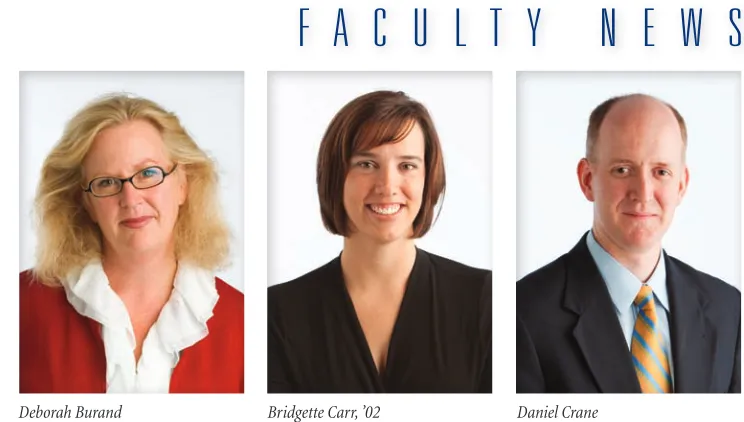
Another first of its kind is the International Transactions Clinic, which focuses on teaching students the art and science of cross-border business deals. The clinic works in emerging global markets representing a wide range of clients such as socially responsible investors and microfinance providers—those who want to, as Professor Deborah Burand says, “do well and do good.” This year the clinic introduced a seven-week “deal boot camp” to prepare law students to handle the wide array of business transactions necessary not only for their work in the clinic but soon, their work as lawyers in an international marketplace.
Just as ground-breaking is the work of Professor Bridgette Carr, ’02, and her students in the Law School’s Human Trafficking Clinic as they represent foreign nationals trafficked in the United States and advocate passionately to educate the public about the ugly reality of modern day slavery. One of Professor Carr’s first clients was Katya, a university student from Ukraine, who was forced into the sex trade by traffickers who kept her against her will for more
than a year. Now the clinic works to bring legal penalties in cases of those forced into labor or prostitution, and to track cases in the United States since trafficking legislation was enacted in 2000.
These three new clinics, all the first of their kind nationally, join Michigan Law’s distinguished family of clinical offerings from child advocacy to urban community transactions. Our clinics have grown substantially over the past few years, both in the variety of offerings and numbers of enrolled stu-dents. In fact, the number of Michigan Law students taking advantage of clinical offerings has increased about 50 percent in the past five years. Clinical education provides a unique path to training students how to think critically and strategically about legal issues, supplementing the more familiar case-focused education using lectures and the tra-ditional Socratic method. Clinics provide experiential learning op-portunities so students can develop other lawyering skills, including, first and foremost, a proclivity for client understanding and service. Today we push way beyond the tried-and-true domain of landlord-tenant disputes to provide a much broader range of pedagogically sound experiences. The growth of our clinics and the important pedagogical role of clinical educational are reflect-ed in our plans for the Law School’s new academic building: The building will feature suites for the clinical programs, enabling fac-ulty and students to meet with clients in a professional, business-styled setting.
5
schools to demonstrate that they effectively prepare students for practice, including working effectively with clients as well as skills in area such as negotiating, legal writing, and interpersonal communication. In part stimulated by this possibility and in part based on their own assessment of desirable pedagogic reforms, law schools (including ours) and practitioners are considering different models for assessment at this time—whether as a matter of best practices for each school, or as a matter of potential common standards across legal education.
In today’s challenging legal employment market, it is more important than ever for new graduates to hit the ground running in the practice of law. At Michigan, the balance of academic rigor and skill-building opportunities help them do just that. And while they’re at it, Michigan students just may change people’s lives forever.
Sincerely,
Evan Caminker
Dean and Branch Rickey Collegiate Professor of Law
Above: 2L Philip Smith meets with a client in the Human Trafficking Clinic.
Below: Student clinicians Nicole Lonsway, ’09 (left) and 3L Luis Avila meet with International Transactions Clinic client Kate McKee of the Consultative Group to Assist the Poor (CGAP).
P
E
T
E
R
S
M
IT
H
P
H
O
T
O
G
R
A
P
H
Y
P
H
IL
IP
D
A
T
T
IL
O
P
H
O
T
O
G
R
A
P
H
B R I E F S
La
w
Q
u
a
d
ra
n
g
le
•
S
p
ri
n
g
2
0
1
0
66
Rounding Out the Ranking Picture
Remember when U.S.News & World Report was practically the only source for law school rankings? No more. Now, an array of rankings offers a broader view of the strengths of law schools. As in the U.S. News designations, Michigan Law also fares extremely well in the newer lists.
In a recent ranking of American law schools by the publisher of Super Laywers, U-M sits comfortably among the upper echelon with a number 2 ranking. The new rankings received a lot of media attention, including a story on the well-read Wall Street Journal Law Blog.
Vault—a site for people searching for information about careers—in 2008 added to its well-known rankings of law firms with a listing of the best law schools. Based on interviews with nearly 400 hiring partners, interviewers, and recruiters, U-M Law School was ranked number 2.
In Princeton Review, Michigan Law is cited as the third best in the country for career prospects, and in the top 10 among the schools that are toughest to get into. On the popular website of University of Chicago law professor Brian Leiter, Michigan Law is in the top 10 based on student quality, faculty quality, where current law faculty went to school, and the schools from which the most prestigious law firms hire new lawyers. The latest U.S. News rankings are scheduled to be released this spring and were not available at press time.
While it’s almost certain that nobody told Barbara McQuade, ’91, the U.S. Attorney’s job was going to be easy, chances are the job got a little more difficult after a would-be terrorist allegedly tried to blow up a plane over her district less than a day after she was confirmed by the Senate.
McQuade took charge as U.S. Attorney for the Eastern District of Michigan—the first woman ever to hold the post—on January 4. She was nominated by President Barack Obama on November 30 and confirmed by the Senate on Christ-mas Eve.
She took office just as media from around the
world were descending on Detroit for the arraignment of accused would-be underwear bomber Umar Farouk Abdulmutallab, who faces life in prison if he’s convicted of several charges—including attempted use of a weapon of mass destruction—in the botched Christmas Day attack on Northwest Airlines 253.
The self-proclaimed Al Qaeda operative is accused of trying to blow up the Amsterdam-to-Detroit flight using about 80 grams of pentaerythritol tetranitrate concealed in his underwear. After setting himself and a section of the airliner’s wall ablaze, the would-be bomber was subdued by his fellow passengers. The case certainly isn’t McQuade’s first exposure to people bent on harming the United States, even if it may be the highest-profile. She has 11 years’ experience in the Eastern District of Michigan, and since 2005 has been the deputy chief of the district’s National Security Unit. After graduating from Michigan Law, she clerked for U.S. District Court Judge Bernard Friedman, then spent five years as an associate at Butzel Long.
“I am deeply honored to receive the opportunity to serve the people of this district,” McQuade told the Detroit Free Press. “We face many significant challenges, and I look forward to tackling them with urgency.”—John Masson
t
t
t
B R I E F S
La
w
Q
u
a
d
ra
n
g
le
•
S
p
rin
g
2
0
1
0
77
New Construction
Projects, in 3-D
The Gargoyle and Its Avatar
If you’ve ever looked up while passing through the Quad’s stone archways, chances are you’ve seen little men. Little concrete men, in cramped poses, who seem to be carrying the weight of the Law Quad on their shoulders. Casually referred to as “gargoyles,” these are, in fact, properly called “corbels,” or—as their supportive stance would corroborate—“Atlas figures,” or “atlantes.”
These stone mascots are Law School icons, and were incorporated into the original design of the Quad in the 1920s. As a way to pay homage to the Quad’s remarkable architecture, and link it to the new buildings to come, this Henry Hutchins avatar, complete with hardhat, has become the logo for the School’s new construction. If you study the vaulted
ceiling marking the cen-tral passage of the Law-yers Club, you’ll see Hutchins (who was dean of the Law School before becoming a University president) and five other former U-M presidents represented: Angell, Bur-ton, Tappan, Haven, and Frieze. In the east and west passageways are slightly smaller figures, representing the sea-sons, sports, and various professions.—CS
A new feature on the Law School’s website allows you to fly through the air with the greatest of ease as you survey the two structures currently under construction on and near the Law Quad. Through 3-D animation, you can get a bird’s-eye view of the Robert B. Aikens Commons next to Hutchins Hall and the academic building on the opposite side of Monroe Street.
To view the animation, visit www.law.umich.edu/buildingproject and go to “Construction Multimedia” on the left side of the page. The Building Project site also provides regular construction updates, illustrations, and a webcam.
The soaring animation takes the viewer over the four-story academic building, designed in a modified Collegiate Gothic style. Next, you’ll go through
the entrance of the Aikens Commons, a two-story space with a glass roof. Once inside, you’ll see the well-lit seating area on the first floor, the café, and study areas. Back to the academic building, you’ll go inside to see a lounge on the main floor, a large classroom, a seminar room, and clinic suites. The new facili-ties are sched-uled for completion in 2012. The project architect is Hartman-Cox Architects of Washington,
D.C., working in association with Michigan-based Integrated Design Solutions. Total cost of the expansion and renovation proj-ect is $102 million. It is being funded through a partnership be-tween the University and the Law School, with private donors giving $70 million of the total. To date, more than 400 law alumni and friends have made gifts to the building project, ranging from $10 to $10 million.
L
A
U
R
A
J
A
R
V
B R I E F S
La
w
Q
u
a
d
ra
n
g
le
•
S
p
ri
n
g
2
0
1
0
88
Improving U.S.-China Relations
Nico Howson, assistant professor of law, presented a paper on financial regulation and the possible demise of the Washington Consensus at the Tsinghua University 21st Century Commercial Law Forum in Beijing in October (above). He later reprised the presentation at the annual meeting of The China Finance Association in November in New York City. In December he was back in China—at Nantong City near Shanghai—to participate in the Inaugural Sino-American Dialogue on the Rule of Law and Human Rights convened by the PRC State Council’s China Human Rights Foundation and the National Committee on U.S.-China Relations. Howson is shown below with Judge John M. Walker Jr., ’66, of the U.S. Second Circuit Court of Appeals (and a cousin of President George H.W. Bush), and Judge Sidney Stein of the Southern District of New York.
Honoring Vining’s
‘Path-Breaking’ Work
Longtime Michigan Law Professor Joseph Vining was honored in the fall by the Villanova University School of Law for leaving his “signature contribution” on a variety of areas of the legal field.
Villanova’s fourth annual John F. Scarpa Conference on Law, Politics, and Culture in October was “a celebration of the path-breaking work of Joseph Vining,” according to the university’s announcement of the event. “Over four decades, Vining has changed the way we think about law by challenging us to resist the reductions and totalizing impulses that are so common in legal and other theory. Where others find in law cause for cynicism or despair, Vining discovers cause for hope and aspiration, even evidence of the transcendent.”
Vining, the Harry Burns Hutchins Collegiate Professor Emeritus of Law, gave the keynote address. The conference began with an appreciation from Columbia University President Lee Bollinger, who was dean of the U-M Law School midway through the 40 years Vining has taught here.
“One of the affecting aspects of it for me was that six of our graduates and my old students made the effort to attend,” Vining noted. They were Joshua Brook, ’02, Gregory Kalscheur, ’88, Jeffrey Kovar, ’85, Michael Moreland, ’02, Eric Orts, ’88, and Larry Thompson, ’74. The Scarpa Conference was part of Vining’s busy year, which included many talks, notably his presentation of the 2009 Lecture in Law, Philosophy & Religious Traditions at The Center for Law, Philosophy, and Culture at The Catholic University of America. He gave that
lec-ture, “The Consequence of Human Differences,”
in November.
U
-M
P
H
O
T
O
S
E
R
V
IC
E
S
, L
IN
J
O
N
E
S
P
H
O
T
O
S
C
O
U
R
T
E
S
Y
O
F
N
IC
O
H
O
W
S
O
B R I E F S
9 La w Q u a d ra n g le • S p rin g 2 0 1 0Michigan Law alumna and senior White House advisor Valerie B. Jarrett will deliver the May 8 commencement address at Michigan Law.
“I am very excited to return to the Michigan Law campus and congratu-late this year’s graduating class,” said Jarrett. “Some of the best times of my
life were spent in Ann Arbor, and this is an incredible honor, not just as an alumna, but as somebody who’s very familiar with how much we need these smart, talented, and committed scholars to help us confront the many challenges facing our country.” Jarrett is the senior advisor to the president and head of four departments in the White House: Intergovernmental Affairs; Public Engagement; Olympic, Paralympic, and Youth Sports; and Urban Affairs. She chairs the White House Council on Women and Girls and leads the White House’s business outreach efforts.
Prior to joining the administration, Jarrett was the president and CEO of the Habitat Company. She was a leader in the civic and business communities of Chicago and served on several corporate and not-for-profit boards, including serving as chairman of the University of Chicago Medical Center Board of Trustees, chairman of the Board of the Chicago Stock Exchange, chairman of the Chicago Transit Board, and director of the Federal Reserve Bank of Chicago.
Jarrett served as finance chair for President Obama’s 2004 run for the U.S. Senate. She also served as a senior advisor to his presidential campaign and as co-chair of President Obama and Vice President Biden’s Transition Committee.
Additionally, Jarrett served for eight years in several positions in Chicago city govern-ment, including deputy chief of staff for Mayor Richard M. Daley and commissioner of the Department of Planning and Development. Prior to that, she practiced law at two Chicago firms.
Jarrett, who earned a B.A. at Stanford before graduating with a Michigan J.D. in 1981, is slated to visit Ann Arbor just one week after President Obama—the fourth sitting presi-dent to visit U-M—delivers the commencement address for the University as a whole. “Selection of Jarrett as the Law School commencement speaker continues the School’s tradition of inviting accomplished, high-profile Law School graduates to Ann Arbor to help usher new graduates into the professional world,” Dean Evan Caminker said. “We’re absolutely delighted to invite Valerie Jarrett back to Michigan Law to address our graduating students,” Caminker said. “In so many ways she personifies the many avenues open to our graduates as they enter the legal world, the business world, the political world—or, in Ms. Jarrett’s case, a progression including all three. We know our graduates will benefit from her remarkable breadth of experience, and we look forward to hearing what she has to say.”—JM
Why were you admitted to Michi-gan Law? Does it still make sense to go to law school in the current economy? And what the heck is an apples-to-pawpaws comparison? You’ll find answers to those ques-tions, plus lots of information de-livered with a sharp wit, at A2Z, the new blog by Assistant Dean and Director of Admissions Sarah C. Zearfoss, ’92.
“There’s a lot of gray” in the admis-sions process, Zearfoss writes in one blog post. “All that gray is why some schools choose to adopt ho-listic admissions policies in the first place, and to employ humans to implement them in a very time-consuming process, rather than just constructing algorithms and going about the process blind to any factor that doesn’t fit in a database.”
In other entries, she writes about topics ranging from Val-O-Grams delivered by the Headnotes, the Mr. Wolverine competition, and work-life balance (complete with a recipe for weapons-grade garlic pasta).
Check out the blog by going to www.law.umich.edu and clicking on the A2Z link on the left side of the page.
Senior Obama
Advisor Jarrett,
’81, to Deliver
Senior Day
Address
A2Z: New
Admissions Blog
from Dean Z
1 0
1 0
By Katie Vloet
Guilty
Guilty
until proven
Innocent
Innocent
La
w
Q
u
a
d
ra
n
g
le
•
S
p
rin
g
2
0
1
0
1 1 1 1
t
t
t
t’s like a scene from a Hollywood
movie. After nearly a decade in
prison, a man’s conviction has been
overturned, thanks to the efforts of
a determined group of law students and
their professors. He’s being released soon, and
the crowd of family, friends, and news
report-ers straightens up every time the door opens. Is
he coming? Not yet, but any minute now. How
about now? Soon, soon.
It is November 3, 2009, the day Dwayne
Provience’s conviction for a 2000 murder has
been overturned, the day a Wayne County
judge has decided he should get a new trial, the
day that the Michigan Law School’s new
Inno-cence Clinic has fought for. This is the day when
Provience will go to his mother’s house and eat
her legendary spaghetti and start to reconnect
with the two teenage children he barely knows
because they’ve grown up while he was locked
away. This is freedom day.
Hours pass outside the Wayne County
Jail. It takes some time for bond to be collected
and posted, for Provience’s paperwork to be
processed, for him to get the clothes—regular
clothes, no more drab prison blues—that he
will wear home.
And then, finally, the attorneys and
stu-dents of the Innocence Clinic walk
purpose-fully toward the doors, toward the awaiting TV
cameras and open arms. With them is the man
of the hour. Provience, 36, is mobbed by people
who want to embrace him. He hugs them all:
family members, the professors who lead the
Innocence Clinic, and “my angels that were
sent to me, my legal students.”
“This day,” he says with a mile-wide smile,
“is a godsend.”
Dwayne Provience’s
Long Journey Begins
If this really were Hollywood, the movie would end here. But nothing in the adult life of Dwayne Provience has been as easy, or as straightforward, as a fictional screenplay, a soaring soundtrack, and the cinematic version of good and evil, of right and wrong.
The saga started in 2000, when a man named Rene Hunter was murdered at the intersection of Greenfield Road and Pembroke Avenue in northwest Detroit. Six eyewitnesses told police that day that the shooters were in a gray Chevy —some said a gray Chevy Caprice Classic —or an older-model gray car. A seventh witness could not identify the type of car, but she described it as gray and with a partial license plate that included the numbers 7, 3, and 4. Several of the witnesses said the car went north on Greenfield after the shooting.
No arrests were made for three months, when Larry Wiley, a panhandler and admitted crack addict who was being questioned in a burglary, offered information on the shooting. He told police he had seen Dwayne Provience and his brother, De-Al, shoot Hunter. Contrary to the information provided by eye witnesses on the day of the shooting, he said they were in a beige Buick Regal, and that they went west on Pembroke after the shooting. Provience—whose only previous brush with the law had resulted in probation for possessing a small amount of cocaine—was charged with murder (De-Al was acquitted, in a 2001 bench trial, of driving the car from which Hunter was shot). At Dwayne Provience’s 2001 trial, prosecutors called Wiley and one of the eye witnesses—the one who had reported seeing 734 in the license plate but who could not identify the type of car. Prosecutors hypothesized that Provience killed Hunter for invading his drug turf.
Provience’s attorney at the time, Reginald Hamilton, did not call any of the witnesses who saw a gray Chevy Caprice that headed northbound after the shooting. Much of the information that was needed to adequately defend Provience was not turned over to the defense at the time of the trial, the Innocence Clinic says. (For mishandling money and misleading clients in other cases— including the abandonment of representation of two clients— Hamilton had his law license revoked in 2003.)
Sentenced to 32 to 62 years, Provience began years of appeals, many of which he handled himself, to no avail.
Then, in 2009, his luck turned when the new U-M Law School Innocence Clinic took on his case, which stood out among many of the others that the Clinic was asked to review. As the first innocence clinic at any law school in the country to deal exclusively with non-DNA-based cases, it has received more than 3,000
I
I
1 2
t
t
t
requests from inmates and families in just its first year ofexistence. One of the things that intrigued them was that Wiley, once the star witness, now appeared to be recanting the story he told during the 2001 trial.
“Mr. Provience’s case raised several red flags for us from the get-go,” says clinic codirector Bridget McCormack. “First, he was convicted solely on the evidence of one witness, who came forward three months after the shooting: a man named Larry Wiley, who was by his own admission a crack addict who offered his story implicating Mr. Provience only when he was in custody and wanted to get out.”
Students from the Clinic brought Wiley in for a videotaped interview. He said police fed him the information about Provience, and that he wasn’t really at the scene. He further threatened his own believability when he said he had come forward because he was dying of cancer, a claim that later turned out to be false, and when he told police that he recanted the videotaped statement he had made to the Innocence Clinic.
Help from a Hit Man’s Mom
The more McCormack and Clinic codirector David Moran, ’91, learned about the case from the students who investigated it, the more incredulous they became. Students hit the streets of Provience’s neighborhood in northwest Detroit, and they started to piece together some fascinating details.
This is where the case becomes complicated. The students visiting the neighborhood heard that the Hunter killing was linked to a murder that occurred a month later. In April 2000, a man named Courtney Irving was killed about a mile from the Hunter murder site, and Eric Woods confessed to the killing. Woods said that he shot Irving to avoid being murdered himself by the Mosleys, a
neighborhood drug gang. He was the hit man for the Mosleys, he said. And the Mosleys wanted Irving dead, according to Woods, because they thought Irving would snitch on them to the police that they were responsible for the Hunter murder.
Innocence Clinic students met with Woods’ mother, who gave them the police progress notes from her son’s case. That’s where student Maria Jhai, then a 2L, found the link to Hunter’s murder. The progress notes referred to alternate suspects in the Hunter case, including the Mosleys. The notes said that multiple witnesses saw the Mosleys arguing with Hunter and then following him to the scene of his murder in a gray Chevy Caprice Classic.
Provience was not mentioned in the notes.
During the 2003 trial in the Irving case, prosecutors told jurors that it was the Mosley brothers who had killed Hunter. “We found out that the prosecutor had argued that the two murders were connected and that someone else was responsible for both of them,” Jhai recalls. “The prosecutors presented in court an entirely different theory of the case. In other words, the prosecutor’s own account of the murder indicated that our client was innocent.”
The students and the Clinic directors were stunned. How could two prosecutors from the same office claim in court that different people were responsible for the same murder? Keep in mind that the charge about the Mosleys having killed Hunter occurred in 2003, two years after Provience had begun his sentence for that murder but more than six years before he would win his initial freedom.
They weren’t the only people who were surprised. When the Clinic tracked down the officer who had provided the content for the progress notes—the ones that mentioned the Mosleys but not Provience—he also couldn’t believe his ears.
La
w
Q
u
a
d
ra
n
g
le
•
S
p
rin
g
2
0
1
0
1 3
1 3
La
w
Q
u
a
d
ra
n
g
le
•
S
p
rin
g
2
0
1
0
Meet Dwayne Provience’s
Legal Team
The Professors
Bridget McCormack: associate dean for clinical affairs, clinical
professor of law, and codirector of the Michigan Innocence Clinic; a former staff attorney with the Office of the Appellate Defender and senior trial attorney with the Criminal Defense Division of the Legal Aid Society, both in New York City.
David Moran, ’91: clinical professor of law and codirector of the
Michigan Innocence Clinic; former assistant defender at the State Appellate Defender Office in Detroit and law professor at Wayne State University. In the Clinic’s first 10 months, the work by McCormack, Moran, and students resulted in the release of three men and one woman after a total of more than 34 years of wrongful incarceration.
The Students
Latoya Antonio: a 3L, one of the first two students to work on the
Provience case, she helped to locate Larry Wiley, a witness who once implicated Provience but more recently recanted (see story, p. 15).
Nick Cheolas: a 3L, tracked down key details that bolstered the
team’s defense of Provience, including information about the automobiles registered to another family (see story, p. 17). Also argued motions in court.
Brett DeGroff: a 3L, tracked down key details that bolstered the
team’s defense of Provience, including information about the automobiles registered to another family (see story, p. 17). Also argued motions in court.
Robyn Goldberg: a 3L, interviewed several key witnesses,
including a man who saw the victim arguing with other men just before he was shot; presented motions in court; successfully argued that Provience should be released on bond.
Judd Grutman: a 3L, one of the first two students to work on the
Provience case, he helped to locate Larry Wiley, a witness who once implicated Provience but more recently recanted (see story, p. 15).
Maria Jhai: a 3L, worked on the Provience case as a summer
intern in 2009. She helped to find a connection with another murder case in a police officer’s progress notes, which led to the discovery that prosecutors in the other murder case presented someone other than Provience as the murderer of Rene Hunter.
Brett DeGroff and Robyn Goldberg Dwayne Provience and Latoya Antonio
La
w
Q
u
a
d
ra
n
g
le
•
S
p
ri
n
g
2
0
1
0
1 4
“When I called him, Officer William Ashford asked me who I represented,” Clinic codirector Moran recalls. “I said Dwayne Provience, who’d been convicted of the murder of Rene Hunter. Officer Ashford said, ‘How on earth did that happen?’ ”
It’s a good question. Much of the puzzle has been put together in the past year, but most of the puzzle pieces have been available for the better part of a decade. “There are two things that bother me about this case. One is obviously that an innocent man has been incarcerated for nine years,” says Innocence Clinic student Nick Cheolas, a 3L. “The other thing that bothers me is the fact that the actual perpetrators of this crime, and the people we know are the perpetrators based on the evidence the police collected, are free.”
One Step Forward, One Step Back
Three weeks after Provience’s release. The Innocence Clinic is ready with its motions, and Provience and his family are ready for his absolute freedom. He sits in the hallway outside Wayne County Circuit Judge Timothy Kenny’s courtroom—he got here at 8 a.m., even though the hearing is scheduled to start an hour later, because he didn’t want to risk being late—with his mom and stepdad. Out here, in a cream-and-brown-striped shirt instead of his prison blues, Provience looks at least 10 years younger than he did on the day of his release.
Once inside the courtroom, it quickly becomes clear that the day will be filled with more frustration than celebration. Assistant Wayne County Prosecutor Robert Stevens pulls McCormack into a side room, and she reappears moments later with a wry smile and a shake of her head. Stevens then tells the judge what he just shared with McCormack: He only received the case file four days earlier, even though the previous hearing—handled by a colleague in the prosecutor’s office—was a full three weeks before. He needs more time.
The attorneys and judge discuss a few details about Officer Ashford’s notes, Wiley’s testimony, and the next hearing date. Three more weeks, and then Provience will have the hearing he thought would happen today.
One more thing, Your Honor, McCormack says. Provience still has to wear an electronic tether that keeps him at home. She asks for the tether to be removed “so he can start to look for a job and take care of his kids.” Stevens says the tether should remain. Judge Kenny amends the order, allowing Provience to wear a GPS tether that will let him be away from home until his new 6 p.m. curfew. Provience flashes a broad smile. It’s not the outcome he had hoped for today, but at least he’ll still be home with his family for Thanksgiving, now just two days away. At least he can look for a job with the custodial and blood-borne pathogen certifications he earned while in jail. And at least he can take his kids to a movie, or maybe even Greenfield Village. Back when they were little, before he was sent to jail in the first place, “that was my favorite thing to do with them.”
‘Déjà Vu All Over Again’
Three more weeks later. Provience, his mom, and his stepdad wait for the courtroom to open. They can’t wait to go inside, for the hearing to begin, to hear that the prosecutor has decided to drop the case.
That’s not what happens. Stevens, the prosecutor, tells the judge, “We’re going forward with trial, Your Honor.” Provience sits stoically in front of his attorneys’ table. After nearly a decade in prison, he is good at coming across as stoic, at concealing his emotions.
After a series of motions, most of which Kenny decides in favor of the Innocence Clinic, the only motion yet to be decided involves Wiley, the witness who helped to put Provience away in the first trial. Wiley is in the courtroom, at the request of the Innocence Clinic. They asked him to be here in case he wanted to announce his decision not to testify again. The judge wants Wiley to talk with an appointed attorney about whether he should assert his Fifth Amendment right not to testify in the new trial. For now, Kenny will wait to decide on a defense motion regarding the submission of Wiley’s original testimony; the Clinic has argued that the cross-examination of Wiley in the first trial should be deemed inadequate.
Kenny is well aware of the frequent changes in Wiley’s account of what happened the night Rene Hunter was killed. He refers to Wiley’s series of changes as the “recantation of his recantation of his recantation.” The Detroit Free Press describes it this way in an article the next day: As a key murder witness, Larry Wiley’s recollection continued to waft Tuesday like a wayward summer breeze.
Dwayne Provience became assustomed to sitting in this courtroom— both before his release (above) and during the hearings that followed.
1 5
The Search for Larry
Around the time they were circling through interstate off-ramps in Detroit, searching for a man who was … well, the kind of guy who frequented interstate off-ramps, Latoya Antonio and Judd Grutman had the same thought: This is what law school should be like.
No, really. Both of them had learned a lot in their other classes, but they also longed to work on cases in the real world. As the first two student attorneys from the Innocence Clinic on the Dwayne Provience case, they had plenty of opportunities. There was the time they were talking with a witness to the murder Provience had been convicted of committing, and everyone turned eerily silent when the students mentioned some of the names of people involved with the case. The time they visited the only livable house on a street where every other structure was condemned, and a car parked directly behind theirs. “Don’t make eye contact,” Antonio said at the time, “just walk to the car.”
And, of course, the off-ramps. This was an element of their search for Larry Wiley, an admitted crack addict and panhandler who initially implicated Provience in the murder. Now, Wiley had signed an affidavit saying that he was not at the scene of the murder, and that he had made up his account. Great news for their client, if only they could find Wiley and interview him about his recantation on video.
They had heard he often could be found at off-ramps, so they set out with map printouts and an assist from one of U-M’s Knight-Wallace journalism fellows. An experienced investigative reporter, Peggy Lowe was able to help the students in their quest for information on the case. She was bold enough to go into backyards, open doors, peer through windows, and ask at off-ramps if anyone had seen Larry Wiley.
Time after time, everyone knew Wiley, a somewhat likable character in spite of his very apparent flaws. He’s on the east side today, they were told. Or: No, we saw him last week, but not today. They got a tip that he may be at a relative’s house, where a man roughly Wiley’s age answered the door; he said he was Larry’s brother Jerome, but that he would let Larry know they were looking for him.
Finally, they caught a break. Provience’s brother called the student attorneys to say he’d tracked down Wiley, and they agreed to meet at Provience’s mother’s house. Grutman and Antonio walked in and saw … Jerome. “I fooled you, didn’t I?” said Jerome/Larry.
Yes, he had, but now they had located the person who was most vital to their appeal in Provience’s case. Grutman and Antonio brought Wiley to the Law School and recorded an interview with him. “I was scared, and I was coached” to give testimony in the original trial that implicated Provience, Wiley said in the video interview. “They had me for a B&E that I didn’t commit, and they said if I’d testify, they’d help me out.”
Mission accomplished.
S
T
O
C
K
P
H
O
T
O
B
Y
G
E
T
T
Y
IM
A
G
E
1 6 1 6
Student attorney Nick Cheolas celebrates his client’s release with Provience’s mother, Vonzella Battle, and Provience’s children’s mother, Toya Robinson (right).
After the hearing, the wafting recollection goes something like this: The police “squeezed me” and made me say that Provience was the killer, Wiley said. “I wasn’t even there.”
Provience, meanwhile, has secured a job as a salesman at Mr. Shoe, part of the Central Bazaar in Highland Park. Kenny agrees that his curfew can be extended, as long as he receives a letter from Provience’s boss.
“It is what it is,” Provience says quietly to McCormack in the hallway after the hearing. Then, to a reporter, he says: “It’s like déjà vu all over again.”
Hollywood Ending?
Some good news: At a January hearing, Judge Kenny grants the Innocence Clinic’s motion to prevent Wiley’s testimony from the first trial from being submitted at his new trial, citing inadequate cross-examination. Since Wiley was the only witness to point to Provience as the killer, and since he has opted to take the Fifth in the new trial, this is a huge victory.
At this hearing and subsequent ones during the next two months, the prosecutor repeatedly asks for more time before various court hearings and the April 5 trial, to no avail. “We all operate best with deadlines,” Kenny says. “I do think [Provience] is due at long last to get his day in court.”
Another issue that becomes a growing concern: missing case files. In particular, the Clinic asserts, case files for two possibly related murders are still missing, and key documents appear to be missing from the file in the Hunter murder. “There needs to be a sense of urgency on the part of the police department to find these files,” Judge Kenny says. “The Detroit Police Department needs to recognize the court is not just going to say, ‘Oh, well.’ ”
In another unusual development, the Clinic’s student attorneys are all listed on the prosecution’s witness list. The Clinic decides to fight back with a motion and a brief, but the issue is not decided. Why not? Well, a funny thing happened on the way to the trial. Though all along the Wayne County Prosecutor’s Office was adamant about its plans to retry Provience, on March 24 the office dropped the murder charge, citing insufficient evidence and a lack of time to track down further information. Stevens maintained that Provience was “the right guy,” and dismissed the charges without prejudice, meaning that Provience could be retried in the future.
La
w
Q
u
a
d
ra
n
g
le
•
S
p
rin
g
2
0
1
0
1 7 Editor’s note: See video of clinic students and other
multimedia at the Law School’s website, law.umich.edu
Behind the Scenes:
The Gray Car
Without all of the legwork of the students in the Innocence Clinic, many aspects that became part of their defense of Dwayne Provience never would have come to light. Here’s one example:
Two students from the Innocence Clinic, Brett DeGroff and Nick Cheolas, discovered a significant document at the Wayne County Prosecutor’s Office shortly before Christmas. The document, it turned out, had been in Provience’s file for more than seven years. That means that prosecutors had access to it during the time of Provience’s early appeals.
The paperwork, dated April 26, 2002, listed all of the vehicles registered to the Mosley family—the family that prosecutors in another murder case had linked to the murder of Rene Hunter, whom Provience was convicted of killing. Lo and behold, one vehicle on the list was a 1985 Chevrolet Caprice Classic, the same kind of car that several eyewitnesses in the Hunter murder described seeing at the scene.
The records did not indicate the color of the car, so the Clinic worked with a private investigator to find that out. It was gray, the same color that several eyewitnesses reported in their accounts to police the day of the shooting.
And the license plate number. One eyewitness in the case had recalled a 7, 3, and 4 in the plate number. The license plate number on this gray 1985 Chevrolet Caprice Classic, registered to Antrimone Mosley: 7CXM34.
A smoking gun? Maybe not on its own, but paired with the other evidence, the team felt confident that it had gathered more than enough evidence to justify Provience’s exoneration. In the end, the court didn’t decide on the motion before the dismissal of the case. Nonetheless, it’s a solid example of the kind of success the Clinic students have had at tracking down buried information—and of the challenges facing people who were wrongly convicted of crimes. After DeGroff and Cheolas found the document in December, David Moran, the codirector of the Innocence Clinic, called Provience to tell him the document “had sat in their files for seven-and-a-half years while Dwayne rotted away in prison.” Provience, Moran recounts, kept his cool and “managed to not fly into what I would have considered a totally justifiable rage.”
Provience walks away from jail with his children, Dwayne and Alexis.
said. “It felt like I still had one foot in prison and one in society. Now I have both feet in society.”
Moran noted that it was the correct outcome in this case, even if it took longer than the Clinic initially anticipated. “What we had amassed over the year that we worked on this case was overwhelming evidence [that police had prosecuted the wrong man]. We hope that, having found that overwhelming evidence of who the real killers are, the prosecution will consider bringing to justice the killer who is still out there walking the streets.”
For the students, the experience will be tough to match. Said 3L Judd Grutman, one of the students who first worked on the case: “Obviously we’ve changed Dwayne’s life, but he’s changed us, too.”
And that hypothetical Hollywood movie? Script writers now have their final scene, and casting agents can get started. They’ll need actors to portray two conscientious professors, six earnest and industrious law students, and a protagonist with a sense of calm in the face of disappointment and a smile that lights up a courtroom when things go his way. If they follow that script, it could be the feel-good movie of the year.
Or maybe it isn’t a movie after all. Here’s the way Dwayne Provience sees it: “It feels like a storybook ending. And this is the best storybook ever.”
1 8
Misshepezhieu—Spirit of the Great Lakes, by Zoey Wood-Salomon, painted
La w Q u a d ra n g le • S p rin g 2 0 1 0 1 9
t
t
t
By Sheryl James
J
ohn Wildhorse called his daughter over and over again by her Indian name, Waboose, which means rabbit in Odawa; but she didn’t turn her head and look at him until he spoke the name given to her by the foster family, Jane. How would the Creator hear his daughter’s prayers if she couldn’t tell the Creator that it was her, Waboose, praying?How, indeed? This is the life mission—call it her own prayer—of Allie Greenleaf Maldonado, ’00, an American Indian attorney who lives in Petoskey, Michigan. A mem-ber of the Little Traverse Bay Band of Odawa Indians and the tribe’s assistant general counsel, Maldonado is an ad-vocate for Native American children everywhere. She de-votes a great deal of her time on bringing the State of Michigan, and other govern-mental entities around the
country, into compliance with the Indian Child Welfare Act (ICWA). The excerpt above is from a book chapter Maldonado penned recently on the subject. The ICWA was passed in 1978 to prevent the kind of problems John Wildhorse faced—and far worse abuses. But, she says, too many legal exceptions have undermined the law and allowed the separation of Indian children from their homes and culture, and other abuses.
Maldonado’s passion for this work has a personal genesis, she says.
“My mother was a victim of pre–Indian Child Welfare Act. When her mother died, there were lots of family members she could have been placed with. But it was a common practice at that time to pull Indian children out of their home, strip them of their cul-ture—to ‘beat the Indian out of the Indian.’ My mother went to be a house slave for a Mennonite minister. She was only 4. She still talks about it. They beat her if she spoke her language. She couldn’t prac-tice her religion. They cut her hair. When she was 18, they married her off to get her out of the house. The abuses that happened to those kids were horrendous.
“That’s why I went to law school. That was the purpose.” Maldonado, chair emeritus of the Federal Bar Assoication Indian Law Section, is among a vital group of Michigan Law alumni who
P H O T O C O U R T E S Y O F T H E L IT T L E T R A V E R S E B A Y B A N D O F O D A W A I N D IA N S
2 0
are making an impact on the complicated, diverse, and at times legally challenging lives of Native Americans and Indian tribal issues. The national profile of U-M alumni is becoming more prominent at the same time that activities at the Law School also are increasingly visible, with an active chapter of the Native American Law Students Association (NALSA); the hosting of American Indian Law Day, when the Navajo Supreme Court heard oral arguments at U-M; and the election of 3L Josh Clause as president of the National NALSA.
The work of alumni with tribes throughout the country reveals a world most Americans rarely think about. It’s a world of melodic names, disparate tribes, ancient customs, and modern-day adaptations.
It takes just one look at the office of Matthew L.M. Fletcher, ’97, to get a sense of this world. Fletcher, director of Michigan State University’s Indigenous Law Center, has abundant evidence of his native culture. One wall bears a map of northwest lower Michigan with all Indian names, such as “Mshii Gum,” the Indian name for “Michigan.” Another poster is labeled “Anishinaabek: Heritage Language Map of the Three Fires People,” referring to the Ottawa, Ojibwe, and Pottawatomie; Fletcher belongs to the Grand Traverse Band of Ottawa and Chippewa Indians.
Perhaps most interesting in the Native American history lessons offered in the office is the large “Map of Indian Country,” showing reservations, tribes, and historical perspectives of Indians. It also briefly narrates important eras: “1492: the Arrival of Columbus; 1790: Indians Forced Inland; 1830: ‘Indian Country’; 1860: Immigrant Stampede; 1890: The Vanquished Indian.” The final date reads, “2090: Indian Land?”
That may sound improbable; Fletcher’s work is much more practical. He serves several functions. He works with the Center, along with his wife, Wenona, the Center’s assistant director and member of the Little Traverse Bay Bands of Odawa Indians; he also works as a tribal appellate judge. But most of his time is spent on teaching and scholarship, he says.
After earning his law degree, he says, “I went back to work for my tribe for four years. It was the best working experience I had as a lawyer.” But, he says, he had not studied Indian law at all because such courses were not plentiful, even at U-M. “It’s really, really hard to graduate from law school and go practice Indian law. I did that and struggled.”
As a result, “I went into teaching because every time I had an interesting legal case, there were no cases or scholarship on it. So the first articles I wrote were research questions I had to answer as a lawyer, because nobody else had written about these things before. That’s why I became a professor.”
Fletcher says there are 12 federally recognized Indian tribes in Michigan, and that, legally speaking, things are going well. “The ability of the various tribal governments in Michigan to govern has expanded exponentially in the last few decades, partly because tribal governments are
A tintype from the late 1800s shows a group of Waganakising Odawa women. Today, several Michigan Law alumni are working on issues of importance to Native Americans, including efforts to ensure that Native American families are kept together.
P
H
O
T
O
C
O
U
R
T
E
S
Y
O
F
T
H
E
L
IT
T
L
E
T
R
A
V
E
R
S
E
B
A
Y
B
A
N
D
O
F
O
D
A
W
A
IN
D
IA
N
La
w
Q
u
a
d
ra
n
g
le
•
S
p
rin
g
2
0
1
0
2 1
Elizabeth Kronk, ’03 Matthew L.M. Fletcher, ’97
Allie Greenleaf Maldonado, ’00
more accountable to their people. Some have gaming money, so they can af-ford to become better.”
Michigan state governmental authorities also, he says, “have been very supportive of working with tribes as opposed to fighting with tribes.” Because so many Michigan tribes have little actual land, they are entering into new, promising cooperative agreements with local and state jurisdictions—a leader in the United States in this approach.
Fletcher also is continually involved with the ICWA, and recently edited the book Facing the Future, The Indian Child Welfare Act at 30.
Maldonado’s chapter cited at the beginning of this article is included in the book.
Outside of Michigan, Elizabeth Kronk, ’03, assistant professor of law at the University of Montana School of Law, focuses on tribal court development and energy development in Indian Country. She is chief judge of the Sault Ste. Marie Tribe of Chippewa Indians Court of Appeals. She also is chair of the Federal Bar Association’s Indian Law Section.
She recently has written about the Indian Civil Rights Act, “and its limitations, specifically that it limits tribal courts’ sentences to $5,000 and/or a year in prison,” Kronk says. “My position in the paper is that that has a significant effect on crime and lawlessness in Indian country. We’re seeing criminals come in and deliberately
develop their criminal enterprise in Indian country thinking they can get away with it. It’s not necessarily true, but there’s that perception in
the criminal world.”
Calling her appellate judgeship “my dream job,” Kronk most often sees child welfare and criminal cases.
All three of the alumni— Maldonado, Fletcher, and Kronk—say their Law School days were positive, and that the School itself was especially sup-portive. Kronk says the School was generous in providing opportunities to attend National Native American Law Students Association moot court competitions every year, and also the Federal Bar Association Indian Law Section’s annual conferences. “There were wonderful learn-ing and networklearn-ing opportunities.”
Fletcher, whose family has 10 U-M graduates stretching back to the 1890s, says he had the chance to be in the founding generation of the Michigan Journal of Race and Law, which helped lead him eventually into scholarship.
Maldonado calls her U-M years “one of the best experiences of my life. I felt like they wanted me to succeed as badly as I wanted to succeed.”
Sheryl James is a Pulitzer Prize-winning journalist who lives in Brighton, Michigan.
“I went into teaching because
every time I had an interesting legal
case, there were no cases or scholarship
on it. So the first articles I wrote were
research questions I had to answer as a
lawyer, because nobody else had written
about these things before. That’s
why I became a professor.”
IL
L
U
S
T
R
A
T
IO
N
B
Y
C
A
R
O
LY
N
R
E
E
D
B
A
R
R
IT
T
La
w
Q
u
a
d
ra
n
g
le
•
S
p
rin
g
2
0
1
0
2 3
Bridge-
Builder
Border
-
Crosser,
By James Tobin
Editor’s note: This is the second in a series of articles about the intellectual history of the Law School, and the impact our scholars have had, from the classroom to the Supreme Court.
On February 21, 1966, Professor Hessel E. Yntema died in Ann Arbor of injuries suffered in an automobile accident. He was 75, four years past retirement, still active in his beloved field of comparative law but eclipsed by younger scholars. So the memorials in European and U.S. law journals, though respectful, carried a whiff of condescension toward a crusty figure seen by the young as out of date:
“He expected of others the same standard of courtesy and sincerity that he himself constantly gave, and when at times he failed to find it he was shocked and a little lost in an unfamiliar atmosphere.”
“...his courtesy, which was all his own ... endeared him to all who had the pleasure and sometimes the difficulty of working with him.”
Photographs reinforced the impression that Yntema (pronounced INE-te-ma) was an antique. Severe high forehead, clipped gray mustache, jug ears, deep frown lines—it was the face of a scowling Dutch burgher, formal and disapproving, hardly the image of the fast-reforming American law establishment of the 1960s.
Now, at a distance of nearly 50 years, we can see how misleading that impression was. In fact, Yntema’s view of the law—as a discipline that must transcend international and cultural boundaries—foretold the future we now live in. Michigan Law’s reputation as a center of global legal studies was built on the foundation that he helped to lay.
La
w
Q
u
a
d
ra
n
g
le
•
S
p
ri
n
g
2
0
1
0
2 4
Yntema grew up in a Dutch-American family that nurtured a thirst for learning. Eventually he would feel as much at home in Vienna or Utrecht as in the small towns of western Michigan where he came of age. After two years as a Rhodes Scholar, he earned a law degree at Harvard and a Ph.D. in political science at Michigan. He learned to read in French, Italian, German, and Spanish. He taught law at Columbia and Johns Hopkins before Dean Henry Bates, perceiving a need for more international expertise at Michigan as the world crisis of the interwar years deepened, lured Yntema to the Law School in 1933.
After early work in jurisprudence and conflict of laws, Yntema shifted to com-parative law, which enjoyed a resur-gence at mid-century thanks to emigrant scholars fleeing Europe and the growth of international cooperation after World War II. Here he made his major mark. He did not write a “big book” or think of a big new idea. He brought people togeth-er, publicized comparative law, and launched endeavors to promote it. In the late 1930s, for example, Yntema learned that the German legal philosopher Ernst Rabel, deposed by the Nazis from the directorship of the
prestigious Kaiser Wilhelm Institute in Berlin, was penniless and out of work. Yntema persuaded the Law School to offer Rabel a home. The appointment of this thinker of global renown put Michigan Law on the European map. When it became known that Rabel’s four-volume masterwork, The Conflict of Laws: A Comparative Study (1945–58), had been written in Ann Arbor, the impression spread in Europe that this distant town in the American Midwest “was a happening place” in international and comparative law—a status it retains today, said Mathias W. Reimann, LL.M. ’83, Hessel E. Yntema Professor of Law at Michigan.
Rabel had been appointed as a research associate, not a teaching professor. Nonetheless, ambitious young Europeans were soon crossing the Atlantic to study comparative and international law under Yntema and his colleagues, William Warner Bishop and Eric Stein. Thus Yntema’s gesture of aid to Rabel turned out to be not only generous but canny. “It sustained us, in a way,” Reimann said. “It paid off hugely.”
Mathias W. Reimann, LL.M. ’83
Hessel E. Yntema teaches a Conflict of Laws class in the 1930s. COURTESY OF JOHN C. MCCARTHY, ’39
U
-M
P
H
O
T
O
S
E
R
V
IC
E
S
,
L
IN
J
O
N
E
2 5
More Memories of Hessel Yntema
From Eric Stein, ’42, Hessel E. Yntema Professor Emeritus of Law: “Hessel helped me greatly in the transition from civil to common law system, particularly with his realist theory of law, so different from the traditional civil law tradition. He and (late Professor) Bill Bishop were my main mentors.”
From “Hessel E. Yntema: Memorial Resolution by Law School Faculty concerning Hessel Yntema,” Michigan Law Review, Vol. 64, No. 6 (April 1966): “Professor Yntema was a stimulating and demanding teacher, proving particularly successful in seminars and small classes, and in direct supervision of legal research. … The high standards to which he adhered in his teaching bore their fruits as attested by the numerous letters and visits of his former students, many of whom occupy high places in the bench and bar of the United States and abroad.”
From Law Quadrangle Notes, Vol. 10, No. 3 (Spring 1966): “We heartily endorse the statement of Acting Dean Charles Joiner, that: … [Yntema’s] distinction has circled the globe. His passing is a loss that will be felt in many countries with the keenness that is felt in Ann Arbor.”
From Stein: “I was honored to receive a Law School Chair named after Yntema. Every time I sign my name with affiliation, I think of him with affection and respect.”
From a volume of essays presented to Yntema on his 70th birthday by the editors of The American Journal of Comparative Law: “The volume honors Hessel Yntema for his untiring dedication to the
Journal and that for which it stands: better understanding of the law, its problems and function through increased knowledge about the legal systems of the world.”
Meanwhile, Yntema was writing letters and talking with colleagues in pursuit of what a friend called his “lifelong dream”—the founding of the American Journal of Comparative Law. In 1952 he was named the Journal’s first editor-in-chief (and staff of one), a post he held until his death. Around Hutchins Hall he was known as crotchety and slightly eccentric, a curmudgeon who talked too much. But in his office, and through extensive contacts in foreign centers of learning, he built the Journal into an international force, a home for cosmopolitan scholars who helped to break down the isolation of American law from the rest of the world. “His main significance was in teaching, documenting, stimulating, organizing,” a European colleague wrote.
“In the United States he was famous in this little circle of comparative law academicians and lawyers, but not a big name,”
Reimann noted. “He was much more famous in Europe. He made most of his contribution to comparative law by making connections with Europe, by building bridges. Michigan, at the time, together with a couple of other sc