2018 International Conference on Computer, Electronic Information and Communications (CEIC 2018) ISBN: 978-1-60595-557-5
Design and Implementation of a Completely Fragile Image Algorithm
Based on Hash Function
Pei-fei SONG
1, Zi-chen LI
1,*, Zhen YUE
2, Run-dong YANG
1and Hai-yang DING
1
Beijing Institute of Graphic Communication, School of Information Engineering, Beijing, China 2
Beijing University of Posts and Telecommunications, Information Security Center, Beijing, China
*Corresponding author
Keywords: Fragile watermarking, Hash function, Integrity authentication, LSB.
Abstract. In order to authenticate the authenticity and integrity of watermark, a fragile watermarking algorithm is proposed for the content authentication of digital media products. First, the watermark is embedded into the least significant bit (LSB) of the pixel of the host image, and then the hash value is generated by the Hash function form the watermark information and is saved the text, Then the watermark hash value is embedded into the image of the carrier. On the authentication side, After extracting the watermark information and the Watermark Digest information, the extracted watermark information is generated by the hash function to generate a new set of watermark summary information, and compared with the extracted watermark information. The experimental results show that the fragile watermarking algorithm can achieve good authentication capability.
Introduction
Related Theoretical Knowledge
Basic Theory of Fragile Watermarking
Robust watermark and fragile watermark respectively complete the copyright protection and content authenticity, integrity authentication function. For the first time in the early 90, fragile watermarks were used for authentication purposes. Through research, we find a weak robustness watermark, because of its low robustness to many image operations, therefore, the operation results will be more or less reflected in the extraction watermark. Based on this feature, the user can determine whether the original image was "manipulated" by an illegal user. This kind of watermark is called fragile watermark. Generally, a fragile watermark should meet three basic requirements:
1) highly sensitive to tampering. Fragile watermarks should detect any tampering with the image, such as data substitution, filtering, and distortion compression.
2) invisibility. Watermark requirements are visually invisible and transparent. This can ensure that the original image in the image quality after adding a watermark can not be changed visually.
3) security. Security is reflected in the watermark algorithm in the fight against a wide range of attacks with the robustness, such as attackers should be very difficult to avoid traces of fragile watermark detection and modify some of the content of the algorithm, the security flaws must be very few.
The Basic Theory of Hash Function
Hash algorithms are often called hash functions, also called hash functions, and can be transliteration into hash functions. The hash function accepts an arbitrary finite length message as input, produces a fixed-length message digest as output, and its basic idea is to use the message digest as a compact representation of the input information for the unique identification information. This article selects the SHA-3 function in the hash function.
SHA-3 is the third generation secure hashing algorithm standard introduced by the National Institute of Standards and Technology (NIST).
The SHA-3 standard algorithm is the Keccak algorithm. The Keccak algorithm uses the sponge structure, and the sponge structure is shown in Figure 1.
⊕
•
⊕
⊕
Figure 1. Sponge structure chart.
The design of the sponge structure is based on fixed-length substitution or conversion, which is divided into two stages: absorption and squeezing. In the sponge structure of the operation process, first of all through the form of iterative absorption of the message, the message is absorbed, and then to squeeze the situation to output any length of the bit string, in the actual application process, usually according to the need to intercept the first n bits.
The basic core function of Keccak algorithm is keccak-f[b] function, eccak-f[b] iterative substitution function. There are 7 different iterative permutations based on the different values of permutation width B, where:
{
25, 50, 100, 200, 400, 800, 1600 .}
b ∈ (1) From the sponge overall structure of the Keccak algorithm, the state update can be regarded as an iterative sequence on the one-dimensional array s of length b, but Keccak-f[b] the internal state update uses the iterative arrangement of the function on the 3 D array A, which corresponds to the following:
(
5)
[ ] [ ] [ ] .s w y + x + z = a x y z
(2)
Realization of Fragile Image Watermarking Algorithm
Watermark Embedding
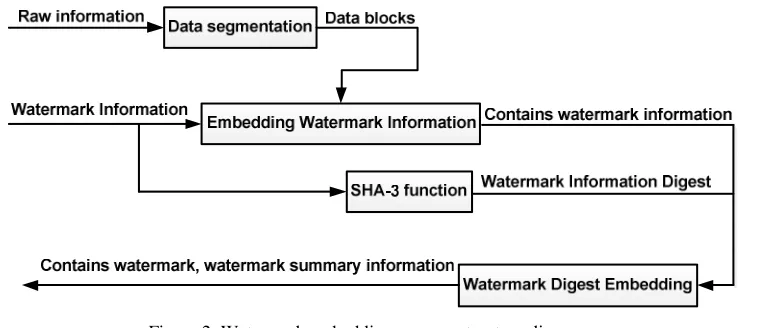
[image:3.612.120.500.302.466.2]The embedding process for the watermark is shown in Figure 2. The size of the carrier image is 256*256 and the original watermark image size is 84*84.
Figure 2. Watermark embedding process structure diagram.
Figure 3. Image chunking and abstract value embedding.
Watermark Extraction and Authentication
The watermark extraction and authentication algorithm is shown in Figure 4. The received watermark image is divided into blocks, which are not overlapping blocks of 3*3 size. Then the least significant bit (LSB) of 8 pixels around each 3*3 image block is extracted, and the binary number of 8 bits is formed, the 8-bit binary number is converted to decimal, then the pixel value of each pixel of the watermark is extracted. The minimum significant bit (LSB) of the last column pixel of the watermark image is extracted respectively, and the original watermark information is abstracted.
Figure 4. Watermark extraction and authentication process structure diagram.
Extract the watermark information and the original Watermark summary information, and then through the SHA-3 function to generate a set of digest value and save. The authentication process of the watermark is basically, the extracted watermark information is obtained through the SHA-3 function, and the Watermark Digest is compared with the extracted original watermark information, and the value of the two sets of abstracts is determined to be identical. If the digest is identical, the watermark information is not tampered with, otherwise the watermark information is tampered with.
Experimental Results and Analysis
The Invisibility of Watermarks
The embedding process for the watermark is shown in Figure 2. The size of the carrier image is 256*256 and the original watermark image size is 84*84.
The watermark required to be added is imperceptible, in order to compare the difference between the measurement of carrier image and embedded watermark image, the peak signal-to-noise ratio (peak signal-to-noise Ratio,psnr) is defined as
(
)
(
)
21 1
255 255
10 l g 1
, ,
M N
i j
PSNR
X i j Xw i j
M N = =
× =
−
×
∑ ∑
(3)Figure 5 (a) carrier image, (b) original watermark image,(c)Digest of Raw Watermark information, (d)Image with watermark and watermark summary,(e)Extract watermark Image,(f)Extract Watermark Summary, (g) Extract watermark information again hash the summary. The algorithm obtains a high peak signal-to-noise ratio and is visually indistinguishable from the original image.
(a) carrier image (b) original watermark image (c)Digest of Raw Watermark information
(d) Image with watermark (e) Extract watermark Image (f)Extract Watermark Summary and watermark summary
(g)Extract watermark information again hash the summary Figure 5. Lena chart experiment results show.
Security Analysis
[image:5.612.73.536.269.622.2]extracting the watermark is S2; When the image is tampered, the digest value generated by the watermark information is S3.
S1: e8f00b4e664528e0f9adfd72eb8172c6edd24a9ed0d688add2522681235f21ba S2: e8f00b4e664528e0f9adfd72eb8172c6edd24a9ed0d688add2522681235f21ba S3: 65acaf1167931cb10fb090ee6a226f779e44dda432ca9f6f175f3f1ac94c130d By comparison, we can clearly determine whether the image has been tampered with.
Conclusions
Based on SHA-3 fragile image watermarking algorithm, a high peak signal-to-noise ratio is obtained by modifying the LSB embedding watermark of pixel points, which ensures the invisibility of the watermark. Through the SHA-3 function, the original watermark and the extracted watermark are hashed and compared, which can be used to judge whether the image has been tampered with. It effectively guarantees the authenticity of digital image and realizes the integrity authentication of digital image.
Acknowledgement
This research was supported by Projects of National Natural Science Foundation(61370188); The Scientific Research Common Program of Beijing Municipal Commission of Education (KM201610015002, KM201510015009); The Beijing City Board of Education Science and technology key project (KZ201510015015, KZ201710015010); Project of Beijing Municipal College Improvement Plan (PXM2017_014223_000063); BIGC Project (Ec201803 Ed201802 Ea201806); Cooperative education project between Ministry of education and Qualcomm Corp (201602034017).
References
[1] Song Yujie, Tan Tieniu. A Brief Review on Fragile Watermarking Based Image Authentication [J]. Chinese Journal of Image Graphics, 2003, 8(1):4-10.
[2] Zhang Jing, Zhang Chun tian. Digital Watermarking Techniques for Image Authentication, 2003, 8(4):367-378.
[3] 2016 International Symposium on Intelligent City and information construction[C].2016.
[4] Zhang Jianwei, Fangr Xinxin, Yan Junhong. Implementation of Digital Image watermarking LSB[J].Micro Computer Information, 2006, 22(10):228-229.
[6] I. Dinur, O. Dunkelman and A. Shamir, New attacks on Keccak-224 and Keccak-256, FSE’2012, 2012.