ScholarWorks @ Georgia State University
ScholarWorks @ Georgia State University
Counseling and Psychological Services
Dissertations Department of Counseling and Psychological Services
Summer 8-11-2011
The Relationship among Social Connectedness, Meaning in Life,
The Relationship among Social Connectedness, Meaning in Life,
and Wellness for Adult Women in Levinson's Mid-Life Transition
and Wellness for Adult Women in Levinson's Mid-Life Transition
Stage
Stage
Karin L. Smithson
Follow this and additional works at: https://scholarworks.gsu.edu/cps_diss
Recommended Citation Recommended Citation
Smithson, Karin L., "The Relationship among Social Connectedness, Meaning in Life, and Wellness for Adult Women in Levinson's Mid-Life Transition Stage." Dissertation, Georgia State University, 2011. https://scholarworks.gsu.edu/cps_diss/63
This dissertation, THE RELATIONSHIP AMONG SOCIAL CONNECTEDNESS, MEANING IN LIFE, AND WELLNESS FOR ADULT WOMEN IN LEVINSON‘S MID-LIFE TRANSITION STAGE, by KARIN L. SMITHSON, was prepared under the direction of the candidate‘s Dissertation Advisory Committee. It is accepted by the committee members in partial fulfillment of the requirements of the degree Doctor of Philosophy in the College of Education, Georgia State University.
The Dissertation Advisory Committee and the student‘s Department Chair, as representatives of the faculty, certify that this dissertation has met all standards of excellence and scholarship as determined by the faculty. The Dean of the College of Education concurs.
Brian J. Dew, Ph.D. Committee Chair
Julie R. Ancis, Ph.D. Committee Member
Kenneth B. Matheny, Ph.D. Committee Member
Frances A. McCarty, Ph.D. Committee Member
Date
JoAnna White, Ed.D.
Chair, Department of Counseling and Psychological Services
R. W. Kamphaus, Ph.D.
AUTHOR‘S STATEMENT
By presenting this dissertation as a partial fulfillment of the requirements for the
advanced degree from Georgia State University, I agree that the library of Georgia State University shall make it available for inspection and circulation in accordance with its regulations governing materials of this type. I agree that permission to quote, to copy from, or to publish this dissertation may be granted by the professor under whose direction it was written, by the College of Education‘s director of graduate studies and research, or by me. Such quoting, copying, or publishing must be solely for scholarly purposes and will not involve potential financial gain. It is understood that copying from or publication of this dissertation which involves potential financial gain will not be allowed without my written permission.
NOTICE TO BORROWERS
All dissertations deposited in the Georgia State University library must be used in
accordance with the stipulations prescribed by the author in the preceding statement. The author of this dissertation is
Karin L. Smithson 202 Valley Road, NW
Atlanta, GA 30305
The director of this dissertation is
Dr. Brian J. Dew
Department of Counseling and Psychological Services College of Education
CURRICULUM VITAE
Karin L. Smithson
ADDRESS:
202 Valley Road, NW Atlanta, GA 30305
EDUCATION:
Ph.D. 2011 Georgia State University
Counselor Education and Practice M.A. 2003 Argosy University
Professional Counseling B.A. 1992 Wesleyan College
Early Childhood Education
PROFESSIONAL EXPERIENCE:
2004-present Counselor
The Anxiety & Stress Management Institute, Atlanta, GA
2005-2008 Course Instructor
Georgia State University, Atlanta, GA
2006-2008 Support Group Facilitator Visions Anew, Atlanta, GA
2002-2003 Behavioral Health Counselor
DeKalb Medical Center, Decatur, GA
PRESENTATIONS AND PUBLICATIONS:
Smithson, K. (2011, April).The meaning of volunteering. Presentation at the 2011 Atlanta Ronald McDonald House Charities Volunteer Appreciation Event, Atlanta, GA.
Smithson, K. (2009, October). The psychological impact of charity for families.
Presentation at the 2009 Atlanta Ronald McDonald House Charities Patron Event, Atlanta, GA.
Smithson, K. (2008, Spring). Sailing the course: Advocating for your own wellness along the doctoral journey, CSI – Chi Epsilon Newsletter, 5, 2-3.
Smithson, K. & Dew, B.(2008, Spring). Is it all talk? Assessing the attitudes and
behaviors of heterosexual married men who use online chat rooms. Presentation at the Annual Conference of the American Counseling Association, Honolulu, HI (in absentia).
Smithson, K. (2007, Fall). In their own words: Exploring the experience of counseling for divorced women: A qualitative research project. Poster session presented at the 2007 ACES Conference, Columbus, OH.
Smithson, K. (2007, Fall). The therapeutic thirties: Assessing and facilitating wellness with female clients in their thirties. Presentation at the AACE 2007 National Assessment Conference, Atlanta, GA.
Smithson, K. (2006, Fall). Welcoming our new doctoral students to the CPS department, CPS News 10, 3.
Jones, K. & McNary, T. (2006, February). Helping to Heal the Pain: Exploring Issues of Trauma within the LGBTQI Population. Poster session presented at the annual AGLBIC Day of Learning Conference at Georgia State University, Atlanta, GA.
Jones, K. (2005, March). Tending to the traumatized client: Creating a safe and beneficial environment for the client in crisis. Poster Session presented at the Annual Conference of the American Counseling Association, Atlanta, GA.
Edwards, N., Fani, N., Ganske, K., Jones, K., & Omonishi, M. (2005, Fall) Welcoming our new doctoral students to the CPS department. CPS News, 8, 4-6.
PROFESSIONAL ORGANIZATIONS:
American Counseling Association (ACA)
Association for Counselor Education and Supervision (ACES)
Southern Association for Counselor Education and Supervision (SACES)
ABSTRACT
THE RELATIONSHIP AMONG SOCIAL CONNECTEDNESS, MEANING IN LIFE, AND WELLNESS FOR ADULT WOMEN IN
LEVINSON‘S MID-LIFE TRANSITION STAGE by
Karin L. Smithson
Abstract
While developmental research on the period of midlife has received increased attention in
the literature, limited focus has been paid to the transitional stage into midlife,
particularly for women. In this study, 286 women between the ages of 38 - 47 years
completed online surveys comprised of a demographic questionnaire, the Social
Connectedness Scale – Revised (SCS-R; Lee, Draper, & Lee, 2001), the Life Regard
Index – Revised (LRI-R; Debats, 1998), and the Five Factor Wellness Inventory – Adult
(FFWel-A; Myers & Sweeney, 1999). Participants were recruited through local
community-based organizations and snowballing efforts. Participants resided in a major
southern metropolitan city. Results from this study indicate that wellness was
significantly higher for women who had advanced degrees, higher income levels, and
were in a parenting role. Full-time employment and higher education levels were
significantly related to higher feelings of meaning in life for women, but being in a
parenting role was not linked to higher meaning in life. Implications for counseling
women in the Mid-Life Transition Stage are explored and directions for future research
THE RELATIONSHIP AMONG SOCIAL CONNECTEDNESS, MEANING IN LIFE, AND WELLNESS FOR ADULT WOMEN IN
LEVINSON‘S MID-LIFE TRANSITION STAGE by
Karin L. Smithson
A Dissertation
Presented in Partial Fulfillment of Requirements for the Degree of
Doctor of Philosophy in
Counselor Education and Practice in
the Department of Counseling and Psychological Services in
the College of Education Georgia State University
Copyright by Karin L. Smithson
ii
TABLE OF CONTENTS
Page
List of Tables ... iii
Chapter 1 THE RELATIONSHIP AMONG SOCIAL CONNECTEDNESS, MEANING IN LIFE, AND WELLNESS FOR ADULT WOMEN IN LEVINSON‘S MID-LIFE TRANSITION STAGE... 1
Middle Adulthood ... 3
Mid-Life Transition Stage ... 6
Women in Mid-Life Transition ... 10
Social Connectedness ... 15
Meaning in Life ... 18
Wellness ... 21
Implications for Counseling ... 23
Implications for Future Research ... 25
References ... 27
2 TOWARD A BETTER UNDERSTANDING OF ADULT WOMEN‘S TRANSITION INTO MIDDLE ADULTHOOD: EXAMINING THE RELATIONSHIP AMONG WELLNESS, SOCIAL CONNECTEDNESS, AND MEANING IN LIFE FOR EARLY MIDLIFE WOMEN ... 48
Social Connectedness ... 51
Meaning in Life ... 52
Wellness ... 54
Research Questions ... 55
Method ... 56
Results ... 62
Discussion ... 70
iii
LIST OF TABLES
Table Page
1 Demographic Description of Participants ... 63
2 Intercorrelations, Means, Standard Deviations, and Range for Social Connectedness Scale, Life Regard Index, and Five Factor
Wellness Inventory ... 66
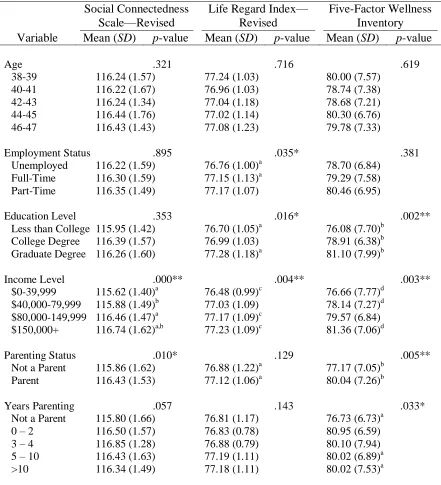
3 Intercorrelations, Means, and Standard Deviations Between
Sociodemographic Variables and Social Connectedness Scale-Revised,
CHAPTER 1
THE RELATIONSHIP AMONG SOCIAL CONNECTEDNESS, MEANING
IN LIFE, AND WELLNESS FOR ADULT WOMEN IN
LEVINSON‘S MID-LIFE TRANSITION STAGE
The scientific study of human development seeks to understand the reasons and
ways that individuals change or remain the same as they age, with the goal of explaining,
evaluating, and promoting human lifespan progression. Although human development
includes the entire length of an individual‘s life, most research in this field has focused on
the eras of childhood, (Egan, 1997; Frazier & Gelman, 2009; Kaplan & Walpole, 2005;
Maslow, 1968; Nelson & Fivush, 2004; Page, Wilhelm, Gamble, & Card, 2010; Piaget,
1962, 1976 ), adolescence (Eccles, Midgley, Wigfield, & Buchanan, 1993; Ferns &
Thom, 2001; Larson, Richards, Moneta, Holmbeck, & Duckett, 1996; Rutter, 1980;
Trentacosta, 2010; Valois, Zullig, Huebner, & Drane, 2009), or childhood through
adolescence (Erikson, 1963, 1980; Freud, 1938; LaFontana & Cillessen, 2010; Snyder &
Feldman, 1977, 1984; Walker, Gustafson, & Hennig, 2001). For instance, Freud (1938)
contended that an individual will reach all five psychosexual stages by adolescence,
remaining in the final stage throughout adulthood. Piaget‘s conceptualization of a
four-stage cognitive lifespan sequence included only one four-stage (Formal Operational) of
adulthood commencing at age twelve (Piaget, 1952, 1970). Although developmental
researchers have largely focused on populations of nonadults, there has recently been
greater emphasis on studying adult development and its unique stages and challenges.
Inclusive models of adult change processes have addressed specific
career development, and physical maturity. For example, Schaie (1982) contended that
adults traverse through four stages of cognition which correspond to adult patterns of
commitment and social emphases, including the early adulthood cognitive stage of
Achieving (goal-directed learning) and the middle adulthood stages of Responsible
(concern for others) and Executive (concern for social systems). Cohen (2005) expanded
cognitive developmental research in late adulthood, identifying stages involving brain
remodeling, recruiting, and information processing. Kohlberg (1971, 1980) identified
two levels of moral judgment usually occurring in adulthood, Conventional, and
Postconventional, with two stages within each level. Super‘s (1972) research on
vocational development indicated that individuals experience five stages of vocational
development, starting at birth with Growth, progressing through Exploratory,
Establishment, Maintenance in midlife, and Decline past the age of 65. Super (1980)
contended that adults experience cycling and recycling of developmental tasks within
each lifespan stage. Fries and Crapo (1981) identified phases of physical organic decline
in adults as a consequence of aging and disease.
Although these developmental models have addressed how adults change over the
lifespan, there remains a lack of emphasis on Middle Adulthood. This period in life has
been called ―a time when themes of juggling multiple roles and achieving balance in life
are front and center‖ (Lachman, 2001) and therefore is worth examining when exploring
constructs in adult development. Less is known about the middle years of adulthood than
earlier and later years of the lifespan, leading Brim (1992, p. 171) to refer to this period
as the ―last uncharted territory in human development.‖ As Lachman (2001) points out,
have an influence on those in this life phase, those approaching this stage or reflecting
back on it, and all individuals who are affected by or cared for by this population.
Middle Adulthood
Middle Adulthood, a developmental phase that follows early adulthood and
precedes a period of late adulthood, has been described as an era of unique demands and
complexities. This phase of life has been described in the literature as beginning and
ending at varying ages, with a converging age range somewhere between the 40s and the
60s (Finch, 2001; Lachman, 2001; MIDMAC, 1999; Staudinger & Bluck, 2001). This
period of life is widely considered the time when an individual leaves young adulthood to
enter an older cohort, but is still somewhat between ‗young‘ and ‗old‘ and thus is
characterized by efforts to reach equilibrium. Midlife has been considered as the central
period of life when an individual looks at balancing the past and the future, while
focusing on utilizing what has been learned in the past to promote success and personal
potential (Staudinger & Bluck, 2001).
Erikson, viewed as a leading developmental theorist, was the first to take a
lifespan developmental approach that includes stages in adult development. Erikson is
credited with extending psychoanalytic stage theory into the adult phase of life and
bringing emphasis on social factors in lifespan development (Corey, 1996). Erikson
(1963, 1978) was the first to address the era of Middle Adulthood as one life stage
between young adulthood and old age, during which an individual faces specific
psychosocial crises, negotiations, and resolutions. Erikson (1963) found that in Middle
Adulthood, the individual struggles with the task of Generativity versus Stagnation.
alongside a counter feeling of stagnation if not contributing in a meaningful way.
According to Erikson (1978), Middle Adulthood is a time of self-generation and
significant identity development as well as the emergence of the psychosocial strength of
care, specifically with children, spouses, and aging parents. This phenomenon has led to
the middle-aged being called ‗the sandwich generation,‘ being caught between caretaking
of the generations before and after them. Although Erikson identified Middle Adulthood
as a specific developmental phase, he failed to break down the various stages within this
era as Levinson (1978, 1986) proceeded to do with his research on lifespan development
and the discovery of distinctive Middle Adulthood stages. Therefore, Levinson‘s stage
model, which succinctly classifies these stages of adulthood by age and developmental
tasks, provides an important framework from which to identify this life stage for further
exploration.
Levinson (1978, 1996) developed a theoretical model of adult developmental
processes by offering distinct, sequential stages, which include phases of relative stability
and transition. Levinson divided the lifespan into four overarching eras: the Era of
Pre-Adulthood (0-22), the Era of Early Pre-Adulthood (17-45), the Era of Middle Pre-Adulthood
(40-65), and the Era of Late Adulthood (60+). Levinson (1978, 1996) detailed additional
stages within these eras, described as periods of formation, transition, and culmination.
The Era of Middle Adulthood contains the Mid-Life Transition (40-45), the Entry Life
Structure for Middle Adulthood (45-50), the Age 50 Transition (50-55), and the
Culminating Life Structure for Middle Adulthood (55-60). The Culminating Life
Structure for the Early Adulthood era precedes Middle Adulthood and is considered to
more secure place in society while departing the ‗junior‘ part of the adult world
(Levinson, 1996). After the Mid-Life Transition Stage begins the Entry Life Structure
for the Middle Adulthood era (45-50), in which the individual focuses on the task of
creating a framework for the initiation of Middle Adulthood by establishing a starting
place in this phase of life (Levinson, 1996). While other theorists focus on separate
domains of adult development, Levinson‘s approach to lifespan issues is inclusive,
detailed, and thus more valuable when examining adult development. Levinson‘s theory
of adult development is significant because he is one of the first to focus primarily on
adult development in Middle Adulthood (Lachman & Bertrand, 2001) and to assign
specific stages to Middle Adulthood‘s developmental years within a lifespan stage theory.
Levinson (1978, 1996) identified the Era of Middle Adulthood as a time when
physical capacities are lowered but sufficient for fulfillment, responsibility for work is
increased, and growth in creativity, purpose, and intimacy is heightened. Levinson
(1978) found a number of central struggles in this transition era, including terminating
Young Adulthood, initiating Middle Adulthood, and coming to terms with the
coexistence of the masculine and feminine parts of the self. Other concerns within this
time period involve social, biological, and environmental issues such as parenthood
(Martin, Hamilton, Ventura, Menacker, & Park, 2002; Peterson & Duncan, 2007;
Sampselle, Harris, Harlow, & Sowers, 2002), marital status (Uhlenberg, Cooney & Boyd,
1990; Reynolds, Lim, & Prior, 2008; Weinberger, Hofstein, & Whitbourne, 2008),
identity formation (Burke, 1995; Stewart et al, 2001), societal norms (Bannister, 2000;
2009) and physical changes (Brown, Gallicchio, Flaws, & Tracey, 2009; Sampselle et al.,
2002).
Within adult development, unique, age-related stages and transitions in Middle
Adulthood have been found to be significant (DeAndrade, 2000; Levinson, 1978, 1986,
1996; Roberts & Newton, 1987; Whitbourne, Sneed, & Sayer, 2009; Woo, 2009). While
the 40-65 year period has been considered the life cycle era of Middle Adulthood, the
stage between the ages of 40 and 45 is especially important. This era, identified by
Levinson (1978, 1996) as the Mid-Life Transition Stage, presents the individual with a
set of unique challenges that are specific to these developmental years (Levinson, 1986).
Considering the significant demands and changes that occur throughout Middle
Adulthood, lifespan research should focus on the identifiable stages within these years
and examine the tasks and issues specific to them. Specifically, theorists should focus on
the years within the Mid-Life Transition Stage, in which individuals face major
developmental tasks, adjustments, and challenges due to leaving the youthful era of Early
Adulthood and entering the more senior stage of Middle Adulthood.
Mid-Life Transition Stage
Levinson (1978, 1986) described the Mid-Life Transition Stage as the first phase
of Middle Adulthood, occurring roughly from ages 40 to 45 (with plus or minus two
years considered normal on either end of the stage). The Mid-Life Transition Stage is
defined as a period representing both a beginning and an end, as an individual both
terminates the younger stage of Early Adulthood and experiences the cross-era shift into
the older stage of Middle Adulthood. Changes within this transition era are shaped by
domains of occupation, leisure, parenthood, family, caregiving, marriage, and self
(Levinson, 1978, 1996).
Individuals may look at life roles within the occupational and family domains and
reevaluate their vision of success and life satisfaction (Levinson, 1996; Wethington,
Kessler, & Pixley, 2004). The family is also a place where reappraisal occurs, as the
Mid-Life Transition Stage individual may experience changes in the family structure due
to divorce, reassessment of the marital relationship, or finding new meanings and roles
for parenting (Levinson, 1996). Relationships may also be examined as the individual
wishes to become more connected and engaged with others while focusing on harms that
have occurred in relationships. Caretaking roles also experience a shift as relationships
change, especially in the family. Children are maturing and perhaps leaving the home,
creating an imminent ‗empty nest‘ (Hagen & DeVries, 2004), or parents or a spouse may
be sick and need caretaking (Levinson, 1996). Individuals in this life stage are also likely
to seek psychotherapy in order to more deeply explore the layers of personal issues
related to life modification in these domains (Goodman, Schlossberg, & Anderson, 2006;
Ivey, Ivey, Myers, & Sweeney, 2004; Levinson, 1996).
The reappraisal process during the Mid-Life Transition Stage occurs when
individuals review their pasts and acknowledge illusions of what life was supposed to be.
During this stage, they begin to question their accomplishments, desires, values, and
talents while experiencing a greater awareness of mortality. Individuals strive to reach a
―good enough‖ place of development wherein aspirations are found, commitments to
people and enterprises are made, and strong obligations to goals are set. Within the years
of one‘s self to the greater good, and building a legacy (Levinson, 1978). An
individuation process encourages individuals to form a stronger sense of self and clearer
boundaries between themselves and the world by becoming more generative and
independent as well as deepening attachments and societal involvement (Levinson,
1978). These tasks align with Erikson‘s (1959, 1963) midlife stage of Generativity vs.
Stagnation, which would likely heighten during struggles that are specific to the Mid-Life
Transition Stage of development.
The polarities that individuals attempt to resolve during the Mid-Life Transition
Stage are the following: (1) Young/Old; (2) Destruction/Creation; (3)
Masculine/Feminine; and (4) Attachment/Separateness (Levinson, 1978). Levinson
(1978, 1996) considered these resolutions to be part of the evolutionary lifespan
individuation process, as each polarity pair represents opposing tendencies that
continually coexist within each individual. For example, an individual struggles with
being both young and old in the Mid-Life Transition Stage, balancing and establishing an
age appropriate place in this era of life. The conflict of Destruction/Creation represents
the Mid-Life struggle of dealing with ours and others‘ mortality and the destructive
harms in our lives, in conjunction with the powerful desire to become more creative and
caring toward ourselves and others. The individual also grapples with the coexistence of
masculine and feminine parts of the self that, although strongly split in childhood,
become almost impossible to overcome in adulthood and therefore become more
integrated. Finally, adults in the Mid-Life Transition Stage struggle with integrating the
strong desire for engagement in the external world while also needing to have
Levinson (1996) stated that although these polarities present challenges at any time
during the life cycle, it is during transitional times such as the Mid-Life Transition Stage
that the need and opportunity for integration becomes most magnified as individuals feel
suspended between the past and the future.
In Levinson‘s (1978) earlier work conducted on males, he initially found these
adult developmental tasks to be predictable and important when considering the male
lifespan. Although Levinson (1978) substantiated these paradigms on a cohort of men,
his later research focused on the lifespan development of women and found the same
paradigms applied to females at consistent ages and life stages as males with some gender
specific challenges (1996). During the Mid-Life Transition Stage, the neglected pieces of
the self become increasingly in need of exploration and expression, encouraging a
modification process of the existing Young Adulthood life structure (Levinson, 1996).
Levinson (1978, 1996) found the Mid-Life Transition stage to be more complicated and
ambiguous than other life eras, with the majority of adults enduring a struggle of
questioning all life domains in order to modify life. It is because of this documented
struggle, specific to these developmental years, that the Mid-Life Transition Stage should
be explored more deeply to broaden awareness and knowledge for mental health
practitioners, Middle Adulthood individuals, and society as a whole.
Further research has found evidence that the era from 40 to 45 presents unique
psychological challenges to the individual that warrant further examination. Jung (1964)
may have been the first theorist to indicate the significance of these years by suggesting
that a transition period of individuation commences around age 40, during which the
new levels of meaning, awareness, and understanding. Longitudinal research has shown
that a person in the early 40s is likely to experience personality instability (Helson &
Wink, 1992) as well as a sense of decreased mastery of life control with increased life
constraints (Lachman, Rosnick, & Rocke, 2009). Blanchflower and Oswald‘s (2008)
results have revealed that happiness scales dip and depression scales rise during the early
years of the Mid-Life Transition Stage, designating this population as one that deserves
empirical attention, especially relating to factors contributing to psychological wellness.
Although Levinson‘s (1978, 1996) research demonstrates that both male and female
adults enter the Mid-Life Transition Stage at similar ages and face comparable tasks and
challenges, there is significant evidence of gender-specific struggles and transitions
experienced by adult women (Levinson, 1996; Martin et al., 2002; Sampselle et al.,
2002).
Women in Mid-Life Transition
Although researchers have historically contended that adults have similar patterns
and stages of lifespan development (Erikson, 1978, 1980; Levinson, 1996), females have
been shown to experience unique challenges related to the cultural and biological
influence of gender on their lives (Baltes, Staudinger, & Lindenberger, 1999; Leaper,
2000; Levinson, 1996; Reid & Bing, 2000). Gilligan‘s (1993) research indicated that
women encounter this entry to midlife with a different psychological history and social
reality than men, making sense of their life experiences based on relationships with
others.
Women‘s lifespan research has suggested that females may experience distinctive
(Levinson, 1996; Stewart et al., 2001). One era that has recently been identified as a
significant developmental stage with its own set of unique challenges is the Mid-Life
Transition Stage. The midlife era has been considered as the ―most central period of life‖
for women (Staudinger & Bluck, 2001), and the genesis of that period should be
considered fundamental and examined. In fact, research has shown that women are more
likely than men to report significant turning points entering into and during midlife, most
resulting from negative life events (Moen & Wethington, 1999) and experienced as
transformational by ‗answering a calling‘ toward life‘s purpose (Keeran, 2007).
Levinson‘s (1996) study on women‘s development found that primary tasks during this
period can be considered reappraising the way one lives her life and exploring potential
changes she can make through new endeavors.
Levinson (1996) defined an array of developmental tasks for women in this
transitional age group. The tasks of individuation and initiation become salient as the
individual forms an inner matrix which evolves and modifies the self and life structure
(Levinson, 1996). The woman may become more compassionate, creative, judicious,
insightful, loving of others and the self, and less stressed by internal conflicts and
external demands. Females in the Mid-Life Transition Stage may experience the desire
to come to terms with family members and the self through the process of healing
significant relationships and deep internal divisions (Levinson, 1996). Women in the
Mid-Life Transition Stage could have increased feelings of responsibility for personal
work as well as contributing to the next generation, leading to increased participation in
social endeavors (Levinson, 1996). The process of reevaluating and balancing
are what Levinson found to be crucial developmental milestones for this life era. In
significant areas of life, such as marriage, lifestyle, and work, the Mid-Life Transition
Stage woman travels through the experiences of exploration, alteration, and evolution,
recognizing that although her life may not be what she once dreamed, she ultimately
decides, ‗This I will settle for.‘
Some of these primary transitions during the Mid-Life Transition Stage are
related to childrearing, marital status, career, societal norms, sexual identity, spirituality,
identity formation, and physiology. Mid-Life Transition Stage women report
childrearing as a major life stage (Sampselle et al., 2002). This era may include the
following experiences and challenges: first-time childbirth (Martin et al., 2002), the
diminution of childrearing, the reevaluation of self-worth regarding societal expectations
toward childrearing (Sampselle et al., 2002), and the emotional conflict due to older
children leaving the home (Hagen & DeVries, 2004; Raup & Myers, 1989). Marital
status may also present an array of transitional experiences, including first time marriage
(U.S. Census Bureau, 2002), divorce (Sakrieda, 2008; Uhlenberg, Cooney, & Boyd,
1990), and the potential struggle regarding low marital satisfaction, leading to
psychological distress regarding feelings of loss, disappointment, and the passing of a
hopeful youth (Leiblum, 1990).
Career and societal issues can also be significant for women during this life stage.
Super (1980) conceptualizes this career phase as the conclusion of the ‗Establishment
Stage‘ (ages 25-44), representing a time when the career pattern becomes clearer and
more stable. While Leiblum (1990) describes women in early midlife as having
this female developmental era can involve a conflict of professional aspirations. Women
who have pursued vocational interests can experience threats to their sense of self due to
the confusion between personal achievement and the ethic of care for others that also
becomes stronger as women mature (Gilligan, 1993). Research has revealed that women
in this era face challenges related to institutional, cultural, and familial challenges
(Pavalko & Gong, 2005), as well as societal norms for life events (Neugarten, 1996;
Setterson & Hagestad, 1996). For example, society can impose challenges to the
self-image and sense of purpose of working women, placing high value on the success of
childrearing and reproduction at this age (Gergen, 1990).
Developmental changes involving sexuality and sexual identity may also become
salient issues during the Mid-Life Transition Stage. Results from previous studies have
found that early midlife women may experience enhanced self-esteem by no longer
defining themselves principally as sex objects (Greer, 1992; Sheehy, 1998).
Degges-White and Myers (2006a) found that 12% of women in this age group identified
renegotiation of their sexual identity as an important transition during the midlife era.
Women in the Mid-Life Transition Stage have also reported spirituality being a
significant component of the midlife transition process (Howell, 2001b). Women may
experience mental and spiritual transitions, involving a reconnection with the self
(Edelstein, 1999), the past, a higher power, or lost loved ones (Kutz, 2007). They may
also go through a Jungian experience of exploring the shadow and integrating the
neglected parts of the unconscious (Brewi & Brennan, 1999). The midlife years have
been conceptualized as a spiritual time of ―re-magining ourselves in order to live in the
during this era as an interweaving of spirituality in all aspects of life, during which
women develop a sense of open-endedness and experience time, spatiality, and motility
differently. Mid-Life Transition Stage women have reported going through a powerful
spiritual awakening during these years (Howell, 2001a), which has been described as a
process of choice and freedom, gaining an understanding of their place in the spiritual
universe and ―becoming the person they believed they needed, or were created, to be‖
(Geertsma & Cummings, p.30, 2004).
The Mid-Life Transition years may also present challenges and growth in a
woman‘s gender identity formation. Stewart et al. (2001) found that a woman‘s identity,
generativity, and confident power in her own authority and competence become more
prominent in her 40s. Josselson (2000) contends that connections, relationships, and
religious involvement are central to women‘s midlife identity formation. Other research
indicates that midlife identity development for women includes seeking continuity and
meaning amidst constant change, gaining permission to succeed in love and work, and
increasing confidence, dominance, coping skills, and well-being (Helson & Moane,
1987).
As a woman in the Mid-Life Transition Stage experiences growth, she inevitably
journeys into a period of developmental physical changes due to the aging process. The
onset of menopause is central to midlife, affecting women with a complicated change
(Langer, 2008; Vliet, 1995) likely including biological, psychological, social, (Anderson,
Hamburger, Liu, & Rebar, 1987; Kurpius & Nicpon, 2003), sexual, and cognitive
components (Amore et al., 2007; Rich & Mervyn, 1999). Other studies show that women
and gain increased wisdom, self-awareness, self-worth (Perz & Ussher, 2008), and
confident power regarding the aging process (Neugarten, 1996). Longitudinal research
shows that a sense of well-being for women in the Mid-Life Transition years significantly
predicted quality of life measures while in their 50s (Helson & Wink, 1992). Levinson
(1996) found that women in this stage were highly likely to experience a moderate or
severe developmental crisis, even hitting ‗rock bottom,‘ feeling like a period of life was
ending amidst uncertainty of how to successfully modify the life structure. Taking into
consideration the complexities and challenges specific to women in the Mid-Life
Transition Stage of Life, and the importance of this stage in the female lifespan, further
research should focus on exploring this developmental era. This need for understanding is
even more enhanced given the prevalence of women in this particular age group.
The United States Census Bureau (2007) estimated that the 2006 national
population was comprised of nearly twelve million women between the ages of 40 and
44. Although there is existing literature regarding women in this life phase, there is a
paucity of research on this specific developmental era of Mid-life Transition. Previous
studies have called for more extensive studies on this transitional period in Middle
Adulthood (Etaugh, 2006; Stewart et al., 2001; Staudinger & Bluck, 2001), specifically
relating to the domains of social connectedness (Krause, 2007), meaning in life (Zika &
Chamberlain, 1992), and well-being (Degges-White & Myers, 2006b; Krause, 2007; Zika
& Chamberlain, 1992).
Social Connectedness
Social connections have been found to be critical to women‘s development and
Zachariah, 1994). Lee and Robbins (1998) conceptualize social connectedness as a type
of relational schema, which signifies patterns in interpersonal relatedness. Social
connectedness has also been characterized as an ―enduring and ubiquitous‖ sense of the
self in relation to the world (Lee & Robbins, 2000, p. 485) which permits individuals to
‗feel human among humans‘ and identify with others that are different than the self (Lee
& Robbins, 1995). Simply stated, social connectedness involves the way that we relate
with others and how we see ourselves in regards to those bonds and associations.
A sense of social connectedness has been found to be related to higher levels of
well-being in such populations as pregnant, low income women (Zachariah, 2004),
disadvantaged young adult women (Griffiths et al., 2007), and older adults (Fiori,
Antonucci, & Cortina, 2006; Litwin, 2001). Research has indicated that social
connectedness in college age populations is related to more social involvement, positive
perceptions of others, easier relationship engagement (Lee, Draper, & Lee, 2001), higher
social competency and psychological health (Williams & Galliher, 2006), and increased
levels of self esteem (Lee et al., 2001; Lee, Keough, & Sexton, 2002; Lee & Robbins,
1995, 1998, 2000). Studies on social connectedness also indicate positive relationships
that lead to feeling ‗buffered‘ against stressful life events (Cohen & Wills, 1985) and
gaining better coping capacity (Julawong, 2009). Low levels of social connectedness
have been correlated with depression in older adults (Golden et al., 2009:
Ingersoll-Dayton, Morgan, & Antonucci, 1997); and with feelings of isolation, maladaptive
interpersonal behaviors, and relationship dissatisfaction (Lee et al., 2001) in college
students. The majority of this research has been conducted with mixed gender samples,
however, no research on social connectedness has focused solely on women between the
midlife ages of approximately 40 and 45.
Women in the Mid-Life Transition Stage have shown strong needs to belong
socially through interpersonal connections (Sargent & Schlossberg, 1988). Previous
research has indicated that women travel through transition periods in terms of their
social relationships (Miller, 1976; Gilligan, 1993) and experience development in their
personal connections (Surrey, 1991; Gilligan, 1993). In fact, for women in the Mid-Life
Transition Stage, social losses such as divorce, widowhood, or career loss can feel so
significant that they may be experienced as a total loss of self (Miller, 1976), and in time
transform one‘s sense of self, ways of knowing, and life perspective (Danforth, 2000).
As they embark into midlife, women in the Mid-Life Transition Stage can gain a sense of
meaningfulness through social relationships, gaining a greater sense of understanding of
interpersonal connection, and caring for others (Josselson, 2000). Russell (1984) argues
that women‘s midlife developments during transition phases are unique from men‘s
experiences due to women being highly influenced by interpersonal relationships, their
biological clocks, and social restraints.
Although existing research points to the significance of social support in women‘s
psychological health (e.g., Shelby et al, 2008; Sundler & Dahlberg, 2009), no study has
been found that focuses on the effects of social support for women specifically in the
Mid-Life Transition Stage. In adult samples of women, there is evidence of a connection
between social support and meaning in life (Krause, 2007). However, no research has
been found that has explored this relationship in a population of women between
Meaning in Life
The construct, meaning in life, has been defined in various ways. Reker (2000)
conceptualized life meaning as ―the cognizance of order, coherence, and purpose in one‘s
existence, the pursuit and attainment of worthwhile goals, and an accompanying sense of
fulfillment‖ (p. 41). Yalom (1980) defined meaning as possessing a sense of coherence
and purpose in life. While Frankl (1984) saw an individual‘s search for meaning as the
primary motivation in life, others have described meaning as making sense of one‘s
existence and life purpose by selecting goals based on a sense of order (Reker, Peacock,
& Wong, 1987; Yalom, 1980).
Having social connections with others has been found to be strongly associated
with a sense of meaning in life, while alienation from interpersonal connections has been
shown to be related to a feeling of meaninglessness (Debats, 1995). Research has shown
that a core component of midlife transition is the individual‘s concern about meaning in
life (Helminiak,1995). Although research exists, Debats (1999), Harris and Standard
(2001), and Krause (2009) claim that the construct of meaning in life has received
inadequate empirical attention in psychological literature. No research has been found
that examines meaning in life specifically in women between the approximate ages of 40
and 45.
A sense of meaning in life has been shown to have many dimensions, including
spiritual (Ryš, 2009; Waisberg & Porter, 1994), cognitive, affective, and behavioral
domains (Debats, 1990; Maddi, 1967). Wong (1998) states that life meaning is
developed through such things as pursuing goal achievement, engaging in
relationships, and being a social, well-liked individual. Areas of life that have been
shown to be sources of life meaning are work, love and marriage, childbirth, involvement
in independent, purposeful activities (Baum & Stewart, 1990), and meaningful
relationships (Josselson, 2000).
Research on meaning in life in college student populations has shown that the
construct is positively related with a sense of hope, fewer depressive symptoms (Mascaro
& Rosen, 2005), higher self esteem, life satisfaction (Halama, 2007), happiness (Bhogle
& Prakash, 1993), extraversion, and conscientiousness (Halama, 2005). Studies also
show relationships between meaning in life and happiness (Debats, 1996; Park, Peterson,
& Ruch, 2009; Scannell, Allen, & Burton, 2002), as well as spiritual well-being (Harris
& Standard, 2001; Scannell et al., 2002) in samples of adult mixed dyads. Relationships
between meaning in life and life satisfaction for populations of unemployed mothers
(Chamberlain & Zika, 1998) and college students (Debats, 1990; Pan, Wong, Joubert, &
Chan, 2008) have also been found in the literature. Other studies show that meaning in
life is associated with self-efficacy in a mixed gender adult population (Skrabski, Kopp,
Rozsa, Rethelyi, & Rahe, 2005), with physical health in older adults (Krause, 2004;
Parquart, 2002), and with overall positive mental health outcomes for college students
(Lindeman & Verkasalo, 1996) and the elderly (Moore, 1997; Reker, 1997).
Studies have indicated that a sense of meaning in life is negatively related to
feelings of boredom, apathy, emptiness (Frankl, 1966), anxiety, depression (Debats,
1990), and hopelessness (Harris & Standard, 2001) in general adult populations, as well
as depressive symptoms (Mascaro, 2007) and psychological distress in college students
negative correlations between meaning in life and suicidal ideation and suicidal behavior
in college aged populations (Edwards & Holden, 2001), as well as with mental pathology
in the elderly (Moore, 1997; Zika & Chamberlain, 1992) and stay-at-home mothers (Zika
& Chamberlain, 1992). While meaning in life has been examined in a number of
previous studies, most of these research designs have focused on mixed gender samples,
college students, or older adults, and none have utilized a sample specifically made up of
women in the Mid-Life Transition Stage.
Researchers have asserted that a sense of meaning has a unique causal influence
on psychological health that exists across a variety of contexts, especially gender (Debats,
1996; Mascaro & Rosen, 2005). Results from previous studies have suggested that
women experience the construct of meaning in life in a unique way. Studies have
characterized a woman‘s journey of creating meaning in life as an ongoing, life-long
process influenced by life transitions (McAdams, 1996; Reker & Chamberlain, 2000).
One study on poor, rural women reported that a sense of meaning and purpose,
interconnectedness, and spirituality accounted for a significant variance in total
individual wellness (Gill, 2005). In a sample of midlife, never married, childless,
heterosexual women, a sense of meaning in life was reported to be derived from personal
independence, lifestyle freedom, and strong interpersonal connections with family and
friends (Robinson-Rowe, 2002). Kovacs (1992) discovered that women in the early
Mid-Life Transition Stage can go through a crisis of life purpose ambiguity. Additional
research has found that life meaning is also positively related to well-being in college age
students (Debats, 1995) and the elderly (Skrabski et al, 2005), and Ryff (1989a) includes
populations. However, what is not known is the relationship between meaning in life and
wellness in the specific stage of Mid-Life Transition for women.
Wellness
Dunn (1961) identified well-being as ―an integrated method of functioning which
is oriented toward maximizing the potential of which the individual is capable‖ (p. 4).
Ryff (1989b) identified six dimensions of positive functioning that should incorporate
psychological well-being, including positive connections with others, purpose in life, and
personal growth. Recent literature has further conceptualized the construct of well-being
in more holistic terms, using the term ‗wellness,‘ but the two terms are considered
synonymous across the literature. Wellness is defined as a way of life oriented toward
optimal health and well-being, integrating the mind, body, and spirit to exist more fully in
the human and natural community (Myers, Sweeney, & Witmer, 2000). Historically,
theorists have seen well-being as an essential goal of lifespan development (Erikson,
1980; Jung, 1954; Levinson, 1978).
The Wheel of Wellness (Witmer & Sweeney, 1992) has emerged as a leading
model in the assessment of wellness. This model conceptualizes the construct of
wellness as a part of an individual‘s developmental process that is multidimensional,
including the elements of psychology, anthropology, sociology, religion, and education.
The Wheel of Wellness includes five individual life tasks including 1) essence and
spirituality, 2) work and leisure, 3) friendship, 4) love, and 5) self-direction, which
interact dynamically with a range of life domains including family, community, religion,
Studies on women have revealed a variety of unique variables that influence
wellness. For example, Saunders and Kashubeck-West (2006) found that women with
higher developmental levels of feminist identity report higher levels of psychological
well-being. These researchers argue that an exploration into this identity development
and gender role orientation is necessary to conceptualize more fully a woman‘s wellness.
A gender-based study found that a mother‘s death has a stronger negative impact on
well-being for women than for men (Marks, Jun, & Song, 2007). Women displaying a higher
feminine quality of expressiveness have been found to report elevated levels of wellness
(Saunders & Kashubeck-West, 2006). Other variables that have been found to be related
to higher levels of well-being among women are experiences in the adult developmental
journey, including being in committed relationships or married, having more advanced
education, and owning one‘s home (Dear, Henderson, & Korten, 2002).
Women in midlife have their own developmental challenges that can influence
wellness. Conflict and stress related to the various roles that a woman faces during this
period can impact her well-being (Baruch & Barnett, 1987; Poole, Langan-Fox, 1992;
Vandewater & Stewart, 2006). However, the role of paid worker has been shown to
enhance levels of well-being for midlife women (Baruch & Barnett, 1987). Research has
shown that a woman‘s midlife well-being is facilitated by her earlier attachments and
ability to articulate her identity (Vandewater, Ostrove, & Stewart, 1997), showing the
importance of experiences throughout the developmental stages preceding midlife
transition. While age has been found to be positively related to wellness in a female
sample when controlling for household income (Degges-White & Myers, 2006b), anxiety
(Stewart et al., 2001). When studying personality domains in midlife females, levels of
identity certainty, generativity, and confident power that are established during this life
phase were shown to be positively related to levels of well-being (Stewart Ivey et al.,
2001). Even though there has been some research on assessing wellness for women in
midlife, there again have been no studies evaluating wellness on samples of women in the
Mid-life Transition Stage of adulthood, nor has there existed a study that has examined
the relationship among social connectedness, meaning in life, and wellness in this
particular population.
Implications for Counseling
Research on the Mid-Life Transition Stage of women‘s lives can provide
important insight for the counseling professional. Counselors must take into
consideration that each client is in his or her own developmental phase in life and that
each phase presents its own unique set of concerns for the individual. This statement is
especially relevant for the population of women going through the Mid-Life Transition
Stage. By studying this population further, counselors can gain more information to
assist clients in achieving personal growth and a higher sense of wellness.
Previous research has found that a majority of counseling clients present to
therapy during life transitions, and therefore counselors should have a secure base of
knowledge of what constitutes significant transitions and what strategies lead to better
mental health outcomes, such as wellness (Ivey, Ivey, Myers, & Sweeney, 2004). By
understanding the challenges, life tasks, and physical concerns during this transition
period, counselors can assist clients in gaining a stronger sense of personal awareness.
that they are not alone, while normalizing developmental struggles. Additionally,
counselors would benefit from utilizing research on Mid-Life Transition Stage women
when working with clients in couples counseling, family counseling, and group
counseling settings. The broad array of physical, psychological, vocational, social,
sexual, spiritual, and lifestyle changes that accompany the Mid-Life Transition era are
likely to have an impact on a woman‘s marriage, partnership, or intimate relationships.
For example, premenopausal challenges, changing familial expectations, career
fluctuations, relationships, societal pressure, spiritual transitions, caretaking
responsibilities, and levels of overall wellness can affect a woman‘s temperament, mental
stability, and physical capacities in intimate relationships and are necessary for
consideration in a counseling setting. These aforementioned issues will also affect family
dynamics and should be acknowledged by family counselors, including such challenges
as caregiving for sick parents, loss of parents, widowhood, divorce, children leaving the
home, childbearing considerations, going back to school, and career change or reentry.
Taking into account the potential for loss during these years, including the death of
parents or spouse, divorce, joblessness, relationship changes, loss of childbearing
potential, and physical aging, grief counselors must stay alert to specific issues for
women between ages 40 and 45.
McQuaide (1998) agrees that clinical work with this population of midlife women
can differ vastly from work with other ages, since so many issues present age-related
factors that contribute to overall well-being, such as marital relationships, identity, loss,
and self-esteem. The experiences of women in the Mid-Life Transition Stage can include
unique developmental challenges that usually occur in this age group would be better
equipped to help facilitate a better sense of identity formation for female midlife clients
in the domains of spirituality, gender, vocation, and sexuality, as well as assist clients in
working through challenges related to roles in the family, working world, and
community. Furthermore, since the literature suggests a strong link between a woman‘s
wellness and her social connections and sense of meaning in life, counselors must be
purposeful about staying alert to such information and applying appropriate interventions
to strengthen social bonds and encourage the pursuit for meaning in life when working
with women in the Mid-Life Transition phase. Although research exists that examines
these constructs in women, more research is needed to substantiate these relationships in
this population.
Implications for Future Research
The evidence presented in this paper provides a variety of directions for further
research on women in midlife stages of the lifespan. As a result of examining the
uniqueness of the different phases of female life from a developmental perspective, it
would be important to look at comparisons between groups of women in various stages
compared to those in the Mid-Life Transition Stage. Future studies should look at
Levinson‘s stages of adult development and seek more evidence to confirm or challenge
his findings, as society continues to change in relation to gender roles, the workforce, and
cultural norms for women, possibly affecting the experiences during this time period of
midlife. Another implication that cannot be ignored is one regarding possible differences
between ethnic groups. It would be important to explore if the relationships between the
women of varying ethnicities and educational achievement level. Additionally, these
same differences could be explored relative to a number of demographic variables that
could have an effect on women‘s mental health, such as socio-economic status, marital
status, marital satisfaction, sexuality, disability, vocational status, substance use history,
life satisfaction, motherhood status or childlessness, gender identity, trauma history, and
spiritual identity. Utilizing a lifespan perspective on women‘s development, it would be
important to conduct a longitudinal study that explores the constructs presented in this
paper at different times in women‘s lives. Considering the scarcity of research on
specific midlife stages of life, the evidence presented in this paper suggests the
importance of continuing to investigate the developmental phases in the midlife season of
References
Amore, M., Di Donato, P., Berti, A., Palareti, A., Chirico, C., Papalini, A., & Zucchini, S.
(2007). Sexual and psychological symptoms in the climactic years. Maturitas,
56(3), 303-311.
Anderson, E., Hamburger, S., Liu, J. H., & Rebar, R. W. (1987). Characteristics of
menopausal women seeking assistance. American Journal of Obstetrics and
Gynecology, 156, 428-433.
Baltes, P. B., Staudinger, U. M., & Lindenberger, U. (1999). Lifespan psychology:
Theory and application to intellectual functioning. Annual Review of Psychology,
50, 471-507.
Banister, E. M. (2000). Women‘s midlife confusion: ‗Why am I feeling this way?‘
Issues in Mental Health Nursing, 21(8), 745-764.
Baruch, G. K., & Barnett, R. C. (1987). Role quality, multiple role involvement, and
psychological well-being in midlife women. Journal of Personality and Social
Psychology, 51, 578-585.
Baum, S. K., & Stewart, R. B. (1990). Sources of meaning through the lifespan.
Psychological Reports, 67, 3-14.
Bhogle, S., & Prakash, I. J. (1993). Indicators of subjective well-being in a non-clinical
adult sample. Psychological Studies, 38, 135-141.
Blanchflower, D. G., & Oswald, A. (2008). Is well-being u-shaped over the life cycle?
Social Science & Medicine, 66(6), 1733-1749.
Brim, O. G. (1992). Ambition: How we manage success and failure throughout our lives.
Brewi, J., & Brennan, A. (1999). Mid-life spirituality and Jungian archetypes. York
Beach, ME: Nicolas-Hays.
Brown, J. P., Gallicchio, L., Flaws, J. A., & Tracy, J. K. (2009). Relations among
menopausal symptoms, sleep disturbance and depressive symptoms in midlife.
Maturitas, 62, 184-189.
Burke, P. C. (1995). Identity development in midlife: A qualitative study of professional
women in the 1990s (Doctoral dissertation, University of Connecticut, 1995).
Dissertation Abstracts International, 55, 3004.
Carpeneto, G. R. (1997). Walking the midlife labyrinth: A phenomenological study of the
embodiment of spirituality in women during the middle years. Dissertation
Abstracts International: Section A: Humanities and Social Sciences, 57(9-A), 4165.
Chamberlain, K., & Zika, S. (1998). Religiosity, life meaning, and well-being: Some
relationships in a sample of women. Journal for the Scientific Study of Religion,
27, 411-420.
Cohen, G. (2005). The mature mind: The positive power of the aging brain. New York:
Basic Books.
Cohen, S., & Wills, T. A. (1985). Stress, social support, and the buffering hypothesis.
Psychological Bulletin, 98, 310-357.
Corey, G. (1996). Theory and practice of counseling and psychotherapy (5th ed.).
Pacific Grove, CA: Brooks/Cole.
Danforth, M. M. (2000). Listen to my words, give meaning to my sorrow: A study in
Dissertation Abstracts International: Section A: Humanities and Social Sciences,
60(9-A), 3233.
DeAndrade, C. E. (2000). Becoming the wise woman: A study of women‘s journeys
through midlife transformation (Doctoral dissertation, The Wright Institute, 2000).
Dissertation Abstracts International, 61, 1109.
Dear, K., Henderson, S., & Korten, A. (2002). Well-being in Australia: Findings from the
National Survey of Mental Health and Well-being. Social Psychiatry and
Psychiatric Epidemiology, 37(11), 503-509.
Debats, D. L. (1990). The Life Regard Index: Reliability and validity. Psychological
Reports, 67, 27-34.
Debats, D. L. (1995). Experiences of meaning in life: A combined qualitative and
quantitative approach. British Journal of Psychology, 86, 359-375.
Debats, D. L. (1996). Meaning in life: Clinical relevance and predictive power. British
Journal of Clinical Psychology, 35, 503-516.
Debats, D. L. (1999). Sources of meaning: An investigation of significant commitments
in life. Journal of Humanistic Psychology, 39, 30-57.
Debats, D. L., Van der Lubbe, P., & Wezeman, F. R. A. (1993). On the psychometric
properties of the Life Regard Index (LRI): A measure of meaningful life.
Personality and Individual Differences, 14, 439-345.
Degges-White, S., & Myers, J.E. (2006a). Midlife lesbians and bisexual women:
Implications for mental health practitioners. Journal of GLBT Issues in Counseling,
Degges-White, S., & Myers, J. E. (2006b). Transitions, wellness and life satisfaction:
Implications for counseling midlife women. Journal of Mental Health Counseling,
28, 133-150.
Dunn, H. L. (1961). High-level wellness. Arlington, VA: Beatty.
Eccles, J. S., Midgley, C., Wigfield, A., & Buchanan, C. (1993). Development during
adolescence: The impact of stage-environment fit on young adolescents‘
experiences in schools and in families. American Psychologist, 48, 90-101.
Edelstein, L. (1999). The art of midlife:Courage and creative living for women.
Connecticut: Bergin & Garvey.
Edwards, M. J., & Holden, R. R. (2001). Coping, meaning in life, and suicidal
manifestations: Examining gender differences. Journal of Clinical Psychology, 59,
1133-1150.
Egan, K. (1997). The educated mind: How cognitive tools shape our understanding.
Chicago: University of Chicago Press.
Erikson, E. (1959). Identity and the life cycle. New York: International University Press.
Erikson, E. (1963). Childhood and society. (2nd ed.). New York: Norton.
Erikson, E. (1978). Adulthood.. New York: Norton.
Erikson, E. (1980). Identity and the life cycle (Rev. ed.). New York: W.W. Norton.
Etaugh, C. A. (2006). Midlife transitions. In J. Worrel & C. D. Goodheart (Eds.),
Handbook of girls’ and women’s psychological health: Gender and well-being
across the lifespan. New York: Oxford University Press.
Ferns, I., & Thom, D. P. (2001). Moral development of black and white South African
Finch, C. E. (2001). Toward a biology of middle age. In M.E. Lachman (Ed.),
Handbook of Midlife Development (pp. 77-108). Wiley & Sons: New York.
Fiori, K. L., Antonucci, T. C., & Cortina, K. (2006). Social network typologies and
mental health among older adults. Journal of Gerontology, Series B: Psychological
Sciences and Social Sciences, 61, 25-32.
Frankl, V. E. (1966). Self-transcendence as a human phenomenon. Journal of
Humanistic Pyschology, 6, 97-106.
Frankl, V. E. (1984). Man’s search for meaning. New York: Simon & Schuster.
Frazier, B. N., & Gelman, S. A. (2009). Developmental changes in judgments of
authentic objects. Cognitive Development, 24(3), 284-292.
Freud, S. (1938). The basic writings of Sigmund Freud. A. A. Brill (Ed. and Trans.).
New York: Modern Library.
Fries, J., & Crapo, L. (1981). Vitality and aging. San Francisco, CA: WH Freeman
Company.
Geertsma, E. J., & Cummings, A. L. (2004). Midlife transition and women‘s spirituality
groups: A preliminary investigation. Counseling and Values, 49, 27-36.
Gergen, M. (1990). Finished at 40: Women‘s development within the patriarchy.
Psychology of Women Quarterly, 14(4), 471-493.
Gill, C. S. (2005). The relationship among spirituality, religiosity, and wellness for poor,
rural women. Dissertation Abstracts International: Section A: Humanities and
Social Sciences, 66(6-A), 2112.
Gilligan, C. (1993). In a different voice: Psychological theory and women’s development
Golden, J., Conroy, R. M., Bruce, I., Denihan, A., Greene, E., Kirby, M., & Lawlor, B. A.
(2009). Loneliness, social support networks, mood, and wellbeing in
community-dwelling elderly. International Journal of Geriatric Psychitatry, 24(7), 694-700.
Goodman, J., Schlossberg, N. K., & Anderson, M. L. (2006). Counseling adults in
transition: Linking practice with theory (3rd Ed.). New York, NY: Springer
Publishing Co.
Greer, G. (1992). The change: Women, aging, and the menopause. New York:
Ballantine Books.
Griffiths, R., Horsfall, J., Moore, M., Lane, D., Kroon, V., & Langdon, R. (2007).
Assessment of health, well-being, and social connections: A survey of women
living in Western Sydney. International Journal of Nursing Practice, 13(1), 3-13.
Hagen, J. D., & DeVries, H. M. (2004). Marital satisfaction at the empty-nest phase of
the family life cycle: A longitudinal study. Marriage & Family: A Christian
Journal, 7(1), 83-98.
Halama, P. (2005). Relationship between meaning in life and the big five personality
traits in young adults and the elderly. Studia Psychologica, 47, 167-178.
Halama, P. (2007). Meaning in life and hope as predictors of positive mental health: Do
they explain residual variance not predicted by personality traits? Studia
Psychologica, 49, 191-200.
Harris, A., & Standard, S. (2001). Psychometric properties of the Life Regard
Index-Revised: A validation study of measure of personal meaning. Psychological
Hattie, J. A., Myers, J. E., & Sweeney, T. J. (2004). A factor structure of wellness:
Theory, assessment, analysis, and practice. Journal of Counseling & Development,
82, 354-364.
Helminiak, D. A. (1995). Men and women in midlife transition and the crisis of meaning
and purpose in life, a matter of spirituality. Dissertation Abstracts International
Section A: Humanities and Social Sciences, 56 (2-A), 462.
Helson, R., & Moane, G. (1987). Personality change in women from college to midlife.
Journal of Personality and Social Psychology, 53, 176-186.
Helson, R., & Wink, P. (1992). Personality change in women from the early 40s to the
early 50s. Psychology and Aging, 7, 46-55.
Hess, R., Conroy, M. B., Ness, R., Bryce, C. L., Dillon, S., Chang, C. H., & Matthews, K.
A. (2009). Association of lifestyle and relationship factors with sexual functioning
of women during midlife. Journal of Sexual Medicine, 6, 1358-1368.
Hollis, J. (1996). Swamplands of the soul: New life in dismal places. Toronto, Canada:
Inner City Books.
Hong, L. (2006). Self-transcendence meaning of life moderates in the relation between
college stress and psychological well-being. Acta Psychologica Sinica ,38(3),
422-427.
Howell, L. C. (2001a). Implications of personal values in women‘s midlife development.
Journal of Counseling and Values, 46, 54-65.
Howell, L. C. (2001b). Spirituality and women‘s midlife development. Adultspan, 3,
Ingersoll-Dayton, B., Morgan, D., & Antonucci, T. (1997). The effects of positive and
negative social exchanges on aging adults. Journals of Gerontology, Series B:
Psychological Sciences and Social Sciences, 52, 190-199.
Ivey, A. E., Ivey, M. B., Myers, J. E., & Sweeney, T. J. (2004). Developmental
Counseling and Therapy: Promoting wellness over the lifespan. NY: Lahaska
Houghton Mifflin.
Josselson, R. (2000). Relationship as a path to integrity, wisdom, and meaning. In P.
Young-Eisendrath & M. E. Miller (Eds.), The psychology of mature spirituality:
Integrity, wisdom, transcendence. pp. 87-102. New York: Brunner-Routledge.
Julawong, O. (2009). The relationship among social support, stigma, and coping
strategies in Thai women with HIV/AIDS. Dissertation Abstracts International,
70(2-B),940.
Jung, C. G. (1954). The development of personality. In W. McGuire (Ed.), The collected
works of C. G. Jung (Vol. 17, pp. 165-186), Princeton, NJ: Princeton University
Press.
Jung, C. G. (1964). Man and his symbols. New York: Doubleday.
Kaplan, D., & Walpole, S., (2005). A stage-sequential model of reading transitions:
Evidence from the Early Childhood Longitudinal Study. Journal of Educational
Psychology, 97, 551-563.
Keeran, C. (2007). Answering a calling in midlife: A woman‘s journey. Dissertation