ScholarWorks @ Georgia State University
ScholarWorks @ Georgia State University
Psychology Theses Department of Psychology
Fall 10-18-2011
HIV in South African Youth: Relations with Parenting Quality and
HIV in South African Youth: Relations with Parenting Quality and
Executive Functioning
Executive Functioning
Christina H. Salama Georgia State University
Follow this and additional works at: https://scholarworks.gsu.edu/psych_theses
Part of the Psychology Commons
Recommended Citation Recommended Citation
Salama, Christina H., "HIV in South African Youth: Relations with Parenting Quality and Executive Functioning." Thesis, Georgia State University, 2011.
https://scholarworks.gsu.edu/psych_theses/90
HIV IN SOUTH AFRICAN YOUTH:
RELATIONS WITH PARENTING QUALITY AND EXECUTIVE FUNCTIONING
by
CHRISTINA H. SALAMA
Under the Direction of Dr. Lisa Armistead and Dr. Mary Morris
ABSTRACT
Black South Africans account for a majority of HIV cases in South Africa, highlighting
the need for greater understanding of risks specific to this group. Within the HIV prevention and risk literature, little information exists regarding the familial and neuropsychological
contributions to HIV risk in youth. The current study addressed this gap. In a group of black South African parent-child dyads, the researchers investigated the independent and interactive contributions of parenting quality and executive functioning in the prediction of HIV risk. Child
report of relationship quality was negatively associated with risky sexual attitudes and externalizing behaviors. Parent report of parental monitoring/involvement was negatively
associated with child pre-coital behaviors. Cognitive inflexibility interacted with child report of parental monitoring/involvement in its relation with externalizing behaviors. Results indicated that parenting may protect black South African youth with respect to HIV risk, and that
executive functioning may play an indirect role in this relationship.
HIV IN SOUTH AFRICAN YOUTH:
RELATIONS WITH PARENTING QUALITY AND EXECUTIVE FUNCTIONING
by
CHRISTINA H. SALAMA
A Thesis Submitted in Partial Fulfillment of the Requirements for the Degree of Master of Arts
in the College of Arts and Sciences Georgia State University
Copyright by Christina Helen Salama
HIV IN SOUTH AFRICAN YOUTH:
RELATIONS WITH PARENTING QUALITY AND EXECUTIVE FUNCTIONING
by
CHRISTINA H. SALAMA
Committee Co-Chairs: Lisa Armistead Mary Morris
Committee: Lindsey Cohen
Electronic Version Approved:
Office of Graduate Studies
DEDICATION
This thesis is dedicated to my uncle, who always supported and encouraged my academic
pursuits. I know that he would be proud of my accomplishments, and I thank him for his enduring love and generosity.
ACKNOWLEDGMENTS
I would like to express my gratitude to Dr. Lisa Armistead and Dr. Mary Morris for being outstanding mentors. Their constant encouragement, support, and invaluable suggestions made
this work successful. They have challenged me to broaden my thinking and contributed to the continued development of my research skills. They have been everything that one could want in
an advisor. I am also deeply indebted to my third committee member, Dr. Lindsey Cohen, for his time and effort in reviewing this work.
I am deeply indebted to my parents and family, who have consistently supported me
TABLE OF CONTENTS
ACKNOWLEDGMENTS………iv
LIST OF TABLES………v
LIST OF FIGURES………..vi
1 INTRODUCTION………1
1.1 HIV in South Africa………...1
1.2 Parenting Quality as a Protective Factor for Youth HIV Risk……….3
1.3 Executive Functioning and Youth HIV Risk……….6
1.4 Summary and Hypotheses………..11
2 METHOD………..13
2.1 Participants……….13
2.2 Procedures………..14
2.3 Measures……….15
2.3.1 Demographic Information………..15
2.3.2 Outcomes Associated with HIV risk………..16
2.3.3 Parenting……….17
2.3.4 Executive Functioning………19
3 RESULTS………..20
3.1 Descriptive Statistics………..20
3.1.1 Demographic Information………..20
3.1.2 Study Variables………...21
3.3 Primary Analyses………25
3.3.1 Child Sexual Attitudes ………...…....26
3.3.2 Child Pre-coital Behaviors………..28
3.3.3 Child Externalizing Behavior………..30
4 DISCUSSION………...33
4.1 Descriptive Summary………...33
4.2 Primary Findings………..35
4.3 Limitations………40
LIST OF TABLES Table 1 Demographic Characteristics of Participants
Table 2 Descriptive Statistics for Study Variables
Table 3 Zero-Order Correlations between All Study Variables
Table 4 Regression Analyses Examining Effects of Child Reported Parent-child Relationship Quality (IBQ) and Executive Functioning on Child Risky Sexual
Attitudes
Table 5 Regression Analyses Examining Effects of Parent Reported Parent-child Relationship Quality (IBQ) and Executive Functioning on Child Risky Sexual
Attitudes
Table 6 Regression Analyses Examining Effects of Child Reported Parental
Monitoring/involvement (IPI) and Executive Functioning on Child Risky Sexual
Attitudes
Table 7 Regression Analyses Examining Effects of Parent Reported Parental
Monitoring/involvement (IPI) and Executive Functioning on Child Risky Sexual
Attitudes
Table 8 Regression Analyses Examining Effects of Child Reported Parent-child
Relationship Quality (IBQ) and Executive Functioning on Child Pre-coital
Behaviors
Table 9 Regression Analyses Examining Effects of Parent Reported Parent-child Relationship Quality (IBQ) and Executive Functioning on Child Pre-coital
Table 10 Regression Analyses Examining Effects of Child Reported Parental
Monitoring/involvement (IPI) and Executive Functioning on Child Pre-coital
Behaviors
Table 11 Regression Analyses Examining Effects of Parent Reported Parental
Monitoring/involvement (IPI) and Executive Functioning on Child Pre-coital
Behaviors
Table 12 Regression Analyses Examining Effects of Child Reported Parent-child
Relationship Quality (IBQ) and Executive Functioning on Child Externalizing
Behaviors
Table 13 Regression Analyses Examining Effects of Parent Reported Parent-child Relationship Quality (IBQ) and Executive Functioning on Child Externalizing
Behaviors
Table 14 Regression Analyses Examining Effects of Child Reported Parental
Monitoring/involvement (IPI) and Executive Functioning on Child Externalizing
Behaviors
Table 15 Regression Analyses Examining Effects of Parent Reported Parental
Monitoring/involvement (IPI) and Executive Functioning on Child Externalizing
LIST OF FIGURES
Figure 1 Simple Slopes Probing the Effect of Child Reported Parental Monitoring on
1 INTRODUCTION 1.1 HIV in South Afr ica
With approximately 5.7 million people infected with HIV, South Africa is home to the
largest prevalence worldwide (UNAIDS, 2009). Black South Africans account for a majority, 79%, of this prevalence (Shisana, 2009), with rates among youth being particularly alarming.
Prevalence of HIV for 15-19 year old males (2.5%) doubles by ages 20-24 (5.1%), and female HIV prevalence triples from ages 15-19 (6.7%) to ages 20-24 (21.1%) (Statistics South Africa, 2009). The primary mode of HIV transmission across age groups is heterosexual sex (UNAIDS,
2009). Factors contributing to the risk associated with heterosexual sex include inconsistent condom use, intergenerational sex, and multiple sexual partners (Kalichman, 2005; Kalichman, 2007; Magnani, 2003; Pettifor et al., 2004; Simbayi et al., 2006). The prevalence of HIV among
South African youth warrants continued probing of HIV risk and protective factors. Despite adequate knowledge of HIV and its risk factors, black South African youth
continue to engage in high risk sexual activity, such as unprotected sex (Simbayi et al., 2005). The average age of sexual debut is 16.7 years, and as youth begin to experiment sexually at a young age and with multiple partners, they become uniquely vulnerable to HIV infection
(Abrams, Abraham, Spears and Marks, 1990). Identification of factors contributing to
vulnerability prior to the onset of sexual behavior may be particularly useful. Interventions aimed
at preventing early onset of sexually risky behaviors may be more effective than aiming to decrease or eliminate behaviors already entrenched (Miller, Levin, Whitaker, & Xu, 1998). Therefore, we focused attention on youth aged 10 to 14. Because of the focus on youth who are
South African youth, aged 10 to 14, have not typically had vaginal or anal intercourse. However, factors proximal to intercourse (e.g, attitudes about sex and pre-coital behaviors) or
associated with sexual activity (e.g., externalizing behaviors) are not uncommon among 10 to 14 year olds. We relied on the HIV youth risk literature and Jessor and Jessor’s Problem Behavior
Theory (1977) to guide the selection of youth outcomes to consider. Researchers often consider both attitudes about sex (Meier, 2003) and pre-coital behaviors, such as dating andfondling (Hansen, Paskett, & Carter, 1999; Smith & Udry, 1989), to be associates of more advanced
sexual behavior. Previous research examining U.S. youths’ HIV risk has demonstrated that attitudes about sex explained a significant amount of the variance in risky sexual behavior, such
as multiple partners (Basen-Engquist & Parcel, 1992) and inconsistent condom use (Richard & van der Pligt, 1991). In the South African context, studies examining relations between sexual attitudes and HIV risk indicated that youth who believed condoms get in the way of sex or that
their partners disliked using condoms also had higher HIV risk index scores (Simbayi et al., 2005), with the HIV risk index including number of sexual partners, previous diagnosis of a
sexually transmitted infection, and unprotected sexual exposure. With respect to pre-coital behavior, Smith and Udry (1985) found significant relations between sexual intercourse and pre-coital activity, such as kissing and fondling, in a two-year longitudinal study of children who
were initially between the ages of 12 and 15. Children engaged in pre-coital behaviors at the beginning of their study were 50% more likely to have engaged in intercourse later in the study.
Informed by Problem Behavior Theory, externalizing behaviors were also included in our examination of youth risk. Problem Behavior Theory (Jessor & Jessor, 1977) suggests that HIV
risk behaviors may occur as part of a constellation of co-occurring problem behaviors, such as getting in trouble at school, threatening others, and fighting. Jessor argued that risk behavior in
adolescents can be characterized as a syndrome and more likely includes a pattern of behaviors that co-occur, such as risky sexual behavior and general delinquency. Accordingly, adolescents who are defiant and aggressive may also be likely to engage in sexual risk-taking behaviors, such
as unprotected sex or having sex with multiple partners. Across U.S. samples (e.g., Bachanas et al., 2002; Doljnac & Zimmerman, 1998; Nyamathi et al., 2000), researchers have linked
externalizing behaviors to increased HIV risk. Similarly, South African young men aged 15 to 26 who engaged in aggressive behavior, such as intimate partner violence, also reported more HIV risk behaviors, such as having multiple partners, transactional sex (Dunkle, Jewkes, Nduna,
Levin, Jama, Khuzqayo, Koss, & Duvvury, 2006), and inconsistent condom use (Hoffman et al., 2006), than those youth who reported limited violent behavior. Consistent with previous HIV
risk literature and Jessor’s theory, and due to the age of the sample, our assessment of HIV risk encompassed multiple outcomes, including attitudes about engaging in sexually risky behaviors, pre-coital sexual activity, and externalizing behaviors. By examining behavior prior to sexual
debut, we aimed to help determine protective factors that may serve as targets for HIV prevention.
1.2 Par enting Quality as a Pr otective Factor for Youth HIV Risk
Despite extremely high prevalence of HIV in South Africa, little research has examined
associations between parenting and youth outcomes. In U.S. research, several studies implicate positive parenting processes in youth outcomes. In particular, two dimensions of parenting, the
parent-child relationship and parental monitoring, have consistently emerged as protective with respect to children’s general adjustment (Lamborn, Dornbusch, & Steinberg, 1996), in addition
to sexual debut and other sexual activity among youth (Kotchick et al., 2001). Given the limited research with South African, or even African, samples, we considered the U.S. research, turning first to the role of the parent-child relationship. Parent-child relationship quality encompasses,
among other factors, communication and interaction comfort between parent and child. Within the U.S., parent-child relationship quality appears to affect youth attitudes about sex, sexual
behaviors and the occurrence of externalizing behaviors across multiple cultural groups. Kotchick et al. (2001) studied Latino and African American family relationships and
demonstrated an inverse relationship between communication and sexual behavior, in which as
positive communication increased, adolescent sexual activity and number of partners decreased (Kotchick et al., 2001). Communication between parents and children also impacted adolescent
attitudes about sex in a sample of Caucasian youth, such that better communication predicted more conservative sexual attitudes (Tubre, 2008). U.S. investigations (Harnish et al., 1995, Kanti et al., 2008) have also demonstrated linkages between the quality of the parent-child
relationship and delinquency or externalizing behaviors. However, only one study examined these relationships among South African families. Palin et al. (2009) found that better
parent-child relationship quality was associated with lower reports of externalizing behaviors in South African adolescents with mothers who have HIV. The link between parent-child
relationship quality and risk behavior has been well-established in a U.S. context. However,
risk in a South African context. Despite its potential protective role, this variable has not been well considered among South African samples, a gap addressed by the current study.
Parental monitoring or supervision of children is also a well established protective factor for U.S. youth (Day & Padilla-Walker, 2009; Li, Fiegelman, & Stanton, 2000; Prado et al.,
2007). Findings by DiClemente et al. (2001) indicated that parental monitoring influenced sexual risk behaviors, in that as perceived parental monitoring increased, African American adolescent females aged 14 to 18 were more likely to use condoms at their most recent sexual
intercourse and were less likely to test positive for a sexually transmitted disease. Youths’ perceptions of parental monitoring played a protective role longitudinally as well. Li, Stanton,
and Feigelman (2000) found that over the course of four years, there was an inverse relationship between urban, African-American youths’ risk behavior (unprotected sex, drug use, and drug trafficking) and perceived parental monitoring. Similarly, Laird et al. (2008) demonstrated that a
sample of U.S. youth who reported more parental monitoring also reported less deviant behavior over time between the ages of 12 and 16. With respect to adolescent sexual attitudes, the
literature demonstrated a negative relationship between parental monitoring and sexual attitudes, such that stricter monitoring was related to less permissive sexual attitudes regarding condom use, number of partners, and dating (Romer et al., 1994; Tubre, 2008). U.S research provides
support for the importance of parental monitoring of children to the regulation and prevention of sexual and other risk behaviors associated with HIV. However, research has yet to consider this
component of parenting and its relation to South African youths’ functioning.
Parental monitoring in the U.S. literature is primarily defined as parents’ knowledge of where their children are, who they are with (when not with a parent) and the activities in which
monitoring among families similar to those participating in this research. South African parents, youth, and child welfare personnel indicated that monitoring should be conceptualized more
broadly to include parental involvement in children’s activities, such as school functions, daily chores, and extracurricular interests. We considered parental involvement in these activities
along with monitoring, hereafter referred to as monitoring/involvement and examined how this component of parenting may be a protective factor against risk behavior outcomes.
In this investigation, two components of parenting quality, the parent-child relationship and
parental monitoring/involvement were anticipated to be environmental factors involved in youth HIV risk. Beyond the examination of these environmental (parenting) factors, we considered
biological or neuropsychological components of adolescents’ decision-making process for engaging in risk behavior (Boyer, 2006; Moffitt & Henry, 1989). Including adolescents’ executive functioning in a model of predicting risk offers an opportunity to investigate the
manner in which environmental and cognitive factors interact to predict South African youth outcomes.
1.3 Executive Functioning and Youth HIV Risk
Miyake (1999) defined executive functioning as a set of neuropsychological processes important for goal-directed behavior, including planning, abstract thinking, problem solving, and
inhibition. Previous researchers have suggested that executive functioning is primarily associated with the pre-frontal cortex region of the brain. In adolescents, Casey et al. (2008) suggested that risky behavior may reflect the contributions of areas of the brain responsible for
increased emotional responsiveness (nucleus accumbens and limbic system) and executive functioning (pre-frontal cortex). Van Leijenhorst et al. (2010)demonstrated support for the
adolescents who made more risky decisions, accompanied by higher reward, also showed activation in the ventral medial pre-frontal cortex.
Significant relations between cognitive measures of executive functioning and some types of risk-taking behaviors (e.g.., delinquency and aggression) have been demonstrated in several
U.S. studies. In a group of adolescents aged 11 to 13 years with a comorbidity of anti-social behavior and attention-deficit disorder, Moffitt and Henry (1989) found deficits in sustained attention and shifting (Trails A and B; Reitan, 1958), inhibition (WISC-R Mazes; Wechsler,
1974), and visual organization and planning (Rey-Osterreith Complex Figure Test; Rey, 1941). Similarly, in a study examining neuropsychological contributions to risks for substance use,
adolescents aged 12 to 15 years with weaker response speed (Symbol-Digit Task; Smith, 1991), cognitive inflexibility (Wisconsin Card Sorting Test, WCST; Heaton et al., 1992), and poor verbal fluency (Controlled Oral Word Association Task, COWAT; Benton & Hamsher, 1978)
exhibited more delinquent and aggressive behaviors than those with better scores on these neuropsychological tasks (Nigg et al., 2004). Additionally, Giancola, Shoal, & Mezzich (2001)
demonstrated a significant inverse relationship between anti-social behaviors and executive functioning in adolescent females aged 14 to 18 years, such that female adolescents with delinquent, violent, and aggressive behaviors performed more poorly on executive functioning
tasks measuring judgment, organization, and planning compared to controls. Giancola, Shoal, & Mezzich (2001) operationalized executive functioning by using a principal-component analysis
and calculated a composite score reflecting performance on the Porteus Maze Test (Porteus, 1965), Stroop task (MacLeod, 1991), Vigilance task (Schneider & Detweiler, 1987), Motor Restraint task (Parsons, Tarter, & Edelberg, 1972), WISC-R Picture Arrangement Test
Test (Wechsler, 1972). These studies used broad conceptualizations of executive functioning, which included mostly spatial and nonverbal measures of planning, inhibition, and shifting and
demonstrated that these measures related separately, or in the context of a composite score, are associated with delinquent and aggressive behaviors in U.S. adolescents. However, evidence for
a direct relationship between executive functioning and youth risk behavior has been inconsistent.
In contrast to the afore-mentioned studies, other investigations failed to support a direct
relationship between executive functioning and risk behavior. Fairchild et al. (2009) found no differences between adolescents who did and did not meet criteria for Conduct Disorder on a
measure of abstract reasoning and cognitive inflexibility (WCST; Heaton et al., 1993).
Executive functioning also was unrelated to risky decision making (Fairchild et al., 2009) and to risky behaviors such as fighting and gambling (Romer, Betancourt, Gianetta, Brodsky, Farah, &
Hurt, 2009). Although Romer et al. (2009) operationalized executive functioning using several measures of working memory, cognitive control, and reward processing, only working memory
played an indirect role in aggressive behaviors, by way of its relation with a measure of trait impulsivity. Overall, these studies suggested that cognitive measures of executive abilities did not play a direct role in the outcome of risky behaviors, such as aggression and delinquency.
Findings across studies examining the relations between executive functioning and youth risk behavior have been inconsistent. Potential explanations for the inconsistencies include
variations in the conceptualization of executive functioning, differences in outcome measures or operationalization of risk, and demographic differences in samples. Varying definitions of executive functioning, both conceptually and operationally, may be responsible for inconsistent
functioning more broadly, including factors such as impulsivity, inhibition, and working
memory, may result in more robust findings (Giancola, Shoal, & Mezzich, 2001; Moffitt &
Henry, 1989). Related, studies that use a factor analyzed composite of multiple executive
functioning measures (Giancola, Shoal, & Mezzich, 2001) may demonstrate more robust effects
of executive functioning, in contrast to studies that assess the contributions of multiple individual
measures (Fairchild et al., 2009; Romer et al., 2009).
Variations in outcomes considered may be another source of disparity between studies with
evidence for and against a direct effect of executive functioning. For example, Moffitt and
Henry (1989) compared children with anti-social disorders with and without comorbid
attentional disorders, and found that only children with both anti-social and attention-deficit
disorders demonstrated executive functioning deficits. The attentional deficits in children with
anti-social disorder were likely responsible for the observations of executive dysfunction in this
sample. Finally, in those studies with non-clinical participants recruited from the general
community (e.g., Romer et al., 2009), individuals may not have exhibited a comparable amount
of externalizing behaviors and executive functioning deficits as adolescents recruited from the
juvenile justice system or otherwise labeled as delinquent (e.g., Giancola, Shoal, & Mezzich,
2001; Moffitt & Henry, 1989). In summary, research supporting a direct link between executive
functioning and adolescent risk behavior is equivocal.
Some studies have suggested that executive functioning may have an indirect effect on
youth risk behavior, either through its relation with or in combination with another predictor of risk. With respect to the former, Romer et al. (2009) suggested that executive functioning may be associated with risky behavior in preadolescents through impulsivity. Specifically, they used
this measure were associated with impulsivity, but not directly related to risky behavior. Rather, impulsivity was associated with risky behavior. Gonzalez et al. (2005) also provided support for
executive functioning interacting with another variable in its association with risk behaviors in a sample of African American men living with HIV who were also substance dependent. In their
work, the relation between sensation seeking and risky sexual behaviors (e.g., multiple partners and inconsistent condom use) depended on the level of executive functioning performance. The studies cited above have explored the interactions of executive functioning with other individual
variables (e.g., impulsivity, sensation seeking). However executive functioning might also interact with environmental variables to predict risk. Evidence for a combined effect of
neurobiological variables and parenting on the development of adolescent behavior problems has been previously demonstrated. Arseneault, Tremblay, Boulerice, and Saucier (2000 as cited in Moffitt & Caspi, 2001) reported that chronic aggression from childhood to adolescence was best
predicted by the combined effect of infant-nervous system development, poor parenting, and social adversity. Also, Raine et al. (1996) suggested that a combined effect of neuromotor
deficits at age 1 and poor parenting better predicted violent behavior in delinquent youth than just one of these factors in isolation. These studies suggest that models that incorporate both biological and environmental variables may be useful in predicting risky behavior. However, the
neurobiological variables that were chosen for these studies emphasized early neurodevelopment rather than neurocognitive constructs such as executive functioning, and the outcomes measured
were distal in time to these early potential predictors. The relations between parenting and child executive functioning with respect to early adolescent outcomes have not been addressed
There is no literature available which considers the direct or indirect role of executive functioning on behavioral outcomes for South African youth. In the current study, the interactive
effects of executive functioning and parenting were examined. Two aspects of executive functioning, abstract reasoning and cognitive inflexibility, as measured by the Wisconsin Card
Sorting Test (WCST; Heaton, 1993) were considered. Evaluating abstract reasoning and cognitive inflexibility as specific components of executive functioning involved in problem solving allows for a more targeted examination of the neuropsychology of risky behavior and
young adolescents’ decision-making process. Abstract reasoning allows an individual to address a problem or challenge by thinking broadly, instead of concretely, which may result in more
alternative explanations or solutions. Similarly, cognitive inflexibility limits the generation and use of multiple solutions. An individual with cognitive inflexibility may exhibit difficulties in forming concepts, learning from mistakes, and modifying unsuccessful strategies (Milner, 1963).
The capacity for problem solving, as indicated by level of executive functioning, may be important for self-regulation and emotion management as children develop and subsequently
encounter situations of risk that may require such critical thinking (Compas, 2009). These abilities may help adolescents generate alternate ideas and facilitate employing these ideas during potential risk behavior situations, such as condom use negotiation and multiple partner
activity.
1.4 Summar y and Hypotheses
As part of a parent study based in the Langa township outside of Cape Town, we
investigated the contributions of parenting and executive functioning to HIV risk in youth aged 10 to 14. In the parent study, “HIV Risk Reduction for South African Youth: Creating a
University Medical School, in collaboration with community stakeholders, developed and piloted a family based HIV prevention intervention that sought to improve parenting and communication
within black South African families, thereby reducing risk among youth. Assessment and intervention development incorporated community input and participation to address the specific
cultural needs of the Langa community.
Various components of parenting quality may impact the choices that South African youth make in regard to sexual attitudes, pre-coital behavior and externalizing problems, all of which
have been linked to HIV risk. In addition, executive functioning may be directly or indirectly associated with aspects of HIV risk. Specifically, the interaction of these two processes may be
integral to explaining risk in youth and contribute to prevention efforts within this high-risk, yet understudied population. In the current study, we investigated the role of two aspects of
parenting (relationship quality and parental involvement/monitoring) and executive functioning
(abstract reasoning and cognitive inflexibility) in the HIV risk of black South African youth. Based on previous HIV risk research and Problem Behavior Theory, HIV risk included youth
self reports of sexual attitudes, pre-coital behaviors, and externalizing behaviors.
(1) We hypothesized that better quality parenting and executive functioning would be associated with less HIV risk in each of the three risk domains (i.e., sexual attitudes, pre-coital
behaviors, and externalizing behaviors).
(2) We further hypothesized that executive functioning would moderate these relationships,
2 Method
Data were obtained from Imbadu Ekhaya (the community-based name for the
aforementioned parent research project), a study launched to develop and pilot an HIV
prevention intervention through a parenting skills workshop for South African caregivers. The
current study only utilized data collected at baseline from parents and children. 2.1 Par ticipants
Participants were recruited by two project staff members and a community outreach worker
from the Langa office of the Cape Town Child Welfare Society (CTCWS) over the course of six months. All participants resided in the Langa Township in Cape Town, South Africa. The study was endorsed by the Civic Association in Langa and approved by the GSU Institutional Review
Board and Stellenbosch University’s Ethics Committee. Recruitment staff visited homes door-to-door, inviting families who met study inclusion criteria to attend one of three informational
meetings.
Based on the aforementioned formative work and the over-arching South African context, only female caregivers were included in this research. Families who participated in focus groups
prior to this study consistently reported that fathers played a limited role in child rearing. Even when fathers were present in the home, mothers assumed responsibility for child care and most
household chores (Zimmerman, Tarantino, Armistead, Cook, Skinner, & Toefy, under review). Moreover, evidence from South African literature (Barbarin & Richter, 2007) suggested that females were most typically the primary caregivers in Black South African families, likely
A total of 106 caregivers attended informational recruitment meetings. Four families were determined to be ineligible, and 102 families enrolled in the study. Inclusion criteria were being
the primary caregiver of at least one child between the ages of 10 and 14 with whom the caregiver had lived for at least the previous year; having lived in the target community (Langa)
for at least one year; and the ability to participate in assessments and the intervention in either English or Xhosa. When the caregiver was responsible for more than one child in a household between the ages of 10 and 14, recruiters selected the child with the most recent birthdayfor
participation. The primary female caregiver was defined as the adult household member who engaged in the majority of the parenting duties for assuring the well being of the 10 to
14-year-old child. For the purposes of the current study, power analysis for regressions involving interactions indicated that a sample total of 77 participants would be adequate to achieve 0.80 power and 0.15 effect size, with an alpha of 0.05.
2.2 Pr ocedur es
The study was implemented in rental space within the Langa township. Subsequent to
informational meetings, interested caregivers and youth were scheduled for the baseline
assessment, which was preceded by the consenting process. Project staff consented and assented each parent and child dyad together. Consent/assent forms were available in English and Xhosa,
with participants choosing the language of administration, and all were read and explained to participants to mitigate literacy concerns. Consent/assent forms clearly indicated that parents did not have access to children’s responses and vice versa.
Caregivers and children were separately assessed using audio-computer assisted interviews (A-CASI) to ensure privacy of responses. Participants selected whether the computer would
written version of each question in both languages. Parents were provided with R70
(approximately $9) in grocery vouchers to off-set costs associated with their completion of the
baseline assessment (e.g., childcare, transportation). The children received a small toy or other appropriate gift (valued at approximately R20 or $3) in appreciation for their participation. The
baseline assessment required approximately one hour for caregivers and 30 minutes for children to complete. Caregivers provided information about family structure, socioeconomic status, and parenting quality. Information on parenting quality, outcome variables, and executive
functioning was obtained through child report and neuropsychological testing. 2.3 Measur es
Several of the measures chosen for this study have previously been used with South African samples demographically similar to those enrolled in the current study. Where
appropriate South African measures were not available, formative work resulted in modification
of U.S.-based instruments for the parents and children. Specifically, we modified the measures considerably to address the sample’s cultural context. Modifications were informed by input
from South African researchers, family service providers, and parents and youth living in the target area. Subsequent to this formative work, the measures were translated from English to Xhosa and back, using the back-translation technique by Brislin (1970).
2.3.1 Demogr aphic infor mation. Socio-economic status was evaluated based on family housing. Caregivers reported housing type based on the following categories: none/homeless, shack, hostel, room/garage, flat, or brick house. Demographic information regarding child age,
2.3.2 Outcomes associated with HIV r isk. Due to anticipation of a low occurrence of actual sexual behaviors among South African early adolescents, we examined attitudes and
behaviors demonstrated to be associated with sexually risky behavior for many youth (Treboux, 1990). Sexual attitudes and behaviors were assessed through measures developed for use with a
previous U.S. family-based HIV prevention intervention (Forehand et al., 2007). Children were asked about their attitudes regarding various aspects of sexual behavior and sex education. Sixteen items asked about three different areas: attitudes about people having sex (in general),
attitudes about the teen him/herself having sex, and attitudes toward birth control, condoms, and responsibility. Sample items from each domain included, “People should have sex only if they
are married,” “I think it is OK to have sex as long as I protect myself from STDs and
pregnancy,” and “I think I should use condoms if I have sex.” Item responses were on a Likert-type scale with three options ranging from “Not at all true” with a value of 0 to “Very true” with
a value of 2. Items were reverse scored as needed and averaged so that higher scores indicated riskier sexual attitudes, and scores could range from 0 to 2. The results of an exploratory factor
analysis revealed three possible factors with an eigenvalue greater than 1. However, the scale items loaded much higher with a one factor scale, with an eigenvalue of 6.98 and a coefficient alpha of 0.93. Therefore, based on the high internal consistency of the complete scale and high
eigenvalue, a one factor interpretation of the scale as measuring riskier sexual attitudes was used. We included a series of questions that assessed pre-coital behaviors (e.g., involvement in
sexually possible situations), and questions were gated such that advanced sexual activity was queried only if earlier questions were answered affirmatively. Items were answered
dichotomously (yes/no) and included questions such as “Have you ever held hands with a
boy’s/girl’s private parts?” A majority of the participants endorsed only pre-coital behaviors with very few reporting advanced sexual activity. Specifically, only 3.8% of the sample reported
having had vaginal intercourse; therefore, only items asking about pre-coital behaviors were included in the final measure of sexual behavior. Thus, the final measure of pre-coital behavior
consisted of nine items and scores could range from 0 to 9.
Externalizing behavior was measured by items from the Child Behavior Checklist Youth Self-Report (CBCL; Achenbach, 1991). This self-report measure has been previously used with
children in South Africa (Barbarin & Richter, 2001; Cluver et al., 2007; Palin et al., 2009). Likert-scale responses offered three potential responses, ranging from “Not at all true” to “Very
true.” Using confirmatory factor analysis of the externalizing behavior items in the CBCL, Palin and colleagues (2009) demonstrated reliability with coefficient alpha of 0.88 in a South African sample of children with HIV seropositive mothers. The version of the CBCL used in the current
study was modified and included 13 items measuring externalizing behavior. This final measure includes 11 original items from the CBCL and 2 additional items developed by the researchers,
in collaboration with South African colleagues and community members. The current sample demonstrated adequate reliability (0.74) with this modified version. Scores could range from 0 to 26.
2.3.3 Par enting. Two components of parenting (relationship quality and parental
monitoring/involvement) were considered. Self-report measures completed by both the caregiver
and the child assessed the quality of the parent-child relationship (i.e., the Interaction Behavior Questionnaire: IBQ). The IBQ-short form (Robin, 1989) consisted of 19 items and evaluated communication-conflict behavior between a caregiver and child. Responses were dichotomous
better relationship quality between child and parent. Good internal consistency and discriminant validity have been reported in U.S. samples (Prinz et al., 1979; Robin, 1989). The measure has
been used in a previous study of black South African mothers living with HIV (Palin et al., 2009). South African collaborators in the current study determined that this construct of
parent-child relationship quality did not differ from a U.S. conceptualization, and therefore, the measure was not modified. The current sample demonstrated adequate reliability for both caregivers (0.78) and children (0.78).
Caregivers and children completed the 23-item Inventory of Parental Involvement which assessed parental monitoring/involvement. The measure was adapted and modified from the
Inventory for Father Involvement (IFI; Hawkins et al., 2002). Due to the differences between the participants used in developing the IFI and the current project (e.g. culture, parent gender), only 12 items out of the original 35 items were retained in the IPI, and 11 items were created based on
feedback obtained during the formative work. The questions asked the frequency with which the caregivers are involved in helping with homework, monitoring school performance, and
spending time with children. Furthermore, response options were changed for all items from the IFI. On the original measure, fathers were given a 0 to 6 Likert scale option, ranging from “Very poor” to “Excellent.” For the modified measure, caregivers and children responded to the items
using a 3 point Likert scale consisting of “Never,” “Sometimes,” or “Often.” Three questions asked about frequency of involvement using a 4 point Likert scale, which included “Never,”
“Once or twice a week,” “About three times a week,” or “Every day or almost every day.” Parents could also indicate that an item was not applicable. Scores could range from 0 to 55. The coefficient alpha of the IPI for this sample was adequate for both the caregiver (0.83) and child
measures frequency of behaviors, rather than a perception of behavior or experience, a sum score of the items was computed, with greater scores indicating more parental
monitoring/involvement.
2.3.4 Executive functioning. Participants completed the computer-based version of the
Wisconsin Card Sorting Test (WCST; Heaton, 1993), an executive function measure that assesses abstract reasoning and cognitive inflexibility in response to changing environmental contingencies. This modified version of the WCST consists of four stimulus cards and 64
response cards that depict various shapes (crosses, circles, triangles, or stars), colors (red, blue, yellow, or green) and numbers of figures (one, two, three, or four). The four response cards with
the following characteristics appear on the top of the computer screen before the participant in left-to-right order: one red triangle, two green stars, three yellow crosses, and four blue circles. As each new stimulus card appears on the bottom of the computer screen, the participant is then
instructed to choose a response card that matches each consecutive stimulus card. The participant is told only whether each response is right or wrong and is never told the correct
sorting principle (or category). Once the participant has made a specified number of consecutive “correct” matches to the initial sorting principle (usually to Color), is changed--to Form or Number--without warning, requiring the participant to use the examiner’s feedback to develop a
new sorting strategy. The WCST proceeds in this manner through a number of shifts in set (i.e., sorting principle) among the three possible sorting categories (Color, Form, and Number). This
and to maintain and shift cognitive sets in the card sorting process. Perseverative errors are an indication of cognitive inflexibility, with higher scores demonstrating greater inflexibility.
Three prior studies known to the researchers have evaluated performance on the WCST in a South African sample (Meyer, 2005; Powell, 2000; Skuy et al., 2001). However, samples in
these studies differ from the current sample with respect to age and ethnicity. Participants in the existing studies were (age) and (ethnicity). Therefore, the researchers determined that it would not be appropriate to compare the current sample to these previous studies. Using established
U.S. normative data would also be inappropriate for this sample. Score discrepancies between South African individuals and the U. S. sample on which the WCST was standardized have been
reported (Skuy et al., 2001) and are likely a reflection of differences in education, unfamiliarity with concepts, and/or language differences. Therefore, we used raw scores rather than
standardized scores in analyses.
3 Results 3.1 Descr iptive Statistics
3.1.1 Demogr aphic infor mation. Descriptive statistics for participant demographic
variables are displayed in Table 1. A total of 102 caregiver-child dyads were enrolled in the study. Three caregiver-child dyads failed to complete any baseline measures, resulting in 99
caregiver-child dyads participating in the Imbadu Ekhaya parent study. However, 22 children did not complete the executive functioning portion of the baseline assessment. Subsequently, 77 caregiver-dyads were included in these analyses. The ages of the child participants ranged from
10 to 14 (M=11.68, SD=1.44), and 51.9% of the children were male. Caregivers ranged in age from 22 to 74 (M=42.55, SD=11.43). Caregivers reported their ethnicity as follows: 81.8%
living in a brick house (71.4%), the housing variable was recoded into stable (brick house) and unstable (none/homeless, shack, hostel, room/garage, or flat) housing. This variable served as
[image:34.612.69.544.196.419.2]the indicator of socioeconomic status.
Table 1
Demographic Characteristics of Participants
Percentage Mean Standard Deviation Range
Age 11.68 1.44 10-14
Gender
Male 51.9%
Female 48.1%
Child Years of Education
5.80 1.41 3-9
Caregiver Ethnicity
Xhosa 81.8%
Zulu 11.7%
Sotho 3.9%
Other 2.6%
Caregiver Age 42.55 11.43 22-74
Housing
Unstable 28.6%
Stable 71.4%
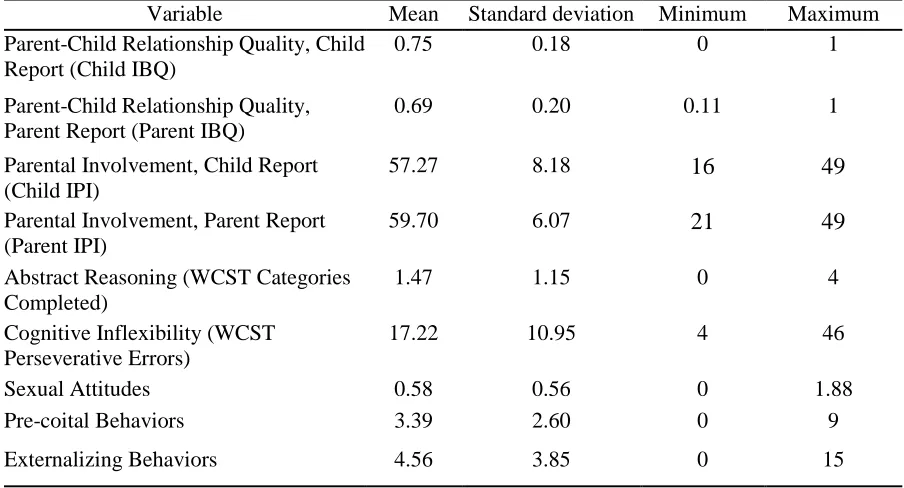
3.1.2 Study var iables. Descriptive statistics for all study variables are presented in Table 2. Evaluation of normality assumptions resulted in a square-root transformation of the WCST perseverative errors score (measuring cognitive inflexibility) to reduce skewness of the
distribution.
3.2 Pr eliminar y Analyses
Bivariate correlations among demographic (child age and gender, housing status) and all study variables were conducted and are presented in Table 3. Only age and gender correlated significantly with outcome variables. Housing status, the proxy for socioeconomic status, was
Older children reported less risky sexual attitudes (r(77)=-0.37, p<.01) and more pre-coital behaviors (r(77)=0.31, p<.01). Child gender was significantly correlated with pre-coital
behaviors (r(77)=-0.39, p<.01), while the association between child gender and risky sexual attitudes approached significance (r(77)=-0.22, p=.059), such that males reported more pre-coital
behaviors and riskier sexual attitudes. Child age was also negatively associated with parent report of parental involvement/monitoring (r(77)=-0.23, p=.05), such that parents with older children reported lessinvolvement/monitoring with them. Child age and gender were not
[image:35.612.70.522.344.588.2]significantly associated with any other study variables.
Table 2
Descriptive Statistics for Study Variables
Variable Mean Standard deviation Minimum Maximum
Parent-Child Relationship Quality, Child Report (Child IBQ)
0.75 0.18 0 1
Parent-Child Relationship Quality, Parent Report (Parent IBQ)
0.69 0.20 0.11 1
Parental Involvement, Child Report (Child IPI)
57.27 8.18 16 49
Parental Involvement, Parent Report (Parent IPI)
59.70 6.07 21 49
Abstract Reasoning (WCST Categories Completed)
1.47 1.15 0 4
Cognitive Inflexibility (WCST Perseverative Errors)
17.22 10.95 4 46
Sexual Attitudes 0.58 0.56 0 1.88
Pre-coital Behaviors 3.39 2.60 0 9
Externalizing Behaviors 4.56 3.85 0 15
Table 3
Zero-order Correlations between All Study Variables
1 2 3 4 5 6 7 8 9 10 11
(1) Risky Sexual Attitudes -- -- -- -- -- -- -- -- -- -- --
(2) Pre-coital Behaviors 0.04 -- -- -- -- -- -- -- -- -- --
(3) Externalizing Behaviors -0.06 0.23* -- -- -- -- -- -- -- -- --
(4) Age -0.37** 0.31** -0.02 -- -- -- -- -- -- -- --
(5) Gender -0.22
(p= .059)
-0.39** 0.05 0.06 -- -- -- -- -- -- --
(6) Housing -0.08 -0.04 0.06 0.05 -0.09 -- -- -- -- -- --
(7) Abstract Reasoning -0.25* 0.06 0.04 0.04 -0.05 0.05 -- -- -- -- --
(8) Cognitive Inflexibility 0.21
(p= .062)
0.01 0.01 -0.08 0.03 -0.12 -0.48** -- -- -- --
(9) Parent IBQ -0.07 -0.08 -0.04 0.07 0.01 0.05 -0.05 -0.05 -- -- --
(10) Child IBQ -0.21
(p= .069)
-0.24* -0.35** -0.21
(p= .074)
0.01 0.03 0.10 0.07 0.10 -- --
(11) Parent IPI 0.08 -0.29** -0.12 -0.23* -0.04 0.08 0.01 <0.01 0.37** 0.21
(p= .069) --
(12) Child IPI -0.14 -0.07 -0.32** -0.08 -0.04 0.13 0.06 < 0.01 0.01 0.35** 0.25*
Bivariate correlations among the proposed independent and dependent variables were also completed and are presented in Table 3. Among dependent variables, as predicted by Problem
Behavior Theory, child pre-coital behaviors were positively associated with externalizing
behaviors (r(77)=0.23, p=0.04). Also of note, risky sexual attitudes did not significantly relate to
either pre-coital (r(77)=0.04, p=0.71) or externalizing behaviors (r(77)= -0.06, p=0.59). Among independent variables, some significant relations appeared. Child and caregiver reports of parental monitoring/involvement were significantly, though not highly, correlated (r(77)=0.25,
p=0.03), whereas child and caregiver reports of parent-child relationship quality were not. A significant, positive association appeared between child reports of relationship quality and
parental monitoring/involvement (r(77)=0.38, p<.01), such that children who perceived better parent-child relationship quality reported more parental monitoring/involvement. Similarly, parent reports of both relationship quality and parental monitoring/involvement were
significantly, positively correlated (r(77)=0.37, p<.01). A significant association between abstract reasoning and cognitive inflexibility also appeared in the expected negative direction
(r(77)=-0.48, p<0.01).
Table 3 also presents the relations between independent and dependent variables. All three dependent measures were significantly correlated with at least one proposed independent
variable. Turning to child risky sexual attitudes, there were associations between this outcome variable and abstract reasoning (r(77)=-0.25, p=.03), cognitive inflexibility (r(77)=0.21, p=.06),
and child report of parent-child relationship quality (r(77)=-0.21, p=.07) though the latter two relationships only approached significance. Significant negative associations appeared between child pre-coital behaviors and child report of relationship quality (r(77)=-0.24, p=.04), as well as
were observed between externalizing behaviors and child report of relationship quality (r(77)=-0.35, p<.01) and child report of parental monitoring/involvement (r(77)=-0.32, p<.01). All
relations were in the expected directions. 3.3 Pr imar y Analyses
Hierarchical multiple regression analyses were completed according to Baron and Kenny’s (1986) specifications to examine study hypotheses. Twelve separate analyses were conducted, one for each parenting variable (child and parent reports of relationship quality and parental
monitoring/involvement) in combination with both executive functioning variables (abstract reasoning and cognitive inflexibility) with each of the three outcome variables. Because
parenting quality was the primary predictor, regressions examined each component of parenting quality variable separately. Since problem solving abilities are comprised of abstract reasoning and cognitive inflexibility processes together, these variables were included together in each
regression. When demographic variables and outcome variables were significantly correlated (or approached significance), these variables were controlled in each regression. In these cases,
variables were entered in three blocks. The first block included demographic variables as needed; the second block included one parenting variable and both executive functioning variables; and the third block included the interaction term between the parenting variable and
each executive functioning variable. Regression analyses with externalizing behaviors as the outcome did not include control variables as a first block, since no demographic variables were associated with child report of externalizing behaviors. Regression analyses are reported in
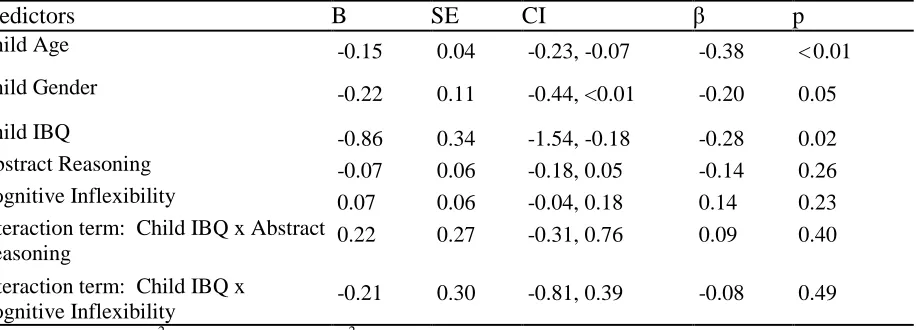
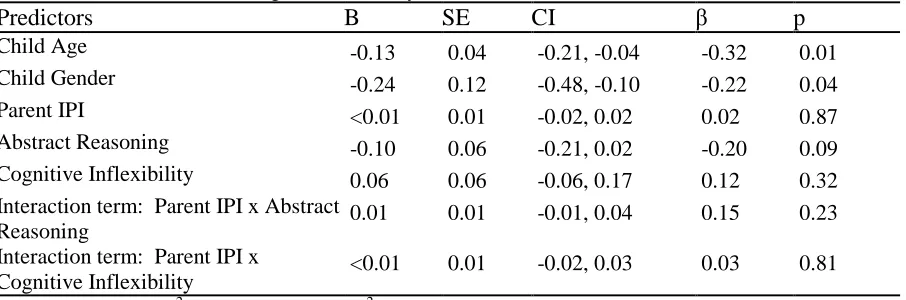
3.3.1 Child sexual attitudes. Results when child sexual attitudes served as the outcome variable are presented in Tables 4 through 7. All the models accounted for a significant amount
of variance in child sexual attitudes, ranging from 26% to 33% but only main effects were observed. Age explained a significant portion of variance in all models. A significant positive
effect was observed for child report of relationship quality on sexual attitudes, children reporting better relationship quality also endorsed less risky sexual attitudes. No main effects of child report of parental monitoring/involvement, parent report of parenting variables, or executive
functioning on risky sexual attitudes were observed. None of the interaction terms between parenting and executive functioning accounted for a significant portion of the variance in child
sexual attitudes.
[image:39.612.83.541.439.604.2]Regression Tables 4-7 for Child Risky Sexual Attitudes Outcome, Controlling for Child Age and Gender
Table 4.
Regression Analyses Examining Effects of Child Reported Parent-child Relationship Quality (IBQ) and Executive Functioning on Child Risky Sexual Attitudes
Predictors B SE CI β p
Child Age -0.15 0.04 -0.23, -0.07 -0.38 < 0.01
Child Gender -0.22 0.11 -0.44, <0.01 -0.20 0.05
Child IBQ -0.86 0.34 -1.54, -0.18 -0.28 0.02
Abstract Reasoning -0.07 0.06 -0.18, 0.05 -0.14 0.26
Cognitive Inflexibility 0.07 0.06 -0.04, 0.18 0.14 0.23
Interaction term: Child IBQ x Abstract
Reasoning 0.22 0.27 -0.31, 0.76 0.09 0.40
Interaction term: Child IBQ x
Cognitive Inflexibility -0.21 0.30 -0.81, 0.39 -0.08 0.49
Table 5
Regression Analyses Examining Effects of Parent Reported Parent-child Relationship Quality (IBQ) and Executive Functioning on Child Risky Sexual Attitudes
Predictors B SE CI β p
Child Age -0.14 0.04 -0.22, -0.05 -0.35 0.00
Child Gender -0.22 0.12 -0.45, 0.01 -0.20 0.07
Parent IBQ -0.11 0.29 -0.69, 0.47 -0.04 0.71
Abstract Reasoning -0.09 0.06 -0.20, 0.03 -0.19 0.13
Cognitive Inflexibility 0.06 0.06 -0.06, 0.17 0.12 0.33
Interaction term: Parent IBQ x Abstract
Reasoning -0.31 0.39 -1.08, 0.46 -0.11 0.42
Interaction term: Parent IBQ x
Cognitive Inflexibility -0.37 0.32 -1.00, 0.27 -0.15 0.25
[image:40.612.82.530.324.485.2]Note. Total Model R2 = 0.26, p = .003, ∆R2 = 0.02, p = 0.51
Table 6
Regression Analyses Examining Effects of Child Reported Parental Monitoring/involvement (IPI) and Executive Functioning on Child Risky Sexual Attitudes
Predictors B SE CI β p
Child Age -0.14 0.04 -0.22, -0.06 -0.35 < 0.01
Child Gender -0.23 0.12 -0.46,< 0.01 -0.21 0.05
Child IPI -0.01 0.01 -0.02, 0.01 -0.13 0.24
Abstract Reasoning -0.08 0.06 -0.19, 0.04 -0.16 0.19
Cognitive Inflexibility 0.07 0.06 -0.05, 0.18 0.14 0.25
Interaction term: Child IPI x Abstract
Reasoning 0.01 0.01 -0.01, 0.03 0.11 0.36
Interaction term: Child IPI x
Cognitive Inflexibility 0.01 0.01 -0.01, 0.02 0.09 0.47
Note. Total Model R2 = 0.28, p = .002, ∆R2 = 0.01, p = 0.62
Table 7
Regression Analyses Examining Effects of Parent Reported Parental Monitoring/involvement (IPI) and Executive Functioning on Child Risky Sexual Attitudes
Predictors B SE CI β p
Child Age -0.13 0.04 -0.21, -0.04 -0.32 0.01
Child Gender -0.24 0.12 -0.48, -0.10 -0.22 0.04
Parent IPI <0.01 0.01 -0.02, 0.02 0.02 0.87
Abstract Reasoning -0.10 0.06 -0.21, 0.02 -0.20 0.09
Cognitive Inflexibility 0.06 0.06 -0.06, 0.17 0.12 0.32
Interaction term: Parent IPI x Abstract
Reasoning 0.01 0.01 -0.01, 0.04 0.15 0.23
Interaction term: Parent IPI x
Cognitive Inflexibility <0.01 0.01 -0.02, 0.03 0.03 0.81
[image:40.612.74.527.556.706.2]
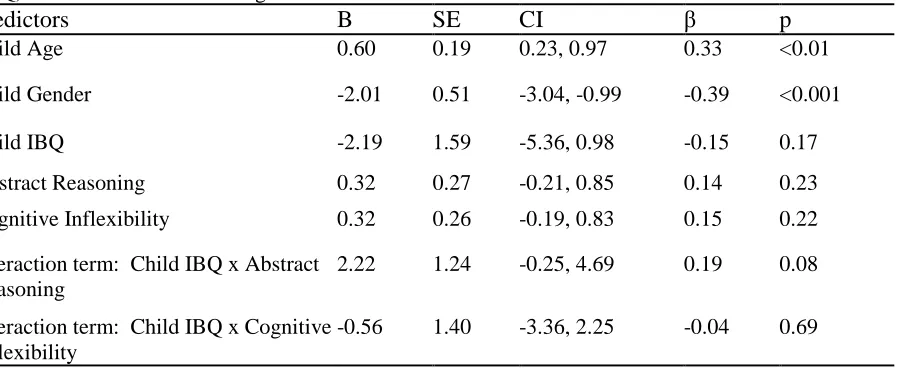
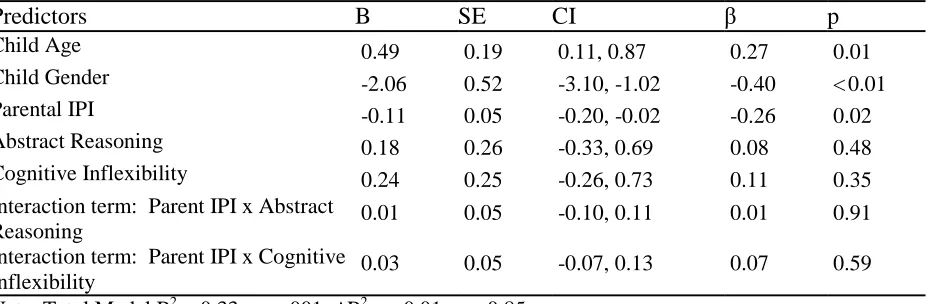
3.3.2 Child pr e-coital behavior s. Results are reported in Tables 8 through 11. All the models accounted for a significant amount of variance in child pre-coital behaviors, ranging from
28% to 33%. Age and gender explained a significant portion of variance in all models, such that older children and males reported more pre-coital behaviors. Parent report of parental
monitoring/involvement exerted a significant negative effect on child pre-coital behaviors, such
that as parent report of monitoring/involvement increased, youth reported fewer child pre-coital behaviors. In contrast to the bivariate correlations discussed above, the relation between child
report of the parent-child relationship quality and this outcome variable was not significant once child age and gender were considered. Moreover, neither executive functioning variable exerted a significant effect on child pre-coital behaviors. None of the interaction terms between parenting
and executive functioning accounted for a significant portion of the variance in child pre-coital behavior.
[image:41.612.86.535.490.676.2]Regression Tables 8-11 for Child Pre-coital Behaviors Outcome, Controlling for Child Age and Gender
Table 8
Regression Analyses Examining Effects of Child Reported Parent-child Relationship Quality (IBQ) and Executive Functioning on Child Pre-coital Behaviors
Predictors B SE CI β p
Child Age 0.60 0.19 0.23, 0.97 0.33 <0.01
Child Gender -2.01 0.51 -3.04, -0.99 -0.39 <0.001
Child IBQ -2.19 1.59 -5.36, 0.98 -0.15 0.17
Abstract Reasoning 0.32 0.27 -0.21, 0.85 0.14 0.23
Cognitive Inflexibility 0.32 0.26 -0.19, 0.83 0.15 0.22
Interaction term: Child IBQ x Abstract Reasoning
2.22 1.24 -0.25, 4.69 0.19 0.08
Interaction term: Child IBQ x Cognitive Inflexibility
-0.56 1.40 -3.36, 2.25 -0.04 0.69
Table 9
Regression Analyses Examining Effects of Parent Reported Parent-child Relationship Quality (IBQ) and Executive Functioning on Child Pre-coital Behaviors
Predictors B SE CI β p
Child Age 0.67 0.19 0.30, 1.05 0.37 < 0.01
Child Gender -2.04 0.52 -3.08, -1.00 -0.40 < 0.01
Parent IBQ -1.08 1.31 -3.69, 1.53 -0.08 0.41
Abstract Reasoning 0.20 0.26 -0.32, 0.72 0.09 0.45
Cognitive Inflexibility 0.18 0.25 -0.33, 0.69 0.08 0.48
Interaction term: Parent IBQ x Abstract
Reasoning 0.51 1.74 -2.97, 3.99 0.04 0.77
Interaction term: Parent IBQ x Cognitive
Inflexibility -1.98 1.43 -4.82, 0.87 -0.18 0.17
[image:42.612.79.542.344.496.2]Note. Total Model R2 = 0.31, p < .001, ∆R2 = 0.04, p = 0.16
Table 10
Regression Analyses Examining Effects of Child Reported Parental Monitoring/involvement (IPI) and Executive Functioning on Child Pre-coital Behaviors
Predictors B SE CI β p
Child Age 0.63 0.19 0.25, 1.00 0.35 < .01
Child Gender -2.16 0.54 -3.23, -1.09 -0.42 < .01
Child IPI -0.01 0.04 -0.08, 0.06 -0.03 0.80
Abstract Reasoning 0.15 0.27 -0.38, 0.69 0.07 0.57
Cognitive Inflexibility 0.21 0.26 -0.31, 0.74 0.10 0.42
Interaction term: Child IPI x Abstract
Reasoning 0.02 0.04 -0.06, 0.10 0.07 0.56
Interaction term: Child IPI x Cognitive
Inflexibility -0.02 0.03 -0.09, 0.04 -0.09 0.50
Note. Total Model R2 = 0.28, p = .001, ∆R2 = 0.02, p = 0.43
Table 11
Regression Analyses Examining Effects of Parent Reported Parental Monitoring/involvement (IPI) and Executive Functioning on Child Pre-coital Behaviors
Predictors B SE CI β p
Child Age 0.49 0.19 0.11, 0.87 0.27 0.01
Child Gender -2.06 0.52 -3.10, -1.02 -0.40 < 0.01
Parental IPI -0.11 0.05 -0.20, -0.02 -0.26 0.02
Abstract Reasoning 0.18 0.26 -0.33, 0.69 0.08 0.48
Cognitive Inflexibility 0.24 0.25 -0.26, 0.73 0.11 0.35
Interaction term: Parent IPI x Abstract
Reasoning 0.01 0.05 -0.10, 0.11 0.01 0.91
Interaction term: Parent IPI x Cognitive
Inflexibility 0.03 0.05 -0.07, 0.13 0.07 0.59
[image:42.612.77.544.553.705.2]3.3.3 Child exter nalizing behavior s. Results are reported in Tables 12 through 15. Two
of the four models accounted for a significant amount of variance in child externalizing
behaviors, ranging from 14% to 18%. A significant negative effect was observed for child report
of relationship quality, with better relationship quality and reduced child-reported externalizing behaviors. Similarly, child report of parental monitoring/involvement exerted a significant negative effect on child externalizing behavior, indicating that children who reported more
parental monitoring/involvement reported fewer externalizing behaviors. Neither executive functioning variable exerted a significant effect on child externalizing behaviors.
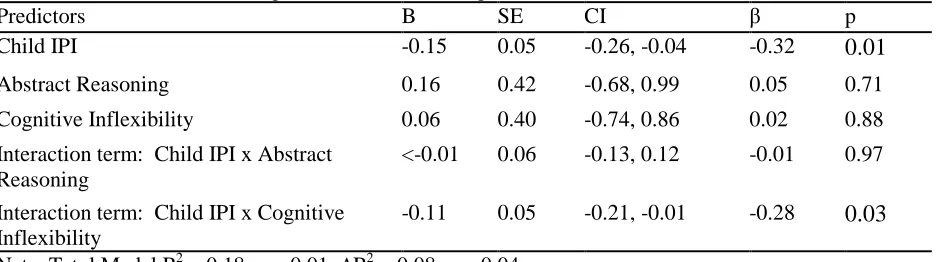
The effect of child reported parental monitoring/involvement on child externalizing behavior was qualified by a significant interaction between child report of
monitoring/involvement and cognitive inflexibility (see Table 14). As predicted, simple slopes
probing indicated that at higher levels of cognitive inflexibility, lower child reported parental monitoring/involvement was associated with greater reports of child externalizing behavior, β =
-0.57, p < 0.01. In contrast, at low levels of cognitive inflexibility, child report of
monitoring/involvement was not associated with child externalizing behaviors, β = -0.03, p = 0.84 (see Figure 1), suggesting that cognitive inflexibility may moderate the impact of child
Regression Tables 12-15 for Child Externalizing Behavior Outcomes
Table 12
Regression Analyses Examining Effects of Child Reported Parent-child Relationship Quality (IBQ) and Executive Functioning on Child Externalizing Behaviors
Predictors B SE CI β p
Child IBQ -7.74 2.52 -12.76, -2.71 -0.37 < 0.01
Abstract Reasoning 0.46 0.44 -0.41, 1.33 0.14 0.30
Cognitive Inflexibility 0.34 0.41 -0.49, 1.17 0.11 0.41
Interaction term: Child IBQ x Abstract Reasoning
1.41 2.03 -2.64, 5.46 0.08 0.50
Interaction term: Child IBQ x Cognitive Inflexibility
-0.98 2.16 -5.29, 3.33 -0.05 0.65
[image:44.612.82.542.332.457.2]Note. Total Model R2 = 0.14, p = 0.04, ∆R2 = 0.01, p = 0.66
Table 13
Regression Analyses Examining Effects of Parent Reported Parent-child Relationship Quality (IBQ) and Executive Functioning on Child Externalizing Behaviors
Predictors B SE CI β p
Parent IBQ -0.51 2.21 -4.91, 3.90 -0.03 0.82
Abstract Reasoning 0.31 0.44 -0.57, 1.19 0.09 0.48
Cognitive Inflexibility 0.17 0.42 -0.67, 1.01 0.05 0.69
Interaction term: Parent IBQ x Abstract Reasoning
-2.83 2.88 -8.57, 2.91 -0.14 0.33
Interaction term: Parent IBQ x Cognitive Inflexibility
-5.47 2.40 -10.26, -0.68 -0.33 0.03**
Note. Total Model R2 = 0.07, p = 0.35, ∆R2 = 0.07, p = 0.07
[image:44.612.74.542.555.686.2]**Although this interaction is significant, these results are questionable because the overall model did not explain a significant amount of variance in externalizing behaviors.
Table 14
Regression Analyses Examining Effects of Child Reported Parental Monitoring/involvement (IPI) and Executive Functioning on Child Externalizing Behaviors
Predictors B SE CI β p
Child IPI -0.15 0.05 -0.26, -0.04 -0.32 0.01
Abstract Reasoning 0.16 0.42 -0.68, 0.99 0.05 0.71
Cognitive Inflexibility 0.06 0.40 -0.74, 0.86 0.02 0.88
Interaction term: Child IPI x Abstract Reasoning
<-0.01 0.06 -0.13, 0.12 -0.01 0.97
Interaction term: Child IPI x Cognitive Inflexibility
-0.11 0.05 -0.21, -0.01 -0.28 0.03
Table 15
Regression Analyses Examining Effects of Parent Reported Parental Monitoring/involvement (IPI) and Executive Functioning on Child Externalizing Behaviors
Predictors B SE CI β P
Parent IPI -0.09 0.08 -0.24, 0.07 -0.14 0.26
Abstract Reasoning 0.22 0.45 -0.67, 1.12 0.07 0.62
Cognitive Inflexibility 0.15 0.43 -0.72, 1.01 0.05 0.74
Interaction term: Parent IPI x Abstract Reasoning
-0.03 0.09 -0.21, 0.15 -0.04 0.76
Interaction term: Parent IPI x Cognitive Inflexibility
0.02 0.09 -0.15, 0.19 0.03 0.81
Note. Total Model R2 = 0.02, p = 0.89, ∆R2 = <0.01, p = 0.85
Figure 1.
Simple Slopes Probing the Effect of Child Reported Parental Monitoring on Externalizing Behaviors, Moderated by Cognitive Inflexibility
____ High Cognitive Inflexibility
[image:45.612.66.526.301.562.2]4 Discussion
The purpose of this study was to examine the impact of parenting and executive
functioning on HIV risk among a sample of township-dwelling South African youth. Specifically, the study addressed whether parent-child relationship quality and parental
monitoring/involvement were related to risk factors, including sexual attitudes, pre-coital behaviors, and externalizing behaviors, and whether there was any moderating effect of
executive functioning. Considerable U.S.-based research has demonstrated a direct link between
parenting and youth outcomes. However, we found only one study focused on the role of parenting for South African youth. Moreover, few studies with U.S. samples have examined the
role of neuropsychological functioning in the relations between parenting and child outcomes, and none have occurred in a South African context. The goal of this research was to improve understanding of factors associated with HIV risk in South African youth, a group very
vulnerable to infection. The potential protective roles of parenting and executive functioning may aid in the development of HIV preventions tailored to these youth.
4.1 Descr iptive Summar y
Participants for this study were drawn from a sample of 99 South African parent-child dyads engaged in a parent study aimed at developing and evaluating a family-based HIV
prevention intervention. A final sample of 77 parent-child dyads completed all the measures and was included in the study. A significant majority of the families were primarily Xhosa-speaking, which is consistent with the demographic composition of Langa township and Cape Town more
broadly (Statistics South Africa, 2001). Female caregivers were, on average, middle-aged, and the majority of families lived in stable housing. Among youth participants, approximately half