Art and Design Theses Ernest G. Welch School of Art and Design
Summer 8-11-2011
Telling Stories About Monsters Through Art
Telling Stories About Monsters Through Art
Megan L. Peterson
Follow this and additional works at: https://scholarworks.gsu.edu/art_design_theses
Recommended Citation Recommended Citation
Peterson, Megan L., "Telling Stories About Monsters Through Art." Thesis, Georgia State University, 2011. https://scholarworks.gsu.edu/art_design_theses/86
TELLING STORIES ABOUT MONSTERS THROUGH ART
by
MEGAN L. PETERSON
Under the Direction of Dr. Kevin Hsieh
ABSTRACT
This study is about how the research of monsters and
contemporary artists who create monster-related work can help
create monsters from my own imagination using the process of
synthesis. In it I discuss how the monsters I created in my
artwork tell a story. I also talk about how this study can be
used to relate art to other fields of study such as English and
History, and the idea of Visual Culture.
INDEX WORDS: Monsters, Fantasy, Imagination, Storytelling,
TELLING STORIES ABOUT MONSTERS THROUGH ART
by
MEGAN L. PETERSON
A Thesis Submitted in Partial Fulfillment of the Requirements
for the Degree of
Master of Art Education
In the College of Arts and Sciences
Georgia State University
Copyright by
Megan Leigh Peterson
TELLING STORIES ABOUT MONSTERS THROUGH ART
by
MEGAN L. PETERSON
Committee Chair: Dr. Kevin Hsieh
Committee: Dr. Melody Milbrandt
Dr. Melanie Davenport
Electronic Version Approved:
Office of Graduate Studies
College of Arts and Sciences
Georgia State University
Dedication
I would like to dedicate this thesis to my family and
friends who have supported me, and my art, throughout the
Acknowledgements
I would sincerely like to thank my thesis committee
members: Dr. Kevin Hsieh, Dr. Melody Milbrandt, and Dr.
Melanie Davenport for the guidance and encouragement
throughout this entire process. I would also like to thank
Table of Contents
Acknowledgements v
List of Tables viii List of Figures ix
Chapter One: Introduction to the Study 1
Description of the Study 1
Timeline and Outcomes 3
Develop a Plan for Reflection 6
Chapter Two: Methods of Study 7
Definition of Key Terms 7
Composition. 7
Contrast. 7
Fantasy. 7
Imagination. 7
Monsters/Fictional creatures. 7
Shading. 7
Sketch. 8
Sketchbook. 8
Story/Storytelling. 8
Synthesis. 8
Tone/Value. 8
Detail Method Used in Study 8
Loch Ness monster. 11
Vampires. 12
Werewolves. 14
Goblins. 15
Frankenstein. 16
The creation of monsters. 17
Generated from fears and
misunderstandings. 17
Generated from synthesis. 18
Artist influences. 19
Artwork production. 25
Chapter Three: Development, Interpretation And Reflection
Of Works 33
Creation of My Art Work 33
Limitations 41
Reflection on My Process 42
Chapter Four: Implementation and Educational Practice 46
Impact on Teaching 46
Contributions in the Field of Art Education 48
Chapter Five: Conclusion and Recommendation 52
List of Tables
List of Figures
Figure 1. Childhood Imagination #1, acrylic on canvas,
16 x 24”. 3
Figure 2. Childhood Imagination #2, acrylic on canvas,
18 x 24”. 4
Figure 3. Artist Page in Sketchbook, Charles Burchfield,
4 x 6”. 20
Figure 4. Mikesell, M., Chicken Dish, oil on birch,
30 x 40”. 21
Figure 5. Burchfield, C. An April Mood, watercolor and
charcoal on joined paper, 40 x 54”. 22
Figure 6. Ryden, M. The Long Yak, oil on canvas,
12 x 30”. 24
Figure 7. List of Childhood Words, pen, 4 x 6”. 26
Figure 8. Monster Drawings, colored pencil, 4 x 6”. 27
Figure 9. Composition Sketches for the Word “Playground”,
pencil, 4 x 6”. 28
Figure 10. Adding Value/Contrast to Playground Sketch,
pencil, 4 x 6”. 29
Figure 11. Adding Monsters to Playground Sketch, pencil,
4 x 6”. 30
Figure 12. Adding Color to Playground Sketch, colored
pencil, 4 x 6”. 31
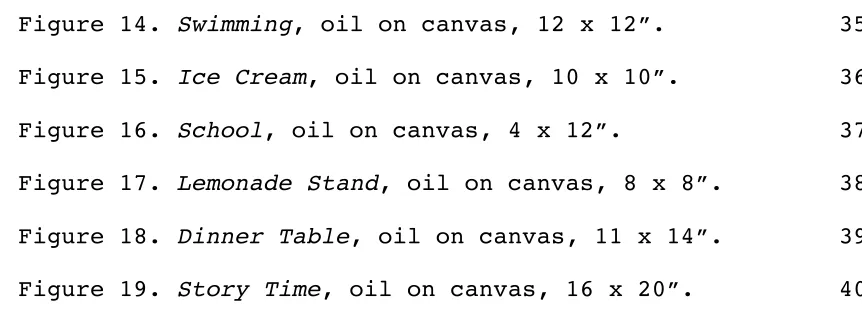
Figure 14. Swimming, oil on canvas, 12 x 12”. 35
Figure 15. Ice Cream, oil on canvas, 10 x 10”. 36
Figure 16. School, oil on canvas, 4 x 12”. 37
Figure 17. Lemonade Stand, oil on canvas, 8 x 8”. 38
Figure 18. Dinner Table, oil on canvas, 11 x 14”. 39
Chapter One: Introduction to the Study
Description of the Study
In this study, I conducted a studio-based project. I produced
a series of paintings using fictional monsters that I have
created from my imagination and I have given a story to them,
which is told visually through my compositions. I desired to use
monsters because I was always fascinated with monster stories as
a kid; I was always curious as to how the hero was going defeat
the monster. Another reason I chose monsters is because of how
popular they are in stories today (Booker, 2006). I reflected on
my study in terms of processes, themes, and its importance to
art education. I wanted to find out how monsters can be used in
visual art to tell stories and how this can relate to art
education. My research questions for this study are:
• How can I use research of monsters to inspire the creation of
my own?
• How can I use the strategy of synthesizing different human
and animal body parts to create imaginary monsters from my
imagination?
• How can I visually tell a story through composition?
When I was creating my artwork I faced some challenges, such
as, how to successfully give my monsters stories. To help with
historical contexts because understanding the misunderstandings
of the origins and historical development of different monsters
would greatly assist me to conduct this study; it was through
this research, that I understood how monsters came to be. From
this research I implemented various sketches, lists, and notes
from my sketchbook to help me in the development of my artistic
process.
I used several research methods in my thesis such as
researching monsters, artists, creating various sketches, and
keeping data about my research in my sketchbook. First, I
researched some fictional monsters within a historical
framework. Second, I began my artistic process by looking at
various contemporary artists that work with the theme of
fictional monsters. Then I sketched out fictional creatures in
my sketchbook from my imagination. Before I chose which monsters
I wanted to portray in my paintings, I had to come up with ideas
of how to portray them so that I could build up a composition
for them that would tell a story. I wanted to base my stories
around childhood themes and ideas because of the fascination I
had with them while I was young, and because they are popular in
children’s stories today (Bettelheim, 1976). I created a list of
words, such as swimming and playgrounds, which reminded me of
childhood to help develop my ideas for my compositions that
to help me narrow down my ideas and focus on specific ones. From
this list, I chose words to create compositions for my
paintings; from these compositions, stories are told. I did
several sketches of each composition/story and picked the one
that would be the most successful in telling a story and which
one would hold the viewer’s interest while looking at my
artwork; a “successful composition draws in the viewer and pulls
their eye across the whole painting” (Boddy-Evans, 2011, p. 1).
Timeline and Outcomes
Throughout a six-month period I created seven paintings. I
used some pieces that I created in the summer of 2010 as
starting off point for this series of work. These two paintings
are about monsters and imagination, but lacked interest and a
[image:15.612.76.344.467.686.2]clear message (see images below).
Figure 2. Childhood Imagination #2, acrylic on canvas, 18 x 24”.
These paintings are about remembering what it is like to have
a playful child-like imagination. I have worked with children,
and am inspired by their imaginations. Warner (2009) states “in
play, a child beams her projective imagination upon inert things
and animates them with fantasy, infusing objects with meaning”
(p. 7). Even if a child does not have toys to play with, they
can make mental objects become real through their imagination
(Warner, 2009). I wanted to portray a child pretending they were
playing with monsters, but I feel these paintings were
unsuccessful in communicating a message of reminiscing on a
the monsters and the child in the work. The child was detached
from her imagination when she should be engulfed in it. This
void of interaction made for a composition that lacked interest
because, as mentioned before, they were just characters on a
canvas; there was nothing there to make the eye move around the
painting which made it difficult to hold the attention of the
viewer.
Even though the paintings I created in the summer of 2010
were unsuccessful, they inspired me to work with the concept of
monsters further, so I created seven new oil paintings on canvas
for this study. Through this series of paintings, I used
monsters I created from my imagination and give them stories,
which are told through my paintings. These stories are based off
things that remind me of childhood.
I used the month of August 2010 to begin research on monsters
to better understand them, and I also researched how
contemporary artists are using monsters in their work. This
research helped me create my own monsters, which I will explain
later in Chapter Two. I took the month of September 2010 and
created several sketches of my monsters and worked on a list of
words about childhood to help me come up with my stories. I used
the months of October through December of 2010 to finalize my
compositions and stories, and continued to work on my paintings.
on whether or not my paintings had the desired effect, and then
spent the next couple of months, January and February 2011,
making revisions to my work. My paintings were completed in
March 2011.
I hoped that I could create a body of work that is cohesive
and evokes interest in the viewer. My hope was that my paintings
would successfully convey a story about fictional monsters
through attention-grabbing compositions. I looked forward to
further developing my painting skills through this process, as
well discovering what I could create through using my
imagination.
Develop a Plan for Reflection
Throughout this study, I ran into problems regarding how to
create interesting compositions from my imagination, and how to
successfully convey a story through my compositions. I have
solved these problems by researching the historical development
of monsters to help as a basis for creating my own monsters, and
by researching other artists who are creating monster-related
work from imagination to help with generating compositions from
my imagination, which I will discuss further in Chapter Two. I
have also solved these problems through experimentation of
Chapter Two: Method of Study
Definition of Key Terms
Composition.
“arrangements of elements in or the subject matter of a
painting. A successful composition draws in the viewer and pull
their eye across the whole painting.” (Boddy-Evans, 2011, p. 1).
Contrast.
For the purpose of this study, contrast is defined as
arrangement of opposite elements, such as color (light versus
dark).
Fantasy.
“imaginary perceptions or reminiscences” (Brenner, 2003, p. 1).
Imagination.
“the act of power of forming a mental image of something not
present to the senses or never before wholly perceived in
reality” (Kay, 2010, p. 1).
Monsters/Fictional Creatures.
An imaginary creature usually having various human or animal
parts (Hunter, 2007).
Shading.
For the purpose of this study, shading is defined as the
Sketch.
For the purpose of this study, sketch is defined as the
preliminary drawings to my paintings.
Sketchbook.
For the purpose of this study, sketchbook is defined as the book
that I am using to document my research, plan ideas, and create
compositions for my paintings.
Story/Storytelling.
For the purpose of this study, storytelling is defined as
visually telling a story through narration in a painting.
Synthesis.
For the purpose of this study, synthesis is defined as the use
of juxtaposing human and animal parts together to create a
monster.
Tone/Value.
For the purpose of this study, tone/value is defined as the
degree of lightness and darkness in an area.
Detail of Methods Used in the Study
The historical context & development of European monsters.
I began this series of work by researching monsters because I
wanted to figure out why monsters exist; in what context they
were created. I decided on five monsters from the European
region because it has a rich history of fictional monsters
from one geographical area because some monsters have different
traits in different regions (Keyworth, 2006), this way I would
only be focusing on one history per monster versus multiple
histories from all over the world of the same monster. From my
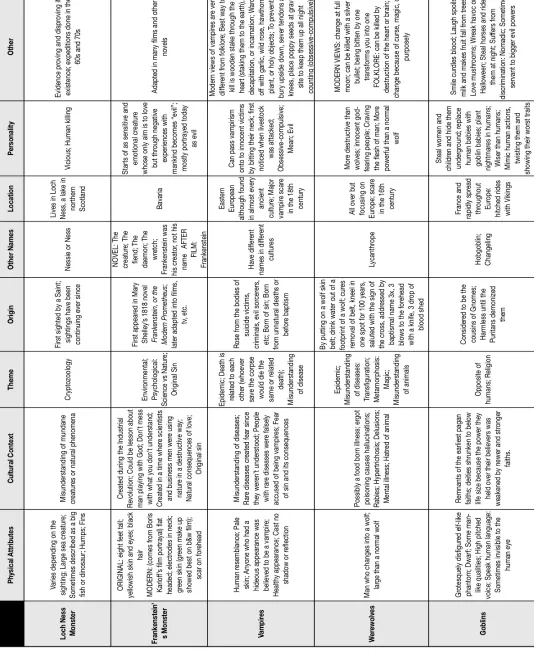
research, I produced a chart of traits and information about
each monster I chose to help organize my research findings (see
Loch Ness monster.
One of the monsters I decided to research was the Loch Ness
Monster because it is from my chosen region and it is widely
famous; it is known all over the world (Loxton, 2004). The Loch
Ness Monster is also known as Nessie, or Ness, and is believed
to be located in lake Lock Ness in Northern Scotland (“The
modern,” 2004). The first recorded sighting of Nessie was by a
Scottish saint 1,400 years ago (“The monster,” 2004); it was
described as a “50-foot-long creature with a slim neck”; it
looked like a big fish (“Lady Loch,” 2006, p. 18). Descriptions
of the Loch Ness monster have varied over time; later Ness
sightings reported the creature looking like an ancient
dinosaur, plesiosaurs, or a fish called a sturgeon (“Deeper,”
2004). People have described Nessie has having “one hump, many
humps, feet, flippers, horn, no horns, and so on” (“Deeper,”
2004, p. 105). Some believe that “it wouldn’t be surprising if
fossils themselves” inspired the tale of the Nessie (“Fossil,”
2002, p. 97). People may have seen fossils of dinosaurs or other
creatures and not understood what they were, creating Nessie
stories. Others believe that maybe people saw an animal in the
lake in which they did not know what it was, and the ledged grew
from there, of people trying to understand their environment
Vampires.
Another monster I picked to research was a vampire because
they are popular today and they have a strong history in Europe;
there was a major vampire scare in Europe in the eighteenth
century (Keyworth, 2006). Vampires are defined as:
Spirits or demons that left their graves at night to seek and
enslave their victims; it was thought that their victims
themselves became vampires…they could be warded off with a
variety of charms, amulets, and herbs and could finally be
killed by driving a steak through its heart or by cremation
(“Vampire,” 2010, p. 1).
According to vampire folklore, they are believed to have a
healthy appearance, filled with blood from their victims (humans
and animals) and the blood sometimes flows from their nose or
ears, make appearances at night; people who have sinned, were
criminals, committed suicide, died an unnatural death before
baptism, catching an unknown illness from someone in the family
who had the same thing, etc. were commonly accused as returning
as vampires (Keyworth, 2006). Vampires’ appearances vary from
region to region (Keyworth, 2006). There are a few explanations
to describe how people could possess traits connected to those
of vampires.
One believed the origin of vampires comes from the
described in the New York times, “involves a malfunctioning in
the body’s manufacture of crucial chemicals, could have left
victims grotesquely disfigured, turned them into creatures of
the night and caused them to suck the blood of their brothers
and sisters” (p. A.15). Boffey (1985) also believed that
porphyrias could be spread genetically or by an infected person
biting another, and in turn, spreading it to them (p. A.15). It
is also believed that garlic “contains a chemical that
exacerbates the symptoms of porphyrias” (Boffey, 1985, p. A.15).
The misunderstanding of this rare disease could have started the
myths about vampires; they are similar to the ideas of vampires
appearing at night, biting and sucking blood of others, and
their victims becoming vampires themselves.
Another one of the widely believed ideas, which comes from
Barber (1990), is that the origin of vampires has come from the
“misunderstood process of decomposition” (p. 76). One of the
earliest recorded vampires in Europe was a man named Arnold
Paole who died from falling off a wagon and came back to haunt
the living (Barber, 1990). Townspeople dug up a corpse and:
They found that he was quite complete and undecayed, and that
fresh blood had flowed from his eyes, nose, mouth, and
ears:…that the old nails on his hands and feet, along with
the skin, had fallen off, and that news ones had grown; and
through his heart, according to their custom, whereby he gave
an audible groan and bled copiously (Barber, 1990, p. 76).
The decomposition process can explain the things they witnessed.
“As a corpse decomposes it bloats (from the gases given off by
decomposition), while the pressure from bloating causes blood
from the lungs to emerge at the mouth” (Barber, 1990, p. 79).
The blood people saw coming from the corpse was real, just not
from its victims. In decomposition, it is also common for the
nails to fall off (Barber, 1990). The sound they heard can be
explained by “the compression of the chest cavity forces air
past the glottis, causing the sound similar in quality an origin
to the groan or cry of a living person” (Barber, 1990, p. 79).
Werewolves.
I chose to research werewolves because they too have a rich
history in Europe; there was a werewolf scare in the sixteenth
century (Blecourt, 2007). Werewolves are defined as “a man
temporarily or permanently transformed into a wolf”
(“Lycanthropy,” 2010, p. 1). They are described as being
“tailless or having truncated tails…smaller heads or appear
different in color” (Lawrence, 1996, p. 110). Werewolves were
sometimes described as “destructive, bloodthirsty, and cunning”
and people who were “antisocial or marginal, living apart from
others…conceived at the full moon, born feet first or with a
whose eyebrows met in the middle” were accused or suspected of
being werewolves (Lawrence, 1996, p. 109). Misunderstandings of
diseases can be used to explain the origin of werewolves. One
example is ergot poisoning and rabies, which could explain the
irrational behavior of those suspected to be werewolves
(Lawrence, 1996). Other diseases are “hypertrichosis giving a
bestial appearance; malnutrition simulating an appetite for
flesh; various psychoses; ingestion of pharmacological
hallucinogens leading to delusions of lupine identity”
(Lawrence, 1996, p. 110).
Goblins.
Goblins also interest me because they are more spiritual than
human or animal and give more variety to my research. Goblins
are defined as a “small household spirit…performed household
tasks but also can make mischief, such as pulling the covers off
sleepers” (“Goblin,” 2010, p. 1). They are described as beings
dwarf, sometimes invisible to the eye, having elf and human-like
features, and they wreak havoc upon the human world; thier
description varies from region to region (Carver, 2010) Goblins
are believed to have originated from “leftover people” or the:
Remnants of the earliest pagan faiths…they are not dead gods
but rather deities shrunken down to below life-size because
the power they held over their believers has been weakened by
practices, and eroded away. Their lack of size is a
manifestation of their lack of influence (Grischy, 2010, p.
1).
They are often described as being the servants of greater evil
beings, the creators of nightmares, and as pranksters (Carver,
2010).
Frankenstein.
Finally, I decided to research the monster from the story
Frankenstein. I chose Frankenstein’s monster because I wanted to
study a monster created for a story to see how it was similar or
how it varied from monster myths and folklore. Frankenstein’s
monster fits into my focus of the European region since it takes
place in Bavaria, part of Europe (Shelly, 2003). The monster is
described as ugly and made up of other body parts that were
jointed together; the body parts came from dead bodies
(Bissonette, 2010). Frankenstein’s monster was intended to be
beautiful and loving, but ended up being ugly and sought out
love from his creator; when his creator did not return his love,
he became evil and went rouge (Hammond, 2004). The novel was
written during the first industrial revolution and the idea for
the novel came from the fear of messing with nature, playing
The creation of monsters.
Through my research, I learned that monsters are created from
peoples’ fears and misunderstandings of the world around them,
such as: nature, diseases, death, etc. The images of monsters
that people generated were created from things that are familiar
to people, though the synthesis of human and animal parts.
Generated from fears and misunderstandings.
From my research of monsters, I learned that a lot of monster
origins are very similar to one another. A lot of the monsters
came to exist because of fear created from misunderstandings of
nature (Vitaliano, 2007). For example, the Loch Ness Monster
originated from the fear of misunderstanding fossils or seeing
animals that had not been discovered yet (“Fossil,” 2002).
Monsters were also created out of the fear and
misunderstanding of diseases (Boffey, 1985). For example,
vampires rose out of the fear and from the misunderstanding of
disease and the decomposition process of the human corpse
(Boffey, 1985).
As discovered from the research on Frankenstein, people also
created monsters to represent things that they feared (Hammond,
2004). For example, Frankenstein was created by Shelly to
represent her fear of technology during the Industrial
Generated from synthesis.
I discovered through my research that these monsters were all
constructed through synthesis; they are made up of human and
animal parts fused together (Gilmore, 2003). For example, the
Loch Ness monster has been described to look like various
different animals, such as: a plesiosaurs, a sturgeon, etc.;
people used animal parts that they knew to make sense of what
they thought they were seeing (Loxton, 2004). Another example is
Frankenstein, he was created out body parts from different
people (Bissonette, 2010).
Monsters are not just created out of the synthesis of animal
parts, they are also made from human parts, as seen by the
Frankenstein example; this is mostly due to birth defects,
disfigurements, diseases, etc. and peoples’ fears and
misunderstandings about them (Pullman, 2009). An example of this
is the creation of werewolves, which could be explained by
diseases that cause people to grow abnormal amounts of hair all
over their bodies (Lawrence, 1996). Other examples are: abnormal
growths, parts of the body that enlarged or shrunk, body parts
in unusual areas (an extra arm), absence of a body part,
displaced organs, premature aging, etc. (Pullman, 2009). The
synthesizing of human and animal parts makes allows for monsters
not to fit into any categorization in any systematic structure,
monsters personify (Cohen, 1996).
This process of synthesis is also metaphorical in nature
(Pullamn, 2009). Not only are monsters given life from fear,
misunderstandings, and fantasy, they also signify something
other than themselves (Cohen, 1996). Monsters also embody a
cultural moment; they inhabit the time and upheaval that it was
created it (Cohen, 1996). For example, Frankenstein embodies the
fear of the industrial revolution (Hammond, 2004).
Monsters are our children, created from our fears and
misunderstandings; they show us how we perceive our world, how
we misinterpret what we attempt to understand, and evaluate our
cultural assumptions (Cohen, 1996). These fears and
misunderstandings have given the monsters stories that have
lasted hundreds of years, seeing as how monsters are still a
common theme in stories today (Booker, 2006). What I have
gathered and learned from researching monsters will help me
greatly in coming up with my own monsters using synthesis. I
looked at various animals in my environment and from my memory
to synthesize together to create my creatures, which I will
discuss more in Chapter Three.
Artist influences.
I also looked at several artists who create art from
imagination and whose artwork consists of monsters and fictional
imaginations and then incorporated into their artwork. This has
helped me to see how other artists are using their imaginations
to inspire them and their artwork and has also helped with my
creation of my own monsters in my sketchbook. The artists I have
looked at are: Michele Mikesell, Charles Burchfield, Scott
Musgrove, Mark Ryden, and Tim Burton. I have noted some of their
work and biographies or artists statements in my sketchbook for
documentation and to look back at for further inspiration; below
is an example of the documentation I did of one of the artists I
studied in my sketchbook which includes notes about the artist
[image:32.612.74.524.390.691.2]and images of their work.
When looking at the work of Michele Mikesell, it was her
characters that inspired me; she fuses human and animal figures
together (Mikesell, 2010). For example, in her painting, Chicken
[image:33.612.72.292.204.493.2]Dish, she has a human figure wearing an animal costume.
Figure 4. Mikesell, M., Chicken Dish, oil on birch, 30 x 40”
(2010).
The person is dressed like a chicken, but also has chicken-like
features; the person has very short, wing-like arms and wobbly
little legs, like a chicken. Her technique of human and animal
synthesis inspired me because in my research on the history of
animal parts because most of them originated from people
misunderstanding disease and/or animals (Gilmore, 2003). By
seeing how a contemporary artist, such as Mikesell, synthesized
human and animal parts, it helped me to come up with ideas on
how to create my monsters using different body parts of humans
and animals and putting them together.
Another contemporary artist I explored was Charles
Burchfield; he has created some landscape paintings, both from
observation and imagination (Cotter, 2010). I was inspired by
the way Burchfield could paint fantasy landscapes that are
interesting and complicated. For example, the painting, An April
Mood, is invented from fantasy, but it has excellent
composition; the viewers’ eye never stops moving around the
[image:34.612.73.326.468.657.2]canvas (Gober, 2010).
Figure 5. Burchfield, C. An April Mood, watercolor and charcoal
I looked at the way he created his landscapes realistically but
used lots of organic and abstract shapes as well to develop more
interest. By looking at Burchfield’s work, it helped me create
interesting fantasy settings for my paintings by drawing from
things I know, my imagination, and from observation (Cotter,
2010).
I also investigated the contemporary artist, Scott Musgrove
(2011), who creates his own creatures from imagination and from
his knowledge on the subject of biology. He invents new or
extinct species that have never existed before and then paints
them in environments that you would not expect to find these
creatures in, for example, under a freeway (Lowpro, 2011).
Musgrove has even had books of paintings published; these books
are about the discovery and archeology of his imaginary
creatures (Musgrove, 2011). He has created creatures and given
them a story (Jager, 2005), like I am doing in my work.
Musgrove’s use of imagination and storytelling helped me not
only draw my own monsters, but also assisted me in coming up
with compositions that could tell their stories as well.
Another contemporary artist I researched was Mark Ryden, who
uses his childhood and child-like imagination as inspiration for
his work. Ryden believes in letting his imagination thrive in
his art (Ryden, 2009) and he tries to capture the things that
concept to what I was working with in the summer of 2010. I
looked at how Ryden’s imaginary creatures interacted with people
in his artwork because this is something that was lacking in my
own artwork. In his painting, The Long Yak, the yak is giving a
piggyback ride to a couple of children; they are interacting
[image:36.612.72.541.258.444.2]together in the composition.
Figure 6. Ryden, M. The Long Yak, oil on canvas, 12 x 30”
(2008).
His work helped me to come up with ideas of how to make my
monsters and children interact in my artwork.
Finally, I looked at the artwork of Tim Burton; besides
animation and film, Burton also creates illustrations and
drawings (Gallo, 2009). Burton has created artwork from his
imagination about his passion for misunderstood monsters (He,
of simple lines and child-like drawing style inspired me while
creating my artwork in a more cartoon-like style.
Each one of these artists depicts monsters, creatures, or
characters in fantasy settings that they have created. They have
inspired me to invent more interesting settings for my paintings
in comparison to the ones I created over the summer of 2010, as
talked about in Chapter One. In the paintings I created over the
summer, it was more like the child was observing monsters in her
world, and now the child is playing with the creatures, like a
child might do when they are playing pretend. Through the
interaction between the child and the monsters in my
compositions, I hope to tell a story. I want my paintings to
tell a story because of the way that historical fictional
monsters each have their own story (Booker, 2006). Researching
these artists and how they use monsters, story, and imagination
in their work has helped me to develop my own artwork.
Artwork production.
After researching artists, I began the artistic process in my
study. Going off of the theme of childhood in the paintings I
created in the summer of 2010, as mentioned in Chapter One, I
made a list of words that reminded me of childhood. Below is an
Figure 7. List of Childhood Words, pen, 4 x 6”.
This list of words was used to help me create compositions that
tell stories for my monsters. I added to and narrowed down the
list over time, and from here I picked seven key words to create
compositions from my paintings. I wrote down notes about how I
could convey a story based on these words through composition in
my sketchbook.
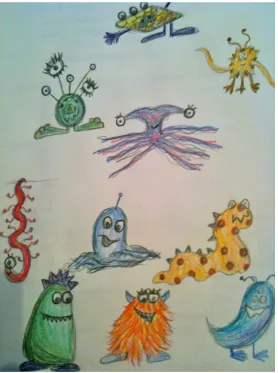
Then I began thinking about the monsters I created from my
imagination. I filled up many pages in my sketchbook of monster
Figure 8. Monster Drawings, colored pencils, 4 x 6”.
I drew from the inspiration from the artists and monsters I
researched, as mentioned earlier in this chapter, and I used
what I knew about synthesis and how monsters usually consist of
human and animal parts (Gilmore, 2003). I drew my monsters from
imagination, from observing people and animals in my
environment, and from my memory of what I have seen or know
about other animals. I then used the process of synthesis to
from my imagination. I created the monsters to look cartoon-like
because I was inspired by the way a lot of the artists I
researched create monsters in the same style and because since I
wanted them to have a theme of childhood, I noticed that
monsters from children’s movies, TV shows, and books are created
in a similar style. I chose the most successful monsters from
these drawings to depict in each painting.
From here, I went back to the seven chosen words from my list
and looked at my notes about how I could use these words to tell
a story though my compositions. I sketched a few different ideas
[image:40.612.74.228.389.592.2]per word in my sketchbook.
Figure 9. Composition Sketches for the Word “Playground,”
pencil, 4 x 6”.
compositions ideas of how to convey that word and story through
my paintings. I drew the landscapes for my paintings from
imagination and from things from my environment. I chose to
sketch out multiple compositions so that I would have several
different ways to tell a story, and from there I selected the
sketch that I thought had the most interesting composition for
each word and that most successfully told a story.
Then I began thinking about how to add contrast to my
compositions. After selecting the composition I was going to use
for each word/story, I then sketched at least three different
ways, per word/story that I could add contrast to them by
picking different imaginary light sources.
[image:41.612.73.224.416.618.2]
Figure 10. Adding Value/Contrast to Playground Sketch, pencil, 4
After creating a few different ways to shade my compositions, I
chose the most successful one to build on.
After choosing the composition with the best shading, I then
picked monsters and added them to the sketch. I also shaded them
[image:42.612.74.542.231.580.2]to go along with the composition.
Figure 11. Adding Monsters to Playground Sketch, pencil, 4 x 6”.
After creating sketches that showed how I would add contrast
to my work and which monsters would work best in my composition,
most successful composition and contrast sketch and added color
[image:43.612.74.523.149.487.2]to them.
Figure 12. Adding Color to Playground Sketch, colored pencil, 4
x 6”.
I chose bright colors because many children’s items (toys,
clothes, etc.) are made with bright colors because children tend
to favor bright colors (Feeney & Moravcik, 1987); since my
stories are about childhood, bright colors seemed appropriate,
with excitement and happiness (Feeney & Moravcik, 1987). I also
chose to leave the children in the paintings as silhouettes,
because I wanted anyone to be able to relate to the paintings,
and place him or herself in the space where the child is.
From the finalized color sketches, I began painting. I have
chosen to paint with oil paints on canvas. The canvas size and
shape was determined by on how successful I thought my paintings
would be on them. The canvas sizes will be small due to
limitation of time allotted to work on this series and so that
they can be easily transported to and from campus. It is my hope
that this series of paintings will successfully convey a story
about monsters and childhood.
Chapter Three: Development, Interpretation and Reflection of
Works
Creation of Art Work
Using the work in Figures 1 and 2 as a jumping off point for
this series of work, I began researching monsters and artists
who work with this concept, as I explained in Chapter Two.
Through my research, I learned how people create monsters from
fear and misunderstandings about illness, death, and nature
(Barber, 1990 & Vitaliano, 2007). I also learned how these
monsters are usually a synthesis of things they are familiar
with, such as human and animal parts (Gilmore, 2003). From these
fears and misunderstandings, people have given monsters stories
that have lasted hundreds of years (Booker, 2006). From my
research and notes, I planed to create my body of work, a series
of paintings that tell a story about monsters. These monsters
are created from my imagination and are centered on the theme of
childhood because of children’s fascination with monsters
(Bettelheim, 1976). I used the strategy of synthesis to create
the monsters from my imagination by combining the parts of
animals and people from my environment or from memory. The goal
of these paintings is for them to tell a story visually through
Figure 13. Playground, oil on canvas, 18 x 24”.
For my first painting, I chose the word “playground” from my
list (see Figure 13 above). I selected the word “playground”
because I remember spending hours playing on the playground in
my backyard and at my neighborhood park. I was fearless on the
playground; I would jump from swings and climb on top of the
monkey bars. One memory that sticks out the most is, playing a
game where me and my friends could not touch the ground because
the ground was lava and was filled with all kinds of scary
creatures; we had to jump around from one part of the playground
to another without touching the ground in fear the creatures
would get us. I took this memory and began to wonder what it
monsters in this painting symbolize the imaginary fear of
nonexistent monsters I had created playing on the playground as
a child. Through this painting, a story of a day spent at the
[image:47.612.72.398.204.530.2]park with monsters is told.
Figure 14. Swimming, oil on canvas, 12 x 12”.
For my next painting, I chose the word “swim” (see Figure 14
above). The word “swim” stuck out to me because of my many years
on swim team growing up; I practically spent all day, every day,
at the pool, whether it was for team practice, teaching swim
lessons, I encountered a lot of people who were terrified of the
water, and for someone who spent so much time in the pool, and
is very comfortable in the water; I had a hard time
understanding this fear. This observation of fear is what
inspired my story of swimming. This painting tells a story of
what it is like to be afraid of the water. The monsters in this
painting are a symbol of the fear of water that is overcoming
[image:48.612.72.342.308.581.2]the child.
Figure 15. Ice Cream, oil on canvas, 10 x 10”.
In another painting, I chose the word “ice cream” (see Figure
15 above). I chose this word because something I always looked
from a local ice creamery with my grandparents. Another thing I
remember is my friends and I always getting excited when the ice
cream truck came through the neighborhood. Summers are filled
with ice cream memories, so it did not seem right to not depict
a story of ice cream when thinking about childhood. I thought
about what it would be like to go to an ice cream shop with
monsters friends. This painting tells the story of a child
sharing ice cream, her favorite dessert, with her monster
friends. The monsters in this painting represent the importance
of friends in our lives and how as a child, the concept of true
[image:49.612.145.223.384.633.2]friendship was something I did not fully comprehend.
For my next painting, I chose the word “school” from my list
(see Figure 16 above), because school is a big part of growing
up. While I was in grade school, I would spend the day doodling
in my notebooks. I drew a lot of monster characters I made up
from my imagination. I began thinking about these monster
doodles and what it would be like to go to school with monsters.
This inspired me to tell a story about monsters at school. In
this story, the monster doodles have jumped off the page and
come to live taking over the classroom causing all kinds of
mischief, like drawing on the chalkboard and hanging from the
ceiling. These monsters represent the rebellious side in all of
us, the side that tempts us to misbehave, as well as my fear of
[image:50.612.75.306.443.680.2]getting in trouble as a child.
In another one of my paintings, I chose to represent the
words “lemonade stand” from my list because last summer there
was a group of kids in my neighborhood who had set up a lemonade
stand on the main road everyday for weeks. They were very
persistent and excited about what they were doing. One week they
even set up their lemonade stand at the front entrance of the
neighborhood in hopes that people would pull off the road and
into the neighborhood just for a glass of lemonade. I admired
their persistence and it inspired me to tell a story of what it
would be like to have monsters helping you run a lemonade stand
on a hot summer day. The monsters in this painting symbolize how
it seems that children grow up faster these days, childhood
seems shorter than it should be; the fear of growing up. They
are bringing out the grown up side of children by helping them
work instead of playing games outside like young children should
[image:51.612.72.271.521.672.2]do.
For another painting, I decided to choose the word “dinner”
off my list of words (see Figure 18 above); it stuck out off the
page because dinnertime was always a struggle for me. To this
day, I am an incredibly picky eater; when I was little my
parents would cook dinner and make me eat whatever was prepared.
Being the picky eater that I am, I would protest and pout, I
would sit at the table myself until I finished my dinner. These
memories made me think about all kinds of different things that
would have made dinner better as a kid, for example, sharing my
dinner with monsters. In this painting, I tell a story of what
it would be like to eat dinner with monsters; a dinner filled
with all kinds of junk food, for example, cake, and how much fun
a monster feast would be. These monsters represent the fear I
[image:52.612.73.238.467.677.2]had of trying new foods as a child.
For my last painting, I chose the word “story” from my list
because growing up, being read a bedtime story was one of my
favorite things. As mentioned earlier, I always had a
fascination with monster stories. In this painting, I tell a
story about a child curled up in bed sharing a bedtime story
with monsters, the very creatures that make up many stories,
both for children and adults. These monsters represent, not a
fear or misunderstand, but the fantasy world we can become
engulfed in through a book, which is something I enjoyed as a
child, and still enjoy today.
Limitations
I have chosen to limit my monster research to only five
monsters because of time allotted to work on my study while also
taking classes. I also restricted my monster research to focus
on monsters from one geographical area, this way I am focusing
on one history of each monster versus multiple histories. Since
monsters have different histories in different regions, this
helped to keep from mixing up and confusing different ones
(Keyworth, 2006).
My artistic process in terms of number and size of my
paintings. I have selected to work with smaller canvas sizes
because of time available to work on them and because of the
nature of oil paint taking longer to dry. Also, because of
painting mostly from my imagination.
Reflection on My Process
When I began this study, I started with researching monsters
and this was vitally important to my understanding of monster
myths and legends and how these creatures and their histories
came to be. This knowledge was significant in creating my body
of work; from what I learned about monsters, I was able to
create monsters and stories of my own based on how I learned
about how monsters stories and myths were generated. I also
learned how they were created out of fears, misunderstandings
and a need for people to understand their environment
(Vitaliano, 2007) and about how monsters are a major theme in
stories (Booker, 2006). This research helped me take memories
and observations and create stories from them for my paintings.
From my research, I was able to create metaphors for my own
monsters based on fears or misunderstandings from childhood
memories. I took what I learned about how monsters are created
from peoples’ fears and misunderstandings and thought about
fears and misunderstandings I had as a child, from these
memories, my monsters were born. Through my compositions, these
monsters were able to come to life.
From my monster research, I learned about how they are
usually depicted as a synthesis of human and animal parts
creating my own monsters from my imagination. I sketched out
monsters in my sketchbook using the strategy of synthesis; I
drew monsters based on human and animal parts from my
environment, from what I know, and my imagination.
I also researched several contemporary artists who work with
similar ideas to my own; such as monsters, childhood, and
drawing from imagination. This research of contemporary artists
was essential to the development of my body of work because by
looking at other artists, I was able to see how other people are
portraying similar ideas to mine. I was able to take what I
learned about monsters, compare it to what I was seeing in the
contemporary art world, and use this as inspiration to create my
body of work. All of this research helped me work out my ideas
for my own paintings in my sketchbook. The use of my sketchbook
was also important because it helped me work out compositions
ideas for each painting and served as a place for me to document
my research to look back at for further inspiration.
Throughout this process, I have encountered many expected and
unexpected challenges, for example, I knew that after choosing
my topic, that coming up with visual stories for my paintings
would be a challenge. I also understood that coming up with
interesting compositions from my imagination would be difficult
as well. The research that I did on both monsters and
these challenges. The research on monsters helped me better
understand my topic; learning the origins of monsters helped me
to brainstorm and come up with my own monsters. The research on
contemporary artists helped me to see how other people are
creating work about monsters and from their imagination; this
helped me to create work from my imagination, which helped to
improve my compositions. I took what I learned from my research
and sketch from there. As mentioned earlier in this paper,
throughout a series of sketches, I was able to come up with
solutions to my problems.
However, one problem I was not expecting was determining
sizes for the paintings. I had not thought about how the size
and the shape of the canvas could alter my sketches for my
paintings. I was able to solve this solution by taking my
sketches with me when I went out canvas shopping. This was
useful because I was able to pick a size and shape that fit my
sketches the best. Maybe in the future, I would pick out canvas
sizes and shapes I want to work with, and sketch with those in
mind.
Overall, I feel my process has been successful in terms of
creating paintings that tell a story through interesting
compositions by helping me come up with contexts to create my
monsters in and ways to integrate them into compositions.
that grew and helped me to create monster stories about
Chapter Four: Implementation and Educational Practice
Impact on Teaching
This study could be easily adapted to use in a classroom by
allowing students to use my methods, such as research and
synthesis, to create their own monster artwork. Since I began my
study by researching monsters, I would begin by introducing the
students to the histories of a couple of monsters. I could
introduce the theme of monsters to the classroom through a
PowerPoint presentation; I would introduce them to the history
of monsters, how they came to be, what contexts they were
created in, and how people portray monsters, etc. We could then
have a class discussion about monsters and how they view them
today. I would then provide the students with a blank chart,
like the monster chart I created in Chapter Two, and have the
students research monsters of their choice and fill in the
chart.
From there, I could introduce the class to artists, who use
the theme of monsters in their work through another PowerPoint
presentation. I could introduce the students to the artists I
researched, such as Charles Burchfield, Mark Ryden, Michele
Mikesell, Scott Musgrove, Tim Burton, etc. We could also look at
monsters in pop culture, such as in movies, TV shows, or even
from synthesis, and talk about these artists and how they use
the process of synthesis to create their own monsters. I would
explain to the students how these artists created my monsters
from imagination, like I did, and through the method of
synthesis, and how to approach doing it themselves.
After learning about monsters, artists who work with that
theme, and the process of synthesis, the students could practice
creating their own monsters using synthesis in their sketchbook.
I could provide images of various animals, insects, dinosaurs,
etc. to help inspire them. The students would practice imagining
what a monster would like if they fused the animal body parts
together, and then draw it in their sketchbooks.
From there, the students could create their own artwork
about the monsters they have created in their sketchbook from
synthesis and imagination. They could pick an environment for
their monster, and practice drawing compositions from the
imagination like I did before beginning their final piece.
Once the project is completed, we could talk about
everyone’s work and discuss the stories of their monsters, how
they were created, and how they used their research to inspire
their work. The project could even be taken further by having
the students write a story about their monster to tell their
something that I did not do, but could be something to consider
for further research.
Contributions in the Field of Art Education
This study can contribute to the field of art education in
multiple ways because it provides a way to make art
interdisciplinary, which is something that many schools are
implementing because it can “inform and enhance the study of
other subjects” by connecting different curriculums (Ulbricht,
1998, p. 15). By having students create their own monsters, and
create art about them, as a teacher, one could connect this
project to various other subjects such as: English or Language
Arts and History; and it could even connect to the idea of
Visual Culture.
This study can be interdisciplinary in relating art to
English or Language Art classes, especially through creative or
narrative writing and reading. It is important to write about
your art because “it is an extension of the art making process
using words” and it is another “expression of you” (Bouk, 1999,
p. 1). Writing about your work can help give others some
“guidance and inspiration” about your art and help you develop
another way of communicating your message (Bouk, 1999, p. 1).
For the purpose of this study, students can create their own
monsters in their artwork, and then write their own stories
the came to be, etc. There are also many stories written about
monsters). The art teacher can talk about these stories, or read
a short story or samples of a story to the students in class,
which they could use as inspiration for creating their own
monsters in their artwork. By having the students use a
monster-related stories as inspiration for their artwork, and then have
them write about their artwork “can facilitate the exploration
of ideas” in different ways (Caldwell & Moore, 1991, p. 207).
According to Siegenthaler and Vihos (1998), stories can be told
in multiple ways, spoken, written, portrayed in works of art,
etc. and this project would allow students to practice language
skills by telling stories visually and written. This process of
creating art and then writing its story allows student to see
how using “different forms of expression could have a dramatic
effect upon the way we process information” (Caldwell & Moore,
1991, p. 208) and it can contribute to language, concept
formation, and other aspects of intellectual functioning
(Thompson, 2005). It also allows for studies to practice their
own ideas, letting them be creative and will also let them
capture their own ideas, their understanding of others and the
world around them, and their feelings and experiences in
interesting and authentic ways (Thompson, 2005).
Another way of integrating other disciplines into art is
students, for the purpose of my study, select their own monster
and research the history of it; the students could conduct
research of a monster of their choice and take notes on it, and
then they could use this research as inspiration to create art
about monsters (Fontichiaro, 2010). This research of the history
of monsters could help them to inspire the creation of their own
monster artwork. It also connects to history through history
paintings; for centuries people have been trying to capture
historic events and tell their stories through art, for example,
American genre paintings, such as The County Election by George
Caleb Bingham in 1852 depicts a scene from everyday life in
America during that time period (Holt, 1998). Studying history
paintings allows students to gain a “global context, one which
reflects the organizations and institutions of a culture as they
respond to social, religious, and political forces” (Ortuno,
1994, p. 509). This cultural awareness is important because
monsters are typically created from something happening in a
culture and this kind of thinking can help them connect they
ways in which monsters were created (Cohen, 1996). Also by
looking at history paintings, students can try and guess the
when, where, and why of the situation which can help them
develop their own history painting of a monster (Ortuno, 1994).
This study also shows that it could be used to connect art
in art education (Duncum, 2001). This study can relate to visual
culture because it can teach students how to view and interpret
the monsters they see in pop culture, which is important because
there is a usually a cultural metaphor or significance behind a
monster (Cohen, 1996). Also, by studying visual culture,
students can gain knowledge of the deeper meaning behind the
images of monsters created in the media, especially since
monsters usually signify something other than themselves: they
often inhabit the gap between the time of the upheaval that
created them (Cohen, 1996). Through this cultural understanding,
students can use what they know about their culture and create
monsters that could stem from them.
Chapter Five: Conclusion and Recommendation
The main strategies I used to create my monsters were:
researching the history of monsters, researching artists who
create monster-related work from their imaginations, and the use
of synthesis to create my monsters. The research of monsters was
important because by understanding the contexts in which
monsters were created helped me to be able to create contexts in
which to create my own monsters from; these ideas for my own
contexts helped me with my development of my compositions. The
research of artists showed me how others were creating
monster-related art and this helped inspire me while I was sketching
from my imagination; I was inspired by their style and layouts
of their compositions. The process of synthesis was important
because it helped me to construct monsters from my imagination
by envisioning what it would look like if I combined different
animals and then sketching them out in my sketchbook. All these
strategies combined to help me create my artwork.
Through these strategies, I was able to answer the questions
outlined in Chapter One. I used the research of monsters to
inspire the creation of my own by using the process of synthesis
I learned about which inspired me to create my own monsters; I
created monsters by fusing together parts of animals and humans.
monsters; once I knew what kinds of animals I wanted to use, I
would then use my memory of these animals to imagine what they
would look like if they came together to create something else.
Then from my imagination, I would create my own monsters. Then
to tell a story with my paintings about the monsters, I
carefully planned out compositions based on a word that I wanted
the story to revolve around; through the composition and
metaphorical meaning behind the monsters, the painting told a
story.
I feel that this study opens up multiple doors for further
research; such as some of the ways this study could be used to
relate art to other fields of study (English and History, and
the idea of Visual Culture), as I mentioned in Chapter Four. One
could take those ideas, and implement them into their classroom
and see what kind of effects it has. One could also try to
relate this study to other subjects I did not mention, or come
References
Barber, P. (1990). The real vampire. Natural History, 99(10),
74-81.
Bettelheim, B. (1976). The uses of enchantment: The meaning and
importance of fairy tales. London: Penguin Books.
Bissonette, M. B. (2010). Teaching the monster: Frankenstein and
critical thinking. College Literature, 37(3), 106-120.
Blecourt, W. D. (2007). I would have eaten you too: Werewolf
legends in the Flemish, Dutch and German area. Folklore,
118(1), 23-43.
Boddy-Evans, M. (2011) Art glossary: Composition. Retrieved
http://painting.about.com/od/artglossaryc/g/defcomposition.ht
m (2011, May 9).
Boffey, P. M. (1985, May 31). Rare disease proposed as cause for
‘vampires.’ New York Times, pp. A.15.
Booker, C. (2006). Seven basic plots: Why we tell stories. New
York, NY: Continuum.
Bouk, P. (1999). How to write an effective artist’s statement.
Retrieved from http://www.promotingartists.
com/artistscorner/artist-statement.html (2011, May 31).
Brenner, A. (2003). Fantasy. Retrieved from http://csmt.
uchicago.edu/glossary2004/fantasy.htm (2011, May 9).
Burchfield, C. (1946). An April Mood [Painting]. Whitney Museum
Collection/CharlesBurchfield/5539 (2011, June 17).
Caldwell, H., & Moore, B.H. (1991). The art of writing: Drawing
as a preparation for narrative writing in the primary grades.
Studies in Art Education, 32(4), 207-219.
Carver, N. (2010). Mythical creatures: origins of the goblin.
Retrieved from http://www.helium.com/items/17575
52-mythological-creatures-goblins/print (2010, December 16).
Cohen, J.J. (1996). Monster theory: Reading culture.
Minneapolis, MN: University of Minnesota Press.
Cotter, H. (2010, June 25). Up close and personal. New York
Times, pp. C23.
Deeper waters. (2004). Skeptic, 11(1), 103-105.
Feeney, S., & Moravcik, E. (1987). A thing of beauty: Aesthetic
development in young children. Young Children, 42(6), 7-15.
Fossil sea monsters. (2002). Skeptic, 9(4), 97.
Gallo, L. (2009). The art of Tim Burton: Standard and deluxe
editions. Los Angeles, CA: Steeles Publishing.
Gilmore, D.D. (2003). Monsters: Evil beings, mythical beasts,
and all manner of imaginary terrors. Philadelphia, PA:
University of Pennsylvania Press.
Grand unveiling of Scott Musgrove’s how is the empire? (2010).
Retrieved from http://www.juxtapoz.com/Features/
grand-unveiling-of-scott-musgroves-how-is-the-empire (2011, April
Gober, R. (2010). Heat waves in a swamp: The paintings of
Charles Burchfield. Retrieved from http://hammer.ucla.ed
u/exhibitions/detail/exhibition_id/165 (2011, April 2).
Goblin. (2010). In Columbia Electronic Encyclopedia online.
Retrieved from EBSCOhost http://ezproxy.gsu.e
du:4518/login.aspxdirect=true&db=a9h&AN=39009053&site=ehost-live (2010, December 16).
Grischy, J. (2010). European mythology: goblins. Retrieved from
http://www.helium.com/items/1927467-european-mythology-goblins/print (2010, December 16).
Hammond, K. (2004). Monsters of modernity: Frankenstein and
modern environmentalism. Cultural Geographies, 11(2),
181-198.
He, J. (2009). Tim Burton. New York, NY: The Museum of Modern
Art.
Holt, J. (1998). Looking at American history through art. The
History Teacher, 31(2), 181-192.
Hunter, L. (2007). A little book of monsters. CA: Bobcat
Publishing.
Jager. (2005). Interview with Scott Musgrove. Retrieved from
http://www.millionaireplayboy.com/entertainment/mus
grover.php (2011, April 2).
Kay, S. (2010). What does the 2011 NAEA national convention
education” mean, and why was it selected? [PDF document].
Retrieved from the NAEA Web site
http://arteducators.org/news/national-convention/2011_Convention_Them_Description.pdf (2010,
December 16).
Keyworth, G. D. (2006). Was the vampire of the eighteenth
century a unique type of undead-corpse? Folklore, 117(3),
241-260.
Lady of the lake: the Loch Ness monster. (2006). Scholastic
Scope, 54(12), 18.
Lawrence, E. (1996). Werewolves in psyche and cinema: Man-beast
transformation and paradox. Journal of American Culture,
19(3), 103-113.
Lowpro. (2011). Creative process: Scott Musgrove. Retrieved from
http://arrestedmotion.com/2011/01/creative-process-scott-musgrove/ (2011, April 2).
Loxton, D. (2004). The Loch Ness monster in Scotland. Skeptic,
11(1), 97.
Lycanthropy. (2010). In Columbia Electronic Encyclopedia,
online. Retrieved from EBSCOhost http://ezproxy.gsu.
edu:4518/login.aspx?direct=true&db=a9h&AN=39019288&site=ehost
-live (2010, December 16).
Mikesell, M. (2006). Michele Mikesell. Retrieved from
Mikesell, M. (2010). Chapter 1: Allegory. Retrieved from
http://www.decorazongallery.com/gallery/artist/michele_mikese
ll/chapter_1_allegory.html (2010, December 16).
Mikesell, M. (2010). Chicken Dish [Painting]. Retrieved from
http://michelemikesell.com/artwork/1597345_chicken_dish.html
(2011, June 17).
Musgrove, S. (2011). Scott Musgrove. Retrieved from
http://www.scottmusgrove.com/book.php (2011, April 2).
Ortuno, M.M. (1994). Teaching language skills and cultural
awareness with Spanish paintings. Hispania, 77(3), 500-511.
Pullman, G. L. (2009). Monster mash, or how to create a monster.
Retrieved from http://writinghorrorfiction.
blogspot.com/2009/02/monster-mash-or-how-to-create-monster.html?zx=3cb3dcd4ab021cf6 (2011, May 9).
Ryden, M. (2001). The art of Mark Ryden: Anima Mundi. San
Francisco, CA: Last Gasp of San Francisco.
Ryden, M. (2008). The Long Yak [Painting]. Retrieved from
http://www.markryden.com/paintings/snowyak/paintings/longyak_
d.html (2011, June 17).
Ryden, M. (2009). Mark Ryden. Retrieved from http://markryd
en.com/ (2011, April 2).
Shelly, M. (2003). Frankenstein. New York, NY: Penguin Classics.