SENSITIVITY STUDY ON INFLUENCING PARAMETERS OF TRANSFORMER THERMAL MODEL WITH DIRECTED OIL FLOW
NIK MOHD AZRI BIN NIK SUPIAN
A thesis submitted in partial
fulfillment of the requirement for the award of the Degree of Master of Electrical Engineering
Faculty of Electric and Electronic Engineering Universiti Tun Hussein Onn Malaysia
ABSTRACT
vii
ABSTRAK
TABLE OF CONTENTS
TITLE i
DECLARATION ii
DEDICATION iv
ACKNOWLWDGEMENT v
ABSTRACT vi
ABSTRAK vii
TABLE OF CONTENTS viii
LIST OF FIGURES xi
LIST OF TABLES xiii
LIST OF ABBREVIATIONS xiv
CHAPTER 1 INTRODUCTION 1
1.1 Overview 1
1.2 Problem Statement 3
1.3 Objectives 3
1.4 Project Scope 4
CHAPTER 2 LITERATURE REVIEW 5
2.1 Introduction 5
2.2 Power Transformer 5
2.2.1 Liquid-Filled of Transformer 8
2.2.2 Transformer Heating 9
2.2.3 Impact Oil Temperature of Transformer 10
ix
2.4 Oil Guided and Non-Oil Guided Disk Windings 13
2.5 Transformer Cooling System 14
2.6 Cooling Arrangement 15
2.6.1 Oil Natural Air Natural (ONAN) 15 2.6.2 Oil Natural Air Force (ONAF) 16 2.6.3 Oil Force Air Force (OFAF) 18 2.6.4 Oil Direct Air Force (ODAF) 19
CHAPTER 3 METHODOLOGY 22
3.1 Introduction 22
3.2 Project Methodology 22
3.3 Method Approach 25
3.3.1 Model Description 25
3.3.2 Circular Core and Coil Winding 29 3.3.3 Oil Pressure and Velocities 30 3.3.4 Oil Nodal Temperature and Path
Temperature Rises 33
3.3.5 Disk Temperature 36
3.4 Flow of Analysis 36
3.5 Programming in MATLAB 39
CHAPTER 4 RESULTS AND ANALYSIS 41
4.1 Introduction 41
4.2 Initial Values Estimation 41
4.3 Calculation for One Disk 43
4.3.1 Velocity 43
4.3.2 Pressure 44
4.4 Oil Velocities 47
4.5 Pressure Drop 53
4.6 Temperature Rise 55
4.7 Disk Temperature 56
4.8 Sensitivity Study on Parameters 58
4.8.1 Vertical Duct Size 58
4.5.1 Horizontal Duct Size 62
CHAPTER 5 CONCLUSIONS AND RECOMMENDATION 66
5.1 Conclusion 66
5.2 Recommendations 67
REFERENCES 68
VITA 71
xi
LIST OF FIGURES
FIGURE NO TITLE PAGE
1.1 Three phase transformer 2
2.1 Structures of disk winding transformer 6
2.2 A simple transformer representation 7
2.3 2D cross-sectional images of disk windings 13
2.4 ONAN cooling diagram 16
2.5 ONAF cooling diagram 17
2.6 OFAF cooling diagram 18
2.7 Cross section of a disc or helical winding showing
heat flow paths 19
2.8 Oil flow in a directed flow winding 20
2.9 ODAF cooling diagram 21
3.1 Flow chart in modelling thermal disk oil 23 3.2 Summarized flowchart of modelling thermal model 24 3.3 Numbering scheme for a disk coil with directed oil
flow; disk, node and path 25
3.4 Cross sectional areas and diameters 26
3.5 Numbering scheme for T, P, v, ΔT and TC 26
3.6 Details of the conductor disk 27
3.7 Arrows represent the typical flow patterns of oil
3.8 Process flow in this project 38 3.9 Diagram of main features and capabilities of MATLAB 39
4.1 One disk coil 43
4.2 Programming using Matlab 45
4.3 Graph oil velocity for disk one 46
4.4 Programming Matlab for temperature rise 47
4.5 Oil velocity for five of disk 48
4.6 Horizontal path oil velocity 50
4.7 Vertical path oil velocity (inlet) 51
4.8 Vertical path oil velocity (outlet) 53
4.9 Graph for pressure drop 54
4.10 Graph for temperature rise 56
4.11 Graph for Disk temperature 57
4.12 Oil velocity horizontal with variables vertical duct size 59 4.13 Oil velocity inlet and outlet with variables
vertical duct size 59
4.14 Pressure drop with variables vertical duct size 60 4.15 Disk temperature with variables vertical duct size 61 4.16 Oil velocity horizontal with variables horizontal duct size 62 4.17 Oil velocity inlet and outlet with variables horizontal
duct size 63
xiii
LIST OF TABLES
TABLE NO TITLE PAGE
2.1 Liquid-immersed transformer 9
2.2 Transformer cooling designations 10
2.3 IEEE standard temperature rise 11
2.4 Summary of technology development that done
by other researcher 12
3.1 Geometrical details 28
4.1 Result for other parameter velocities and pressure drop 46 4.2 Result temperature rise and disk temperature 47
4.3 Data oil velocity 48
4.4 Data horizontal path oil velocity 50
4.5 Data vertical path oil velocity (inlet) 51 4.6 Data vertical path oil velocity (outlet) 52
4.7 Data pressure drop 54
4.8 Data temperature rise 55
4.9 Data disk temperature 57
LIST OF ABBREVIATIONS
CHAPTER 1
INTRODUCTION
1.1Overview
Power transformers represent the largest portion of capital investment in transmission and distribution substations. In addition, power transformer outages have a considerable economic impact on the operation of an electrical network since the power transformers are one of the most expensive components in an electricity system [1].
In fact most of power transformers use paper and oil as the main form of insulation. There are three possible mechanisms that contribute to the insulation degradation are hydrolysis, oxidation and pyrolysis. The agents responsible for the respective mechanisms are water, oxygen and heat temperature indeed the temperature has been considered as the main parameter affecting the loss-of-life of insulation. Hence, the heat produced (internal temperature) in the transformers as a result of loading and the effect of ambient temperature is the important factor that affecting the life other transformer [2].
There is an exponential relation between temperature, duration of thermal effect and the extent of aging of insulating material.
The thermal stress reduces the mechanical and dielectric performance of the insulation. The experiments, which were carried out by Montsinger indicate that when the transformer temperature has the values between 90-110o C, 8o C increments on these values results in having the life of the insulation [3]. Therefore, the temperature limits permitted in the active parts, influence on structure design, size, cost, load carrying capacity and operating conditions of the transformers have already been precisely defined.
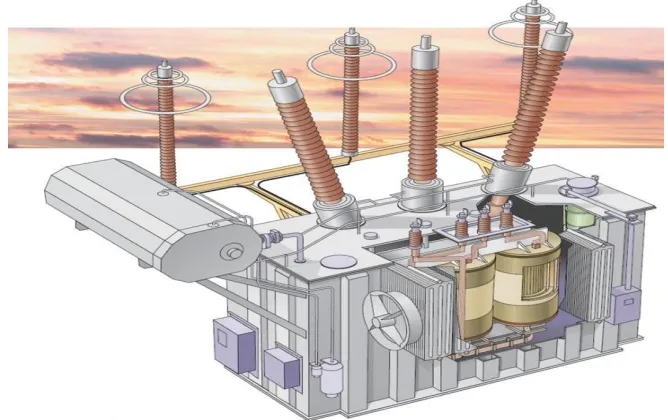
[image:12.612.160.494.447.657.2]There are two types of winding and ducts arrangement in power transformer; disk type winding and layer type winding. The case considered is a disc type of winding which is cooled sometimes by directed oil flow and sometimes by non-directed oil flow. Figure 1 shows a three phase power transformer. When higher voltage started to be transformed there was a need for a better insulation material than air. Mineral-oil was then used as insulation material in the transformers. A side effect of this was that the heat produced in the transformer was better transported away and the transformer cooled down. An interest for cooling equipment began.
3
1.2 Problem Statement
The no load losses and the load loss consist of I2R,all these losses cause heating in the corresponding parts of transformer and this heat must be taken away to avoid high temperature which will cause deterioration of insulation.
In liquid-immersed power transformers, the temperature of the winding is very important in order to prolong the service life of the transformer. Knowing the temperature distribution especially hot spot temperature at each point of transformer is vital [6, 7, 8, 9, 10] to ensure safe operation during the period of service. The winding made of copper can hold mechanical strength up to several hundred degrees Celsius without deterioration and the transformer oil does not significantly degrade blow 140 C o
, however this is not case for the paper insulation. The paper insulation deterioration rapidly if its temperature is more than 90 Co [11].
Most of the transformers are using mineral oil as transformer insulating oil. The insulating oil temperature depends on the winding temperature and is usually used to indicate the operating conditions of the transformer [9]. The increase in temperature will influence the insulating material and may cause aging. Depends to the insulating material type, the transformer has a maximum limit of temperature rise [12].
There are several types of numerical protection relay designed to provide protection for transformers. They are also used to calculate losses due to high temperature generated inside the transformer. In this project, Matlab software is used to predict the heat distribution in liquid-immersed transformers.
1.2 Objectives
The objectives of this project are as the following:
(ii) To develop a program using MATLAB, that can modulate the suitable parameter that not exceeds maximum temperature rise in disk coil transformer. (iii) To analyze the result of sensitivity study.
1.3 Project Scope
The scope of this study is designed base on the following considerations:
(i) Transformer parameter
The project will consider only three transformer parameters which are different location of block washer for five disks, vertical duct size and horizontal duct size.
This study focus on pressure drop, oil velocity and temperature value for five disks.
Transformer cooling type for this study is oil directed air flow (ODAF).
(ii)Software
CHAPTER 2
LITERATURE REVIEW
2.1 Introduction
This chapter presents literature reviews that focus on both fundamental theories and modeling of transformer. This includes specification of power transformer, cooling system, oil flow, and also MATLAB software.
2.2 Power Transformer
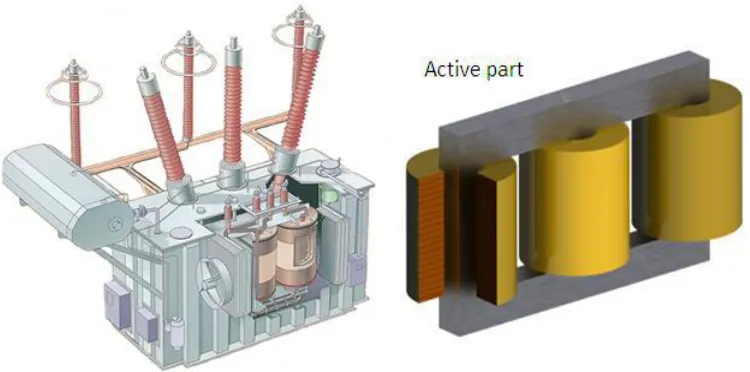
is the part inducing the varying magnitude flux. Nowadays, transformers play key roles in long distance high-voltage power transmission.
Figure 2.1: Structures of disk winding transformer
The term power transformers used to refer to those transformers used between
the generator and the distribution circuits and these are usually rated at 500 kVA and
above. Power systems typically consist of a large number of generation locations,
distribution points, and interconnections within the system or with nearby systems, such
as a neighboring utility. The complexity of the system leads to a variety of transmission
and distribution voltages. Power transformers must be used at each of these points where
there is a transition between voltage levels.
Power transformers are selected based on the application, with the emphasis
toward custom design being more apparent the larger the unit. Power transformers are
available for step-up operation, primarily used at the generator and referred to as
generator step-up (GSU) transformers, and for step-down operation, mainly used to feed
distribution circuits. Power transformers are available as single-phase or three-phase
apparatus. The construction of a transformer depends upon the application. Transformers
intended for indoor use are primarily of the dry type but can also be liquid immersed.
7
The normal life expectancy of a power transformer is generally assumed to be
about 30 years of service when operated within its rating. However, under certain
conditions, it may be overloaded and operated beyond its rating, with moderately
predictable “loss of life.” Situations that might involve operation beyond rating include
emergency rerouting of load or through-faults prior to clearing of the fault condition.
Power transformers have been loosely grouped into three market segments based on size
ranges [10, 13, 14]. These three segments are:
a) Small power transformers: 500 to 7500 kVA
b) Medium power transformers: 7500 to 100 MVA
c) Large power transformers: 100 MVA and above.
[image:17.612.188.461.486.676.2]A laminated steel core with copper or aluminum windings are used in power transformer in which the windings have a solid insulation of refined paper, and highly refined mineral oil is the insulating and cooling medium for the entire transformer. The core, windings and insulation all have specific thermal capabilities. Losses in the winding and core cause temperature rises in the transformer, which are transferred to the insulating oil. Failure to limit these temperature rises to the thermal capability of the insulation and core materials can cause premature failure of the transformer.
2.2.1 Liquid-Filled of Transformer
Each of the transformers is constructed according to its application. Indoor transformer intended to use dry type transformer but sometimes can be liquid-filled. But for outdoor use, usually liquid-filled transformer will be chosen. Some of the dry type transformer are not suitable for outdoor because the method of cooling system is by circulating air through the coil and core assembly which is use either by force air flow (fan) or natural convection.
This cooling method is suitable for low voltage – indoor transformer. At higher voltage, oil is needed to insulate the winding due to the losses which are high through the process of conduction, convection and radiation for effective winding cooling, the moving oil must be able to contact with every conductor for maximum convection and conduction of the conductor heat from the winding to the oil. In the other hand, direct oil cooling is not effective for outdoor environment where it can make the windings dirt and moisture.
A Comparison of Liquid-Filled and Dry Type Transformer Technologies written by Tommy Nunn [7] of IEEE-IAS Cement Industry Committee evaluated the comparison both types of the transformer. He stated that both type have pro and cont in terms of loads, environment, purchase cost, safety, availability to operate, materials and manufacturing process. In recent years, transformers technologies have improved the insulation system, core material and computer design programs.
9
Table 2.1: Liquid-immersed transformer [9]
Advantage Disadvantage
Transformer oil is combustible Needs oil regular checking filtration and replacement of oil
Smaller size Costly and need high recurring expense Lower cost Produce a little bit of danger Greater overload capability Located away from the main building
2.2.2 Transformer Heating
In thermal modeling of power transformer, two significant sources of heating are considered; load losses and load losses. Whenever the transformer is energized, no-load losses will present which is made up of hysteresis and eddy loss in the transformer core. Hysteresis loss is caused by the elementary magnets in the material aligning with the alternating magnetic field. Eddy currents are induced in the core by the alternating magnetic field.
Load losses consist of copper loss due to the winding resistance and stray load loss due to eddy currents in other structural parts of the transformer. The copper loss consists of both DC resistance loss, and winding eddy current loss. The amount of loss is dependent on transformer load current, as well as oil temperature. DC resistance loss will increase the increasing temperature but other load losses decrease with increasing oil temperature [9].
substation and power plan) required active cooling to remove the heat from the core and windings and usually through circulating oil. Sometimes have two stage of cooling.
[image:20.612.121.524.255.386.2]There are various cooling modes of transformer that established by IEEE and IEC. IEEE has adopted the IEC designation [9]. The designations totally describe the cooling method for the transformer and the cooling method impact the response of insulating oil to overload condition. Table 2.2 lists the common transformer cooling designations.
Table 2.2: Transformer cooling designations [9]
Old IEEE Cooling Designations IEC Equivalent Self-cooled OA ONAN Forced air cooled FA ONAF Directed-flow forced liquid cooled FOA ODAF Water cooled OW OFWF Forced liquid and water cooled FOW OFWF
2.2.3 Impact Oil Temperature of Transformer
The temperature of insulating oil will increase if the transformer load is increases, so loading the transformer above the nameplate rating can cause a risk to transformers life [5]. According to the IEEE standard, temperature rise of the oil near to the top main tank should not exceed 65º C.
11
[image:21.612.117.542.171.280.2]standard - Guide for Loading Mineral Oil-Immersed Power Transformers and list in the Table 2.3.
Table 2.3: IEEE standard temperature rise
Standard temperature limits Average windings temperature rise
Hot-spot temperature rise Top liquid temperature rise Maximum temperature limit
65º C 80º C 65º C 110º C Above ambient Above ambient Above ambient Absolute
The insulating transformer’s fluid must meet the same criteria similar to those other high voltage equipment such as circuit breaker and capacitors. The criteria are:
i. The fluid must conduct heat but not electricity ii. Must not be chemical reactive
iii. Must not be easily ionize that can allow are.
2.3 Review of Previous Research
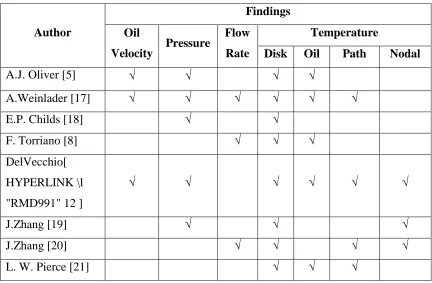
Robert M. Del Vecchio and Pierre Feghali (1999) have modeled a thermal model of a disk coil with directed oil flow. In this model each path segment, oil velocities and temperature rises are computed. The oil Flow is assumed to be thermally driven. The model includes temperature dependent oil viscosity, resistivity, oil density, and temperature and velocity dependent heat transfer and friction coefficients a computer code based on the analysis The code calculates temperatures of the coil disks and of the oil in all the ducts as well as duct oil velocities[15].
immersed transformer windings. A line of eight-disc-coil has been modeled as a series of heat producing sources in a vertical channel. The heat transfer equations for the model in hand were solved by a semi numerical-analytical method to obtain temperature distribution. Also, the results obtained are verified by ANSYS packet program [4].
[image:22.612.108.540.357.640.2]Zoran R. Radakovic and Marko S. Sorgic (2010) they have introduced basics of detailed thermal hydraulic model for thermal design of oil power transformers .The paper presents the method for the calculation of temperatures inside oil power transformers, and the transformer in more detail starting from the construction of a transformer, physical parameters of applied materials, temperature of the outer cooling medium, and distribution of power losses, and the calculation temperature distribution of the winding, in each conductor of the oil, temperature in each cooling channel and in each characteristic point, and in the core, on the surfaces and the hottest spots[16].
Table 2.4: Summary of technology development that done by other researcher
Author
Findings Oil
Velocity Pressure
Flow Rate
Temperature
Disk Oil Path Nodal
A.J. Oliver [5] √ √ √ √
A.Weinlader [17] √ √ √ √ √ √
E.P. Childs [18] √ √
F. Torriano [8] √ √ √
DelVecchio[ HYPERLINK \l "RMD991" 12 ]
√ √ √ √ √ √
J.Zhang [19] √ √ √
J.Zhang [20] √ √ √ √
13
2.4 Oil Guided and Non-Oil Guided Disk Windings
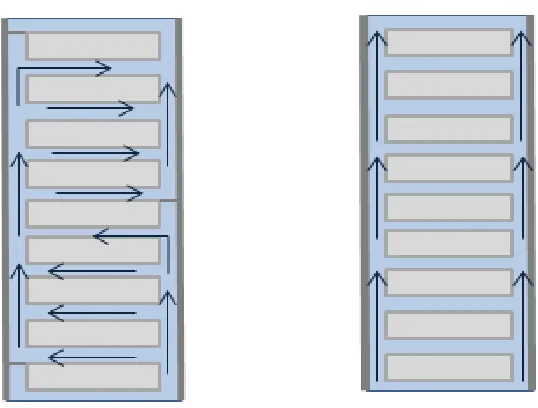
Oil guided and non-oil guided windings are proposed in disc windings transformers. In the active part, as shown in Figure 2.1, between winding and core, LV windings and HV windings, windings and outer casing, there are insulation board layers. Then, a closed space can be formed for each layer of windings. Figure 2.3 shows the 2D cross sectional area of one layer of disc windings. As Figure 2.3 at the left side shows, the guides are set in vertical ducts every 6 disks are oil guides. The purpose of setting oil guides is to improve the natural convection capability of the oil flow by avoiding the stagnation of the oil inside ducts. Cold oil come in the windings from the bottom and go through the vertical and horizontal ducts, the oil guides would change the oil flow direction and make the global oil distribution even.
[image:23.612.202.471.386.590.2]
Figure 2.3: 2D cross-sectional images of disk windings
winding looks like a longer section of winding with oil guides. For non-oil guided model, due to its large scale in the vertical length, the oil flow distribution as well as the temperature distribution is expected to become complex [4, 5, 17].
2.5 Transformer Cooling System
The heat produced in a transformer must be dissipated to an external cooling medium in order to keep the temperature in a specified limit. If transformer insulation is experienced higher temperature than the allowed value for a long time, it will cause rapid degradation of insulation and hence severely affect the transformer life.
In oil immersed transformer, the heat is transferred from the active parts (core, winding and structural components) to the external cooling medium by the oil. The heat from the active parts is transferred by the process of oil circulation. The process of transferring heat from involves three different heat transfer mechanisms which are conduction, convection and radiation [12]. The conduction process involves the heat transfer between the solid parts, whereas the convection process involves the heat transfer between a solid surface to a liquid or vice versa. The heat transfer by radiation is between solid or liquid to the surrounding ambient temperature.
15
2.6 Cooling Arrangement
2.6.1 Oil Natural Air Natural (ONAN)
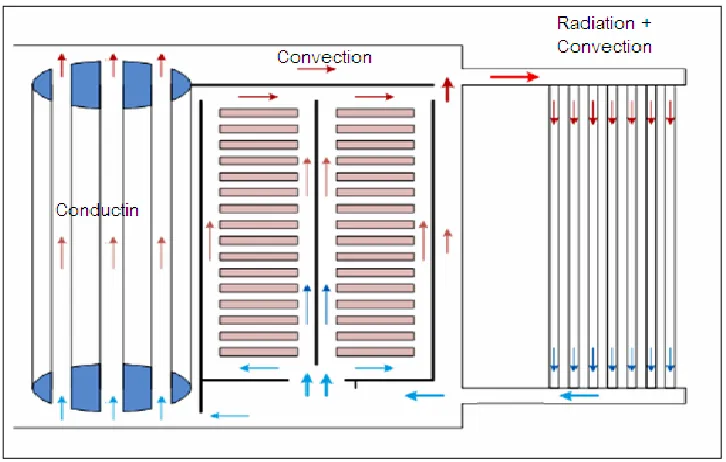
The simple and most common cooling type used in the practice is ONAN. ONAN refers to Oil Natural Air Natural. The ONAN cooling is achieved when the oil flow through the transformer winding is driven by pressure difference between the tank oil and the cooler oil. This pressure difference is due to a temperature difference between the oil temperature in the tank and the oil temperature in the radiators. This natural circulation of oil sometimes has been referred as a “thermo siphon” effect. The ONAN design is shown in Figure 2.4.and arrows in the figure show the oil flow direction in the transformer.
The term siphon effect occurs when the heat generated in transformer core and winding are dissipated to surrounding oil mainly through the convection process. The density of the oil is inversely proportional to the temperature and is proportional to the pressure and height. As the oil temperature increases, its density reduces. The oil becomes light and due to buoyancy effect it moves upwards towards the top of the tank. Its place is taken by the cool oil from bottom which has a higher density. As the oil enters the cooler, the heat is dissipated along colder surfaces of the cooler, at the same time oil increases its density. The oil then flows downwards through the cooler and enters the bottom of transformer tank from the inlet thus the continuous oil circulation occurs.
Figure 2.4: ONAN cooling diagram
This ONAN cooling mode is normally used for smaller rating transformer (distribution transformer). The ONAN cooling mode has a few advantages. They are:
It requires less maintenance and more reliable as no cooler controls are involved.
It is useful when low noise transformers are needed. The low noise level is easier achieve when the transformer are without the fans.
No cooler loss due to malfunction of the fans and pumps.
2.6.2 Oil Natural Air Force (ONAF)
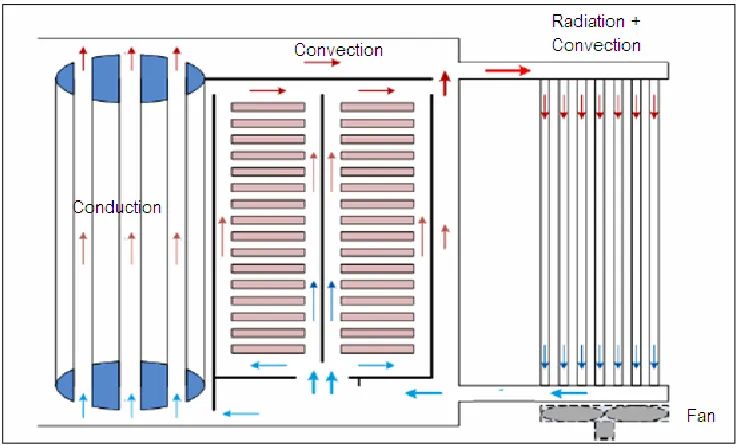
17
[image:27.612.143.514.173.397.2]Forced) as shown in figure 2.5. The introduction of the fans to the radiators improves the cooling characteristics of the radiators thereby reducing the number of radiators required to achieve the same amount of cooling. This also leads to smaller overall dimensions of the transformer/cooling design.
Figure 2.5: ONAF cooling diagram
In the ONAF cooling mode the oil circulates through the core and winding as the same as in the ONAN cooling mode. The flow rate inside the winding under ONAN and ONAF cooling arrangement is controlled by the themosiphon effect. Normally this flow rate is relatively low. Because of this, the heat dissipating of oil is low. The heat capacity can be expressed as
QUOTE (2.1)
2.6.3 Oil Force Air Force (OFAF)
[image:28.612.148.510.298.517.2]One way to improve the heat dissipation capability is to increase the value of mass flow rate; m and this can be done by using a pump to circulate the oil. Moreover to increase heat transfer rate, fans have to be always operating at the radiators. This improves the heat transfer to the radiators (cooling) and reduces considerably the temperature difference between the top and bottom of the radiators hence lower the oil temperature rise in the top parts of the transformer. This type of cooling is called OFAF (Oil Forced and Air Forced) as shown in Figure 2.6.
Figure 2.6: OFAF cooling diagram
19
2.6.4 Oil Direct Air Force (ODAF)
[image:29.612.162.495.277.451.2]Figure 2.7 shows a group of conductors surrounded by vertical and horizontal cooling ducts. The heat generated in each conductor must be transferred to the oil to keep the temperature within the limits. The heat flow in the horizontal direction from a central conductor is limited by the similar temperature conductors on either side of it. Therefore the heat can transferred via vertical directions.
Figure 2.7: Cross section of a disc or helical winding showing heat flow paths
Figure 2.8: Oil flow in a directed flow winding
The transformer with directed forced cooling is called ODAF (Oil Directed Air Forced). A typical arrangement is detailed in Figure 2.8. Where the pumps are used to move the oil into the transformer and block washer are used to direct the oil flows inside the winding. The OD design will result in lower winding gradients than the ON and OF. It also reduces the top oil temperature rise of the winding and therefore the hotspot rise is much reduced compared to the ON and OF cooling mode.
21
CHAPTER 3
METHODOLOGY
3.1 Introduction
Methodology includes the following concepts as they relate to a particular discipline of field of inquiry: collection of theories, concept or ideas; comparative study of different approached; and critique of the individual methods. Methodology refers to more than a simple set of methods; rather it refers to the rationale and the philosophical assumptions that underlie a particular study. Proper process guidance will help to monitor and troubleshoot any problem occurred in the middle of the process and also to make sure the project is successfully.
3.2 Project Methodology
23
NO YES
NO
SUCCESS
[image:33.612.211.543.56.682.2]
Figure 3.1: Flow chart in modeling thermal disk oil Start
Collecting all the relevant information
Analyze the information
Enough info?
Working planning & built the program
Modeling
Testing the model
Adjust the program
Thesis Writing
Figure 3.1 shows the main flow chart in modeling the disk coil from collecting the information until writing thesis. From all the steps, it can be summarize into three main phases, see Figure 3.2 below. Phase I will be done in PS 1 meanwhile Phase II and III planning to be done in PS 2.
Phase I
Phase II
[image:34.612.207.544.171.587.2]
Phase III Yes
Figure 3.2: Summarized flowchart of modeling thermal model
Start
Model Identification
Model Development
Implementation
68
REFFERENCES
[1] Susa D., Lehtonen M., and Nordman H., (2005)" Dynamic Thermal Modeling of Power Transformers", IEEE Transactions on Power Delivery, Vol. 20, Iss. 1, January 2005, pp. 197 – 204.
[2] MohadTaufiqIshak.,"Simulation Study on Influencing Parameters of Thermal Ageing for Transformer Lifetime Prediction", 17 DEC2009.
[3] KIRIS., ÖZKOL “Determination of temperature distribution in the disk –type coil of transformer windings via numerical –analytical methods” ,Journal of Electrical & Electronics Engineering, Vol 2, No 2 (2002).
[4] Kömürgöz, G., Özkol, Ý.,Güzelbeyoðlu, N., “ Temperature Distribution in the Disc-Type Coil of Transformer Winding”, ELECO’(2001) , Second International Conference on Electrical and Electronics.
[5] A. J. Oliver, "Estimation of transformer winding temperatures and coolant flows using a general network method," 1980.
[6] S.H. Digby H. J. Sim, "Transformer design for dual voltage application," in IEEE, Rural Electrical power Conference, 2002.
[7] A. Bulucea, L. Perescu M. C. Popescu, "Improved transformer thermal model," in WSEAS Transaction on Heat and Mass Transfer, 2009, pp. Vol. 4, No. 4. [8] M. Chaaban, P.Picher F. Torriano, "Numerical study of parameters affecting
the temperature distribution in a disc type winding," 2010
[9] L. Michael. Giordano Rich Hunt, "Thermal overload protection of power transformers – operating theory and practical experience," , Atlanta, Georgia, 2005
[11] M.J. Heathcote, J&P Transformer Book (1998). 12th ed. London, Reed Education and Professional Publishing Ltd, 1998.
[12] T. Nuun, "A comparison of liquid-filled and dry-type transformers,”, 2000. [13] M. Lehtonen, H. Nordman D. Susa, "Dynamic thermal modeling of power
transformers," in IEEE, Transaction on Power Delivery, 2005, pp. Vol. 20, No.1
[14] James H. Harlow, “Electric Power Transformer Engineering,”, CRC Press I Llc , 2004.
[15] R. M. Del Vecchio and P. Feghali, "Thermal model of a disk coil with directed oil flow," in IEEE, Transmission and Distribution Conference, 1999, pp. 914-919.
[16] M. S. Sorgic Z. R. Radakovic, "Basics of detailed thermal-hydraulic model for thermal design of oil power transformers," , 2010.
[17] R.Hosseini, M.Nourolahi&G.B.Gharehpetian, 2008. Determination of OD cooling system parameters based on thermal modeling of power transformer winding. Simulation modelling Practice and Theory, pp. 585-596
[18] M. Chaaban, P.Picher F. Torriano, “Numerical study of parameters affecting the temperature distribution in a disc type winding,” 2010.
[19] W. Wu, S. Tenbohlen, Z. Wang A. Weinlader, “Prediction of the oil flow distribution in oil-immersed transformer windings by network modeling and computational fluid dynamic,” vol. 6, no. 2, 2011.
[20] X.Li M. Vance, J. Zhang, “Experiments and modeling of heat transfer in oil transformer winding with zigzag cooling ducts,”, Canada, 2007.
[21] X. Li, J. Zhang, “Coolant flow distribution and pressure loss in ONAN transformer windings – Part I: Theory and model development,” vol.19, no. No. 1, 2004.
[22] S.H. Digby H. J. Sim, “Transformer design for dual voltage application,” in IEEE, Rural Electric Power Conference, 2002.
70
[24] B. Poulin [et all], Transformer design principles with application to core-form power transformer : CRC Press, 2010.
[25] M.R Tanner, T.Nuun, J.Kern J. Wimmer, “Dry type vs. liquid immersed transformer: Specification installation and operational impact in a marine environment, “ in Petroleum and Chemical Industry Conference (PCIC), 2011 Record of Conference Papers Industry Application Society 58th Annual IEEE,
2011. pp. 1-8.
[26] N. C. Chereches, J. Padet N. El. Wakil, “Numerical study of heat transfer and fluid flow in a power transformer,” 2005.
[27] “IEEE Standard for General Requirement for Liquid-immersed Distribution, Power, and Regulating Transformer,” New York, 2010.
![Figure 2.2: A simple transformer representation [9]](https://thumb-us.123doks.com/thumbv2/123dok_us/8774559.900686/17.612.188.461.486.676/figure-a-simple-transformer-representation.webp)
![Table 2.1: Liquid-immersed transformer [9]](https://thumb-us.123doks.com/thumbv2/123dok_us/8774559.900686/19.612.108.548.101.249/table-liquid-immersed-transformer.webp)
![Table 2.2: Transformer cooling designations [9]](https://thumb-us.123doks.com/thumbv2/123dok_us/8774559.900686/20.612.121.524.255.386/table-transformer-cooling-designations.webp)