2017 International Conference on Information, Computer and Education Engineering (ICICEE 2017) ISBN: 978-1-60595-503-2
An Intelligent Algorithm of Fire Detection
Based on WSN
Deng-yin Zhang, Yuan-yuan Qian and Fei Ding
ABSTRACT
In this paper, a hierarchical model combining wireless sensor network (WSN) and information fusion technology is proposed to adapt to different fire environments. The algorithm analyzes the applicability of the WSN and the non-structural characteristics of the process of fire. The experimental results show that the system has a higher fire recognition rate and a lower false alarm rate than the algorithm of the other schemes.
1. Introduction
With the rapid development of the theory on WSN and data fusion, more and more researchers have applied them to the field of firefighting. Haiqun Wang uses the multi-sensor data fusion technology in the fire detectors [1]. Luo Hong deems that the data fusion is the key strategy of solving the resource-scarcity on WSN [2]. In this paper, we propose an intelligent fire detection algorithm based on data fusion to realize the requirements of WSN on energy, real-time and reliability.
_________
Deng-yin Zhang, Fei Ding*, School of Internet of Things, Nanjing University of Posts and Telecommunications, Nanjing, China
2. Homogenization and Normalization on data level
Assume that there are N type of sensors integrated in the WSN,
X(t)=( , ,… , ) represents the input signal values of the N sensors
at time t. The homogenization function is as follows:
√ 1, (1)
where, ∑ , ∑ , K is used to
calculate the sample data’s number of and . The transforming formula is as follows:
y t | |=| 1| (2)
So the converted signal is Y(t)=( , ,… , ), where, is the data obtained after homogeneous converting by at time t. The next processing on data level is as follows, where, is the value of normalizing .
0.05 (3)
3. Neural Network Fusion on feature level
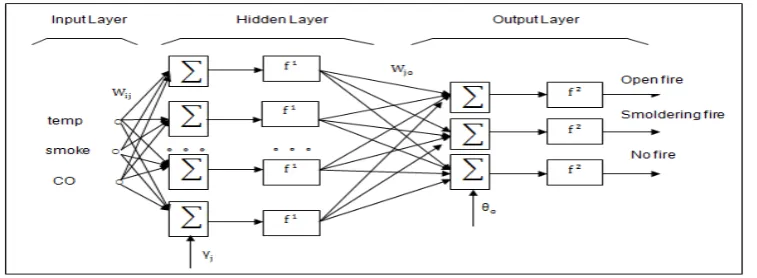
The input signal provides the information of smoke, CO and temperature. The output of the network includes the probability of open fire, smoldering fire and no fire. So the number of the nodes in the network’s input layer and output layer is both 3. There is no clear rules on choosing how many hidden nodes is appropriate. So we take the commonly used empirical formula which is as follows [3]:
n = +a (4)
Figure 1. Model of neural network
The input-pattern vector is =[ , , ], where, the , and represents the input of the kth group’s samples of temperature, smoke density and CO density. Expected output vector is =[ , , ], where, the , and represents the desired output of the kth group’s samples of open fire, smoldering fire and no fire. The input vector for activing value of each unit in the implicit layer is =[ , , ]. The output vector of each unit in the implicit layer is
=[ , , , , , , , ]. The input vector for activing value of each unit in the output layer is =[ , , , , , , , ]. The output vector with actual value is =[ , , ], where, the , and represents the actual output of the kth group’s samples of the probability of open fire, smoldering fire and no fire. The connection weight between the input layer and the hidden layer is
. The connection weight between the hidden layer and the output layer is . The threshold of neurons of the hidden layer and the output layer is and .
4. Simulation results and performance analysis
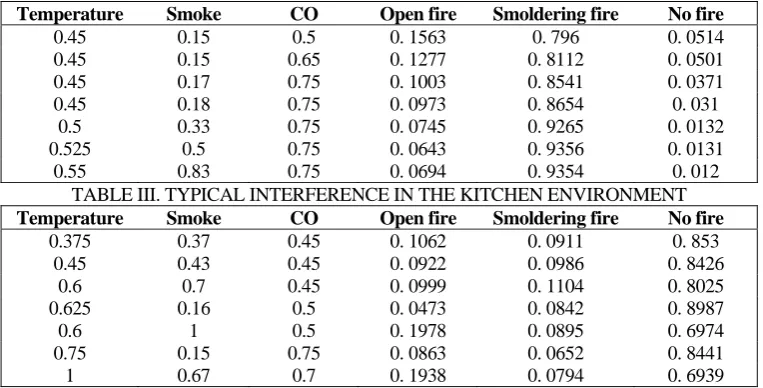
[image:3.595.102.481.120.259.2]This paper selects seven sets of sample from the authoritative fire data which includes the chinese standard open fire SH4, the chinese standard smoldering fire SH1 and the typical interference signal in the kitchen environment (Duisdurg City, Germany, the hospital kitchen) [4]. The simulation of the neural network on feature-fusioned layer is carried out by matlab2012b [5,6].
TABLE I. STANDARD OPEN FIRE SH4
Temperature Smoke CO Open fire Smoldering fire No fire
0.9 0.13 0.2 0.8086 0.0975 0.0918
0.925 0.18 0.25 0.7911 0.0934 0.1084 0.975 0.17 0.5 0.8533 0.1057 0.0541 0.975 0.2 0.8 0.8929 0.0824 0.0143
1 0.22 0.85 0.9133 0.0769 0.0116
1 0.25 1 0.9435 0.0448 0.0694
TABLE II. STANDARD SMOLDERING FIRE SH1
Temperature Smoke CO Open fire Smoldering fire No fire
0.45 0.15 0.5 0. 1563 0. 796 0. 0514
0.45 0.15 0.65 0. 1277 0. 8112 0. 0501
0.45 0.17 0.75 0. 1003 0. 8541 0. 0371
0.45 0.18 0.75 0. 0973 0. 8654 0. 031
0.5 0.33 0.75 0. 0745 0. 9265 0. 0132
0.525 0.5 0.75 0. 0643 0. 9356 0. 0131
[image:4.595.99.481.143.337.2]0.55 0.83 0.75 0. 0694 0. 9354 0. 012
TABLE III. TYPICAL INTERFERENCE IN THE KITCHEN ENVIRONMENT
Temperature Smoke CO Open fire Smoldering fire No fire
0.375 0.37 0.45 0. 1062 0. 0911 0. 853
0.45 0.43 0.45 0. 0922 0. 0986 0. 8426
0.6 0.7 0.45 0. 0999 0. 1104 0. 8025
0.625 0.16 0.5 0. 0473 0. 0842 0. 8987
0.6 1 0.5 0. 1978 0. 0895 0. 6974
0.75 0.15 0.75 0. 0863 0. 0652 0. 8441
1 0.67 0.7 0. 1938 0. 0794 0. 6939
It can be seen from the above tables that the system can effectively identify the fire and achieve improving the recognition rate of the fire detection and the robustness of WSN. Besides, the accuracy of the algorithm has been a certain degree of verification. So the system can achieve the early detection of fire.
5. Summary
In this paper, we present a fire detection algorithm based on fusing multi-sensor information by combining the principle of the distributed WSN and the characteristics of the automatic data fusion. It divides the system into multiple levels including data level and feature level, which realizes the modularization of the fire detection algorithm and the hierarchization of information fusion. The simulation results verify the correctness and feasibility of fire warning and prove that the system can solve the non-structural problem of fire detection.
6. Acknowledgements
REFERENCES
1. Wang, H., Zhang, Y., Meng, L., et al. The research of fire detector based on information fusion technology[C]// in Electronic and Mechanical Engineering and Information Technology (EMEIT), 2011 International Conference on. IEEE, 2011.
2. Luo Hong, Tao Huixiang, Ma Huadong, et al.Data fusion with desired reliability in wireless sensor networks[J].IEEE TRANSACTIONS ON PARALLEL AND DISTRIBUTED SYSTEMS, 2011 22(3): 501-513.
3. HU Zhuge. Design and research on fire detection and a-larm system based on multi-sensor information fusiontechnology [D]. Xi'an: Xi'an University of Architecture and Technology, 2013.
4. Compilation of Chinese national standards[S]. Beijing: China Standard Press, 2002.
5. Zhang Defeng. MATLAB programming and typical application[M]. Beijing:Electronic Industry Press, 2009.