2017 2nd International Conference on Advances in Management Engineering and Information Technology (AMEIT 2017) ISBN: 978-1-60595-457-8
Model of Network Information Propagation Based on Quantum Game
Qin-ying WANG and Feng-ming LIU
*School of Management Science and Engineering, Shandong Normal University, Ji’nan 250014, China
*
Corresponding author
Keywords: Quantum game, Game theory, Network information propagation, Nash equilibrium.
Abstract. Quantum game has wide applicability in many aspects of our lives, such as politics, economics, culture and so on. Combining the quantum game with network information propagation, the model of network information propagation based on the quantum game was established in this paper. From an information propagator’s perspective, the liquidity of network information transmission and trust mechanism were taken into account. We construct the model of network information propagation. The information propagator is the decision body and the trust mechanism is the decisive factor. We find the Nash Equilibrium in this game through the simulation experiment to gain maximum returns.
Introduction
Various SNS (Social Network Service) has been flooded in every corner of our lives such as Blog, WeChat and MicroBlog. Various types of information, from enterprise marketing to the government’s public opinion guidance and information regulation, may be quickly swept through the social network. The widespread of numerous network information not only have an impact on the information receiver but also affect government regulation and social stability to some extent[1].
In recent years, the academic research on network information propagation is mainly based on the following two perspectives[2]. For one hand, taking the network topology as the foothold, scholars extract the most influential nodes to analyze the behavior rules and study the communication mechanism through the algorithm. For the other hand, based on the typical applications such as MicroBlog, scholars make improvement of the existing model. Then, some simulation experiments may be done through the application data. So far, SIR model and LT model are the most popular models in all of the research results.
Many researchers have focused on the information propagation of Social Network Service. They proposed SNS community discovery algorithm based on different solution strategies such as the GN algorithm and FN algorithm[3]. Domingos used the probability theory to solve the most influential problem in SNS information propagation in the first place[4]. Kempe proposed three kinds of formal information propagation models: LT, IC and WC[5]. Wang Hui et al studied the rumors in SNS and they proposed and validated the corresponding propagation model[6]. Yanchao Zhang et al analyzed the behavior patterns of various nodes in SNS, and they built information propagation model based on the SIR model[7].
Model of Network Information Propagation
From the information propagators’ perspective, we divide the decision body into two parts, and each participant has only two strategies. Taking into account of the mobility of information propagation, we consider the receiver of the current time information propagation as the propagator in the next to improve the applicability of the model. We suppose that both of the information propagators are rational to maximize their own income. The trust mechanism is adopted. If the information recipient decided to trust the propagator, he would forward the information, otherwise he would not. Reputation value is considered as income to construct the income matrix. We assume that the game is a static game of complete information in this paper[8].At the end, we use the MATLAB software to present a two-player quantum game simulator that can simulate with any amount of entanglement between the initial strategies of the players under the condition that in its classical form is described by a 2-dimensional payoff matrix and the classical players have access to two different strategies only. Denote N = {A,B}, representing information propagator A and B respectively. A knows the authenticity of the information. B doesn’t know the authenticity of the information received from A.
Denote S = {S1,S2}. Expressing the strategy space of information propagator A in terms of S1 = {s11,
s12}. s11 represents that A propagates real information. s12 represents A propagates distortion
information through processing. S2 = {s21, s22}. s21 represents that B determines to forward the
information, that is, B trusts A. s22 represents that B doesn’t trust A.
Denote U = {U1,U2}. U1 and U2 represent the payoff function of information propagator A and B
[image:2.612.210.403.371.429.2]respectively. The initial reputation value of A is m and n for B at the same time. Notice that s>0, t>0. We convert the payoff function into the payoff matrix for convenience. The income of participant is represented by the reputation value in matrix shown in Table 1 below.
Table 1. The payoff matrix of A and B
B, s21 B, s22
A, s11 m , n+t m , n
A, s12 m-s , n-t m-s , n
At first, the model is quantized. Information propagator A and B have a quantum bit to manipulate respectively[9]. The classical strategies are represented by two basis vectors |T⟩ and |F⟩ in the Hilbert space of a two-state system. For example, the quantum strategy |T⟩ of A represents the classical strategy s11 and |F⟩ for s12. At each instance, the state of the game can be described by a vector in the
H2⨂H2 space which is spanned by the basis |TT⟩, |TF⟩, |FT⟩ and |FF⟩ where the first and second
entries refer to quantum bit of A and B respectively.
Denote the game’s initial state by ⋀ = U|TT⟩. U is a unitary operator which is already known to both players and acts on two quantum bits simultaneously. A and B represent the strategy of information propagator A and B respectively and we have S1 = UA, S2 = UB. UA and UB are the unitary operators.
The independence of the players dictates that UA and UB operate exclusively on the quantum bits in
A’s and B’s possession respectively. The strategy S can be represented by a subset of H2⨂H2 space.
Then, the information propagator A and B execute their moves, which leaves the game in the state (UA⨂UB)U|TT⟩. At the end, we use the measurement device to measure the final state.
[image:2.612.236.377.676.731.2]The physical model of network information propagation based on quantum game is shown in Figure 1. The physical model is consisted with three parts[10]. For the first, a source of two bits, each player has his own bit. Then, a set of physical instruments that enables A and B to manipulate his own bit, that is, each player chooses his strategy. In the end, there is a physical measurement device which determines the players’ payoff by measuring the final state of two bits.
The state of the game is recorded as |ψf⟩ after the players executing their moves. The inverse of
unitary operator U is U+. Therefore, the state of the game is |ψf⟩ = U+ (UA⨂UB)U|TT⟩. We use the
device to measure the final state of the game and record the result as σσ' which is one of the four basic vector |TT⟩, |TF⟩, |FT⟩ and |FF⟩ in the H2⨂H2 space. We can determine the payoff according to the
Table 1.
Since quantum theory is a fundamentally probabilistic theory[11], the payoff of the participant in the quantum game should be represented by expected payoff.
The expected payoff of Information propagator A is given by
P
P
P
P
TT FT TF FFA m (m s) m (m s)
$
= + − + + − (1) The expected payoff of Information propagator B is given byP
P
P
P
TT FT TF FFB=(a+t) +(a−t) +a +a
$
(2)where Pσσ' is the joint probability that the result is σσ' and Pσσ' = |⟨σσ'|ψf⟩|2. Pσσ' = PA(σ)PB(σ') where P(T)
= cos2 (θ/2) and P(F) = 1- P(T).
It’s obviously that the payoff of A and B is associated with UA and UB. The payoff of information
propagator A depends on his strategy choice UA as well as the strategy choice UB of B. At the same
time, the payoff of information propagator B also depends on UA and UB.
According to Eisert’ s research, we restrict the strategic space to the 2-parameter set of unitary matrices with 0 ≤θ≤π, 0 ≤φ≤π/2.
− = − 2 cos 2 sin 2 sin 2 cos ) , ( θ θ θ θ ϕ θ ϕ ϕ e e i i U (3) In the newly established quantum model, the strategy space of each participant has been greatly expanded. However, when T and F are only selected in the strategy space, the model should correspond to the corresponding grid in the yield matrix. In order to guarantee the versatility of the model, we add to the following subsidiary conditions [U,F⨂F] = 0, [U,F⨂T] = 0 and [U,T ⨂F] = 0. The solution is U = exp{iγF ⊗ F /2}where γ∈[0,π/2]. Γ is a measure of the game’s entanglement. When γ=0, the entanglement between the two quantum bits is zero which represents the classical game. When γ = π/2, the entanglement reach to the maximum. According to the condition above, we can get any set of strategies in the subset
{
ˆ(θ,0)θ[
0,π]
}
0 = U ∈
S
.Example Study
It is obviously that the information propagator A get the maximum payoff when he selected the strategy T regardless of the choice made by B. In other words, forwarding the real information is a dominant strategy for propagator A. Using the line method, we can get the Nash Equilibrium (T, T) of this game in classical game theory, that is, A chooses to forward the real information and B forwards the real information received from A.
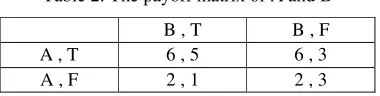
[image:3.612.212.402.652.700.2]In order to facilitate the calculation, we take specific values of the parameters in Table I as shown in Table 2 below.
Table 2. The payoff matrix of A and B
B , T B , F
A , T 6 , 5 6 , 3
A , F 2 , 1 2 , 3
In this quantum model, there are five independent variables γ, θA, φA, θB, φB and one dependent
variable $A. If we take all the parameters into consider to generate a visual effect map, it requires
our ability to display the graphical result is limited to three dimensional at most. Therefore, we consider the strategy parameters θB and φB of B and the entanglement γ remain constant in the
experiment after their initial definition at the beginning of the simulation. Then, the strategy parameters θB and φB of A are respectively taken in the corresponding intervals to obtain the
corresponding payoff values.
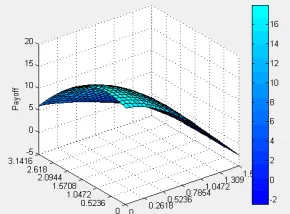
When γ= 0, θB = 0, φB = 0, it corresponds to the payoff of A when B adopts classical strategy. We
use MATLAB to simulate the expected payoff of A as shown in Figure 1.
It is obviously that when θA = 0, φA = 0, that is, A chooses the strategy T, A will obtain the
maximum payoff. At this time, it corresponds to the Nash Equilibrium of the classical game where T⨂T is the dominant strategy.
[image:4.612.231.379.208.318.2]
Figure 2. Expected payoff of A when γ=0, θB=0 and φB=0.
Figure 3. Expected payoff of A when γ=π/2, θB = 0 and φB =π/2.
When γ=π/2, θB = 0, φB =π/2, the entanglement reaches the maximum. At this time, the
expected payoff of A is shown in Figure. 3 and the game gets the maximum of entanglement where participants choose the strategy Q = U(0,π/2) when the Nash Equilibrium is still T⨂T.
According to the experiment simulation results, when A selects to propagate real information, B should choose to forward the real information to get much more profit. When A decides to forward distortion information, B should refuse to forward the information to keep the reputation value. Therefore, the Nash Equilibrium is (forward real information, forward) in this game.
Discussions
According to our simulation experiment, we know that the Nash Equilibrium is (forward real information, forward) in this game not only the classical game but also the quantum game. The model of information propagation built in this paper is a purely strategic game model based on the absolute trust and absolute distrust. It is suitable for the network information transmission situation which has established a relatively clear trust relationship through multiple interactions especially for the information published from the unofficial website or media.
[image:4.612.233.378.345.452.2](1) The network information propagation model constructed in this paper doesn’t divide the types of network information as well as the communication groups. However, the types of information and communication groups will affect the propagation of information in the real process of network information propagation. The next research work needs to subdivide the information and group into different types.
(2) In order to simplify the model analysis and calculation, the model proposed in this paper is based on the static game of complete information and judging whether to take forward information through trust mechanism. In the practical propagation process, it is a dynamic game to a large extent. Therefore, it still needs further study in the context of dynamic game strategy.
(3) Network rumor has become troubled by the vast majority of Internet users, organizations and important social issues in the party and government departments. The propagation of rumor through network has an awful influence on the social awareness, emotional bias and daily life and it even reduce the effect of the government communications with people. We may study the features of the rumor transmission over the network in order to identify the rumor and block the spread in time.
Acknowledgement
This work was supported in part by the National Natural Science Foundation of China (No. 61170038, 61472231), the National Social Science Foundation of China (No. 14BTQ049).
References
[1] Z. W. Tian, Research on information dissemination of micro-blog based on complex network, Ph.D. dissertation, Harbin Institute of Technology Univ., Harbin, China, 2012.
[2] J. L. Wang, A. F. Liu and Z. F. Zhu, An information spreading model based on relative weigh in social network, Acta Phys. Sin, vol. 64, no. 5, pp. 1-11, 2015.
[3] M. Girvan and M. E. Newman, Community structure in social and biological networks, Proceedings of the National Academy of Science of the United States of America, vol. 99, Issue. 12, pp. 1-8, 2002.
[4] M. Richardson and P. Domingos, Mining knowledge-sharing sites for viral marketing, Proceedings of the eighth ACM SIGKDD international conference on Knowledge discovery and data mining, ACM, pp. 61-70, 2002.
[5] D. Kempe, J. Kleinberg and E. Tardos, Maximizing the spread of influence through a social network, Proceedings of the ninth ACM SIGKDD international conference on Knowledge discovery and data mining, ACM, pp. 137-146, 2003.
[6] H. Wang, J. H. Han, L. Deng and K. Q. Cheng, Dynamics of rumor spreading in mobile social networks, Acta Phys. Sin, vol. 62, no. 11, pp. 1-12, 2013.
[7] Y. C. Zhang, Y. Liu, H. F. Zhang, H. Cheng and F. Xiong, The research of information dissemination model on online social network, Acta Phys. Sin, vol. 60, no. 5, pp. 1-7, 2011.
[8] J. Chen, R. Y. Du, L. N. Wang and Z. R. Tian, A trust game method basing on probability model in networks, Acta Electronica Sinica, vol. 38, no. 2, pp.427-433, 2010.
[9] J. Eisert, M. Wilkens and M. Lewenstein, Quantum games and quantum strategies, Physical Review Letters, vol. 83, no. 15, pp. 3077-3080, 1999.
[11] Z. Z. Liu, “A thesis submitted in partial fulfillment of the requirement for the degree of master of science & technical philosophy,” Ph.D. dissertation, Huazhong University of Science & Technology, Wuhan, China, 2006.
![Figure 1. The physical model is consisted with three parts[10]. For the first, a source of two bits, each The physical model of network information propagation based on quantum game is shown in player has his own bit](https://thumb-us.123doks.com/thumbv2/123dok_us/281120.1028685/2.612.236.377.676.731/figure-physical-consisted-physical-network-information-propagation-quantum.webp)