2017 2nd International Conference on Computer, Mechatronics and Electronic Engineering (CMEE 2017) ISBN: 978-1-60595-532-2
Face Recognition Based on Multi-directional Histograms of Orthogonal
Oriented Gradient
Hai-xia WANG
1, Jin-xin TANG
2, Xiao-xiao LI
3, Fan CHEN
3and Wei-fa GAN
31
Hunan Automobile Engineering Professional College, Zhuzhou Hunan 412000, China
2
Hunan Apowertec Co., Ltd, Changsha Hunan 410000, China
3
School of Physics and Photoelectronics, Xiangtan University, Xiangtan Hunan 411105, China
Keywords: Face recognition, Histogram of gradient direction, Nearest neighbor classifier, Robustness.
Abstract. In order to solve the problem of the poor recognition effect of traditional face recognition methods under pose, facial expression and illumination, a face recognition algorithm based on Multi-directional histograms of orthogonal oriented gradient is proposed. Firstly, the gradient characteristics of eight different directions, are extracted by using improved gradient operator. Secondly, counting the histogram feature of gradient direction in each direction and the Hog feature of eight directional orthogonal gradients, in order to get the overall image characteristics, is connected together. At last, overall image characteristics will be classified by nearest neighborhood classifier. The experimental result, which is tested in face library of Yale, ORL, CAS-PEAL-R1, shows that the proposed algorithm can improve the recognition rate effectively and has excellent robustness to the illumination and expression.
Introduction
Face recognition has a wide range of applications in finance, mobile payment, security detection and other fields. Face recognition is the extraction and classification of existing facial images, among which feature extraction is the key to face recognition. At present, feature extraction methods are divided into global feature method and part feature method [1]. Histograms of gradient direction is a kind of excellent method of local feature description [2-3], the classification ability is stronger than LBP and Gabor wavelet [4] and histograms of gradient direction has better robustness in light, scale and direction [5-6] .HOG can well describe the edge contour information of images, but
[7-8]
ignores the spatial arrangement and structural change information of the local features of images. Tong Ying [9]proposed a spatial multi-scale HOG feature, the image layer thinning region in different scale, multi-scale HOG image feature extraction, and applied to facial expression recognition, achieved good recognition effect. GuoJinxin and other people [10] proposed the fusion of the whole image and the HOG feature of the key parts of the face, and reduce the dimension of the data by HOG, the formation of HOG feature fusion has a good effect on face recognition, but it ignores the change of spatial structure OF the local feature of face. Yang Bing [11] and others proposed a kind of Pyramid gradient direction histogram, through multi-scale analysis of constructing face image HOG Pyramid, global and local feature extraction of image, can effectively describe facial features under different scales, and achieved better results in face recognition.
Histograms of Oriented Gradient and Its Improvement
Histograms of Oriented Gradient
The gradientdirection histogram descriptor is evolved from the SIFT operator[12] , which composes the HOG feature by calculating the image pixel gradient and the local gradient direction, which can extract the edge and shape features of the image well. The gradient and gradient directions of the pixel points of the face image are calculated by the equations (1) and (2), where Gx(x,y) and
) , (x y
Gy represent the horizontal gradient and the vertical gradient, respectively.
2 2 ) , ( ) , ( ) ,
(xy G xy G xy
G = x + y (1)
) , ( ) , ( arctan ) , ( y x G y x G y x x y =
θ (2)
) , 1 ( ) , 1 ( ) ,
(x y I x y I x y
Gx = + − − (3)
) 1 , ( ) 1 , ( ) ,
(x y =I x y+ −I x y−
Gy (4)
The gradient direction histogram of the face image is composed of the gradient amplitude and the gradient direction of each pixel block without overlapping. The gradient direction is divided into unsigned (0 ° ~ 180 °) n blocks, the gradient amplitude is 1 Added to the corresponding gradient direction. The HOG feature in each pixel block is normalized by L2-norm. The formula is shown in equation (5). Finally, the HOG characteristics of each pixel block are concatenated to form the HOG feature of the whole face image.
ε + =
∑
×= × N p qk v k
n v n v 1 2 ) ( ) ( )
( (5)
Where: v(n)denotes the nth HOG. To prevent the result from being Infinity, "
ε
" is a constant.Multi-directional Orthogonal Oriented Gradient
In most cases, images that are difficult to extract in a direction are easily extracted in the other direction, so more feature information can be extracted using mufti-directional techniques [13-15]. HOG only extracts the gradient feature in the image in a single direction and ignores the classification information of the image in a certain direction, so that it can not characterize the structural changes in each direction of the image well.
The human face image I, by the Lambert illumination model, is expressed as:
) , ( ) , ( ) ,
(x y R x y L x y
I = • (6) )
, (x y
I represents the gray value of a certain pixel of the image.R(x,y) represents the reflectivity of a certain point of the face image, reflecting the intrinsic intrinsic feature of the face image, which is insensitive to light.L(x,y) represents the brightness value of a point image, which is affected by the light source.
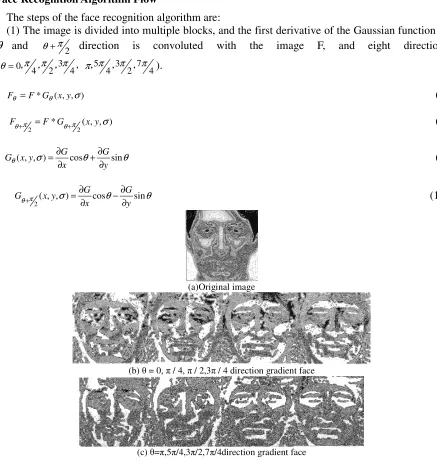
Because the orthogonal gradient of different directions is independent of illumination, the gradient information of different directions can reflect the different facial structure characteristics. A new gradient extraction operator - multi - directional orthogonal gradient extraction operator is proposed for the shortcomings of HOG unidirectional extraction of image feature information. The gradient features of 8 different directions ( ,7 4
2 3 , 4 5 , , 4 3 , 2 , 4 ,
0π π π π π π π
θ = ), are shown in Figure 1,
are obtained by convolution operation between the first derivative of Gaussian function and the image.
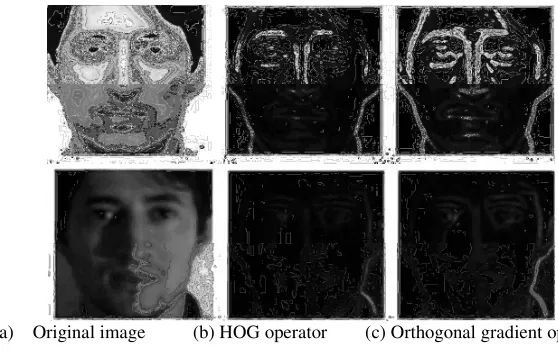
more details of the image Figure 2, shows gradient intensity image extracted by the HOG operator and the orthogonal gradient operator, which we can know that the contour of the image extracted by the orthogonal gradient operator is clearer and insensitive to the illumination change.
Face Recognition Algorithm Flow
The steps of the face recognition algorithm are:
(1) The image is divided into multiple blocks, and the first derivative of the Gaussian function of
θ
and2 π
θ + direction is convoluted with the image F, and eight directions
( 7 4
2 3 4 5 4 3 2 4
0π π π π π π π θ = , , , , , , , ).
) , , ( * θ σ
θ F G x y
F = (7)
) , , ( *
2 2
σ π θ π
θ F G x y
F+ = + (8)
θ θ
σ
θ( , , ) cos sin
y G x
G y
x G
∂ ∂ + ∂ ∂
= (9)
θ θ
σ π
θ 2( , , ) cos ysin
G x
G y
x G
∂ ∂ − ∂ ∂ =
+ (10)
(a)Original image
(b) θ = 0, π / 4, π / 2,3π / 4 direction gradient face
[image:3.612.84.521.119.584.2](c) θ=π,5π/4,3π/2,7π/4direction gradient face
(a) Original image (b) HOG operator (c) Orthogonal gradient operator
Figure 2. Gradient intensity image with different gradient operator.
Where F is the input image, Gθ(x,y,σ) and ( , , )
2 σ π
θ x y
G + are the Gaussian functions whose
standard deviations are
σ
inθ
andθ +π2, respectively and Iθand 2π θ +
I represent the gradient
components of the image in the
θ
and 2 πθ + directions, respectively; * is the convolution operation.
(2) Calculate the gradient intensity and direction of the image θ direction.
) / arctan(
2
π θ θ
θ = F F+
O (11)
2
2 2
π θ θ
θ = F +F+
Gr (12)
(3)The characteristics of HOG are counted on all the blocks in each single direction. Finally, the orthogonal gradient histogram features of 8 directions are concatenated as the overall characteristics of the face image and are classified by the nearest neighbor classifier.
Experimental Results and Analysis
In order to analyze the performance of Multi-directional histograms of orthogonal oriented gradient face recognition algorithm, YALE face database, ORL face database and CAS-PEAL-R1 face database are presented in the paper [2] without any pretreatment of image HOG algorithm, the proposed MHOG in paper[11], and the HOGPF algorithm proposed in paper, where HOGPF selects a 3-layer pyramid model. HOG, MHOG, HOGPF algorithm in the ORL face database, YALE face database, CAS-PEAL-R1 face database were used 7 × 3, 8 × 8, 8 × 8 block number, the direction of 16, all use Nearest neighbor classifier.
Number of Blocks and Interval
Figure 3. The recognition rate of different block ways of Yale database.
Figure 4 .ORL database identification of different ways to block%.
1 2 3
4 5 6 7
8 9 10 11 12 13 1
23 45
67 8
910 11
12 13 0
20 40 60 80 100
列 列块列 行 列块列
率 识 识
%
1 2 3 4
5 6 7 8
9 101112 13 1 2
3 4 5 6
7 8 910
111213 0
20 40 60 80 100
列列 列列块 行列 列列块
率 识 识
%
Line block number Column number of blocks
%R
e
co
g
n
it
io
n
r
a
te
Line block number Column number of blocks
%R
e
co
g
n
it
io
n
ra
Gradient direction number
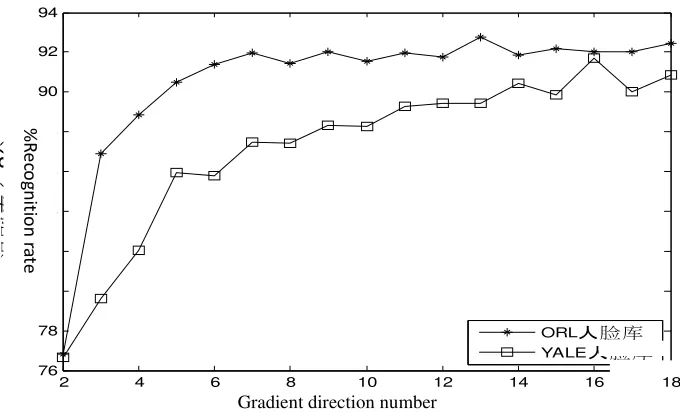
Figure 5. Recognition rate in different gradient directions%.
Trained images, on Yale face Library and ORL face library, are selected by using the same method that three trained images are selected from each person's all images randomly, the other is the tested image. The mean value of the 50 times of cross verification, in order to ensure the validity of the experiment, is taken as the final recognition rate, and then selecting best block method and the gradient direction interval quantization number.
It can be seen from Figure 3 and 4 that the row and column blocks with the highest recognition rate on the YALE database are 13 and 3 respectively, and the row and column blocks with the highest recognition rate on the ORL database are 9 and 2 respectively. It can be seen from Figure 5 that the recognition rate of the YALE database is the highest when the gradient direction is 16, and the recognition rate of the ORL database is 13.
The Influence of the Different σ Values of the Orthogonal Gradient in Different Directions on the Recognition Rate
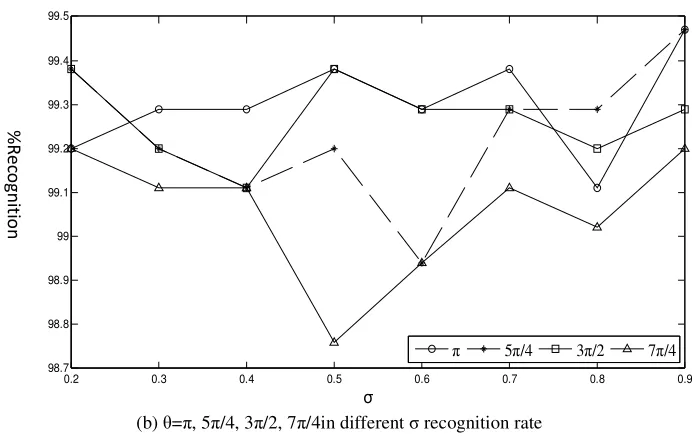
In order to verify the effect of different σ values on the recognition effect in the eight orthogonal gradient directions, the same method is used to select the training images on the YALE database and the ORL database. 2 images are randomly selected from all the images of the individual, and the other is the test image set. In order to ensure the reliability of the experimental data, cross-validation 10 times, take the maximum of 10 times as the final recognition rate, the experimental results shown in Figure 6 Figure 7. CASE PEAL-R1 database on the expression of the selected two images as a training sample, the other is the test image set, the experimental results shown in Figure 8.
2 4 6 8 10 12 14 16 18
76 78 80 82 84 86 88 90 92 94
率
识 识 ( )
%
人脸脸 ORL
人脸脸 YALE
%R
e
co
g
n
it
io
n
ra
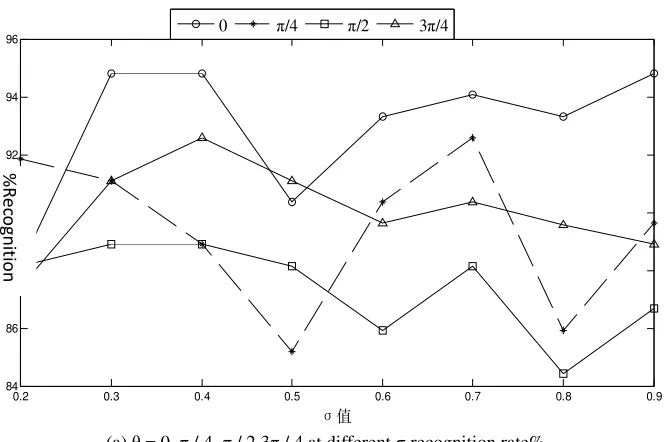
(a) θ = 0, π / 4, π / 2,3π / 4 at different σ recognition rate%
Figure 6. YALE database experiment.
From Figure 6, we know that when selecting standard deviation σ of the highest recognition rate in different directions, Θ=0, Π/4, Π/2, 3π/4, Pi, 5Π/4, 3Π/2, 7Π/4, in Yale face Library, the highest recognition rate of orthogonal gradient direction, respectively, are 94.81% (σ=0.3, 0.4, 0.9), 92.59% (σ=0.7), 88.89% (σ=0.3, 0.4), 92.59% (σ=0.4), 95.56% (σ=0.6), 94.07% (σ=0.9), 87.41% (σ=0.5), 94.07% (σ=0.5).
(a)θ = 0, π / 4, π / 2,3π / 4 in different σ recognition rate
0.2 0.3 0.4 0.5 0.6 0.7 0.8 0.9
84 86 88 90 92 94 96
σ值 识
别 率 ( %)
0 π/4 π/2 3π/4
0.2 0.3 0.4 0.5 0.6 0.7 0.8 0.9
87 88 89 90 91 92 93
值 σ 率
识 识 ( )
%
0 π/4 π/2 3π/4
%R
e
co
g
n
it
io
n
ra
te
%R
e
co
g
n
it
io
(b)θ=π, 5π/4, 3π/2, 7π/4 in different σ recognition rate
Figure 7. ORL database experiment.
It can be seen from Figure 7 that when the standard deviation σ corresponding to the highest recognition rate is selected in different directions, the ORL face database is in the range of θ = 0, π / 4, π / 2,3π / 4, π, 5π / 4, 3π / The highest recognition rate in the orthogonal gradient direction is 91.56% (σ = 0.6), 90.94% (σ = 0.7), 90.94% (σ = 0.6,08), 92.50% (σ = 0.3) 89.79% (σ = 0.5, 0.6, 0.7), 90.00% (σ = 0.6), 88.75% (σ = 0.5) and 88.44% (σ = 0.7).
(a)θ=0, π/4, π/2, 3π/4 in different σ recognition rate
0.2 0.3 0.4 0.5 0.6 0.7 0.8 0.9
75 80 85 90
值 σ
率 识 识 ( )
%
π 5π/4 3π/2 7π/4
0.2 0.3 0.4 0.5 0.6 0.7 0.8 0.9
98 98.2 98.4 98.6 98.8 99 99.2 99.4 99.6 99.8
值 σ
率
识
识
(
)
%
0 π/4 π/2 3π/4
%R
e
co
g
n
it
io
n
%R
e
co
g
n
it
io
(b) θ=π, 5π/4, 3π/2, 7π/4in different σ recognition rate
Figure 8. CAS-PEAL-R1 database experiment.
It can be seen from Figure 8 that the CAS-PEAL-R1 face database is in the range of θ = 0, π / 4, π / 2, 3π / 4, π, 5π / 4π when the standard deviation σ corresponding to the highest recognition rate is selected in different directions, The highest recognition rates in the orthogonal gradient direction are 99.65% (σ = 0.6), 99.56% (σ = 0.6, 0.9), 99.20 (σ = 0.4, 0.6), 99.47% (σ = 0.5), 99.47% (σ = 0.9), 99.47% (σ = 0.9), 99.38% (σ = 0.2, 0.5) and 99.20% (σ = 0.2, 0.9).
Comparison of Recognition Rate and Analysis
The YALE face database and the ORL face database are randomly selected from all the images of each person in the selection of the training image when comparing the recognition rates of the different algorithms, where n is an integer and the value ranges from 2 to 7, the other is the test image. In order to ensure the reliability of the data, cross-validation 50 times, takes the 50 times the average as the final recognition rate. The total number of changes in the CAS-PEAL-R1 database is 199, with a total of 1791 face images per person. The light group chooses the first three images from each of the nine images as the training image, and the remaining six is the test image. The total number of facial changes in the group of 376 people, each 5 a total of 1880 face positive image, which expression group selected the first two as a training sample, the rest as a test sample, the two subsets all the images are scaled to 80 × 80 pixels. The experimental results are shown in Tables 1 to 3.
Table 1 .Yale on the face of different algorithms to choose different training images recognition rate.
Algorithm
Random number of samples/n
2 3 4 5 6 7
HOG[2] 87.80 91.68 93.18 93.48 93.76 93.93
MHOG [10] 89.27 92.15 93.54 94.31 95.36 95.97
0.2 0.3 0.4 0.5 0.6 0.7 0.8 0.9
98.7 98.8 98.9 99 99.1 99.2 99.3 99.4 99.5
值 σ 率
识 识 ( )
%
π 5π/4 3π/2 7π/4
识 别 率 (
%
)
%R
e
co
g
n
it
io
[image:9.612.129.483.560.694.2]Table 2 .ORL face database on different algorithms to select different training images recognition rate.
Algorithm
Random number of samples/n
2 3 4 5 6 7
HOG[2] 87.94 92.36 94.17 96.60 96.64 97.33
MHOG [10] 88.44 95.00 95.83 96.88 98.00 98.33
HOGPF[11] 91.87 95.36 95.83 97.50 98.33 98.50
MHOOG 93.13 96.07 97.92 99.00 99.17 99.38
It can be seen from Table 1 and Table 2 that the recognition rate of MHOOG algorithm is improved by at least 4% and 2% compared with the original HOG algorithm, which shows that the algorithm is more accurate to characterize face posture, and changes in light. On the other hand, compared with the HOGPF algorithm and the MHOG algorithm, the article algorithm also has certain advantages in the recognition rate. The facial image is decomposed by eight orthogonal directions to get the corresponding 8 different HOG features, and the sub-feature graphs are presented in different directions Different structural features, thus retaining more useful local easy to sort information, better recognition.
Table 3. CAS-PEAL-R1 face database on the different algorithms to select the recognition rate of different training images.
Algorithm Expression set Light set
HOG[2] 99.38 93.55
MHOG [10] 99.50 95.81
HOGPF[11] 98.94 93.97
MHOOG 99.82 98.16
It can be seen from Table 3 that the traditional HOG algorithm, MHOG and HOGPF algorithm in the CAS-PEAL-R1 database expression achieve a higher recognition rate, but in the light set on the recognition effect is not ideal. The gradient is robust to slowly changing light, and the orthogonal gradient information in different directions can reflect different facial structure changes. In this paper, the HOG operator is improved and the gradient of different angles of the image is extracted, which effectively preserves the structural features and illumination invariant features of the image. Therefore, the recognition rate of the expression set and the illumination set is higher than that of other methods.
Concluding Remarks
[image:10.612.150.462.362.482.2]Reference
[1] Shu Chang, Ding Xiaoqing, Fang Chi. Histogram of the Oriented Gradient for Face Recognition [J]. Journal of Tsinghua Science and Technology, 2011, 16(2):216-224.
[2] Dalal N, Trriggs B. Histograms of oriented gradients for human detection[C]// CVPR 2005: Proceedings of the 2005 IEEC Computer Society Conference on Computer Vision and Pattern Recognition. Piscataway, NJ: IEEE Press, 2005, 1:886-893.
[3] Deniz O, Buenno, Salido J, et al. Face recongnition using histogram of oriented gradients [J]. Pattern Recognition Letters, 2011, 32(12): 1598-1603.
[4] Xiang Zheng, Tan Hengliang, Ma Zhengming. Performance Comparison of Improved HOG and Gabor and LBP [J] .Journal of Computer Aided Design and Graphics, 2012, 24(6):787-792.
[5] Chung-Wei Liang, Chia-Feng Juang. Moving object classification using local shape and HOG features in wavelet-transformed space with hierarchical SVM classifiers [J]. Applied Soft Computing, 2015, 28:483-497.
[6] Lee S E, Min K, Shu T. Accelerating histograms of oriented gradients descriptor extraction for pedestrian recognition [J].Computers and Eletrical Engineering, 2013, 39(4):1043-1048.
[7] Ajay Kumar Singh, V.P. Shukla, Shamik Tiwari, Sangappa R .Biradar. Wavelet Based Histogram of Oriented Gradient Feature Descriptors for Classification of Partially Occluded Objects [J].I.J. Intelligent Systems and Applications, 2015, 03: 54-61.
[8] Wentao Shen, Xiaoqing Ding, Changsong Liu, Chi Fang, Bin Xiong.New Method of Ground Target Recognition Based on Stable Edge Weight de HOG [J].Procedia Engineering, 2015, 9:1126-1131.
[9] Tong Ying. Facial expression recognition aigorithm based on spatial muiti-scaled HOG feature [J].Computer Engineering and Design, 2014, 35(11):3918-3922.
[10] Guo Xin Jian, Chen Wei. Face Recognition Based on HOG Multi-feature Fusion and Random Forest[J]. Computer Science, 2013, 40(10):279-282.
[11] Yang Bing, Wang Xiao-hua, Yang Xin, Huang Xiao-xi. Face recognition method based on HOG pyramid [J].Journal of Zhejiang University (Journal of Engineering), 2014, 48(9): 1564-1569.
[12] Alberto Albiol, David Monzo, Antoine Martin, Jorge Sastre. Face recognition using HOG-EBGM [J]. Pattren Recognition Lettern, 2008, 29(10): 1537-1543.
[13] Chen X, Zhang J S. Illumination robust single sample face recognition using multi-directional orthogonal gradient phase faces [J]. Neurocomputing, 2011, 74(14): 2291-2298.
[14] Yang Huixian, Cai Yongyong, Zhai Yun long, Li Qiuqiu, Feng Junpeng. Single sample face recognition based on orthogonal gradient binary pattern [J]. Computer Applications, 2014, 34(2):546-549.