2017 2nd International Conference on Artificial Intelligence and Engineering Applications (AIEA 2017)
ISBN: 978-1-60595-485-1
Construction of Hazard Source Evaluation Index
System of Smart Grid
YONGJIE LI, XINJU GUO, HAO TANG and DAPENG LI
ABSTRACT
The smart grid is a perfect combination of modern science and technology, advanced management concept and the traditional power grid, it’s an inevitable choice
of addressing energy security and environmental problems, tackling global climate change, and achieving the sustainability of the economic and social development. Hazard evaluation of Smart grids is the important guarantee for the safe operation of the smart grid and its evaluation work must have a scientific, comprehensive evaluation index system. This article take the idea of grid operation safety control management as the overall plan, combined with the working reality of the smart grid hazard source evaluation, make a discussion on constructing a scientific and practical evaluation index system of the smart grid hazard source, in order to guide the safe operation and management of the smart grid.
KEYWORDS
Smart grid, hazard source, evaluation, index system construction.
INTRODUCTION
With the development of economy and society, human activity has had a huge impact on the environment, energy shortages, environmental pollution and climate change have become serious problems that afflicting the global. Combined with the deepening process of electric power market, users’ requirements of the reliability and quality of electric energy are increasing. The electric power industry is facing unprecedented challenges and opportunities, building a more secure, reliable, environmentally friendly power systems, has become a common goal of global power sector. Based on the analysis above, the Smart grid came into being.
Although the development of the smart grid in China is still in its infancy stage, many experts and scholars at home and abroad do many beneficial research on smart grid’s technical standards, management practices, key technologies and equipment development. At present, the construction of Smart grids has entered a substantive stage, security issues in its operation received growing attention, therefore, the evaluation of
_________________________________________
Yongjie Li, [email protected], Xinju Guo, [email protected], Dapeng Li, [email protected]. State Grid Henan Economic Research Institute, Zhengzhou, Henan 450000, China.
the hazard source that may exist in the smart grid operation has important practical significance. The smart grid as a new thing, however, the literature of researching its hazard sources have not been found. So, this article based on an in-depth study of the hazard theory, through the analysis of the characteristics and development of smart grid technology, in the light of hazards that may exist in the course of its run, combined with the principles of the construction of evaluation index system, building a smart grid hazard evaluation system, with a view to working on smart grid security management references.
THE PRINCIPLES OF THE CONSTRUCTION OF EVALUATION INDEX SYSTEM
The overall effect and its conclusions relevance of hazard assessment on smart grid, depends in large part on principles and methods of the construction of evaluation index system. Therefore, wants the high quality to complete the smart grid safety evaluation work, we must have a set of scientific and complete evaluation system. According to the characteristics of the smart grid, the author believes that, the construction of it should follow the following principles:
(1) Comprehensiveness. Smart Grid security features and its sphere of influence, and all aspects involved, and other details, should be taken into account and reflected in the evaluation index system.
(2) Objective. Should have the destination to choose the indexes that has the real significance, enable the appraisal target system to have the strong sense of purpose and pertinence. At the same time, the selected indicators should have stronger practical reality and good operability.
(3) Comparability. In order to be able to have a better comparison and quantitative analysis, the structure of the hazard source evaluation index system of smart grid should be aligned as far as possible with the entire power grid security evaluation system, enables the same data indicators can be compared with the entire power grid security situation.
(4) Quantitative indicators as primary. Maintaining the combination of quantitative analysis and qualitative analysis of context, emphasis should be placed on a quantitative indicators and qualitative indicators to be supplemented.
(5) Combination of comprehensive indicators and individual indicators. Through the individual indicators, each aspect of smart grid security can be completely evaluated, but lack the overall evaluation of the etire grid. In order to make up for the weakness of individual indicators, make a more accurate and more scientific evaluation of smart grid security situation as a whole, it is necessary to set up with some indicators that have comprehensive function.
CONSTRUCTION OF HAZARD SOURCE EVALUATION INDEX SYSTEM OF SMART GRID
Security Factors
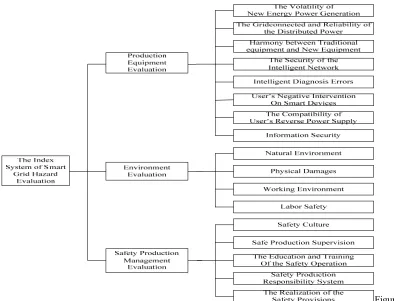
Smart grid system consists of electric power distribution equipment, communications equipment, power transmission lines, measurement, new energy power generation equipment and the intelligent network that connect them. Once any part of the system fails, could pose a threat to the safe operation of local or the entire power grid.Protection of smart grid system reliability and safe operation is a primary task of grid security.
(1) Instability of new energy and distributed power supply. New energy means the development and utilization of non-conventional energy sources based on new technologies, it has the characteristics of intermittent and difficult to store. Distribution of power is a small generator unit that set up to meet the special requirements of users. Smart grid called for support for the distributed power and new energy generating extensive access, system reliability problems will involve.
(2) Operation coordination of traditional equipment and new equipment. Construction of the smart grid is based on the original systems, introducing a lot of new equipment to meet property requirements for smart grid. That there exists compatibility and coordination problems between traditional devices and new devices, once the two devices running conflicts inevitably have an impact on the safe operation of power grids. (3) User factors. Smart grid established by the pattern of two-way interactive services so that users can learn about the real time information of power supply, power quality, electricity prices and blackouts, reasonable arrangements for electrical use, and can contribute to the power user role change to make it both electricity user and sold two properties.More involved, if not control, will pose a burden on the grid security or even damage.
(4) Intelligent networks and intelligent devices. Smart grid's self-healing properties, making grid with real-time, on-line, and continuous security evaluation and analytical capacity, and all this is done through the intelligent network and intelligent devices, combined with the smart grid attaches great importance to and emphasis on interaction with the user, and links through digital networks with users, intelligent network and information security should pay more attention.
Environment Factors
Operation of grids are always in a certain environment, which includes the natural environment, the physical environment, the working environment and so on. A safe, good working environment, which helps to protect the safety and health of workers, and also maintained in a safe, efficient and economic operation of the system, to maximize the system's integrated effectiveness.
(1) The natural environment. There were many factors that force majeure in the natural environment, combined with some other factors such as the aging of electrical equipment, because power grid failures are sometimes chain. Smart grid failure caused by natural disasters are always related to local meteorological and geological conditions, mainly in heavy fog, snow and ice, lightning, flood, earthquake, etc
(3) Working environment and labor safety. A good and safe working environment is not only conducive to the protection of the health and safety of workers, it can also benefit to maximizing the system's integrated effectiveness. Work environment risk factors include theft, user impact. Key labour safety hazards mainly caused by improper maintenance, wrong operations, design errors, and it can cause personal injury, death, power outages.
Safety Management Factors.
In the production activities, most of the accidents were caused by human factors, human failures will lead to insecurity, management failures, and can present a potential cause of an accident and may cause an accident.Through effective safety management, can reduce the incidence of accidents caused by human factors.
(1) Safety culture. The core of Safety culture is human-oriented, this requires an in-house build of self-restraint, self-management, team management and safety culture, ultimately achieving the target of continuous improvement in safety performance, and setting up the long-efficiency mechanism of safety production. Electric power industry as a high technology and high risk actions enterprises should focus more on safety culture cultivation.
(2) Safe production supervision and training. Electric power industry as a high risk industry, should actively promote safety production supervision, and strengthen security legislation and safety education and training at the same time. Publicize work safety laws and regulations and the relevant policies of the state, once found the violation of safety rules or other safety problems, should be submitted in time to stop or rectification. (3) Safety production responsibility system and the relevant provisions. Safety production responsibility system mainly refers to the business leaders at all levels, functions and positions of a certain individual should be responsible for work safety. Electrical safe work procedures is the basic requirements for personal security, grid security, and device safety, so that before posts, electric workers must receive training and perform at work seriously.
Figure 1. the Index System of Smart Grid Hazard Evaluation.
CONCLUSION
At present, China's smart grid hazard source evaluation work is still in its infancy stage, evaluation index system and other aspects still not perfect. This article builds a hazard evaluation index system for smart grid whose evaluation results has a certain practical value for smart grid safety management. First, make all aspects of smart grid security management form a closed-loop of the organic whole, in the security warning and control will be able to demonstrate its superiority, and at the same time will help the security work to a more accurate local extension. Second, may explicitly carries on the division to each correlation functional departments' management responsibility and the jurisdiction, making the command of each hazard source factor achieve the responsibility realization arriving. Third, build up a scientific hazard source evaluation system of smart grid is conducive to improving various policies and mechanisms, and also conducive to make every segment of the hazard source factor command closer. In short, through the analysis and command of the hazard source factors, can reach the purpose of summary issues, feedback, and also the improvement of the technologies and security management of the smart grid.
REFERENCES
1. Liu Zhen-ya, Smart-grid Technology, Beijing, China electric power press 2010.
2. Tian Kuo, Yan Fan, Xun Song, Zeng Ming, Frame Work Study on Key Problems of Technical Economy to Con- struct Unified Strong Smart Grid with Chinese Character- istics, J.East China Electric Power. 2010, 38(1): 1-5 (in Chinese).