2016 International Conference on Artificial Intelligence: Techniques and Applications (AITA 2016) ISBN: 978-1-60595-389-2
A Numerical Integration Method Based on Fireworks Algorithm
Jun-xia GUAN
1, Qing-hua SU
1,*,
Li WANG
2and Yu CHEN
11
School of Information and Mathematics, Yangtze University, Jingzhou, P. R. China
2
Department of Radio Navigation, Dalian Air Force Communications NCO School, China
*Corresponding author
Keywords: Fireworks algorithm, Numerical integration, Non- Equidistant nodes, Simpson method.
Abstract. Numerical integration is widely used in science and engineering. In this paper, a novel method for solving numerical integration based on Fireworks Algorithm (FWA) is put forward. In the presented method, FWA is used to optimize the nodes in an integral interval. Then, Simpson method is employed to get a more precise integral value in every small segment of the integral interval. Some simulation examples of integrals confirm that the presented method is an effective one to calculate numerical integration and has higher calculation accuracy.
Introduction
In the field of engineering technology and natural science, definite integrals play a very important role. Except some limited classes of functions, the primitive functions of most functions cannot be obtained. In addition, the definite integrals with the integrands which are not composed of elementary functions cannot be calculated by Newton-Leibniz formula. In the two cases, numerical integration methods are needed.
There are many traditional numerical integration methods, such as trapezoidal method, Simpson method, rectangle method and so on [1]. These traditional numerical integration methods are low order quadrature formulas. In order to improve the computational accuracy, some composite quadrature methods are proposed. Their fundamental ideas are as follows: Some equidistant nodes are selected in an integral interval, then the numerical integral values on all sub-intervals are calculated and added up to get the numerical integral on the integral interval. However, these nodes are not divided according to the shape of the integrand. Therefore, if the shape of the integrand is complex in its integral interval, the calculation accuracies of these methods are greatly reduced. In view of this situation, some scholars put forward to randomly generate some non- equidistant nodes according to the shape of the integrand [2].
Swarm intelligence algorithms are one class of the popular methods to generate non- equidistant nodes. Luo Y. and Wen H. presented a numerical integration approach by using Neural Network Algorithm [3]. Zhou Y., Zhang M. and Zhao B. gave a method to estimate the integral of a function by using evolution strategy (ES). [2]. Wei X. and Zhou Y. proposed a method based on Particle Swarm Optimization (PSO) for the numerical integration [4]. Nie L. and Zhou Y. gave a method of solving numerical integration for arbitrary function by using Artificial Fish-swarm Algorithm (AFSA) [5]. Deng Z., Huang F. and Liu X. put forward a numerical integration method based on Differential Evolution algorithm (DE) to find unequal node points [6]. Hu Z., Su Q., Yang X., et al. gave a paper that was not guaranteeing convergence of differential evolution on a class of multimodal functions [7]. Lai Z. and Zhang Y. proposed a method based on Genetic Algorithm (GA) for the numerical integration [8]. In these references, swarm intelligence algorithms have been combined with traditional numerical integration methods to solve definite integrals.
[14], and a new power system reconfiguration scheme for power loss minimization and voltage profile enhancement [15] , etc. In traditional numerical integration methods, Simpson method is the one with higher calculation accuracy and lower calculation complexity. In this paper, a numerical integration method combining Simpson method with FWA (S-FWA) is presented to solve definite integrals. In this method, the optimal segmentation nodes on the integral interval of an integrand are found by FWA. Then, the approximate integral value of the integrand is the sum of the integral values calculated by Simpson method on all sub-intervals of the integral interval. Some numerical experiments show that the presented S-FWA could perform well for a class of numerical integral problems.
A Numerical Integration Method Combining Simpson Method with Fireworks Algorithm (S-FWA)
Inspired by fireworks explosion, Tan Y. put forward the Fireworks Algorithm in 2010 for optimization problems. There are four basic operations of FWA: initialization, explosion, the gauss mutation and selection. The specific process of FWA is as follows. N fireworks, as the first generation of initial population, are randomly generated in a randomly selected N locations from the solution space of a problem. Explosion sparks, as explosion individuals, are generated by the number and the amplitudes of the fireworks explosion. Variation sparks, as variation individuals are produced by Gauss mutation. A mapping rule is used for explosion sparks and special sparks beyond the boundary of the solution space. By a roulette selection,N individuals are selected from fireworks, explosion sparks (explosion individuals) and variation sparks (variation individuals), as the next generation of initial population (fireworks). The above steps are repeated until a given number of iterations is satisfied. The final solution is the optimal solution.
In this section, we propose a numerical integration method combining Simpson method with FWA (S-FWA), which mainly includes two parts. Firstly, FWA is used to find the optimal segmentation nodes on the integral interval of an integrand according to its shape. Then, the Simpson formula is used on each sub-interval to calculate the approximate integral value of the integrand. The detailed steps of S-FWA are as follows.
Step 1 Initialization. In S-FWA, we should initialize 5 parameters, that is, population size N , the dimension D of solution space of a problem, the number of iterations Gm, the maximum explosion
amplitude A and the total numbers of sparks M. Here, D is the number of the segmentation nodes in an integral interval, and M is used to control the total number of sparks generated by all fireworks.
The initialization of a population with N, D-dimensional fireworks is implemented by using a uniformly sampling in the solution space.
Step 2 Calculating the Fitness of Each Individual. An integral interval with D segmentation nodes is divided into D 1 sub-intervals. Calculate the fitness value of each firework of the population according to the following fitness function [7]:
1
1
1 ( )
2 D
i j j j
j
f x d W w
. (1) where x ii
1, 2, ,N
is thei th- firework individual, djj1, 2, , D 1 is the length of the j th-sub-interval, Wj and wjj=1,2, ,D+1 are separately the biggest function value and the smallest function value in the function values of the left endpoint, intermediate nodes, and the right endpoint in this sub-interval. The smaller the fitness value of an individual, the better the individual is [7].
Step 3 Calculating the Number and the Amplitudes of the Fireworks Explosion. The explosion amplitude of each firework Ai and the number of explosion sparks Si generated by each
min max i
min max
1 1
( ) y ( )
and
( ( ) ) ( ( ))
i i
i N N
i i
i i
f x y f x
A A S M
f x y y f x
. (2) where yminmin( ( )) and f xi ymax m ax( ( )), (f xi i1, 2,...,N) are separately the minimum and the maximum fitness values of all the current individuals, denotes the smallest constant to avoid zero-division-error in the computer.
To avoid overwhelming effects of splendid individuals, bounds are defined forSias follows [10]:
( ),S
(b ),S and b 1 (S ), else
i
i i
i
round a M aM
S round M bM a
round 0
. (3)
Step 4 Spark Explosion. Each firework can produce a number of explosion sparks. The specific process is as follows:
The number of the affected directions (dimensions) of sparks generated by the explosion of an individual is randomly selected as follows:
0,1
zround D rand. (4) The location of an explosion spark is obtained by updating the coordinate of the k th k- 1, 2, ,z
dimension (which is random selection) of each firework, shown in Eq. (5).
k i
xk ( 1,1)
i x A randi . (5)
When spark k i
x in k th- dimension beyond the boundary of the problem, it is mapped to a new location through the following mapping rule in Eq. (6).
, %( , ,k)
ik LB k ik UB k LB
x x x x x
. (6) where xUB k, and xLB k, are the upper boundary and the lower boundary on the search space of the k th
-dimension.
Step 5 Gaussian Mutation. M firework individuals are randomly selected from all of the firework individuals. Coordinates of the selected fireworks are updated through the following rule in Eq. (7).
1,1 ik ikx x Gaussian
. (7) The updated individuals are variation sparks. When a variation spark beyonds the boundary of the problem, it is mapped to a new location by the above mapping rule in Eq. (6).
In order to increase the diversity of population, we set the size of M as same as the size of the population in the following simulation experiments.
Step 6 Selection. K is the set composed of all current individuals of fireworks, explosion sparks and variation sparks. The current best individual xˆ, which fitness value f x( )ˆ is optimal among those from K, is always kept into the next generation of initial population. Besides, in order to keep the diversity of sparks, other N1 individuals of the next generation of initial population are selected according to their probabilities. A selection probability p x( )i for xi is determined by its distance
( )i
R x as follows.
( )
( ) and ( ) ( )
( ) j j
j
i
i i i j i j
x K x K
j x K
R x
p x R x d x x x x
R x
A smaller R x( )i indicates that there are many other candidate individuals around the individualxi.
So, the smaller R x( )i is, the lower p x( )i is. This means p x( )i for the individual xi is smaller.
Step 7 Circulation. Repeat step 2 to step 6 until to reach a given number of iterations Gm, and get the best individual, that is, the optimal segmentation nodes.
Step 8 Numerical Integration. After finding out the optimal segmentation nodes of an integral interval by FWA, the approximate integral value of an integrand is obtained by using the composite Simpson formula shown as follows:
1
1 2 3 1
( 4 )
6 D
j
j j j
j d
S m m m
. (9) where m1j, m2j and m3j (j1, ,D1) are separately the function values of the right endpoints, the
intermediate nodes and the right endpoints of all sub-intervals.
Experiments and Results
In this section, we will carry out two simulation experiments to show the superiority of S-FWA in a class of numerical integral problems. In the two simulation experiments, the parameters of S-FWA are set as follows:A0.1,M70, a =0.3,b =0.8,N15,D60,Gm=40.
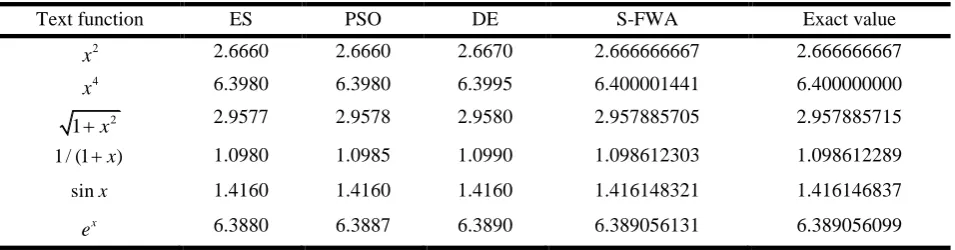
Firstly, S-FWA is compared to ES, PSO and DE by solving definite integrals of the six common test functions. The integral results of ES, PSO and DE on six test functions were given in reference [6]. In this part, the integral results of S-FWA on six test functions are given. All results are shown in Table 1. From Table 1, we can draw that S-FWA can be used to solve definite integrals, and the integral results of S-FWA on six test functions are generally more accurate than the results of ES, PSO and DE.
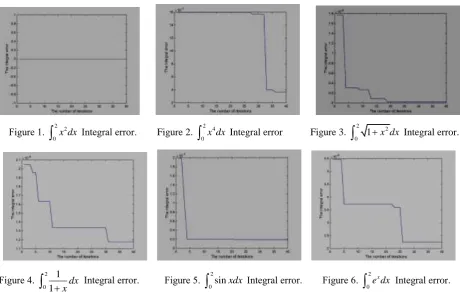
Secondly, the integral error variation law of S-FWA is analyzed. Figure 1 to Figure 6 separately show the variation graph of the integral error with iteration number on six common test functions by S-FWA. From these graphs, we can directly find that S-FWA for six common test functions can get accurate and stable results within the number of iterations less than 35.
[image:4.595.60.538.544.669.2]Through the results of these two simulation experiments, we can find that by S-FWA, we can solve a class of numerical integral problems to get more accurate results. S-FWA also has a faster convergence rate.
Table 1. Four kinds of the integral methods of the integrand value.
Text function ES PSO DE S-FWA Exact value
2
x 2.6660 2.6660 2.6670 2.666666667 2.666666667
4
x 6.3980 6.3980 6.3995 6.400001441 6.400000000
2
1x 2.9577 2.9578 2.9580 2.957885705 2.957885715
1 / (1x) 1.0980 1.0985 1.0990 1.098612303 1.098612289
sinx 1.4160 1.4160 1.4160 1.416148321 1.416146837
x
Figure 1. 2 2 0x dx
Integral error. Figure 2. 2 4 0x dx
Integral error Figure 3. 2 2 0 1x dx
Integral error.
Figure 4. 2
0
1 1xdx
Integral error. Figure 5. 20sinxdx
Integral error. Figure 6. 20
x e dx
Integral error.All the algorithms are implemented in Matlab and the experiments are conducted on a computer with an Intel® CPU E3-1230 v3 @ 3.30GHz and 8GZ RAM.
Conclusion
Fireworks Algorithm is a new type of swarm intelligence algorithm proposed in recent years and has been widely applied to various applications. In this paper, S-FWA has been proposed to solve definite integrals. S-FWA applies the better search ability of FWA to determine the non- equidistant nodes of the integral interval of an integrand. Then the approximation integral value of the integrand is calculated by the composite Simpson method. The results of some comparison experiments on six common test functions show that S-FWA is a feasible method for solving definite integration, and has the better calculation accuracy than PSO, ES and DE. In addition, S-FWA has better convergence speed. In FWA, many parameters are sensitive. Their different settings could result in different effects on FWA. So, S-FWA is valid and feasible for solving the definite integrals of a class of functions, but the errors of the integral values are larger for some singular functions and oscillating functions. In this case, determining the scopes of the parameters of FWA to further improve the performance of FWA and expand the test range of S-FWA on definite integrals will be the main research work in future.
Acknowledgments
This work was supported in part by the Key Project of Hubei Provincial Department of Education (D20161306).
References
[1] Li Q., Wang N. and Yi D., Numerical Analysis Fourth Edition [M]. Wuhan: Huazhong University of Science and Technology Press, 2006. (In Chinese)
[3] Luo Y. and Wen H., A Numerical Integration on Approach Using Neural Network Algorithm, J. Journal of Computer, 2006, 19 (4):1187-1194. (In Chinese)
[4] Wei X. and Zhou Y., Numerical Integral Method Research Based on PSO, J. Microelectronics & Computer, 2009, 26 (7):117-119. (In Chinese)
[5] Nie L. and Zhou Y., Solving Numerical Integration Based on Artificial Fish-swarm Algorithm, J. Mathematics in Practice and Theory, 2009, 39 (19):127-134. (In Chinese)
[6] Den Z., Huang F. and Liu X., Differential Evolution Algorithm for Numerical Integral Problem, J. Computer Engineering, 2011, 37 (20):206-207. (In Chinese)
[7] Hu Z., Su Q., Yang X., et al. Not guaranteeing convergence of differential evolution on a class of multimodal functions, J. Applied Soft Computing, 2016, 41: 479-487.
[8] Lai Z. and Zhang Y., Solving numerical integration based on genetic algorithms, J. Computer Engineering and Applications, 2014, 50 (2):54-57. (In Chinese)
[9] Tan Y., Zheng S., Recent advances in fireworks algorithm , J. CAAI Transactions on Intelligent Systems, 2014, 9 (5):515-528. (In Chinese)
[10] Tan Y, Zhu Y., Fireworks algorithm for optimization[C].International Conference in Swarm Intelligence. Springer Berlin Heidelberg, 2010: 355-364.
[11] Zhang J., Fireworks algorithm for solving 0/1 knapsack problems, Journal of Wuhan Engineering Institute, 2011, 23 (3): 64-66.
[12] Janecek A, Tan Y., Swarm intelligence for non-negative matrix factorization, J. International Journal of Swarm Intelligence Research, 2011, 2 (4): 12-34.
[13] Zheng S, Tan Y., A unified distance measure scheme for orientation coding in identification [C]. 2013 International Conference on Information Science and Technology. Yang Z., China, 2013: 979-985.
[14] Gao H, Diao M., Cultural fireworks algorithm and its application for digital filters design, J. International Journal of Modelling, Identification and Control, 2011, 14 (4):324-331.