Journal of Theoretical and Applied Information Technology 31st January 2019. Vol.97. No 2
© 2005 – ongoing JATIT & LLS
ISSN: 1992-8645 www.jatit.org E-ISSN: 1817-3195
605
EMBEDDING MACHINE LEARNING IN AIR TRAFFIC
CONTROL SYSTEMS TO GENERATE EFFECTIVE ROUTE
PLANS FOR AIRCRAFTS IN ORDER TO AVOID
COLLISIONS
1MUKESH MADANAN, 2NORLAILA HUSSAIN, 3NITHA C VELAYUDHAN, 4BIJU T SAYED
1Lecturer, Dhofar University, Department of Computer Science, Salalah, Oman
2Assistant Professor, Dhofar University, Department of Computer Science, Salalah, Oman
3Research Scholar, Noorul Islam Center for Higher Studies, Tamil Nadu, India
4Assistant Professor, Dhofar University, Department of Computer Science, Salalah, Oman
E-mail: 1[email protected], 2[email protected] , 3[email protected], 4[email protected]
ABSTRACT
Air Traffic Controllers play a vital role in managing and directing flights both in and off the air. The most challenging task assigned to the controllers is to avoid collisions and to plan routes for the flights and make sure that these flights take off and reach the destination airports in time. Most of the route planning in such cases is done in accordance with humans and the decision making is solely dependent on human intelligence which is sometimes time consuming and error-prone. Artificial intelligence capabilities could be embedded in these controllers to make quick decisions and be free of human interventions. The paper focuses on the route planning activity of the controllers and has an in depth consideration towards the pros and cons of designing and implementing an artificial intelligence system to the air traffic controllers. The paper also focuses on the issues faced by air traffic controllers in order to maintain airspace suitable for safe flying.
Keywords: Artificial Intelligence, Air Traffic Control, Machine Learning, Plan generator, Route Plan
1. INTRODUCTION
Air Traffic Control (ATC) is considered to be one of the basic pillars of Air Traffic Management (ATM). ATC systems are software-exhaustive critical systems which ensure that the aircrafts are separated safely in the sky when they fly, when they land and take off at airports. ATC system manages all the land and en-route aircraft operations to avoid crashes and organizing the stream of traffic [1]. ATC can be considered as a real time system which operates in coordination with humans assisted by Artificial Intelligence(AI). The most important task of ATC is to fend off the aircraft crashes. A significant secondary task is to advance traffic both in air and ground. Human air traffic controllers presently perform these operations. However, an increase in the number of aircrafts and traffic are overloading the systems. Citing the mentioned constraints, for creating
effective operations in ATC, Federal Aviations Administration (FAA) has been roped in adequate computer-aids to provide effective solutions and assistance. These assistances can be improved by planned hardware and software updates, which inturn will lead to the growth in controller productivity. However, in future the potential for enhancing the automation of accounting efforts will be drained off. Therefore, further productivity rises will need assistance for decision-making processes and automating the planning [2].
Journal of Theoretical and Applied Information Technology 31st January 2019. Vol.97. No 2
© 2005 – ongoing JATIT & LLS
ISSN: 1992-8645 www.jatit.org E-ISSN: 1817-3195
606 presenting automated ATC in several sectors of airspace [3].
In 1956, John McCarthy first coined the term artificial intelligence, when he held the first academic seminar on the subject. He proposed a system in Vannevar Bush’s seminar work that intensifies the people’s own understanding and knowledge. Alan Turing prepared a paper five years later and it was about the notion of machines capable to simulate human beings and the capability to accomplish intellectual things like play Chess.
The notion of introducing the concept of artificial intelligence in ATC kicks off from here and now the goal of such an improvement would be to lessen the number of human errors which could be accountable for some of the mishaps. Moreover, the perception would be considered in the approach of Air Traffic controllers involved to make superior conversation with numerous different automated subsystems such as radars displays, access databases of textual information etc. Further they could be used for communication between pilots and air traffic controllers at the airport terminal. These communications could be audio links and textual information. From the last ten years, advance in computer technology leads to the successful use of device metaphor and the ATC systems will sustain to reflect this method [4].Moreover, the air traffic control system could implement expert systems for controlling most of the functions. In expert systems, production rules could be employed to represent knowledge gained from a process [5].
Artificial intelligence agents enable machines to perform tasks independently based on previous scenarios and experiences. Artificial intelligence is based on reasoning, knowledge, representation, planning, learning, natural language processing, perception and the potentiality to act and react depending on the particular situations. The research paper focuses on designing ATC controllers that could find the best route for flights and thereby minimizes the chances of collisions in air and on ground and enhances the minimization of human interaction and errors.
A number of artificial intelligence techniques are available and used by AI researchers throughout the industry to generate effective solutions and most sensible response from a machine. The research hypothesis focuses on how
implementing a machine learning system in air traffic controllers that can learn by itself and make decisions based on the set of data input into it from previous scenarios could reduce the chances of aircraft collisions. A number of path finding AI techniques are available. Some of the widely employed AI techniques by researchers comprise of A* algorithm, Neural networks, General Algorithms, Reinforcement Learning, Heuristics, Markov Decision Process and Natural Language Processing and Support Vector Techniques.
The initial part of the paper discuses about linking AI to ATC and then the focus shifts to the ATC functions and how to design and implement machine learning using Markov Decision Process in ATC controller and discusses the limitations in implementing AI techniques in ATC to generate effective route plans. The research paper will also endeavor to analyze and design a machine learning system that can reduce human interaction and reduce mishaps.
2. LINKING ATC TO ARTIFICIAL
INTELLIGENCE
Journal of Theoretical and Applied Information Technology 31st January 2019. Vol.97. No 2
© 2005 – ongoing JATIT & LLS
ISSN: 1992-8645 www.jatit.org E-ISSN: 1817-3195
607 Subsequent to Wesson's findings, S.E. Cross implemented methods in making up better qualitative-physics in region of AI research. This symbolizes the understanding of unique controller constraints that aerodynamics states in air traffic control activities. Moreover an appealing feature of Cross's thesis is a procedure for decomposing multiple-conflict scenario into fundamental or minimal set of conflicts that need to be resolved [2].
3. ATC CONTROLLER FUNCTIONS
In order to provide basic understanding of the implementation of AI in ATC, the paper focuses on the basic operations of the ATC controller namely- the planning and controlling. The description focuses on the aspects in which controller’s job should be handled by the automated system during two training test problems.In ATC, the airspace is divided into a number of sectors which inturn is categorized to zones. In each sector there are ATC controllers which navigate the aircrafts during flight, take off and landing. The research paper cynosures one of the two of the testing problems which comprise coordination of ATC controllers in one sector with another in another sector. Another issue which will be addressed is the navigation of aircrafts and issuance of altitude clearance to aircrafts during flight. Moreover the paper will also discuss the controllers’ job of maintaining a safe distance of separation between aircrafts both in air and land.
3.1 Air Traffic Controller Coordination with
Other Sectors
The traffic in a particular air space sector is handled by air traffic controllers designated by the ATC. Mutually working controllers operate as a physically distributed control system. The segments may be contiguous either vertically at particular floor and ceiling elevations or horizontally across the sector boundaries. When an aircraft moves from one sector to another the control is passed on to the next controller in the next sector along the flight route as per the flight plan. This hand over of the control to each and every sector is considered to be the most basic coordination function of the controller within each sector. A controller should not permit an aircraft to leave sector until the controller in the next sector acquires responsibility for the vehicle [6]. This is one of the most vital part of the air traffic controller and in during the flight time any loss of contact with the pilot cannot be
affordable as many situations may arise such as any technical issues or any medical emergencies. 3.2 Navigating Aircrafts
Before an aircraft takes off from the departure airport, a number of activities have to be carried out. According to Instrument Flight Rules (IFR), in order to enter the ATC system, every flight before takeoff has to register a flight plan at the ATC controller in the airport which will include details regarding the route to be followed during the flight. The route is determined based on prior assumptions of the weather and conditions. This flight plan route creation task is accomplished by the pilot. The flight plan will comprise all the navigational fixes over which the aircraft will fly and the segments of airways that will be utilized. After the flight plan generation, the ATC system will verify the route and plan and provide clearance and approval before a flight proceeds to takeoff. After the approval, the flight takes off and the pilot is expected to navigate the aircraft along the agreed-upon route. In any case the pilot deviates from the route, the ATC controller takes over and guides the aircraft and puts it back on the route as per the flight plan approved earlier. In diverse situation the controller also provides alternative route. The controllers are more responsible for better navigation and also help in making better defined magnetic heading and create navigation of aircraft as per elected vector in specified shape. Vectoring is permitted only when the controller can observe the aircraft on radar and thus can determine its precise location [7].
3.3 Issuing Altitude Clearance
Journal of Theoretical and Applied Information Technology 31st January 2019. Vol.97. No 2
© 2005 – ongoing JATIT & LLS
ISSN: 1992-8645 www.jatit.org E-ISSN: 1817-3195
608 stages. On receiving the request, the controllers issue a magnitude analogous to the altitude in the way of clearances with the altitude obligations that instruct the pilots to be at or above, or at or below assertive altitudes at certain marks on their precise itinerary.
It is essential to consider that the controller can indicate at what time the aircraft may shift its altitude and the altitudes that are permissible, but the controller cannot manage the rate of mount or descent. Based on features of performance of a particular aircraft, the climb and descent rates vary, so these rates must be controlled by pilots. In order to strengthen certain minimum rates the controller can iron out a few altitude stipulations; a pilot can also oppose these clearances if they are believed discomfited. Controllers may attain some information regarding the climb and descent rates for many aircrafts only on particular instances
3.4 Maintaining Aircraft Separation
Pilots must maintain a safe distance between aircrafts in either horizontal or vertical style. In terms of horizontal separation the criteria could be either distance maintained between the flights or the timings between the flights departure and arrivals. Considering the vertical aspect the separation is indicated in terms of heights between the flights in air. In addition to these separations many more factors are considered in relation to a number of variables involved in the process.
Controllers utilize various methods to maintain minimum distances between flights. ATC employs radars in order to keep track of flights within the sectors and zones. In order to make the flights horizontally separated in the radar system surveillance, the flights are vectored in accordance with the positions denoted in the flight plans generated at the time of take off. In the situations of both radar and non-radar, controllers are used to allocate speeds, altitudes and confined paths of flights to aircraft or a delay may be occurred by holding aircraft at an instance. Controller guides the pilot in which way to move either a standard 3600
turn or a racetrack shaped model at some point to which the pilot can consistently return using the aircraft’s navigational apparatus [8].
Near the airports, particular difficult situations may occur where aircraft are arriving
along various integration of route and these routes are to be formed into a single flow of traffic. Main function of the airport-approach controllers is to manage the approaching aircraft to a final landing sequence. Maximum landing rate is achievable, when the aircrafts distance area is systematically arranged in a proper way with exactly the specified distances between the aircraft. Arrangement of aircrafts is essential in airways where we find huge merging of airways.
4. ISSUES IN AUTOMATING ATC
CONTROLLERS
[image:4.612.325.511.387.516.2]The main problem for automating the ATC is that many factors will be taken into account on a particular decision making. Normally there are various actions that could strongly be considered to solve difficulties in automating the ATC. These difficulties could range from a set of circumstances which is depending on the location and configuration of the aircrafts in various sectors. In addition, the traffic also plays a vital role to make a decision.
Figure 1: Aircraft Paths
For instance: assume that two aircrafts are flying on the same course to each other. In such a situation the consideration would be the following:
(i) the altitudes at which the aircrafts are flying,
(ii) their distances and speeds at the point of crossing each other.
Journal of Theoretical and Applied Information Technology 31st January 2019. Vol.97. No 2
© 2005 – ongoing JATIT & LLS
ISSN: 1992-8645 www.jatit.org E-ISSN: 1817-3195
609
There is a possibility of having other aircrafts in that route and the developed maneuvers may not be accurate as per safety norms. There are other various managerial concerns which would help in averting the secondary conflicts and would be considered after the primary conflicts are avoided.
Suppose it is requested for a maneuver and in certain situation the weather may not permit it. In addition, the geographical location might also cause a hindrance if the aircraft is flying very close to the ground, mountain or any other obstructions and it be forbidden to make such maneuvers.
Aircraft will be incapable to fly farther if they are near to their maximum flying height. Additionally, aircraft without oxygen masks or pressurized cabins are not allowed to climb above 10,000 ft.
Certain exercises might result in excessive delays due to altitude alteration or path diversion or by avoiding secondary conflicts
A jet is required to fly long distances but by lowering the elevations or reducing speed often results in wastage of fuel.
The force implied to climb the aircraft to a certain height and then to descend is ineffective.
In certain cases, if the drop of an aircraft is delayed the flight might not have ample time to arrive at the designated altitude.The adequacy of a particular result could be a result of numerous such considerations. Despite the fact that these considerations are taken into account, a particular deliberation is applicable based on the situation where the condition takes place. To design and develop a software architecture and structure which may incorporate all the expected considerations and possible solutions and also create trade-offs between numerous solutions is a tedious process. In addition, it is required to be maintainable, modular, adaptable to locality considerations and quick enough to sustain with the lively environment of ATC. Moreover, the concept of reuse and re-engineering has taken over the software industry to enhance and simplify development.
Currently in most of the industries, many of the automatic decision making is done in accordance and in corporation with humans. This has raised numerous complications and resulted in some mishaps due to human error or negligence. To
rectify this, it would be considered to develop and design automated systems which are intellectually able to take decisions almost similar to humans but more accurately. In such a case, the decisions made by the systems would be always acceptable by the humans as they are built accordingly to human intelligence. As in human controllers used in ATC, these systems would also follow similar communication strategy between adjacent and distant sectors. These controllers work hand in hand and in groups in a particular sector to ensure safety of flights. When working in groups, one of the controllers is assigned to be the primary one and the rest are assigned the task of assisting the primary controller and alleviating it of certain functions. Interaction between each and every controller is as per ATC norms and procedure and every controller understands each other’s actions when in full operation mode.
5. ANALYSIS AND DESIGN OF MACHINE
LEARNING SYSTEM FOR ATC
Journal of Theoretical and Applied Information Technology 31st January 2019. Vol.97. No 2
© 2005 – ongoing JATIT & LLS
ISSN: 1992-8645 www.jatit.org E-ISSN: 1817-3195
610
Figure 2: Markov Decision process with 3 States and Transitions[10]
The Markov Decision Process (MDP) is typically a framework that assists in creating a model for decision-making. The Markov decision process is based on four factors namely: finite set of states(S), a finite set of actions(A) which is to be taken depending on the respective states, probability(P) that a certain action in a particular state at a time ‘t’ will lead to a particular subsequent or prior state at a time t+1 and an immediate award (R) which will be received soon after the transition from existing state to the next state[10].
The functional requirements of the air traffic controller with AI will be to predict and recommend a route plan with high perfection and efficiency. The prediction of the flight route will be based on the historical data fed into the system. All the information fed into the machine learning system will comprise to form a set of data set. Based on the above-mentioned details a flight plan would be created for the flight at the ATC center in the departing airport. The ATC center registers the plan under the particular aircraft and gives green signal for take-off. While departing from one zone to another the ATC centers at various zones are handed over the flight route plan by the ATC centers in the prior zone in flight.
[image:6.612.320.525.68.207.2]The machine learning part of ATC will comprise mainly of three parts: (i) prototype (ii) framework and (iii) probationer. The prototype part of the system makes assumptions and predictions regarding the flight route based on factors such as weather conditions, speed, altitude etc. The framework comprises the factors employed by the prototype to arrive at conclusions and make decisions. Finally, the probationer is the part that modifies the framework factors and thereby the prototype by making a comparative study based on the assumptions and the actual outcome. The most viable part of the system is the prototype and the entire system starts with the prototype assumptions. A sample flight plan is primarily handed to the machine learning system by the people at the control tower.
Figure 3: Model of Machine learning System for ATC
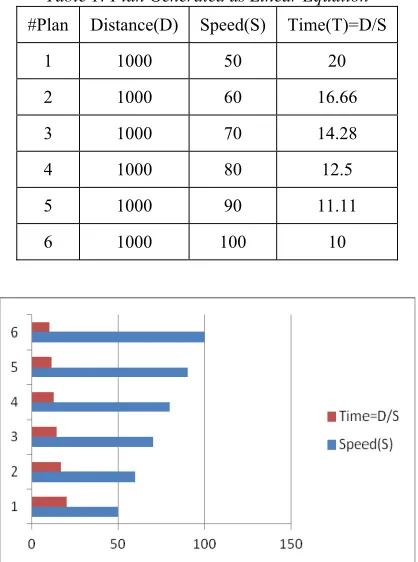
[image:6.612.314.523.364.645.2]The machine learning part of the system employs a mathematical equation to derive at a unique graph to express a general expected outcome. For example, the equation could be that of a straight line as y=Ax+B, where A and B are constants. Consider a flight that has to travel a distance of 1000 miles and the framework will contain the various speeds in knots with which the flight will traverse this distance. The time taken can be calculated by the formula Time=Distance/Speed.
Table 1: Plan Generated as Linear Equation #Plan Distance(D) Speed(S) Time(T)=D/S
1 1000 50 20
2 1000 60 16.66
3 1000 70 14.28
4 1000 80 12.5
5 1000 90 11.11
6 1000 100 10
Figure 4: Graph1 as per the Linear Equation
Journal of Theoretical and Applied Information Technology 31st January 2019. Vol.97. No 2
© 2005 – ongoing JATIT & LLS
ISSN: 1992-8645 www.jatit.org E-ISSN: 1817-3195
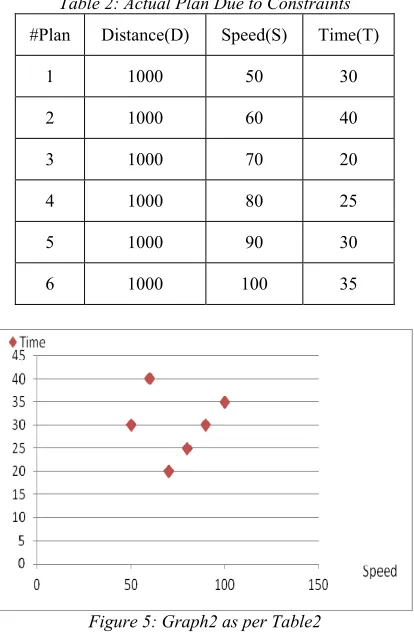
[image:7.612.92.299.240.556.2]611 and the expected time taken is 16.66 hours. But due to weather conditions the pilot may have to alter the speed and the route which may cause various alterations. Hence the graph obtained might be containing scattered values for speed and time. Here the Time does not only depend on the speed (may increase or reduce) since the pilot may alter the route to avoid collisions (which increase the miles) or diverse weather conditions and can be considered as the actual value of time reported.
Table 2: Actual Plan Due to Constraints #Plan Distance(D) Speed(S) Time(T)
1 1000 50 30
2 1000 60 40
3 1000 70 20
4 1000 80 25
5 1000 90 30
6 1000 100 35
Figure 5: Graph2 as per Table2
These set of values obtained in graph2 are marked against the initial output provided in graph 1.As it is evident that the values in the graph2 does not match the values in graph1.Similarly a number of plans with speed of the aircraft is fed into the system. These values can be considered as a pool known as training data. The probationer in the machine learning system uses the training data to train itself to create a good prototype. The probationer after generating the scores of time as shown above in the Graph2 studies the values and computes the variance and finally employs mathematical formula to adjust the initial predictions. After modifying the values a perfect
[image:7.612.314.520.319.457.2]plan will be generated that will show an apt time of arrival with a suitable speed for the aircraft. Similarly the entire process is repeated a number of times with a new set of training data and the time scores are again compared with the prototype which was created earlier by the probationer and another revised new prototype is created by making minor modifications to the framework training data. This process of revising the prototype is done multiple times by the probationer in order to achieve a plan which has time scores nearest to the graph1.This process of gradient learning is employed by the machine learning part of the system to arrive at a score with a high degree of confidence. As evident clearly the prototype changes with alterations and the probationer using mathematics modifies the factors in the framework a revised model can be depicted as shown below in Fig 6.
Figure 6: Revised Model of Machine learning System for ATC
6. A SOFTWARE ARCHITECTURE FOR
ATC ROUTE COMPLICATIONS- MACHINE LEARNING IMPLEMENTATION
[image:7.612.316.523.598.672.2]In order to solve the above discussed issues, software architecture is blocked-out in the Fig 7. The software architecture will comprise mainly of two parts-one plan critics section and a plan generator section.
Figure 7: AI Architecture for Air Traffic Controller
Journal of Theoretical and Applied Information Technology 31st January 2019. Vol.97. No 2
© 2005 – ongoing JATIT & LLS
ISSN: 1992-8645 www.jatit.org E-ISSN: 1817-3195
[image:8.612.97.308.268.364.2]612 module in the architecture is used in every sector of ATM to generate plans for aircrafts to control the traffic in the respective sectors. The plan generated will include the routes for each and every aircrafts and also the clearances that are essential in these specific routes. The aircraft clearances may be regarding the variance in speed and the altitudes which the aircraft must cruise during its flight to a destination airport. In fact, the altitude of the aircrafts and the vector positions if the aircrafts are marked using this plan created. As the plan is created prior to take off the plan consists of all these details mainly the future positions both horizontal and vertical
.
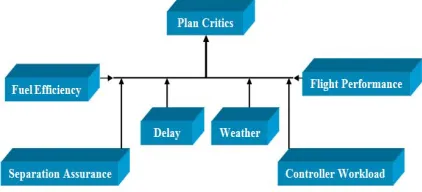
Figure 8: Plan Critics Module
The plan generated is passed on to the plan critics’ module which works independently to find out the consequences of the plan generated. The plan is then evaluated and ranked according to the undesirable features present in the plan. A high rank indicates the severity of the plan generated and the problems existing in the plan. The plan critic module comprises a number of individual units such as particular functions for measuring the fuel efficiency, calculating the delay caused, determining the weather conditions, working out the aircraft performance, determining the aircraft separation and the workload of the controller etc. All these units generate a rank and all these ranks are summed sum to calculate a rank for the whole plan.
All the plans generated are passed on to the plan critic module and all are ranked accordingly. The plan critics rank is passed on to the plan generator with the suggestions and these ranks will be used to make trade-offs between various problems discussed in the earlier section. The ranking of the plans could be done based on empirical analysis and the ranks could be combined from the plan critics units and finally adjusted using neural networks. One way for determining the ranks could be based on the expenditure of each step. Between the plan generator and the plan critic modules there lies a state predictor for predicting
the states of the aircrafts in certain situations and a multiplexer which multiplexes suggested changes from the plan critics back to the plan generator. There is also embedded a combine function unit which combines the results of all the plan critics units back to the plan generator. As stated earlier the higher the rank the higher the chance of plan being rejected. Based on the ranks an optimum plan is to be searched from among all the plans generated by the plan generator. The evaluated plans and their proposals are selected by search strategies. The AI could employ directed search techniques as the undirected search techniques could prove to be much expensive. These search strategies also evaluates and modifies various versions of the plan by certain suggestions. In most of the search techniques AI could employ a common approach based on the domain in which it is used. There are various other processes to select new branch for creating effective branch among others for better appearance. On the basis of the suggestions and ranks combined from the plan critics the plan generator generates a new plan to be more effective in controlling the air traffic and passes it back to the plan critics’ module for evaluation. The plan generator’s main function is to search for a perfect solution as the directed search will make the original plan as the root and the child nodes are derived from the parent node. In the search strategy a stopping decisive factor must be identified to decide an acceptable plan. These plans are sent to the actual section of the system that executes it. The current plan will not change unless the plans score is increased. For instance, if a new aircraft appears in a particular route of an aircraft, then this aircrafts plan may conflicts with the plans of other aircrafts that is known to the system. In this condition a new way of searching will be emerged to determine the safest path. Welch stated that minor course adjustments and minor timing adjustments frequently caused significant spacing changes between aircrafts.[9]
7. IMPLEMENTATION OF THE MACHINE
LEARNING PROCESS IN PROBATIONER OF ATC
Journal of Theoretical and Applied Information Technology 31st January 2019. Vol.97. No 2
© 2005 – ongoing JATIT & LLS
ISSN: 1992-8645 www.jatit.org E-ISSN: 1817-3195
[image:9.612.88.299.85.225.2]613
Figure 9: Decision process in ATC
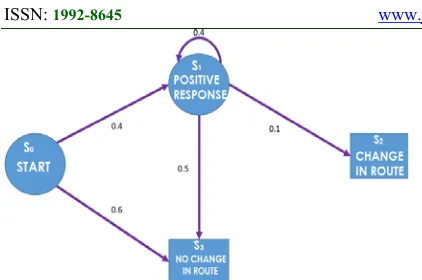
Markov Decision Process is in fact a probabilistic model that can be utilized to make route plans for ATC. Applying the Markov Decision process in ATC we can define the state of flight as:
S∈{s0 :Start,s1 :PositiveResponse,s2 :No Change in route, s3 :Change in Route}
The rewards in the Markov Decision process can be considered as a rank, which is given to each plan followed by the flight during its journey from the departure airport to the arrival airport. We can define the total ranks from all plans received as Gt , which is just the summation of all of the ranks (R) up to time-step t.[10]
Estimating the value of a route is very much essential for ranking a plan. For representing the value function of a plan we need a state-value function V. This V is a function of the state S of the flight and can be represented as V(S). We can also define an action-value function Q(S,A) which is dependent on S and A where S is the state and A is the action taken. Markov decision process is governed by a number of policies and ATC is prone to a number of issues and regulations. The functions stated above are in turn evaluated in terms of a policy, π represented as Vπ (S) or Qπ (S,A).The policy determines how a flight in air or land should alter its routes depending on the situation. The above equation for the flight route plan rewards function can be rewritten if the change of route or direction has to be taken after a particular time interval as:
where
γ
is in a range between 0<γ < 1. In order to co-relate and connect the above stated value function to the future actions and flight states wemay employ Bellman Equation. This process may be regarded as making a reinforcement learning to the ATC machine learning system. Hence the value function can be rewritten as:
Applying the Bell Equation to the State1 for one iteration and consider the policy term as 1 we get
V(s1 )=P(s1 ∣s1 ,a)[R+γVπ (s1)]+P(s2 ∣s1 ,a)[R+γ
Vπ (s2 )]+P(s3 ∣s1 ,a)[R+γVπ (s 3 )] Set the values of γ=1 and V(s1)=0, we get
V(s 1 )=0.4(−1+1⋅0)+0.5(−1+1⋅0)+0.1(1+1⋅0)=−0.8
A number of Markov Decision Process (MDP) algorithms are available for implementation of the machine leaning system in the probationer for the ATC controller. Some of the most utilized ones are as follows:
Backward Induction Finite Horizon
Policy Iteration
Modified Policy Iteration
Q-Learning
Relative Value Iteration
Value Iteration
Gauss-Seidel Value Iteration
Implementing the value function and getting ranks of plan can be implemented using python.
z = 0
for i in range(20):
z = 0.4 * (-1 + 1 * x) + 0.5 * (-1 + 1 * 0) + 0.1 * (1 + 1 * 0)
print(z)
Journal of Theoretical and Applied Information Technology 31st January 2019. Vol.97. No 2
© 2005 – ongoing JATIT & LLS
ISSN: 1992-8645 www.jatit.org E-ISSN: 1817-3195
614 Applying the Bellman equation for each of the states and getting the ranks for each plan is as follows:
8. CONSTRAINTS OF THE PROPOSED
IMPLEMENTATION USING AI
The design architecture for the controlling the route planning by air traffic controllers could be implemented using a variety of artificial intelligence programming languages namely python, LISP, Prolog or Java. Python being object oriented and interpreted supports Rapid Application Development and supports ease of learning, scalability and adaptability with a numerous prebuilt libraries such as Numpy, Scipy and Pybrain. LISP is considered to be the pioneer programming language for AI since it has numerous mathematical notations which are used in the algorithms of self learning machines. Prolog
finds its root in terms of inductive logic programming and is basically centered on simple mechanisms namely pattern matching and tree-based data structuring and automatic backtracking. The litheness disparity with lot of rule-based systems with computational potentialities is obliged for the process offered by their language designers.
As far as the design concept is concerned, the automated system for the controller works perfectly fine it terms of prediction and decision-making. However, as per the system depicts the number of search in the tree is limited to an extent. As stated earlier the plan critics will look at the areas such a weather, fuel efficiency, delay, etc and determine the ranks after combining these individual ranks and then the plan generator will consider only these alternatives and suggestion provided by the plan critics module. Now consider secondary conflicts which might occur due to maneuvers resulted from one suggestion to avoid crash. In this situation, the ranks generated by the critics’ module will always be higher. Now if the search algorithm were to search much deeper in the tree for alternatives, the solution might be much better prior to the first suggested change of the first node of the tree.
The architecture generally designed above resembles with power and reliability that needs better automation process and have clear decision making methods .To develop the system efficiently more effort is necessary and its most of the AI programming languages have limitations in various aspects. The search methodology implemented with the current system is simple such that it looks over one level below in the tree. The below limitation is occurred due to one level restriction. The plan generator will find out other alternatives for the problems on those which are caused by the current plan. If other alternatives could be considered for better solving of difficulties, they are ranked high and are mostly rejected. To produce resolutions to secondary problems the system must scan deeper a new better plan must be discovered that overrides first level plans.
Journal of Theoretical and Applied Information Technology 31st January 2019. Vol.97. No 2
© 2005 – ongoing JATIT & LLS
ISSN: 1992-8645 www.jatit.org E-ISSN: 1817-3195
615 elevation to travel. It is necessary to develop the critics that are required and regulate their scores in order to reflect rankings so that appropriate ones to be considered by human controllers. The main repositories of ATC knowledge are the critics of plan and the gaining function in the design of the system.
The planning and execution functions are other constraints of the proposed system. This system has less repertoire number of procedures to determine problems. Generally, conflicts are solved by changing altitudes. There are exceptional conditions where the paths of two aircrafts integrate and a clash may occur either at the integrated point or it may occur when both the aircrafts try to overtake or cross each other. To set on this type of events, we have to direct one of the flights to craft a 360° right turn. As the design considers only the first node in the search tree, the system does not verify to ensure that the turn that is to be taken is free of conflicts in that particular airspace. The choices left are very less and there is limitation in deep search. To a specified conflict, the plan generator can follow all the suggested resolution in the available amount of time.
Finally, the plan generator should use the most relevant strategy that makes the searching easy and it should select relevant branches of a search tree that promise success. Under some circumstances, we may not use best plans in such strategies. However, ATC does not consider for the best solution to be tracked among many suitable solutions found while resolving to any one problem. It is likely to be achievable in the near future that those which have to be done are optimized for speed and those that utilize special hardware are going to implement a full search procedure in practical
.
The implementation of the machine learning system is totally based on the input provided into the system by humans. These inputs are purely based on the previous experiences and decisions taken and are regarded as test data sets. Any error in the input will lead to failure of the system and will result in less ranking of the route plans generated. In addition, the machine learning algorithms discussed and implemented may require huge amount of data to be saved. The data processing speed must be in a much accelerated pace and robust computing power is essential. Moreover, the data set which is the training data for
the probationer part of the machine learning system will require labeling because the entire system is a supervised learning environment. The paper is focusing mainly on the design concepts and the implementation using Markov Decision Process is only a guide to the entire system generation.
9. CONCLUSION
This paper uses self-learning techniques and plan critics to make an endeavor for affording an efficient programmed ATC. Many difficulties have been encountered to provide automated ATC as it needs to take decisions to be made but it supports to offer some assistance to the ATC. This is going to assist in the due course in organizing and verifying the causes and effects which could not be solved by human so effectively and fast [2].
In general, the research has brought up the following conclusive points:
The comprehensive planning design of the system appears as competent for performing Programmed ATC. This architecture included ATC knowledge in a modular fashion by fulfilling the basic functional necessities. This modularity permits the system to create trade-offs betwixt the possibly contradictory recommendations of the data resources. The architecture also allows searching for optimal solutions by using time effectively.
Additional work is required to develop the efficiency of the system in searching process and also in evaluating the mechanism. Here well-processed and multilevel searches methods are used for mounting the evaluation weights appear required. The basic planning mechanisms have similarities with the ones employed in automated chess programs in a way that handy propositions will be acquired from recent advances in the airspace for the flights.
A huge amount of work has to be done, both to confine the required ATC knowledge in plan critics, and to investigate the system on obstacles to corroborate error-free performance. One mode of completing the above issue while getting some profits in the period of development would be to utilize the system as a training support.
Journal of Theoretical and Applied Information Technology 31st January 2019. Vol.97. No 2
© 2005 – ongoing JATIT & LLS
ISSN: 1992-8645 www.jatit.org E-ISSN: 1817-3195
616 vision of NextGen, one can imagine that the future air transportation system will soon evolve from this verbal information sharing platform to an automatic “sensing and action web” in the sky, in which on-board sensed data are disseminated through secure communications, and are processed and analyzed in real time to provide reliable decision support for ATM [12].
REFRENCES:
[1] Choy, M. C.,Real-Time Coordinated Signal Control Through Use of Agents with Online Reinforcement Learning. In Transportation Research Record:Journal of the Transportation Research Board, No. 1836, Transportation Research Board of the National Academies,Washington, D.C., 2003,64-75.
[2] Teodorovic,D.K.-N.,Airline seat inventory control by application of the simulated annealing, Transportation Planning and Technology, 17,1993, 219-233.
[3] Vortac,0.U.,En route air traffic controller's use of aircraft progress strips: A graph-theoretic analysis. International journal of Aviation Psychology,1991
[4] Welch,D.S.,Experimental Examination ofthe Benefits ofImproved Terminal AirTraffic Control Planning. LincolnLaboratory Journal,2,1989, 527.
[5] Allen., E.,YAPS: A Production Rule System Meets Objects. Proc. ojthe Ntl. Conj. on Artificial Intelligence AAAI-83.Washington. DC.,1983, p. 5.
[6] Winston, P,. ArtificialIntelligence. (2nd ed.). Addison.AddisonWesley,1984
[7] Teodorovic, D., Fuzzy sets theory applications in traffic and transportation- invited review.
European Journal of Operational Research, , 74, 1994,379-390
[8] Kloster., H. A., En Route/Tenninal ATC Operations Concept,ComputerTechnology Associates. Inc.. Report,1983.
[9] Kyle D. Julian, Jessica Lopez, Jeffrey S. Brush, Michael P. Owen, Mykel J. Kochenderfer, Policy Compression for Aircraft Collision
Avoidance Systems, SISL Reference,
Stanford,2016.
[10] Wikepedia. Markov Decison process.
Wikepedia. [Online] December 12, 2018. https://en.wikipedia.org/wiki/Markov_decision _process.
[11]DataHubbs. Reinforcement Learning and Markov Decision Processes. DataHubbs.
[Online] 2017.
https://www.datahubbs.com/reinforcement-learning-markov-decision-processes/.