S T U D Y P R O T O C O L
Open Access
Effect of a home-based exercise program
on functional mobility and quality of life in
elderly people: protocol of a single-blind,
randomized controlled trial
Glauber Sá Brandão
1,2, Luís Vicente Franco Oliveira
3*, Glaudson Sá Brandão
4, Anderson Soares Silva
5,
Antônia Adonis Callou Sampaio
2, Jessica Julioti Urbano
5, Alyne Soares
6, Newton Santos Faria Jr
7,
Luisa Teixeira Pasqualotto
7, Ezequiel Fernandes Oliveira
5, Rodrigo Franco Oliveira
3, Deise A. A. Pires-Oliveira
3and Aquiles Assunção Camelier
1,2Abstract
Background:Elderly people have high rates of functional decline, which compromises independence, self-confidence, and quality of life (QoL). Physical exercise leads to significant improvements in strength, balance, functional mobility, and QoL, but there is still reduced access to this therapeutic strategy due to difficulties in locomotion to training centers or lack of adaptation to the exercise environment.
Methods/design:The purpose of this clinical trial will be to verify the effect of a progressive and semi-supervised, home-based exercise program on the functional mobility, and in the QoL of sedentary elderly people. This is a protocol of a consecutive, single-center, single-blind, and randomized controlled trial. The design, conduct, and report follows the SPIRIT (Standard Protocol Items: Recommendations for Interventional Trials) guidelines. Sedentary elderly people will be enrolled, and randomly allocated into two groups. The intervention group will perform exercises in their own home and the control group will not perform exercises. The evaluations will occur at study enrollment and after 3 months of intervention, and will be performed using the functional mobility Timed Up & Go (TUG) test and sociodemographic and QoL questionnaires. In the statistical analysis, comparisons of mean and correlation analyses will be performed. The primary expected outcome is the improvement in functional mobility verified through the TUG test and the secondary outcome is the improvement in QoL verified by the WHOQOL-OLD.
Discussion:The lack of scientific evidence demonstrating the benefits of semi-supervised home exercise on functional mobility and QoL in elderly people represents an obstacle to the development of guidelines for clinical practice and for policy-makers. The World Health Organization highlighted the importance of musculoskeletal health programs for elderly people, and the exercise program described in this protocol was designed to be viable, easy to implement, and inexpensive, and could be performed at the home of elderly subjects after receiving only guidelines and follow-up via periodic visits. Based on these facts, we hope that this study will demonstrate that a well-structured, home-based exercise program can be effective in improving functional mobility and QoL of sedentary elderly people, even without constant supervision during exercise.
(Continued on next page)
* Correspondence:[email protected]
3Medical School, Centro Universitário de Anapolis–UniEVANGÉLICA, Av.
Universitária Km 3,5–Cidade Universitária, Anápolis, GO, Brazil Full list of author information is available at the end of the article
(Continued from previous page)
Trial registration:Registro Brasileiro de Ensaios Clínicos (ReBEC), Identifier:RBR-3cqzfy. Registered on 2 December 2016.
Keywords:Aged, Motor activity, Quality of life, Community
Background
Increased life expectancy is associated with biopsychoso-cial changes that occur naturally with advancing age [1]; among these changes, the decline in functional perform-ance, and fear of falls are some of the factors with the most influence on quality of life (QoL) in elderly people [2, 3]. The growing process of population aging has emerged as a clinical priority in the fields of public health and social assistance policies [4], considering that old age and disability are among the main determinants of the use of public health services [5,6].
Elderly people in the community have high rates of functional decline and disability, progressively comprom-ising their independence, self-confidence, and QoL. These impairments are intensified by physical inactivity, which is linked to important negative outcomes in the general health of elderly people [7,8]. Some studies have demon-strated that the implementation of specific physical exer-cise programs produces significant improvements in muscle strength, balance, and functional mobility of eld-erly people, even in subjects of more advanced age, and that regular practice of these exercises produces positive effects on the QoL in this population [7,9,10].
However, despite scientific evidence showing the bene-fits of physical exercise in this population, there is still low adherence to this strategy, possibly related to exter-nal factors such as difficulties in locomotion or non-adaptation to the environment where the exercises are performed, since the majority of studies use super-vised exercise programs performed at physical training centers [11]. A recent study [12] showed that elderly people with a history of falls prefer to participate in ex-ercise programs that can be performed at home or do not require transportation.
Considering that semi-supervised, home-based exer-cise is a safe, inexpensive, and easy-to-implement thera-peutic resource, this study aims to test the hypothesis that the regular practice of a progressive physical exer-cise program performed at home improves functional mobility and QoL in a population of sedentary elderly individuals. Our hypothesis is that regular practice of semi-supervised and progressive home exercise improves functional mobility and QoL of sedentary community-dwelling elderly subjects. The primary objective of the study is to verify the effect of a progressive and semi-supervised, home-based exercise program on the functional mobility of a population of sedentary elderly
persons in the community. The secondary objective is to analyze the effect of a progressive and semi-supervised, home-based exercise program on the QoL of a sedentary elderly population in the community.
Methods/design Study design and setting
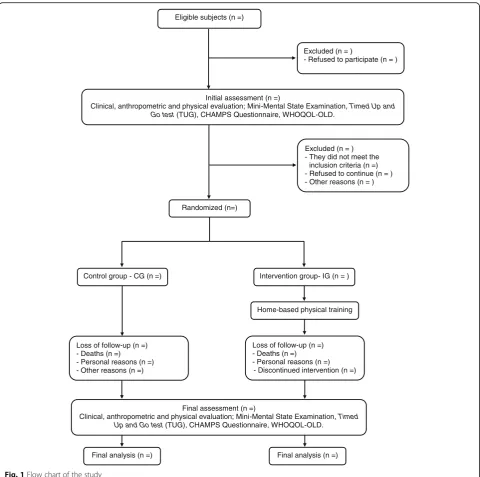
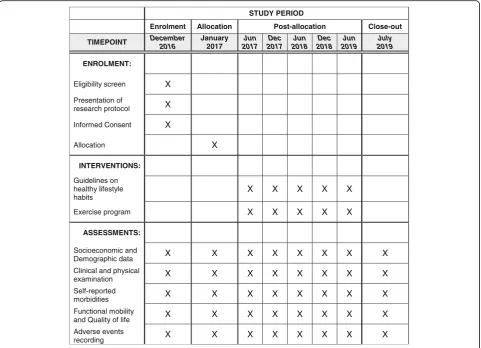
The design and conduct of this study follows the guide-lines of The Standard Protocol Items “Recommendations for Intervention Trials (SPIRIT) guidelines” [13], accord-ing to the flow chart of the study showed in Fig.1. This is a blind, randomized controlled clinical trial, using a super-iority test and a 1:1 allocation ratio. The sample will be of convenience, composed of elderly subjects in a commu-nity in the city of Senhor do Bonfim, BA, northeastern re-gion of Brazil. The protocol is reported according to the Standard Protocol Items: Recommendations for Interven-tional Trials (Fig.2SPIRIT diagram and Additional file1: SPIRIT Checklist).
Ethical and legal aspects
This study protocol was approved by the Research Ethics Committee of the Bahia School of Medicine and Public Health (Brazil), process no. 39072514.6.0000.5544, and was registered on the website “ensaiosclinicos.gov.br with Identifier: RBR-3cqzfy.” All participants must agree and sign the informed consent form to participate in the study. Removal is permitted at any time without any loss. After the explanatory meeting with all subjects in-volved in the study, the informed consent will be ob-tained individually, in a reserved place, by the main investigator and supervising physician.
Participants and recruitment procedure
interested people will be able to contact the team of researchers.
Eligibility criteria
The inclusion criteria for the study will be age≥60 years old and not having performed regular exercise for at least 3 months prior to the start of the study. Partici-pants with cognitive deficits will be excluded according to the Portuguese version of the Mental State Mini Exam (MSME) (an illiteracy group ≤20, a primary school group ≤25, a junior high school group ≤26.5, a high school group≤28, and a well-educated group≤29).
According to the authors, its application is very good for hospital patients, outpatients, and for the population study, including the elderly [14]. Participants will also be excluded if they have any clinical and/or orthopedic con-dition that contraindicates the performance of regular physical exercise, identified through a clinical and phy-siotherapeutic evaluation.
Randomization and allocation concealment
All subjects involved in the study, before randomization, will participate in groups of 12 elderly in a 40-min talk with explanations on the evaluation and intervention Eligible subjects (n =)
Excluded (n = ) - They did not meet the
inclusion criteria (n =) - Refused to continue (n = ) - Other reasons (n = ) Initial assessment (n =)
Clinical, anthropometric and physical evaluation; Mini-Mental State Examination, Timed Up and Go test(TUG), CHAMPS Questionnaire, WHOQOL-OLD.
Excluded (n = )
- Refused to participate (n = )
Randomized (n=)
Control group - CG (n =) Intervention group- IG (n = )
Home-based physical training
Loss of follow-up (n =) - Deaths (n =) - Personal reasons (n =)
- Discontinued intervention (n =) Loss of follow-up (n =)
- Deaths (n =) - Personal reasons (n =) - Other reasons (n =)
Final assessment (n =)
Clinical, anthropometric and physical evaluation; Mini-Mental State Examination, Timed Up and Go test(TUG), CHAMPS Questionnaire, WHOQOL-OLD.
Final analysis (n =) Final analysis (n =)
[image:3.595.58.539.86.563.2]procedures and will receive educational leaflets contain-ing guidelines on healthy habits related to food, hydra-tion, and sleep hygiene. The subjects in the IG will be informed that they will follow the guidelines of healthy habits of life and a program of home-based physical ex-ercise. For this program, they will participate in theoretical-practical training concerning adequate ac-complishment of the exercises and will receive a booklet, developed by the researchers, that contains illustrative and written guidelines on the method of performing the exercises, and a diary to register the frequency of exer-cise on a weekly basis.
After the explanatory meeting with all subjects, the main investigator will enroll the subjects of the study and request the randomization. A researcher from the same department, not involved in the trial, will prepare the group allocation after explanatory meeting and baseline assessment. Randomization will be computer based and carried out at a 1:1 ratio according to a random sequence generated by the Research Randomizer ( https://www.ran-domizer.org/), generating two groups, control group (CG) and intervention group (IG: semi-supervised, home-based
exercise program). Consecutively numbered, sealed, opaque envelopes containing group allocation will be pre-pared by the same researcher not involved in the trial. The concealed envelopes will be securely stored and will be opened in sequence to reveal group allocation (CG or IG). The researchers, after making sure that the partici-pants will be able to properly perform all the proposed exercises, will guide the family members to help the par-ticipants and stimulate their practice. Any change in the physical or mental condition of the participants should be communicated by telephone to the research team. Participants in the CG will be informed that they should only continue their daily living activities and follow the guidelines of healthy living habits.
Clinical evaluation
A previously trained physician and physiotherapist will perform all evaluations. Participants will receive standard verbal instructions on the procedures and will be evalu-ated individually in an appropriate room. Evaluations will be conducted before and after the intervention period. A clinical evaluation, physical examination, and evaluation
STUDY PERIOD
Enrolment Allocation Post-allocation Close-out
TIMEPOINT December
2016
January 2017
Jun 2017
Dec 2017
Jun 2018
Dec 2018
Jun 2019
July 2019
ENROLMENT:
Eligibility screen X
Presentation of
research protocol X
Informed Consent X
Allocation X
INTERVENTIONS:
Guidelines on healthy lifestyle habits
X X X X X
Exercise program X X X X X
ASSESSMENTS:
Socioeconomic and
Demographic data X X X X X X X X
Clinical and physical
examination X X X X X X X X
Self-reported
morbidities X X X X X X X X
Functional mobility
and Quality of life X X X X X X X X
Adverse events
recording X X X X X X X X
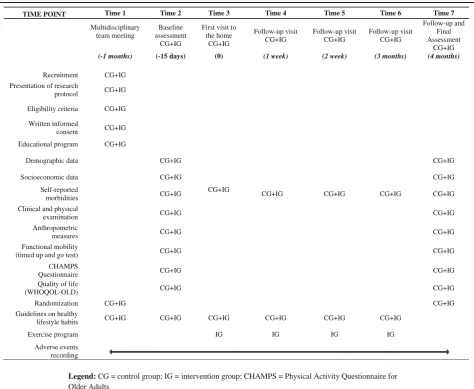
[image:4.595.58.540.88.436.2]of functional mobility, and physical activity levels, and QoL will be performed and socioeconomic, demographic, anthropometric, and self-referenced morbidity data will be collected according the schedule for data collection and outcome measurement (Table1).
Weight will be measured while wearing light clothing and without shoes, after emptying of the bladder, using a digital scale to the nearest 100 g. Height will be measured without shoes, with a stadiometer to the nearest 0.5 cm (model 200/5; Welmy Industria e Comercio Ltda, Sao Paulo, Brazil). Body Mass Index (BMI) will be calculated by dividing weight (kg) by the square of height (m) [15].
Functional mobility will be evaluated by the Timed Up & Go (TUG) test. This test measures, in seconds, the time taken by an subject to stand up from a standard arm chair (seat of the chair with height of 46 cm and arms with 65 cm of height), walk a distance of 3 m, at a comfortable and safe pace, turn, walk back to the chair,
and sit down again. The subject wears his regular foot-wear and uses his customary walking aid (none, cane, or walker). Three tests will be performed with each subject in a 1-min interval, with the best performance being chosen as the final measure [16].
According to the test, an execution time of less than 10 s suggests totally free and independent individuals. Individuals who perform the test between 10 and 19 s are considered independent, and those who perform the test in 20 to 29 s are in the so-called“grey zone,”that is, demonstrating limited functional capacity and difficulties in tasks of daily living. Those who perform the test in 30 s or more tend to be totally dependent for many basic and instrumental activities of daily living [16].
[image:5.595.61.536.327.716.2]The measurement process of physical activity levels re-quires the use of reliable and valid assessment tools. One of the most common assessment tools is questionnaires, with the advantage of low cost and easy administration.
Table 1The schedule for data collection and outcome measurement
Legend: CG = control group; IG = intervention group; CHAMPS = Physical Activity Questionnaire for Older Adults
TIME POINT Time 1 Time 2 Time 3 Time 4 Time 5 Time 6 Time 7
Multidisciplinary team meeting
Baseline assessment
CG+IG
First visit to the home
CG+IG
Follow-up visit CG+IG
Follow-up visit CG+IG
Follow-up visit CG+IG
Follow-up and Final Assessment
CG+IG (-1 months) (-15 days) (0) (1 week) (2 week) (3 months) (4 months)
Recruitment CG+IG Presentation of research
protocol CG+IG
Eligibility criteria CG+IG
Written informed
consent CG+IG
Educational program CG+IG
Demographic data CG+IG CG+IG
Socioeconomic data CG+IG CG+IG
Self-reported
morbidities CG+IG
CG+IG
CG+IG CG+IG CG+IG CG+IG
Clinical and physical
examination CG+IG CG+IG
Anthropometric
measures CG+IG CG+IG
Functional mobility
(timed up and go test) CG+IG CG+IG
CHAMPS
Questionnaire CG+IG CG+IG
Quality of life
(WHOQOL-OLD) CG+IG CG+IG
Randomization CG+IG CG+IG
Guidelines on healthy
lifestyle habits CG+IG CG+IG CG+IG CG+IG CG+IG CG+IG
Exercise program IG IG IG IG
Adverse events recording
To evaluate the levels of physical activity among the eld-erly subjects involved in this study, a well-known efficacy instrument called the Physical Activity Questionnaire for Older Adults (CHAMPS) will be used. The CHAMPS is one of the first physical activity questionnaires for older adults designed specifically for use in evaluating interven-tions that primarily aim to increase levels of physical activ-ity in older adults. According to the authors, the CHAMPS measure may be useful for evaluating the ef-fectiveness of programs aimed at increasing levels of phys-ical activity in older adults [17].
The CHAMPS assesses the level of physical activity in older adults (> 60 years and/or) taking into consideration caloric expenditure and frequency of the activities per-formed. This instrument is composed of 41 questions in which the answer is “yes” or “no.” After responding
“yes,” the answer specifies the frequency of days and hours per week that the activity was performed within the last 4 weeks. The types of activities assessed by CHAMPS are activities of daily living at home, exercise, and recreational activities [17, 18]. In this study, the CHAMPS will be applied at the baseline moment of data collection and at the end of the execution of the home exercise program, according to the proposed protocol.
Quality of life will be evaluated using the World Health Organization Quality of Life Group for Older Adults (WHOQOL-OLD) questionnaire, which contains six facets of four items each, evaluated by a Likert scale (1 to 5 points): Facet I –“Sensory Function”; Facet II–
“Autonomy”; Facet III – “Past, Present, and Future Activities”; Facet IV – “Social Participation”; Facet V –
“Death and Dying”; Facet VI – “Intimacy.” Each of the facets has four items; thus, for all facets the score of the possible values ranges from 4 to 20, and the scores of these six facets or the values of the 24 items can be combined to produce a“global”score of the QoL [19].
Intervention
Physical exercise program at home
The home exercise program will be based on the recom-mendations of the American College of Sports Medicine for exercise and physical activity of elderly people [3]. The program consists of aerobic exercises, muscle strengthening exercises, balance training, motor coord-ination, and flexibility, always prioritizing exercises in-volving large muscle groups. The protocol will last for 12 consecutive weeks, with a minimum frequency of three sessions per week and a planned execution time of 40 min. During each session, two to three sets will be performed with 5 to 15 repetitions for each exercise at a target effort rate of 13–15 (“a little difficult” to “ diffi-cult”) on Borg’s perceived exertion scale of 6 to 20 points [20].
The participant will perform the exercise program in-dividually in their own home, without direct supervision during its execution, but with on-site guidance through home visits every 15 days by one of the members of the team. Participants will be instructed to increase the in-tensity of the exercises, using the Borg scale to evaluate intensity, and in a manner proportional to their execu-tion capacity, evaluated by the research assistants at each of the visits. The exercises will be carried out using the weight of the body itself and with the aid of some low-cost equipment (recyclable plastic bottles to demar-cate the signage of the course, sticks and weights of 1 and 2 kg for performing the resistance exercises). The following are the exercises to be performed:
Warm-up exercises–Active-free exercises of the upper and lower limbs, including extension, flexion, and rotation of the shoulders associated with breath-ing exercises
Aerobic exercises–Displacement of a stick with both hands, from the knees to above the head and returning to the knees, and walking exercises with alternating thigh flexion and placing the hand on the opposite knee
Resistance exercises–For the upper limbs: starting from the position with the elbow extended and the hand resting on the opposite thigh, movement of the whole member diagonally upwards and then returning the hand to the thigh. For the lower limbs: squatting exercise, starting from the sitting position on a chair and with arms crossed in front of the body, lifting to the orthostatic position and then returning to the sitting position
Balance and coordination exercises–Walking on a straight line and walking while diverting from lined obstacles with progressively smaller distances. When possible, the exercise will evolve and the walk will be performed by touching the heel of one foot to the toes of the other foot (foot with foot)
Note: to ensure safety, these exercises will be performed close to fixed furniture in the house, making it possible to lean when necessary
Stretching exercises–From the sitting position and with knees in extension, trying to reach the tip of the feet; from the sitting position on a chair and with the feet on the ground, performing rotation of the trunk to one side and elevation of the upper limb, on the same side, above the head, stretching as high as possible
specific monitoring in relation to the practice of the exercises and assistance with possible adverse events. After the end of the proposed 12-week period, the researchers will reassess the participants in both groups and encourage them to con-tinue with the home program. Those in the CG will be pro-vided follow-up for the regular practice of home exercises for the same period performed by the IG participants.
Statistical analysis
The principle of intention-to-treat analysis will be respected. For missing data, we will perform a sensitivity analysis, through simple imputation, using the mean of the variables. Student’sttest for numerical variables and Pearson’s chi-square test for categorical variables will be applied to verify whether the randomization process generated two groups of subjects (CG and IC) with homogeneous clinical and demographic characteristics before intervention, thus avoiding a possible selection bias. To test the normality of the data, an analysis of the study histogram, mean and median, standard deviation, skewness, and kurtosis will be performed and for its confirmation, we will use the Shapiro-Wilk normality test. With a normal distribution of variables, parametric statistics will be used, and intragroup comparisons will be made using the Student’s t test for paired samples; the intergroup comparisons will be performed using the Student’s t test for independent samples. If there is no normal distribution of the variables, the corresponding non-parametric tests will be used. For the analysis of the groups by age, as will be done with more than two groups, we will use the one-way analysis of variance (ANOVA) for parametric distribution or Kruskal-Wallis for non-parametric analysis. The significance level estab-lished for all analyses will be p< 0.05 and all statistical procedures will be analyzed and processed using the Statistical Package of the Social Sciences SPSS 21.0 soft-ware (IBM® SPSS version 21, IBM, Armonk, NY, USA).
Sample size
The sample size was calculated using the WINPEPI (PEPI-for-Windows) [21] software, based on the main hypothesis of the study. According to a relevant study published by Lacroix et al. [8], where a group of health older adult subjects performed unsupervised exercises obtaining a reduction of 0.37 s in TUG execution time when compared to pre and post intervention with dur-ation of 12 weeks. Considering the standard devidur-ation of 0.84 for the IG and 1.02 for the CG observed in the study, with a statistical power of 80% and an alpha error of 5%, 101 participants in each group would be neces-sary. The sample will be increased by 10% to compen-sate for possible dropouts, leading to 111 subjects in each group (overall sample = 222 participants).
Outcome measures
Primary outcome
The expected primary outcome is the change in the functional mobility of the elderly involved in the study, verified through the mean time in minutes for the TUG test, compared at the baseline and after the 3 months’ post-intervention period.
Secondary outcomes
The expected secondary outcomes for the subjects in-volved in this study will be the change in QoL verified by the WHOQOL-OLD questionnaire and the improve-ment in the level of physical activity measured using the CHAMPS, compared at the beginning and after the post-intervention period of 3 months. Feasibility of the protocol will be determined by the number of eligible elderly people recruited and retention and adherence rates to the home-based exercise program. The retention rate will be defined as the percentage of subjects who completed the protocol. Adherence will be defined as the percentage of exercise sessions attended by those who were randomized to the IG. Adherence to the home-based exercise program will be recorded using at-tendance records (recorded by the study physicians and physiotherapists) and participant exercise diaries (re-corded by the participant). The proportion of subjects distributed between the CG and the IG will be 1:1, ac-cording to the randomization process.
Data monitoring and quality control
Systematic training of five assistants will be carried out exclusively for evaluations, and training of ten assistants will be performed for home monitoring of elderly people, five of whom will visit the IG and five of whom will visit the CG. The distribution of the number of par-ticipants to be evaluated and the number of domiciles to be visited will be done in an equivalent way among the research assistants.
Achieving retention
Safety
Although clinical evaluations and tests are routine in academic life, possible adverse events, highlighting falls, hospitalizations, and deaths, will be monitored and re-corded by the researchers directly involved in the study and reported to the research coordinator of the study and to the Research Ethics Committee responsible for the ethical approval of the study protocol.
Dissemination policy and data sharing
The results of this study, whether positive, negative or inconclusive, will be submitted to the peer-reviewed international journal for possible publication. Additional data are available from the corresponding author on rea-sonable request.
Quality control, data management, and governance All investigators who will participate in the study are qualified physicians and physiotherapists, including a chief physician supervisor, visiting staff, and residents of the Bahia School of Medicine and Public Health, Salva-dor (BA), Brazil and Bahia State University–UNEB, De-partment of Education (DEDC-VII), Senhor do Bonfim (BA), Brazil. In order to avoid possible biases in the col-lection and analysis of the data, searching for robust and high-quality results, the main investigator (GSB) and the statistician will do the manual conference and release of all the data referring to the subjects involved in this study, inserted in a single database. The data will be coded and the identity of the subjects will be preserved. The governance of the trial will be carried out by the Study Management Committee, composed of the main investigator (GSB), statistician, and physician supervisor (AAC), who will control data quality through weekly meetings and rigorous training to ensure that all re-searchers involved in study are following the proposed protocol. During all phases of the trial, the Study Man-agement Committee will supervise the study ensuring that [1] the subjects recruited are within the scope of the protocol [2]; all participants meet the inclusion cri-teria; and [3] that all participants perform the activities proposed by the clinical trial. A performance audit will be conducted every 2 weeks of activities with the entire team of researchers.
Discussion
This is a study designed to verify whether a semi-supervised, home-based exercise program alters the functional mobility and QoL of sedentary community elderly persons when compared to a control population. This hypothesis is based on research that has already demonstrated the efficacy of physical exercise programs in terms of functional mobility [7, 22, 23] and improving the QoL of elderly people [8, 9]. However, most of these studies adopted
professional supervision during the execution of exercise programs, in addition to being performed in training and/or rehabilitation centers [24–26], which is charac-terized as a limiting factor for the participation of eld-erly people, as they may have difficulties with mobility and transfer [27]. The benefits of such programs de-pend on the degree of adhesion to exercise, which is influenced by the intensity of pleasure and satisfaction provided [27, 28].
It has already been demonstrated in the literature that physical exercise performed at home, in addition to be-ing the preference of elderly people, can provide import-ant health benefits [7, 25, 29], leading to improved adherence and continuity of the exercises after the end of the proposed program [30].
One of the main characteristics of the present study is the focus on the practice of semi-supervised exercises. A strength of this study is that, after the random allocation of the participants, both groups will receive periodic home visits with the same frequency, aiming to provide the same orientation and stimuli in relation to healthy lifestyle habits. This allow the groups to acquire similar behaviors, differing only in terms of the practice of phys-ical exercise, considering that previous studies suggest that frequent contact with the participants by telephone calls, Internet, or personal visit increases adherence of elderly people to home exercise programs [8,29,30].
Trial status
The study is currently recruiting participants. This phase is expected to end in July 2019.
Additional files
Additional file 1:Standard Protocol Items: Recommendations for Interventional Trias (SPIRIT) Checklist. (PDF 129 kb)
Abbreviations
BMI:Body Mass Index; CG: Control group; CHAMPS: Physical Activity Questionnaire for Older Adults; IG: Intervention group; MSME: Mental State Mini Exam; QoL: Quality of life; TUG: Timed Up & Go; WHOQOL-OLD: World Health Organization Quality of Life for Older Adults
Acknowledgements
The authors are especially grateful to the Department of Education– Campus VII of the State University of Bahia–UNEB for providing the necessary equipment for the evaluation of the participants, the members of the research group on quality of life and healthy aging–QUALES for the dedication to data collection, and to the elderly participants during the whole period of the intervention. Special thanks to the elderly people who accepted participation in this study.
Funding
This study was funded by the State University of Bahia, through the Support Program for the Training of Teachers and Administrative Technicians (PAC), without influencing any of the stages of the study, from the conception, development, analysis, and interpretation of the results. LVFO receives grants from Research Productivity, modality PQ1B; Process no. 313053/2014–6 of the National Council for Scientific and Technological Development (local acronym CNPq), Brazil.
Availability of data and materials
Trial data and documents will be stored in the archives of Bahia School of Medicine and Public Health, Salvador (BA), Brazil, and Bahia State University– UNEB, Department of Education (DEDC-VII), Senhor do Bonfim (BA), Brazil, and made available on request.
Authors’contributions
GlauberSB, LVFO, and AAC provided the concept of the study, formulated the hypothesis, and wrote the original proposal. GlauberSB, EFO, AS, and NSFJ obtained ethics approval. GlauberSB, AACS, and GlaudsonSB will participate in the data collection and perform clinical evaluations. GlauberSB, LVFO, and AAC prepared the drafted manuscript. GlaudsonSB, LVFO, LTP, ASS, DPO, JJU, RFO, and AAC were involved in the critical revision of the manuscript. GlauberSB, AAC, and LVFO are co-lead investigators. GlauberSB, AAC, and LVFO wrote this protocol paper, with input from all co-authors. All the authors agree to be accountable for all aspects of the work in ensuring that questions related to the accuracy or integrity of any part of the work are appropriately investigated and resolved, and read and approved the final manuscript.
Authors’information Not applicable
Ethics approval and consent to participate
The study was approved by the Research Ethics Committee of the Bahia School of Medicine and Public Health, Process 39072514.6.0000.5544. All participants will sign an informed consent form before randomization. The results of this protocol study will be published in peer-reviewed journals as well as at national and international conferences. The data collected will also be made available in a public data repository.
Consent for publication
All subjects give their consent for publication in the informed consent form. However, every attempt will be made to ensure their anonymity.
Competing interests
The authors declare that they have no competing interests.
Publisher’s Note
Springer Nature remains neutral with regard to jurisdictional claims in published maps and institutional affiliations.
Author details
1Bahia School of Medicine and Public Health, Salvador, BA, Brazil.
2Department of Education (DEDC-VII), Bahia State University–UNEB, Senhor
do Bonfim, BA, Brazil.3Medical School, Centro Universitário de Anapolis–
UniEVANGÉLICA, Av. Universitária Km 3,5–Cidade Universitária, Anápolis, GO, Brazil.4Diagnostic and Specialty Clinic–IMAIS, Senhor do Bonfim, BA, Brazil. 5Rehabilitation Sciences Master’s and Doctoral degree, University of Nove de
Julho–UNINOVE, São Paulo, SP, Brazil.6Physiotherapy School, Nove de Julho
University–UNINOVE, São Paulo, SP, Brazil.7Physiotherapy School, University of the State of Minas Gerais–UEMG, Divinópolis, MG, Brazil.
Received: 17 November 2017 Accepted: 20 November 2018
References
1. World Health Organization. Global age-friendly cities: a guide. Geneva: WHO. 2007. Available from:https://www.who.int/ageing/publications/ Global_age_friendly_cities_Guide_English.pdf. Accessed 28 May 2018. 2. Balboa-Castillo T, León-Muñoz LM, Graciani A, Rodríguez-Artalejo F,
Guallar-Castillón P. Longitudinal association of physical activity and sedentary behavior during leisure time with health-related quality of life in community-dwelling older adults. Health Qual Life Outcomes. 2011;9:47. 3. American College of Sports Medicine, Chodzko-Zajko WJ, Proctor DN,
Fiatarone Singh MA, Minson CT, Nigg CR, et al. American College of Sports Medicine position stand. Exercise and physical activity for older adults. Med Sci Sports Exerc. 2009;41:1510–30.
4. World Health Organization. Good health adds life to years. Global brief for World Health Day. WHO. 2012. p. 28.https://www.who.int/ageing/ publications/whd2012_global_brief/en/. Accessed 4 May 2018. 5. Lacroix AZ, Guralnik JM, Berkman LF, Wallace RB, Satterfield S. Maintain
mobility at the end of life. II. Smoking, alcohol consumption, physical activity and body mass index. Am J Epidemiol. 1993;137(8):858–69. 6. Nelson ME, Rejeski WJ, Blair SN, Duncan PW, Judge JO, King AC, et al.
Physical activity and public health in older adults: recommendation from the American College of Sports Medicine and the American Heart Association. Med Sci Sports Exerc. 2007;39(8):1435–45.
7. Nelson ME, Layne JE, Bernstein MJ, Nuernberger A, Castaneda C, Kaliton D, et al. The effects of multidimensional home-based exercise on functional performance in elderly people. J Gerontol A Biol Sci Med Sci. 2004;59(2):154–60.
8. Lacroix A, Kressig RW, Muehlbauer T, Gschwind YJ, Pfenninger B, Bruegger O, et al. Effects of a supervised versus an unsupervised combined balance and strength training program on balance and muscle power in healthy older adults: a randomized controlled trial. Gerontology. 2016;62(3):275–88. 9. Oken BS, Zajdel D, Kishiyama S, Flegal K, Dehen C, Haas M, et al.
Randomized, controlled, six-month trial of yoga in healthy seniors: effects on cognition and quality of life. Altern Ther Health Med. 2006;12(1):40–7. 10. Donat H, Ozcan A. Comparison of the effectiveness of two programmes on
older adults at risk of falling: unsupervised home exercise and supervised group exercise. Clin Rehabil. 2007;21(3):273–83.
11. Brown DS, Finkelstein EA, Brown DR, Buchner DM, Johnson FR. Estimating older adults’preferences for walking programs via Conjoint Analysis. Am J Prev Med. 2009;36(3):201–7.
12. Franco MR, Howard K, Sherrington C, Ferreira PH, Rose J, Gomes JL, et al. Eliciting older people’s preferences for exercise programs: a best-worst scaling choice experiment. J Physiother. 2015;61(1):34–41.
13. Chan A-W, Tetzlaff JM, Altman DG, Laupacis A, Gøtzsche PC, Krleža-JerićK, et al. SPIRIT 2013 Statement: defining standard protocol items for clinical trials. Ann Intern Med. 2013;158(3):200–7.
14. Brucki SM, Nitrini R, Caramelli P, Bertolucci PH, Okamoto IH. Suggestions for utilization of the Mini-mental State Examination in Brazil. Arq
Neuropsiquiatr. 2003;61(3B):777–81.
Epidemiology of Obesity. Warsaw 21–23 October 1987. Copenhagen: WHO; 1989. Nutrition Unit Document, EUR/ICP/NUT 123
16. Podsiadlo D, Richardson S. The Timed“Up & Go”: a test of basic functional mobility for frail elderly persons. J Am Geriatr Soc. 1991;39(2):142–8. 17. Stewart AL, Mills KM, King AC, Haskell WL, Gillis D, Ritter PL. CHAMPS
Physical Activity Questionnaire for Older Adults: outcomes for interventions. Med Sci Sports Exerc. 2001;33(7):1126–41.
18. Stewart AL, Mills KM, Sepsis PG, King AC, McLellan BY, Roitz K, Ritter PL. Evaluation of CHAMPS, a physical activity promotion program for older adults. Ann Behav Med. 1997;19(4):353–61.
19. Fleck MP, Chachamovich E, Trentini CM. WHOQOL-OLD Project: method and focus group results in Brazil. Rev Saude Publica. 2003;37(6):793–9. 20. Borg GA. Psychophysical bases of perceived exertion. Med Sci Sports Exerc.
1982;14(5):377–81.
21. Abramson JH. WINPEPI (PEPI-for-Windows): computer programs for epidemiologists. Epidemiol Perspect Innov. 2004.https://doi.org/10.1186/ 1742-5573-1-6.
22. Ross LA, Schmidt EL, Ball K. Interventions to maintain mobility: what works? Accid Anal Prev. 2013;61:167–96.
23. Gill TM, Baker DI, Gottschalk M, Peduzzi PN, Allore H, Van Ness PH. A prehabilitation program for the prevention of functional decline: effect on higher-level physical function. Arch Phys Med Rehabil. 2004;85(7):1043–9. 24. Reid KJ, Baron KG, Lu B, Naylor E, Wolfe L, Zee PC. Aerobic exercise
improves self-reported sleep and quality of life in older adults with insomnia. Sleep Med. 2010;11(9):934–40.
25. Morey MC, Snyder DC, Sloane R, Cohen HJ, Peterson B, Hartman TJ, et al. Effects of home-based diet and exercise on functional outcomes among older, overweight long-term cancer survivors: RENEW: a randomized controlled trial. JAMA. 2009;301(18):1883–91.
26. Matsuda PN, Shumway-Cook A, Ciol MA. The effects of a home-based exercise program on physical function in frail older adults. J Geriatr Phys Ther. 2010;33(2):78–84.
27. Schutzer KA, Graves BS. Barriers and motivations for exercising in older adults. Prev Med. 2004;39(5):1056–61.
28. Williams NH, Hendry M, France B, Lewis R, Wilkinson C. Effectiveness of exercise-referral schemes to promote physical activity in adults: systematic review. Br J Gen Pract. 2007;57(545):979–86.
29. Ashworth NL, Chad KE, Harrison EL, Reeder BA, Marshall SC. Home versus center based physical activity programs in older adults. Cochrane Database Syst Rev. 2005;25(1):CD004017.
30. Martin KA, Sinden AR. Who will stay and who will go? A review of older adults’adherence to randomized controlled trials of exercise. J Aging Phys Act. 2001;9(2):91–114.