DELAY SENSITIVE OPPORTUNISTIC AND
HABITUAL ROUTING IN
WIRELESS MULTIMEDIA SENSOR NETWORKS
1G.VITHYA, 2B.VINAYAGASUNDARAM
1Associate Professor,St.Joseph’s College of Engineering,Chennai-119,Tamil Nadu, India
2 Head, Associate Professor, Dept of IT , M.I.T Campus, Anna University, Chennai, India
E-mail: [email protected] , [email protected]
ABSTRACT
Heterogeneous Wireless Multimedia Sensor Network (WMSN) is a delay prone network requires an energy entropy model to overcome delay during multimedia packet transmission. The core idea of this work is to avoid delay by determining the next hop of a node based on factors such as, residual energy, success ratio and time taken to deliver a packet. The proposed Transport Layer algorithm called Delay Sensitive Opportunistic and Habitual Routing Protocol (DSOHRP) provides an optimized path between the sender and receiver by using delay sensitive constraints in the holistic network.
Another key factor that is satisfied with this approach is Load Balance. Load balance is achieved by transmitting packets on the path, based on the opportunistic routing feature exuded in the proposed algorithm. This work is an algorithmic approach to maximise the Network life time and minimize the delay by choosing two optimal paths for the transfer
Keywords:QOS in WMSN, Delay sensitive WMSN, Habitual Routing in WMSN
1. INTRODUCTION
Wireless Multimedia Sensor Network (WMSN) is a collection of Wireless Multimedia Sensor node (WMSn) and Wireless Sensor node (WSn). The sensed data is required to be transmitted to the receiver or sink without any delay. A clear route is essential for this type of transfer. The major factor causing discrepancies is the overhead that arises due to delay in almost all the parts of a network.
To avoid overhead in routing, travel path of the packet is determined prior to forwarding and redundancy is removed by the comparison operation performed on the base packet and successive packets. Here, the best path for routing is chosen such that QOS is highly supported thereby reducing the delay and traffic overhead. Though WMSN has a number of limitations, the most sought after applications such as surveillance management and Environment Monitoring turns laborious without WMSN. Delay sensitive routing overcomes ping pong effect and looping, thus managing power in a Multimedia node. The necessary QOS parameters to route the packet to the destination are Loss tolerance, jitter, delay, and throughput.
Power constraints of a network impose delay calculation prior to forwarding and habitual routing for the sustenance of the network. Habitual routing
is based on the temporal performance of the nodes. Power consumption is minimal if the captured data is forwarded to the base or sink before the nodes lose power. Hence, Loss of data becomes a rare event.
The rest of the paper is organized as follows. Section II reviews the related work of the delay sensitivity in WMSN. Section 3 describes the functionalities of present DSOHR protocol. Section 4 describes dissemination and Section 5 Conclusion.
2. RELATEDWORK
In reference [3] the survey paper explained, the network is designed with a Delay Estimation Module and an Adaptive Routing Module. It proactively calculates, mean delay at each node without actual packet exchange. It uses two exploration agents to discover the best available routes between a given pair of nodes[4].Routing is viewed as an approach of selecting single path for transmission [6], [7].
Due to the minimum transmission capacity and energy restrictions of sensor nodes, a single path often do not meet all the requirements of video transmission [5], [8].Cluster Head election is performed to increase the life time of the network [9] without delay or jitter. Since traditional wireless sensor networks approaches are not feasible in many situations or efficient in specialized scenarios, the nature of video-based wireless sensor networks demands new algorithms and solutions.
In comparison with the existing research, the proposed work is distinct in terms of delay sensitivity. Multipath routing by choosing an optimized path and Habitual routing are the techniques that throughputs a profound increase in lifetime of the network even in the presence of unreliable nodes.
3. MATERIALANDMETHODS
WMSn captures video or still images and routes them finding application in numerous fields such as environmental monitoring, fire accidents etc.Each MSN is aware of its own location by making use of location techniques or beacon signals. A multitude of nodes is deployed to capture the images and videos for monitoring and surveillance purposes in a remote environment. There are two different types of sensor nodes deployed in WMS Network: WSn for sensing data, WMSn for capturing video or image. The duo uses sink nodes for receiving, storing, and processing data.
To enhance the lifetime of a network, expected travel time of the packet is calculated by selecting a cluster head and forming an arc (path) between sender and receiver.
Selection of a node as a cluster head is based on its resources. Resources refer to the RGB value of sensed images taken at stipulated intervals of time. A node rich in resources is most likely to become the cluster head.
As a result of using Multimedia Sensor Node cogently, event coverage takes place with the least
amount of redundancy. Once an event is detected, the sensors in the vicinity can be actuated to capture an image or video of the event until the event ends. Such video data can then be used for observations. 3.1 Identifying Resource Rich cluster Head
One of the multimedia sensors is selected as the cluster head and other WSns are used for routing purposes. The prerequisites for choosing the cluster head depends on the fact, that, a cluster head can be a node which possesses more RGB value compared to all the other WMSn .Since all the sensors are static, each node knows about its neighbours by sending a beacon signal. Routing is based on the power of the nodes. Thus, Delay is avoided by choosing the resource rich node for transmission.
3.1.1Cluster head selection
Splitting the sensor networks into small manageable units is referred as clustering and, the process is called clustering process. A cluster head is selected from each cluster, based on the energy level of the nodes and their distances.
The main objective is to make the cluster head alone communicate with the base station, so that the remaining nodes can be put to a sleep state, thus preserving power. The set is considered to be acceptable once the clusters obtained after an iterative selection process are found to be physically significant.
To support QOS in routing Images, Videos, and Audio files, an approach is designed to be delay sensitive and to provide habitual as well as opportunistic routing. This is supported by the algorithm called DSOHRP.
Algorithm:
Layout of Delay Sensitive Opportunistic and Habitual Routing Protocol
Event driven multimedia transport layer routing is divided into two phases.
1. In phase1, a base frame is the first frame of an event and each frame is compared with its predecessor at the Cluster head and the Proxy cluster Head.
2.In Phase 2, the proposed Transport layer protocol ,Delay Sensitive Opportunistic and Habitual Routing
is
by2.The paths or links connecting sender and receiver are realised in the form of arcs based on Token values.
3.
Habitual routing is introduced to validate the calibre of nodes in the arc, based on their temporal parameters. The behaviour of the node is categorisedby
(i) Transmission speed (ii) Success rate (iii)Sensor features4.Path Selection: Among number of path ,the path that can be chosen is based on
(a)Cut graph, (b) capacity of the arc, (c) weight of the Upper arc, (d) weight of the Lower arc. Cut graph protect the set of nodes from the
multipath,
5.Load Balance: Opportunistic Routing is implemented by setting a priority for path to choose upper or lower arc, in order to balance the load in the path arc.
In this protocol, a source node senses the multimedia data with phase detection combined with auto focusing techniques and communicates the sensed data to the destination node via sink taking into account ,the Qos factors .There are 2 phases to support Qos delay sensitive opportunistic routing algorithm.
3.2 Evaluation Metrics
In the Phase1, a heterogeneous network, and Multimedia sensor nodes are validated in terms of its resource which is the RGB value. There are three types of routing and data reporting in a Wireless Multimedia sensor Network,
(1) Event Driven (2) Time Driven (3) Query Driven.
The event driven method is used to deliver the data when any event occurs, whereas query driven approach occurs when a query arises at the receiver’s side.
The time driven Data reporting method is used for reporting the data in a periodical manner and sensed Data needs to be delivered before the loss of battery power in the node. Loss of battery power can be denoted by critical factor.
For the Query Driven reporting Method, when a query is triggered from the sink, it reaches the location of the proxy cluster head, which stores the data for a while, and reports to the sink.
3.2.1 Delay Sensitive Routing Protocol (phase1)
Phase1 revolves around choosing two High power neighbouring nodes, one of them is the cluster head and the other is the proxy cluster Head. The cluster Head of a group of nodes collects all
the information from that particular group and transfers it to proxy cluster Head. The proxy cluster head which stores only the previous frame. The next frame from the cluster Head is checked with previous frame, if there is a difference, only the difference bit frame is passed on to next cluster , and forwards multimedia frames simultaneously.
If the High power nodes are not neighbours, then the node with the highest power is the cluster Head, which stores a frame and forwards the multimedia frame simultaneously.
Routing is established by transferring the packet to the next node which may be any node like the proxy cluster head, cluster Head or any ordinary Node. Fig-1 shows the Phase 1 (Frame Comparison) & phase 2 of Routing.
Video data can be portrayed as a series of still image frames. The sequence of frames contains spatial and temporal redundancy that video compression algorithms attempt to eliminate. This is performed by comparing two frames and appending only the difference.
3.2.2 Multimedia Frame Comparison Algorithm (Phase1):
Let F1 be the base image with r1 pixels and d1 data, and F2 be the incoming image with r2 pixels and d2 data.
Image is set with a metadata [‘id_flag’] = null, metadata [‘id_change’]=null
For every incoming image other than base_image do:
Let y1 be the normalized base image with data d1 & y2 be the normalized incoming image with data d2
Comparing_phase:
Let f1 be the base image and f2 be the incoming image do:
If y1 == y2 then
append id_flag = false to d2 append id_change = false to d2 Else
append id_flag = true c = deviation(f1-f2) If c > critical_value then Append c_value = 1 to d2 append id_change = c append id_flag =true to d2 Return f1 and f2
Fig-1 Phase1 & Phase2 Of Routing
3.3 Delay Sensitive Opportunistic and Habitual Routing Protocol (DSOHRP) (Phase2)
In the cluster of nodes, instead of allocating an entire task to WMSn, WSn can be used as source node, relay or sink. WSn may be in sense mode and in relay mode. High power WSN is chosen to act in both the modes. Otherwise a node acts in either of the modes. In sense mode, the data is sensed and in relay mode node it merely acts as a relay route.
Critical factor is the minimum amount of energy a node can operate with. Once the node reaches the critical factor, it can be taken as a warning for a dead node and data is transmitted as quickly as possible.
3.3.1 Parameters:
Routing Path Selection
Multipath routing addresses two major constraints: The number of paths that are available and the path that is to be chosen for transmission. The computation steps to determine the optimal path for enhancing DHSORP is as follows.
For event driven routing, packet with an end to end delivery and reliability is designed for selecting a path based on the characteristics of each node such as: (i) Energy consumption, (ii) Success ratio of the node (iii) Time taken to deliver the packet
The next hop is based on the above characteristics of the node. A token is assigned for each of the characteristic features, which decides whether the node is accepted on the path. This is represented by the token of Hop (TOH), generated based on the threshold value of tokens
The proposed work estimates the minimum hop delay among the number of paths between sender and receiver by issuing a token of hop. Fig-2 shows the routing in DSHORP
Fig-2 Routing In DSHORP
(i). Energy Consumption:
A residual value is calculated for each node enabling the node to act as a cluster head or a proxy cluster head or as a next hop. A residual value is calculated for each node based on Packet Sending /
Receiving Rate (PSR/PRR), Number of packets sent
or received over a period of time.
A Differentiated threshold value is assigned to the node in order to set priority. The higher priority node is assigned with an optimal value (opval) and critical value (cval), a second priority node is assigned with optimal value1 (opval1) and critical value1 (cval1).
(ii) Success Ratio of the Node
The success ratio of the node is calculated by Habitual routing, which requires the history of the transmissions of the node and is found by (i) Transmission speed (ii) Success rate (iii) Sensor features
The transmission speed is the ratio of power and the number of transmissions. They normally depend on Link quality and distance between the nodes. Due to static topology of sensor network, the distance is same whereas the link quality depends on channel behaviour in multipath environments.
If the channel quality is good then speed is calculated as Distance/Time.
Success ratio of the node is calculated by
Packet Dropping Rate (PDR), is the number of packets that were sent to a certain node but were not forwarded by that node which is based on the ratio between Received Signal Strength (RSS) and
Packet arrival process. The RSS is the
Measurement of power present in received radio signal and measured in mill watts and the Packet Arrival Process (PAP) is a Poisson process in
which the inter arrival time distribution is exponential with rate λ.
Notations Simplicity of formulation there are certain notations used
The above factors decide the Packet
Forwarding Rate (PFR) that is the number of packets that the node received from its neighbors and consequently forwarded to its parent node in a period of time.
The Quality of the node is quantized for deciding the success ratio by Forward Delay Time (FDT) here, the time is calculated as a difference
Notat ions
Explanation
Opvl Optimal Value Cval Critical value E Set of Arc rv Residual Value Sr Success ratio ds Data Size
Ec
Energy Consumption (The energy consumption based on the mode of the sensor)
I.E. initial energy of the node,
T.E transmission energy to transmit the packet
E.C energy consumed by receiving a packet
TOS Token of Selection TOR Token of Success ratio Tdeli
very Token of delivery TOH Token of Hop Pr Priority of the arc Fr frame rate
la
Length of the arc (calculated as no of Hops between Source and destination)
Wa Max. Weight of node in the arc Ca Capacity of arc (Between Source
and destination)
Wua Weight of the Upper Arc (Highest Optimal Power)
Wla Weight of the Lower arc (Second Highest Optimal Power)
between the reception and transmission time of the packet.
The sensor features depict the configuration of the node which may be a high-ended version, and also the time of deployments.
Based on an ID, a value is assigned to the configuration. For example ID=3 denotes High Memory, ID=2 for Medium & ID=1 for Low. The success rate is calculated as the number of packets received without the packet being dropped.
Another token is assigned to selection process based on its characteristics and this is named as tokens of success ratio (Tor) with values as 2 and for second priority as 1for others 0.
History of the node helps in including or excluding a node from a path or an arc.
(iii)Time Taken to Deliver the Packet
On Hop by hop transmission of the packets in
a cluster, a packet from one cluster is selected, based on node power and distance. The transmission may be proxy cluster head to proxy cluster head or to cluster Head, or to the Node. The time taken is calculated based on
(i)Hop Count (HC) Hop count referred as intermediate nodes through which data must pass between Source and destination.
(ii) Wireless Neighbor Nodes (WNN): Neighbor nodes are the adjacent nodes, which may be cluster head to cluster head or to cluster Head to Node. (iii)Packet Transmitting Power (PTP): Packet Transmitting power is the power with which a packet is sent to the Neighboring nodes in stipulated time.
A third token is assigned for selection namely token of delivery. A token Tdelivery having a value 3 for PCH to PCH. This transmission is bestowed with high priority because of its reliability. Transmission from Proxy cluster Head
to Cluster Head Tdelivery has 2 and from Proxy cluster Head to node Tdelivery has 1, as their token values.
3.4 Path Selection
The next hop is calculated based on the token values of Residual energy, Success ratio of the Node, Time to deliver of the node. A threshold value is required to decide the performance of the node.
Token of Hop: The Token of Hop for a particular neighbour node is decided by summing up each of the token values assigned to a node,
TOH= TOS+TOR+ Tdelivery .
The neighbouring node is identified by the beacon signal and TOH generated by each node. After receiving the beacon signal along with TOH from neighbours, next hop is decided based on TOH value. Higher TOH value is for Upper arc and lower value compared to upper for lower arc. The sender node responds with their ID to avoid intrusion from intruders.
The above factors conclude how many paths are available and the path that can be chosen .This is based on
a)Cut graph (b) Capacity of the arc (c) Weight of the Upper arc (d) weight of the Lower arc.
To avoid delay in Multimedia packet routing, prior calculation is necessary for efficient packet disseminations.
Data packet transmitted along the path is successfully delivered by successful hop-by-hop fashion based on residual Energy of the node, Success ratio of the node and the Time taken to deliver the packet named these factors as TOH. Then that node is involved in transmission of considering the arc.
3.4.1 Cut graph
The basic purpose of a cut graph is to group nearby nodes thereby forming a subset, such that the next two viable hops can be decided prior to the actual hop itself, when the network is sufficiently long.
The process is carried out in such a way, that ,once a packet is forwarded to a node ,next two best possible choices are found by the cut graph nodes based on the trigger signal sent to them from node that has received the packet.
(Trigger)I I= 0,1,2..K-1
Where K is the number of Nodes in the path If (Trigger)I =1
(Cut graph)I =active
A cut graph usually contains around 3 or more neighbouring nodes. Including a node, the cut graph is based on their distance calculated from the current node.
Due to multipath network, the nodes in the cut graph are held till the packets cross the group. When a cut graph signal is active, this means that other transmissions through this set should wait until the transmission crosses.
3.4.2Capacity of the Arc
From a group of nodes in a subset, two different arcs are chosen, with the help of its weight. They are considered as upper and lower arcs. As the name suggests, the lower arc has lower weight and upper arc has higher weight.
If N is the number of arcs, choose two arcs among N, for routing and allocate priority for the arc to transmit reliable data and for differentiated routing.
E= {ar1 , ar2, ar3……. arn } where n€W; Where W is the set of Whole numbers
Packet size= (Image size / 1024);
ds=( packet size*1000)-1024
Priority of the arc is calculated by the capacity of the arc and it is given by the weight of the path, it is calculated as
Wa[i ] = max(TOH[i]); Wa-1[i]= max-1(TOH[i]); .
. . ..
Wa-n[i]= max-n(TOH[i]);
Ca[i..n]={wa[i], Wa-1[i], Wa-2[i]…. Wa-n[i]} Pr= max (Ca[i], Ca-1[i]);
Pr-1= max-1(Ca[i], Ca-1[i]);
The pr is chosen as upper arc and Pr-1 as Lower arc
3.4.3 Upper Arc
These two arcs are required to have higher weights compared to other arcs and are regarded as optimised arcs .They are considered as upper and lower arcs. The lower arc has lower weight compared to upper.
Let K be the no of nodes in the chosen arc allotted with highest priority.
Wa={Wua,Wla)
The algorithm for node selection in the arc as, Algorithm:
3.5 Load Balancing
The image or video frame packets in proxy cluster head are transmitted by setting a priority for packet, choosing upper arc for transmission up to t1 seconds.(Wua)
The same packet is transmitted in second arc which is the lower arc for the same amount of time as that of upper arc.(Wla) This is done for the first frame because this frame is the base image , upon which all comparisons are carried out. There is no chance to lose the base image if the packet from the first arc is not reached due to congestion then the second arc packets transfers the full image or frame of the video.
Hence, duplication is avoided by comparison and reliability is supported by taking the same data in two arcs to avoid acknowledgement sending time. The second frame is compared with the first and if the difference is minimal, then lower arc can be chosen as the routing path and routing is done for t2 seconds.
A similar process is carried out for all the remaining frames taking t3, t4…times respectively. If the differences between the two frames are more than a threshold then the upper arc is taken for transmissions. This reduces a significant amount of delay and jitter in transmission.
4. DISCUSSION
Efficiency of Proxy cluster:
The number of incoming packets at every stage of routing is calculated by assuming, following Poisson process.
Let PX(t) represent the probability of getting x occurrences in time t and x represent the number of packets arriving at time interval t .Let λ
be the mean rate of packet arrival.
The Main function of the proxy cluster is to continuously compare each frame of data and transmit only the data that is not repeated. This has been proven to be efficient by the following the efficiency derivation.
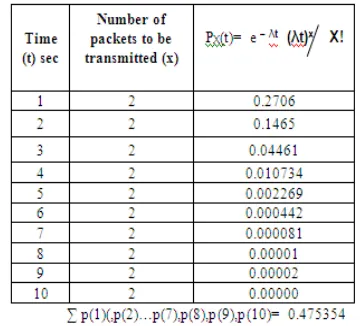
Scenario: Consider a scenario, in which events occurred simultaneously in neighbouring clusters then priority is calculated by using Poisson process
[image:8.595.314.494.534.697.2]An area under coverage is observed for 10 seconds. It is seen that the time period is utilized by transmitting frames which is sent as 2 packets per second. For any situation, the first and foremost frame to be transmitted is the independent frame. In the next seconds, significant changes are seen in the vicinity and so the packets are sent without any comparisons between frames. In every second, furtive changes appear in the vicinity. Now, quick transmissions of packets occur.
Table 1 Without Comparison of Packet between the cluster Heads and proxy Cluster Head
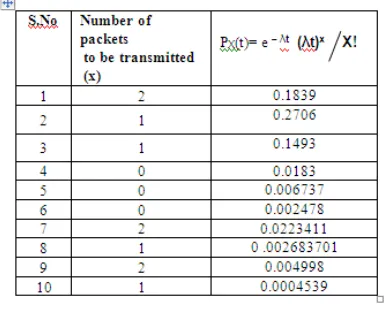
destination lower. So, each frame is compared with the previous frames and data, which has not occurred previously, alone is transmitted.
It is seen that, after comparison, the first 2 seconds are utilized by transmitting the independent frame which is sent in 2 packets. In the next 4 seconds, no significant changes are seen in the vicinity so the packets sent will be null after comparison is over. After the 6th second, furtive changes appear in the vicinity.
The probability, from the results shows a significant rise thus increasing the overall probability which bears more benefits such as less loss of data, increased battery power, reliability of data. Consequently the algorithm shows that the end to end support is given by two phases, which are comparison and transmission
Table 2 Comparison of packet frames between the cluster Heads and proxy Cluster Head
5. CONCLUSION
The paper presented is on DSOHRP, a hybrid scheme for efficient video communications over WMSNs. It comprises of an actuation sensor, adaptive routing based algorithm. This ensures removal of the redundant frame by comparing with stored frame in the proxy cluster and efficiently manages power. Moreover, in order to improve the video transmission rate, the proposed scheme is utilized an intelligent video packet, which selectively removes jitter prior to their transmission by means of habitual routing factors such as energy, success ratio, time to delivery of packets, End–to-end reliability is subsisted as well, for multimedia transmission by sending the same amount of data in
two arcs to prevent loss of data, making every event important. Future enhancements are also possible by including Query driven data routing perspectives.
REFERENCES
[1] Samir Medjiah and Toufik Ahmed.streaming multimedia over WMSNs:an online multipath routing protocol . Int. J. Sensor Networks, Vol 11,No.1,pp10-21, 2012. [2] G A Montoya,,Vel quez-Villada C, Donoso Y.
Energy Optimization in Mobile Wireless Sensor Networks with Mobile Targets Achieving Efficient Coverage for Critical Applications. INT J COMPUT COMMUN, Vol 8,No.2,pp 247-254, 2013.
[3] Samina Ehsan, Bechir Hamdaoui. A Survey on Energy-Efficient Routing Techniques with QoS Assurances for Wireless Multimedia Sensor Networks[j]. IEEE Communications Surveys and Tutorials,Vol14,No.2, pp265-278,2012.
[4] Salda Ziane and Abdelhamid Mellouk.Dynamic Routing Optimization based on Real Time Adaptive Delay Estimation for Wireless Networks.The IEEE symposium on Computers and Communications. pp381-386, 2010.
[5] M.Zhang, Hauswirth L.Shu Z .Multi priority Mutipath selection for Video Streaming in Wireless Multimedia Sensor Networks.Ubiquitous Intelligence and Computing,Springer Berlin/Heidelberg,LNCS 5061: pp 439-452,2008.
[6] Ian Akyildiz F, Tommaso Melodia, Kaushik R Chowdhury . A survey on wireless multimedia sensor networks. Computer Networks,Vol.51, No.4,pp921–960, 2007.
[7] Akkaya K, Younis M.A survey on routing protocols for wireless sensor networks.Ad Hoc Networks, Vol ,3,No.3,pp.325–349, 2005. [8] Maurits de Graaf, Energy efficient networkings
via dynamic relay node selection in wireless networks [J].Ad Hoc Networks Vol 11,No.3,pp 1193–1201, 2013.
[image:9.595.99.294.390.548.2]