ISSN: 1992-8645 www.jatit.org E-ISSN: 1817-3195
320
ARABIC HANDWRITTEN WORD CATEGORY
CLASSIFICATION USING BAG OF FEATURES
1AYMAN AL-DMOUR, 2MOHAMMED ABUHELALEH
1&2
College of Information Technology, Al-Hussein Bin Talal University, Ma’an, Jordan.
E-mail:
1[email protected], [email protected]
ABSTRACT
Human writing is highly variable and inconsistent, and this makes the offline recognition of handwritten words extremely challenging. This paper describes a novel approach that can be employed for the offline recognition of handwritten Arabic words. Through conceptualizing each word as single, inseparable objects, the proposed approach aims to recognize words in accordance with their complete shape. This paper describes the bag-of-visual-words method that has been effectively employed for the purposes of classifying images. The study consisted of four main stages. First, a set of image patches were sampled for the purposes of training, and a speeded up robust features (SURF) descriptor was then used to characterize them. Following that, the bag-of-visual-words model was employed through constructing the K-means clustering algorithm. A histogram of each whole world was developed and this operated as the image feature vector. This was employed to train the support vector machine classifier, which was then able to effectively distinguish between handwritten words. Finally, the effectiveness of the proposed method was tested using a sample of Arabic words extracted from the IFN/ENIT database and the results indicated that the bag-of-visual-words approach represents a promising method of recognizing and classifying
handwritten Arabic words. The best and averagerecognition rates of the proposed method are 85% and 75%
respectively.
Keywords: Arabic Handwriting, Word-Level Recognition, Support Vector Machine,
Bag-Of-Visual-Words, IFN/ENIT Database.
1. INTRODUCTION
Systems by which the handwriting recorded on electronic or photographed documents can be recognized are still relatively limited, and significant resources have been invested in the development of effective and efficient approaches to handwriting recognition. Many systems have emerged including those that can recognize the handwriting in historical documents as a means of performing research, storing data, identifying authors, etc.
Image processing is at the heart of these recognition systems. Image processing involves applying several mathematical approaches to determine the information contained within a photograph, video, picture or scanned document. Once an image has been processed, a group of parameters are identified and subsequently applied to further images in an attempt to decipher their content. Image processing has been effectively applied in a range of different industries and for various purposes including handwriting analysis, satellite image processing, analyzing medical
images, etc. It also allows handwritten documents to be analyzed in a mathematical fashion to gain important insights and secondary information. There are two main methods by which the images in documents can be processed: offline methods and online methods [1].
Online recognition involves processing
electronic images. In the case of handwriting recognition, this typically involve analyzing signatures and writing as they are in the process of being created on a notepad, tab or via a special pen. The system assess a number of spatial and temporal factors, including the movement of the writer’s hand and the velocity of the pen, and then attempt to determine how these directly impact the shape of the resulting words.[2],[3]
ISSN: 1992-8645 www.jatit.org E-ISSN: 1817-3195
321 the process of recognition. On the contrary,
handwriting is unpredictable and varies
significantly from one individual to another.
Handwritten word recognition (HWR) has found an application in many different industries and for different purposes including verifying signatures and bank checks, forensic analysis, and to read historical documents [4],[5]. There are generally two approaches to HWR: a segmentation-based approach or a segmentation-free approach. The segmentation-based approach involves dividing the words that are being analyzed into different characters in an attempt to decipher each of the letters that makes up the word. However, segmentation itself can be problematic because handwriting is typically cursive and, as such,
different characters can be merged. The
segmentation-free approach takes this into
consideration by treating each word as an entirety and attempting to form a holistic view of its shape, structure, and general features.
Regardless of the type of recognition system that is used, word recognition generally involves five main processes: data collection, preprocessing, segmentation, feature extraction, and classification. For the purposes of acquiring data that can be applied and tested within a given system, researchers can either use their own datasets or can make use of global datasets that are available in central databases. During the preprocessing phase, a range of morphological and mathematical techniques are applied on the dataset to perform
baseline detection, binarization, grayscale
conversion, normalization, binarization, skew correction, slant detection and correction, noise removal, etc. If the input image is a sentence, this sentence is segmented into separate words and each word then be holistically processed to identify and extract density features, hierarchical features, structure-based features, etc. These extracted features are subsequently compared with the main features of the training images and, in the event a match is found, the image is recognized. A range of classifiers can be used during the classification process. These include neural networks, the hidden Markov model (HMM), support vector machines (SVMs), and k-nearest neighbor (KNN), etc. [6],[7].
Human writing is inconsistent and highly
variable. This makes offline handwriting
recognition very challenging. This is particularly the case with the offline recognition of Arabic handwriting, which incorporates overlapping, infinite variations in shapes and the fusion of diacritical points, etc. A holistic approach to handwriting recognition has been proposed as a means of overcoming this problem.
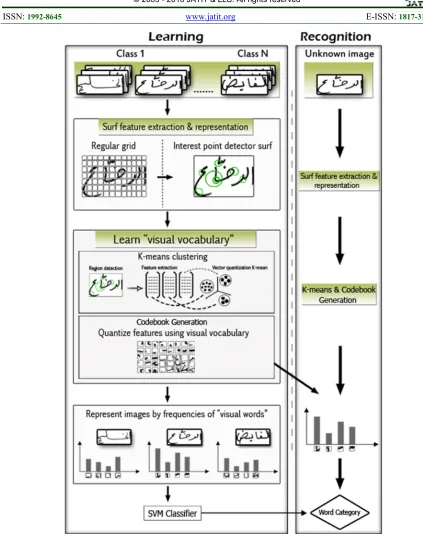
This study describes a novel algorithm that employs a bag-of-visual-words approach [8–11] that is similar to those techniques that have previously been employed for scene and object recognition. We start by sampling patches from a set of handwritten Arabic words and then employ the SURF [12] descriptor to develop descriptions for these words. The SURF descriptor, as opposed to the SIFT descriptor, was chosen for this project because it represents a more straightforward, efficient and robust method of describing words [13]. Following that, the bag of visual words was constructed through the application of the K-means clustering algorithm and the SURF descriptors of the sampled words were subsequently quantized according to the bag of words. Histograms were developed to depict the patches, and these were treated as the image feature vectors. Finally, the feature vectors were trained, and the SVM classifier was obtained.
The process by which the images were processed is depicted in Figure 1. The experimental results that were achieved on the sample data set highlighted how the proposed method was promising as an offline handwriting recognition method.
ISSN: 1992-8645 www.jatit.org E-ISSN: 1817-3195
[image:3.612.88.511.65.599.2]322
Figure 1: The Process Of Word Recognition
2. LITERATURE REVIEW
While there are a relatively limited number of studies available that have examined the methods by which the word recognition of offline Arabic handwriting can be performed. The main studies in this area are summarized below.
ISSN: 1992-8645 www.jatit.org E-ISSN: 1817-3195
323 researchers concluded that a hybrid approach to word recognition can improve the performance of the system.
El-Hajj et al. in [15] studied a 1D HMM offline handwriting recognition method that was based on an analytical methodology. Using a set of language-independent elements that were based on binary images, they employed a combination of upper and lower baseline parameters to identify a subcategory of baseline-dependent aspects that considered variations in the upper and lower elements of the words. The system developed in this research also
developed character models without the
requirement for performing character
pre-segmentation. The model was tested using a set of Arabic words that consisted of handwritten Tunisian village names that were extracted from the IFN/ENIT database. The researchers concluded that their system was effective.
El-Hajj et al. in [16] developed a model for the off-line recognition of Arabic city names. Their approach employed the HMM application in combination with an independent and dependent baseline. A sliding window was employed to extract these features. The resulting system merged three homogeneous HMMs that varied only in terms of the sliding window orientation and that had the same topology as the reference system. The outputs of the research indicated that a combination of classifiers were more effective that a classifier in isolation when attempting to recognize slant corrected images. The researchers concluded that their method represented an effective approach to the identification of a significant number of orientation angles.
Authors in [17] developed an Arabic word recognition system that was designed to read off-line Arabic words that had been written by hand. The research was based on the notion that both
feature extraction and explicit grapheme
segmentation could effectively interpret Latin cursive handwriting. The researchers developed a hybrid HMM/NN system that utilized a new shape-based alphabet for the purpose of recognizing
handwritten Arabic characters through
incorporating recognition techniques that were designed to interpret elements of handwriting that are specific to Arabic writing. The researchers validated their approach with data from the IFN/ENIT database and concluded that the system they had developed achieved an 87% level of accuracy.
In [18] authors developed an offline word recognition system that was designed to interpret Arabic text through the application of structural techniques. The researchers segmented a line of Arabic text into words and sub-words and extracted dots to leave parts of Arabic words. These parts were then slant corrected through the application of an innovative slant estimation and correction approach that employed polygonal approximation. The researchers argued that this approximation approach represented a robust, high-resolution method.. The researchers validated the system using data from the IFN/ENIT database and concluded that it offered a 79.58% level of accuracy.
AlKhateeb et al. in [19] described a study involving a HMMs-based offline recognition method. The text recognition method proposed involved three stages: classification, feature extraction and preprocessing. During the first stage, the words were normalized and segmented. Following that, feature extraction was performed for each of the segmented words through the use of a sliding window that moved across each mirrored image of the word. The researchers developed a combined system that utilized the features that had been extracted to classify the words. The researchers used intensity features to train the HMM classifier and then improved the recognition rate by re-ranking the features using structure-like features. The researchers validated the system using data from the IFN/ENIT database and concluded that it offered a promising level of accuracy.
In [20] Mahjoub et al. proposed a technique for recognizing handwritten words produced by multiple Arabic writers that was based on multiple Bayesian networks. First, images of words were dissected into blocks, and a vector for each block was developed. K-means was then used to group the low-level elements, such as Hu and Zernik moments. Finally, the researchers used four different Bayesian networks classifiers: Dynamic Bayesian network (DBN), forest augmented naïve Bayes (FAN), naïve Bayes and tree augmented naïve Bayes (TAN), to classify the entire image of the handwritten Tunisian city name. The results of the research indicated that FAN and DBN achieved reliable rates of recognition.
ISSN: 1992-8645 www.jatit.org E-ISSN: 1817-3195
324 outputs of which consisted of features that had been obtained from the image rows and columns. Through the application of coupled classifiers, the vertical and horizontal observation streams were combined into a Dynamic Bayesian Network (DBN). The researchers proposed a novel method by which the word baseline and other features could be extracted in a straightforward manner and subsequently used to develop feature vectors. Some of the features employed within the recognition
approach were statistical, based on pixel
distribution and local pixel configurations, and others were structural, based on the interpretation of ascenders, descenders, diacritic points and loops. The method was tested on handwritten Arabic words that were extracted from IFNIENIT, and the results indicated that the application of PGM achieved reliable rates of recognition.
Recently in [22] researchers developed a word recognition method that employed the Dynamic Hierarchical Bayesian Network (DHBN). The objective of the study was to develop insights into the composition of Arabic handwriting that could
be subsequently employed to reduce the
convolution of word recognition by applying a partial-recognition approach. The words were segmented using a vertical smoothed histogram projection with a variety of width values to reduce segmentation errors. Following that, HU and Zernike moments were used to extract the characteristics of each cell that do not change as a result of rotation, scaling and translation. The sub-characters were then approximated at the lowest Bayesian network level while the characters were approximated at the highest level. The entire word was assessed using a dynamic BN. The proposed approach was tested using words that were extracted from the IFN/ENIT database, and the researcher concluded that the method offered a 62-78.5% level of accuracy.
3. FEATURE EXTRACTION
The bag-of visual-words model has been widely adopted in computer vision area as a simple model that can be applied in information retrieval and natural language processing. The model includes two main parts: recognition and learning. It starts with obtaining the local descriptors which are then quantized into a codebook. On the other side, the model describes the image as words collection. The procedure begins by sampling the points of interests in order to get the local descriptors for each image. To apply this step, Hessian-based detector is used to find the interest points and
SURF descriptor is used in order to describe the produced points [23]. The next step is to quantize the produced descriptors. K-means clustering algorithm is used for this step to produce a codebook. In this step, the feature vectors of the images are presented as histograms to represent the visual words. The produced feature vectors are then trained and the SVM classifier is obtained. This step ends the learning part and produced the material needed for recognition part. The recognition process is then starts to compare the image code words with the other code words that are classified by VSM classifier to produce the match Figure 1 shows the details of model.
3.1 SURF Descriptor
SURF proposed by [23] carries many advantages comparing to other descriptors. Mainly, it has the capability to compute distinctive descriptors very fast. It has also the ability to apply common image transformations features efficiently. These features includes: image scale changes, rotation, small changes in viewpoint, and illumination changes. This section describes briefly the SURF processes.
The SURF detector specifies the interest points using cropped Hessian Matrix proposed by [24] due to its promising performance and accuracy. The SURF detects the matched pieces located at the
maximum determinant. This evolves low
computational cost when dealing with the integral images. SURF also improved the Hessian Matrix performance by using the Box filters to approximate second order Gaussian derivatives.
3.2 Interest Point Specification
SURF uses Haar wavelet x,y with 64 dimensions responses proposed by [25] to describe the contents within the interest neighborhood’s point. The use of 64 dimensions reduces the time needed for feature matching and computation and it increases the robustness. In addition, SURF follows the Laplacian sign to represent the indexing step to increase the descriptor robustness and the matching speed.
The process starts by indexing the pieces based on the collected information from the surrounding area of the interest point. Then, a square region is constructed for each area with its own SURF descriptor. The last step evolves the matching between the two images features.
4. CLASSIFIER: SVM
ISSN: 1992-8645 www.jatit.org E-ISSN: 1817-3195
325 SVMs can be describe as kernel-based methods, which raises from the statistical learning theory [26].Due to their practicality and inherited solid theoretical foundation, these supervised learning methods have emerged as a promising approach to classify the data, and to solve regression tasks. One of the main advantage of SVMs compared to neural networks approaches (like the back propagation model) is that it involves optimizing over convex cost function. Thus, any local minima is actually a
global minima, where in neural network
approaches, false minima can be obtained. In addition, a key factor in the superior performance of SVMs is the use of this Structural Risk Minimization (SRM) principle. By using this principle, SVMs minimize the upper bound of the errors. In contrast, other methods uses Empirical Risk Minimization (ERM) that minimize the error on training data.
SVMs can be described as the process of identifying the hyper plane that divide the training data set, based on the provided labeling
mechanizing. For instance, let n be the set of
training points, where any training point is
represented by two valuesn x , y .xis the
representation of the given point in d-dimensional
space, and y ∈ 1,1 is two levels class label.
Now assume that we have a hyper plane that classify (separate) between the negative and the positive data sets. This hyper plane is represented
by w x b 0. wis the normal to the hyper
plane, and b is the bias. The distance between the
origin point 0,0 and the hyperplane is represented
by ‖ ‖| |. In this direction, SVMs is the process of identifying the hyperplane that maximize the margin between the data sets, since relatively small margin can results in false classification. The problem of maximizing the margin can be
represented as quadratic problem, with the following objective function:
min , ‖w‖ C β
Subject to the following constraint:
y w x b ! 1 β , β ! 0 ∀i
βare positive parameters, and in order for these
constraints to be satisfied, the values of β must be
sufficiently large. Cis a slack parameter that can be
used to control the behavior of the objective.
Increase the value of C results in enforcing the
formulation to obtain narrow or hard margin. Some of the well-known kernels are the linear, polynomial, and the radial basis function (RBF).In this work, we use the RBF kernel. Compared to the other kernels, the RBP has the smallest number of parameters that we need to determine in advance. Also, in term of computation, the RBF is significantly more stable compared to the polynomial kernel, which is recognized as a special case of the RBF. Thus, the RBF can handle relatively higher number of tasks' structures.
5. EXPERIMENTAL RESULTS
ISSN: 1992-8645 www.jatit.org E-ISSN: 1817-3195
326
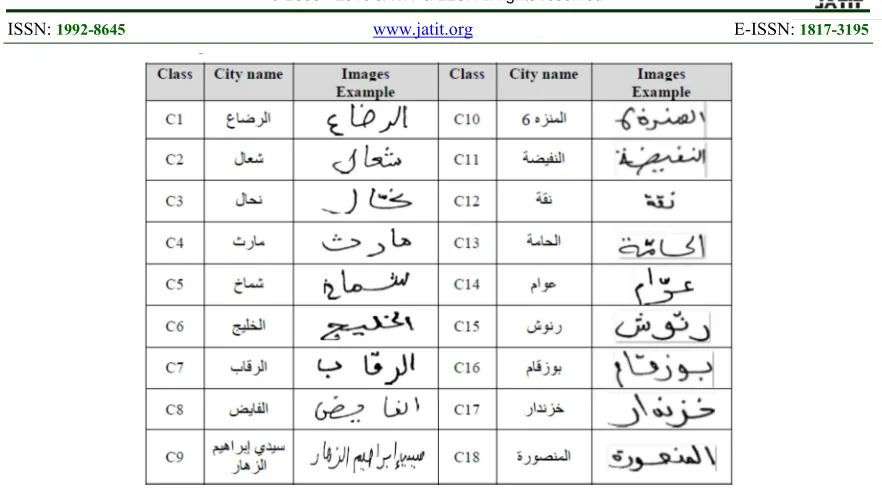
Table 1. Names Of Cities Employed Within The Experimental Model [20].
Three subsets of each class were identified and employed for training, validation, and testing purposes. Of the images available, 50% were used to develop the model parameters, 25% were used to adjust the parameters, and the remaining 25% were used to test the developed model. The effectiveness of the technique applied within this research was verified formula for each class using the following:
Success rate Number of successfully classified words Total number of words in class
The analysis of the outputs of the experiment revealed that the word images were successfully identified in terms of the respective classes in the majority of cases. However, there were some instances in which the technique was unable to accurately identify the word images. A summary of the experimental results is presented in Table 1. The rate of success was 85%, which is comparable to the results outlined in existing literature, as outlined in Table 4.
Research Recognition Rates
Touj et al. (2007) 80.44%
El-Hajj et al. (2005) 75-86%
Menasri et al. (2008) 83-92%
Pechwitz & Maergner (2003)
84%
Al Khateeb et al. (2011) 66%
Mahjoub et al. (2013) 83.7 %
[image:7.612.87.528.67.313.2]Proposed 75-85%
Table 4: Comparative results using IFN/ENIT Database The system that was developed and tested as part of this research did produce some errors. Such errors are common across existing studies in this area. An analysis of the literature reveals that the error rates that are typical in experiments of this nature can be divided into two main areas: segmentation and recognition. Both of these present significant challenges and result from the fact that human writing is highly variable and inconsistent [27], [28]. Because the Arabic language is characterized by shape discrimination, slants, overlaps and fusion of diacritical points, it is
particularly different to interpret using
segmentation and recognition methods.
6. CONCLUSION
ISSN: 1992-8645 www.jatit.org E-ISSN: 1817-3195
327 word images. The proposed system was tested on a subset of words from the IFN/ENIT database and the results indicated that this approach offers a significant improvement in terms of recognition rate than some of the alternative methods that are available.
As a future work, we plan to extend this research to different feature extraction and classification methods to minimize error rates. These result from the fact that human writing is highly variable , inconsistent and cursive nature of Arabic handwritten text.
REFRENCES:
[1] R. Plamondon and S. N. Srihari "On-line and
off-line handwriting recognition: a
comprehensive survey". In: IEEE
Transactions on Pattern Analysis and
Machine Intelligence 22(1), 2000, 63–84. [2] Y. Bengio, Y. LeCun, C. Nohl, and C. Burges,
“Lerec: A NN/HMM hybrid for on-line
handwriting recognition,” Neural
Computation, vol. 7, no. 6, 1995, pp. 1289– 1303.
[3] S. Bercu and G. Lorette, “On-line handwritten word recognition: an approach based on
hidden Markov models,” in Proceeding Third
Int. Workshop on Frontiers in Handwriting Recognition, 1993, pp. 385–390.
[4] S. Bercu and G. Lorette, “On-line handwritten word recognition: an approach based on
hidden Markov models,” in Proceeding Third
Int. Workshop on Frontiers in Handwriting Recognition, 1993, pp. 385–390.
[5] A. Vinciarelli, “A survey on off-line cursive
word recognition,” Pattern recognition, vol.
35, no. 7, 2002, pp. 1433– 1446.
[6] Ashwin S Ramteke, Milind E Rane, “A Survey on Offline Recognition of Handwritten Devanagari Script,” International Journal of Scientific & Engineering Research Volume 3, Issue 5, ISSN 2229-5518, May-2012.
[7] Yousri Kessentini, Thierry Paquet and AbdelMajid Benhamadou, “A Multi-Stream HMM-Based Approach for Off-line Multi-Script Handwritten Word Recognition,” journal pattern recognition letters volume 31, issue 1, January 2010.
[8] D.A.R. Vigo, F.S. Khan, J. van de Weijer, T. Gevers. The Impact of Color on
Bag-of-Words Based Object Recognition,
International Conference on Pattern
Recognition (ICPR), 2010, pp. 1549 - 1553.
[9] Sonal Gupta, Joohyun Kim, Kristen Grauman and Raymond J. Mooney, Watch, Listen & Learn: Co-training on Captioned Images and
Videos, European Conference on Machine
Learning and Principles and Practice of Knowledge Discovery in Databases (ECML
PKDD 2008) , Antwerp, Belgium, September
2008.
[10] Wu-Jun Li, Dit-Yan Yeung. Localized
content-based image retrieval through
evidence region identification., IEEE
Computer Society Conference on Computer
Vision and Pattern Recognition (CVPR),
Miami Beach, Florida, USA, 20-25, June 2009.
[11] Fei-Fei and P. Perona. A Bayesian Hierarchical Model for Learning Natural
Scene Categories. IEEE Comp. Vis. Patt.
Recog, 2005.
[12] H. Bay, A. Ess, T. Tuytelaars and L.Van Gool.
SURF: Speeded Up Robust Features.
Computer Vision and Image Understanding, vol.110, no.3, 2008, pp.346-359.
[13] D.G. Lowe. Distinctive Image Features from
Scale- Invariant Keypoints. International
Journal on Computer Vision, vol.2, no.60, 2004, pp.91-110.
[14] S Touj, Najoua Essoukri Ben amara, H Amiri. A hybrid approach for off-line Arabic handwriting recognition based on a Planar Hidden Markov modeling, International Conference on Document Analysis and Recognition (ICDAR 2007). 2007
[15] R. El-Hajj, L. Likforman-Sulem, C. Mokbel.
Arabic handwriting recognition using
baseline dependent features and Hidden Markov Modeling, IEEE 8th International Conference on Document Analysis and Recognition (ICDAR 2005), Seoul, 2005, 893-897.
[16] R. El-Hajj Mohamad, L. Likforman-Sulem and C.Mokbel, “Combining Slanted-Frame Classifiers for Improved HMM-Based Arabic Handwriting Recognition”,Pattern analysis and machine intelligence, vol.31, no.7, 2009. [17] F. Menasri, N. Vincent, E. Augustin and M.
Cheriet, ”Shape-based Alphabet for Off-line Arabic Handwriting Recognition”, Proc. of the 9th ICDAR, 2007, pp 969–973, Curitiba, Brazil.
[18] M.T. Parvez and S. A. Mahmoud,
“Arabic handwriting recognition using
ISSN: 1992-8645 www.jatit.org E-ISSN: 1817-3195
328 [19] J. H Al Khateeb, J. Ren, J. Jiang and H.
Al-Muhtaseb, “Offline handwritten Arabic
cursive text recognition using Hidden Markov Models and re-ranking”, Pattern Recognition Letters, vol. 32, 2011, pp.1081– 1088. [20] M. A. Mahjoub, N. Ghanmy, K. Jayech, I.
Miled, “Multiple models of Bayesian
networks applied to offline recognition of Arabic handwritten city names”, Computer Vision and Pattern Recognition, 2013. [21] A. Khémiri, A. Kacem Echi, A. Belaïd and M.
Elloumi, "Arabic handwritten words off-line
recognition based on HMMs and
DBNs," Document Analysis and Recognition
(ICDAR), 2015 13th International
Conference on, Tunis, 2015, pp. 51-55. [22] Khaoula Jayech, Mohamed Ali Mahjoub, and
Najoua Ben Amara Arabic Handwritten Word Recognition based on Dynamic Bayesian Network The International Arab Journal of Information Technology VOL. 13, NO. 3, May 2016
[23] H. Bay, A. Ess, T. Tuytelaars and L.Van Gool.
SURF: Speeded Up Robust Features.
Computer Vision and Image Understanding, vol.110, no.3, 2008, pp.346-359.
[24] K. Mikolajczyk and C. Schmid. Indexing based on scale invariant interest points. In ICCV, volume 1, 2001, pp 525 -531.
[25] D. Lowe. Distinctive image features from scale-invariant keypoints, cascade _ltering approach. IJCV, 60(2):91- 110, January 2004. [26] Vapnik, V. The nature of statistical learning
theory. N.Y.: Springer. 1995.
[27] Ayman Al-Dmour and Fares Fraij,
Segmenting Arabic Handwritten Documents into Text lines and Words, International Journal of Advancements in Computing Technology(IJACT) Volume 6, Number 3, May 2014,pp. 109-119.