ENTERPRISE RESOURCE PLANNING ADOPTION
LIFECYCLE: A SYSTEMATIC LITERATURE REVIEW
1,2
MARINA HASSAN, 3MARZANAH A. JABAR, 3FATIMAH SIDI, 4YUSMADI YAH JUSOH,
4
SALFARINA HASSAN
1
Department of Computer Science, Faculty of Computer Science and Information Technology, Universiti Selangor
2
Department of Information System and Software Engineering, Faculty of Computer Science and Information Technology, Universiti Putra Malaysia
3
Associated Prof., Department of Information System and Software Engineering, Faculty of Computer Science and Information Technology, Universiti Putra Malaysia
4
Senior Lecturer, Department of Information System and Software Engineering, Faculty of Computer Science and Information Technology, Universiti Putra Malaysia
E-mail: [email protected], [email protected], [email protected],
4
[email protected], [email protected]
ABSTRACT
Enterprise Resource Planning (ERP) system is a tool in managing the business management function from operational, tactical and strategic management towards the emergence of Information System (IS). The awareness of ERP technology is slowly develops among industrial and non-industrial people. Needs of having the ERP software is not properly discussed within the organization. Some does not even know why they need ERP in their industry. Few in depths knowledge regarding ERP will bring to failure of ERP adoption. The paper was conducted by following systematic literature review methods. Literature search related to ERP methodology reveal 345 papers. After further reading done, 133 papers were identified as a key paper for the topics chosen. Obtaining details understanding of ERP lifecycle, we identified 19 ERP lifecycle papers from the literature from 2009 to 2015. We do a tabulated table to check on ERP needs, objectives and factors affecting the success of ERP adoption in order to get the expectations usage of ERP. A conceptual model of ERP lifecycle will be developed to understand the stages on how to choose a quality ERP software based on the organization objectives. The paper includes the details stages in ERP adoption lifecycle so that user will know specifically what they need to do before or during implementing ERP software. This paper expected to bring awareness about the ERP model itself and to acknowledge people that ERP model will lead to the successful of ERP adoption in developing their business.
Keywords: ERP models, ERP success factors, ERP adoption
1. INTRODUCTION
Enterprise Resource Planning (ERP) is getting well known among people in various industries nowadays. In last decades, ERP popular among the industry peoples in managing and organizing their business. Nowadays, ERP can be used in different type of businesses [1], [2], [3], [4]. Knowledge about ERP is not limit at the early stages of implementation only. Organization who involve in ERP solutions must have a full knowledge before, during and after ERP solutions being implement to make sure of successful in implementing the ERP software [5].
Much of the earlier literature on ERP tends to focus more on adoption of ERP in early stage of implementation [2], [3], [6] critical success factors (CSFs) issues [4], [7], [8], [9], [10] and implementation methodologies [11], [12], [13], [14]. Few studies have appeared to check on other elements of ERP. When we talk about to implement ERP in organization, it means that we need to be ready in all proportions that relate with ERP [15].
assessment on implementing ERP [16], [17], [18]. Risk management is equally important in managing successful of ERP implementation.
ERP software sometimes can be abandoned by the organization without noticing it. Maintaining the usage of ERP after the production or project finished is important to sustain the effectiveness and efficiency of the production. It is very difficult to do maintenance of ERP system [17]. This is because sometimes the progress and outcomes are usually uncertain and not the same as expected. Identification of factors that affected the risk also can determine the success of ERP projects. Many studies have shown that selective of model is needed to verify and validate the successful of ERP implementation.
In the competitive business environment of the twenty first century many companies have decided to use a popular tool that has evolved over the past few decades. ERP software is the descendant of MRPII offers the "answer" to the economic and productivity troubles of manufacturing and service enterprises. ERP system becomes very brilliant software because of the capability in controlling and managing all data and information by using centralized databases to perform effective and efficient works in a minimal required time among departments in big organizations.
The main goal of ERP system is to improve and streamline internal business processes, which typically requires reengineering of current business processes. To achieve this goal, user needs to identify what is the stage that they need to verify before they implement and choose ERP software. The most general categorizations for these stages normally consists of three phases [2]:
(1) Pre-implementation
(2) Implementation
(3) Post-implementation
This above categorization of phases has also been used to study the critical success factors of ERP project [8]. In order to make sure the project
success, organization must identified and
understand the model they choose to earn the effectiveness and efficiency of the ERP software.
There is lot of researchers doing research on ERP lifecycle. They want to know which model suite best for ERP lifecycle. Each model has its own factors and benefits to ERP implementation.
Both academic and industrial peoples still do the talks on this model even though ERP has been already nearly 54 years emerge in this world.
The objective of this paper is to acknowledge user that in choosing a good quality of ERP software or modules, we have to know the details step of selecting the software. In this paper, we will describe you the details and provide you the way of selecting ERP software in an appropriate manner accordingly to those three phases that already being discussed previously.
The searching strategy and ways to conduct systematic literature review is covered in research methodology section. Meanwhile, understanding the details of the ERP lifecycle concepts covered in literature reviews on ERP lifecycle section. The propose ERP lifecycle model will than discuss in next section. Finally, the outcomes of the systematic literature review presented in ERP lifecycle model diagram together with conclusions, and also offer the research findings.
2. RESEARCH MODEL
The method used for this paper to conduct this systematic literature review based on the approach proposed by Barbara Kitchenham [19]. Few steps were proposed by author in manage the literature in systematic manner to facilitate the finding of the most relevant information in the field of research. Steps to conduct systematic literature review was identified as developing reviewing protocol, identification and selection of primary studies, data extraction and lastly reporting the results. The reported result is the core activity that leads to the knowledge gap finding. In order to identify the researchable problem, knowing knowledge gap is important in conducting research. Research must starts with a problem and questions. ERP effectiveness and efficiency on its adoption research relies on the following research questions that need to be answered during the literature review process.
Q1:What are the activities of ERP lifecycle? Q2:What is the effects of ERP implementation towards it activities?
Q3:Is there any relation between activities and phases in ERP?
Finding journal names that relate to Enterprise Resource Planning software and its critical success factors is the first way of paper article searching strategy. Journal name and their associated publisher are identified in the initial step that helps in developing review protocol as mention by Barbara Kitchenham [19]. Article searching strategies become very irritating as the improper searching strategies reveal many searching results and give difficulties in identifying and selecting primary studies. Enterprise Resource Planning, critical success factors, ERP methodology, ERP implementation, ERP phases have been identified as affiliated terms of main domain of ERP. Searching strategy divided into 2 sections; ERP and level of management. Search terms sections and its affiliated terms shows in Table 1 below. Affiliated terms play an important role in locating the paper, as different author using different term but pointing to same meaning.
Table 1: Search term used
Section ID
Section Affiliated Terms
/Keyword
1 ERP Enterprise Resource
Planning
ERP methodology ERP implementation ERP phases
2 ERP
lifecycle
Pre-Implementation Implementation Post Implementation
Our searching strategies have revealed 345 papers that associated with ERP and its lifecycle. There is certain filtration process used in the process of finding the primary paper. Figure 1 shows the stage by stage filtration process that help in displaying primary result that closely related to ERP implementation towards its lifecycle. As an initial stage article searched by keyword in a cross section manner using available electronic databases such as IEEE, ACM, Wiley and etc. 133 articles have been identified using these searching strategies which later refined by article publication year. Article which is published in latest 5 years used to locate the latest finding on the field of research. Search result displayed 76 articles from various journals and conference preceding which then refine to dedicated journal and conference proceeding. First level reading has been conducted in order to obtain primary article that reflects the idea of ERP implementation towards its lifecycle.
Figure 1: Primary Paper Filtration Process Flowchart
3. LITERATURE REVIEW
The basic element of this paper is about ERP Adoption Lifecycle. These elements will be described with respect to the most relevant literature. From literature review, we identified that most researchers identified ERP in three different stages [2], [3]. They are few researchers’ mention that ERP lifecycle consists of five stages only (Chuck, Charlie & Bruce, 2010). Some researchers determined that ERP adoption lifecycle depends on 2 stages which is “to-be” and “as-is” [13].
Based from literature review, we decide that ERP need to follow those three stages as per mention previously [6]. But we also agree that the five stages mention in other researchers’ works also needed in ERP adoption lifecycle. Upon those research made, we identified few elements or stages that must be put in ERP adoption lifecycle model [20]. The identified stages are:
(1) Pre-evaluation screening
(2) Package evaluation
(3) Project planning phase
(4) Gap analysis
(5) Reengineering
(6) Configuration
(7) Implementation team training
(8) Testing
(10) End-user training
(11) Post implementation
From above identified phases, we decide to classified it and break down it to three main phases like suggested figure 2 below:
Figure 2: ERP Lifecycle
From this identified main phase, we classified again the activities stated before and adapt it in the main focus phases. Figure 3 shows each activities or stages that have been classified under the three main phases.
Figure 3: Activities in ERP Lifecycle
Detail explanation about those three phases will be elaborate in ERP adoption lifecycle section.
4. ERP ADOPTION LIFECYCLE
4.1 Pre-Implementation Phase
In this pre-implementation phase, we decide there will be three main activities that will involve directly which are pre-evaluation screening, package evaluation and project planning.
Figure 4: Activities in pre-implementation phase
In pre-evaluation screening, user need to do more works in determining which vendors and which ERP modules need to be implement to their organization. Only few selections of vendors and ERP modules will be identified. Selection of vendors and ERP modules will be based from the user business needs. User will be advice to eliminate those packages that are not suitable for the company’s business process. At this stage also, user will analyzing the entire packages offer before reaching a decision that is not a viable solution. This procedure will be very time consuming process due to user must be really knowledgeable on the ERP selection so that user will choose only the best solution that they really need to cater for their business purposes [21].
the most important factor that should be kept in mind is that none of them are perfect. Sometimes user need to make a customization of their ERP software due to availability of the ERP modules. User must really understand and identified either their ERP can be integrated with other modules or not [8]. Or else problem will occur if the software is not compatible to each other. The objective of the selection process is not to identify a package that covers each and every requirement [11]. But the main objective is to find a package that is flexible enough to meet the company’s needs. Some important points in evaluating ERP software modules to be implementing in their business include few criteria which are:
• Functional fit with the company’s business
processes.
• Degree of integration between the various
components of the ERP system.
• Flexibility and scalability of the ERP software.
• Complexity of the implementation.
• User friendliness.
• Quick implementation.
• Ability to support multi-site planning and
control.
• Technology – client/server capabilities,
database independence, security.
• Availability of reference sites.
• Total costs, including costs of license, training,
implementation, maintenance, customization, and hardware requirements.
The third activity in pre-implementation phase is the project planning phases. In these activities, details of how to achieve the implementation are decided. Top level management or strategic management plays an important role in this implementation. They will decide what type of ERP modules to be implementing after few stages of refinement done. Technical people and user also play a part in this activity in contributing to build the time schedules, deadlines until the project plan document is developed. Roles are identified and responsibilities are assigned at this phases [22]. The organizational resources that will be used for the implementation also need to be identified detail. Project planning phase is the phase which organization will plan:
• the ‘what to do’ in case of contingencies.
• how to monitor the progress of the
implementation.
• what control measures should be installed.
• what corrective actions should be taken when
things get out of control.
The project planning is usually done by a committee constituted by the team leaders of each implementation group. Involvement of strategic management level is needed so that they will know on the approval budget of implementing the ERP software.
4.2 Implementation Phase
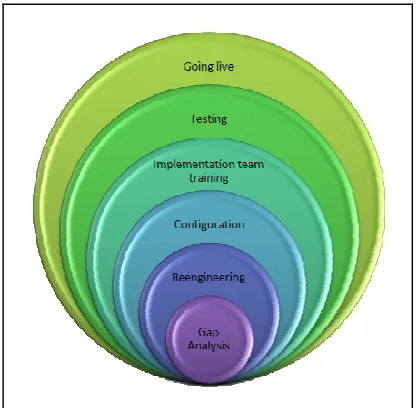
In implementation phase, there will be six main activities that we already identified which are gap
analysis, reengineering, configurations,
implementation team training, testing and going live.
Figure 5 shown the relationship between each activity done in implementation phase.
Figure 5: Activities in implementation phase
[image:5.612.312.520.334.538.2]problematic issue for the company’s BPR (Business Process Reengineering) [10][18].
Second activity in implementation is
reengineering. In this phase, human factors are taken into account. Reengineering has 2 different connotations which are:
• The first connotation is the controversial,
involving the use of ERP aid in downsizing efforts.
• The second use of word reengineering, in the
ERP field, refers to an ERP implementation model initially designed and used with much success by the ‘Big Six’ consulting firm [9].
Third activity in implementation is by doing configuration. This is the main functional area of the ERP implementation. Configuring a company’s system reveals not only the strengths of a company’s business process but also – and perhaps more importantly – it’s weaknesses. Weaknesses of the company need to be identified earlier as to find and reduce gap of the problems. ERP vendors are constantly striving to lower configuration costs [23].
The fourth activity that relates with
implementation is implementation team training. Around the same time that the configuration is taking place, the implementation team is being trained, not so much on how to use the system, but how to implement it. This is the phase where the company trains its employees to implement and later, run the system. The ERP vendors and the
hired consultants will leave after the
implementation is over. It is very vital that the company recognizes the importance of this phase and selects those employees who have the right attitude which is people who are willing to change, learn new things and are not afraid of technology. At the same time company also need to identified the quality and good functional knowledge of their workers [4].
Next activity in implementation will be the critical activity in implementing ERP software. Testing of the ERP software is needed in making sure that the software is really useful to the company. This is the phase where you try to break the system. The system is configured and now you must come up with extreme-case scenarios, system overloads, multiple users logging on at the same time with the same query and so on. The test cases must be designed specifically to find the weak links
in the system and these bugs should be fixed before going live [24].
Last activity in critical crucial implementation phase is going live. On the technical side, the work is almost complete which means the data conversion is done, databases are up and running; and on the functional side, the prototype is fully configured and tested and ready to go operational. Once the system is ‘live’, the old system is removed, and the new system is used for doing business.
4.3 Post Implementation Phase
In post-implementation phases, there are two main activities identified by authors which are end user training and post implementation itself. Figure 6 shows the relationship between these two activities in completing the ERP adoption lifecycle.
Figure 6: Activities in Post Implementation Phase
In post-implementation phases, the first activity held was ends user training. These phase where the actual users of the system will be given training on how to use the system. The employees who are going to use the system are identified. Their current skills are noted and based on the current skill levels, they are divided into groups. Each group will be given training on the new system. Training is important as the success of the ERP system is in the end of the end-users [18].
Next activity which is the last activity to be implement is the maintenance mode or also known
Post-implementation phase is very critical. There should be people, within the company, who have the
technical powers to make the necessary
enhancements to the system as and when it’s required. The system must be upgraded and when the new versions or new technologies are introduced technical person need to maintain the existing ERP software. An organization can only get the maximum value of these inputs if it successfully adopts and effectively uses the system.
5. CONCLUSIONS
5.1 Discussions
In this paper we presented an ERP adoption lifecycle model. We believe that the future of ERP research can be depending on this ERP adoption lifecycle. We do hope by following the suggested phases it can help in enhancing and give extra knowledge on the ERP itself to the organizations.
Figure 7 shows the overall ERP adoption lifecycle phases together with its activities involved.
Figure 7: ERP Adoption Lifecycle
5.2 Future Works
For future enhancement, we will propose what are the elements or attributes that will effects the ERP adoption lifecycle in its whole adoption. This factor will than hope to make the system more efficient and effective in driven the organization towards globalization.
REFRENCES:
[1] E. T. G. Wang, C. Chia-Lin Lin, J. J. Jiang,
and G. Klein, “Improving enterprise resource planning (ERP) fit to organizational process
through knowledge transfer,” International
Journal of Information Management, vol. 27, no. 3, pp. 200–212, Jun. 2007.
[2] J. Razmi, M. S. Sangari, and R. Ghodsi,
“Developing a practical framework for ERP readiness assessment using fuzzy analytic
network process,” Advances in Engineering
Software, vol. 40, no. 11, pp. 1168–1178, Nov. 2009.
[3] A. Hakim and H. Hakim, “A practical model
on controlling the ERP implementation
risks,” Information Systems, vol. 35, no. 2,
pp. 204–214, Apr. 2010.
[4] P. Ifinedo, B. Rapp, A. Ifinedo, and K.
Sundberg, “Relationships among ERP post-implementation success constructs: An
analysis at the organizational level,”
Computers in Human Behavior, vol. 26, no. 5, pp. 1136–1148, Sep. 2010.
[5] E. T. G. Wang, S.-P. Shih, J. J. Jiang, and G.
Klein, “The consistency among facilitating factors and ERP implementation success: A
holistic view of fit,” Journal of Systems and
Software, vol. 81, no. 9, pp. 1609–1621, Sep. 2008.
[6] A. Elragal and M. Haddara, “The Future of
ERP Systems: look backward before moving
forward,” Procedia Technology, vol. 5, no.
2212, pp. 21–30, Jan. 2012.
[7] Y. Su and C. Yang, “A structural equation
model for analyzing the impact of ERP on
SCM,” Expert Systems with Applications,
vol. 37, no. 1, pp. 456–469, Jan. 2010.
[8] J. Ram, D. Corkindale, and M.-L. Wu,
“Implementation critical success factors (CSFs) for ERP: Do they contribute to
implementation success and
post-implementation performance?,”
International Journal of Production
Economics, vol. 144, no. 1, pp. 157–174, Jul. 2013.
Pre-Imple menta tion
Imple ment ation
[9] J. Y. T. Chang, E. T. G. Wang, J. J. Jiang, and G. Klein, “Controlling ERP consultants:
Client and provider practices,” Journal of
Systems and Software, vol. 86, no. 5, pp. 1453–1461, May 2013.
[10] R. Seethamraju and D. Krishna Sundar, “Influence of ERP systems on business
process agility,” IIMB Management Review,
vol. 25, no. 3, pp. 137–149, Sep. 2013. [11] J. May, G. Dhillon, and M. Caldeira,
“Defining value-based objectives for ERP
systems planning,” Decision Support
Systems, vol. 55, no. 1, pp. 98–109, Apr. 2013.
[12] S. Rouhani and A. Zare Ravasan, “ERP success prediction: An artificial neural
network approach,” Scientia Iranica, vol. 20,
no. 3, pp. 992–1001, Dec. 2012.
[13] P.-A. Millet, “Toward a model-driven,
alignment-oriented ERP methodology,”
Computers in Industry, vol. 64, no. 4, pp. 402–411, May 2013.
[14] D. Aloini, R. Dulmin, and V. Mininno, “Modelling and assessing ERP project risks:
A Petri Net approach,” European Journal of
Operational Research, vol. 220, no. 2, pp. 484–495, Jul. 2012.
[15] T. Gürbüz, S. E. Alptekin, and G. Işıklar Alptekin, “A hybrid MCDM methodology for ERP selection problem with interacting
criteria,” Decision Support Systems, vol. 54,
no. 1, pp. 206–214, Dec. 2012.
[16] P. S. Azevedo, M. Romão, and E. Rebelo, “Advantages, Limitations and Solutions in the Use of ERP Systems (Enterprise Resource Planning) – A Case Study in the
Hospitality Industry,” Procedia Technology,
vol. 5, pp. 264–272, Jan. 2012.
[17] C. Lopez and J. L. Salmeron, “Dynamic risks modelling in ERP maintenance projects
with FCM,” Information Sciences, vol. 256,
pp. 25–45, Jan. 2014.
[18] D. Aloini, R. Dulmin, and V. Mininno, “Risk management in ERP project introduction:
Review of the literature,” Information &
Management, vol. 44, no. 6, pp. 547–567, Sep. 2007.
[19] B. Kitchenham, O. Pearl Brereton, D. Budgen, M. Turner, J. Bailey, and S. Linkman, “Systematic literature reviews in software engineering – A systematic
literature review,” Information and Software
Technology, vol. 51, no. 1, pp. 7–15, Jan. 2009.
[20] P. Ifinedo, “Examining the influences of external expertise and in-house computer/IT
knowledge on ERP system success,” Journal
of Systems and Software, vol. 84, no. 12, pp. 2065–2078, Dec. 2011.
[21] “50. 2013 - A Conceptual Model for Adaptive ERP Courses.pdf.” .
[22] V. S. Lai, C. K. W. Liu, F. Lai, and J. Wang, “What influences ERP beliefs — Logical
evaluation or imitation?,” Decision Support
Systems, vol. 50, no. 1, pp. 203–212, Dec. 2010.
[23] S. C. L. Koh, a. Gunasekaran, and J. R. Cooper, “The demand for training and consultancy investment in SME-specific
ERP systems implementation and
operation,” International Journal of
Production Economics, vol. 122, no. 1, pp. 241–254, Nov. 2009.
[24] A. Kumar and P. C. Gupta, “Identification and Analysis of Failure Attributes for an
ERP System,” Procedia - Social and
Behavioral Sciences, vol. 65, no. ICIBSoS, pp. 986–991, Dec. 2012.