MORPH- SYNTACTIC ANALYSIS OF ARABIC WORDS
BY DETERMINISTIC FINITE AUTOMATON (DFA)
1HAMMAD BALLAOUI,2EL HABIB BEN LAHMAR,3NASSER LABANI
1Department of Math and Computing, Faculty of Science, Chouaib Doukkali, University, LAMAI, El
jadida, Morocco.
2Hassan II University- Casablanca,Ben M’sik, Faculty of Science, Information Technology and
Modeling Laboratory, Cdt Driss El Harti, , BP 7955 Sidi Othman Casablanca, Morocco.
3Department of Math and Computing, Faculty of Science, Chouaib Doukkali University,
LAMAI, Eljadida, Morocco.
1E-mail: [email protected],2[email protected],,3[email protected]
ABSTRACT
In this article we introduce a technical analysis that permits; on the one hand, to help the user to discriminate optimally the morphological results of a word in an Arabic text and to identify its nature (noun or a verb) on the basis of these prefixes, suffixes and its particles of attributions. On the other hand, we can determine the syntactic results of each analyzed word on the basis of the context. In this humble work, the approach has two steps: In the first stage, the study focuses on a broad analysis of words on the basis of Arabic rules. Then, in the second stage, we can clarify a technique based on a deterministic finite automaton (DFA), which is designed to treat the chosen words character by character in the sense of a suitable transition. In the final output and via different labels, the system determines the nature, the gender and number for each automated word.
Keywords: Arabic Language, Automatic Natural Language Processing, Deterministic Finite Automaton (DFA), Disambiguation, Labeling, Morph-syntactic Analysis.
1. INTRODUCTION
Thanks to the advent of Internet and search engines, where the problem is not anymore the access to the information [1], the Arabic language natural processing has known these last years (since 2000, so far) a true ascent whether it is on various scientists plans (the design of the Latin-Arabic or Latin-Arabic-Latin scientific dictionaries and the mechanisms which allow to handle concepts in ontology ...), or social factors (the encouragement of the Arabic researchers to develop and improve their searches …) or economic (sale of products and computing software …); all that is done by the emergence of a very important number of the technical inventions (TI)such as the automatic translators of texts, spell-checkers of errors, and automatic generators of summaries … etc. [2]. But even with these technical developments, there are still several difficulties in the automatic treatment bound by the characteristics of the Arabic language
and agglutinative morphology; it’s a very similar textual construction of the words in morphological, syntactic and semantic form. Besides that, the Arabic written texts are completely characterized by the absence of the (diacritic) short vowels [4], which led to the domination of the ambiguity.
The improvement of the disambiguation is in the development of the last TI revolution and the massive explosion in quantity of information. The need for improving and designing the new methods and the techniques of treatment, and in particular, the necessity of labelling the words in the Arabic texts through considerable applications
or by systems of suitable studies, as seen by examples of the automatic treatment by the system of (DFA) for the morpho-syntactic and sometimes semantic detection[5] words. It's in this context that we undertake this work.
2. STATE OF THE ART
The analysis classify words according to their morpho-syntactic categories and identify named entities[6] in order to achieve the highest level applications, such as information retrieval, automatic translation, answer questions, etc.
Approaches:
Various works are interested in the objective analysis of the Arabic words and the elaboration of the morpho-syntactic analyzers allows reaching this goal and which can be gathered in the form of three approaches [7]:
The symbolic approach: which is based on the method of segmentation of the word in prefixes, infixes and suffixes with the aim of extracting the root of the Arabic word? Among these analyzers which were developed and lean on this approaches [8], [9], [10], [11], [12], [13], [14][15].
The statistical approach: this approach calculates the possibilities and the probability that a prefix, a suffix and a radical can appear together in a database of the words [16] .The most used statistical methods are the methods for overseen learning. This type of method bases itself on a mechanism of learning from a big corpus of pre-labelled texts [17].
The hybrid approach: it presents a combination of these two approaches [18].
The majority of the works handling the Arabic morphology were rather interested in the morphological labelling [19] by basing itself on methods of learning and a light morphological analysis [20], [21], [22], [23]. Nevertheless, we notice a big need to the complete and available systems for analyzing the Arabic words because of their morphological complexities; the difficulty is incomparable, because the ambiguities are more frequent and the Arabic words are difficult to analyze.
Nevertheless, we can mention activities concerning the morphological analysis for the Arabic language:
-The system of morphological analysis of Arabic texts [24] which gives for every word a single morphological analysis, at first met a valid
solution. -Therefore, the system can give an adequate solution without the context of the word.
-The system of morphological analysis of the Arabic nouns [25] allowing only the determination of morphological characteristics of the Arabic nouns.
-The Sebawai system [8] is a system of surface morphological analysis used in an application of search for information. This system has two main models: the first one uses a list of pairs of the Arabic word-root, while the second model in the draft of the Arabic words in the entrance, tries to build prefix - suffix - radical's possible combinations, and gives them as it lets the possible roots of a given Arabic word.
-The AraParse system [26] is based on linguistic resources (lexicons and grammars) in wide cover and allows dealing with Arabic vowel, no - vowel or partially vowel … The system consists of two main functions: a function of morpho-lexical analysis and the function of parsing.
-The morphological analyzer in states finished of Xerox [12] uses the generic tools of Xerox, based on models of languages implemented by automatons in finished states. It gives every word all its lists of possible morphological characteristics.
-The Web based Arabic morphological analyzer [27] is a morphological analyzer treating Arabic texts with no vowel derived of the Internet. It bases itself on a method of contextual exploration which allows to identify the word and its contextual characteristics and thus to look for the affixes which can be associated to it.
paintings of corrections to determine the correct combinations which attach prefixes and suffixes to the words.
-Morphological analyzer Sakher allows to determine the possible root of an Arabic word by deleting all affixes and suffixes, and by describing the morphological structure of this one [28]. Unfortunately, there is not a trial version for this analyzer.
-The labeler ASVM of Diab [22], which is an adaptation to Arabic of the English system YamCha, is pulled on an annotated corpus named Arabic Treebank [29]. This corpus connects the label THE POS Arabic with the label Penn English, what allows to group several label Arabic in a single label English, for example, to connect all adjectives with a single class [30].
-The MORPH2 system [31] is is a morphological analyzer for Arabic in which no vowel developed within the team LARIS (RESEARCH LABORATORY in Computing in Sfax-Tunisia). The lexicon used in MORPH2 is stored in fifteen files XML of different structures.
3. MORPHOLOGY
The study of morphological analysis consists in decomposing the words into morphemes [32], [33] without taking into account grammatical links between the latter [34]. This part of study has the objective of giving the majority of labels to the Arabic words with their affixes. But it does not mean that we can find difficulties at the level of the morphology in particular, when it comes to case study of the morphemic structure of some Arabic words.
We distinguish in our study, two categories of words (we consider an exception for the words accompanied by particles): the first category includes words consisting of prefixes (eg. the word ﻊﻤﺠﯾ / pick), infixs (eg, the word ﻲﺳاﺮﻛ / chairs) and suffixes (eg the word ﺔﻔﻗو / pause) and the second category established by consonants identical to affixes, but they are different from these last morphemes (eg. نﻮﻤﯿﺳ ,رﺎﺴﯾ ,ﻞھأ...). The difficulty of treatment by the system DFA can seem morphologically between these two categories.
4. SYNTAX
The syntactic study is considered as an important task for the detection of the Arabic words and the decision concerning the phenomenon of the ambiguity of the words. The
main difficulty of parsing is to make the link enter the program (the continuation of words) and the grammar out of context of the language.
The parsing has an objective to recognize the sentences belonging to the syntax of the language. It contains the following three parts:
i) The syntactic categories: labels that allow us to resemble words together according to various characteristics.
ii) The syntactic rules and the construction of the sentences: syntactic rules allow us to combine words into sentences.
iii) The transformation of the sentences: the different forms of transformations of the sentences for the same type of sentence. Example: ﺚﺤﺒﯾﺐﻟﺎﻄﻟا
ﻦﻋ
ﺔﻣﻮﻠﻌﻤﻟا / student research information. This sentence can be transformed to the questioning of ways ﻦﻋ ﺐﻟﺎﻄﻟا ﺚﺤﺒﯾ أ ,؟ﺔﻣﻮﻠﻌﻤﻟا ﻦﻋ ﺚﺤﺒﯾ ﺐﻟﺎﻄﻟا
ﺔﻣﻮﻠﻌﻤﻟا ؟ , ﻞھ ﺚﺤﺒﯾ ﺐﻟﺎﻄﻟا ﻦﻋ ﺔﻣﻮﻠﻌﻤﻟا ؟
5. THE AUTOMATIC TREATMENT OF THE WORDS BY DFA
Let us consider the set E, associated by all the attributes which give a label for every Arabic word: verbal prefixes (Pv) or nominal (Pn), verbal suffixes (Sv) or nominal (Sn), verbal particles (Vp) or nominal (Np) and others (time, kind, number …):
E= {Mo, N,V, Pn, Pv, Vp, Np, Sn, Sv, Pc, Sc,FN, SM, SF,PF,PM,DF,DM, FSN, FSV, FDN, FDV, MSN, MSV, MDN, MDV, FPN, FPV, MPN, MPV}. And the character esp represents the space between the words and other punctuations: esp = { '،' .‘،'', ' ' ، ; '' :' }.
A. Verbs analysis by DFA
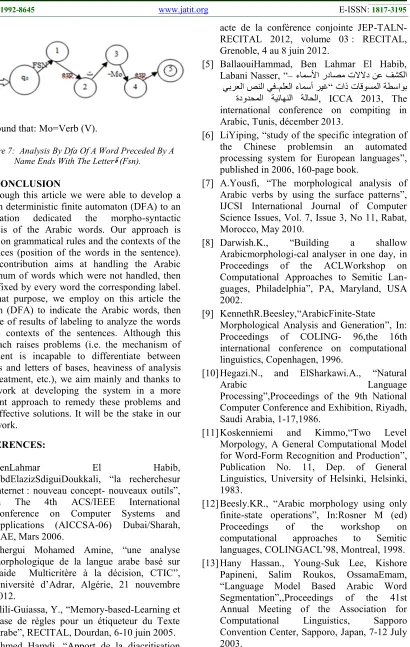
The system (DFA), which allows us to analyze the Arabic verbs with their prefixes and suffixes, is the following form (figure 1).
Explanation (corresponding figure 1) : Between the following states we have: - From q0to state 6 we get V(present).
-From q0to state 8 we get FDV present/past
or MDV present/past.
- From q0to state 11 we get FPV present.
- From q0 to state 15 we get MPV
- From q0to states 17 and 19 we get a word
(Mo)
-The state schematized by represents the
initial state, and the symbol represents the final state.
-The symbol * represents any Arabic letter. And c: */ {أ ،س ،ي ،ت ،ن} (any character, excepted the following morphemes: (أ ،س ،ي ،ت ،ن)).
Note:
-Writing (Mo) means any word.
B. Nouns Analysis by DFA
The Arabic nouns handled by the system (DFA), according to their affixes (prefixes and suffixes) are the following form (figure 2).
Explanation(corresponding figure 2) : Between the following states we have:
- From q0 to states: 9, 44, 45, 46, 47, 48 and 54 we get
a word (Mo).
- From q0 to states: 10, 13, 15, 17, 19, 21 and 23 we get
FSN (Feminine Singular Noun).
- From q0 to states: 11, 14, 16, 18, 20, 22 and 24 we get
a Noun (N).
- From q0 to state: 31 we get MSN (Masculine Singular Noun).
-From q0 to state:33 we get FPN/MPN (Feminine
Plural Noun or Masculine Plural Noun). - From q0to state: 41we get Particle (P).
- From q0to state: 42 we get Often Particle
(P).
6. THE ARABIC WORDS ASSOCIATED WITH PARTICLES
The Arabic particles are divided into three categories: first category concerns the relevant particles in verbs; the second category includes the particles in nouns; and the third involves the common particles between verbs and the Arabic nouns.
A. Examples of Particles Attributed by Verbs (Vp)
In this task of study, we consider a class of verbal particles which are frequently used. We obtain:
-Accusative Particles. They are four particles: {ﻲﻛ– ﻦﻟ- نذإ - ْنأ}.
-The particles of the source (رﺪﺼﻤﻟا فوﺮﺣ) which are formed by five particles: {ﻮﻟ - ﺎﻣ - ﻲﻛ - ّنأ- نأ}.
--The affirmative particles or "particles jussifs " (مﺰﺠﻟا فوﺮﺣ) formed also by five particles: { ﻢﻟ - ْنإ
– ّﻤﻟ ﺎ ﺮﻣﻷا مﻻ مﻻ
ﺔﯿھﺎﻨﻟا } (figure 3).
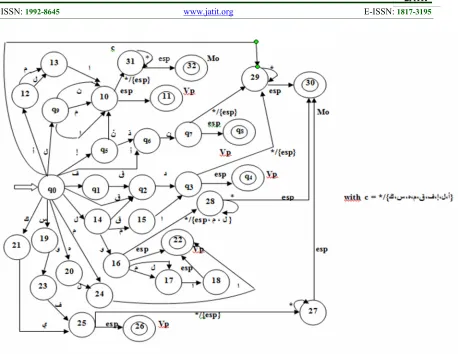
Explanation (corresponding figure 3) : Between the following states we have:
- From q0to state: 4 we get Particles of Verbs
(Vp)
- From q0 to state: 8 we get Particles of
Verbs (Vp)
- From q0to state: 11 we get Particles of
Verbs (Vp)
- From q0to state: 22 we get Particles of
Verbs (Vp)
B. Example of Particles Attributed by Names (Np)
The nominal particles are established with typical infinity:
-The prepositionsis are 17 particles: { ﻦﻋ - ﻰﻟإ -ﻦﻣ -ﻰﻠﻋ -ﻲﻓ -بر -فﺎﻜﻟا -مﻼﻟا -ءﺎﺒﻟا -ءﺎﺘﻟا -واﻮﻟا ﻰﺘﺣ -ﺬﻣ -ﺬﻨﻣ -ﻼﺧ -اﺪﻋ -ﺎﺷﺎﺣ
- }. (We insist in our study (DAF), in particular on the most frequent prepositions).
-Three particles of the oath: {واﻮﻟا - ءﺎﺘﻟا- ءﺎﺒﻟا}. -Particles of exception: {ﺎﺷﺎﺣ -اﺪﻋﻼﺧ -ﻻإ}.
-The particles of the most frequent interjections are :{ﺎﯾأ-يأ آ- -ﺎﯾ أ -}.
-Particles ّنإ "" And their group, and who are five particles: {ﻞﻌﻟ -ﺖﯿﻟ -ﻦﻜﻟ-نﺄﻛ - ّنإ}.
-Both particles of condition: { ْنإﻮﻟ- }. -Particles of the future: {فﻮﺳ}
-Three particles of the anticipation: {ﺪﻗ – ﺪﻘﻟ – ﺪﻘﻓ}.
-The particles of incentive (ﺾﯿﻀﺤﺘﻟا فوﺮﺣ) are five particles :{ﺎﻣﻮﻟ - ﻻﻮﻟ- ّﻼھ- ﺎﻣأ - ﻻأ}.
We notice according to the previous information that there are common verbal particles, and which have several functions (ex: ْنإ"": can consider on
q
one hand, as a particle of jussif and particle of condition on the other hand).
To avoid these iterations, we can select a set of the verbal particles Vp whatever is the category. Thus we have:
Vp = { ،ﻮﻟ ،ﺪﻘﻓ ،ﺪﻘﻟ ،ﺪﻗ ،فﻮﺳ ،نذإ ،ﺎّﻤﻟ، ْنأ ،ﻲﻛ ،ّنأ، ﺎﻣ،ﻦﻟ ،ﻢﻟ {ﺎﻣﻮﻟ ،ﻻﻮﻟ ،ﻼھ ،ﺎﻣأ ،ﻻأ،ﻻ ، ْنإ.
-The particle which indicates the surprise ( فﺮﺣ ةﺄﺟﺎﻔﻤﻟا): {اذإ}.
-Both particles which indicate the detail of an event in a sentence: {ﺎﻣإ -ﺎّﻣأ}.
-Three particles of “attanbih/(ﮫﯿﺒﻨﺘﻟا فوﺮﺣ)”: { ﺎھ اﺬﻧأﺎھ)
( ﺎﻣأ
ّﻻأ }.
Either the set of the nominal particles following one (where, we avoid in this case all the particles who have a low frequency in the Arabic texts):
Np = { -ﻰﻠﻋ - ﻦﻋ - ﻰﻟإ -ﻦﻣ-ءﺎﺘﻟا -ءﺎﺒﻟا-مﻼﻟا -فﺎﻜﻟا ﻰﺘﺣ ﻲﻓ
- - ﻻإ -ﺎﯾأ -يأ آ- -ﺎﯾ-ﻞﻌﻟ -ﺖﯿﻟ -ﻦﻜﻟ -نﺄﻛ - ّنإ– ﺎﻣإ ﺎّﻣأ - اذإ - ﻻأ} (figure 4).
Explanation:
- Where: c= */ {،إ ،أ ،م ،ح ،آ ،ع ،ف ،ك ،ل} Between the following states we have:
- From q0to state: 3 we get Particles of
nouns (Np).
- From q0to state: 10 we get Particles of
nouns (Np).
-from q0to state20 we get a word (Mo).
-from q0to state: 24 we get a word (Mo).
7. THE ARABIC WORDS IN CONTEXTS IN THIS STAGE
We can label the Arabic words in contexts on the basis of the previous results in the following way:
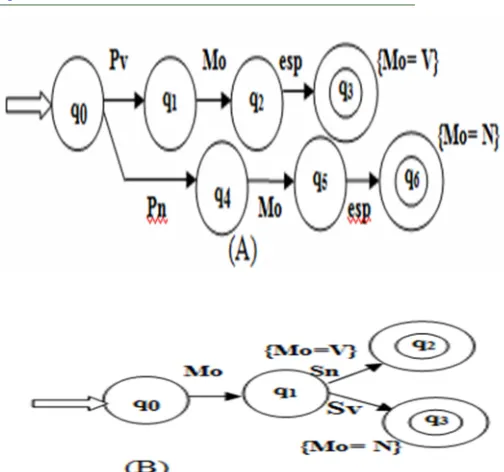
-The final word (state 3 or 6), can be considered as a verb (V) / noun (N), if it is preceded by Pv or suffixed by Sv/preceded by Pn or suffixed by Sn. Where the expressions:
(Pv_Mo or Mo_Sv/ Pn_Mo or Mo_Sn), impliquent que (Mo = V/ Mo=N).
Figure 5: The Treatment Of Arabic Names And Verbs Based Their Prefixes (A) And Their Suffixes (B).
-When one is in a sentence of the form: Mo1 Mo2 Mo3, such as Mo1 = V, Mo2 = V and Mo3 (unknown). Automatically the word Mo3 can be a name (if it is not up to the list of the particle) .example: (ﺎﯿﻟﺎﻋ خﺮﺼﯾ دﺎﻋ ﺪﻗ), as Vp(ﺪﻗ) V(دﺎﻋ) MSV( خﺮﺼﯾ: PV Mo) Mo(ﺎﯿﻟﺎﻋ). So:
[image:5.612.316.568.86.322.2]It is found that: Mo=Noun (N).
Figure 6: Example For Treatment Of Arabic Words In Contexts.
It is found that: Mo=Verb (V).
Figure 7: Analysis By Dfa Of A Word Preceded By A Name Ends With The Letterة(Fsn).
8. CONCLUSION
Through this article we were able to develop a system deterministic finite automaton (DFA) to an application dedicated the morpho-syntactic analysis of the Arabic words. Our approach is based on grammatical rules and the contexts of the sentences (position of the words in the sentence). This contribution aims at handling the Arabic maximum of words which were not handled, then we affixed by every word the corresponding label. For that purpose, we employ on this article the system (DFA) to indicate the Arabic words, then the use of results of labeling to analyze the words in the contexts of the sentences. Although this approach raises problems (i.e. the mechanism of treatment is incapable to differentiate between affixes and letters of bases, heaviness of analysis and treatment, etc.), we aim mainly and thanks to this work at developing the system in a more relevant approach to remedy these problems and find effective solutions. It will be the stake in our next work.
REFERENCES:
[1] BenLahmar El Habib,
AbdElazizSdiguiDoukkali, “la recherchesur Internet : nouveau concept- nouveaux outils”, in The 4th ACS/IEEE International Conference on Computer Systems and Applications (AICCSA-06) Dubai/Sharah, UAE, Mars 2006.
[2] Chergui Mohamed Amine, “une analyse morphologique de la langue arabe basé sur l’aide Multicritère à la décision, CTIC”, Université d’Adrar, Algérie, 21 nouvembre 2012.
[3] Tlili-Guiassa, Y., “Memory-based-Learning et Base de règles pour un étiqueteur du Texte Arabe”, RECITAL, Dourdan, 6-10 juin 2005. [4] Ahmed Hamdi, “Apport de la diacritisation
dans l’analyse morphosyntaxique de l’arabe”,
acte de la conférence conjointe JEP-TALN-RECITAL 2012, volume 03 : JEP-TALN-RECITAL, Grenoble, 4 au 8 juin 2012.
[5] BallaouiHammad, Ben Lahmar El Habib, Labani Nasser, “ ءﺎﻤﺳﻷا ردﺎﺼﻣ تﻻﻻد ﻦﻋ ﻒﺸﻜﻟا–
ﻢﻠﻌﻟا ءﺎﻤﺳأ ﺮﯿﻏ
ﻲﺑﺮﻌﻟا ﺺﻨﻟا ﻲﻓ “ تاذ تﺎﻗﻮﺴﻤﻟا ﺔﻄﺳاﻮﺑ ةدوﺪﺤﻤﻟا ﺔﯿﺋﺎﮭﻨﻟا ﺔﻟﺎﺤﻟا, ICCA 2013, The international conference on compiting in Arabic, Tunis, décember 2013.
[6] LiYiping, “study of the specific integration of the Chinese problemsin an automated processing system for European languages”, published in 2006, 160-page book.
[7] A.Yousfi, “The morphological analysis of Arabic verbs by using the surface patterns”, IJCSI International Journal of Computer Science Issues, Vol. 7, Issue 3, No 11, Rabat, Morocco, May 2010.
[8] Darwish.K., “Building a shallow Arabicmorphologi-cal analyser in one day, in Proceedings of the ACLWorkshop on Computational Approaches to Semitic Lan-guages, Philadelphia”, PA, Maryland, USA 2002.
[9] KennethR.Beesley,“ArabicFinite-State Morphological Analysis and Generation”, In: Proceedings of COLING- 96,the 16th international conference on computational linguistics, Copenhagen, 1996.
[10]Hegazi.N., and ElSharkawi.A., “Natural
Arabic Language
Processing”,Proceedings of the 9th National Computer Conference and Exhibition, Riyadh, Saudi Arabia, 1-17,1986.
[11]Koskenniemi and Kimmo,“Two Level Morpology, A General Computational Model for Word-Form Recognition and Production”, Publication No. 11, Dep. of General Linguistics, University of Helsinki, Helsinki, 1983.
[12]Beesly.KR., “Arabic morphology using only finite-state operations”, In:Rosner M (ed) Proceedings of the workshop on computational approaches to Semitic languages, COLINGACL’98, Montreal, 1998. [13]Hany Hassan., Young-Suk Lee, Kishore
[14]Khoja.S and Garside.,“Stemming Arabic text”, Computer Science Department, Lancaster University, Lancaster, UK, 1999. [15]A. Soudi, “A Computational Lexeme-Based,
Treatment of Arabic Morphology”, Doctorat d’état, Mohamed V University, Rabat, 2002 [16]Goldsmith J. and John. A., “Unsupervised
learning of the morphology of a natural language”,ComputationalLinguistics, 27(2), 1 53-198, USA, 2001.
[17]Inès Zribi, Souha Mezghani Hammami, Lamia Hadrich Belguith, “L’apport d’une approche Hybride pour la reconnaissance des entités nommées en langue arabe”, ANLP Research Group – Laboratoire MIRACL, TALN, Sfax – TUNISIE, 19-23 juillet 2010.
[18]Mansouri A, Suriani Affendey L. Mamat A.,” Named Entity Recognition Approaches”, IJCSNS International Journal of Computer Science and Network Security, VOL.8 No.2, Malaysia, February 2008.
[19]Hadrich Lamia Belguith, Nouha Chaâben,” Analyse et désambiguïsation morphologiques de textes arabes non voyellés”, TALN, Leuven, 10-13 avril 2006.
[20]Khoja Shereen, “Apt: Arabic part-of-speech tagger”, In NAACL Student Workshop, North American, 2001.
[21]El-Kareh S., Al-Ansary S., “An Arabic Interactive Multi- feature POS Tagger”, In Proceedings of the, ACIDCA conference, Monastir, Tunisia, 204-210, 2000.
[22]Daniel Jurafsky Mona Diab, and Kadri Hacioglu, “Automatic tagging of arabic text: From raw text to base phrase chunks”, In NAACL/HLT, Stroudsburg, 2004.
[23]El Jihad A., Yousfi A., “Étiquetage morpho-syntaxique des textes arabes par modèle de Markov caché”, In Actes de RECITAL 2005 : 649-654, Dourdan, 6-10 juin 2005.
[24]Tahir Y., Chenfour N., Harti M., “Realization of a morphological analyzer for Arabic Language text”, In Proceedings of American workshop on the information technology, 2003.
[25]Abuleil S., Evens M.., “Classify Arabic Nouns for Morphology Systems”, In Actes de TALN 2004, chicago, 2004.
[26]Ouersighni R., “A major offshoot of the DIINAR-MBC project: AraParse, a morphosyntactic analyzer for unvowelled Arabic texts”, In Actes de l’assemblée internationale du traitement automatique de la langue arabe(TALA), France, 2002.
[27]Atwel E., Sulaiti L., Osaimi S., Abu Ahawar B., “A Review of Arabic Corpus Analysis Tools”, Arabic Language Processing, JEP-TALN 2004.
[28]Mourad Mars, Georges Antoniadis, Mounir Zrigui,” Nouvelles Ressources et Nouvelles Pratiques Pedagogiques avec les outils TAL”, Laboratoire LIDILEM, Université Stendhal de Grenoble, France & Laboratoire UTIC, Université de Monastir, Tunisie, 2008. [29]M. Maamouri and A. Bies., “Developing an
Arabic Treebank: Methods, Guidelines, Procedures, and Tools Workshop on Computational Approaches to Arabic Script-based Languages”, COLING 2004, USA 2004.
[30]Iskandar Keskes, Farah Beanamara, Lamia Hadrich Belghuith, “Segmentation des teextes arabes en unités discursives minimale”, TALN- RECITAL 2003, 17- 21 juin, Les Sables d’Olonne, 2003.
[31]Chaâben N., Belguith L., “Implémentation du système MORPH2 analyse morphologique pour l'arabe non voyellé”, GEI’04, Monastir, Tunisie, 2004.
[32]Attia Mohamed A., “Devloping Robust Arabic Morphological Transducer Using Finite State Technology”, 8th Annual CLUK Research Colloquium. Manchester, UK. 2005.
[33]Mohamadi, T.S. Mokhnache, “Design and development of Arabic speechsynthesis”, WSEAS 2002, Greece, Sept. 25-28, 2002. [34]Bessou Sadik &Touahria Mohamed,
Figure1: Extract Of The Graph Of DFA To Handle The Arabic Verbs.
Figure3: Extract Of The DFA To Handle The Arabic Verbs With Their Particles.