ISSN: 1992-8645 www.jatit.org E-ISSN: 1817-3195
A MULTIDIMENSIONAL PAGERANK ALGORITHM OF
LITERATURES
KUN YU, XIAOBING CHEN, JIANHONG CHEN
Department of Computer Engineering, Huaiyin Institute of Technology, Huaian, Jiangsu, China
ABSTRACT
Literature is usually evaluated based on impact factor, cited information or the quality of literature database. Here, some more exact evaluation schemes and algorithms are investigated and a synthetically reputation model and its evaluation algorithm are proposed. The reputation model integrates much more information of academic interactions such as reviews and comments. The literature reputation can be modeled by complex relationships among literature, authors, publish sources and readers. The model is in some ways similar to the Google PageRank model. However, in the literature reputation model, the relationships belong to different classes and have different importance that is great different from PageRank which regard all links as the same class. We propose a centralized algorithm that can compute the reputation most exactly and a distributed version that can run in P2P systems. The simulations show that the reputation evaluation algorithm is convergent and efficient. The communication cost of the distributed algorithm is low if the convergence condition is relaxed.
Keywords: Reputation Evaluating, Literature Evaluation, PangRank, Impact Factor
1. INTRODUCTION
Nowadays, since science research activity
becomes more and more complex, the
communication and collaboration between different domains, different researchers and groups are more urgent and frequent. Development of computer and communication technologies facilitates knowledge acquisition in their studies, generally by BBS, Email, instant communication, WWW and so on, which has been necessities in daily activities. A main way to gain new knowledge in academic research is through reading scientific documents[1]. In this process, researchers often refine and store their thoughts into notes. This process information is usually important for others to enlighten them on their researches more effectively. In the discipline of education, it is called computer-supported collaborative learning (CSCL)[2] which can also been applied in science research.
However, the user groups and environment characteristics in research are very different to that in education. In researches, the user group is enormous and they are usually having not uniform benefits. Since everyone generally has the self-interested tendency and his academic thought is the valuable personal wealth, he is willing to share the information only when he can receive equivalent services. In game theory, it is a problem of reciprocity and incentive mechanism. On the other hand, the system is opened and any kind of
information can spread in it, so how to find out the good from enormous jumble information is considerable challenging [3]. Because of the lack of systematic support, it is often hard to choice the peer in this interaction.
Academic forums are a common form to share the process information, the organization structure of forums is more fitful for the above objective. However, the existed systems by now cannot provide the enough incentive and still cannot attract the researchers participating widely. The effective incentive mechanism depends on two factors: the assessment accuracy of user reputation and the strength of the incentive measure. User reputation assessment is the level of user participation which accuracy is the base of incentive efficiency. The strength of the incentive is proportionate to the ratio of the user utility to his cost. General forums system provides services (ways to improve users of utility) is too monotone, more incentive methods, for example recommending suited collaborators in researches according to user reputation, need to be employed to increase the incentive power to participate.
ISSN: 1992-8645 www.jatit.org E-ISSN: 1817-3195
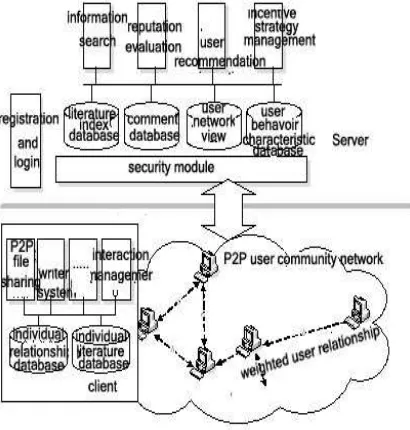
[image:2.612.92.297.272.487.2]offered. However, the file itself cannot be shared. User comments are offered in the form of forum. Reputation evaluation module implements the evaluation of literature quality, comment quality and user prestige (i.e. reputation). The user here may be a common user or the author of a literature. If he registers as an author, he can gain an initial reputation according to the quality of literature source. All users interact with each other in peer model and form a relationship network, which is achieved by client software. However, the client must send interaction information to the server platform in the same while, so the system can record the information into user network view database.
Figure 1: Cooperative Research System
Information search is a primary function that uses keyword search, importance sort based on information quality and information filter based on cooperative recommendation to improve the preciseness.
User recommendation can be used to search and locate the peers who have similar research interests
or learning demands. Reciprocity and
trustworthiness are also considered. The reputation is used to filter the users who cannot be trusted enough. The users with similar interests can be located based on their behaviors and the relationship network.
Incentive strategies management module
implement all kinds of incentive mechanisms. Up to now, the mechanisms include information access control based on user right, reputation-based object
choice for user recommendation, interference proof and the special setting to gain the right to read comments.
Obviously, reputations of various objects are key elements in searches, filters and incentive mechanisms. This paper proposes a centralized reputation model of elements in the forum system presented as Figure 1 to support cooperative learning and improve the learning efficiency of the researchers.
The forum can also be built in distributed mode that can be fit to the P2P structure of the client system. The software architecture is shown as Figure 2.
Figure 2: Client System Structure
The system applies Pastry to build the P2P storage system to implement the basic storing, locating, and searching. The data in the system, including papers, comments, citations and user records, are stored by a distributed way. Single-point failure can be avoided since there is no centralized server in the system. However, it brings new problems about information search and reputation calculation. They are key problems that will be considered in this paper.
2. BACKGROUND
[image:2.612.323.537.275.408.2]ISSN: 1992-8645 www.jatit.org E-ISSN: 1817-3195
Figure 3: Reputation Model
In the field of academic research, the reputation of a literature is the quantitatively evaluation of the literature value which can be simply estimated by the times cited of the literature. Nowadays, the most representative type of reputation is based on citation analysis, among which SCI [5] is the most famous one. However, SCI can only make quantitative evaluation on the periodical, which can't reflect the differences between different literatures in the same journal [6]. The SCI can only be counted on the data from the limited journal list, so 80% of a journal's IF is determined by only the 20% of the papers published[7].
Usually, academic reputation are not only judged based on single quantitative variable but through synthesizing multiple subjective factors. This method has great difficulty to implement, especially in literature search and recommendation, and dramatically increases the learning cost of researchers. The Index Copernicus Scientists[8] provides scientists with global scientists networking and international research collaboration, presents a multi-parameter career assessment system, which analyses the researcher individual profile. This goal is accomplished by a uniform scoring system that evaluates the contribution of scientists in three areas of professional activity: research potential, teaching potential and administration experience. The ResearcherID[9] is a website where researchers can register for a unique researcher ID number to
avoid the frequent difficulty of author
misidentification. In this way the researcher build their publication list using Web of Science and citations counts will be automatically updated in order to generate citation metrics. The h-index[10] for ResearcherID participants is also calculated. Remarkably, it was discussed very recently the need for speed the personal IF assessment in which the subject of calculation is the scientist and not the journal. This measure would really provide a more accurate measure of an individual’s citation rate. Journal to Field Impact Score (JFIS) [11] developed an alternative system for the journal impact
evaluation. Its source to compute index includes literatures, technical reports, notes and reviews.
PageRank algorithm [12], which is widely used in search engines, extends the reputation evaluation model and improves the validity of the information recommendation[13] through introducing weighted links in citation analysis. Google Scholar uses PageRank with a broad range of open data sources: peer reviewed literature from scholarly journals as also non-reviewed material like books, abstracts, technical and other reports etc. Popular journals are those that are cited frequently by journals could be with little prestige. These journals therefore could have a very high IF and a very low weighted PageRank. Bollen has proposed a measure that
combines Google’s PageRank with Impact
Factor[14]. The reputation model EngerTrust[15] employs the concept of explicit recommend and the computation method of the global reputation based on weighted recommending credibility reflects the thought of weighted citation analysis.
Our scheme is similar to PageRank and EngerTrust algorithm. However, different from all the schemes above, the data used to compute reputation includes users, literatures and comments, which come from data or activities in the academic forum as Figure 1 and can be easily obtained by systematic means. By combining various classes of data, the reputation model is steadier than single reputation. This paper will examine how to utilize the forum information to construct a complete reputation model and discuss the feasible reputation evaluation algorithm. The Evaluation algorithms in the model are proposed and analyzed below.
3. THE BASIC REPUTATION MODEL
This system is a platform for the researchers to communicate with the others and their literatures. The system is formed as a forum in which the basic unit is the literature. Other readers can discuss about a paper by feed his personal comments back. The explicit feedback can serve as reputation. Combined with impact factor and author's reputation, we can evaluate the literature more accurately.
ISSN: 1992-8645 www.jatit.org E-ISSN: 1817-3195
[image:4.612.100.276.165.244.2]user reputation will change dynamically if the discussion takes place. There are complex interactions among user reputation, literature reputation and review reputation, as shown in Figure 3.
Figure 4: Recommendation Relation
In order to effectively calculation user reputation,
the above reputation model needs some
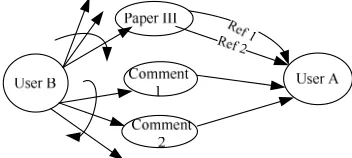
simplification. As links in PageRank or EngerTrust, is we can regard literature review or citation as recommendation which weight is decided by the presenter's reputation and the total amount of recommendations, as shown in Figure 4.
A. Literature reputation model
Literature reputation Rp shall consider at least
three factors: authors, citations and comments. The formula (1) shows the reputation evaluation of literature i:
1 2 3
1 2
( ) ( ( )) ( ( )) ( )
(1 3) ( )
p s a c
r
R i R s i R a i R i R i
λ λ λ
λ λ λ
= + +
+ − − − (1)
Here, Rs is the initial reputation of the journal or
the proceeding the article published on. Usually it is in proportion to its impact factor. If it has not impact factor, its initial reputation is 0.
Ra is the reputation of the first author, defined in
formula (3). Rc(i) is the score from comments about
it, as show in formula (4).
Rr denotes citation value of the article.
( )
( ) ( )
( )
p r
jrefi
R j
R i
ref j
∈
=
∑
(2)|ref(j)| donates the number of the citations of literature j.
B. User reputation model
User reputation reflects the user’s academic authority and the academic value of his articles and reviews. There are two kind of user reputation: reputation of author and common reader. Figure 4 shows that the relation between two users is built on comments or articles. Therefore, we can
calculate the two kinds of reputation by formula (3):
4 4
( ) ( ) (1 ) ( )
a p c
R u =λ
∑
R i + −λ∑
R j (3)Here, i is a paper issued by the author u, j is a comment about u.
C. Comment reputation model
Comment reputation of a comment k includes two parts: commentator reputation and the comments on this comment by other readers.
5
5 ()
( ( )) ( ( ), ( )) ( )
( ( )) ( ) ( , ) (1 )
5 ( )
c
isub k a c
R a k Val p k a k R k
comments a k
R i Val k i
comments i λ
λ
∈ =
+ −
∑
(4)
|comments(a(k))| denotes the total number the user a(k) has posted, Val(p(k),a(k)) is the score a(k) marks on p(k) and |comments(i)| is the total number of the comments posted by user i.
The comments form a tree structure that a father comment can be made up of a few child comments and each child may have a few children of him. The reputation formula is a recursive function: the end node in the comment tree is firstly evaluated by only Ra, his father then combines Ra and the
reputations of child comments gained just now.
D. Rank leak
The formula above is based on a hypothesis: all the elements and their relationship form a strong connected graph. However, it should not be true in most instances. There are always many isolated elements, which hasn’t any link to other elements. When a user hasn’t any paper citing other papers and no comment, he is called dangling user. Simultaneously, the dangling paper is the paper without any citation. A comment always has an out link so it hasn’t the dangling problem. Dangling entities can disturb the reputation evaluation of other entities because the “rank leak” problem. Rank leak will cause the reputations of all the elements go on decreasing until zero.
ISSN: 1992-8645 www.jatit.org E-ISSN: 1817-3195
importance of the literature, the user or the comment. However, the rank can. Rank is the order of the reputation in the literature set.
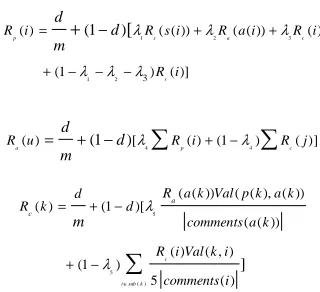
The modified formula is as below:
1 2 3
1 2 3
( ) ( ( )) ( ( )) ( )
(1 ) ( )]
(1 )[
p s a c
r
R i R s i R a i R i
R i
d d m
λ λ λ
λ λ λ
= + +
+ − − −
−
+
4 4
( ) (1 )[ ( ) (1 ) ( )]
a p c
R u d d R i R j
m λ + −λ
= + −
∑
∑
5
5 ()
( ( )) ( ( ), ( )) ( ) (1 )[
( ( )) ( ) ( , ) (1 )
5 ( )
]
c
isub k a c
R a k Val p k a k d
R k d
comments a k
R i Val k i
comments i
m
λ
λ
∈
= + −
+ −
∑
Here, d is a decay factor satisfying 0<d<1 and is usually set to 0.85. m is the number of all the entities in the system.
E. Initial reputation
Formula (1) can be used to compute initial literature reputation, here Rs(j) is the reputation of
journal or proceeding j can be gained by literature databases. By now we choose most well-known databases include SCI journals, EI source, the list of Chinese core journals of PKU. The normalized computing is as (5):
( )
1 - 0.5 SCI
( ) 0.3 EI
0.1 core journal list of PUK
factor j
s
j
R j j
j
∈
= ∈
∈
(5)
Then, with the initial literature reputation above, initial user reputation can be computed by (3).
A user who hasn’t published any paper will receive a reputation of 0.1 firstly.
F. Reputation evaluation algorithm
Evidently, reputation variables in (1)~(4) is not independent, so reputation computing is an iterative process and must be convergent. The adopted algorithm refers to the idea of recommendation networks, for example PageRank, which can be expressed in a common form of matrix:
( )
k ij jk
j
T =
∑
C ×CIt can be proved that globe reputation Tk is
converged to principal left eigenvector of recommendation trust degree matrix C, the condition of convergence is irreducibility and non-periodicity of matrix C.
The evaluation algorithm is detailed in Figure 5.
10 Procedure Evaluation 20 Begin
30 For each user u and literature i, Ra(u)=1 and
Rp(i)=1
40 calculate initial reputation Rp(i) by formula (1),
(2) and (5)
50 store reputations of all entities t in R(t)
60 recalculate user reputation Ra(u) with formula
(3)
70 recalculate literature reputation Rp(i) with
formula (1)
80 recalculate comment reputation Rc(k) with
formula (4)
90 store reputations of all entities t in R’(t) 100 if max ( ) '( )
t R t R t ε
∀ − > goto 50
[image:5.612.113.273.145.291.2]110 End
Figure 5: The Iterative Reputation Evaluation Algorithm
4. DISTRIBUTED IMPLEMENT OF
REPUTATION MODEL
P2P system, such as Pastry, supports storing, searching and locating the literature information and its reputation. But as explained above, reputation algorithm is iterative, so it isn’t suitable to be implemented in distributed mode, which will bring too high communication cost. On the other hand, the globe algorithm is static that it is unavailable in dynamic network. Furthermore, m cannot be gain in a P2P network because each peer has only a local view of the network.
ISSN: 1992-8645 www.jatit.org E-ISSN: 1817-3195
so the iterative algorithm will repeat for several times to gain stable globe reputation.
To decrease the communication overhead, P2PEval applies a dynamic partitioning strategy: Each node i is associated with a value called connection intension, which is decided by the amount of links from this node to an outer node j, denoted by L(i,j). When the node finishes a round
of iteration, it send the reputation update to the linked node j proportional to L(i,j). Obviously, nodes with higher connection intension will update their reputation more frequently.
Dangle entity is another problem. Apply the globe algorithm in each node can solve the problem locally but cannot diminish all the outside dangle entities. The local reputation model is shown as:
1 2 3
1 2 3
( ) ( ( )) ( ( )) ( ) (1 ) ( )]
(1 )[
p s a c
r
R i R s i R a i R i
R i
d d λ λ λ
λ λ λ
= + +
+ − − −
−
+
(6)
4 4
( ) (1 )[ ( ) (1 ) ( )]
a p c
R u = + −d d λ
∑
R i + −λ∑
R j (7)5
5 ()
( ( )) ( ( ), ( )) ( ) (1 )[
( ( )) ( ) ( , ) (1 )
5 ( )
] c
isub k a c
R a k Val p k a k
R k d
comments a k
R i Val k i
comments i
d λ
λ
∈
= + −
+ −
∑
(8)
Here, the decay factor is d that will not break the order computed by d/m.
Assuming x is an entity at node i, y is an entity at node j, and exists a relationship (x, y) from x to y. When i transport reputation data to j, the reputation will be amended as below:
1
( ) ( ) (1 )
( , )
R y R x d
L i j
= − − (9)
Here, we regard all the entities at a node as whole and each outlink can only gain mean reputation compensation that total is d. Therefore, the sum of reputations of all the entities in the system can keep invariable.
The P2PEval algorithm is detailed in Figure 6.
10 Procedure P2PEval (i) , i is node id 20 Begin
30 For each user u and literature x, Ra(u)=1 and
Rp(x)=1
40 calculate initial reputation Rp(x) by formula (6),
(7) and (5)
50 count L(i, j) for each peer j who has a link from i 60 while ( max ( ) '( )
t R t R t ε
∀ − > ) t is any entity at i
70 send reputation info to j with the probability of L(i, j)/ ∑L(i, x) , x denotes any peer who has a link from i.
80 receive reputation info from other peers
90 compute local reputation by globe iterative algorithm
100 end while 110 End
Figure 6: P2PEval algorithm
5. SIMULATIONS AND PERFORMANCE
ANALYSIS
Simulations abstract literature indexes randomly from SCI and EI database to construct the test base database, which is selected from 1995 to now, mainly from the field of computer science. The first authors of the papers in the base dataset are added into test user set. The dataset contains approximately 33, 500 articles, with 510, 000 citations. There are about 15, 000 authors. Two authors are considered identical if their full names match. A few citations to an article published outside the paper set were removed.
In the same while, the test produces a number of users who are not the authors, and only issue comments but not publish new literatures. The proportion of the users who are not authors to authors is 2. There are some comments randomly issued for each literature, includes direct comments upon the literature and indirect comments that are comments to other comments. The numbers of direct and indirect comments follow the Poisson distribution of P(1). Commentators are chosen randomly from all users. Here, λ1=0.2, λ2=0.3,
λ3=0.2, λ4=0.8, λ5=0.5. Comment mark level is an
integer selected from 0 to 5.
We firstly experiment to check the convergence of globe iterative algorithm. The experimental papers are selected randomly from base dataset. The number of documents in base dataset is called dataset scale.
At first, we specify a series of dataset scales from 400 to 33, 500 and apply the globe algorithm to calculate the reputation. The end condition is
ε<0.001. The experiment with each dataset runs for 5 times, counts the entities not satisfied with end condition and records the calculation time. That can be used to evaluate the algorithm complexity. The result is shown in Figure 7 and table 1.
ISSN: 1992-8645 www.jatit.org E-ISSN: 1817-3195
[image:7.612.306.506.115.282.2]other hand, if the data scale increases, the calculation complexity increases dramatically.
Figure 7: The Availability Of Centralized Algorithm
Dataset scale
Iteration rounds
time cost(s)
400 17.8 3.5
800 20.4 25.1
1600 22.8 64.2
3200 23.2 388
6400 25.6 1903
12800 27.2 7350
[image:7.612.93.281.131.273.2]25600 28.8 34723
Table 1: Algorithm Complexity Of Iterative Algorithm For Reputation Evaluation
Then the efficiency of the P2P algorithm is assessed. The main index is the difference to the centralized algorithm. Here an index from the literature[17] is applied that denotes the difference of the order of k entities which reputations precede others.
( , )( , )
( , )
( 1)
i j
K G D
K G D
k k
=
−
∑
(10)K(G,D) denotes the difference of two sequences G and D, i and j is two entities in G. if i or j doesn’t exist in D,
( , )
0 if or
( , ) 0 if the order in is not the same in
1 if the order in is the same in
i j
i D j D
K G D G D
G D
=
∉ ∉
(11)
The simulation introduced 2000 peers that stored a few of literatures. The assignment is random and the comments about the literature are stored at the same node. Because the keywords of all the entities are the author, the reputation is also stored at the node. We specify a series of dataset scales from
4000 to 33, 500 and compare the P2PEval to the globe one by K(i,j)(G,D). G is first 300 entities of centralized algorithm.
0 0.1 0.2 0.3 0.4
4 6 8 10 12 14 16 18 20 22 24 26 28 30 32
nodes at total (×1000)
K
(
G
,
D
)
Figure 8: The Availability Of P2peval
0 5 0 1 0 0 1 5 0 2 0 0 2 5 0 3 0 0 3 5 0 4 0 0
0 2 4 6 8 1 0 1 2 1 4 1 6 1 8 2 0 2 2 2 4 2 6 2 8
error rate(× 0.001)
c
o
n
v
e
r
g
e
n
c
e
r
o
u
n
d
s
Figure 9: Convergence Times Of P2peval
The simulation shows in Figure 8 that P2PEval can gain acceptable exactness when the literatures increase over 14000. When the literature set is too small, the result is unstable and the error is higher. It is mainly due to the low centrality when a node can only be assigned a few entities. At that condition, the inaccuracy brought by dangle entities effect the computation more remarkably and the exactness of globe computation drops.
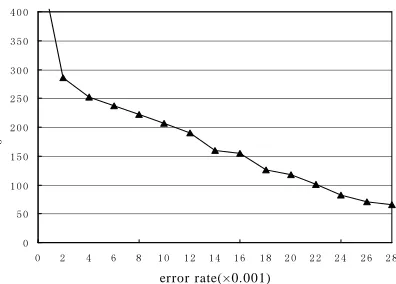
We also measure the convergence times at different ε that satisfy max ( ) '( )
t R t R t ε
∀ − > . The
[image:7.612.307.505.312.454.2]ISSN: 1992-8645 www.jatit.org E-ISSN: 1817-3195
6. CONCLUSION
We present a new reputation evaluation mechanism that can be used to evaluate reputation of literatures and researchers. The basic idea is that there are some relationships among literatures, its author, periodicals and readers. The relationship can be regard as recommendation for each other that is in some ways similar to hyperlink in Google. Therefore, we build a similar reputation model here and propose a PageRank-like algorithm. By simulations, we prove that the mechanism is feasible and convergent. We also discuss the strategies to apply the algorithm to gain better performance. A tradeoff scheme is proposed to replace the globe reputation by a local one. The outstanding advantage of local scheme is its simplicity and decentralization. Therefore, it is easy to deploy in huge distributed forum systems.
There are some issues remained unsolved. One is that if the reputation model and the evaluation method can exactly indicate the academic values of literatures or researchers. What is the standard? In despite of impact factor is widely accepted, but whether it is the most scientific one is in doubt. Another problem is how to decide the values of the parameters, such as λ1~λ5. Here the values are
specified subjectively. Lastly, because the comment is a key factor of reputation model, how to promote users to issue their reviews is the next work in the future.
REFERENCES:
[1] Slavin. R. E, Cooperative learning: Theory research and practice (Boston Ally & Bacon,1995).
[2] Kumara. V. S, Assessing process in CSCL: An ontological approach, Computers in human behavior, Vol. 26, No. 5, pp. 825-834, 2010. [3] Abdul-Rahman. A, Hailes. S, Supporting trust
in virtual communities, Proceedings Hawaii International Conference on System Sciences (Page: 4 -7 Year of Publication: 2000 ISBN: 0-7695-0493-0 ).
[4] Marsh. S, Formalising Trust as a computational concept, PhD Thesis, Dept. of Math. and Comp., University of Stirling, UK, 1994. [5] Kaltenborn. KF, Kuhn. K, The journal impact
factor as a parameter for the evaluation of researchers and research, Rev Esp Enferm Dig, Vol. 98, No. 3, pp. 153-169, 2003.
[6] Brumback. RA, “Worshiping false idols: The impact factor dilemma”: Correcting the record, Journal of Child Neurology, Vol. 23, No. 9, pp. 1092-1094, 2008.
[7] Castelnuovo. G, Limonta. D, A More
Comprehensive Index in the Evaluation of Scientific Research: The Single Researcher Impact Factor Proposal, Clinical practice and epidemiology in mental health, Vol. 6, No. 6, pp. 109-114, 2010.
[8] Graczynski MR, Personal impact factor: the need for speed, Med Sci Monit, Vol. 14, No. 10, pp. ED1-2, 2008.
[9] http://www.researcherid. com/
[10] Banks. M. A, Dellavalle. R, Emerging alternatives to the impact factor, OCLC Systems Services, Vol. 24, No. 3, pp. 167-173, 2008.
[11] Soualmia. LF, Darmoni. SJ, Web impact factor: a bibliometric criterion applied to medical informatics societies' web sites, Stud Health Technol Inform, No. 90, pp. 178-183, 2002.
[12] Page. L, Brin. S, Motwani. R, and Winograd. T, The Pagerank Citation Ranking: Bringing Order to the Web, Technical report, Stanford Digital Library Technologies Project, 1998. [13] Srivastava. J, Cooley. R, Deshpande. M, Tan.
P, Web Usage Mining: Discovery and Applications of Usage Patterns from Web Data, SIGKDD Explorations, Vol. 1, No. 2, pp. 12-23,2000.
[14] Bollen. J, Rodrigues. MA, PageRank for impact ranking, Scientometrics, vol. 69, n. 3, pp. 669-687, 2006.
[15] Kamvar. S. D, Schlosser. M. T, and Mollina. H. G, The Eigen Trust Algorithm for Reputation Management in P2P Networks, Proccedings of The 12th International World Wide Web
Conference (Page: 640-651 Year of
Publication: 2003 ISBN: 1-58113-680-3). [16] Aykanat. C, Turk. A, Site-Based Partitioning
and Repartitioning Techniques for Parallel PageRank Computation, IEEE Transactions on Parallel and Distributed Systems, Vol. 22, No. 5, pp. 786-802, 2011.
[17] Wang. Y, Dewitt. D. J, Computing PageRank in a Distributed Internet Search System,
Proceedings of the 30th VLDB
Conference(Page: 420-431 Year of