Image Segmentation Techniques with Remote Sensing Perspective-A
Review
Dr. G. Pandyan
1Mrs. Arthi. H
21
Associate Professor
2Research Scholar
1,2
Department of Computer Science
1,2
Rathnavel Subramaniam College of Arts and Science
Abstract— A methodological study on need of image-processing and its various applications in computer artificial intelligence based carried out here. Due to the advent of computer field image-processing approach have become rapidly needed in a various applications. During an image-processing operation the input given is a picture and its output is an improved high quality picture as per the approach used. Image-processing usually defined as digital image-processing, but optical and analog image-processing also are possible. This field is classic subject in the image-processing and also is a hotspot and focus of approach. Several generally many algorithms and approach have been developed for in this field of image-processing. There exist many image segmentation approaches, which partition the picture into different parts based on certain image features like image Pixel, image intensity value, image color, image texture, etc. These approaches are classified based on the image segmentation method used. In this paper the various image segmentation approach are revised and finally a comparison of their disadvantages and advantages are listed. Our study provides an introduction to image-processing along with segmentation approach, systematic vision fundamentals and its applied applications that will be of useful to the image-processing and computer artificial intelligence based research field.
Key words: Image Restoration; Image Segmentation; Face Detection; Character Recognition; Signature Verification; Biometrics; Automatic Target Recognition; Fuzzy C-Mean
I. INTRODUCTION
An image is a way of transferring detail information, and the image contains various needful information. Understanding the picture information and extracting that information from the picture to accomplish some works is an important area of application in digital/analog image processing field, and the first step in understanding the image is the image segmentation. In practice, it is some time not interested in every parts of the image, but only for some particular areas which have the same information or characteristics [1]. Image segmentation is one of the important in image-processing and computer artificial intelligence. It is also an important basis for image recognition/understanding. It is based on certain factor to divide an input image into a number of the same nature of the kind in order to extract the area which people are preferred in. And it is the basis for image analysis and needed in image feature extraction and recognition. There are many generally used image segmentation algorithms preferred in many authors. This paper mainly describes the following some algorithms for simple analysis. The first is the threshold method. Threshold segmentation is one of the frequently used segmentation approach in boundary-based algorithms [2]. Its essence is to automatically determine the
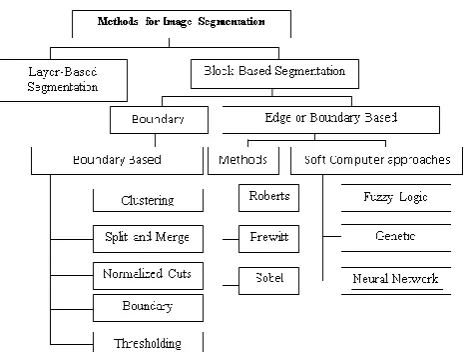
optimal threshold value according to a certain factor, and use these image Pixels according to the gray level to achieve clustering. Followed by the boundaries growth separation. The basic idea of the boundaries growth algorithm is to combine the image Pixels with similar properties to form the various boundary, that is, for every boundary to be divided first to find a seed image Pixel as a growth point, and then merge the surrounding neighbourhood with similar properties of the image Pixel in its area. Then is the edge detection method. Edge detection segmentation algorithm refers to the use of different boundaries of the image Pixel gray or color discontinuity detection area of the edge in order to achieve image separation [3]. The next is the segmentation based on clustering. The algorithm based on clusters is based on the similarity between things as the factor of class division, that is, it is divided into several subclasses according to the internal structure of the sample set, so that the same kind of pictures are as same as possible, and the different are not as similar as possible[4]. The last is the segmentation based on weakly-supervised learning in CNN. It points to the problem of assigning a semantic label to each image Pixel in the image and consists of three parts. 1) Give an image which contains which is particular objects. 2)Give the edge of an object. 3) The object area in the image is marked with a divided image Pixel [5]. Currently, the international image segmentation, the specific function of the process of segmentation method is very diverse and difficult, and there is no certified unified standard. This paper discusses and compares the above following methods, and learns from the shortcomings to analyze better solutions and make future forecasts.
Fig. 1: Methods of Image Segmentation
II. LITERATURE SURVEY
A. Region-based Segmentation
This method works on the principle of uniformity by considering the fact that the adjacent image Pixels inside a boundary possess same characteristics and not similar to the picture Pixels in other boundaries. The purpose of boundary based segmentation is to produce a uniform boundary which is bigger in size and results in very few boundaries in the image.
1) Threshold Segmentation
Threshold segmentation is the simplest method of image segmentation and also one of the most common parallel segmentation methods. It is a common segmentation algorithm which directly divides the image greyscale information processing based on the gray value of different targets. Threshold segmentation can be divided into local threshold method and global threshold method. The global threshold method divides the image into two boundaries of the target and the background by a single threshold [6]. The local threshold method needs to select multiple thresholds and separates the image into multiple target boundaries and backgrounds by multiple thresholds.
The most frequently used threshold segmentation algorithm is the largest interclass variance method (Otsu)[7], which choose a globally optimal threshold by peak value of the variance between classes. In addition to this, there are entropy-based threshold method, minimum error method, and co-occurrence matrix method, moment preserving method, simple statistical method, probability relaxation method, fuzzy set method and threshold methods combined with other methods [8].
The advantage of the threshold method is that the computation is simple and the calculation speed is faster. In general, when the target and the background have high contrast, the segmentation effect can be fetched. The drawback is that it is hard to obtain accurate results for image separation problems where there is no significant greyscale difference or a large overlap of the greyscale values in the image[9]. Since it only takes into account the gray information of the image without considering the spatial information of the image, it is sensitive to noise and greyscale not even, leading it often merged with other methods [10].
2) Regional Growth Segmentation
The boundaries growth method is a typical serial boundary segmentation algorithm, and its basic idea is to have similar properties of the image Pixels together to form boundary [11]. The method requires first selecting a seed image Pixel, and then merging the similar image Pixels around the seed image Pixel into the boundary where the seed image Pixel is located. Figure 1 shows an example of a known seed point for boundary growing. Figure 1 (a) shows the need to split the image. There are known two seed images Pixels (marked as gray squares) which are prepared for boundaries growth. The factor used here is that if the absolute value of the gray value difference between the image Pixel and the seed image Pixel is considered to be less than a certain threshold T, the image Pixel is included in the boundary where the seed image Pixel is located. Figure 1 (b) shows the boundary growth results at T = 4, and the whole plot is well divided into two boundary. Figure 1 shows the results of the boundary growth at T = 6 and the whole plotis in an area. Thus the choice of threshold is very important[12].
The advantage of boundaries growth is that it usually separates the connected boundaries’ with the same characteristics and provides good boundary information and segmentation results. The idea of boundaries growth is simple and requires only a few seed points to complete. And the growth criteria in the growing process can be freely specified. Finally, it can pick multiple criteria at the same time. The disadvantage is that the calculation cost is huge[13]. Also the noise and greyscale not even can lead to voids and over-division. The last is the shadow effect on the image is often not very good[14].
B. Edge Detection Segmentation
The edge of the object is in the form of uneven local features of the picture, that is, the most significant part of the picture changes in local brightness, such as gray value of the mutation, color mutation, texture changes and so on[15]. The use of discontinuities to find the edge, so as to get the purpose of picture segmentation.
There is always a gray edge between two adjacent boundaries’ with different gray values in the picture, and there is a case where the gray value is not continuous. This discontinuity can often be detected using derivative operations, and derivatives can be calculated using differential operators [16]. Parallel edge detections often done by means of a spatial domain differential operator to perform picture segmentation by convoluting its template and image. Parallel edge detection is generally used as a method of image pre-processing. The widely first-order differential operators are Prewitt operator, Roberts’s operator and Sobel operator [17]. The second-order differential operator has nonlinear operators such as Laplacian, Kirsch operator and Wallis operator.
1) Sobel Operator
effectively eliminate the effect of noise. The presence of the Sobel operator on the position of the picture Pixel is weighted, which is better than therewith operator and the Roberts operator.
The Sobel operator consists of two sets of 3x3matrices, which are transposes and longitudinal templates, and are pointed with the picture plane, respectively, to obtain the variation between the horizontal and the longitudinal difference. In actual use, the following two templates are used to detect the edges of the picture. 2) Laplacian Operator
Laplace operator is an isotropic operator, second order differential operator. It is more accurate when it is only concerned with the position of the edge regardless of the picture Pixel greyscale difference around it[18].The Laplace operator's response to isolated image Pixels is stronger than the edge or line, and therefore applies only to noise-free images. In the presence of noise, the Laplacian operator needs to perform low-pass filtering before detecting the edge. Therefore, the usual segmentation algorithm joined the Laplacian operator with the smoothing operator to generate a new template.
The Laplacian operator is used to increases the blurring effect due to the blurring effect, since it conforms to the descent model. Diffusion effect is often happens in the imaging process.
C. Image Segmentation based on clustering
There is no general theory of picture segmentation. However, with the implementation of many new laws and methods of various disciplines, there have been many image segmentation methods combined with some specific theories and methods. The so-called class refers to the collection of same elements. Clustering is in accordance with particular requirements and laws of the classification of things in the process [19].
The feature space clustering method is used to segment the picture Pixels in the image space with the corresponding feature space points. According to their aggregation in the feature space, the feature space is segmented, and then they are mapped back to the original image space to get the segmentation result.
K-means is one of the most generally used clustering algorithms. The basic idea of K-means is to collect the samples into various clusters according to the distance. The
closer the two points are, the closer they are to get the compact and independent clusters as clustering targets [20]. The implementation process of K-means is expressed as follows: Randomly select K initial clustering centres, 1) Calculate the distance from each sample to each cluster
centre, and return each sample to the nearest clustering centre;
2) For each cluster, with the mean of all samples as the cluster of new clustering centres;
3) Repeat steps (b) to (c) until the cluster centre no longer changes or reaches the set number of iterations [21].
The merits of K-Means clustering methods are that the algorithm is quicker and simple, and it is highly efficient and scalable for large data sets. And its time difficulty is close to linear, and suitable for mining large-scale data sets. The drawbacks of K-means are that its clustering number K has no explicit selection criteria and is difficult to find out [22]. And, it can be seen from the K-means algorithm framework that every iteration of the algorithm traverses all the samples, so the time of the algorithm is very expensive. Finally, the K-means algorithm is a distance-based partitioning method [23]. It is only applicable to the data set which is convex and not good for clustering non-convex clusters.
D. Image Segmentation based on weakly-supervised learning in CNN
In recent years, the deep learning has been in the picture classification, identification, segmentation, high-resolution image generation and many other areas have made breakthrough results[24]. In the aspect of image segmentation, an algorithm is proposed which is more effective in this field, which is the weakly- and semi-supervised learning of a DCNN for semantic image segmentation. Google's George Papandreou and UCLA's Liang-Chieh Chen studied the use of bounding box and image-level labels as mark-up training data on the basis of Deep Lab and used the expected maximization algorithm (EM) to estimate unmarked picture Pixel class and CNN various parameters. Deep Lab method is divided into two Steps, the first step is still using the FCN to get the coarse score map and interpolate to the original image size, and then the second step began to borrow the fully connected CRF from the FCN to get the details of the segmentation refinement[25].
Name of
Technique Advantages Disadvantages
1
Threshold
method Does not require proper information of the image. Computation inexpensive.
For an image with broad and flat valleys or without any peak, it doesn’t works well
2
Inverse dynamics
method
This algorithm employs a non-linear optimizer. Data extraction is done in fair manner. Better quality
animation is achieved.
The different patterns of EMG received can give identical output
3
Novel edge-based method
The basis for this segmentation algorithm is procedure of minimization of energy
The dislocation & progression of the segmented objects amid objects is assumed
to be small.
4 Clustering Method
For small values of k, k means is computationally faster. Eliminates noisy spots. Reduces false blobs.
Difficult to predict k with fixed number of clusters. Sensitive to initialization
5
Boundary based Method
Gives better result in comparison with other segmentation methods. Provides flexibility to choose
between interactive and automatic technique for image segmentation.
Sequential by nature and quite Expensive in both computation time and memory. To decide stopping criteria for
segmentation is difficult task.
6
Fuzzy C – means Method
FCM is better than Kmeans. FCM Unsupervised and converge very well.
Sensitive to noise. Computationally expensive. Determination of fuzzy
Membership is not very easy.
7 Watershed Method
The basis for this algorithm is mathematical morphology. The capture range is improved
[image:4.595.46.552.64.193.2]Segmentation is done at high scale
Table 2.1: Various Segmentation Approach with Their Advantages &Disadvantages For the training picture that gives the bounding box
mark, the method uses the CRF to automatically segment the training image, and then do full supervision on the basis of the segmentation. Experiments show that simply using the
picture level of the mark to get the segmentation effect is poor, but the use of bounding box training data can get better results [27].
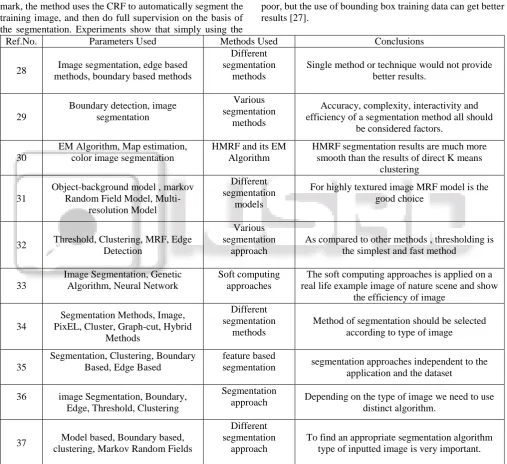
Ref.No. Parameters Used Methods Used Conclusions
28 Image segmentation, edge based methods, boundary based methods
Different segmentation
methods
Single method or technique would not provide better results.
29
Boundary detection, image segmentation
Various segmentation
methods
Accuracy, complexity, interactivity and efficiency of a segmentation method all should
be considered factors.
30
EM Algorithm, Map estimation, color image segmentation
HMRF and its EM Algorithm
HMRF segmentation results are much more smooth than the results of direct K means
clustering
31
Object-background model , markov Random Field Model,
Multi-resolution Model
Different segmentation
models
For highly textured image MRF model is the good choice
32 Threshold, Clustering, MRF, Edge Detection
Various segmentation
approach
As compared to other methods , thresholding is the simplest and fast method
33
Image Segmentation, Genetic Algorithm, Neural Network
Soft computing approaches
The soft computing approaches is applied on a real life example image of nature scene and show
the efficiency of image
34
Segmentation Methods, Image, PixEL, Cluster, Graph-cut, Hybrid
Methods
Different segmentation
methods
Method of segmentation should be selected according to type of image
35
Segmentation, Clustering, Boundary Based, Edge Based
feature based
segmentation segmentation approaches independent to the application and the dataset
36 image Segmentation, Boundary, Edge, Threshold, Clustering
Segmentation
approach Depending on the type of image we need to use distinct algorithm.
37 Model based, Boundary based, clustering, Markov Random Fields
Different segmentation
approach
[image:4.595.45.553.207.671.2]To find an appropriate segmentation algorithm type of inputted image is very important.
Table 2.2: existing segmentation approach and conclusions
III. CONCLUSION
Image segmentation is of utmost need in the area of digital/analog image-processing field. In this an image is classified into multiple segments for analyzing the image. Numbers of approach, techniques and algorithms have been developed for image segmentation. This paper provides a
algorithms, the development of image segmentation approach may present the following trends: 1) the combination of multiple segmentation methods. Because of the diversity and uncertainty of the picture, it is required to combine the multiple segmentation methods and make full use of the advantages of different algorithms on the basis of multi-feature fusion, so as to achieve better segmentation effect.2) In the parameter selection using various machine learning algorithm for analysis, in order to improve the segmentation effect. Such as the threshold selection in threshold segmentation and the selection of K values in the K-means algorithm. 3) CNN model is used to frame the ROI, and then segmented by non-machine learning segmentation method to increase the segmentation effect. It is believed that in the future research and exploration, there will be more image segmentation method to be further developed and more widely used.
REFERENCES
[1] Ashraf A. Aly , Safaai Bin Deris, NazarZaki;”Research review for digital segmentation approach”;International Journal of Computer Science & Information Technology (IJCSIT) Vol 3, No5, Oct 2011.
[2] Haralick R M, Shapiro L G. Image segmentation approach [J]. Computer artificial intelligence, graphics, and image-processing, 1985, 29(1): 100-132.
[3] Marr D, Hildreth E. Theory of edge detection [J].Proceedings of the Royal Society of London B: Biological Sciences, 1980, 207(1167): 187-217. [4] Wu Z, Leahy R. An optimal graph theoretic approach to
data clustering: Theory and its application to image segmentation [J]. IEEE transactions on pattern analysis and machine intelligence, 1993, 15(11): 1101-1113. [5] Lin D, Dai J, Jia J, et al. Scribblesup: Scribble-supervised
convolution networks for semantic
segmentation[C]//Proceedings of the IEEE Conference on Computer artificial intelligence and Pattern Recognition. 2016: 3159-3167.
[6] Davis L S, Rosenfeld A, Weszka J S. Boundary extraction by averaging and thresholding [J]. IEEE Transactions on Systems, Man, and Cybernetics, 1975 (3): 383-388.
[7] N. Dabhi and H. Mewada, “Review on Outdoor Scene image Segmentation”, International Journal of Computer Science and Information Technologies (IJCSIT), Vol. 3, 2012.
[8] Kohler R. A segmentation system based on thresholding [J]. Computer Graphics and Image-processing, 1981, 15(4): 319-338.
[9] N. R. Pal and S. K. Pal, “A review on image segmentation approach”, Pattern recognition society, Vol. 29, 1993.
[10]Pal N R, Pal S K. A review on image segmentation approach [J]. Pattern recognition, 1993, 26(9): 1277-1294.
[11]Wani M A, Batchelor B G. Edge-boundary-based segmentation of range images [J]. IEEE Transactions on Pattern Analysis and Machine Intelligence, 1994, 16(3): 314-319.
[12]Fan W. Color image segmentation algorithm based on boundary growth [J]. JisuanjiGongcheng/ Computer Engineering, 2010, 36(13).
[13]Angelina S, Suresh L P, Veni S H K. Image segmentation based on genetic algorithm for boundary growth and boundary merging[C]//Computing, Electronics and Electrical Technologies (ICCEET), 2012 International Conference on. IEEE, 2012: 970-974.
[14]Ugarriza L G, Saber E, Vantaram S R, et al. Automatic image segmentation by dynamic boundary growth and multire solution merging[J]. IEEE transactions on image-processing, 2009, 18(10): 2275-2288.
[15]Davis L S. A survey of edge detection approach [J]. Computer graphics and image-processing,1975, 4(3): 248-270.
[16]Senthilkumaran N, Rajesh R. Edge detection approach for image segmentation–a survey of soft computing approaches [J]. International journal of recent trends in engineering, 2009, 1(2): 250-254.
[17]Kundu M K, Pal S K. Thresholding for edge detection using human psycho visual phenomena[J]. Pattern Recognition Letters, 1986, 4(6): 433-441.
[18]Haddon J F. Generalised threshold selection for edge detection[J]. Pattern Recognition, 1988, 21(3):195-203. [19]Sulaiman S N, Isa N A M. Adaptive fuzzy-Kmeans
clustering algorithm for image segmentation [J].IEEE Transactions on Consumer Electronics, 2010,56(4). [20]Kumar S, Singh D. Texture Feature Extraction to
Colorize Gray Images [J]. International Journal of Computer Applications, 2013, 63(17).
[21]Chuang K S, Tzeng H L, Chen S, et al. Fuzzy c-means clustering with spatial information for image segmentation[J]. computerized medical imaging and graphics, 2006, 30(1): 9-15.
[22]Celebi M E, Kingravi H A, Vela P A. A comparative study of efficient initialization methods for the k-means clustering algorithm [J]. Expert Systems with Applications, 2013, 40(1): 200-210.
[23]Zhang L, Gao Y, Xia Y, et al. Representative discovery of structure cues for weakly-supervised image segmentation [J]. IEEE Transactions on Multimedia,2014, 16(2): 470-479.
[24]Chen L C, Papandreou G, Kokkinos I, et al. Deep lab: Semantic image segmentation with deep convolution alnets, atrous convolution, and fully connectedcrfs[J]. arXiv preprint arXiv:1606.00915, 2016.
[25]Papandreou G, Chen L C, Murphy K, et al. Weakly-and semi-supervised learning of a DCNN for semantic image segmentation [J]. arXiv preprintarXiv:1502.02734, 2015.
[26]Fu K S, Mui J K. A survey on image segmentation [J]. Pattern recognition, 1981, 13(1): 3-16.
[27]SujataSaini and KomalArora,”A Study Analysis on the Different Image Segmentation Approach”, volume4, Number 14 (2014).
[28]Ashraf A. Aly, Safaai Bin Deris, NazarZaki,” Research Review for Digital Image Segmentation Approach”, IJCSIT, Vol 3, No 5, Oct 2011.
Gmm-Based Hidden Markov Random Field For Colour Image Segmentation”, April, 2015.
[30]V. Dey , Y. Zhang and M. Zhong,” A Review On Image Segmentation Approach With Remote Sensing Perspective”, IAPRS, Vol. XXXVIII, Part 7A, July 5–7, 2010.
[31]R.Yogamangalam, B.Karthikeyan,” Segmentation Approach Comparison in Image-processing”, IJET, Vol 5, No 1, Feb-Mar 2013.
[32]N.Senthilkumaran and R. Rajesh,”Edge Detection Approach for Image Segmentation – A Survey of Soft Computing Approaches”, International Journal of Recent Trends in Engineering, Vol. 1, No. 2, May 2009. [33]A. M. Khan, Ravi. S,” Image Segmentation Methods: A
Comparative Study”, IJSCE, Volume-3, Issue-4, September 2013.
[34]SandhyaArchanaPoonamRani,”Image Segmentation Methods: A Review”, Volume 5, Issue 4, 2015.
[35]SmritiPathak, Punit Kumar Chaubey,” Salient Features of Image Segmentation Methods”, Volume 6, Issue 3, March 2016.