THE PSYTRANCE PARTY
C. DE LEDESMA
M.Phil.
THE PSYTRANCE PARTY
CHARLES DE LEDESMA
A thesis submitted in partial fulfilment of the requirements of the School
of Humanities and Social Sciences, University of East London for the
degree of Master of Philosophy
Abstract
In my study, I explore a specific kind of Electronic Dance Music (EDM) event - the psytrance party to highlight the importance of social connectivity and the generation of a modern form of communitas (Turner, 1969, 1982).
Since the early 90s psytrance, and a related earlier style, Goa trance, have been understood as hedonist music cultures where participants seek to get into a trance-like state through all night dancing and psychedelic drugs consumption. Authors (Cole and Hannan, 1997; D’Andrea, 2007; Partridge, 2004; St John 2010a and 2010b; Saldanha, 2007) conflate this electronic dance music with spirituality and indigene rituals. In addition, they locate psytrance in a neo-psychedelic countercultural continuum with roots stretching back to the 1960s. Others locate the trance party events, driven by fast, hypnotic, beat-driven, largely instrumental music, as post sub cultural and neo-tribal, representing symbolic resistance to capitalism and neo liberalism.
My study is in partial agreement with these readings when applied to genre history, but questions their validity for contemporary practice. The data I collected at and around the 2008 Offworld festival demonstrates that participants found the psytrance experience enjoyable and enriching, despite an apparent lack of overt euphoria, spectacular transgression, or sustained hedonism. I suggest that my work adds to an existing body of literature on psytrance in its exploration of a dance music event as a liminal space, redolent with communitas, but one too which foregrounds mundane features, such as socialising and pleasure. In addition my work contributes to popular music studies and youth cultures research notably when related to field work methods and ethnographic approaches.
i
The Psytrance Party
Contents
List of Plates
Chapter 1 Challenging the Spectacular in Electronic Dance Music Accounts
1.1 Goa and Psychedelic Trance Development 3
1.2 Situating Psytrance: Widening a Little Culture 5
1.3 Central Concepts and Pystrance Party Findings , 9
1.4 Chapter Overview: a Material Analysis of a Psytrance Party Event 15 Chapter 2 The Psychedelic Trance Party: Literature Review of Scholarly Works 2.1 Psychedelic Trance Studies and the Globalising of Exotica 18
2.2 A Spiritualised Ritual? Themes in Psychedelic Trance and Rave Studies 26 2.3 Bodies, Dance Floors and Drugs: An Analysis of the Late Rave Moment 33
Chapter 3 Insider and Participant Research: Methodology and Methods at the Psytrance Party 3.1 Guaranteeing Communitas 40
3.2 The Operationalising of Reflexivity in Psytrance Party Fieldwork 40 3.3 Insider Research at the Psytrance Party 44 3.4 Site and Gatekeepers: Finding the Party and Contact Immersion 46
3.5 Negotiating the Psytrance Network: Dancing Bodies to Audio Texts 50
3.6 Temporarily Autonomous: From Cereal Field to Psytrance Party 56
3.7 I’ll see you at the Chai Tent 70
Chapter 4 ‘It’s just a Tea Shop and we’re having a Laugh’: Social Connectivity at the Psytrance Party 4.1 Exploring the Psytrance Social: Rob, Friends and the Peak Sets 74
4.2 Exploring the Psytrance Social: Rose, Amy and Connectivity 78
4.3 Exploring the Psytrance Social: Promoters, Participants and Opportunities
82
4.4 Connecting the Lulls: Recreational Drugs and Communitas 87
ii
Chapter 5 Psytrance Information Channels: The DJ-Dancer Conversation
5.1 Good Time DJs and the Solo Dancer 95
5.2 Alex Sense: Greece’s Progressive Trance Haberdasher 97
5.3 Liquid Ross: A Visit to ‘Stealthy Fungus’ and Return 101
5.4 Beardy and the Whacked Out Crowd: The Closing Act 106
5.5 Interludes in the Conversation 112 5.6 Social Connectivity and the DJ-Dancer Dialogue 114 Chapter 6 Psytrance Communitas - Heterogeneity, Cognitive Connections and the Consensual Dance Music Moment 6.1 Reviewing Fieldwork Results 119
6.2 Classifying a Little Culture 123
6.3 Psytrance, Communitas, and Dance Music Research 125
Bibliography 128
Discography 137
Appendices
Appendix A Participant Profiles 138
Appendix B Schedule of Meetings and Interviews 142
Appendix C Psymusic.UK: Music Thread 146
iii List of Plates
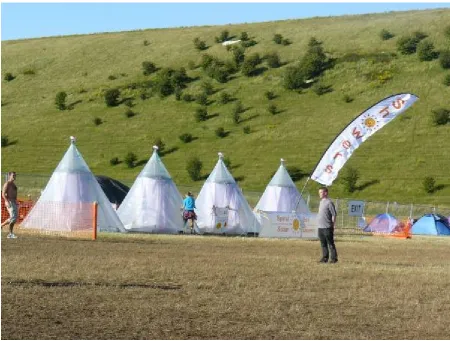
1 Crew canteen and Chai Emporium canvas structures 39
2 Solar-powered showers 43
3 Author and DJ Fluid at the chill-out tent 58
4 Merlin cafe and the chill-out 60
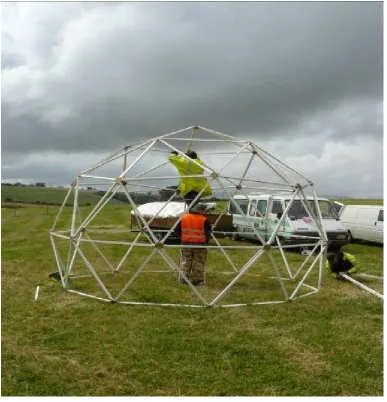
5 Assembling the psytrance dome 61
6 The camping zone 63
7 Minimal progressive trance DJ Frechbax 64
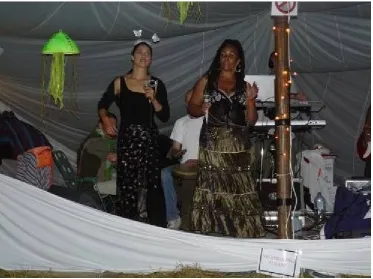
8 Live band Orchid Star at the chill-out 65
9 String art by Bjorn in the psytrance dome 66
10 The Travelling Observatory bric a brac stall 69
11 Outside the psytrance tent 73
12 Rob from Cape Town 75
13 Dancers in the psytrance dome 77
14 Rose in her green fairy outfit 78
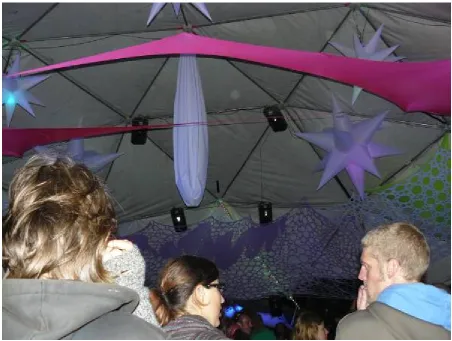
15 Night-time in the psytrance dome 83
16 Psytrance stage organiser Ben Grant 86
17 String art and dancers during Deviant Species’ set 94
18 The hill and the psytrance dome 95
19 DJ Alex Karanasos 99
20 DJ Liquid Ross 103
21 DJ Beardy 109
22
23
Alex Sense and Rose in artists camping
Night activity at the psytrance stage
115
1 Chapter 1
Challenging the Spectacular in Electronic Dance Music Accounts
The psy-festival... allows its inhabitants multiple freedoms, including the freedom to join one’s flame to the conflagration, and to hold self-promotions on and off the dance floor.
Graham St John (2009a, p.48)
Introduction
My ethnographically-informed analysis of a psychedelic trance party 1explores the ‘multiple freedoms’ Graham St John (2009a) refers to. Key to my account, however, is the lack of conflagration St John detects, or hopes to find, in this reference to the psychedelic trance mission as it spread from Goa, India, to the wider world. I argue that a certain amount of mythologizing surrounds this kind of cultural practice and that, based on research at one event, more attention should be paid to pleasure and community. My argument - that fun, sociality and connections are highly prized products - calls for a wider examination of such Electronic Dance Music (EDM) events which could lead to a more confident conclusion. My research into one particular event suggests there are grounds for these questions to be asked.
The study differs from some academic work (Chan, 1998; Cole and Hannan, 1997; Gore, 1997; Greener and Hollands, 2006; D’Andrea 2007; St John, 2010b; Saldanha, 2007), as I examine in detail the event site and the technologies used, drawing on the experiences and perspectives of around twenty participants over a 14-month period. The fieldwork at the fully-legal, four-day, medium-sized, event, incorporated its lead in and break down too. 2 Fewer than 1000 attended the event which took place at the end of July 2008 in southern England. 3 Research methods were primarily participant
1 Offworld took place from the 31st July to the 3rd August, 2008 at Liddington Warren, Berkshire, UK. 2 Most UK psychedelic trance outdoor events are not properly licensed and tend towards shorter,
all-night time frames, but some last for 24 hours or longer. The first legal festival to centrally feature the style was 2004’s Glade Festival (www.gladefestival.com) which is an annual event
3 The following is a list of 2008 UK and Irish festivals featuring psychedelic trance: Glade Festival,
2
observation with repeat promoter, participant and DJ interviewing. Use was made too of a focus group, email dialogues, social media, artefacts, digital photography and reflexive analysis of notes and reflections.
As a result of my fieldwork I conclude that social connectivity is paramount for participants. Other authors (D’Andrea 2007; Lambert 2010; Ryan 2010; St John 2010a, 2010b, 2009a, 2004; Schmidt 2010; Sylvan 2005) have drawn attention to this facet of trance culture, but, my findings constitute the first sustained analysis in English of psytrance’s social qualities at one research site.
The conclusions to my analysis reveal some surprising areas. Dance moments can be deemed enjoyable and successful when the dance floor is not apparently a magnet for involvement or the music considered of high quality. Elsewhere, I monitor the work of psytrance DJs as they try to invigorate dance floors populated by small numbers and follow the impact of their sonic journeys (Cole and Hannan, 1997) on dancing. A final key subject are the ‘body technologies’ (Rietveld, 1998, p.176) that dancers favour at psytrance events. As consumption of various dance drugs, and occasionally alcohol, is a constantly recurring theme in my study I will now offer Hillegonda Reitveld’s definition (ibid.) which is precise and enveloping enough for application here.
Body technologies are devices used to enhance a feeling of ‘other worldliness’ and of escape from daily reality. In this context, I use the world ‘drug’ not to distinguish between what is legal and what is not; rather the word ‘drug’ refers to a substance which affects the user in a physiological manner, with noticeable result’s to the user’s mental state. The drugs taken enable the user to last through the night and to make it an ecstatic experience.
This wide perspective helps me make sense of the range of body technology practices encountered at Offworld. Although chemical concoctions such as LSD and Ecstasy were available, dancers I talked to often shunned them, or displayed an ambivalence. Some told me that such intoxicants reduced the degree of social connectivity at the psytrance party.
Shamania, 31 July-5 August Pendle, Lancashire, Waveform, 12-14 September, Liddington Warren
3 1.1. Goa and Psychedelic Trance Development
The embryonic Goa style was first played at late 80s full moon parties on the beaches of Goa, south India (Cole and Hannan, 1997; D’Andrea, 2007; Partridge, 2004; Saldanha, 2007). These were frequented by long stay travellers and locals, involved in event infrastructure rather than as fellow revellers. Beach gatherings around the villages, Anjuna, Arambol and Candolim in North Goa had been taking place since the late sixties and were attended by hippie visitors cognisant of an alternative traveller global map - others included Ibiza, north India and Marrakesh, Morocco – where drugs were easy to buy and the density of like-minded people created opportunities for cafe/bar culture, dedicated forms of retailing and informal all-night music sessions (Odzer, 1995; McAteer, 2002). 4
Subsequently the social and music milieu has fanned out, extending to Europe through the early 90s; Japan, Israel, South Africa, Australia, Brazil and the US in the mid-to-late 90s and, from 2000 onwards, to Russia, Mexico, much of South America and Morocco (see www.Chaishop.com). In Israel by 2010, for example, psytrance’s popularity was such that it could be classed as a pop, as opposed to an underground, or alternative, form (Regev, 2007). 5 Psytrance, faster and more abrasive that the early Goa style, is created on software unlike the classic early nineties tracks which used analogue technology.
A major appeal of electronic trance has been all-night, or all-day, dance sessions where dancers intoxicated by powerful body technologies immerse themselves in the digitised rhythms to better effect a kind of trance dance state. Trance dancing at the psychedelic trance party must not be mistaken for shamanic trance dancing (Becker, 2004; Rouget, 1985) which has a clear structural purpose. I suggest it is an umbrella
4 Cleo Odzer’s Goa Freaks: My Hippie Years in India is an enjoyably, sassy autobiography by one of
the ‘original’ Goa hippies from the sixties. Michael McAteer’s thesis ‘Redefining the Ancient Tribal Ritual for the 21st century: Goa Gil and the Trance Dance Experience’ (2002), incorporates well blocks
of interview transcript from Gil, regarded as the progenitor of Goa trance, who argues that Goa’s psychedelic trance is a direct continuum from sixties psychedelic music and culture.
5 “By 2000, the term “psytrance” was coined, initially as an umbrella to corral a sector of electronic
4
term with at one end of the continuum, drug-inspired, interior-focused movement and more outward playful body moves at the other. Also characteristic of the outdoor events emergent from the Goa model are the multi-coloured backdrops adorning the dance spaces printed with computer-generated designs and patterns often with Hindu, pagan and sci-fi imagery.
A starting point in my argument is that much academic work and fan discourse have upheld the view that psychedelic trance events are part of and shaped by a “psychedelic continuum”, with roots and patterns traced back to 60s counterculture, particularly the aspect represented by West Coast psychedelia and transgressive escapades, such as author Tom Wolfe’s The Electric Kool-aid Acid Test (1969). Hillegonda Reitveld (2010) finds that late 60s and early 70s psychedelically-inspired German, US and British music, ranging from new age, jazz, rock and contemporary genres, is stylistically central to psychedelic trance aesthetics.
Such a “psychedelic legacy” is perhaps underlined by the controversial premise that psychedelic drugs are transformative. Indeed, Arun Saldanha (2007) sees the increasingly popular psychedelic trance scene in 90s Goa as a direct product of these 60s scenes. He suggests that key individuals, such as Goa Gil (see also St John, 2011) were formative along with others who provided the seasonal cohort with supplies of the hallucinogenic chemical LSD (lysergic acid diethylamide), first synthesized and ingested by Swiss scientist Albert Hoffman.6 This foregrounds an activity - the “trance quest” - where the intoxicated dancer would internalise the experience, effect a shift in consciousness and, purportedly, access profound realms.
This dissertation will question these assertions – or at least question their validity for the present day – by understanding the contemporary psytrance party as a liminal space triggering a variety of affects, most rather softer, and more everyday, than hitherto suggested. My method is, through an in-depth study of one contemporary event, to ask questions about the general assumptions around psychedelic trance, now commonly referred to as psytrance. I argue that, at least in the event studied, any promised transformation has been replaced by an emphasis on fun, light heartedness and inter-personal engagement.
5
I find in this psytrance sociality a form social communitas, a term explored by Victor Turner in his coverage of African social rituals (1969; 1974; 1982; with E.Turner, 1992). When Turner (1982) writes, ‘Individuals who interact with one another in the mode of spontaneous communitas become totally absorbed into a single synchronized, fluid event’ (48), he could have been commenting on a psytrance party. In dance event connectivity communitas is not required to be dramatic or spectacular. As I endeavour to show, the connective communitas at Offworld met a different formula than is customary in studies of psytrance or, often, in wider EDM cultures. For example Des Trammachi (2000) coins the term, “psychedelic communitas,” to encapsulate his reading of turn-of-the-century trance bush parties in Australia, commonly known as “doofs”, and Joshua Schmidt (2005) uses “hallucinatory communitas” to understand Israel psytrance culture, circa 2000-5.
This argument’s research base is different from other authors, with more emphasis on the material components and how they interact in the event spaces. I will now provide a short summary of psychedelic trance history, before looking in more detail at my methodology. I will then identify pivotal themes which have emerged in the analysis of the fieldwork data and summarise the study’s chapter breakdown.
1.2. Situating Psytrance: Widening a Little Culture
The central feature of psytrance music which it shares with a wider palette of electronic trance styles, is all-night dancing to a multi-layered 4/4 beat cycle where the tempo is relatively quick for an EDM - around 142-50 beats per minute (bpm).
Dancing to this abstract music is often in tandem with body technologies, with participants traditionally favouring drugs (highs) such as hallucinogens, including LSD, stimulants, primarily MDMA7 and synthetics such as Ketamine, also used to tranquillise horses, and, through 2009-10 in particular in the UK, Mephedrone. The purportedly soft drug, cannabis, is also popular for its reputed capacities in facilitating social bonding and as mood-altering agent aiding come-downs from psychedelic or
7 The full name for MDMA is '3,4 Methylene-dioxy-N-methylamphetamine' or
6
other hard drugs passages. A further body technology, alcohol, is present at psytrance parties but my personal experience view is that few fans habitually over-indulge. The dance moves preferred in psytrance vary from the robotically repetitive to aerobic and extravagant gestures although, as with other EDM, despite the rapid tempo some participants will move slowly, as if exploring a range of speeds, or choose not to dance at all.
The sonic possibilities realised by the Goa trance producers when shaping the genre, emerged from a particular style of Djing. The hybrid mixes played at late 80s Goa beach parties by Western DJs, including Ray Castle, Five-Fingered Eddie, Goa Gil and Raja Ram (Rietveld, 2010; St John, 2011; Saldanha, 2007) , selected the hypnotic 4/4 beats and miasmic qualities from instrumentally repetitive passages in US house and German techno in particular, to entrance dancers. Another popular tactic was to take from industrialised post punk, grating, twisted noises.
Rave-era acid house parties had arrived in Goa, albeit in a smaller form than in the UK in 1987-9, and DJs incorporated the acid house sound with eastern elements they had been exposed to in India. Later, in the mid-90s, I had been drawn to Goa trance by its use of voice samples which were sometimes snatched from Indian classical raga and tribal artefact but such melodic and coherent elements were usually transmuted by a production framework characterised by a headlong rush of persistent electronic beats, rhythms and unsettling noise. Dancing in the Indian heat, Anthony D’Andrea describes Goa trance in this way. ‘By persistently listening to the endless pounding, listeners report no longer to hear music, but a meta-music of absurd sounds’ (2007; p.212). Early psychedelic, or Goa, trance (1991-97) was consequently inspired by these formative DJs, especially Goa Gil (see St John, 2011).
A further technical, shaping input was a set of West European traditions ranging from Britain’s hippie festival legacy through to electronic body (EDM) music acts like Front 242 and industrial UK bands including Throbbing Gristle and onto early rave acid house acts such as, Cybersonic and The Shamen (Partridge 2004 and 2006; Rietveld, 2010). Chris Partridge (2006, p.46) notes,
7
scene...and the avant-garde electronic music of groups and artists such as Brian Eno and Cabaret Voltaire.
The embryonic genre was made on analogue drum machines and synthesizers by Western and Israeli producers in the summer months in preparation for the winter party season. The music gradually became faster (from 130-136 bpm) and, increasingly, integrated trance like passages and eastern elements.
The consolidation of a cohesive psytrance style, denser busier and faster than Goa trance and rising from around 136 beats-per-minute (bpm) to 146 bpm, emerged as producers, increasingly using digital synthesis, exploring complex software packages like Logic and Cubase. 8 Psytrance also pronounced the bass beat and low pitch sound elements more than Goa trance. This development made the music more “funky”, as a degree of syncopation was written into the electronic collage. Another aesthetic shift was away from a brighter, high-end sonic palette toward a more crammed, darker mood. I have examined elsewhere (De Ledesma, 2010) how, by 2010, psychedelic trance contained few of the distinctive features of the earlier Goa trance.
Psytrance, a very specific genre, nevertheless has similarities with other EDM trance modes. The styles – also developed through the 90s in Britain and elsewhere – include euphoric trance, Euro, vocal, and deep trance.9 A further style, progressive trance - which I discuss briefly in Chapter 5 – is for the purposes of this study subsumed within the wider psytrance wider rubric. I do not intend to detail the characteristics of these other electronic trance styles but I would like to note that, despite some internal differences, they are commonly more melodic in composition and anthemic in effect than psytrance. A further difference between the Goa-derived mode and other EDM trance is the latter’s popularity in what is referred to as commercial clubbing, attracting a more “mainstream”, and less “alternative” crowd, although Measham and Moore (2009, pp.439-41) in an overview of research on this subject, convincingly caution against simple dichotomies when categorizing EDM fan groups.
8 Digital synthesis refers to the combining of increasingly powerful computer platforms with complex
audio editing software. The synthesis in the term referring first and foremost to a way of conceptualising and developing music electronically
8
Psytrance party spaces, in contrast with commercial urban spaces, tended initially to be likened to, or inspired by, “temporary autonomous zones” – or TAZ - (Bey, 1991), and have been a class of EDM which has not been severely restricted by the UK’s 1994 Criminal Justice Act. Bey was not writing on the rave phenomenon of the late 80s and early 90s but, given the proximity of rave to psytrance music culture, the concept of the TAZ remains apposite.
Like their colleagues in other trance styles, psytrance promoters do hire commercial urban clubs but the spaces of choice tend towards flamboyant locations, such as warehouses and squatted buildings, as hiring costs are lower, surveillance minimal and anti-smoking legislation seldom enforced. Psytrance fans, or “psytrancers”, clearly prefer outdoor events where the TAZ practice, by early 2012, still occurs, albeit on a small scale.
My event case study site, Offworld, took place at the official end of this continuum, a legally sanctioned event in common with numerous festivals incorporating EDM which occurred in Western Europe in 2008. It was a four-day, medium-sized, psytrance party with just under one thousand attendees, taking place in southern England over a long late July/early August weekend in 2008. I considered Offworld ideally suited for my research needs because it was akin to many others in size, aesthetic quality and demographic constituency taking place that year.
It was important that I researched an event that had a high chance of coming off, rather than an illegal, fly-by-night one, which may have been cancelled or even halted during its passage. An optimistic view is that such a party would last just till morning and, anyway, would not provide enough data for a single-event research model. Acquiring a temporary festival licence makes it much more likely that the party will take place and, importantly, provides the green light for a promotional team to advertise and sell tickets.
9
structured, with those involved with the event - organisers, dancers and DJs - over the research period. On some occasions these interviews were in-depth, while others were conducted in a more fleeting manner. I collected data from participant observation at parties leading up to the late July 2008 main event, at the event, and at subsequent gatherings where participants attended. Data was also obtained from a focus group in early July 2008 and by analysis of in situ DJ and music maker performances, with close attention afforded to music texts present in CD and transferable audio file formats. Visual artefact - images and video - were important in the ethnography too for, as Sarah Pink (2007) attests, ‘Images are “everywhere”’ (21), with ‘Ethnographic research... intertwined with visual images and metaphors’ (ibid.).
Many of the study’s participants play central roles in the evolving analysis. I found the participant I will call Amy, which is not her real name, socialised to find the right people for her kind of play and used costumes to explore various personas.10 Another, ‘Ben’, adopted various roles to heighten event involvement, whereas ‘Steve’ and ‘Franko’ appeared closer to regular trance fans as depicted through their fondness for multiple drug highs and dance floor marathons. 11
1.3. Central Concepts and Pystrance Party Findings
To help in my understanding of the psytrance event I have explored, besides body technologies, a range of concepts, most of which have been useful for other authors of EDM studies. The ideas which recur with some regularity through my study, and which I now define, are communitas, the liminal, vibe and peak and psychedelic. A further one, the spiritual, will be considered in Chapter 2.
The first key concept that has helped me explore the significance of social interaction and community at the Offworld psytrance party is social communitas (Turner 1969, 1974, 1982, with E. Turner, 1992). Given that I focus in some depth on communitas
10 Henceforth the names of interviewees referred to as ‘participants’ are aliases by convention.
However, DJs and promoters keep their original names throughout.
10
in Chapter 4, I continue by introducing its various strands before identifying further concepts important for the study.
Turner first developed communitas as a way of explaining social religious experiences in a variety of cultural spheres from indigenous African societies and to pilgrimage. In addition, he saw its appeal for 60s and 70s musico-cultural trends such as the US subculture which had built around formative psychedelic rock band, The Grateful Dead.Turner divides social communitas three ways: spontaneous, normative and ideological. He writes,
I distinguish three types of communitas: the spontaneous, “existential” types... which defies deliberate cognitive and volitional construction; (2)
normative communitas, the attempt to capture and preserve spontaneous
communitas in a system of ethical precepts and legal rules... and (3)
ideological communitas, the formulation of remembered attributes of the
communitas experience as a utopian blueprint for the reform of society... (Turner and Turner 1992, p.59, authors italics)
Although all three types of communitas are relevant for my study of a psytrance event , it is the first which fits best, as it is more applicable to events which feature hypnotic music and drug consumption. Psytrance culture enthusiasts finds affinity with spontaneous communitas in the high value placed on social connections and on an expectation of bonding.
Another, and more specific, instance of spontaneous communitas occurs when music and dancing gel powerfully. At Offworld such moments were few but one, which I discuss in detail in Chapter 5, occurred during a set by Liquid Ross. Dancers told me in contemporaneous conversations, interviews and email reflections, that they experienced a strong sense of communal melding during peak passages. A further, if more mundane example was the non-hierarchic co-mingling at the event. At most outdoor psytrance parties - Offworld was no different - there is no backstage area sectioned off for VIPs. Consequently there is little social hierarchy of the type noted in some coverage of EDM’s club milieu (Collin and Godfrey, 1997; Thornton 1995).
11
where skills and interests can be traded and built upon (Saldanha, 2007; Ueno, 2003). I go into this subject in more detail in Chapter 4.
A further key Turner idea, which was he developed prior to communitas, is liminality (Turner, 1969). Indeed, Turner did not coin this idea but shaped its usage from Arnold Van Gennep who he describes as a ‘French folklorist’ (1992, p.48) Liminality refers to ‘rites of passages in many cultures... with a tripartite processual structure... marked by three phases: separation; margin (or limen) and reaggregation’ (ibid.) A number of authors have seen the relevance of such liminal processes to psytrance events. For example, Graham St John (2010b) defines the liminal culture of large “festal” events such as Portugal’sBoom and Morgan Gerard (2004) the “processual liminality” of DJ sets in EDM club settings. I will refer occasionally to the liminal but have found the term, with its emphasis on ritual and a specific pattern of experience less useful for my fieldwork analysis than other authors.
Through an understanding of communitas and to a lesser degree liminality, I have brought to the fore the psytrance party’s social features. As I examined the event’s material elements - dance spaces, party plant infrastructure, the camp site, bars, eating zones, sound system technology and DJ’s musical selections - I saw how participants negotiated dance, music and drug consumption to enhance social connectivity. I understood those elements as an affective continuum, ranging from powerful dance floor moments to participants relaxing and bonding in the green grass site. I saw too how dance floors extended beyond the specific spaces defined by the sound system speaker stacks into the fields, bars and cafe zones nearby.
12
The term vibe is the second key concept of central importance for my study. My use of the term centres on both specific moments in the DJ-dancer dialogue discussed in detail in Chapter 5, and in the more general sense in which event promoters earmarked spaces and participants and music intermingled to generate affect (and communitas).
The idea of the vibe, often found in both academic and popular work on music and youth cultures has its roots, St John (2009b) suggests, in the ‘happenings and pyschedelic jouissance of the Summer of Love in the mid-1960s San Francisco’ (95, author italics). St John emphasizes the experiential quality of the vibe, which is ‘only know through affect’ (93). Certain core features of a generic vibe are however apparent. St John’s definition is a useful starting point: ‘the vibe most commonly denotes a successful or optimum social dance-music experience, one participants are compelled to re-live’ (94).
Other authors of EDM offer insights into the kind of vibe which has emerged in their research areas. In discussing African-American house music Sally Sommer (2009, p.285) sees the shared sensual physicality of expressive dance as a cornerstone.
The vibe is an active, communal force, a feeling, a rhythm created by the mix of dancers, the balance of loud music, the effects of darkness and light and physical/psychic energy. Everything interlocks to produce a powerful sense of liberation. The vibe is an active, exhilarating feeling of “nowness” that everything is coming together, that s good party is in the making.
Whereas Mark J Butler (2006), in his analysis of techno music, finds that ‘Individual dancers collaborate with the DJ and with each other to create a sense of “vibe” - a powerful affective quality associated with the experience of going dancing - among those present’ (.72).
13
people, members of a party, many of whom are typically strangers to one another, experience both the dissolution and performance of self within the context of music and dance.’
In my ethnographic study of social connectivity through sharing a sonic experience, vibe appeared as less sharp-edged or all-encompassing. As I show in Chapter 5, some music-dance passages fitted such definitions, but much of the time the excitement required for a palpable, shared EDM vibe was in short supply. A vibe of sorts was however certainly apparent as the social connectivity harnessed by promoters, music providers and participants maintained a presence at and beyond dance floor spaces. This form of softly affectual vibe has parallels with Kathleen Stewart’s notion of ordinary affects: ‘The ordinary is a shifting assemblage of practices and practical knowledges, a scene of both liveness and exhaustion, a dream of escape or of the simple life’ (2007, p.1). The vibe was certainly present at Offworld but it was not of the order or calibre discussed elsewhere.
An important specific aspect of vibe is the dance party peak, which I discuss in Chapter 5 with reference to DJ-dancer conversations and the prime time set from Liquid Ross (Ross March). 12 Peak can be construed in a general manner and in so doing is commensurate with vibe but when seen as a process, can be detected as a potent product triggered by the successful meshing of various components. St John (2009b) highlights such coalescence, ‘... event organizers will attempt to optimize space, time, art, and other resources to achieve a synchronicity variously referred to as “trance”, “tribal” or “shamanic” states”’ (100), whereas Melanie Takahashi (2005) understands that peak time DJing ‘is built around a series of tension-building episodes, which are resolved, with each subsequent cycle of tension and release being more intense that the previous one’ (256). She goes on to describe this affect of this sonic catharsis: ‘At this point a surge of energy is released by the dancers, who exhibit their approval and gratitude by jumping up and down’ (258).
The last idea I would like to define is the psychedelic, by which I mean a generalised pursuit of a psychedelic experience. This is important to my discussion, given that the
12 London-based psytrance DJ and entrepreneur Ross March was interviewed by the author on six
14
first syllable of the music style I am discussing drawn from “psychedelic”. In re-accessing the countercultural psychedelic legacy of the 60s, Glenn O’Brien (2005) reminds us of the potential impact of hallucinogenic body technologies on the individual and on social groupings. In his essay, Psychedelicacies: Psychedelia and
Its Legacies, he says, ‘To take psychedelics was to lift the veil on a kind of
consciousness that was not ordinarily possible’ (354) while, John Harris, in the same volume, reports, ‘Psychedelic… was self-consciousness and body-consciousness, and a new social consciousness too’ (2005, p.11). In addition Hillegonda Rietveld (1998) seeks to explain the desire for such a potent “high” in the dance club settings of 90s Britain. ‘LSD or “acid” is used by members of the dancing crowd in order to get a giggly high and to have an experience of being submerged in the sound, lights and social company of dance events’ (177-8).
Also, as will be noted in Chapter 2, many authors on Goa and psytrance confer an almost a priori psychedelic practice or intent, to the trance party milieu from Trammachi’s description of the event as a ‘psychedelic ritual’ (2000, p.201) to Saldanha’s (2007) analysis of trance fans in Goa, embodying a psychedelic worldview as an ‘ethical practice, a relationship to oneself, one’s body, one’s place in society and the world’ (12). Saldanha, like Rietveld, explores the symbiosis between the drug-fuelled psychedelic experience and specific music genres. He writes (62),
It should be remembered that psychedelic trance music reacts strongly with LSD. The crunchy squelches and ominous bass synth stable the militaristic kick drum, the sci-fi voices and completely inhuman fluttering of sound are, after all, specifically designed to make your brain, stomach, legs, and inner ear dwell in a fractal world quite inexplicable to the initiated.
Whereas Saldanha is concerned with his “white freak” protagonists’ embodied behaviour and worldview, other authors, as I note below, apply the term psychedelic with less precision.
15
candid portrayal of drug consumption, often assumed to be prolific at these events. I explored down time, when not much appeared to be going on. These periods were not inactive ones, for it was then that the dynamics among participants, and between them and the organising team, often developed and cohered.
In sum, my research suggests that the constantly euphoric, spectacular dance part event, with its well-timed peaks, and substantive plateaux, need to be re-evaluated to include finer gradations. Further, the analysis of the fieldwork, at least at this one event, indicates that mundane, softer elements can be central to contemporary psytrance’s appeal, rather than the psychedelic, or notions of a spectacular ritual, which are prominent in other accounts. This diluted affective ordering can be of a more subtle measure with the dance floor less a place for experiencing a sequence of psychedelic moments and more a space to pass onto and through, with people lingering for a time if attuned to the music, or if friends found.
1.4. Chapter Overview: a Material Analysis of a Psytrance Party Event
This introduction concludes with an overview of the rest of the study. In Chapter 2, titled, “The Psychedelic’ Trance Party: Literature Review of Scholarly Works”, I contextualise my findings around the central value of social connectivity at the psytrance party by considering authors’ work on Goa and psytrance. Here I indicate that this aspect of events is under-discussed while other perspectives, such as ritual, religion, self transcendence, and technoshamanistic DJ practice, dominate. To counter a lack of attention paid to organisational and fieldwork data, I evaluate relevant literature on clubbing, and on recreational drug use, which offers engaging approaches, notably in a promotion of party participant viewpoints and experiences.
16
2007). The chapter also examines choices made by the five-person promoting team 13 as they endeavour to design an environment that for four summer days will facilitate communitas. I also introduce my study’s participants, whose opinions and experiences are central to the study. The chapter concludes with an account of the evolution of the Offworld event. I identify the DJs, live music acts, sound systems and infrastructural elements, including tents for the music stages, bar and catering.
The main body of the fieldwork analysis is located in Chapters 4 and 5. Here I report on the event’s peaks and lulls, finding sustained forms of communitas (Turner, 1979, 1974, 1982, 1992) and providing evidence that questions connections between EDM events and endemic drug consumption. Chapter 4, Offworld: “‘It’s just a Tea Shop and we’re having a Laugh’: Social Connectivity at the Psytrance Party”, introduces my key finding, that social connectivity lies at the centre of psytrance appeal. Much of the narrative follows the activity at the party site with the ways participants negotiate drugs in social groups being a central thread. Chapter 5 - “Psytrance Information Channels: The Dancer Conversation” - considers in detail the dance floor’s DJ-dancer interactivity with a close study of three DJ sets and DJ-dancer responses.
My conclusion, Chapter 6 – “Psytrance Communitas: Heterogeneity, Cognitive Connection and the Dance Music Moment” - commences with an overview of study findings and draws out their significance. In addition, I consider what social classifications, if any, can be applied to psytrance culture, and I identify some limits in my own research – limits that I, or others, may address in future work.
13 As well as Ben Grant and Paul Bacon, the team consisted off site supervisor Graham Langley,
17 Chapter 2
The ‘Psychedelic’ Trance Party: Literature Review of Scholarly Works
The psychedelic era in music can truly be said to have burned out. Like a joint. But ever since, somebody’s been trying to light the roach. Techno, trance, rave... it’s all a revival of the psychedelic era. Contemporary psychedelic music, the rave soundtrack, is not so much about breaking through to the other side as visiting it on weekends. The ravers have returned psychedelic music to its early sixties, pre-Summer of Love therapeutic roots. There’s nothing like nice rave to tune you up to full humanity after a mind-numbing work week.
Glenn O’Brien (2005, p.358)
Introduction
How is my data situated in relation to literature on psychedelic trance culture? The work I now discuss on Goa, psytrance and to a lesser extent on rave music culture, has helped me arrive at the methodology I will outline in Chapter 3. However, additional material - ethnographies on dance club spaces, EDM music and recreational body technology consumption in night time economies (NTE) – has been additionally invaluable. The different fields of knowledge I have consulted, including social anthropology, cultural geography, popular music studies and religious/spiritual cultures, offer a wide range of insertion points to help make better sense of the psytrance event under discussion. Through a review of varied, often inter-related academic work, as well as journalistic and fan-based publications, I have been able to better shape my fieldwork results on the high value afforded to pursuit of pleasure social connections and community spirit at such events.
18
the DJ as a quasi-magical intermediary, the endlessly euphoric dance party and self-transcendence, or transformation. I suggest too that an empirically-based picture of event dynamics is seldom at the forefront in these writings and my contribution to this field consequently lies in the emphasis on material elements and themes surrounding the nature of social interaction at event spaces.
The chapter’s last section turns to published work, not always directly connected with psychedelic trance culture. It is in a series of ethnographies of dance music club milieu (Jackson, 2004; Malbon, 1999; Pini, 2001) where I find a more considered and convincing use of fieldwork data used, wherein participant voices and worldviews are closely analyzed. Likewise I consider papers on recreational drug use (including Aldridge, Measham and Williams, 2011; Measham and Moore, 2009; Moore and Measham, 2008; Moore and Miles, 2004) which offer analyses of detailed empirical reports focusing on risk, harms and pleasures as well as highlighting complexity and ambivalence.
2.1. Psychedelic Trance Studies and the Globalising of Exotica
Early coverage of the electronic dance music party events (Collin and Godfrey, 1997; Melechi, 1993; Redhead, 1993; Rietveld, 1993, 1997 and 1998) focuses primarily on the effect of hypnotic, repetitive music on dance floors ranging from Manchester’s legendary Hacienda, to the outdoor raves popular across the UK in the late 80s, and to the beach clubs and bars of Goa and Ibiza.
Popular insider accounts, Simon Reynolds in Energy Flash and Matthew Collin in
Altered State, emphasise the euphoric, relentless music flow and the tendency for
19
‘alternative’ stylistically and sonically – appeared to many authors less worthy of comment.
I suggest that the narratives on Goa trance, which appeared from 1997 onwards, some journalistically-oriented (Bussman, 1998; Reynolds, (1998) another from a popular music studies perspective (Cole and Hannan, 1997) while a fourth emerging via a cultural studies viewpoint (Gore, 1997), aimed to re-enliven commentary on a form of EDM party event, one with few commercial trappings and where participants were ostensibly committed to extravagant expression. These early weeks, developed through the period 2000-5 and into more recent accounts, reveal dominant themes: counterculture history, the role and perceived value of psychedelics, travel and the exotic. My research, albeit drawn from just one event, reveals more mundane and less colourful or dramatic activities.
The first paper on Goa trance, from Georgina Gore (1997), can be seen as furthering a view, first applied to British acid house music culture, that the music effected a personalised ‘ecstasy of disappearance’ (Melechi, 1993, p.29) and a hedonistic, Dionysian tribalism. In conflating Goa trance with the British acid house phenomenon, Gore suggests that ‘raving become a form of positive escapism from the humdrum constraints of the quotidian’ (1997, p.64). This underlines the contrast with safer more commoditised and stratified club cultures which dominated EDM in the mid-90s. Gore writes, ‘The antithesis of modern corporate clubbing, the acid-techno-trance scene represents the political wing of techno’ (56).
Meanwhile, others (Bussman, 1998; Chan, 1998; Cole and Hannan, 1997; Reynolds, 1998), elevate trance music’s origin moment, the exotic location, Goa, by romantically dramatising the all-night, full moon party events held there. Fan-author Bussman comments (somewhat prematurely), that, ‘Of all the acid house sub-cultures, trance is the one that has taken off over the world’ (1998, p.134), while popular music critic Reynolds judges that, ‘by the late 80s Goa had evolved into a dance-and-drug paradise, albeit oriented around LSD rather an ecstasy’ (1998, p.175).
20
understood in the 1960s argot of countercultural “gurus” Timothy Leary, Ralph Metzner and Richard Alpert (1964) and other authors since.14 In The Tibetan Book of
the Dead they declared that a psychedelic guide is ‘perhaps the most exciting and
inspiring role in society’ (1964, p.110). To paraphrase Metzner and Alpert, this guide is a liberator, one who provides illumination and frees men from their life-long internal bondage. Consequently Cole and Hannan couple Goa trance with such a purpose, ‘in general, the structure of a Goa trance track reflects the idea of a journey, both in a mythological sense and as a reflection of the LSD experience’ (Cole and Hannan 1997, p.7).
If the romantic and generalist appear the dominant narratives, then one paper in this first wave of writings on Goa trance indicates an alternate focus. Sebastian Chan (1998), in response to Cole and Hannan’s paper, questions any intrinsic radicalism around Goa trance. Chan argues, ‘Psychedelic trance culture can, in many ways, only be separated from the White excesses of the psychedelic culture of the Sixties by its technologically-different music’ (2).
Chan’s article goes on to pinpoint specific material omissions in early work on Goa trance. He explains, ‘Rather than bring to the fore the issues of communality among dancers or philosophies of liberation through dance, the musicological approach (of Cole and Hannan) ignores these positives by ignoring the social contexts of consumption’ (Chan 1998, p.8). To draw a parallel with my study’s analysis, the fieldwork analysis highlights the social benefits derived from organizing and attending the four-day event, while seeing few signs of purported psychedelication in action.
Finally, I consider a study of a group of New York city-based Goa trance fans. Timothy Taylor (2001), likens his enthusiastic and committed party-going group to a “little culture” (McCracken, 1997) emphasizing ‘the multiplicity and diversity” (179)
14 These include, Andy Roberts who, in Albion Dreaming (2008) provides a popular history of LSD in
21
in an era which McCracken suggests are characterised by ‘cultures of commotion’ (in Taylor 2001, p.179). Reacting against the loss-of- self agenda promoted by Gore through to Cole and Hannan, Taylor declares, ‘Goa/psy trance people do not simply deemphasize the individual… after all, you can’t have communitas without individuals coming together, and you can’t transcend the self without having a self to transcend’ (2001, p.200). Opting for a site-specific if not slightly cynical tone, Taylor reminds us that ‘after the party, psy-trancers go slowly back to their profane languid lives, which is made tolerable by their memories and anticipations of their connectedness’ (ibid.).
I suggest that these comments point in the direction of a more pragmatic, even mundane, reading of the psytrance party. My fieldwork on psytrance culture strongly indicates an affective type of communal networking and a valorising of belonging. For my group of study participants, drawn from the organizing team, party helpers and typical punters, a supportive, empathic and mature social environment was the chief draw and rated above preoccupations with music aesthetics, preponderance for dance and dance music stimulants. Even for the five-person organising team, the event was perceived as first and foremost a forum for engagement, rapport and fun.
If there appears to be a division developing in psytrance scholarly discourse around the maintaining of fundamental themes driven by the counterculture and psychedelic on the one hand and material detail on social grouping, dance and music specifics on the other, then a number of social anthropology writings from 2000 to 2006 (D’Andrea, 2004; Davis, 2004; Saldanha, 2004; Tramacchi, 2004; Ueno, 2003) reflect a union of sorts, as well as a gratifying attention to trance culture detail.
22
A contrasting thread emerges in social geographer Toshiya Ueno’s (2003) work which explores material factors, and particularly party event pragmatics. In an observation of open-air techno trance parties in Japan, he suggests, ‘the open air party can become a sort of node or entrance to different activities or ‘tribes’ in a global as well as local context. In this way it can surely become the en-trance (a gate of entering the unknown field with pleasure) to various movements and activities’ (114). But he also sees the party space in socially interactive and material terms, as ‘a contact zone (for)... other possibilities and developments’ (ibid.).
At larger-scale events attracting an international clientele, Ueno finds instances where ‘local people prepare domestic food dishes in their shops and cafes’ (111) and when ‘some older people collaborate with techno musicians or DJs by playing traditional drums’ (ibid). Later work by cultural anthropologist St John (2010a and 2010b) includes mention of the plethora of roles, facilities and services present at major psytrance events, including Portugal’s Boom, Australia’s Rainbow Serpent and Hungary’s Ozora. This turn towards event detail is encouraging even if St John’s account tends to uphold his concept of the sacra, whereby a generalized community’s prime intent is to tap, through ritual, into the potential for transformation. My research does not so much indicate that ritual is entirely absent, or that transformation is unattractive or unattainable, but rather that some psytrance parties may have migrated from a place of experimental spirituality to one of experiential sociality.
23
In sympathy with Ueno’s (2003) concern with the local and specific, St John (2004) notes that any self-work cannot spring out of nowhere commenting that ‘there is more to these events than “peak experience” or trance-state, as they sometimes require a high level of participation - the kind of personal sacrifice embodied in the rule of no spectators’(38). As I will go on to demonstrate, my fieldwork supports this insight. A central need for most participants at my selected psytrance event, Offworld, was a desire to co-build the event, as much as the organizers assessed their efforts in terms of learning curves and self growth.
Scholarship over the last four years (2006-10) has widened the understanding of the psychedelic trance event. Yet there remains hesitancy in investigating material processes over apparently grander themes. The sole single-authored work exclusively on Goa trance culture, Saldanha’s Psychedelic White (2007) discusses trance culture through the dramas associated with backpacker ‘freak’ lifestyle, an exotic fixation with the post-colonial setting in Goa, India and the penchant for serial intoxication.
24
what, beyond body technology consumption, compels the (always) white trance freak to devote so much time to these activities.
Besides Saldanha’s geographically-precise study, further work on psytrance supports the view that psytrance springs from a cult of hedonistic abandon with D’Andrea (2007) discussing destructive legacies of wild behaviour. Adding to the view that psytrance springs from a cult of hedonistic abandon, he discusses destructive legacies of wild behaviour. In a study on neo-nomadic “expressive expatriates” berthed in three locations including Goa, D’Andrea explores a climate of danger and risk that can characterise the Goa party event. He writes, ‘the seriousness of freaks at trance parties dramatizes the dangerous effects of psychedelic experience upon the self, therefore justifying the sacred sphere of protectiveness’ (176).
However, D’Andrea takes the reader into a generic Goa trance dance but then ignores event specifics. He says, ‘trance parties have been designed to engender a magic aura that remits participants into a cosmic temporality’ (2007, p.210); and… ‘the trance party unravels as a dynamic machine that gradually absorbs the dancers, by making them feels as members of a pulsating organism’ (211). We find out little on event location, dancers/participants; DJs; musicians (usually referred to as “live acts”), organizers, or if indeed any local people are present in his chosen party enclaves, Goa and Ibiza.
A more careful attention to events and participant perspectives emerges in Sunaina Maira’s paper Trance-Formations (2005). Drawn from a collection on US youth culture trends, Maira delves into psytrance party detail during a short examination of the local and the global characteristics of a small group of trance ravers in the Eastern USA. An illustration is that some of her respondents think the trance parties are “underground”: that is that they are not linked to so-called mainstream US culture.15 ‘Raves are spectacles that are very much intertwined with the leisure industry and the targeting of youth as a niche market, even if psytrance parties are going underground and trying to distinguish themselves from commercialized events’ (Maira, 2005, p.27). Maira also shows interest in party specifics and, following talks with
15 Psytrance’s exposure in mainstream settings, commented on earlier in Europe and in particular Israel,
25
organisers, she writes, ‘successful party producers pay special attention to the visual decorations, which include not just the digital displays found at other parties but also installations of fabric and banners...‘Om’ symbols and images of Hindu deities are also common’ (19).
In addition, Maira records psytrancers’ experiences on the dance floor and their views on the wider cultural significance of psytrance little culture. But again, her work does not address how and why this particular music can generate a potent affect, or trigger such enthusiasms. Later in this study, an analysis of DJ sets, wherein a range of techniques are employed to trigger dance floor affects, aims to redress this balance. Through hypnotic beats, voice samples and various musical “mottos” (Butler, 2006; Rouget, 1986), attempts are made to galvanize, consolidate and deepen dance floor energy.
Finally, The Local Scenes and Global Culture of Psytrance (2010) shows ongoing commitment to the psychedelic foundation argument, although the position is now significantly imore nuanced and variegated. St John (2010a) sees the legacy as still central to the large “neotrance” festivals of recent years with their multiple music genres stages. He argues, ‘the psychedelic character of thepsytrance festival (and its culture) should be recognised as critical to understanding its fluidity of genre, scene and style’ (3). St John emphasises that this defining character must now be understood in terms of difference, attracting ‘diverse cultural and musicological experiments’ (10).
26
scenes’ (53). These last two positions contain intriguing points but still isolate and elevate the trance dance experience at the expense of material detail into specifically how the affect is arrived at.
In addition, the collection offers accounts on psytrance in new territories, with music studies contributor Botund Vitos (2010) discussing one of the harshest stylistic departures from the initial Goa trance aesthetic format, “demence” on “dark psytrance” dance floors in the Czech Republic. Fresh insights into psychedelic trance music’s founding influences are offered by Rietveld (2010) and Rob Lindrop (2010), respectively.
In sum, The Local Scenes and Global Culture of Psytrance reflects assessments of both the widening geographic reach of Goa-originating music culture, as well as updating prevailing themes which serve to entrench a psychedelic worldview and a nostalgia for sixties countercultural values.
My survey has sought so far to illustrate the trends in works on Goa and psytrance which, I suggest, indicate that a space has opened up for a different kind of analysis, one which is site-specific and where the material elements, and how they interact, are looked at in some detail over the course of an event, and which allows for a lens to be focused on social networks, dance floor interactions and modes of pleasure.
2.2. A Spiritualised Ritual? Dominant Themes in Psychedelic Trance and Rave Studies
27
communal nature of events reinforce the case for research on social value and connectivity.
The assertion that some forms of EDM are examples of contemporary rituals is forcefully conveyed by some authors (Gauthier, 2004; Hutson, 1999 and 2000; Olaveson, 2004; Sylvan, 1999 and 2005; Tramacchi, 2004). The perception of psychedelic trance party as ritualized moves quickly to parallels with religious community and indigene cultural ceremonies. Tim Olaveson (2004, pp.88-95) understands raving’s neo-tribal affiliations - and the shared musical and bodily interests of a sub-group like trance fans - as exemplifying collective/social effervescence, a term developed early last century by Emile Durkheim (1995,
originally published, 1912; in Olaveson, 2004
).
More generally, ideas on liminality inindigene social groups have been foregrounded to help explain the impacts of the rave dance party machine. Morgan Gerard (2004, p.167) draws attention to Turner’s interest in seeing a secular version of liminal activity. Gerard argues that ‘in his quest to locate contemporary manifestations of liminal performance, Victor Turner wrote about “retribalization as an attempt to restore the original matrix of ritual”’ (Turner 1984, p.25 in Gerard, 2004, p.167).
Robin Sylvan, an expert on the religious and ritualized aspects of the US rave formation, (1999) argues for ritual as a psychological need. US rave, especially psychedelic trance, can be ‘rites of passage’ (8) for participants. He writes,
These rituals emphasize the liminal, “betwixt-and-between” (Turner 1969) quality of this time of life by separating the initiates from the rest of society, stripping them of their normal social identities, and placing them in their own temporary form of alternative community that Victor Turner has called “communitas” (ibid.).
28
set up, transportation, DJ-ing, dancing, chilling out and after-party’ (ibid.), and then locates the presence of ritual technologies which enable a sacred mood to pervade events. He says powerful (sacred) experiences happen at raves (97),
by combining certain identifiable structural elements, e.g., DJ-mixed EDM, lights and visuals, decorations and alters, opening and closing ceremonies and so forth, in a consistent manner that has proven effective.
As will become clear, my fieldwork questions these assumptions by showing that such combinations of elements are not certain to trigger potent effects. These accoutrements can be viewed as stage props enabling theatrical effect and are in need of wider component interaction to enable the kind of frisson Sylvan assumes.
Sylvan has however developed an influential argument: 90s rave expression, particularly in psytrance, helped fill a gap made by the ‘inadequacies of organised religion’ (1999, p.1). The immediate danger with this position is that it presupposes a transcendent aspect to these events. Sylvan (4) goes on:
(This)… musical subculture provides almost everything for its adherents that a traditional religion would. In the heat of the music, it provides a powerful religious experience which is both the foundation and the goal of the whole enterprise, an encounter with the numinous that is at the core of all religions.
Trance participants, for Sylvan, might not see their involvement in specifically religious terms, but their involvement nevertheless mirrors earlier religious rituals. In a wider sense, if a transcendent impulse inhabited Sylvan’s trance habitués, then the social milieu I encountered in the UK seemed more comfortable with less mystical, and more outward and social, interrogations.
Given that authors on EDM have often turned to ideas of the spiritual to understand a purportedly transcendent aspect of the trance dance experience, I pause to define this concept before returning to this section’s review of dominant themes in relevant literary works.
29
suitably named “trance”) is enough to cause an ecstatic experience on its own’ (62). Hutson goes on, ‘With dance, light and music as techniques of ecstasy, ravers claim to have ecstatic experiences in which they enter’ (ibid.), as one of his informants describe, ‘areas of consciousness not necessarily related to everyday “real” world experiences’ (ibid.) Hutson suggests further that these ecstatic experiences at raves leads to ravers wanting to ‘create a framework for spiritual healing’ (63) which extends beyond the party to wider spheres of life. In such a way, he argues, the proto-transcendent insights experienced on the dance floor are viewed not just as insightful but psychically nourishing too. Hutson, like Sylvan (1999), reminds that the kind of healing he is referring to exists outside of organized religion, an argument developed by Gordon Lynch and Badger (2006) in their work on “secondary institutions” and EDM events.
Chris Partridge (2004, 2006) offers a cultural and historical perspective on trance culture’s reputed spiritual dimension, in suggesting that it is also sourced from different, European roots. He locates psychedelic trance as a mini culture absorbing pagan ideas and motifs, and adding to the visual and exoticist interest in Eastern mysticism. Partridge partially locates psytrance in a broad sweep of ideas encompassed as occulture. But, like Rietveld (2010), he understands the intricacies of musical detail - such as how early psychedelic and progressive rock, and motorik
German beats, as well as ambient electronic, draw various legions of fans to psytrance. Partridge underlines the temporal and arbitrary; processes constantly altering taste and expectation. This highlights how spirituality among psytrance fans - the drive Sylvan assumes - is hard to quantify and difficult to generalise about.
30
A further theme permeating works on rave and psytrance – already seen as part of a nuanced definition of the spiritual – is that of transcendence, or the urge to explode the boundaries of self through continuous trance dancing and body technologies intake. My research suggests that dancers downplay self-working, turning their attention mostly outward in their desire for communitas (Turner 1969, 1982, 1992).
In addition, contextualising psychedelic trance’s evolution within the exotic and the pagan, Partridge (2006, pp.46-7) seeks to account for an urge to go beyond:
It was not just the pulse of the beat and the hallucinogens that made Goa trance ‘special’ music – there was also a sense of transcendence; a sense that the music was connecting dancers to that which was beyond the mundane.
More generally, the concept of transcendence is often bound up with vibe and peak, in the sense that an alliance of factors: crowd response, stimulating music, pleasing spatial configuration and, often, ‘quality’ drug’ availability - has generated an electric, all-consuming affective energy. Again, my research critiques this view. My analysis of fieldwork data from one well-resourced, psytrance party indicates that such affects are materially produced and do not always happen.
It would be understandable if psytrance music per se was thought to be the key ingredient behind transformation; a centrifugal ritual component capable of shifting the dancer towards the transcendent and leading the collective towards spiritual togetherness. In this narrative the spotlight would be clearly on the DJ who is the chief music mediator, in psychedelic trance as in most rave music. Although it is hard to generalise out of one event, my study suggests it is time to question the prevailing view that the DJ in psychedelic trance is a kind of shaman with almost magical abilities. I find that, on the contrary, the DJ is hard-working in his approach to his craft, meticulous in technical execution and, usually, topical in his music selections. 16
16 The DJ as digital or technoshaman is also discussed in Bill Brewster and Frank Broughton (1999);
Scott Hutson (1999, p.71); Chris Partridge (2004, pp.166-175); Hillegonda Rietveld (1998, p.195); Robin Sylvan (2005, pp.112-3) & Timothy Taylor (1999, p.198). As well, the Tyrone Adams & Stephan Smith-edited Electronic Tribes: the Virtual Worlds of Geeks, Gamers, Shamans, and
Scammers (2008) contains a wider discussion on digital shamanism as applied to tribes, community,
31
Butler’s work on DJ method and delivery in US techno clubs (2006) is of particular relevance as he explains in detail how the music is materially constructed. In analysing elements in Detroit techno - rhythm, meter and musical design - Butler shows how tracks are built by using a variety of patterns. ‘I contend that many of the nuances in EDM rely on ambiguous structuring to achieve their effects’ (137). The building blocks available in the modular, loop-based, technology then leads producers to design tracks where affect can be used to sustain and surprise. For example, Butler theorises the practises of “turning the beat around”, “dropping the beat”, “withholding the beat” and applying “breakdowns”, all of which apply to trance DJ sets analysed in this study.
Butler understands that a complex of techniques leads to a dance floor experience where pre-planning is never enough. It is clear that Butler’s Mid-West DJs are no “technoshamans” with supra-normal gifts but, rather, skilled professionals with a necessary ability and instinct to tune empathically into dancers’ needs. These workers must persistently evaluate their audio texts within a wide understanding of spaces, sonic potential and dancing/non dancing bodies.
The DJ-as-technoshaman explanation, however, has been endorsed by many authors, including Gore (1997). While she declares, ‘DJs.... like chief priests, are simultaneously guardians of a musical tradition as well as potential innovators’ (1997, p.64), Rietveld (1998), when referring to Ecstasy-fuelled Chicago house events, writes: ‘The DJ could be represented by the shaman who leads the dancing community through a ‘hell’ of loss and back again ideally finishing the experience of total loss with a re-embodying anthem’ (195). In turn, Sylvan sees the male (seldom female) DJ as a preacher harnessing technologies to bring the throng, or flock, towards a promised land. ‘The DJ is responsible for leading dancers into the powerful experiential states that connect them to the sacred’ (2005, p.112); (He)... has a set of tools and strategies to facilitate the peak dance-floor experience’ (113). Moreover, D’Andrea (2007) emphasizes a fluid, possessed aspect, with the DJ a dashing figure, a stylish shaman with technical nous. He writes (211),