http://dx.doi.org/10.4236/jcc.2014.211009
A Humanoid Robot Gait Planning and Its
Stability Validation
Jian Zeng, Haibo Chen, Yan Yin
Department of Modern Mechanics, University of Science and Technology of China, Hefei, China Email: [email protected], [email protected], [email protected]
Received August 2014
Abstract
Gait planning based on linear inverted pendulum (LIPM) on structured road surface can be quick-ly generated because of the simple model and definite physical meaning. However, over-simplifi- cation of the model and discontents of zero velocity and acceleration boundary conditions when robot starts and stops walking lead to obvious difference between the model and the real robot. In this paper, parameterized gait is planned and trajectories’ smoothness of each joint angle and centroid are ensured using the 3-D LIPM theory. Static walking method is used to satisfy zero ve-locity and acceleration boundary conditions. Besides, a multi-link model is built to validate the stability. Simulation experiments show that: despite of some deviation from the theoretical solu-tion, the actual zero-moment point (ZMP) is still within the support polygon, and the robot walks steadily. In consequence, the rationality and validity of model simplification of LIPM is demon-strated.
Keywords
Humanoid Robot, Gait Planning, 3-D LIPM, Stability Validation, Multi-Link Model
1. Introduction
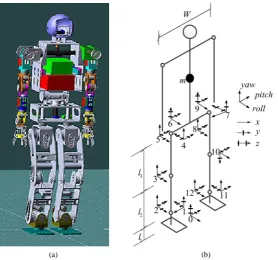
D-H rule [7]. The 0 coordination is the world coordinate system (WCS) fixed on the ground. 1 - 12 coordina-tions are the local coordinacoordina-tions. After calculating the homogeneous transformation matrixes between the local coordinations, and knowing the angles at each joint, the WCS coordinates of any point in the local coordinate system can be calculated based on the chain rule of homogeneous transformation, thus providing the WCS coor-dinates and orientations of each link for stability validation.
3. Humanoid Robot Gait Planning
Each joint angle trajectory can be calculated by inverse kinematics once the trajectories of the center of mass (CM) and the swing legs are planned, thus the corresponding gaits are generated. The trajectories of swing legs are fitted by polynomial interpolation through the parameters as step length, step cycle, zero speed and zero ac-celeration at the time swing leg leaving and landing ground. Here we focus on the design of trajectory for CM.
[image:2.595.177.456.436.696.2]3.1. Trajectory of CM
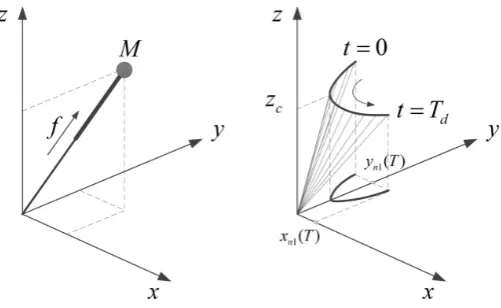
Figure 2 shows the3-D LIPM which is proposed for trajectory planning of CM under the assumption that the mass of lower limbs is neglected, the mass of the upper body is condensed to one point and its vertical height
c
z
remains constant.
(a) (b)
Figure 2. 3-D LIPM model and its trajectory.
In this case, the motion differential equations of 3-D LIPM are given by:
c c g x x z g y y z = = (1)
The solutions are:
( )
( )
(
)
( )
(
)
( )
( )
cosh(
)
( )
(
)
0 cosh 0 sinh
sin
0 0 h
c c c
c c c
x t x t T T x t
y
T
t =y t T T y t T
= +
+
(2)
And the first derivatives versus time are:
( )
( )
(
) ( )
(
)
( )
( )
sinh(
) ( )
cos(
)
0 sinh 0 cosh
0 0 h
c c
c
c c
c
x t x T t T x t T
t
y y T t T y t T
= +
= +
(3)
where, Tc = zc g.
3.1.1. Middle Gait
For single leg support phase: assuming the time section is
[ ]
0,T , the CM trajectory component for x vector and y vector are xn1( )
t and yn1( )
t , respectively. Because of symmetry and periodicity conditions, it is re-quired that:( )
( )
( )
( )
( )
( )
( )
( )
1
1 1 1
1 1
1
1
0 ,
0 , 0
0
n n n
n n n
n n
x T x x T x
T T
y = y y = y
= − = − (4)
Substituting Equation (4) into Equation (3), one gets
spectively. The CM trajectories of this phase can be calculated in the same way by considering the symmetry and periodicity conditions.
The robot keeps static before starting to walk. To satisfy the continuous requirements of velocity and accele-ration of CM, the swing legs need to retreat to get an accelerating process for CM until the velocities and acce-lerations are equal to the initial start time of LIPM, assuming the section time is [0,Ts]. Similarly, after the final gait, the swing legs need to take a distance forward from support leg, and the CM moves from the final state of LIPM to static in the double leg support phase. The trajectories of above static walking phases are fitted by po-lynomial interpolation.
3.2. Joint Angle Trajectory
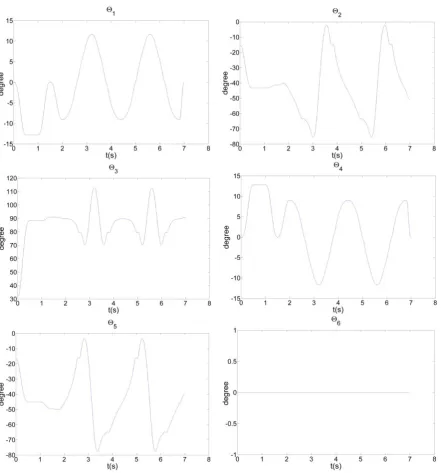
It is supposed that T =1.0s, Td =1.2s, Ts =2.5s, s1=0.35m, s2=0.4m, w=0.08m, zc =0.9m. The
trajectories of lower limb joint angles including the phase [0,Ts], start gait by left leg, three cycles of middle gait, and the final gait are calculated by inverse kinematics as Figure 4 (take the right leg for example).
4. Stability Validation
4.1. Theoretical Calculation
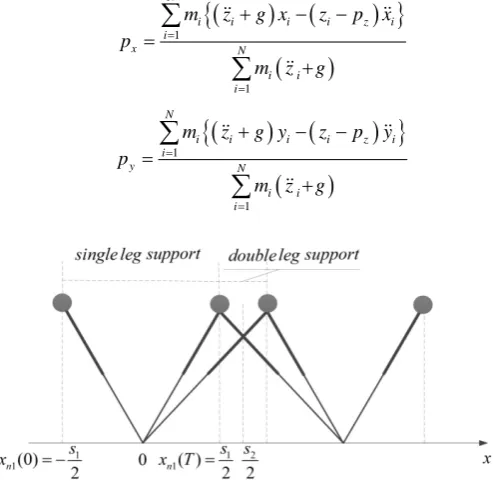
A multi-link model, shown in Figure 1(b), is usedfor theoretical calculation. It is assumed that inertial tensor of each link around its CM is neglected, the equations of ZMP are as follows:
(
)
(
)
{
}
(
)
1 1 Ni i i i z i
i
x N
i i
i
m z g x z p x
p
m z g
= = + − − = +
∑
∑
(6)(
)
(
)
{
}
(
)
1 1 Ni i i i z i
i
y N
i i
i
m z g y z p y
p
m z g
[image:4.595.191.438.465.706.2]= = + − − = +
∑
∑
(7)Figure 4. Joint angle trajectories of right leg.
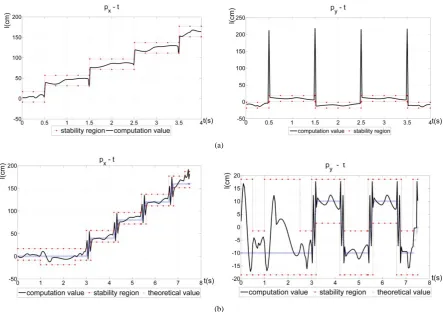
The WCS trajectories of CM of each link are calculated by substituting each joint angle from the gait plan-ning into multi-link kinematics model, where the victory and acceleration are calculated by the difference me-thod. Substituting all these above into Equations (6) and (7), the solutions of ZMP trajectories are shown in Figure 5.
(a)
[image:6.595.93.537.225.537.2](b)
Figure 5.Trajectory of ZMP: (a) Trajectory of ZMP without static walking phase and double leg support phase; (b) Trajec-tory of ZMP with static walking phase and double leg support phase.
[image:6.595.92.539.576.707.2]prototype is built for simulation. By gait planning and stability validation above, conclusions are drawn as fol-lows:
1) 3-D LIPM is effective for structured pavement gait planning, the additional improvement of boundary con-ditions on the start and stop moment is effective and conforms to the actual rule.
2) The trajectories of joint angles are designed more smoothly after considering the speed and acceleration discontinuity problems when two gait cycle switching, which increases the walking stability of the robot.
3) The effect on ZMP by LIPM simplification is shown and the rationality of simplification is verified by theoretical calculation and simulation. Thus, the simplification can be used for real robot walking planning.
4) The stability can be validated by the relationship between ZMP trajectory and support polygon when robot walks, which is applicable to most structured road conditions.
References
[1] Fu, C.L. and Chen, K. (2008) Gait Synthesis and Sensory Control of Stair Climbing for a Humanoid Robot. IEEE Transactions on Industrial Electronics, 55, 2111-2120.http://dx.doi.org/10.1109/TIE.2008.921205
[2] Hirai, K., Hirose, M., Haikawa, Y. and Takenaka, T. (1998) The Development of Honda Humanoid Robot. Proceed-ings of the 1998 IEEE International Conference on Robotics and Automation, Leuven, 16-20 May 1998, 1321-1326.
[3] Nguyen, T.P., Kim, D.W., Kim, H.K. and Kim, S.B. (2008) An Optimal Control Method for Biped Robot with Stable Walking Gait. Proceedings of the 2008 IEEE-RAS International Conference on Humanoid Robots, Korea, 1-3 Decem-ber 2008, 211-218.
[4] Katic, D. and Vukobratovic, M. (2003) Survey of Intelligence Control Techniques for Humanoid Robots. Journal of Intelligence and Robotic Systems, 37, 117-141. http://dx.doi.org/10.1023/A:1024172417914
[5] Fu, G.P. and Yang, Y.M. (2011) Survey and Prospect on Walking Control Strategies for Humanoid Robot. Machine Tool & Hydraulics, 39, 154-158. (in Chinese)
[6] Shuuji, K., Hirohisa, H., Kazuhito, Y. and Kensuke, H. (2005) Humanoid Robots. Ohm-sha Ltd, Tokyo.