Economic Backwardness in Security
Perspective
Carney, Richard
RSIS, NTU
October 2004
Online at
https://mpra.ub.uni-muenchen.de/3279/
Richard Carney
Assistant Professor
S. Rajaratnam School of International Studies
Nanyang Technological University
Singapore
Abstract:
Modern political economies are distinguished from each other by the institutions that
mediate actors’ interactions, falling somewhere along a spectrum between pure market and
non-market mechanisms. But how did these institutions originally emerge? With regard to the
financial sector, I argue that higher levels of national security threats
in combination with
economic backwardness lead to a financial system more dominated by banking relationships. To
evaluate the argument, I conduct a focused comparison of Japan and Germany before WWII
since they had similar political and legal institutions and were both ‘backward’, but differed with
regard to the security threats they faced.
Germany confronted more menacing threats from neighboringgreat powers as well as greater domestic unrest following unification in 1871, which led the government
to direct lending to sectors vital to the nation’s security via banks. Japan, by contrast, did not face the
I. Introduction
How did different types of national financial systems originally emerge? The study of financial systems is
one aspect of national political economies that falls within the Varieties of Capitalism (VoC) literature
(Hall and Soskice, 2001). Coordinated market economies (CMEs) privilege relationship-based interactions
over the more market-based forms of coordination found among actors in liberal market economies
(LMEs). Accordingly, banking finance is more prevalent in CMEs, while securities markets are more
dominant among LMEs. VoC analysis embeds national financial systems into a broader set of institutional
practices including corporate governance, wage determination, job security, welfare systems, education
and training, product-market competition, monetary and fiscal policy. They argue that financing practices
interact with these other variables, so that the elements need to be treated as a whole, not in isolation. I am
sympathetic to that interest in institutional complementarity, but I narrow the research focus to national
financial systems in order to emphasize and measure them.
In this paper, I examine the effects of a variable commonly disregarded by scholars of
comparative political economy: national security threats. While such threats are ever present to greater or
lesser degrees, little work has been done to illustrate whether there is a systematic effect on the structure
of national political economies. I seek to fill this void by examining whether severe security threats, in
combination with economic backwardness, cause governments to move the domestic financial system
toward a greater reliance on banks than capital markets since banks allow savings to be mobilized more
effectively in economically backward countries, and allow the government to direct financing to those
sectors that best contribute to the nation’s security.
To evaluate the argument, I compare Germany and Japan in the late nineteenth and early twentieth
century since they shared several important features in common, but differed with regard to the severity of
the national security threats they faced. Their commonalities included: (1) similar government institutions
and legal systems (Japan’s 1889 Meiji Constitution was modeled after Germany’s 1871 Constitution and
industrialization. Despite these similarities, German firms relied heavily upon banking finance, while
Japanese firms depended far more extensively on securities markets. I argue that Germany relied heavily
on banks partly because banks permitted leaders to funnel money to those sectors that bolstered
Germany’s national security apparatus. On the one hand, there were geopolitical concerns: Russia in the
east, France in the west, Austria-Hungary to the south, and the UK at sea. On the other hand, there was
also considerable domestic instability following Germany’s unification in 1871, which threatened the
power and authority of the ruling elites, thereby leading to a build-up of military forces for domestic
security purposes. When Bismarck instituted Germany’s constitution in 1871, he granted the military
considerable independence from the legislature, placing it under the control of the emperor. Consequently,
the emperor, with support from others in government, used banks as policy allies of the government to
direct financing to those sectors that either served the dual purpose of enhancing economic growth and
national defense, such as railways, or which bolstered national security alone. While early modern
Japanese leaders are well-known to have employed the slogan ‘rich nation, strong army’ to guide national
policymaking, Japan did not face the same level of threats to its national security. Consequently, Japanese
businesses had greater scope for private action in comparison to their German counterparts who worked
more closely with the government during its industrializing period.
This study seeks to complement the Gerschenkronian argument that large banks acted as effective
mobilizers of capital for German industrialization, not to discredit it. That is, I see these large banks as
serving the dual purpose of propelling Germany’s industrialization as well as serving as useful
government allies to bolster the young republic’s national security. Because the origins of contemporary
Germany’s coordinated market economy can be traced to the strong ties that developed between banks and
firms in its industrializing period, the paper seeks to illuminate the link between national security and the
origins of modern capitalism.
In the next section, I discuss various explanations for Germany’s reliance on banks, as opposed to
of the paper is devoted to the following section which contrasts Germany and Japan, with focused
comparisons of their financial systems, pace of industrialization, political systems, and the influence of
interest groups. Because railways were the cornerstone of German industrialization, I illustrate the dual
purpose they served for economic growth and military strategy, and the government’s close involvement
with their development in contrast to Japan’s hands-off approach. Finally, I conclude.
II. Alternative Explanations
The most prominent argument with regard to Germany’s high level of banking concentration and
dominance at the end of the nineteenth century is Alexander Gerschenkron’s. He argues that late
industrialization pushed Germany (among other European nations) toward a reliance on a concentrated
banking sector dominated by universal banks:
The industrialization of England had proceeded without any substantial utilization of
banking for long-term investment purposes. The more gradual character of the
industrialization process and the more considerable accumulation of capital, first from
earnings in trade and modernized agriculture and later from industry itself, obviated the
pressure for developing any special institutional devices for provision of long-term capital
to industry. By contrast, in a relatively backward country capital is scarce and diffused, the
distrust of industrial activities is considerable, and, finally, there is greater pressure for
bigness because of the scope of the industrialization movement, the larger average size of
plant, and the concentration of industrialization processes on branches of relatively high
ratios of capital to output. To these should be added the scarcity of entrepreneurial talent in
the backward country.
It is the pressure of the circumstances which essentially gave rise to the divergent
development in banking over large portions of the Continent as against England.1 (italics mine)
1
Many have argued, however, that Gerschenkron’s thesis does not fully consider political and legal
factors in the development of financial systems. One view considers the development of the banking
system and the role of the central bank in facilitating different kinds of industrialization. The Bubble Act
of 1720 and the monopoly of the Bank of England over limited liability banking until 1825, for example,
kept the British banks excessively small and conservative. Moreover, the lack of a dependable lender of
last resort made bankers reluctant to invest in new, risky and potentially illiquid enterprises (Kennedy,
1992, and Tilly, 1994). According to this argument the Reichsbank both squeezed other banks out of much
of the short-term commercial business and facilitated those banks’ provision of riskier investment
services. Capie (1999), however, argues that the lender of last resort function did not become dependable
in Europe until after the turn of the twentieth century. Thus, there is skepticism about the timing and role
of the central bank with regard to Germany’s industrialization.
La Porta, Lopez-de-Silanes, Shleifer, and Vishny (LLSV, 1996, 1999) argue for the importance of
legal traditions in determining the character of a country’s financial system. They argue that common law
countries are more market-oriented than civil law countries because of the legal protection for investors.
Because common law judges can make rulings based on whether a defendant has violated the spirit of the
law, investors in these countries have greater protection from managers’ actions that violate the law’s
intent. In civil law countries, on the other hand, if a manager does not contravene an explicitly detailed
edict, courts have a more difficult time punishing the manager. Common law systems are found in
Anglo-American states such as Britain, the US, New Zealand, Australia, and Canada, while civil law systems are
found in most other democracies, including Japan, but are especially prominent in Europe.
However, LLSV’s argument is not robust when tested across the entirety of the twentieth century
since many civil law countries, such as France and Japan, had well-developed capital markets at the
beginning of the century. Moreover, the argument is also theoretically unappealing since recent research
on political influence on the American judicial system illustrates that politics influences court decisions
1995; Pablo T. Spiller, and Rafael Gely, 1990; John DeFigueiredo, and Emerson H. Tiller, 1996; G. Zuk,
G.S. Gryszki, and D. Barrow, 1993; Gary Zuk, Deborah J. Barrow, and Gerad S. Gryszki, 1996).
Verdier (1997 and 1999) argues that universal banking is prevalent when there is both a
segmented deposit market, dominated by non-profit and provincial banks, and a reliable lender of last
resort that could ensure liquidity in the banking system. Furthermore, he argues that these two
preconditions for universality emerged simultaneously only when state centralization was sufficient to
provide a strong central bank with credible lender of last resort status, but limited enough to permit
coexistence of provincial and, in his terms, ‘center’ banks. However, Verdier acknowledges that political
centralization was neither solitary nor decisive in determining financial structure in most cases. Moreover,
the lender of last resort function was not well dependable until after the turn of the twentieth century as
Capie (1999) argues. Thus, Verdier does not offer a convincing alternative to Gerschenkron’s hypothesis.
So far, the literature has not offered a convincing and central role for political or legal
explanations that would account for the different forms of financial development in Germany and Japan at
the turn of the twentieth century.
III. Argument
Gerschenkron uses the term ‘backward’ to refer to those countries which are relatively more dependent on
a ‘pre-modern’ agricultural sector than their neighbors, and which likewise lack a well-developed
industrial sector with associated financing institutions that can mobilize vast amounts of capital via
markets. The extent of a country’s backwardness acts as the key causal mechanism for determining
whether large banks are used to mobilize and transfer savings for industrializing purposes. I seek to
modify this view by emphasizing the importance of an additional factor which also influences whether a
country mobilizes savings and lends funds via large banks: national security threats. A ‘backward’ country
will seek to mobilize savings via large banks only when it faces a severe and persistent security threat.
government leaders to direct financing to those sectors which best bolster the nation’s security. In this
view, countries will depend more heavily on banks as the interaction of the extent of underdevelopment
and the level of the security threat increases. The longer that this situation endures, the more entrenched
that the bank-firm relationships and the affiliated political economic institutions will become.2 In the late nineteenth century, both Germany and Japan were ‘backward,’ but only Germany
turned to banks to industrialize. I argue that Germany faced more severe threats to its national security
than Japan, and that German political leaders consequently favored the development of a banking
dominated financial system since this would allow them to direct financing to sectors that would bolster
national security and foster industrialization. In Japan, national security threats were not as high, and so
political leaders did not intervene as heavily in the economy, thereby allowing the development of a
financial system more reliant on equities markets. But once security threats became sufficiently high
during the war with China and during World War II, Japanese leaders also moved the financial system
toward greater banking dominance, laying the groundwork for Japan’s postwar banking-oriented financial
system.3
IV. Comparing Germany and Japan
In this section, I first show that Germany had a banking-dominated financial system while Japan relied
extensively on securities markets. Next, I show that Japan industrialized late – later than Germany, in fact
-- but relied on markets. I then detail the structure of their governments, illustrating that they had similar
institutions and delineating which groups actually had political power. In particular, I show that large
2
Additionally, the government will be more likely to accommodate labor demands to ensure that industrialization proceeds as quickly as possible.
3
firms and the military both had considerable political influence, but that the German government paid far
greater attention to its military needs while pursuing its industrialization policies.
IV.A. The Financial Systems
Japan relied heavily on its securities markets from the 1880s to the 1930s. Hoshi and Kashyap (2001)
describe the character of the financial system:
The first financial regime starts in the 19th century and continues until the beginning of Japanese hostilities with China in the late 1930s. …this era was characterized by the
relatively low importance of banks in the financing of corporations. For instance, bank
financing of large firms was often less important than bond financing. Even among the large
industrial alliances known as zaibatsu, bank financing was not a very important funding
source during this period.
In contrast, securities markets were quite active. New shares were routinely issued by the
leading corporations and shares were traded actively on stock exchanges and
over-the-counter. The trading was done by a diverse group; the banks as a rule did not own much
equity and the notion of “shares held in friendly hands” was rarely mentioned. Bond
markets were also deep and vibrant. It was not unusual to see years where more net
corporate funding was done in bond markets than through bank borrowing.4
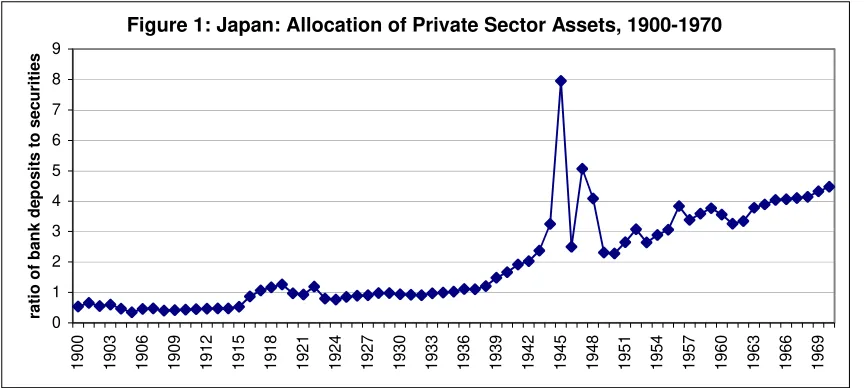
Figure one places the evolution of Japans financial system in historical perspective,
clearly illustrating its reliance on markets prior to 1937, and its subsequent move to banking
dominance. Table 1 likewise illustrates the increasing concentration of the five largest banks from
1900 to 1945.
4
Figure 1: Japan: Allocation of Private Sector Assets, 1900-1970 0 1 2 3 4 5 6 7 8 9 1 9 0 0 1 9 0 3 1 9 0 6 1 9 0 9 1 9 1 2 1 9 1 5 1 9 1 8 1 9 2 1 1 9 2 4 1 9 2 7 1 9 3 0 1 9 3 3 1 9 3 6 1 9 3 9 1 9 4 2 1 9 4 5 1 9 4 8 1 9 5 1 1 9 5 4 1 9 5 7 1 9 6 0 1 9 6 3 1 9 6 6 1 9 6 9 ra ti o o f b a n k d e p o s it s t o s e c u ri ti e s
Source: Hoshi and Kashyap
, 2001.5
Table 1: Relative Size of the Five Largest Banks
(in percents of total for all ordinary and savings banks)
Source: Hoshi and Kasyap, 2001.
Germany, by contrast, is well known for its continually heavy reliance on banks, and the
development and concentration of its universal banks. Speculative excesses after the unification of
Germany in 1871, and ending in the bust of 1873, led to slow economic growth in the ensuing decade, and
initiated consolidation in the banking industry. Consolidation continued during the next several decades,
and by 1914 there were 8 “Great Banks” (the Great Banks were simply a group of very large Berlin banks,
such as the ‘4 D-Banken’-- the Deutsche, Dresdner, Darmstädter, and Diskonto-Gesellschaft -- along with
the Schaafhausen’scher Bankverein and the Berliner Handelsgesellschaft) and 86 major regional credit
banks. But large banks also formed long-term relationships with smaller banks in which they had no
5
Data calculated as demand deposits relative to securities (net).
Year
Paid-in-capital
Deposits
Lending
1900
5.4
15.1
10.6
1910
10.2
17.4
15.1
1920
13.9
20.5
16.5
1930
24.1
31.0
27.6
1940
31.6
35.4
44.7
[image:10.612.150.400.341.451.2]formal ownership interest. A Great Bank’s ‘group’ could control assets considerably larger than those of
the bank alone. And, according to Whale (1930), nine Berlin banks with their groups controlled 83 percent
of all working funds owned by the 160 largest credit banks in 1913. Indeed, by World War I Germany’s
banks were by world standard enormous. In 1913 the three largest incorporated entities (by assets) in
Germany were banks, and banks comprised 17 of the 25 largest German firms in that year (Guinnane,
2002). That relative bank position was equaled in no other industrial country at the time.
At the same time, however, Tilly (1999) illustrates that, over the period from 1883-1913, Berlin’s
capital markets were well-functioning and could meet the demands of industrial finance placed on them.
He finds that German spreads were, in fact, significantly lower than in the US, and comparable to Great
Britain’s, and that new issues of ordinary shares were far more important in Berlin than in London over
the 1880-1913 period. Indeed, data on Berlin’s capital market relative to London’s suggests that it
“developed more adequate facilities for the finance of equity capital than did Great Britain.” Analysis by
Calomiris (1993) confirms this. Thus, it seems reasonable to conclude that German institutional
arrangements for the supply of industrial finance via securities markets were, by international comparative
standards, more than adequate.
IV.B. Industrial Development
Germany and Japan both industrialized late. In fact, Japan actually developed later than Germany which,
according to Gerschenkron, should correspond to a heavier reliance on banking finance. Table two
illustrates Japan’s development from 1879 to 1930, and the growing reliance on manufacturing as
Table 2: Percent of Net National Product in Japan, 1879-1930
Source: Ohkawa, Kazushi and Henry Rosovsky. 1965. “A Century
of Japanese Economic Growth,” in Lockwood (ed.) The State and
Economic Enterprise in Japan.
Looking more closely at manufacturing we can see which particular sectors grew quickly (metals
and machinery, chemicals and ceramics, and electricity and gas) and which grew more slowly (textiles,
wood products, food products, and other).
Table 3: Growth of Manufacturing Production in Japan (indices; 1910-14=100)
1895-99
1900-04
1905-09
1910-14
1915-19
1920-24
Approximate
Growth %
per year
Textiles
41
50
70
100
152
185
5.3
Metals and
Machinery
25
33
61
100
162
244
8.2
Chemicals and
Ceramics
na
na
53
100
186
252
8.5
Wood
Products
na
56
91
100
142
na
5
Food Products
80
88
85
100
123
170
2.6
Electricity and
Gas
na
10
27
100
198
356
16
Other
a49
90
126
100
248
190
4.8
Total
Manufacturing
(37)
(48)
69
100
160
217
aThis includes leather goods and straw mats.
Source: Lockwood, William W. 1954. The Economic Development of Japan, p. 115.
Year
Agricultural
Output
Output of Factory
Manufacturing
1879
64.4
3.2
1885
55.7
4.1
1886
53
5.2
1898
52.2
5.9
1899
43
8.1
1905
39
9.1
1906
41
8.9
1919
36.5
14.3
1920
33.7
14.9
[image:12.612.69.532.457.687.2]Germany’s industrial development can be seen from the following table.
Table 4: Percentage Distribution of Output by Sectors in Germany, 1860-1913
Source: Tipton, Frank B. “Technology and Industrial Growth,” in Imperial Germany. Roger Chickering (ed.). 1996. Westport, CT: Greenwood Press.
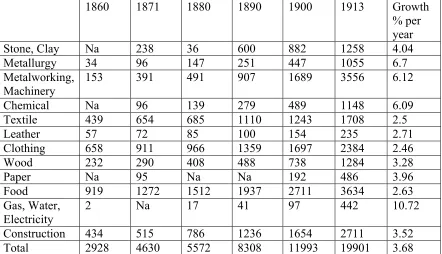
We can also look more closely at the rate of growth of industrial sectors in Germany during this
period. The growth sectors resemble those of Japan, and include metallurgy, metalworking and machinery,
chemical, and gas, water, and electricity.
Table 5: Net Output in Branches of German Manufacturing and Construction in Millions of 1913 Marks
1860
1871
1880
1890
1900
1913
Growth
% per
year
Stone, Clay
Na
238
36
600
882
1258
4.04
Metallurgy
34
96
147
251
447
1055
6.7
Metalworking,
Machinery
153
391
491
907
1689
3556
6.12
Chemical
Na
96
139
279
489
1148
6.09
Textile
439
654
685
1110
1243
1708
2.5
Leather
57
72
85
100
154
235
2.71
Clothing
658
911
966
1359
1697
2384
2.46
Wood
232
290
408
488
738
1284
3.28
Paper
Na
95
Na
Na
192
486
3.96
Food
919
1272
1512
1937
2711
3634
2.63
Gas, Water,
Electricity
2
Na
17
41
97
442
10.72
Construction
434
515
786
1236
1654
2711
3.52
Total
2928
4630
5572
8308
11993
19901
3.68
Source: Tipton, Frank B. “Technology and Industrial Growth” in Chickering (1996).
Year
Agriculture
Mining
Manufacture,
Construction
Services
1860
45.2
1.1
21.8
31.8
1871
38.7
1.9
28
31.4
1880
36.4
2.6
29.4
31.7
1890
32.8
2.9
33.7
30.7
1900
29.9
3.2
36.8
30.1
[image:13.612.91.533.435.689.2]During the period for which we have data for both countries, from 1880 to 1913, Germany
increased its manufacturing output by over ten percent. Japan increased its output by around ten percent as
well (extrapolating from the trend of the data). However, a far greater proportion of Germany’s output
derives from manufacturing during this period. Accordingly, one could argue that this forced Germany to
rely more heavily on banking to provide sufficient financing that the capital markets couldn’t handle.
However, the prior section illustrated that Germany’s securities markets could adequately meet the
demands of industrial finance. Additionally, the data reveal that the growth of particular manufacturing
sectors occurred more quickly in Japan than Germany for the dates listed above, and that Japan’s
industrial development likely began later than Germany’s if we compare the proportion of manufacturing
to each country’s total national output. Even if Japan’s level of industrialization did not reach Germany’s
pre-WWI levels until the interwar period, Japan continued to rely predominantly upon securities markets.
Recall that it was not until the war with China in 1937 that Japan began moving toward a greater reliance
on banks.
The important point is that German banking became more concentrated and grew in importance
during the pre-WWI period of rapid industrial growth, while capital markets remained dominant in Japan.
Why did late industrialization in Germany and Japan depend on different forms of financing?
IV.C. The Political System
Although Germany had the superficial qualities of a democracy prior to 1914, in fact it was governed by
the elites. The following figure details the structure of Germany’s political institutions for the period in
Figure 2: Germany’s Government (1871-1914) Executive
Legislative Branch
Although mobilization of the masses occurred, with voter turnout increasing in nearly every
federal election from 1871 to1907, the structure of the political institutions prevented the legislature from
having much influence on government policy, except as an obstructionist force. That is, bills required the
approval of the legislature and thus it could threaten to veto them, but even in this respect its powers were
limited since the legislature could be dissolved at will by the emperor, and this actually happened in 1887
and 1893 over military bills. Thus, for legislation to be passed it required the sponsorship of the emperor.
With regard to legislation affecting the financial system, Fohlin (2002) identifies 11 laws passed
between 1870 and 1908 which caused concentration in universal banking, expanded universal banks, or
encouraged the use of banks over securities exchanges. Considering the strong push toward banks, we
must determine which interests most heavily influenced the emperor, or which priorities were at the top of Reichstag: Elected based on male suffrage. A
majority of its members could refuse to agree to a law proposed by the executive, particularly legislation relating to Imperial finances, and used this refusal as a weapon to force concessions—a weapon blunted by the executive’s right to dissolve the Reichstag and call for new elections. Emperor: Selected the Chancellor. Can dissolve
Reichstag at will and call for new elections.
Cabinet ministers: appointed by the Chancellor.
Army and Navy: The army and navy were controlled by the Emperor. The legislature had limited power over the army’s budget. The navy, however, was completely under the control of the Emperor, including the budget.
Chancellor: chosen by the emperor, without consultation of the Reichstag.
the emperor’s list, and why banking concentration would be appropriate. I turn to this in the next section.
First, I detail Japan’s political institutions.
Japan used Germany’s constitution as a model for their Meiji Constitution of 1889 (in addition to
adopting Germany’s civil law legal system). Figure three illustrates the structure of Japan’s government
from 1889 – 1937.6
6
Figure 3: Japan’s Meiji Constitution Government (1889-1937) Executive
Legislative Branch Imperial Diet: Coequal Power
House of Representatives: Popularly elected. Voted on premier. Sought to gain influence over departments of the bureaucracy, but only had minimal success.
House of Peers: Appointed by the Emperor and aristocrats who inherited appointment. Voted on premier. Acted to protect the bureaucracy by vetoing the House’s anti-bureaucracy legislation.
Genrō: Elder Statesmen. Made all important political decisions in the Emperor’s name and served as the real centralized power of the state up to the 1920’s. Recommended the selection of the prime minister to the Emperor and
legislature.
Cabinet: Ministers of State. Signed off on legislation passed by the legislature. The premier appointed the cabinet. Parties attempted to increase their power over the bureaucracy via the cabinet by voting for premiers catering to their interests.
Emperor: Proposed laws and sent them to the legislature. The Constitution was given to the people by him, making it subordinate to the Emperor.
Privy Council: Members appointed by the Emperor for life. Served as an advisory council.
Bureaucracy: Members were hand-picked by the oligarchy (Privy Council, Genrō, and House of Peers) until they changed the requirement to enter via a civil service exam, which further protected them from attacks on their power by parties since university students were usually from the oligarchy. Cabinet ministers ran various departments of the bureaucracy. The
bureaucracy implemented the law.
Ministers of the army and navy had direct access to the Emperor, and were therefore completely beyond the control of the prime minister. As a result, the administration of the army and navy was entirely beyond the control of a cabinet dominated by political parties. The ministers of the army and navy did not resign with a retiring premier, but continued in office in the cabinet of his successor.
In theory, the Emperor exercised absolute political power. The Constitution was subordinate to the
Throne, and thereby to the Sat-Cho7 oligarchs who controlled the Throne.8 The Constitution placed the Privy Council, the cabinet, and the House of Peers effectively out of any popular control. Moreover, the
powers of the House of Representatives were sufficiently limited to give popular government little
positive power. It could only serve as a weak veto-gate. It was weak because the oligarchs retained the
ability to circumvent uncooperative legislatures: they could often avoid statutes through Imperial Orders,
they could keep the budget beyond real legislative control (e.g., by implementing the previous year’s
budget and deflating the currency to increase its relative size), and the oligarchs could even dissolve the
legislature if necessary.
One of the most powerful mechanisms for undermining popular rule was the Genrō (Elder
Statesmen). They made important political decisions in the Emperor’s name, such as recommending the
prime minister to the legislature, and served as the real centralized power of the state up to the 1920’s.9 No political institution was as powerful as the Genrō in the early constitutional period. Although they lost
their influence as fewer members survived to advise the Emperor in the 1920’s, the Privy Council also
acted as an advisory council. These members were appointed by the Emperor for life, but the Council was
a constitutionally recognized body and could more easily be reined in, unlike the Genrō.
Members of the House of Peers were either appointed by the Emperor or were aristocrats who
inherited their membership. The Peers often sought to protect the bureaucracy by vetoing the lower
house’s anti-bureaucracy legislation since all policies required concurrent Peer-House approval.
For most of the period, the House of Representatives was not popularly elected since only wealthy
taxpayers were permitted to vote -- usually businessmen and wealthy landowners. The Elections Act of
1889 enfranchised only 453,000 voters out of a total population of 42 million. Subsequent election laws in
1900, 1919, and 1925 raised the voting population, ultimately to the entire male population aged 25 or
7
Sat-Cho is the abbreviation used by Japanese historians to designate the oligarchy of Satsuma and Choshu men who constituted the supreme governing power of Meiji Japan.
8
For detailed discussion on prewar Japan’s political institutions, see Ramseyer and Rosenbluth 1995, Matsunami 1979, Duus 1968, Umegaki 1988, Banno 1992, and Banno 1987.
9
more, totaling 12.5 million voters, or 21 percent of the population. Indeed, during the twenties, political
parties’ influence increased. Policy outcomes reflected more of the parties’ objectives via the Diet’s power
to approve of the premier, who was recommended by the Emperor. Because the premier selected cabinet
members, this was the Diet’s one way to influence the administration. Frequently, the premier would
bargain with party leaders to ensure his election, and in doing so, would offer cabinet positions to them.10 On average, however, the lower house of the legislature had little power throughout most of the
period, and was dominated by wealthy farmers and business interests. The twenties witnessed increasing
party influence, but it was insufficient to dramatically alter government policies.
The important point is that the levers of power were controlled by the Emperor and Bundesrat in
Germany, and by the Emperor and the oligarchy (the Genrō, Privy Council, and House of Peers) in Japan.
Thus, we must determine which interest groups most heavily influenced them.
IV.D. Interests and Government
Japan: The development of Japan’s industrial and commercial sectors initially depended upon intensive
government planning, supervision, and subsidization. But in 1880, the government of Japan began to
privatize the burgeoning industrialization movement because of the heavy expenditures the government
had made, contributing to a budget crisis and inflation.11The sale of these enterprises meant that the government could no longer influence the industrialization process directly and instead had to make it
worthwhile for private entrepreneurs to bring about the goal of industrialization. Subsidies, loans, and
technical assistance were offered to industries the government considered essential, fostering close,
informal ties between
big business and the government. For example, “large number[s] of new
industrial leaders … were men of the old
bushi
class and consequently men whose political
10
Members of the bureaucracy were hand-picked by the oligarchy (Privy Council, Genrō, and House of Peers) until they changed
the requirement to enter via a civil service exam, which simply changed it from an aristocratic clique to a university clique. The cabinet ministers ran various departments of the bureaucracy, and the bureaucracy was responsible for implementing the laws.
11
predilections and personal friendships—not to mention economic security—lay with the
government. With Meiji political and economic elites extremely small in numbers, with the latter
frequently selected by the former and having a similar background, close personalized contacts
were most natural” (Scalapino, 1967, 251). At this early date, Japanese industry was highly
centralized, and the zaibatsu were the ultimate recipients of tremendous economic and political
power.
12Big business had privileged access to Japan’s political leaders, not simply because they
frequently shared a common background, but also because agrarian political power was
concentrated in the lower house, which lacked real political influence. Thus, the zaibatsu, who
garnered political favors from the oligarchs through their financial influence, frequently prevailed
when conflicting urban-rural interests arose, such as nominating premiers and legislation
affecting the financial system.
13For example, the
Genrō’s
nominations of premiers illustrate their
preference for business-friendly leadership. One early example is Yamagata’s premiership, which
began in November 1898. He allied with the
Jiyūtō
group of the Kenseito (the precursor of the
Kenseikai pro-business party and created by the cooperation of the
Jiyūtō
and
Shimpōtō
parties)
and made a bargain with them which helped to align the political parties to the growing class of
capitalists (Umegaki, 1988). Up through the 1920s, premiers were always pro-business
(Scalapino, 1967).
However, it would be incorrect to conclude that Japan’s industrial growth succeeded as a result of
the government’s leadership. For example, in the textile industry, the most important sector to Japan’s
nineteenth century economy, Yamamura (1974: 178-83) shows that the state contributed little to its
12
Regarding the Meiji era, Iwasaki (1921, 102) remarks, “The way to get rich was to become the friend of some high officers in
the government. Such friendships were frequent. For example, Marquis Inouye, the great Genrō and leader of financial reform,
was an intimate of the Mitsui family. Marquis Okuma and the Iwasaki family, the steamship kings, are also closely associated. The connection between the government and big business in Japan is frankly admitted.”
13
success. Most of the capital for the textile industry’s expansion came from small-scale ventures making
use of local sources of capital. Modern cotton-spinning firms were generally organized as joint-stock
enterprises, raising share capital from private sources, having little to do with the state bureaucracy.
While the government was more directly involved in the initial development of railways,
especially with their financing, the amounts came nowhere near those of European nations. In the
mid-1880s, the rail network had fewer than 200 miles of track (Ericson 1996: 9). With the government having
taken the initial risks, private investment subsequently boomed and nearly 4000 miles of track were built
by the turn of the century, three-quarters of it privately owned. While the government offered subsidies for
the construction of many rail lines, with local and national politics playing a role, the vast majority of the
financing came from private sources. Some have argued that Japan’s nationalization of the railways in
1906-7 suggests that the government no longer trusted the market to develop such an important national
asset, but Ericson shows that nationalization occurred to relieve firms of an increasingly costly burden and
to free private sector capital to enter new fields. In this manner, the government assisted and bolstered the
private capital markets. Moreover, Japan’s rail lines never acquired the same level of economic
importance as in Europe since coastal shipping remained an inexpensive alternative.
In the nascent overseas shipping industry, the state’s intervention was much more pronounced.
Military needs provided the impetus for the government’s increasing presence, which was initiated with
Japan’s decision to launch a naval expedition to strengthen its claims to sovereignty over Taiwan in 1874.
At this time, only four of the seventy-four licensed mariners then operating in Japan were Japanese. But
this initiative proved extremely slow; by the late 1890s, no more than 10 percent of Japan’s overseas trade
was carried out by Japanese vessels. From 1897 to 1913, however, shipping and shipbuilding together
received around 75 percent of all government subsidy payments in the 1897-1913 period, contributing to
significant growth in the overseas shipping industry, and to the benefit of the Nippon Yusen Kaisha firm
in particular (Blumenthal 1976: 36). Government subsidies declined in importance with the onset of the
offering Japanese firms an opportunity to fill the vacuum. At the end of the war, the Wasington Naval
Conference, held between November 1921 and February 1922, called for a ten-year moratorium on the
construction of capital ships and limits on armaments and fortifications, leading to an 80 percent drop in
Japan’s tonnage between 1921 and 1932, and forcing shipbuilders to move into new fields. Thus, the
government’s intervention and subsidization of the shipping industry declined after 1913. While overseas
shipping was important to Japan’s economic development, it did not require the same level of capital
outlays as railways in Europe since coastal shipping provided an affordable, well established alternative
for domestic transport.
Foreshadowing the government’s privatization of its major industrial enterprises, and the
liberalizing trend after 1880, the first Stock Exchange Act was passed in 1874.14 It was patterned after the rules of the London exchange, but was considered too restrictive and too different from the practices of
the already extant rice and commodities markets which participants were more used to. Consequently, the
government passed new legislation in 1878 which recognized many of the more familiar transaction
formats. The Tokyo Stock Exchange was established in May, followed by several more exchanges in the
major cities shortly thereafter. Corporate bond markets developed slowly until the 1890 Commercial Code
was passed, which specified rules regarding corporate form and liability as well as guidelines regarding
the issuance of bonds.15 Both prospered. Indeed, despite the 1923 earthquake (measuring 7.9!) and the 1927 financial crisis, the government and the zaibatsu ensured that stock and bond markets recovered
quickly and remained deep and vibrant. Banking services were largely used to bolster firms’ securities
markets financing activities, making bank financing “the least important source of funds” for the Japanese
economy during the 1889-1937 era.16
The US economy’s entry into a deep depression which spread around the globe, as well as Japan’s
decision to revert to the gold standard following the crash on the New York Stock Exchange, led Japan’s
14
For information on business elites’ preference for capitalism (but not with regard to bank or securities markets), see Marshall,
1967, Capitalism and Nationalism in Prewar Japan. For a thorough account of Japan’s prewar financial system, including the
formation of securities markets, see Adams, 1964, A Financial History of Modern Japan.
15
See Adams, 1964, chapters 1, 2, 3, and 4; and Hoshi and Kashyap, 2001, chapter 2.
16
export trade to fall 27 percent from 1929 to 1930 (Allen, 1981: 107–8). Labor and farmers were especially
hard hit as exports and wages dropped because of lower exports and as a result of the deflationary policies
to keep Japan on the gold standard; prices on all farm goods fell an average of 34% from 1929 to 1930
(Nakamura, 1981: 216–7). The economic effects on the average worker and farmer were worse than the
Great Kantō earthquake in 1923 or the financial crisis in 1927. Consequently, party government became
the victim of the public’s growing anger over their dire economic straits. Ultranationalism spread and
resentment toward party leaders grew as they were increasingly perceived as corrupt. The military became
emboldened, and Prime Minister Hamaguchi was attacked in November 1930, and later died, for
supporting the London Naval Treaty over the objections of the navy. In February 1932 Finance Minister
Inoue was assassinated, and Takuma Dan, a top manager of Mitsui, was killed in March. The murder of
prime minister Tsuyoshi Inukai by young military officers on May 15 1932 (the May 15 Incident) marked
the end of party–led government. From then until August 1945, Japan had eleven military–backed non–
party governments.
In July 1937, war broke out with China and the government enacted legislation mobilizing the
country’s resources for war. Of primary importance was the ability to direct finance. When the war with
China began, a series of laws were passed to put the allocation and control of finance firmly under
government control. To this end, banks were consolidated. The 424 ordinary banks at the end of 1936
were reduced to 186 in 1941, and further consolidated to just 61 in 1945.17 In May 1943, ordinary banks were granted the right to collect small deposits, causing the number of savings banks to fall from 69 in
1941 to 4 in 1945. More important, however, were consolidations among the zaibatsu banks, with four
major zaibatsu banks controlling almost half of the capital of Japan’s financial institutions in 1945.
Hoshi and Kashyap (2001) find that the relations formalized by the munitions companies system
of WWII (where a bank is assigned to a particular firm) lasted into the postwar period. Even after 30 years
(1974), 79% of 157 munitions companies from WWII still had close ties to their designated wartime
17
financial institution, suggesting that the wartime transformation was very important to the structure of the
postwar banking-oriented financial system. Moreover, because the designated institution typically had
been involved in a firm’s postwar reorganization, Occupation period policies further cemented these
relationships.
Germany: The new German Reich of 1871 was a “Great-Prussian militaristic” enterprise (Stig, 1996):
The Prussian army had been the key instrument in the creation of the empire, and by
virtue of its prestige and constitutional position, it became a main pillar of that state.
Henceforth the emperor, the government, and the military administration itself all
regarded the Prussian army as a major integrating factor, which would hold the empire
together and preserve its semiconstitutional structure. In this respect, the political
structure of Imperial Germany was indeed militaristic, for its rulers intended, if
necessary, to use the army for domestic purposes, to defend the existing social and
political order.18
Most significantly, the emperor, who was also King of Prussia, was the supreme commander of
the German army in both peace and war, according to Article 63 of the constitution. This permitted him to
devote considerable government resources to the military if he so desired. As a consequence of the wars in
1864, 1866, and 1870-1 that ultimately led to the unification of the German state, there was an emphasis
on maintaining domestic security and creating more centralized administrative powers in the immediate
decades that followed. Central to this effort was railroad construction and its administration by the new
federal government. Fremdling (1977) shows that this single innovation was also vital to Germany’s
economic growth and industrialization during the nineteenth century because of its backward linkages,
such as iron production and development of the engineering sector, as well as its trade enhancing effects.
Equally important was the federal government’s growing control over it, which began dictating how rail
lines would be laid down for strategic military reasons (Veblen, 1915). Specifically, railways had become
18
crucial to the military’s quick mobilization of troops from across Germany to specific battle areas, to
supplying them after they arrived, and to the conduct of battle itself (e.g., flanking enemy troops;
Showalter, 1975). A biographer of Moltke, the Prussian army’s Chief of Staff from 1858 until Germany’s
unification, wrote:
Hardly a single important railway line was built … in Prussia and later in Germany, without
Moltke submitting an opinion on the most favorable routing, or the construction of bridges,
tunnels, etc. … Moreover he endeavored to make clear the general viewpoints influencing his
thinking in memoranda to the responsible authorities in order to create understanding for the
interests of the military and give them emphasis.19
While commercial interests generated considerable demand for railway construction, this proved
dangerously inadequate to the Confederation’s, and later to Germany’s, military needs, leading to renewed
efforts at railway improvement and additional construction. In 1861, a special commission was established
to evaluate the suitability of Germany’s railway network for military purposes. It concluded that there
were wide differences in the construction and administration of the railroads, too few junctions in many
regions, and that three-fourths of the German Confederation’s railways required upgrading from
single-tracked to double-single-tracked lines since only double-single-tracked lines could fulfill military requirements
(Showalter, 1975, 45). The Commission also recommended the closest possible cooperation of military
and civilian authorities at all levels, with a combined central authority controlling the work of the agencies
supervising individual routes.
At the same time, the revolution in military technology accelerated. All of Europe’s armies were
caught up in a technological race. The introduction of smokeless powder, advanced breech-loading rifles,
machine guns, and heavier, more accurate, and faster-firing artillery contributed to an enormous increase
in firepower. In 1897, Tirpitz, the new State Secretary for the Navy, launched Germany’s successful effort
to build a world class navy, which ranked third in size behind the UK and the US in 1914 (Owen, 1978).
Automobiles, zeppelins, and the first airplanes likewise opened new military prospects on the eve of the
war. Through all of this, the relationship between heavy industry, the military, and government was
notoriously close. For example, the Krupp firm, Germany’s leading arms manufacturer, kept in close
contact with the Hohenzollerns, especially Wilhelm II, as well as the Prussian military and government
officials (Boelcke, 1970).
As Germany industrialized, the executives of the great banks exercised considerable power, as
indicated by the large number of banks they took over, the resultant increase in their share of total bank
deposits, the large number of directorships they occupied in German business corporations, their ability to
control strategic decisions through the institution of proxy voting in shareholders meetings, by the close
links between leading bankers and the political elite of the German government, and by a number of well
documented cases of enterprise decision making in which conflicts resolved themselves in favor of
intervening banks (Feldenkirchen, 1981; Tilly, 1992). The influence of the banks was most acute in the
heavy and electro-chemical industries – industries central to the expansion of the nation’s
military-industrial complex (Feldenkirchen, 1991).
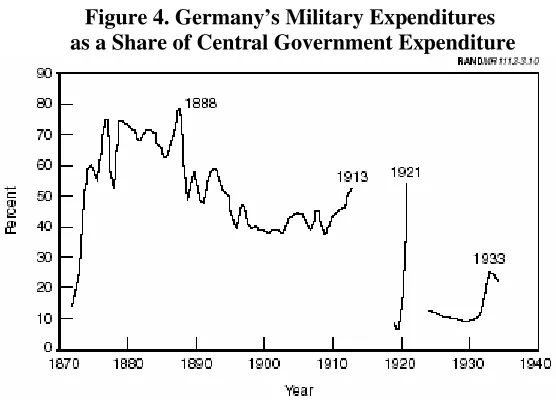
Relative to Japan prior to 1937, Germany’s military was far more important to national security
and required a far higher proportion of the government’s total expenditures (except for the 1894-95
Sino-Japanese War, and the 1904-05 Russo-Sino-Japanese War). The following figures from Castillo et al (2001)
Figure 4. Germany’s Military Expenditures as a Share of Central Government Expenditure
Figure 5. Japanese Military Expenditures
as a Share of Government Expenditure
Because of the domestic instability that lingered after the three wars that led to unification in
1871, as well as its proximity to other great powers including Russia, France, Austria-Hungary, and the
UK, Germany’s military played a far bigger role in national politics than Japan’s. Indeed, Van Evera
(1984) discusses the “cult of the offensive” that swept through Europe at the turn of the twentieth century,
and which led states to adopt more aggressive foreign policies. The belief that the offense had the
advantage, based on their observations of how wars were won during the nineteenth century, helped to
mold the offensive military doctrines which every European power adopted during the period leading up
[image:27.612.161.439.69.271.2]believed that the offense has the advantage since expansion becomes more tempting; specifically, the cost
of aggression declines when the offense has the advantage. Also, the advantage goes to the state striking
first, raising the risk of preemptive war. Finally, ‘windows’ of opportunity and vulnerability open wider
since smaller shifts in force ratios have larger effects on relative capacities to conquer territory, again
raising the risk of preventive war. Because Germany was surrounded by great powers who subscribed to
this perception, it was particularly vulnerable to an offensive strike, forcing German leaders to remain
continually vigilant with regard to their national security interests. Moreover, this perception created
strong incentives to build a militarily suitable railway network that could quickly move troops across the
country. A centrally controlled, double-tracked, and efficiently run railway network was critical to
Germany’s military needs, and likewise acted as the key factor to Germany’s rapid industrialization
through backward and forward linkages.
Japan did not have these same security concerns with its relatively stable domestic politics, and
remoteness from threatening powers. There was also no equivalent belief in the cult of the offensive,
which would have been less troublesome since Japan could more easily defend its shores from sea-based
aggression. Not until the 1930’s did the military dominate Japanese policy making in the same way that it
did in Germany’s pre-WWI government.
V. Conclusion
The bank-firm relationships prevalent in contemporary Japan and Germany are frequently identified as
exemplars of the coordinated market economy in the VoC literature. How did these relationships
originate? In both cases, national security needs motivated the state to intervene in the economy in order
to funnel money to militarily important industries via banks. Economic ‘backwardness’ simply added to
this need to funnel money to industrializing sectors of the economy since a state’s overall power is
determined by both its economic and military might. The construction of railroads in Germany had the
intervention, likely would have succeeded in fostering economic growth through private investment in
railways, the government had to intervene to ensure that military needs were also attended to, including
both the scope and speed of railway construction. The prolonged duration of this government-guided
investment cemented these bank-firm relationships so that they endured into the post-war period. The
China and Pacific Wars for Japan led to similar bank-firm relationships that lasted into the post-war
period.
While a nation’s relative power is implicit in Gerschenkron’s identification of economically
backward states, he does not consider military priorities to have guided how industrialization occurred.
But it is clear from the German case that military needs were of great importance to the construction of
railroads; and this certainly influenced other European states as well. Germany, and Moltke in particular,
was constantly worried about the speed with which French and Austrian railways could mobilize troops
along the German border. Moreover, adding national security as a factor that determines whether late
industrializers rely on banks explains why Japan remained reliant on securities markets until the
mid-1930s – resolving an old empirical puzzle for the Gerschenkronian argument.
This paper illustrates that the origins of the Japanese and German bank-firm financing
relationships can be located in their preparations for war, in combination with the need to become less
economically ‘backward.’ However, these relationships persisted after the war because interests found
these relationships expedient to their own ends. In particular, several authors (e.g., Allen and Gale, 2000;
Carney, 2003; Perrotti and von Thadden, 2003) have argued that labor favors bank financing over
securities markets because it offers greater employment stability. After WWII, labor gained considerable
political influence in both Germany and Japan-- largely because big businesses were seen to have
benefited from the war – and modified only slightly the existing bank-firm relationships. In Germany, this
led to a private banking system in which banks acted as policy allies of the government, and labor was
given representation in corporate boardrooms (Zysman, 1983; Deeg 1999). In Japan, labor struck bargains
representation in corporate boardrooms, but perhaps best exemplified by the new lifetime employment
policies (which did not exist in the interwar period). Thus, labor’s newfound political power propelled the
wartime bank-firm relationships into the decades following WWII.
References
Adams, Thomas Francis Morton. 1964. A Financial History of Modern Japan. Tokyo: Research.
Allen, Franklin and Douglas Gale. 2000. Comparing Financial Systems. Cambridge, Massachusetts: MIT Press.
Allen, G. C. 1981. A Short Economic History of Modern Japan. New York: St. Martin’s Press.
Blumenthal, Tuvia. 1976. “The Japanese Shipbuilding Industry,” in Hugh Patrick (ed.), Industrialization and its Social Consequences for Modern Japan. Los Angeles: University of California Press.
Boelcke, Willi A. 1970. Krupp und die Hohenzollern in Dokumenten:
Krupp-Korrespondenz mit Kaisern, Kabinettschefs und Ministern 1850-1918. Frankfurt am Main: Akademische Verlagsgesellschaft Athenaion.
Calomiris, Charles, W. 1993. "Corporate-Finance Benefits from Universal Banking: Germany and the United States, 1870-1914," NBER Working Paper 4408.
Carney, Richard. 2003. “The Political Economy of Financial Systems: Explaining Varieties of Capitalism,” dissertation manuscript, University of California, San Diego.
Castillo, Jasen, Julia Lowell, Ashley J. Tellis, Jorge Muñoz, and Benjamin Zycher. 2001. Military Expenditures and Economic Growth. Santa Monica, CA: Rand Corporation.
Capie, Forrest. 1999. “Banking in Europe in the Nineteenth Century: the role of the central bank,” in Richard Sylla, Richard Tilly, and Gabriel Tortella (eds.) The State, The Financial System, Economic Modernization. Cambridge: Cambridge University Press.
Chickering, Roger (ed.). 1996. Imperial Germany. Westport, Connecticut: Greenwood Press.
Colegrove, Kenneth. 1929. ‘Labor Parties in Japan’, American Political Science Review, vol. XXIII, no. 2.
DeFigueiredo, John, and Emerson H. Tiller. 1996. “Congressional Control of the Courts: A Theoretical and Empirical Analysis of the Expansion of the Federal Judiciary.” Journal of Law and
Economics 39:435-62.
Harvard University Press.
Ericson, Steven. 1996. The Sound of the Whistle: Railroads and the State in Meiji Japan. Cambridge, Mass; Harvard University Press.
Feldenkirchen, Wilfried. 1981. ‘The Banks and the Steel Industry in the Ruhr. Developments in Relations from 1873 to 1914,’ in: German Society for Business History, Cologne in cooperation with the Institute for Banking History, Frankfurt/Main (ed.), German yearbook on business history. Berlin: Springer.
Feldenkirchen, Wilfried. 1991. “Banking and Economic Growth: Banks and Industry in
Germany in the Nineteenth Century and their Changing Relationship During Industrialisation,” in W. R. Lee (ed.), German Industry and German Industrialisation. Essays in German Economic and Business History in the Nineteenth and Twentieth Centuries, Chapter 4, London & New York: Routledge, 116-47.
Francks, Penelope. 1999. Japanese Economic Development. New York: Routledge.
Fohlin, Caroline. 2002. “Regulation, Taxation, and the Development of German Universal Banking System, 1884-1913,” European Review of Economic History, 6, 221-254.
Fremdling, Rainer. 1977. “Railroads and German Economic Growth: A Leading Sector Analysis with a Comparison to the United States and Great Britain,” Journal of Economic History, XXXVII (3), September, 583-604.
Furushima, Toshio. 1951. Gaisetsu Nihon nōgyō gijutsushi. Tōkyō : Yōkendō.
Garon, Sheldon. 1990. The State and Labor in Modern Japan. Berkeley: University of California Press.
Gerschenkron, Alexander. 1962. Economic Backwardness in Historical Perspective. Cambridge, MA: Harvard University Press.
Guinnane, Timothy. 2002. “Delegated Monitors, Large and Small: The Development of Germany’s Banking System, 1800-1914.” Journal of Economic Literature XL: 73-124.
Hall, Peter and David Soskice. 2000. Varieties of Capitalism: The Institutional Foundations of Comparative Advantage. New York Oxford University Press.
Hoshi, Takeo. 1995. “Back to the Future: Universal Banking in Japan.” Research Report 95-01, Graduate School of International Relations and Pacific Studies, UCSD.
Hoshi, Takeo, and Anil Kashyap. 2001. Corporate Financing and Governance in Japan. Cambridge, Massachusetts: The MIT Press.
Iwasaki, Uichi. 1921. The Working Forces in Japanese Politics. New York: Columbia University.
Japanese Boards: Determinants and Implications for Managers,” Journal of Financial Economics, 36, 225-258.
Kennedy, W. P. 1992. “Historical Patterns of Finance in Great Britain: A Long-Run View,” in V. Zamagni (ed.), Finance and the Enterprise. London: Academic Press.
Johnson, Chalmers. 1982. MITI and the Japanese Miracle: The Growth of Industrial Policy, 1925-1975. Stanford, California: Stanford University Press.
La Porta, Rafael, Florencio Lopez-de-Silanes, Andrei Shleifer, and Robert W. Vishny
1998. “Law and Finance,” Journal of Political Economy, Volume 106, Issue 6 (Dec., 1998), 1113-1155.
La Porta, Rafael, Florencio Lopez-de-Silanes, Andrei Shleifer, and Robert W. Vishny. 1999. “Investor Protection and Corporate Governance.” Manuscript.
Levitsky, Jonathan E. 1994. “The Europeanization of the British Legal Style.” American Journal of Comparative Law 42: 347-380.
Marshall, Byron K. 1967. Capitalism and Nationalism in Prewar Japan; the ideology of the business elite, 1868-1914. Stanford, California: Stanford University Press.
McCubbins, Mathew, and Thomas Schwartz. 1988. “Congress, the courts, and public policy: consequences of the one man, one vote rule.” American Journal of Political Science. 32(2): 388-415.
McCubbins, Mathew, Roger NOLL, and Barry Weingast, 1995. "Politics and the Courts: A Positive Theory of Judicial Doctrine and the Rule of Law." Southern California Law Review. 68(6):1631-1684.
Mitchell, B. R. 1988. British Historical Statistics. New York: Cambridge University Press.
Munshi, Kaivan D., and Michael R. Reich. 1993. “Investment Behavior and Financial Structure: The Case of the Japanese Pharmaceutical Industry,” manuscript, MIT.
Ohkawa, Kazushi and Henry Rosovsky. 1965. “A Century of Japanese Economic Growth,” in William W. Lockwood (ed.) The State and Economic Enterprise in Japan. Princeton, NJ: Princeton University Press.
Owen, Richard. 1978. “Military-Industrial Relations: Krupp and the Imperial Navy Office,” in Richard Evans (ed.) Society and Politics in Wilhelmine Germany. London: Croom Helm.
Ramseyer, J. Mark. 1994. “The Puzzling (In)dependence of Courts: A Comparative Approach.” Journal of Legal Studies 23:721-47.
Ramseyer, J. Mark, and Eric B. Rasmussen. 1997. “Judicial Independence in a Civil Law Regime: The Evidence From Japan.” Journal of Law Economics and Organization 13:259-286.
Roe, Mark J. 2002. Political Determinants of Corporate Governance. New York: Oxford University Press.
Samuels, Richard. 1994. Rich Nation, Strong Army. Ithaca, NY: Cornell University Press.
Scalapino, Robert. 1967. Democracy and the Party Movement in Prewar Japan. Los Angeles: University of California Press.
Shirk, Susan. 1993. The Political Logic of Economic Reform in China. Berkeley: University of California Press.
Showalter, Dennis. 1975. Railroads and Rifles: soldiers, technology, and the unification of Germany. Hamden, Conn.: Archon Books.
Spiller, Pablo T., and Rafael Gely. 1990. "Congressional Control of Judicial Independence: The
Determinants of U.S. Supreme Court Labor Relations Decisions, 1949-1987." Mimeo. University of Illinois.
Stig, Forster. 1996. “The Armed Forces and Military Planning,” in Chickering (ed.), Imperial Germany. Westport, Connecticut: Greenwood Press.
Tilly, Richard. 1992. “An overview on the role of the large German banks up to 1914,” in Y. Cassis (ed.), Finance and Financiers in European History, 1880-1960. New York: Cambridge University Press.
Tilly, Richard. 1994. “German Banks and Foreign Investment in Central and Eastern Europe before 1939,” in D. Good (ed.), Economic Transformations in East and Central Europe. New York: Routledge Press.
Tilly, Richard. 1999. “Public policy, capital markets and the supply of industrial finance in nineteenth-century Germany,” in Richard Sylla, Richard Tilly, and Gabriel Tortella (eds.) The State, The Financial System, Economic Modernization. Cambridge: Cambridge University Press.
Umegaki, Michio. 1988. After the Restoration: the Beginning of Japan’s Modern State. New York: New York University.
Van Evera, Stephen. 1984. “The Cult of the Offensive and the Origins of the First World War,”
International Security Vol. 9, No. 1: 59 – 108.
Veblen, Thorstein. 1915. Imperial Germany and the Industrial Revolution. New York: The Macmillan Company.
Verdier, Daniel. 1997. “The Political Origins of Banking Structures,” Policy History Newsletter 2.
Verdier, Daniel. 1999. “The Origins of Universal Banking in 19th Century Europe, North America, and Australia,” European University Institute, mimeo.
Yamamura, Kozo. 1974.
A Study of Samurai Income and Entrepreneurship : Quantitative Analyses
of Economic and Social Aspects of the Samurai in Tokugawa and Meiji, Japan.
Cambridge, Mass: Harvard University Press.
Zuk, Gary, Deborah J. Barrow, and Gerad S. Gryszki. 1996. The Federal Judiciary and Institutional Change. Ann Arbor: University of Michigan Press.