IJPSR (2019), Volume 10, Issue 5 (Research Article)
Received on 31 August 2018; received in revised form, 28 November 2018; accepted, 06 December 2018; published 01 May 2019
RP-HPLC METHOD FOR QUANTIFICATION OF OROTIC ACID IN CAPSULE FORMULATION
T. Hemant Kumar *, D. Jhanavi, K. Vara Prasad Rao and Y. Srinivasa Rao
Department of Pharmaceutical Analysis and Quality Assurance, Vignan Institute of Pharmaceutical Technology, Beside VSEZ, Duvvada, Visakhapatnam - 530049, Andhra Pradesh, India.
ABSTRACT: A simple, sensitive and specific RP-HPLC method was developed and validated for the determination of Orotic acid in bulk and capsule dosage form. Chromatography was carried out on an Enable C18G (250 × 4.6 mm i.d.,5µ) column using filtered and degassed mixture of acetonitrile and methanol in the ratio of 60:40% v/v as mobile phase at a flow rate of 1 ml/min and effluent was monitored at 280 nm. The method was linear over the concentration range of 10 - 70 µg/ml with a correlation coefficient of 0.999. The retention time of the drug was 9.1 min. The proposed method was validated by determining sensitivity, accuracy, precision, robustness studies. The developed method was effectively applied to capsules of orotic acid, and the % assay of the drug was found to be 99.65%. The method is simple, accurate, precise and reproducible and hence can be applied for routine quality control analysis of orotic acid in pure and capsule dosage form.
INTRODUCTION: Orotic acid chemically 2,
4-dioxo-1H-pyrimidine-6-carboxylic acid Fig. 1 is an intermediate product in pyrimidine synthesis which plays a role in chemical conversions between dihydrofolate and tetrahydrofolate. Orotic acid is used to treat hyperuricemia associated with chronic gout, acute uric acid nephropathy, recurrent uric acid stone formation, certain enzyme disorders 1. Orotic acid is used for the prevention of hyperuricemia during chemotherapy in patients with cancer, leukemia, lymphoma. Orotic acid is an excellent marker for OTC deficiency 2. Orotic acid increases in urea cycle disorders due to the accumulation of carbamoyl phosphate when there is a mismatch between the fluxes through carbamoyl phosphate synthetase, and the urea cycle steps 3.
QUICK RESPONSE CODE
DOI:
10.13040/IJPSR.0975-8232.10(5).2343-47
The article can be accessed online on
www.ijpsr.com
DOI link: http://dx.doi.org/10.13040/IJPSR.0975-8232.10(5).2343-47
FIG. 1: CHEMICAL STRUCTURE OF OROTIC ACID MONOHYDRATE
Carbamoyl phosphate enters the pyrimidine nucleotide synthesis pathway leading to markedly increased concentrations of orotic acid. One UV spectrophotometric method was reported for estimation of orotic acid in capsule formulation 4. Estimation orotic acid can be quantified in urine or plasma using liquid chromatography-tandem mass spectrometry (LC-MS/MS) methods 5 but only one RP-HPLC method 6 reported for estimation of Orotic acid in urine as there is a lack of LC-MS instrument in every lab so there is a need of RP-HPLC method for quantification of orotic acid. Hence, an attempt has been made to develop and validate a novel, simple and sensitive RP-HPLC method by ICH guidelines 7 for the estimation of orotic acid in its capsules formulation.
Keywords:
Orotic acid, RP-HPLC, Validation, Capsule dosage form Correspondence to Author: T. Hemant Kumar
Department of Pharmaceutical Analysis and Quality Assurance, Vignan Institute of Pharmaceutical Technology, Beside VSEZ, Duvvada, Visakhapatnam - 530049, Andhra Pradesh, India.
[image:1.612.49.299.648.730.2]MATERIALS AND METHODS:
Instrumentation: Chromatographic separation was performed on a Shimadzu LC-20AD HPLC system equipped with a C18 G column (250 × 4.6 mm i.d, 5 µm particle), binary pumps, degasser, Variable wave length detector and Rheodyne injector with 20 μl loop volume. ‘LC solution’ software was used to collect and process the data.
Chemicals and Reagents: Orotic acid and its pharmaceutical form capsules were purchased from the local market. Acetonitrile, methanol, and water of HPLC grade were used. All other chemicals and reagents are of HPLC grade.
Optimized Chromatographic Conditions:
Mobile phase : Methanol: Acetonitrile 60:40 (v/v).
Elution type : Isocratic
Column : Enable C18 G 250 × 4.6 mm U.V. detection : 280 nm
Flow rate : 1.0 ml/min Injection volume : 20 μl Temperature : Ambient Runtime : 18 min
Preparation of Mobile Phase: The mobile phase Acetonitrile and methanol were mixed in the ratio of 40: 60 v/v and filtered through a membrane filter (Millipore Nylon disc filter of 0.45 µ). This filtered
mobile phase was sonicated for 15 min in ultrasonic bath before use.
Preparation of Standard Stock Solution: A stock solution was prepared by taking accurately weighed 10 mg of orotic acid in 100 ml volumetric flask and initially dissolved in 50 ml mobile phase. Then the solution was made upto mark with mobile phase to obtain a concentration of 100 µg/ml and the resulting solution was sonicated for 15 min and filtered through 0.45 µ nylon membrane filter. The chromatogram for standard orotic acid was shown in Fig. 2.
Preparation of Sample Solution: Weighed
accurately 10 capsules net fill weight and crushed into fine powder in a mortar by using a pestle. Weigh accurately and transfer about 557.7 mg capsule powder (equivalent to 500 mg of orotic acid) into 100 ml dry volumetric flask, added about 60 ml dry volumetric flask, sonicated for about 5 minutes, cooled to room temperature, diluted to volume with mobile phase and mixed. Transferred 5 ml of the above solution to 50 ml volumetric flask and volume made with mobile phase and mixed. Pipetted 2.0 ml from the above solution into a 20 ml volumetric flask, diluted to volume with mobile phase and mixed. Filtered a portion of the clear solution through 0.45 μm Nylon syringe filter. The chromatogram of orotic acid from formulation was shown in Fig. 3.
FIG. 2: CHROMATOGRAM OF STANDARD FIG. 3: CHROMATOGRAM OF OROTIC ACID OROTIC ACID FROM CAPSULE FORMULATION
RESULTS AND DISCUSSION:
Method Validation: System Suitability: A
standard solution was prepared by using the orotic acid working standard as per the test method and was injected five times into the HPLC system. The system suitability parameters were evaluated from standard chromatograms by calculating the % RSD
from replicate injections for orotic acid monohydrate peak areas. The system suitability parameters met the requirement of method validation. The % RSD for the retention times and peak areas were found to be within limits. The data for system suitability parameters are shown in
TABLE 1: SYSTEM SUITABILITY PARAMETERS DATA FOR OROTIC ACID
Specificity: A study to evaluate the interference of placebo was conducted. Test solutions were prepared in duplicate with placebo equivalent to the amount present in test preparation and analyzed as per the test method. The placebo should not show any peak at the retention time of orotic acid monohydrate indicates the specificity of the method.
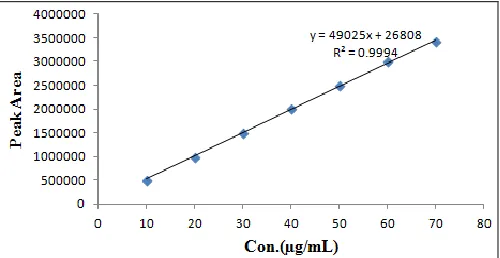
Linearity: The calibration curve was prepared in a concentration range of 10-70 µg/ml by taking 1-7 ml of standard stock in 10 ml volumetric flask, and the volume was made up to the mark with the mobile phase. The resulting solutions were filtered through 0.45 µ membrane filter paper, and the filtrate was used for analysis. The calibration curve was plotted for different concentrations of working standards prepared from standard drug solution of pure drug and showed linearity over a concentration range of 10-70 µg/ml. The method was found to be linear in the concentration range of 10-70 µg/ml. The correlation coefficient was found to be 0.9994. The calibration curve was shown in
Fig. 4 and linearity data was shown in Table 2. TABLE 2: CALIBRATION TABLE OF OROTIC ACID
S. no. Concentration (µg/ml) Peak area
1 10 500256
2 20 999028
3 30 1503793
4 40 2003900
5 50 2498118
6 60 2997181
7 70 3412377
FIG. 4: CALIBRATION CURVE OF OROTIC ACID
Precision: The precision of an analytical procedure expresses the closeness of agreement (degree of scattering) between a series of measurements obtained from multiple sampling of the same homogeneous sample under the prescribed conditions. Six solutions of the same concentrations were prepared, and the peak area was noted. The results were shown in terms of % RSD. The inter and intra-day precision results of orotic acid showed % RSD less than 1, which showed that the method was precise. The table for precision was shown in Table 3.
TABLE 3: TABLE FOR PRECISION Precision
Intra-day
Inter-day
Day 1 Day 2 Day 3 Mean 2004672 2305612 2235990 230222 Standard
deviation
18520.4 11889.4 13965 12147.3
% RSD 0.44 0.35 0.43 0.36
[image:3.612.315.565.54.183.2]Accuracy: Accuracy (recovery) of the method was obtained by spiking 80, 100 and 120% of orotic acid working standard concentrations, in which the amount of marketed formulation was kept constant, and the amount of pure drug was varied. Solutions were prepared in triplicates and accuracy was indicated by % recovery. The recovery was well within the limit. Hence, the method was accurate. The accuracy results are shown in Table 4.
TABLE 4: RECOVERY RESULTS OF OROTIC ACID % Spike
level
Sample (µg/ml)
Amount added (Std.)
Amount found (µg/ml)
% Recovery
Statistical parameters
80
40 32 31.84 99.55 Mean = 100.1
SD = 0.85 % RSD = 0.84
40 32 32.34 100.1
40 32 31.85 99.48
100 40 40 39.67 99.07 Mean = 98.74
SD = 0.925 % RSD = 0.93
40 40 38.17 97.64
40 40 39.83 99.52
120 40 48 47.74 99.38 Mean = 99.15
SD = 0.31 % RSD = 0.31
40 48 47.87 99.75
40 48 46.82 97.2
Parameter
% RSD for peak areas 0.1
No. of Theoretical plates 3725
Tailing factor 1.01
[image:3.612.47.567.613.746.2]Robustness: To evaluate the robustness of the developed method, small, deliberate variations in optimized method parameters were made. The effect of change in flow rate, changes in the composition of mobile phase and detection
[image:4.612.47.564.145.239.2]wavelength on retention time, tailing factor and theoretical plates were studied. The method was found to be unaffected by small changes in flow rate, change in the composition of mobile phase and detection wavelength as shown in Table 5. TABLE 5: ROBUSTNESS RESULTS
Conditions %
Assay
System Suitability parameters Theoretical Plates Tailing Factor
Flow Rate 0.8 ml/min 99.68 3992 1.08
Flow Rate 1.2 ml/min 99.49 3847 1.12
Mobile Phase- ACN(65): MET(35) 99.67 3762 1.12
Mobile Phase- ACN(55): MET(45) 99.84 3649 1.11
Wavelength 278 nm 99.83 3839 1.12
Wavelength 282 nm 99.61 3869 1.12
Ruggedness: The ruggedness was studied by
evaluating by different analysts but in the same chromatographic conditions. The results of the ruggedness of the developed method are started in
Table 6. The results are shown during by different
[image:4.612.47.568.329.471.2]analysts, but in the same chromatographic condition of the test, solution wasn’t affected & in accordance with the actual. The suitability parameters are also found good; hence this method was concluded as rugged.
TABLE 6: EVALUATION DATA OF RUGGEDNESS STUDY OF OROTIC ACID ID
Precisions
No. of Injections
Orotic acid
Peak Area RT
ID Precision - 1 1 249537 9.143
2 242874 9.189
3 248593 9.205
ID Precision - 2 1 245487 9.118
2 240784 9.197
3 245292 9.183
Mean 245427.8
St. Dev 3317.0
% RSD 1.0
Sensitivity: The limit of detection (LOD) is defined as the lowest concentration of an analyte that an analytical process can reliably differentiate from background levels. The limit of quantification (LOQ) is defined as the lowest concentration of the standard curve that can be measured with acceptable accuracy, precision, and variability. The LOD and LOQ were calculated from the linear curve using formulae
LOD = 3.3 * σ / S LOQ = 10 * σ / S
(Where σ = the standard deviation of the response and S = Slope of calibration curve).
The results were shown in Table 7. TABLE 7: LOD AND LOQ
Drug LOD (µg/ml) LOQ (µg/ml)
Orotic acid 0.42 1.16
Application of Proposed Method: The assay of the marketed sample (capsule formulation) for orotic acid are summarized in Table 8.
TABLE 8: DATA DERIVED FROM ASSAY OF OROTIC ACID
Drug Label Claim
Mean amount found
% Purity ± SD Orotic acid 300 mg 298.71 99.6 ± 0.3
CONCLUSION: A high-performance liquid
literature, advantages of this new proposed method simple, economic mobile phase, user friendly and convenient approach. All these key features proposed that this method can be considered as advantageous over other methods
ACKNOWLEDGEMENT: The authors are
grateful to Dr. L. Rathaiah, Chairman of Lavu educational society for providing necessary facilities to carry out the above research work.
CONFLICT OF INTEREST: Nil
REFERENCES:
1. Nieper HA: The anti-inflammatory and immune-inhibiting effects of calcium orotate on bradytrophic tissues. Agressologie 1969; 10(4): 349-57.
2. Nieper HA: Recalcification of bone metastases by calcium diorotate. Agressologie 1970; 11(6): 495-02.
3. Nieper HA: The clinical effect of calcium-do rotate on cartilage tissue, the specific function dependent upon the pentose metabolism of bradytrophic tissue [in German], 1973; 3(4): 82-9.
4. SaifulIslam MD, Taleb Hossain MD, Sukalyan KK,
Maksuda A and Rafiquzzaman MD: Development and validation of UV spectroscopic method for determination of calcium orotate in bulk and tablet dosage form. European Journal of Pharmaceutical and Medical Research 2016; 3(5): 165-70.
5. Oceania DA, Daniela G, Giancarlo la M, Antonio DR and Gaetano C: Reference intervals for orotic acid in the urine, plasma and dried blood spot using hydrophilic interaction liquid chromatography-tandem mass spectrometry. Journal of Chromatography B 2012; 3: 883-84.
6. Jahan SM, Islam HM, Khan MR, Hossain A, Kayesh R and Rahman A: A simple reversed-phase HPLC method for quantitative estimation of calcium orotate and its degradation products in the solid dosage form. Journal of Research Analyica 2016; 2(4): 108-12.
7. ICH Harmonized Tripartite guideline, Validation of Analytical Procedures: Text and Methodology Q2: 2005, 1-13.
All © 2013 are reserved by International Journal of Pharmaceutical Sciences and Research. This Journal licensed under a Creative Commons Attribution-NonCommercial-ShareAlike 3.0 Unported License.
This article can be downloaded to Android OS based mobile. Scan QR Code using Code/Bar Scanner from your mobile. (Scanners are available on Google Play store)
How to cite this article: