REVIEW
Enhancing crop yield by optimizing plant developmental features
Jyotirmaya Mathan, Juhi Bhattacharya and Aashish Ranjan*ABSTRACT
A number of plant features and traits, such as overall plant architecture, leaf structure and morphological features, vascular architecture and flowering time are important determinants of photosynthetic efficiency and hence the overall performance of crop plants. The optimization of such developmental traits thus has great potential to increase biomass and crop yield. Here, we provide a comprehensive review of these developmental traits in crop plants, summarizing their genetic regulation and highlighting the potential of manipulating these traits for crop improvement. We also briefly review the effects of domestication on the developmental features of crop plants. Finally, we discuss the potential of functional genomics-based approaches to optimize plant developmental traits to increase yield.
KEY WORDS: Crop biomass and yield, Domestication, Functional genomics, Leaf features, Plant architecture, Vasculature
Introduction
The world population is increasing rapidly and is expected to reach 8 billion by 2024, according to the most recent United Nations estimates (http://esa.un.org/unpd/wpp/Publications/). This exponential increase in population, without an associated increase in arable land, is a serious threat to sustainable food production for the planet. Furthermore, the rapid global environmental changes observed in recent years significantly threaten crop production (Lobell and Gourdji, 2012). Therefore, engineering crop plants in order to achieve greater yields has been a major focus of plant biologists and breeders with a view to ensuring food availability for an increasing world population under changing environmental conditions (Long et al., 2015; Zhu et al., 2010).
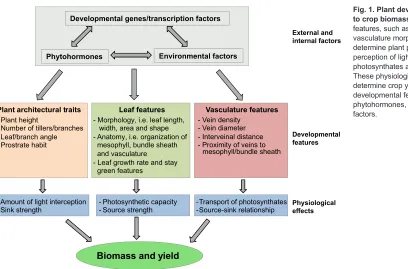
Plant performance is strongly associated with, and dependent on, plant development and growth. Several developmental features of plants, such as overall plant architecture, leaf features and vasculature architecture, are major traits that determine the overall performance of crop plants (Fig. 1). For example, leaf features and plant architecture determine the quantity of light interception, photosynthetic capacity and the source strength of plants, whereas the architecture and function of the vasculature direct the mobilization of photosynthates from source to sink and are crucial for efficient partitioning of photoassimilated carbon. These features can thus be considered part of a developmental module that dictates crop performance and yield (Fig. 1); the optimization of these developmental features is essential for the efficient performance of crop plants.
The importance of plant developmental features in increasing crop yield potential became evident during the‘green revolution’, when an unprecedented increase in yield was achieved by breeding
for semi-dwarf varieties of rice and wheat (Peng et al., 1999). Reducing plant height, for example by altering gibberellic acid (GA) biosynthesis and signaling (Peng et al., 1999; Spielmeyer et al., 2002), had an obvious advantage in reducing lodging as well as increasing the number of tillers. Knowing that leaves are the primary site of photosynthesis, it is logical to imagine that plants can also be engineered to produce leaves of optimal shape and size for more efficient light harvesting, leading to a faster growth rate and increased yield. Indeed, leaf photosynthesis is amenable to genetic manipulation and could thus be targeted to improve photosynthesis and yield (Horton, 2000). The plant vasculature is another feature that regulates the overall performance of a plant by not only providing mechanical strength but also serving as a channel for the transport of water, minerals and photosynthates (Brodribb et al., 2007; Sack and Scoffoni, 2013). Thus, genetic manipulations that alter these developmental traits in a desirable way may mark a significant step forward in increasing crop yield. The effect of domestication on plant and leaf architecture in crop plants further supports the idea that manipulation of these developmental traits can lead to improved crop performance (Meyer and Purugganan, 2013). Engineering developmental traits with the aim of improving photosynthetic efficiency, and thus yield, requires a thorough understanding of the genetic basis of these traits. Considerable progress has been made in deciphering the genetic and molecular basis of the developmental processes that govern these traits, particularly in the model plant species Arabidopsis thaliana. However, there are only limited examples of such understanding in crop plants. Nonetheless, it is becoming clear that the translation of basic knowledge acquired through plant developmental studies can be applied to increase crop yield. In this Review, we briefly discuss how the manipulation of plant architectural traits has been used to increase yield in crop plants. We then discuss the genetic control of leaf features and vasculature architecture in the model plantArabidopsisand in crop plants, highlighting potential of their manipulation to increase crop performance. We also provide a brief account of flowering time regulation and its association with crop yield, as well as an overview of the modulation of developmental features during domestication and the underlying genetic basis of these changes. Finally, we provide a perspective on the applications of recent functional genomics-based approaches for associating plant developmental features with overall yield and performance.
The genetic manipulation of plant architecture can improve crop yield
Plant architectural traits, such as plant height, branching and canopy characteristics, are important agronomic traits for crop yield. Plant breeders have extensively modulated plant architectural traits, in particular plant height and canopy features, for optimizing crop performance and yield in rice and wheat (Horton, 2000; Peng et al., 1999). Tillering – the process of branching in crop plants – determines the number of panicles per plant, which is a key component of grain yield and is usually negatively correlated with plant height in crop plants (Xing and Zhang, 2010). As we discuss National Institute of Plant Genome Research, New Delhi 110067, India.
*Author for correspondence ([email protected])
A.R., 0000-0003-3447-4442
DEVEL
O
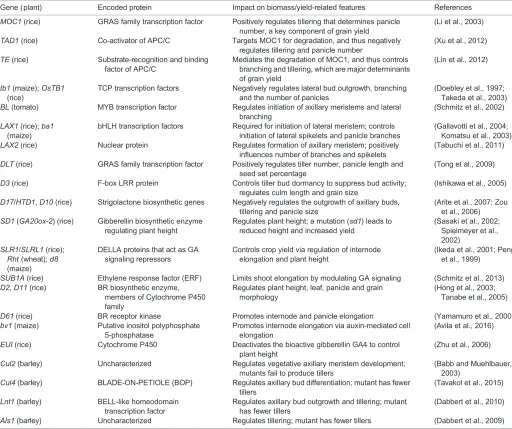
below (and summarize in Table 1), a number of genetic factors regulate these plant architectural traits.
Factors that influence plant height
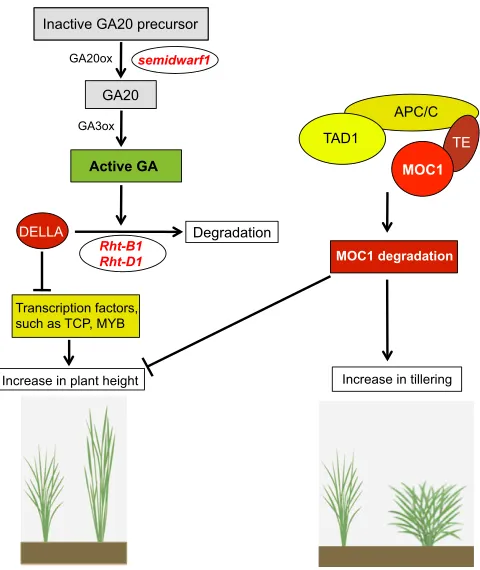
The plant hormone GA plays a crucial role in determining plant height and, as such, a number of genes associated with GA signaling have been shown to control plant architecture (Davies, 1995). An increase in GA level promotes stem elongation via an increase in cell division and expansion through the GA-mediated degradation of a growth-repressing DELLA protein. DELLA otherwise inhibits the activity of cell cycle-promoting TCP transcription factors (Davière et al., 2014). The GA-DELLA-TCP module is thus an important regulator of plant height and, notably, one that is amenable to genetic manipulation (Fig. 2). Indeed, genetic alteration of GA biosynthesis and/or signaling pathways was employed during the green revolution to remarkably reduce plant height in rice and wheat (Table 1), resulting in tremendous yield increase (Peng et al., 1999; Spielmeyer et al., 2002). Ricesemidwarf
(sd1), a mutant in a gene that encodes a GA biosynthetic enzyme, and mutations in GA signaling pathway genes such as Reduced height(Rht-B1andRht-D1) in wheat andSLENDER RICE1(SLR1) in rice, result in semi-dwarfed high-yielding rice and wheat varieties (Fig. 2) (Peng et al., 1999; Sasaki et al., 2002). The development of submergence tolerance in deep-water rice, conferred by the
Submergence 1A (SUB1A) locus, also results in a reduction in plant height via accumulation of the GA signaling repressors SLR1 and SLR1-LIKE 1 (SLRL1) (Ikeda et al., 2001; Schmitz et al., 2013). Recently, the NAC family of transcription factors has also been shown to regulate plant height by regulating key genes in the GA pathway in rice (Chen et al., 2015).
Besides GA biosynthesis and signaling, brassinosteroid (BR) and inositol polyphosphate signaling have also been reported to regulate plant height in crop plants. Mutations in the BR biosynthetic genes
DWARF2andDWARF11, and the BR signaling geneDWARF61in rice result in a dwarf phenotype (Hong et al., 2003; Tanabe et al., 2005; Yamamuro et al., 2000). A recent study showed that a
mutation in the maize gene brevis plant1 (bv1), which encodes putative inositol polyphosphate 5-phosphatase, results in a dwarf phenotype by inhibiting auxin-mediated cell elongation (Avila et al., 2016).
Factors that control branching
A network of interacting hormonal signals that involves auxin, cytokinin and strigolactone regulates branching pattern. Auxin and strigolactone suppress branching, whereas cytokinin functions as a positive regulator (Leyser, 2009). Auxin increases the transcription of strigolactone biosynthetic genes such asCCD7andCCD8, and inhibits cytokinin biosynthesis by suppressing the cytokinin biosynthetic geneIPT(Brewer et al., 2009; Tanaka et al., 2006). Thus, high auxin levels in the stem negatively regulate bud outgrowth by maintaining local high strigolactone and low cytokinin levels (Ferguson and Beveridge, 2009). In addition, strigolactone can inhibit the activation of buds and shoot branching by reducing the accumulation of auxin transporters at the plasma membrane (Bennett et al., 2006).
Analyses of mutants in different plant species, such as tomato, rice and maize, have also established roles for many transcription factors in lateral branching (Table 1) (Gallavotti et al., 2004; Komatsu et al., 2003; Li et al., 2003; Schmitz et al., 2002). For example, GRAS family transcription factors, such as tomato LATERAL SUPPRESSOR (Ls), Arabidopsis LATERAL SUPPRESSOR (LAS) and rice MONOCULM 1 (MOC1), comprise one of the most important groups of transcription factors regulating branching pattern (Li et al., 2003; Schmitz et al., 2002). LAS and MOC1 act upstream of the meristem identity geneSHOOT-MERISTEMLESS
(STM) inArabidopsisandOSH1in rice, respectively, to control the initiation and establishment of axillary meristems (Greb et al., 2003; Li et al., 2003). Degradation of MOC1 through the coordinated action of TILLERING AND DWARF1 (TAD1), which encodes a co-activator of the anaphase-promoting complex (APC/C), and
TILLER ENHANCER(TE), which encodes a substrate-recognition and binding factor of APC/C, reduces expression of the meristem
Developmental genes/transcription factors
Phytohormones Environmental factors
Plant architectural traits Leaf features Vasculature features
Biomass and yield
- Plant height
- Number of tillers/branches - Leaf/branch angle - Prostrate habit
- Morphology, i.e. leaf length, width, area and shape - Anatomy, i.e. organization of mesophyll, bundle sheath and vasculature - Leaf growth rate and stay green features
- Vein density - Vein diameter -Interveinal distance - Proximity of veins to mesophyll/bundle sheath
Amount of light interception Sink strength
Photosynthetic capacity Source strength
Transport of photosynthates Source-sink relationship
External and internal factors
Developmental features
Physiological effects
-Fig. 1. Plant developmental features relevant to crop biomass and yield.Developmental features, such as architectural traits, leaf and vasculature morphology, predominantly determine plant physiology, including the perception of light, photosynthesis, transport of photosynthates and source-sink relationship. These physiological parameters in turn determine crop yield and biomass. The developmental features are further regulated by phytohormones, genetic and environmental factors.
DEVEL
O
[image:2.612.54.462.52.321.2]identity geneOSH1to regulate tillering in rice (Fig. 2) (Li et al., 2003; Lin et al., 2012; Xu et al., 2012). Accordingly,moc1mutants fail to produce tillers and exhibit only the mother culm, whereas mutations in TAD1 lead to an increase in tillering in rice. Furthermore, bothMOC1overexpressing transgenic rice andtad1
mutants have been shown to regulate plant height negatively (Li et al., 2003; Xu et al., 2012). This MOC1-TAD1 module in combination with the associated cell cycle machinery could thus potentially be used not only to optimize branching patterns in crop plants, but also to achieve a balance between plant height and branching (Fig. 2).
The TCP family [TEOSINTE BRANCHED1 (TB1) from maize, CYCLOIDEA (CYC) from snapdragon (Antirrhinum majus), and PROLIFERATING CELL NUCLEAR ANTIGEN FACTOR (PCF) from rice] comprises another group of transcription factors that regulate various plant developmental processes including branching. Two of the founding members, TB1 and CYC, are class II growth repressors, whereas two other founding members, PCF1 and PCF2, belong to class I and have been shown to promote cell proliferation and organ growth in rice (Doebley et al., 1997;
Kosugi and Ohashi, 1997; Li, 2015; Luo et al., 1999). TB1 and OsTB1 suppress lateral branching in maize and rice, respectively, via transcriptional regulation of cell cycle genes (Doebley et al., 1997; Takeda et al., 2003). Recently, the modulation of strigolactone signaling via interactions between OsTB1 and a MADS-box transcription factor has been shown to control tillering in rice (Guo et al., 2013). In addition, bHLH transcription factors, such as BARREN STALK 1 (BA1) in maize and LAX PANICLE (LAX) in rice, and MYB transcription factors, such as BLIND (BL) in tomato, also regulate lateral branching in crop plants, either via modulation of phytohormone activity or through their direct effect on cell cycle regulation (Gallavotti et al., 2004; Komatsu et al., 2003; Schmitz et al., 2002; Takeda et al., 2003). Recent years have also seen significant progress in understanding the genetic control of tillering in barley. For example, the mutantsuniculm2(cul2),low number of tillers1 (lnt1), absent lower laterals1 (als1) and
[image:3.612.48.560.69.498.2]uniculme4 (cul4) either fail to develop tillers or show lower number of tillers owing to compromised axillary bud outgrowth (Table 1) (Babb and Muehlbauer, 2003; Dabbert et al., 2009, 2010). Barley Cul4 encodes the BLADE-ON-PETIOLE (BOP) protein,
Table 1. Key genes associated with plant architecture in crops
Gene (plant) Encoded protein Impact on biomass/yield-related features References
MOC1(rice) GRAS family transcription factor Positively regulates tillering that determines panicle number, a key component of grain yield
(Li et al., 2003)
TAD1(rice) Co-activator of APC/C Targets MOC1 for degradation, and thus negatively regulates tillering and panicle number
(Xu et al., 2012)
TE(rice) Substrate-recognition and binding factor of APC/C
Mediates the degradation of MOC1, and thus controls branching and tillering, which are major determinants of grain yield
(Lin et al., 2012)
tb1(maize);OsTB1 (rice)
TCP transcription factors Negatively regulates lateral bud outgrowth, branching and the number of panicles
(Doebley et al., 1997; Takeda et al., 2003) BL(tomato) MYB transcription factor Regulates initiation of axillary meristems and lateral
branching
(Schmitz et al., 2002)
LAX1(rice);ba1 (maize)
bHLH transcription factors Required for initiation of lateral meristem; controls initiation of lateral spikelets and panicle branches
(Gallavotti et al., 2004; Komatsu et al., 2003) LAX2(rice) Nuclear protein Regulates formation of axillary meristem; positively
influences number of branches and spikelets
(Tabuchi et al., 2011)
DLT(rice) GRAS family transcription factor Positively regulates tiller number, panicle length and seed set percentage
(Tong et al., 2009)
D3(rice) F-box LRR protein Controls tiller bud dormancy to suppress bud activity; regulates culm length and grain size
(Ishikawa et al., 2005)
D17/HTD1,D10(rice) Strigolactone biosynthetic genes Negatively regulates the outgrowth of axillary buds, tillering and panicle size
(Arite et al., 2007; Zou et al., 2006) SD1(GA20ox-2) (rice) Gibberellin biosynthetic enzyme
regulating plant height
Regulates plant height; a mutation (sd1) leads to reduced height and increased yield
(Sasaki et al., 2002; Spielmeyer et al., 2002)
SLR1/SLRL1(rice); Rht(wheat);d8 (maize)
DELLA proteins that act as GA signaling repressors
Controls crop yield via regulation of internode elongation and plant height
(Ikeda et al., 2001; Peng et al., 1999)
SUB1A(rice) Ethylene response factor (ERF) Limits shoot elongation by modulating GA signaling (Schmitz et al., 2013) D2,D11(rice) BR biosynthetic enzyme,
members of Cytochrome P450 family
Regulates plant height, leaf, panicle and grain morphology
(Hong et al., 2003; Tanabe et al., 2005)
D61(rice) BR receptor kinase Promotes internode and panicle elongation (Yamamuro et al., 2000) bv1(maize) Putative inositol polyphosphate
5-phosphatase
Promotes internode elongation via auxin-mediated cell elongation
(Avila et al., 2016)
EUI(rice) Cytochrome P450 Deactivates the bioactive gibberellin GA4 to control plant height
(Zhu et al., 2006)
Cul2(barley) Uncharacterized Regulates vegetative axillary meristem development; mutants fail to produce tillers
(Babb and Muehlbauer, 2003)
Cul4(barley) BLADE-ON-PETIOLE (BOP) Regulates axillary bud differentiation; mutant has fewer tillers
(Tavakol et al., 2015)
Lnt1(barley) BELL-like homeodomain transcription factor
Regulates axillary bud outgrowth and tillering; mutant has fewer tillers
(Dabbert et al., 2010)
Als1(barley) Uncharacterized Regulates tillering; mutant has fewer tillers (Dabbert et al., 2009)
DEVEL
O
which functions at axil and leaf boundary regions to control axillary bud differentiation (Tavakol et al., 2015).
The molecular mechanism of cross-talk between the genes controlling plant height and those controlling branching is still unexplored, but offers an opportunity to achieve optimum plant architecture for efficient photosynthesis. The balance of these architectural traits is also important for maintaining high yields at high planting densities.
Leaf morphological features associated with crop yield
Leaf shape, size and thickness are some of the most important morphological features that can directly affect plant yield. These morphological parameters determine cell number, chlorophyll content and ribulose-1,5-bisphosphate carboxylase/oxygenase (RuBisCO) per unit area exposed to sunlight, thus influencing leaf photosynthetic rate (Zhu et al., 2010). Leaf morphology is dependent on an intricate network of multiple processes such as cell division, cell expansion, growth axis establishment, and the differentiation and specification of tissues (Bar and Ori, 2014). This network, in turn, is subject to regulation by phytohormones, transcription factors and changes in the mechanical properties of
tissues. A number of recent reviews have discussed the basic genetic mechanisms underlying leaf development and morphogenesis in both monocots and dicots (Bar and Ori, 2014; Lewis and Hake, 2016). Here, we focus primarily on leaf morphogenetic processes and their underlying genetic mechanisms that have either been shown to influence plant performance or have the potential to increase plant yield and biomass.
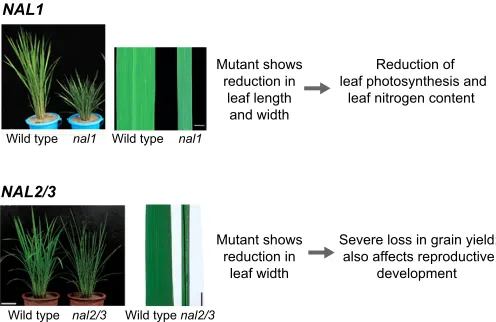
WUSCHEL-RELATED HOMEOBOX (WOX) genes are prime examples of genes that can be used to manipulate leaf dimensions in order to increase photosynthesis. The riceNARROW LEAFgenes (NAL1,NAL2andNAL3), which belong to theWOXfamily, have been shown to be associated with larger leaf width through the regulation of the cell cycle as early as during leaf primordia initiation (Jiang et al., 2015).NALgenes promote cell proliferation in lateral regions of leaves, thus increasing leaf blade outgrowth (Fig. 3) and giving rise to a corresponding increase in photosynthetic efficiency, leaf nitrogen content and yield (Cho et al., 2013; Fujita et al., 2013).NAL1also regulates vein density in rice, and it was shown to control leaf dimension and vein density via modulation of the cell cycle and basipetal auxin transport (Jiang et al., 2015). The maizeNALorthologsnarrow sheath1(ns1) and
ns2are also associated with leaf width (Scanlon et al., 1996). Thus,
WOX family transcription factors could potentially be used as developmental tools to increase leaf width and area, to increase leaf photosynthesis, and to optimize vein density for efficient mobilization of photosynthates. TCP transcription factors, in addition to regulating tillering as discussed above, also have major effects on leaf width determination. For example, wavy auricle in blade1(wab1), which encodes a maize TCP transcription factor, regulates leaf width, proximal-distal patterning and lateral vein number in a cell-autonomous manner (Foster et al., 2004). TCPs also regulate the differentiation, patterning and maturation of leaves by maintaining GA/cytokinin homeostasis in Arabidopsis
and tomato, and thus could be used to control the timing of photosynthetic capacity in leaves (Shleizer-Burko et al., 2011).
YABBY, PLETHORA (PLT) and JAGGED (JAG) genes also influence leaf features, positively regulating leaf blade growth and lamina expansion inArabidopsis(Ohno et al., 2004; Sarojam et al., 2010). YABBY genes are associated with the induction of leaf lamina-specific genetic programs and the suppression of meristem fate in the leaf primordial, JAG promotes leaf blade growth and differentiation by directly repressing meristematic and cell cycle genes, and PLT genes promote organ initiation and growth by promoting auxin biosynthesis at the shoot apical meristem (Horstman et al., 2014; Sarojam et al., 2010; Schiessl et al., 2014). The function of these transcription factors in crops has just begun to be established. For example, the JAG ortholog OPEN BEAK(OPB), and one of theYABBYgenes,YAB3, are involved in leaf growth promotion in rice (Dai et al., 2007; Horigome et al., 2009).
Many of the above transcription factors affect leaf shape and size through regulation of the cell cycle or cell expansion, making these cellular processes attractive targets that can be manipulated to modulate leaf features. The consequence of increasing both cell number and cell size, by mutations or transgenics, is an increase in leaf lamina size, as seen following the ectopic expression of
Arabidopsis ORGAN SIZE RELATED 1(ORS1) (Feng et al., 2011).
ANGUSTIFOLIA(AN),ROTUNDIFOLIA (ROT3), LONGIFOLIA
(LON) and SPATULA (SPT) are also known to regulate cell proliferation and expansion in the Arabidopsis leaf blade, and mutations in these genes produce short and narrow leaves via their effects on the cell cycle (Groszmann et al., 2010; Lee et al., 2006). Inactive GA20 precursor
GA20
Active GA
DELLA
Transcription factors, such as TCP, MYB
APC/C
TE
MOC1
TAD1
MOC1 degradation
Degradation
Increase in plant height Increase in tillering GA20ox semidwarf1
GA3ox
[image:4.612.55.295.55.340.2]Rht-B1 Rht-D1
Fig. 2. The control of plant height and tillering in crop plants.The GA-DELLA-TCP module (left) is an important regulator of plant height; a number of mutations that affect this module result in altered plant height. DELLA, a growth-repressing protein, inhibits a number of transcription factors required for elongation/growth and hence plant height. Active GA mediates the degradation of DELLA protein, thereby promoting internode elongation and increasing plant height.sd1, a mutation in riceGA20ox-2, impairs GA biosynthesis and thus results in a dwarfed phenotype. Similarly,Rhtmutants in wheat exhibit mutations in a DELLA-encoding gene, making them resistant to GA-induced degradation, resulting in dwarfed plants. Tillering in rice (right) is regulated by the coordinated action ofMOC1,TAD1andTE. TAD1 is a co-activator of the anaphase-promoting complex (APC/C), while TE is a substrate-recognition and binding factor of APC/C. The interaction of these various proteins mediates the degradation of MOC1, which promotes tillering and reduces plant height.
DEVEL
O
The‘cell cycle arrest front’ –the boundary at which a switch from proliferation to expansion occurs within leaf primordia – is important for regulating leaf size, and has recently been shown to be correlated with the onset of photosynthesis in Arabidopsis
(Andriankaja et al., 2012). However, its importance in crop plants, and its possible use as a developmental marker for photosynthesis in crop plants, needs further investigation.
The above studies highlight that overlapping functions of specific developmental genes, transcription factors, cell cycle regulators and hormones regulate leaf shape, size and maturation. Although the developmental role of these factors has only just begun to be characterized in crop plants, it is likely that they will have great potential for modulating leaf shape and size in a desirable way in crops.
Leaf anatomical features contributing to photosynthesis and plant performance
Leaf anatomical features vary substantially among and within plant species, and are closely related to photosynthetic efficiency under different environmental conditions. Leaf anatomy influences photosynthesis by affecting the distribution of light in the mesophyll, CO2diffusion, leaf temperature and leaf water relations
(Evans and Loreto, 2000; Niinemets, 1999). The anatomical differences between C3and C4plants, and the associated increase
in photosynthetic efficiency in C4 plants, strongly underscores the
importance of anatomical features for photosynthesis and yield (Sage and Sage, 2009). The characteristic‘Kranz anatomy’of C4plants–a
special developmental architecture in which mesophyll cells are surrounded by specialized bundle sheath cells in leaves–helps to increase photosynthetic efficiency and allow better photoassimilation of atmospheric CO2 (Wang et al., 2014). This is also closely
associated with an increase in vein density, which is likely to be due to auxin-related modifications, in C4 plants (McKown and Dengler,
2009). The genetic basis of these developmental differences between C3 and C4plants is just beginning to be deciphered (Huang et al.,
2016). Notably, theSCARECROW(SCR) andSHORTROOT(SHR) genes appear to be important for establishing the specialized bundle sheath and mesophyll cells in C4 leaves. Although the detailed
mechanism underlying SCR/SHR-mediated patterning of Kranz anatomy needs further investigation, SCR is likely to restrict the
movement of SHR to the cells that will become bundle sheath (Slewinski et al., 2012). A number of other developmental genes have also been associated with this difference (Liu et al., 2013; Wang et al., 2013) and could be targeted to trigger a C3-to-C4conversion. Indeed,
a global consortium based at the International Rice Research Institute (Philippines) aims to convert C3 rice to C4 by manipulating the
biochemistry and anatomy of the plant (von Caemmerer et al., 2012; http://c4rice.irri.org/).
Besides converting C3plants to C4plants, there are many other
potential ways of changing leaf anatomical features to increase photosynthesis. Maintaining uniform light distribution within a leaf could be an important approach for increasing leaf photosynthesis, as light distribution within a leaf is otherwise highly heterogeneous (Johnson et al., 2005). Certain modifications to leaf anatomical features such as bundle-sheath extensions, which are parenchyma or sclerenchyma cells without chloroplasts connecting the epidermis and vascular bundles, can help to provide a more uniform distribution of light through thicker leaves, thereby enhancing photosynthesis (Buckley et al., 2011). However, the quantitative effects of these anatomical changes on photosynthesis need to be evaluated. Leaf thickness also affects photosynthesis levels. For example, a leaf of minimal thickness, containing all necessary photosynthetic machinery, would allow for more efficient absorption and usage of light energy. This minimal leaf thickness will vary from species to species and will also depend upon environmental conditions. The shape and size of mesophyll cells might also be critical factors for light distribution as well as for CO2
diffusion to RuBisCO, a key CO2-fixing enzyme (Sage and Sage,
2009; Tholen et al., 2012). There is potential to increase photosynthetic efficiency by∼20% by reducing resistance to CO2
diffusion and optimizing the shape and size of mesophyll cells (Tholen et al., 2012; Zhu et al., 2010).
Although much progress has been made in understanding the genetic regulatory mechanisms that control leaf growth, the molecular mechanisms regulating leaf anatomical traits that influence photosynthesis are still largely unknown. To allow the engineering of a specific leaf anatomy that would achieve a more homogeneous internal light distribution, more efficient CO2delivery
and improved water transport capacity, more effort is required to study the genetic mechanisms underlying different leaf structures.
The contribution of the leaf vasculature to optimal crop performance
The development of vasculature in plants is one of the major evolutionary events that helped plants to colonize land (Lucas et al., 2013). Leaf venation–a network of veins or veinlets consisting of extensions of xylem and phloem–not only serves as a conduit for the distribution of nutrients and water for photosynthesis, but also mobilizes photoassimilated carbon from its source (i.e. leaves) to other parts of the plant (Sack and Scoffoni, 2013). Leaf development and vascular pattern have been intimately linked throughout the evolution of land plants. The onset of major vein formation coincides with primary leaf morphogenesis, whereas minor veins are formed during leaf expansion (Berleth and Mattsson, 2000; Esau, 1965). Studies of vascular pattern and leaf shape mutants suggest common mechanisms regulating the two processes through the involvement of auxin (Candela et al., 1999; Sieburth, 1999). Nonetheless, early studies elegantly demonstrated that leaf development and venation are two interdependent processes (Dengler and Kang, 2001). Auxin maxima at the site of leaf initiation, and the subsequent polar movement of auxin to the inner tissues, are major steps in establishing the leaf vasculature (Scarpella et al., 2006). Auxin, in combination Wild type nal1 Wild type nal1
Wild type nal2/3 Wild type nal2/3 NAL1
NAL2/3
Reduction of leaf photosynthesis and
leaf nitrogen content Mutant shows
reduction in leaf length
and width
Mutant shows reduction in
leaf width
Severe loss in grain yield; also affects reproductive
[image:5.612.50.298.58.219.2]development
Fig. 3. The effects of leaf width on crop biomass and yield in rice.A mutation inNAL1causes a reduction in leaf length, width and overall plant vigor, which is associated with a decrease in leaf photosynthesis and nitrogen content. Similarly,nal2 nal3double mutants exhibit a severe loss in grain yield due to defective vegetative and reproductive development. Plant and leaf images are adapted from Cho et al. (2013) and Jiang et al. (2015).
DEVEL
O
with cytokinin, plays an important role in regulating the formation as well as the activity of vascular cambium (Hejatko et al., 2009). Other phytohormones have also been shown to be associated with the development and differentiation of vascular bundles (Agusti et al., 2011; Caño-Delgado et al., 2004). In addition, roles for a number of transcription factors during vascular development in Arabidopsis
have been established: WOX4 is crucial for cambial cell proliferation; ATHB8 and ATHB15 may act as positive regulators of cambial activity and xylem development; VND6 and VND7 are master regulators of xylem differentiation; the KANADI family of transcription factors act antagonistically to ATHB transcription factors; and ALTERD PHLOEM DEVELOPMENT (APL) is required for phloem identity (Bonke et al., 2003; Kim et al., 2005; Kubo et al., 2005; Nieminen et al., 2015). The strong association between leaf and vasculature development is further emphasized by studies of a number ofArabidopsismutants, such astornado(trn),
as1andas2, that show both a defective leaf phenotype and abnormal venation (Cnops et al., 2006). Furthermore, recent studies have demonstrated that the initiation of successive vein orders is associated with an increase in blade area (Kang et al., 2007). Although these distinct genetic relationships between leaf morphogenesis and the development of the plant vasculature still need to be elucidated, they suggest that the manipulation of both leaf features and the vasculature might be possible using a similar set of genes.
Besides impacting leaf morphogenesis, leaf venation regulates a number of physiological processes, such as transpiration rate and leaf hydraulic conductance (Sack and Scoffoni, 2013). Vein length per unit area (VLA) is an important developmental feature that varies from species to species, and plants with a larger VLA usually have higher leaf conductance, greater stomatal density and conductance, and higher rates of gas exchange per leaf area (Brodribb et al., 2007). C4plants have a greater vein density than C3
plants, and this facilitates the transport of sugar to the enlarged bundle sheath (Ogle, 2003; Sage and Sage, 2009). The distance between veins (interveinal distance) is associated with the efficiency of CO2 fixation (Ogle, 2003) and is inversely related to leaf
photosynthetic rate; accordingly, the rate of photosynthesis increases with a decrease in interveinal distance, as seen in C4
plants (Ueno et al., 2006). Indeed, the maximum rate of photosynthesis increases with vein density, and is negatively correlated with the distance from veins to evaporative surfaces of the leaf, such as the epidermis (Brodribb et al., 2007). In addition, more efficient export of photosynthates from mesophyll cells favored by an increased vein density may facilitate a higher photosynthetic capacity (Amiard et al., 2005). Nonetheless, although the association of vein architecture with yield through photosynthesis or mobilization of photosynthates has clearly been observed, a genetic understanding of these desirable vein features is mostly lacking for crop plants. Understanding the genetic regulation and then manipulating the leaf vasculature might thus serve as an important developmental strategy for optimizing crop yield. Indeed, efforts are already being made to increase leaf vein density by mutagenesis in order to investigate the effect of vein density on yield (Feldman et al., 2014).
The association of flowering time with crop yield
Flowering time, which marks the transition from vegetative to reproductive growth during the plant life cycle, is decisive for optimal yield in crop plants. It is controlled by a complex regulatory network that involves a set of interacting pathways of transcription factors, photoreceptors, enzymes, phytohormones and miRNAs, and prevailing environmental conditions (Jung and Müller, 2009).
The genetics of flowering time and yield has been studied extensively in crop plants, such as rice and wheat, using quantitative trait locus (QTL) analyses and association genetics (Xue et al., 2008; Yan et al., 2011; Yano et al., 2001). A large number of QTLs involved in the regulation of flowering time have been mapped, and some of them have been cloned using a map-based cloning strategy. HEADING DATE 1 (HD1), EARLY HEADING DATE 1(EHD1),GRAIN NUMBER, PLANT HEIGHT AND HEADING DATE 7(GHD7),HD5,HD6,HD16,HD17,RICE FT1 (RFT1) and HD3A are some of the genes identified to be associated with flowering time in rice (Lee and An, 2015).GHD7,
HD1,HD5,HD6andHD16inhibit flowering under non-inductive long-day conditions. Under sufficient vegetative growth and under inductive short-day conditions, HD1 becomes a flowering promoter, which, in concert with reduced expression of inhibitors in leaves, promotes flowering. Most of these upstream signals control EHD1, which positively regulates HD3A and RFT1 to induce reproductive transition at the shoot apical meristem (Lee and An, 2015; Takahashi et al., 2009).
HD1 in rice, an ortholog of Arabidopsis CONSTANS, was identified as a major QTL regulating photoperiodic flowering. Subsequently,HD1was characterized to have pleiotropic effects on flowering time, plant height and yield traits, and was suggested as a good candidate gene for breeding high-yielding rice varieties in low latitudes (Zhang et al., 2012). The transcript levels of GHD7, another crucial regulator of flowering time, regulate yield potential in rice via modulating panicle size and branching (Weng et al., 2014). SimilarlyGHD8, another major flowering time QTL in rice, pleiotropically regulates grain productivity and plant height. GHD8 upregulatesMOC1, a key branching gene in rice, to increase tiller number and thus grain productivity (Yan et al., 2011). The two key flowering time genes, HD1and EHD1, have also been shown to regulate panicle development in rice and thus affect yields in the field through florigen expression in leaves (Endo-Higashi and Izawa, 2011). As expected, the regulation of yield traits by flowering time genes has also been observed in other crop plants. For example, theQgene, which regulates flowering time in wheat and has been associated with its domestication (as discussed below), affects a series of traits, including plant height and spike length (Simons et al., 2006).
Taken together, these findings suggest a strong potential usage of flowering time genes for improving the yield of crop plants under different environmental conditions. Moreover, studies have elucidated that the QTLs that regulate leaf size also cluster with QTLs that regulate flowering time, suggesting that a close association between flowering time and leaf traits determines yield and crop performance (Wang et al., 2012). Thus, targeting both vegetative and reproductive features using common sets of genetic targets could increase yield potential.
The effect of domestication on crop developmental features
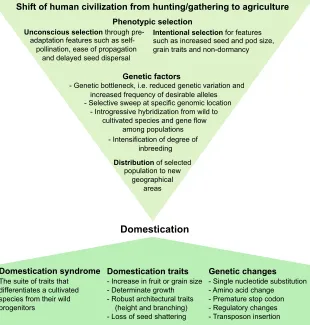
Domestication literally means the entrance of plants into the human domain from their wild population. Our ancestors completed the domestication of major crop plants, including rice, wheat and maize, ∼4000 years ago, transforming unpromising wild plants into remarkably productive crops (Doebley et al., 2006). Initial agricultural practices, and both the unconscious as well as conscious selection of plant species for desirable traits, formed the basis of crop domestication (Fig. 4). Genetic factors, such as reduced genetic diversity and increased frequency of desirable alleles, interspecific hybridizations, and gene flow among the populations, were key to the development of modern cultivated
DEVEL
O
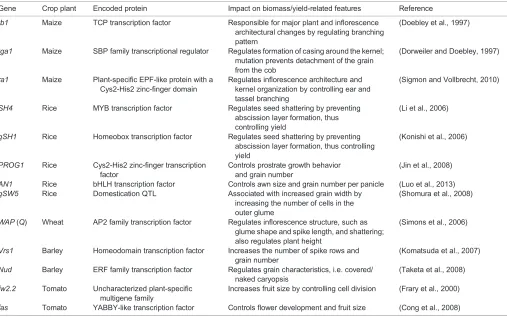
crops (Doebley et al., 2006; Meyer and Purugganan, 2013). Genetic alterations associated with crop domestication include single nucleotide substitutions, regulatory changes and transposon insertions, which led to desirable changes in the behavior and phenotype of plants – the domestication syndrome (Fig. 4). A number of genes have been associated with domestication (Table 2). More recently, various genomic approaches, such as QTL mapping, genome-wide association study (GWAS) and whole-genome resequencing have been instrumental in deciphering the genetic basis of crop domestication (discussed in detail in the next section). Together, these findings have revealed that the process of domestication affected diverse plant developmental pathways and traits, ranging from plant architecture and growth behavior, to fruit or grain size and seed dispersal characteristics (Fig. 4). In addition, domestication altered various physiological processes, such as seed dormancy, photoperiodic sensitivity and flowering.
Cultivated maize, with a single stalk and short branches, is an excellent example of domestication. Maize (Zea maysspp.mays) was domesticated from the highly branched wild progenitor teosinte (Zea maysspp.parviglumis). The geneteosinte branched1(tb1), which encodes a TCP transcription factor and key player in maize domestication, represses branching in domesticated maize by its repressive effects on the cell cycle (Doebley et al., 1997). Theteosinte glume architecture1(tga1) gene, another important contributor to maize domestication, encodes a member of the SQUAMOSA promoter-binding protein (SBP) family of transcriptional regulators that affects kernel characteristics (Dorweiler and Doebley, 1997).
The domestication of Asian cultivated riceOryza sativafrom the wild rice species Oryza rufipogon involved changes in prostrate growth, modification of awn features, disruption of seed shattering,
and fewer but larger grains per panicle (Sweeney and McCouch, 2007). The genetic basis of most of these rice domestication traits is now well understood. For example,SHATTERING4(SH4), which encodes a MYB transcription factor, andqSH1, which encodes a homeobox transcription factor, have been identified as the major loci controlling the shattering behavior in rice, driving the normal development of an abscission layer that controls the separation of a grain from the pedicel (Konishi et al., 2006; Li et al., 2006). In addition, PROSTRATE GROWTH1 (PROG1), which encodes a single Cys2-His2 zinc-finger domain protein, has been associated with prostrate growth behavior in domesticated rice (Jin et al., 2008), whileAWN-1 (AN-1), which encodes a bHLH protein, is associated with the optimization of awn features and the associated increase in grain number per panicle during rice domestication (Luo et al., 2013). Domestication has also helped to increase sink strength by increasing the number of cells in the outer glume of the rice flower, through the activity of qSW5 (QTL for seed width on chromosome 5) (Shomura et al., 2008).
Genes implicated in the domestication of other plants have also been identified. An increase in sink strength during the process of domestication has been observed in barley, where Vrs1 ( SIX-ROWED SPIKE 1), which encodes a homeodomain transcription factor, controls the transition from two- to six-rowed barley (Komatsuda et al., 2007). In wheat, Q, a member of the AP2 family of transcriptional regulators, played an important role in domestication by regulating a diverse set of developmental traits including inflorescence structure and flowering (Simons et al., 2006). The process of domestication also selected for larger fruit size in tomato;Fruitweight2.2 (fw2.2) was identified as a large-effect QTL controlling fruit size, probably via the regulation of cell
Domestication
Phenotypic selection Unconscious selection through pre-
adaptation features such as self- pollination, ease of propagation and delayed seed dispersal
Intentional selection for features such as increased seed and pod size, grain traits and non-dormancy
Genetic factors
- Genetic bottleneck, i.e. reduced genetic variation and increased frequency of desirable alleles - Selective sweep at specific genomic location - Introgressive hybridization from wild to cultivated species and gene flow among populations
Distribution of selected population to new
geographical areas
Domestication syndrome The suite of traits that differentiates a cultivated species from their wild progenitors
Genetic changes - Single nucleotide substitution - Amino acid change - Premature stop codon - Regulatory changes - Transposon insertion Domestication traits
- Increase in fruit or grain size - Determinate growth - Robust architectural traits (height and branching) - Loss of seed shattering
Shift of human civilization from hunting/gathering to agriculture
[image:7.612.59.369.409.734.2]- Intensification of degree of inbreeding
Fig. 4. Factors involved in, and the effects of, crop domestication.The initial selection of plant species from their wild populations by human ancestors on transition from hunting/gathering to agriculture laid the foundation of crop domestication. These selection processes led to reduced genetic diversity and increased frequency of desirable alleles–the‘genetic bottleneck’ –in domesticated populations. In addition, introgression from the wild species and gene flow among the populations contributed to domestication. Domesticated species were then transferred to new geographical locations, becoming adapted to varied environments and local preferences. This
domestication resulted in a suite of developmental changes–the‘domestication syndrome’ –conserved across many plant species. Most of these changes relate to seed/fruit size, plant architecture, and seed shattering and dormancy, with single nucleotide substitutions, regulatory changes and transposon insertions as their underlying genetic causes. A detailed list of genes controlling domestication traits is presented in Table 2.
DEVEL
O
division (Cong et al., 2008; Frary et al., 2000). Besides the genes involved in the classical domestication of crop plants from wild progenitors, many genes that confer desirable agronomic traits by influencing important developmental features among crop varieties have also been identified (Ashikari et al., 2005; Olsen et al., 2006).
Together, these studies are beginning to unravel the genetic basis of domestication. Thus far, investigations have highlighted transcriptional control as a predominant regulatory mechanism underlying crop domestication. Given that transcriptional regulation plays a predominant role in plant morphogenesis, the involvement of transcription factors in the process of domestication is not surprising (Doebley and Lukens, 1998). With the rapid progress in understanding the genetics underlying biological processes, other components, such as small RNAs and epigenetic mechanisms, are likely to be added to the list of factors mediating crop domestication. Moreover, since domestication mostly involved selection for larger organ size, the involvement of the cell cycle and associated cell cycle-related genes, during crop domestication is not unexpected. Nonetheless, these findings highlight that transcriptional regulation and the cell cycle could potentially be targeted to further optimize crop yields and performance.
Functional genomics-based approaches for optimizing developmental features
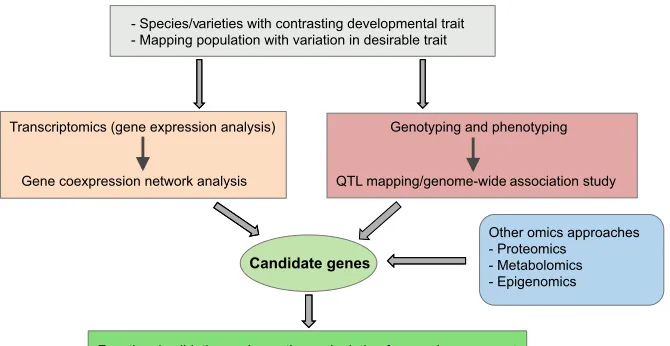
Recent advances in sequencing-based technologies and functional genomics have provided the ability to quickly decipher the genetic basis of desirable plant developmental traits. Transcriptome profiling, along with the characterization of genetic variation at the level of the entire genome, and associated QTL mapping and
GWAS are major strategies to identify the genes that underlie a desirable trait in crop plants (Fig. 5). Indeed, various transcriptome profiling studies have revealed a genetic basis of association between photosynthesis and leaf development (Huang et al., 2016; Wang et al., 2014). An investigation of transcriptome dynamics along the maize leaf developmental gradient revealed the transition from basic cellular metabolism at the leaf base to C4photosynthetic
development at the tip (Li et al., 2010). Furthermore, a number of transcriptomic analyses have been used to differentiate C3and C4
plants, and putative positive and negative regulators associated with Kranz anatomy have been identified in maize (Huang et al., 2016; Wang et al., 2013). A recent transcriptomic analysis in rice, in combination with measurements of chlorophyll fluorescence, revealed that the transition from the P3 to P4 stage of leaf development is associated with initiation of photosynthesis (van Campen et al., 2016). Leaf traits have also been associated with photosynthesis and fruit sugar levels in tomato using RNAseq gene expression analysis (Chitwood et al., 2013).
[image:8.612.50.557.68.385.2]Genomics-assisted QTL mapping and GWAS are also becoming instrumental for investigating the genetic changes underlying a developmental alteration that contributes to yield. The contribution of leaf angle and size to crop yield is undisputed, as shown by classical mutants of crop plants. For example,liguleless(lg) mutants of maize exhibit more upright leaves than their normal counterparts and an associated grain yield increase (Emerson, 1912; Walsh et al., 1998). GWAS results using a maize association-mapping panel further showed that variations atligulelessgenes have contributed to leaf angle determination (Tian et al., 2011). Similar GWAS in rice using 373 indica lines identified genomic regions showing strong associations with multiple agronomic traits, including
Table 2. Major genes associated with crop domestication
Gene Crop plant Encoded protein Impact on biomass/yield-related features Reference
tb1 Maize TCP transcription factor Responsible for major plant and inflorescence architectural changes by regulating branching pattern
(Doebley et al., 1997)
tga1 Maize SBP family transcriptional regulator Regulates formation of casing around the kernel; mutation prevents detachment of the grain from the cob
(Dorweiler and Doebley, 1997)
ra1 Maize Plant-specific EPF-like protein with a Cys2-His2 zinc-finger domain
Regulates inflorescence architecture and kernel organization by controlling ear and tassel branching
(Sigmon and Vollbrecht, 2010)
SH4 Rice MYB transcription factor Regulates seed shattering by preventing abscission layer formation, thus controlling yield
(Li et al., 2006)
qSH1 Rice Homeobox transcription factor Regulates seed shattering by preventing abscission layer formation, thus controlling yield
(Konishi et al., 2006)
PROG1 Rice Cys2-His2 zinc-finger transcription factor
Controls prostrate growth behavior and grain number
(Jin et al., 2008)
AN1 Rice bHLH transcription factor Controls awn size and grain number per panicle (Luo et al., 2013) qSW5 Rice Domestication QTL Associated with increased grain width by
increasing the number of cells in the outer glume
(Shomura et al., 2008)
WAP(Q) Wheat AP2 family transcription factor Regulates inflorescence structure, such as glume shape and spike length, and shattering; also regulates plant height
(Simons et al., 2006)
Vrs1 Barley Homeodomain transcription factor Increases the number of spike rows and grain number
(Komatsuda et al., 2007)
Nud Barley ERF family transcription factor Regulates grain characteristics, i.e. covered/ naked caryopsis
(Taketa et al., 2008)
fw2.2 Tomato Uncharacterized plant-specific multigene family
Increases fruit size by controlling cell division (Frary et al., 2000)
fas Tomato YABBY-like transcription factor Controls flower development and fruit size (Cong et al., 2008)
DEVEL
O
developmental traits such as tiller number and leaf angle (Huang et al., 2010). The importance of the flag leaf for photosynthesis in crop plants has long been recognized (Li et al., 1998), and considerable efforts have thus been made to identify the genetic basis of flag leaf development. Recently, a strong positive correlation between flag leaf width and plant yield in rice was demonstrated, and candidate genes underlying a major QTL regulating flag leaf width were identified (Zhang et al., 2015).
Considering that developmental and architectural traits are of utmost importance for the overall performance of crop plants, an efficient way of high-throughput phenotyping these traits is crucial for the success of genomics approaches to crop improvement. Some of these important traits may include a balance between plant height and branching, rapid early leaf growth to attain full leaf size and maximum photosynthetic potential, features of bundle sheath cells, and increased vein density associated with decreased interveinal distance. A major limitation, however, is the tedious phenotyping of these traits, particularly for leaf anatomical features and vasculature traits. This could, at least in part, explain why there are almost no genome-wide studies of leaf anatomical traits. There has been some progress in throughput phenotyping of developmental traits, including a high-throughput leaf scorer (Yang et al., 2015) and the commercial LemnaTech Scanalyzer phenotyping platform. Further progress will no doubt complement the genomics-based approaches to improving crop yield. These transcriptomic or genomic analyses could also be complemented with other omics-type approaches to increase the resolution and limit the number of candidate genes for functional validation (Fig. 5). For example, comparative gene expression analysis, in combination with metabolite profiling, between developing leaves of C3 rice and C4 maize has already provided
important insights into the candidate cis-regulatory elements and transcription factors associated with differences in photosynthetic capacity (Wang et al., 2014). Similarly, the combination of transcriptome and proteome analyses for a rice midrib-less mutant (dl2) has provided important information about the molecular changes that occur during leaf vasculature initiation and differentiation (Peng et al., 2015). Gene coexpression network analysis also appears to be very helpful for limiting the number of candidate genes regulating a developmental trait (Ichihashi et al., 2014).
The ideal goal of plant genomics would be to identify the genetic basis of desirable traits of crop plants that are amenable to genetic manipulations (Fig. 5). For example, the genetic basis of maize leaf architecture can potentially be used to increase maize planting
density through optimum leaf architecture. The potential of functional genomics approaches to improve crop plants has been underlined in the rice research community; the RICE 2020 project, which aims to identify the function of every rice gene by the year 2020 and apply the findings of such functional genomics approaches to crop improvement, is an outstanding example of such a concerted effort to improve crop (Zhang et al., 2008). It should also be noted that natural genetic variation for developmental traits and photosynthetic capacity is an underutilized resource, yet has huge potential for crop improvement, and genomics approaches could also be instrumental in this direction.
Conclusions
With the exception of modifications to plant height and canopy architecture, efforts to optimize plant developmental features to increase photosynthesis and yield have been limited. Developmental features, in particular leaf features that contribute to photosynthetic capacity and photoassimilate transport, are overlooked and untapped resources, yet have a huge potential for crop improvement. There are only a few examples in which leaf morphological features, such as leaf width, have been manipulated to improve the performance of crop plants. A better understanding of the genetic basis of leaf shape, size and anatomy in crop plants will thus be crucial in our efforts to efficiently manipulate these developmental traits for increased crop performance (Fig. 1). Compared with metabolic engineering, the engineering of developmental traits for increased photosynthesis is still in its infancy because the genetic and molecular mechanisms controlling leaf shape, size, anatomy and vasculature features are very complex, and have only just begun to be understood. Moreover, the phenotyping methods for plant developmental traits are inefficient. However, it is becoming evident that advances in functional genomics are now enabling us to decipher the genes and gene regulatory networks underlying developmental traits of agricultural importance. These, in combination with efficient phenomics approaches, will be the way forward to efficiently manipulate plant developmental traits for increasing yield. These approaches will also significantly advance our understanding of the genetic basis of plant domestication, hopefully allowing the identification of additional factors that could be targeted in crop improvement. Finally, it should be noted that most of these developmental and photosynthetic traits are controlled by many genes and gene regulatory networks. Therefore, modeling, simulation and systems biology approaches will also help plant biologists to integrate and link gene networks with - Species/varieties with contrasting developmental trait
- Mapping population with variation in desirable trait
Transcriptomics (gene expression analysis)
Gene coexpression network analysis
Genotyping and phenotyping
QTL mapping/genome-wide association study
Other omics approaches - Proteomics
- Metabolomics - Epigenomics Candidate genes
[image:9.612.48.383.56.229.2]Functional validation and genetic manipulation for crop improvement
Fig. 5. Functional genomics-based strategies for identifying and characterizing the genes that underlie a developmental trait associated with altered crop biomass and yield.Gene expression analyses using RNAseq approaches, in conjunction with gene coexpression network analyses can be used to identify the transcriptional basis of a desirable trait. QTL mapping and GWAS, facilitated by high-throughput genotyping and phenotyping, can identify genomic regions and genotypic variations associated with the trait. When combined, these two strategies help to limit the number of candidate genes associated with the trait, and can be further complemented with other omics-based approaches. The candidate genes, after functional validation, may be used for crop improvement using transgenic or breeding approaches.
DEVEL
O
developmental and physiological traits, thus further improving our understanding of plant development.
Acknowledgements
We thank Prof. Neelima Sinha and Dr Jyothilakshmi Vadassery for their input and comments on this Review.
Competing interests
The authors declare no competing or financial interests.
Funding
J.M. and J.B. are supported by a research fellowship from the Council of Scientific and Industrial Research, India. A.R. is a recipient of a Ramalingaswamy Fellowship from the Department of Biotechnology, Ministry of Science and Technology, India.
References
Agusti, J., Herold, S., Schwarz, M., Sanchez, P., Ljung, K., Dun, E. A., Brewer,
P. B., Beveridge, C. A., Sieberer, T., Sehr, E. M. et al.(2011). Strigolactone
signaling is required for auxin-dependent stimulation of secondary growth in plants.Proc. Natl. Acad. Sci. USA108, 20242-20247.
Amiard, V., Mueh, K. E., Demmig-Adams, B., Ebbert, V., Turgeon, R. and
Adams, W. W.III(2005). Anatomical and photosynthetic acclimation to the light
environment in species with differing mechanisms of phloem loading.Proc. Natl. Acad. Sci. USA102, 12968-12973.
Andriankaja, M., Dhondt, S., De Bodt, S., Vanhaeren, H., Coppens, F., De Milde,
L., Mühlenbock, P., Skirycz, A., Gonzalez, N., Beemster, G. T. S. et al.(2012).
Exit from proliferation during leaf development in Arabidopsis thaliana: a not-so-gradual process.Dev. Cell22, 64-78.
Arite, T., Iwata, H., Ohshima, K., Maekawa, M., Nakajima, M., Kojima, M.,
Sakakibara, H. and Kyozuka, J. (2007). DWARF10, an RMS1/MAX4/DAD1
ortholog, controls lateral bud outgrowth in rice.Plant J.51, 1019-1029. Ashikari, M., Sakakibara, H., Lin, S., Yamamoto, T., Takashi, T., Nishimura, A.,
Angeles, E. R., Qian, Q., Kitano, H. and Matsuoka, M.(2005). Cytokinin oxidase
regulates rice grain production.Science309, 741-745.
Avila, L. M., Cerrudo, D., Swanton, C. and Lukens, L.(2016). Brevis plant1, a
putative inositol polyphosphate 5-phosphatase, is required for internode elongation in maize.J. Exp. Bot.67, 1577-1588.
Babb, S. and Muehlbauer, G. J. (2003). Genetic and morphological
characterization of the barley uniculm2 (cul2) mutant.Theor. Appl. Genet.106, 846-857.
Bar, M. and Ori, N.(2014). Leaf development and morphogenesis.Development
141, 4219-4230.
Bennett, T., Sieberer, T., Willett, B., Booker, J., Luschnig, C. and Leyser, O. (2006). The Arabidopsis MAX pathway controls shoot branching by regulating auxin transport.Curr. Biol.16, 553-563.
Berleth, T. and Mattsson, J.(2000). Vascular development: tracing signals along
veins.Curr. Opin. Plant Biol.3, 406-411.
Bonke, M., Thitamadee, S., Mähönen, A. P., Hauser, M.-T. and Helariutta, Y.
(2003). APL regulates vascular tissue identity in Arabidopsis. Nature 426, 181-186.
Brewer, P. B., Dun, E. A., Ferguson, B. J., Rameau, C. and Beveridge, C. A. (2009). Strigolactone acts downstream of auxin to regulate bud outgrowth in pea and Arabidopsis.Plant Physiol.150, 482-493.
Brodribb, T. J., Feild, T. S. and Jordan, G. J.(2007). Leaf maximum photosynthetic
rate and venation are linked by hydraulics.Plant Physiol.144, 1890-1898.
Buckley, T. N., Sack, L. and Gilbert, M. E.(2011). The role of bundle sheath
extensions and life form in stomatal responses to leaf water status.Plant Physiol.
156, 962-973.
Candela, H., Martınez-Laborda, A. and Micol, J. L.́ (1999). Venation pattern
formation in Arabidopsis thaliana vegetative leaves.Dev. Biol.205, 205-216.
Caño-Delgado, A., Yin, Y., Yu, C., Vafeados, D., Mora-Garcıa, S., Cheng, J.-C.,́
Nam, K. H., Li, J. and Chory, J. (2004). BRL1 and BRL3 are novel
brassinosteroid receptors that function in vascular differentiation in Arabidopsis. Development131, 5341-5351.
Chen, X., Lu, S., Wang, Y., Zhang, X., Lv, B., Luo, L., Xi, D., Shen, J., Ma, H. and
Ming, F.(2015).OsNAC2encoding a NAC transcription factor that affects plant
height through mediating the gibberellic acid pathway in rice.Plant J.82, 302-314. Chitwood, D. H., Kumar, R., Headland, L. R., Ranjan, A., Covington, M. F., Ichihashi, Y., Fulop, D., Jimenez-Gomez, J. M., Peng, J., Maloof, J. N. et al. (2013). A quantitative genetic basis for leaf morphology in a set of precisely defined tomato introgression lines.Plant Cell25, 2465-2481.
Cho, S.-H., Yoo, S.-C., Zhang, H., Pandeya, D., Koh, H.-J., Hwang, J.-Y., Kim,
G.-T. and Paek, N.-C.(2013). The ricenarrow leaf2andnarrow leaf3loci encode
WUSCHEL-related homeobox 3A (OsWOX3A) and function in leaf, spikelet, tiller and lateral root development.New Phytol.198, 1071-1084.
Cnops, G., Neyt, P., Raes, J., Petrarulo, M., Nelissen, H., Malenica, N.,
Luschnig, C., Tietz, O., Ditengou, F., Palme, K. et al.(2006). The TORNADO1
and TORNADO2 genes function in several patterning processes during early leaf development in Arabidopsis thaliana.Plant Cell18, 852-866.
Cong, B., Barrero, L. S. and Tanksley, S. D.(2008). Regulatory change in
YABBY-like transcription factor led to evolution of extreme fruit size during tomato domestication.Nat. Genet.40, 800-804.
Dabbert, T., Okagaki, R. J., Cho, S., Boddu, J. and Muehlbauer, G. J.(2009). The
genetics of barley low-tillering mutants: absent lower laterals (als).Theor. Appl. Genet.118, 1351-1360.
Dabbert, T., Okagaki, R. J., Cho, S., Heinen, S., Boddu, J. and Muehlbauer, G. J. (2010). The genetics of barley low-tillering mutants: low number of tillers-1 (lnt1). Theor. Appl. Genet.121, 705-715.
Dai, M., Hu, Y., Zhao, Y., Liu, H. and Zhou, D.-X.(2007). A WUSCHEL-LIKE
HOMEOBOX gene represses a YABBY gene expression required for rice leaf development.Plant Physiol.144, 380-390.
Davière, J.-M., Wild, M., Regnault, T., Baumberger, N., Eisler, H., Genschik, P.
and Achard, P.(2014). Class I TCP-DELLA interactions in inflorescence shoot
apex determine plant height.Curr. Biol.24, 1923-1928.
Davies, P. J.(1995).Plant Hormones: Physiology, Biochemistry, and Molecular
Biology, pp. 6-7. London: Kluwer Academic Publishers.
Dengler, N. and Kang, J.(2001). Vascular patterning and leaf shape.Curr. Opin.
Plant Biol.4, 50-56.
Doebley, J. and Lukens, L.(1998). Transcriptional regulators and the evolution of
plant form.Plant Cell10, 1075-1082.
Doebley, J., Stec, A. and Hubbard, L.(1997). The evolution of apical dominance in
maize.Nature386, 485-488.
Doebley, J. F., Gaut, B. S. and Smith, B. D.(2006). The molecular genetics of crop
domestication.Cell127, 1309-1321.
Dorweiler, J. E. and Doebley, J.(1997). Developmental analysis of teosinte glume
architecture1: a key locus in the evolution of maize (Poaceae).Am. J. Bot.84, 1313.
Emerson, R. A.(1912). The inheritance of the ligule and auricles of corn leaves.
Nebr. Agric. Exp. Stn. Annu. Rep.25, 81-88.
Endo-Higashi, N. and Izawa, T.(2011). Flowering time genes Heading date 1 and
Early heading date 1 together control panicle development in rice.Plant Cell Physiol.52, 1083-1094.
Esau, K.(1965).Plant Anatomy. New York: John Wiley.
Evans, J. R. and Loreto, F.(2000). Acquisition and diffusion of CO2 in higher plant
leaves. InPhotosynthesis: Physiology and Metabolism(ed. R. C. Leegood, T. D. Sharkey and S. von Caemmerer), pp. 321-351. Dordrecht: Kluwer Academic Publishers.
Feldman, A. B., Murchie, E. H., Leung, H., Baraoidan, M., Coe, R., Yu, S.-M., Lo,
S.-F. and Quick, W. P.(2014). Increasing leaf vein density by mutagenesis: laying
the foundations for C4 rice.PLoS ONE9, e94947.
Feng, G., Qin, Z., Yan, J., Zhang, X. and Hu, Y.(2011). Arabidopsis ORGAN SIZE
RELATED1 regulates organ growth and final organ size in orchestration with ARGOS and ARL.New Phytol.191, 635-646.
Ferguson, B. J. and Beveridge, C. A.(2009). Roles for auxin, cytokinin, and
strigolactone in regulating shoot branching.Plant Physiol.149, 1929-1944.
Foster, T., Hay, A., Johnston, R. and Hake, S.(2004). The establishment of axial
patterning in the maize leaf.Development131, 3921-3929.
Frary, A., Nesbitt, T. C., Frary, A., Grandillo, S., van der Knaap, E., Cong, B., Liu,
J., Meller, J., Elber, R., Alpert, K. B. et al.(2000). fw2.2: a quantitative trait locus
key to the evolution of tomato fruit size.Science289, 85-88.
Fujita, D., Trijatmiko, K. R., Tagle, A. G., Sapasap, M. V., Koide, Y., Sasaki, K., Tsakirpaloglou, N., Gannaban, R. B., Nishimura, T., Yanagihara, S. et al. (2013). NAL1 allele from a rice landrace greatly increases yield in modern indica cultivars.Proc. Natl. Acad. Sci. USA110, 20431-20436.
Gallavotti, A., Zhao, Q., Kyozuka, J., Meeley, R. B., Ritter, M. K., Doebley, J. F.,
Pè, M. E. and Schmidt, R. J.(2004). The role of barren stalk1 in the architecture of
maize.Nature432, 630-635.
Greb, T., Clarenz, O., Schäfer, E., Müller, D., Herrero, R., Schmitz, G. and
Theres, K.(2003). Molecular analysis of the LATERAL SUPPRESSOR gene in
Arabidopsis reveals a conserved control mechanism for axillary meristem formation.Genes Dev.17, 1175-1187.
Groszmann, M., Bylstra, Y., Lampugnani, E. R. and Smyth, D. R. (2010).
Regulation of tissue-specific expression of SPATULA, a bHLH gene involved in carpel development, seedling germination, and lateral organ growth in Arabidopsis.J. Exp. Bot.61, 1495-1508.
Guo, S., Xu, Y., Liu, H., Mao, Z., Zhang, C., Ma, Y., Zhang, Q., Meng, Z. and
Chong, K.(2013). The interaction between OsMADS57 and OsTB1 modulates
rice tillering via DWARF14.Nat. Commun.4, 1566.
Hejatko, J., Ryu, H., Kim, G.-T., Dobesova, R., Choi, S., Choi, S. M., Soucek, P.,
Horak, J., Pekarova, B., Palme, K. et al.(2009). The histidine kinases
CYTOKININ-INDEPENDENT1 and ARABIDOPSIS HISTIDINE KINASE2 and 3 regulate vascular tissue development in Arabidopsis shoots.Plant Cell21, 2008-2021. Hong, Z., Ueguchi-Tanaka, M., Umemura, K., Uozu, S., Fujioka, S., Takatsuto,
S., Yoshida, S., Ashikari, M., Kitano, H. and Matsuoka, M.(2003). A rice
brassinosteroid-deficient mutant, ebisu dwarf (d2), is caused by a loss of function of a new member of cytochrome P450.Plant Cell15, 2900-2910.