N A N O I D E A
Open Access
Formation and reinforcement of clusters composed
of C
60
molecules
Shunji Kurosu, Takahiro Fukuda, Yuichi Shibuya, Toru Maekawa
*Abstract
We carry out two experiments: (1) the formation of clusters composed of C60molecules via self-assembly and (2) the reinforcement of the clusters. Firstly, clusters such as fibres and helices composed of C60molecules are produced via self-assembly in supercritical carbon dioxide. However, C60molecules are so weakly bonded to each other in the clusters that the clusters are broken by the irradiation of electron beams during scanning electron microscope observation. Secondly, UV photons are irradiated inside a chamber in which air is filled at 1 atm and the above clusters are placed, and it was found that the clusters are reinforced; that is, they are not broken by electron beams any more. C60molecules located at the surface of the clusters are oxidised, i.e. C60Onmolecules, wheren= 1, 2, 3 and 4, are produced according to time-of-flight mass spectroscopy. It is supposed that oxidised C60molecules at the surface of the clusters may have an important role for the reinforcement, but the actual mechanism of the reinforcement of the clusters has not yet been clearly understood and therefore is an open question.
Introduction
It is known that clusters composed of C60molecules such as chains and sheets can be formed by polymeris-ing C60molecules via the irradiation of photons [1-13], application of high pressure and/or high temperature [3,5,6,14-17], or introduction of foreign atoms or mole-cules [18-20]. It is also known that C60 molecules can be modified with oxygen atoms and molecules [21-30].
The gas-liquid coexistence curves terminate at the cri-tical points [31]. Incident light cannot penetrate fluids as they approach their critical points, known as critical opa-lescence, due to the formation of large molecular clusters [31]. It was recently shown that fibres, fibre networks, sheets and helices composed of C60molecules were self-assembled by leaving C60crystals in ethane, xenon or car-bon dioxide under supercritical conditions for 24 h [32]. Those structures were formed via van der Waals interac-tions between C60and the fluids’molecules.
In this letter, we create clusters composed of C60 molecules via self-assembly in supercritical carbon diox-ide and reinforce the clusters by attaching oxygen atoms to the surface of C60molecules.
Experimental details
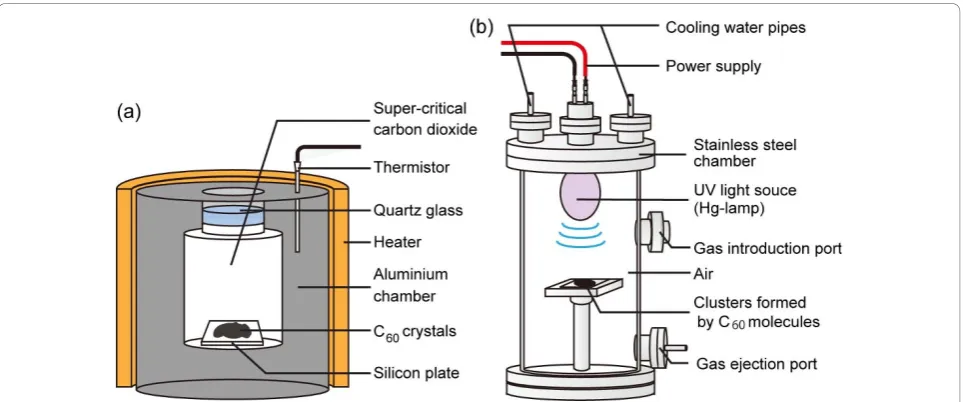
Figure 1 shows an outline of the experimental apparatuses. We carried out two experiments. First, clusters composed of C60molecules are produced by leaving C60crystals in carbon dioxide under supercritical conditions for 24 h [32] (see Figure 1a). The inner volume of the supercritical fluid chamber made of aluminium was 11.7 ml. Of the crystals composed of C60molecules, 0.2 mg was placed on the sur-face of a silicon plate set at the bottom of the supercritical fluid chamber and carbon dioxide of critical density was introduced into the chamber. The temperature of the fluid was set at 36.0°C by a heater installed around the chamber, which was regulated by a PID controller (C541, Technol Seven Co. Ltd., Tokyo, Japan). The temperature was moni-tored by a thermistor (SZL-64, Takara Thermistor Co. Ltd., Tokyo, Japan) embedded inside the chamber wall. Note that the critical temperature, pressure and density of carbon dioxide are respectively 31.0°C, 7.38 MPa and 468.0 kg m-3[33]. After the experiment, the fluid in the chamber was gradually released by controlling a valve switch. Clusters formed by C60molecules were observed by a scanning electron microscope [SEM] (JSM-7400F, JEOL, Tokyo, Japan). Secondly, the clusters formed on the silicon plate were moved to another chamber made of stainless steel for irradiation of UV light (Figure 1b). The inner height and diameter of the chamber were 500 and 254 mm. The clusters were placed 150 mm under an Hg
* Correspondence: [email protected]
Bio-Nano Electronics Research Centre, Toyo University, 2100, Kujirai, Kawagoe, Saitama, 350-8585, Japan
lamp (200 W, low-pressure Hg lamp, SEN Light Co. Ltd., Osaka, Japan). The chamber was filled with air at 1 atm and the air irradiated with UV light, the primary wave-lengths of which were 184.9 and 253.7 nm, for 3 h. After the experiment, the chamber was vacuumed via the ejec-tion port and fresh air was injected. The structures of the clusters were observed by an SEM. Mass spectroscopic analysis of the clusters was also carried out by matrix-assisted laser desorption ionisation time-of-flight mass spectroscopy (Brücker Daltonics, Autoflex, Bremen, Germany).
Results
First of all, clusters such as fibres and helices were formed by C60molecules after having left the crystals composed of
C60molecules in carbon dioxide under supercritical condi-tions (36.0°C) for 24 h [32] (see Figure 2a). However, C60 molecules were so weakly bonded to each other that the clusters were broken by electron beams during the SEM observation (Figure 2b; see also Additional file 1 for the movie). Note that the accelerating voltage, current and diameter of the electron beams were 1 kV, 4.7 × 10⁻²nA and 2.0 nm, respectively, and therefore the energy flux of the electron beams was 1.5 nW nm-2.
[image:2.595.58.540.88.289.2]As mentioned, the clusters were placed in another chamber filled with air at 1 atm and irradiated with UV light in the chamber. Figure 3 shows the fibres and helices composed of C60 molecules after irradiation of UV light for 3 h. Those structures were not broken by electron beams anymore even when the accelerating Figure 1Outline of the experimental apparatuses.(a)Supercritical fluid chamber. Crystals composed of C60molecules are placed on a silicon
plate set at the bottom of the chamber. The chamber is then filled with carbon dioxide of critical density. The temperature is set at 36.0°C by a heater regulated by a PID controller. Crystals composed of C60molecules are left in the chamber for 24 h. Clusters formed by C60molecules are
observed by an SEM.(b)UV light irradiation chamber. The clusters formed by C60molecules are placed in the chamber which is filled with air at
1 atm. After irradiation of UV light for 3 h, the clusters are observed by an SEM and mass spectroscopic analysis is carried out.
Figure 2Formation of clusters.(a)Clusters formed by C60molecules after having left the crystals composed of C60molecules in carbon
dioxide under supercritical conditions (36.0°C) for 24 h.(b)C60molecules were so weakly bonded to each other that the clusters were broken
[image:2.595.59.539.561.693.2]voltage was raised up to 10 kV (see Additional file 1 for the movie). Note that those structures were broken by electron beams when the clusters were placed in a vacuumed chamber irradiated with UV light. Mass spec-troscopic analysis of those clusters was carried out to investigate the component of the structures. Figure 4 shows the result of the mass spectroscopic analysis. Interestingly, C60On molecules (where n = 1, 2, 3 and 4), that is, C60 molecules to which oxygen atoms are bonded, were detected, but neither C120 nor C60 -O-C60 molecules were found. In other words, the rein-forced clusters were not polymerised via a chemical bond. Note that when the chamber was vacuumed and UV light was irradiated, the clusters were broken as mentioned, but dimers such as C108, C110, C112, C114, C116 and C118were created (see Figure 5). It is therefore supposed that air and irradiation of UV photons are essential for the reinforcement of clusters composed of
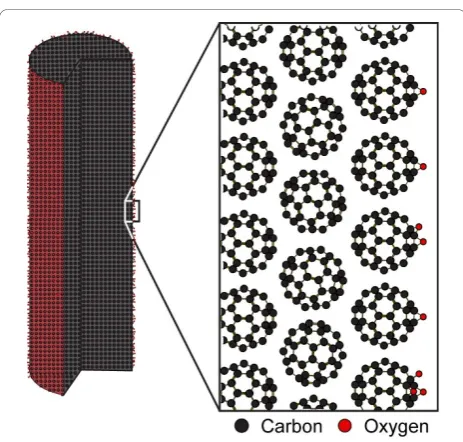
C60 molecules. The dissociation energy of an oxygen molecule, O2®O + O, is 5.1 eV [34]; therefore, it is sup-posed that oxygen molecules in the chamber were disso-ciated by photons of 184.9-nm wavelength, the energy of which is 6.48 eV, and oxygen atoms were bonded to C60 molecules. The order of the diameter of the clusters being 10 nm, it is supposed that C60molecules located at the surface of the clusters were oxidised (see Figure 6) and the clusters somehow reinforced. It is inferred that oxidised C60molecules located at the surface of the clusters may have an important role for the reinforce-ment of the clusters.
[image:3.595.57.539.88.226.2] [image:3.595.304.538.503.679.2]We will be investigating the mechanism of the reinfor-cement of the clusters, that is, the role of oxidised C60 molecules (C60On) located at the surface of the clusters, in the reinforcement process in detail, carrying out quantum mechanical calculations. We will also be mea-suring the electric, electronic, mechanical and thermal Figure 3Clusters after UV light irradiation for 3 h in a 1 atm air-filled chamber.(a)Fibres.(b)Helices. Those structures were not broken by electron beams any more.
Figure 4Time-of-flight mass spectroscopy. The clusters were composed of C60molecules (not shown in the graph) and C60On
molecules (n= 1, 2, 3, 4). It is supposed that oxygen atoms are bonded to C60molecules at the surface of the clusters.
[image:3.595.57.291.504.680.2]properties of the fibres and helices so that the clusters may be utilised for the development of nano electron devices, nano/microelectromechanical systems and micro-total analysis systems.
Summary
We carried out two experiments: (1) Crystals composed of C60molecules were placed in supercritical carbon dioxide (36.0°C), and it was found that fibres, fibre net-works and helices composed of C60molecules were self-assembled. Since C60 molecules in the clusters were bonded to each other via van der Waals interactions [32], the clusters were easily broken by the irradiation of electron beams during the SEM observation. (2) The clusters were placed in another chamber filled with air at 1 atm and irradiated with UV photons. Oxygen mole-cules were dissociated by UV photons, C60molecules at the surface of the clusters were oxidised, and C60On molecules were created. The clusters were not broken by the electron beams any more. It is supposed that C60Onmolecules located at the surface of the clusters may have an important role in the reinforcement pro-cess, but the actual mechanism of the reinforcement of the clusters has not yet been clearly understood and therefore is an open question.
Acknowledgements
Part of the present study has been supported by a Grant for High-Tech Research Centres organised by the Ministry of Education, Culture, Sports, Science and Technology (MEXT), Japan. T. Fukuda would like to thank MEXT for their financial support.
Authors’contributions
SK designed the study and carried out the experiment. TF participated in the design of the study and performed SEM observation and mass spectroscopic analysis. YS participated in the reinforcement experiment. TM participated in the design of the study, coordinated the study and wrote the manuscript. All authors read and approved the final manuscript.
Competing interests
The authors declare that they have no competing interests.
Received: 25 August 2010 Accepted: 12 January 2011 Published: 12 January 2011
References
1. Eklund PC, Rao AM, Zhou P, Wang Y, Holden JM:Photochemical transformation of C60and C70films.Thin Solid Films1995,257:185.
2. Rao CNR, Govindaraj A, Aiyer HN, Seshadri R:Polymerization and pressure-induced amorphization of C60and C70.J Phys Chem1995,99:16814.
3. Rao AM, Eklund PC, Venkateswaran UD, Tucker J, Duncan MA, Bendele GM, Stephens PW, Hodeau J-L, Marques L, Núñez-Regueiro M, Bashkin IO, Ponyatovsky EG, Morovsky AP:Properties of C60polymerized under high
pressure and temperature.Appl Phys A1997,64:231.
4. Onoe J, Takeuchi K:How many [2+2] four-membered rings are formed on a C60molecule when photopolymerization is saturated?Phys Rev Lett
1997,79:2987.
5. Rao AM, Eklund PC, Hodeau J-L, Marques L, Nunez-Regueiro M:Infrared and Raman studies of pressure-polymerized C60s.Phys Rev B1997,
55:4766.
6. Onoe J, Takeuchi K:Photo-induced coalescence of C60molecules in a
potassium-doped C60film: mass spectral evidence.J Mass Spectrom1998,
33:387.
7. Wågberg T, Jacobsson P, Sundqvist B:Comparative Raman study of photopolymerized and pressure-polymerized C60films.Phys Rev B1999,
60:4535.
8. Fujitsuka M, Fujiwara K, Murata Y, Uemura S, Kunitake M, Ito O, Komatsu K:
Properties of photoexcited states of C180, a triangle trimer of C60.Chem Lett2001,5:384.
9. Dunsch L, Rapta P, Gromov A, Staško A:In situ ESR/UV-vis-NIR spectroelectrochemistry of C60and its dimers C120, C120O and C120OS.
J Electroanal Chem2003,547:35.
10. Onoe J, Nakayama T, Aono M, Hara T:Electrical properties of a two-dimensionally hexagonal C60photopolymer.J Appl Phys2004,96:443.
11. Karachevtsev VA, Mateichenko PV, Nedbailo NY, Peschanskii AV, Plokhotnichenko AM, Vovk OM, Zubarev EN, Rao AM:Effective
photopolymerization of C60films under simultaneous deposition and UV
light irradiation: Spectroscopy and morphology study.Carbon2004,
42:2091.
12. Alvarez-Zauco E, Sobral H, Basiuk EV, Saniger-Blesa JM, Villagrán-Muniz M:
Polymerization of C60fullerene thin films by UV pulsed laser irradiation.
[image:4.595.57.289.85.306.2]Appl Surf Sci2005,248:243.
Figure 6 Outline of a reinforced fibre composed of C60
molecules. Originally, the fibre composed of C60molecules was
self-assembled in supercritical carbon dioxide (36.0°C). C60molecules
were so weakly bonded to each other that the fibre was broken by electron beams. The fibre was then placed in another chamber filled with air at 1 atm, which was irradiated with UV photons. C60
13. Yamamoto H, Iwata N, Hashimoto R, Ando S:Photon-assisted synthesis of C60polymers by laser irradiation.Appl Surf Sci2007,253:7977.
14. Oszlanyi G, Forro L:Two-dimensional polymer of C60.Solid State Commun
1995,93:265.
15. Persson P-A, Edlund U, Jacobsson P, Johnels D, Soldatov A, Sundqvist B:
NMR and Raman characterization of pressure polymerized C60.Chem
Phys Lett1996,258:540.
16. Sundqvist B, Edlund U, Jacobsson P, Johnels D, Jun J, Launois P, Moret R, Persson P-A, Soldatov A, Wågberg T:Structural and physical properties of pressure polymerized C60.Carbon1998,36:657.
17. Chen X, Yamanaka S, Sako K, Inoue Y, Yasukawa M:First single-crystal X-ray structural refinement of the rhombohedral C60polymer.Chem Phys Lett2002,356:291.
18. Wang G-W, Komatsu K, Murata Y, Shiro M:Synthesis and X-ray structure of dumb-bell-shaped C120.Nature1997,387:583.
19. Lebedkin S, Gromov A, Giesa S, Gleiter R, Renker B, Rietschel H, Krätschmer W:Raman scattering study of C120, a C60dimer.Chem Phys Lett1998,285:210.
20. Komatsu KK, Wang G-W, Murata Y, Tanaka T, Fujiwara K:Mechanochemical synthesis and characterization of the fullerene dimer C120.J Org Chem
1998,63:9358.
21. Wood JM, Kahr B, Hoke SH, DejarmeII L, Cooks RG, Ben-Amotz D:Oxygen and methylene adducts of C60and C70.J Am Chem Soc1991,113:5907.
22. Zhou P, Rao AM, Wang K-A, Robertson JD, Eloi C, Meier MS, Ren SL, Bi X-X, Eklund PC, Dresselhaus MS:Photo-assisted structural transition and oxygen diffusion in solid C60films.Appl Phys Lett1992,60:2871.
23. Lebedkin S, Ballenweg S, Gross J, Taylor R, Krätschmer W:Synthesis of C120O: A new dimeric [60] fullerene derivative.Tetrahedron Lett1995,
36:4971.
24. Penn SG, Costa DA, Balch AL, Lebrilla CB:Analysis of C60oxides and
C120On(n = 1,2,3) using matrix assisted laser desorption-ionization
Fourier transform mass spectrometry.Int J Mass Spectrom Ion Processes
1997,169/170:371.
25. Gromov A, Lebedkin S, Hull WE, Krätschmer W:Isomers of the dimeric fullerene C120O2.J Phys Chem A1998,102:4997.
26. Krause M, Dunsch L, Seifert G, Fowler PW, Gromov A, Krätschmer W, Gutierez R, Porezag D, Frauenheim T:Vibrational signatures of fullerene oxides.J Chem Soc Faraday Trans1998,94:2287.
27. Heymann D, Bachilo SM, Weisman RB, Cataldo F, Fokkens RH, Nibbering NMM, Vis RD, Chibante LPF:C60O3, a fullerene ozonide:
Synthesis and dissociation to C60O and O2.J Am Chem Soc2000,
122:11473.
28. Weisman RB, Heymann D, Bachilo SM:Synthesis and characterization of the“missing”oxide of C60: [5,6]-open C60O.J Am Chem Soc2001,
123:9720.
29. Resmi MR, Ma S, Caprioli R, Pradeep T:C120Onfrom C60Br24.Chem Phys Lett
2001,333:515.
30. Heymann D, Weisman RB:Fullerene oxides and ozonides.CR Chim2006,
9:1107.
31. Stanley HE:Introduction to phase transition and critical phenomena.
Oxford: Oxford University Press; 1971.
32. Fukuda T, Ishii K, Kurosu S, Whitby R, Maekawa T:Formation of clusters composed of C60 molecules via self-assembly in critical fluids.
Nanotechnology2007,18:145611.
33. Somayajulu GR:Estimation procedures for critical constants.J Chem Eng Data1989,34:106.
34. Okabe H:Photochemistry of small molecules.New York: Wiley; 1978.
doi:10.1186/1556-276X-6-80
Cite this article as:Kurosuet al.:Formation and reinforcement of clusters composed of C60molecules.Nanoscale Research Letters20116:80.
Submit your manuscript to a
journal and benefi t from:
7 Convenient online submission
7 Rigorous peer review
7 Immediate publication on acceptance
7 Open access: articles freely available online 7 High visibility within the fi eld
7 Retaining the copyright to your article