BIROn - Birkbeck Institutional Research Online
Fair, Helen and Jacobson, Jessica (2018) Process evaluation of the
Restorative Prisons project. Project Report. Restorative Solutions, London,
UK.
Downloaded from:
Usage Guidelines:
Please refer to usage guidelines at or alternatively
Process evaluation
of the
Restorative Prisons project
Helen Fair and Jessica Jacobson
Institute for Criminal Policy Research,
Birkbeck, University of London
i
Table of Contents
Acknowledgements ... ii
Summary ... iii
1. Introduction ... 1
1.1 The project ... 1
1.2 The context ... 2
1.3 The prisons ... 4
1.3.1 HMP Buckley Hall ... 4
1.3.2 HMP Featherstone ... 5
1.3.3 HMP Peterborough ... 5
1.4 The evaluation... 6
2. Project progress ... 8
2.1 Progress to date in Buckley Hall ... 8
2.1.1 Buckley Hall project governance and referrals ... 8
2.1.2 Buckley Hall training ... 9
2.1.3 Buckley Hall restorative interventions ... 10
2.2 Work initiated and discontinued in Featherstone ... 12
2.3 Progress to date in Peterborough ... 13
2.3.1 Peterborough project governance and referrals ... 13
2.3.2 Peterborough training ... 14
2.3.3 Peterborough interventions... 16
3. Challenges and opportunities ... 19
3.1 Fluid parameters and implementation of Restorative Approaches ... 19
3.1.1 Types of conflict ... 19
3.1.2 Defining conflict ... 20
3.1.3 Defining informal RA ... 20
3.1.4 RA and the adjudications process ... 21
3.2 Practical and logistical challenges ... 24
3.3 The prisoner facilitator role ... 26
3.3.1 Selection of prisoner facilitators ... 26
3.3.2 Scope of prisoner-facilitator role ... 27
3.3.2 Constraints on prisoner facilitation ... 28
3.3.3 Conflicts and tensions within the prisoner facilitator role ... 29
3.4 Staff receptiveness to RA ... 30
3.5 Ownership, leadership and sustainability ... 32
ii
Acknowledgements
Many prisoners and staff at Buckley Hall, Featherstone and Peterborough prisons
contributed to this evaluation by talking to us about their expectations and experiences of restorative approaches. We are grateful for the time they gave us and for their willingness to be open, honest and reflective in responding to our many questions.
We are also grateful to Restorative Solutions for their support throughout the evaluation, and particularly for the assistance provided by Dave Aukett.
Sincere thanks are due to the Monument Trust for funding the pilot programme. The pilot was also dependent on support from the Ministry of Justice, which helped to identify suitable prisons for the work and approved the research undertaken for the evaluation.
iii
Summary
This report presents the findings of a process evaluation by the Institute for Criminal Policy Research (ICPR) at Birkbeck, University of London, of a Restorative Prisons pilot project. The project was developed by Restorative Solutions and funded by the Monument Trust, and was launched in two prisons – HMP Buckley Hall and HMP Featherstone – in July 2016. It was subsequently discontinued at Featherstone and introduced to HMP Peterborough in February 2017. The evaluation period was from July 2016 to end November 2017.
The project
The Restorative Prisons pilot involves the use of ‘restorative approaches’ (RA) to address conflict in prisons, including conflict in the form of verbal altercations, physical violence, and bullying or intimidation. As defined by Restorative Solutions, restorative approaches:
bring people in conflict into a dialogue. Using a skilled and structured process, those who have been harmed have an opportunity to be heard and those that have caused the harm are held to account for what they have done.
The core components of the Restorative Prisons pilot are as follows:
It encompasses conflict between prisoners, between prisoners and staff and (potentially) between staff;
Both staff and prisoners are trained to deliver, facilitate and promote RA;
RA are applied in formal meetings and in informal meetings and conversations;
In RA meetings and conversations, the parties to the conflict are asked to respond to the key ‘restorative questions’:
o What happened?
o What were you thinking?
o What were you feeling at the time? And now?
o Who has been affected? How do you think they have been affected? o What needs to happen to put this right?
RA complement internal prison disciplinary processes, including adjudications.
Use of RA is intended to ensure that individual incidents are resolved quickly and effectively and that escalation of conflict is thereby avoided. It is expected that staff and prisoners’ exposure to skilled facilitation, and to restorative principles more generally, will help those involved in conflict to be better able to take responsibility for their actions, to reflect on how these actions impact others, to show respect for others’ feelings, and to reintegrate
iv
hoped that trained prisoner facilitators will acquire skills to enhance their resettlement and employment prospects post-release.
Evaluation findings
As evaluators, we undertook interviews and group discussions with staff and prisoners involved in the pilot in different capacities: as trained facilitators, participants in restorative meetings, project managers/administrators and through senior management roles in the
prisons. By these means, we sought to chart the RA in each of the pilot sites; to identify factors supporting or impeding implementation; to review the scope of project activities; and to draw learning for further development of RA in prisons.
Training and implementation in Buckley Hall and Peterborough
In Buckley Hall and Peterborough, training was delivered to both staff and prisoners who
were interested in becoming facilitators. In Buckley Hall, 20 prisoners and 38 staff were trained, at least to ‘foundation’ level; in Peterborough, 21 prisoners and 75 staff received foundation level training. Feedback from trainees reveals that the training was extremely
well-received across all groups: for example, all trainees who submitted feedback replied ‘Yes’ to the questions: ‘Did the course meet your needs?’ and ‘Would you recommend the course to a colleague?’. Alongside the training, a range of activities aimed at raising
awareness of and promoting RA among both staff and prisoners were undertaken in the pilot sites.
In Buckley Hall, the log of RA activities shows that 11 formal and 15 informal meetings were completed over the period January to 2017. (It should be noted that there is likely to be significant under-counting of informal work.) Prisoners facilitated or co-facilitated with staff
seven of the formal and four of the informal meetings. Peterborough saw the completion of ten formal and 29 informal meetings, with prisoners having facilitated or co-facilitated five of each type of meeting.
Pilot launched and discontinued at Featherstone
Seven prisoners and nine staff received foundation level training at Featherstone. Feedback from the nine staff trainees was very positive, as in the other two prisons; prisoner feedback was not received. In Featherstone, the pilot did not continue in a meaningful way beyond the training: we were told of only one intervention which took place here. The pilot was
subsequently discontinued in this prison, which was grappling with severe staff shortages and a general problem of violence.
Challenges and opportunities
v
significant value in the fluidity of the concept of RA. This permits its application in a highly flexible manner to the wide-ranging types of conflict that can readily – and often very quickly – arise in the highly pressurised prison environment.
Like any restorative project, this one has encountered practical and logistical difficulties – relating, for example, to the identification and referral of cases, liaison between parties, and project monitoring. The highly structured and limiting prison setting poses its own
challenges, particularly at a time when general staff shortages reduce the capacity of staff to
engage fully with new initiatives.
The involvement of prisoners as trained facilitators is a critical component of the project, but
is also challenging. While there are many established peer support initiatives in prisons, the active involvement of prisoners in the management of conflict – including conflict between prisoners and staff – amounts to a notable and unique extension of existing peer support work. The prisoner facilitators we talked to were highly enthusiastic about their role and optimistic about the effectiveness of RA; and also about the opportunities for personal and professional growth that involvement in the project offered to them. However, many were
also frustrated that their opportunities to facilitate meetings had to date been limited. They were inclined to place at least part of the blame for this on staff lack of awareness or understanding of the project. On the other hand, among staff who spoke to us about their
own involvement in the RA work, there was a clear recognition of the critical importance of the prisoner facilitator role, and a willingness to give a considerable level of responsibility and trust to prisoners who demonstrated their ability to fulfil this role. Within the limited scope
of the evaluation, it was not possible to assess the extent of support for RA among prison staff more generally.
Conclusion
Introducing innovative practices in the prison context is fraught with difficulty. By virtue of their very purpose – that is, the secure detention of people who are convicted of, or are suspected of having committed, criminal offences – prisons are necessarily rule-bound, bureaucratic institutions, within which the maintenance of security and good order is a paramount aim. Given the risk averse culture of prisons, change tends to be a slow process, and a core part of prison life is the unambiguous delineation of status and roles between staff and prisoner.
Thus, the scale of the ambition of the Restorative Prisons project – particularly, its requirement that staff and prisoners should work together in examining, addressing and seeking to resolve conflict – is considerable. And yet this process evaluation has found that none of the challenges encountered by the Buckley Hall or Peterborough in the
vi
and resources to the project, but also to take the risks that its development and implementation entailed.
These prisons have proved that, with commitment, leadership and clear lines of
accountability, it is possible to use RA to deal, both formally and informally, with a wide
variety of conflicts. There is no doubt that this can only happen where prisoners and staff alike are willing to challenge some ingrained aspects of prison culture. It is striking that in both Buckley Hall and Peterborough, many individuals in diverse circumstances were
1
1. Introduction
This report presents the findings of a process evaluation by the Institute for Criminal Policy Research (ICPR) at Birkbeck, University of London, of a Restorative Prisons pilot project. The project, developed by Restorative Solutions and funded by the Monument Trust, entails training and supporting staff and prisoners to use restorative approaches in addressing conflict in the prison setting. The project was initially launched in two prisons, HMP Buckley Hall and HMP Featherstone, in July 2016. In January 2017 it was discontinued at
Featherstone and was subsequently introduced to HMP Peterborough.
1.1
The project
‘Restorative approaches’ are defined by Restorative Solutions as approaches which:
bring people in conflict into a dialogue. Using a skilled and structured process, those who have been harmed have an opportunity to be heard and those that have caused the harm are held to account for what they have done.1
The premise of the Restorative Prisons project is that restorative approaches can be usefully applied to much of the conflict that arises in prisons on a day-to-day basis, including conflict in the form of verbal altercations, physical violence, and bullying or intimidation. The core components of the project design are:
Conflicts between prisoners, between prisoners and staff and (potentially) between staff are all within the scope of the project.
Both staff and prisoners are trained to deliver restorative approaches – including by identifying and referring cases, facilitating meetings, and promoting a
restorative culture in the prison more generally.
Restorative approaches encompass formal, pre-planned meetings, and informal, ad hoc meetings and conversations.
Restorative meetings and conversations (whether formal or informal) are expected to explore how both parties to a conflict – generally defined as the ‘harmer’ and ‘harmed’ – understand the conflict, by focusing on the key ‘restorative questions’:
o What happened?
o What were you thinking?
o What were you feeling at the time? And now?
o Who has been affected? How do you think they have been affected? o What needs to happen to put this right?
1
2
Restorative approaches complement the existing system of adjudications within the prison.2
As distinct set of practices, restorative approaches are delivered additionally to any conventional (victim-offender) Restorative Justice that is being undertaken within the prison.
The most immediate aims of this ‘whole prison approach’ to tackling conflict are twofold: first, to ensure that individual incidents are resolved quickly and effectively and that
escalation of conflict is thereby avoided; secondly, to reintegrate prisoners back into prison life after the conflict has been resolved (and after the case has gone through the prison disciplinary process where necessary). It is expected that staff and prisoners’ exposure to skilled facilitation, and to restorative principles more generally, will help those involved in conflict to be better able to take responsibility for their actions, to reflect on how these actions impact others, to show respect for others’ feelings, and to reintegrate themselves within the prison community. Over the longer term, the goal is to achieve organisational and cultural change: improved relations among staff and prisoners alike, an overall reduction in levels of violence and self-harm, and a better living and working environment for all.
An additional intended outcome of the project is that trained prisoner facilitators will acquire general lifestyle as well as specialist skills to enhance their resettlement and employment prospects post-release – including, for example, through participating in further restorative training which can lead to BTEC Accreditation in Restorative Approaches.
Further, as a pilot, the project is intended to generate lessons for the wider design and implementation of restorative approaches across the prison service.
1.2
The context
At the time of writing, the prison population of England and Wales stands at around 85,000 – having almost doubled in size since the early 1990s. While prisoner numbers have stabilised in recent years, England and Wales continues to have a significantly higher prison
population rate than most western and northern European countries. Prisons are
overcrowded, and poor conditions have been exacerbated in recent years by staff shortages.
Rising levels of violence and self-harm in the prisons of England and Wales are a cause of profound concern. The past year has seen a series of prison disturbances, while growing use of ‘Spice’, a type of New Psychoactive Substance, is causing severe health problems and is associated with debt, bullying and violence among prisoners.3 Latest Ministry of Justice Safety in CustodyStatistics reveal that over the 12 months to June 2017 there were:
2
Adjudications are the formal process by which alleged offences by prisoners against Prison Rules are dealt with by prison management.
3 HM Inspectorate of Probation and the Care Quality Commission (2017) New Psychoactive Substances: the
3
41,103 self-harm incidents, of which 2,833 required hospital attendance;
19,678 prisoner-on-prisoner assaults, of which 2,911 were serious assaults;
7,437 assaults on staff, of which 798 were serious.4
In his 2016-17 Annual Report, the Chief Inspector of Prisons noted ‘startling increases in all
types of violence’, and that of 29 local and training prisons that had been inspected over the year, 21 were judged to be ‘poor’ or ‘not sufficiently good’ in terms of safety. The proportion of adult male prisons assessed by the inspectorate as ‘good’ or ‘reasonably good’ dropped from 78% to 49% over the year 2016-17 – described as ‘a dramatic and rapid decline’.5
An innovative and flexible approach to addressing conflict, which makes full use of existing staff and prisoner resources, potentially has much to offer a prison system struggling with record rates of violence, intensifying drug problems, under-staffing and poor conditions
(albeit a basic level of good order in an establishment is required if the project is to be successfully implemented). The pilot sites welcomed the opportunity to take part in the Restorative Prisons project and – as will be documented over the course of this report – embarked on the work with considerable commitment and enthusiasm, notwithstanding the implementation challenges that arose. The broader policy environment has been favourable to the project from the outset; with, for example, the 2016 Prison Safety and Reform White Paper referring explicitly to the pilot as one way in which violence against staff is being tackled.6 David Lidington, Secretary of State for Justice from June 2017 to January 2018, made it clear that prisoner rehabilitation and prison safety are closely linked priorities of his
department, and that increased staff numbers and improved quality of engagement between prisoners and staff will play a vital part in work towards these goals.7
https://www.justiceinspectorates.gov.uk/cjji/wp-content/uploads/sites/2/2017/11/New-Psychoactive-Substances-report.pdf
4 Ministry of Justice (2017) Safety in Custody Statistics, England and Wales: Deaths in Prison Custody to
September 2017 Assaults and Self-Harm to June 2017,
https://www.gov.uk/government/uploads/system/uploads/attachment_data/file/654498/safety-in-custody-stats-q2-2017.pdf
5
HMIP (2017) HM Chief Inspector of Prisons for England and Wales Annual Report 2016 –17,
https://www.gov.uk/government/uploads/system/uploads/attachment_data/file/629719/hmip-annual-report-2016-17.pdf
6
Ministry of Justice, November 2016, Prison Safety and Reform,
https://www.gov.uk/government/uploads/system/uploads/attachment_data/file/565014/cm-9350-prison-safety-and-reform-_web_.pdf
7 ‘Prison reform: open letter from the Justice Secretary’, 21 June 2017,
4
1.3
The prisons
After the funding was secured for the Restorative Prisons project, Restorative Solutions requested advice on the selection of prisons from the (then) National Offender Management Service, which provided a shortlist of establishments.8 The Restorative Solutions project team then met with the Governor of each of the shortlisted prisons, and selected Buckley Hall and Featherstone as the initial two sites. The main selection criteria, at both the shortlisting and final stages, were that:
The pilot prisons should be male, Category B or C,9 public sector establishments;
They should not hold large numbers of young offenders or remand prisoners;
They should not have severe problems with gangs or extremism;
They should have a relatively stable staff and prisoner population;
They should not be engaged in other major programmes that would limit capacity;
There should be strong commitment to the pilot from the Governor and senior management, and support from the regional Deputy Director of Custody;
The Governor and senior management should have experience of managing change and be supportive of restorative justice and peer support initiatives.
Following difficulties with implementation at Featherstone (see Chapter Two), the project
was discontinued there and Restorative Solutions took the decision to introduce the pilot at Peterborough. This prison had not been on the initial shortlist, but was considered
appropriate for accelerated implementation of the pilot on the grounds that it was highly
committed to victim-offender restorative justice work, in which Restorative Solutions was already involved. Further, as a private prison, and one which holds both male and female prisoners, it was deemed to offer an interesting point of contrast with Buckley Hall.
Restorative Solutions are currently in discussion with the North West Region and HM Prison and Probation Service to progress the initiative in a sustainable way across this region and
the secure estate more widely.
1.3.1 HMP Buckley Hall
HMP Buckley Hall, situated just outside Rochdale in the North West region, is a Category C Training Prison with a capacity of 445. It holds adult male prisoners serving sentences of four years or more. After five years as a privately run prison, Buckley Hall has been under public sector management since 2000. An unannounced inspection in June 2016 ‘found a prison that continues to ensure reasonably good or better outcomes in most of the areas we inspect’ and that ‘prisoners had good access to time out of cell and the majority were
involved in full-time work or training’. The inspection report also commented on the ‘effective leadership’ provided by senior management, and described the establishment as ‘generally
8 In April 2017, the National Offender Management Service was replaced by Her Majesty’s Prison and
Probation Service (HMPPS).
9
5
safe’, with low levels of violence, although there had been a significant increase in use of force by the prison.10
1.3.2 HMP Featherstone
HMP Featherstone is situated near Wolverhampton, in the Midlands region. Like Buckley
Hall, it is a public sector, Category C prison for adult males; its capacity is 687. An
unannounced inspection in late 2016 (at which time efforts were being made to implement the restorative pilot at the prison) found a ‘shocking worsening of standards’ at the prison, particularly with respect to safety which was judged to be ‘poor’.11
The inspectorate reported ‘clear evidence of poor industrial relations, staff shortages and some significant prisoner unrest’, that 37% of prisoners said they felt unsafe, and that both staff and prisoners were ‘outspoken about what they perceived to be a lack of leadership and direction in the prison’. The most recent reported disturbance at Featherstone was in August 2017.12 A report by the prison’s Independent Monitoring Board, published on 5 January 2018, refers to very poor physical conditions; encouragingly, however, it also notes an increase in staff numbers and improving prisoner-staff relationships.13
1.3.3 HMP Peterborough
Peterborough is a private prison, operated by Sodexo Justice Services, and is the country’s only purpose-built prison for both men and women, who are housed entirely separately. The prison’s capacity is 916 men and 360 women (including 12 in a mother and baby unit). For men, Peterborough operates as a category B local prison, meaning that it takes prisoners immediately after sentencing and prisoners on remand. Female prisoners in Peterborough
include both long and short-sentence prisoners, remand prisoners, and young offenders. The men’s section of Peterborough was last inspected in February 2015, and found ‘a prison which produced very good outcomes’ and that ‘excellent relationships between staff and prisoners underpinned much that was good about the prison’.14
A 2014 inspection of the women’s section noted the ‘wide and complex range of needs’ of the women prisoners, but found that the women were well managed overall, that staff-prisoner relationships were
good, and that the prison was safe.15
10
HM Chief Inspector of Prisons (2016), Report on an unannounced inspection of HMP Buckley Hall, 7-16 June 2016, https://www.justiceinspectorates.gov.uk/hmiprisons/wp-content/uploads/sites/4/2016/12/Buckley-Hall-Web-2016.pdf
11
HM Chief Inspector of Prisons (2016), Report on an unannounced inspection of HMP Featherstone, 24 October-3 November 2016,
https://www.justiceinspectorates.gov.uk/hmiprisons/wp-content/uploads/sites/4/2017/02/Featherstone-Web-2016.pdf
12
http://www.bbc.co.uk/news/uk-england-41093345
13 Independent Monitoring Boards (2018), Annual Report of the Independent Monitoring Board at HMP
Featherstone, for reporting year 1 November 2016-31 October 2017,
https://s3-eu-west-2.amazonaws.com/imb-prod-storage-1ocod6bqky0vo/uploads/2018/01/Featherstone-2016-17.pdf
14
HM Chief Inspector of Prisons (2015), Report on an unannounced inspection of HMP Peterborough (Men), 16-27 February 2015,
https://www.justiceinspectorates.gov.uk/hmiprisons/wp-content/uploads/sites/4/2015/06/Peterborough-Men-web-2015.pdf
15 HM Chief Inspector of Prisons (2014), Report on an unannounced inspection of HMP and YOI Peterborough
6
1.4
The evaluation
ICPR was commissioned by Restorative Solutions to conduct a process evaluation of the Restorative Prisons pilot. As a process evaluation, the aim was to chart the procedures
devised and put into practice in each of the pilot sites; to identify factors which supported and those which impeded implementation; to review the scope and types of project activities; and to draw learning for further development of restorative approaches to prison-based conflict. Measurement of the pilot’s success in terms of containing and reducing conflict, and ultimately achieving positive organisation and cultural change, was outside the remit of the evaluation.
For the evaluation, we visited the prisons at regular intervals (including one visit to
Featherstone) to conduct interviews and group discussions with staff and prisoners involved
in the pilot as trained facilitators, participants in restorative meetings, project
managers/administrators and in senior management roles within the prison. Additionally, we observed training in restorative approaches, observed some adjudication hearings, reviewed
project monitoring data and training evaluation forms, and obtained regular feedback from Restorative Solutions.
The pilot, and accompanying evaluation, was originally conceived as a 12-month initiative running from summer 2016. The hope was that at the end of the 12 months, Restorative Solutions would withdraw from the sites and the prisons would continue the restorative work
with limited external support. However, because of delays to implementation and at the request of the Governor, Restorative Solutions extended its involvement in Buckley Hall and, as of January 2018 continues to provide some input here. In Peterborough, where the
initiative was only launched in February 2017, Restorative Solutions’ involvement is
scheduled to end in February 2018. The evaluation period ran to the end of November 2017.
The findings of the evaluation are presented in Chapters Two and Three of this report: Chapter Two outlines project activities to date in each of the three prisons; Chapter Three describes the main challenges encountered during implementation and opportunities offered by the project. Chapter Four then provides a conclusion and sets out learning points for further development of Restorative Prisons.
7
change is perhaps all the more likely at this time when the prison estate as a whole is struggling with staff shortages and high levels of violence and self-harm. To anticipate the
8
2. Project progress
In this chapter, we look at the progress made in implementation of the pilot. We describe project governance in each of the prisons, along with a summary of the referral process that was put in place, training delivered and RA interventions held.
In all three prisons, Restorative Solutions was actively involved from the outset in project design and management, in supporting awareness-raising and communications activities, and co-facilitating some of the initial restorative interventions. Restorative Solutions also had responsibility for delivering all the training to both prisoners and staff. This was based on Restorative Solutions’ standard restorative justice training, but adapted to the prison environment – for example, through inclusion of role plays relevant to conflict in prisons. Most of this work on behalf of Restorative Solutions was undertaken by project manager Dave Aukett, through regular attendance at the prisons.
2.1
Progress to date in Buckley Hall
The pilot got under way in Buckley Hall in early July 2016 when a project steering group was established, membership of which included the Governor and other senior managers.
2.1.1 Buckley Hall project governance and referrals
An early decision was taken to base the pilot in the prison’s Offender Management Unit (OMU), meaning that this unit would hold responsibility for implementing the referral process, overseeing interventions, and maintaining records of the process. The first training of staff facilitators took place in September 2016, and the first prisoner training in December. Alongside the training, and on an ongoing basis, a range of awareness-raising activities have been organised, including presentations at staff meetings, production by the prisoner facilitators of posters and leaflets, and prisoner ‘roadshows’.
With input from Restorative Solutions, A referral process for restorative interventions was designed by Restorative Solutions and agreed with the project management group; this continued to evolve over the course of the pilot, but the essential elements were:
Restorative meetings could be held on either an informal or formal basis, depending on the nature and circumstances of the conflict;
A standardised referral form was provided, for use (by any staff or by trained prisoner facilitators) in reporting informal use of RA or to request referral for a formal
restorative meeting;
Upon receipt of referral forms, OMU was to log instances in which informal RA had been used, and – after risk assessment – allocate formal cases to trained facilitators;
Facilitators were expected to feed back outcomes of formal meetings to OMU
9 is made16).
The referral process was elaborated in a Restorative Prisons Practitioner Guide produced by Restorative Solutions in January 2017, and subsequently in a document entitled Restorative Approaches Policy, produced by the prison in March 2017.
By December 2016, the prison had decided that responsibility for the delivery of the pilot should be moved to the Safer Custody department, which was felt to be a more appropriate
location because its remit includes violence reduction. Two existing Violence Reduction Officers were appointed to a dedicated RA coordinator role, to entail provision of awareness-raising activities, some co-facilitation of interventions, management of the referral system
(encompassing receipt of referrals, case allocation, risk assessment, and recording of interventions on an Excel-based log), and provision of assistance with practical
arrangements for interventions. The expectation had been that the two officers would come
into post in January 2017; in the event, due to wider staffing problems in the prison, this did not happen until May 2017. Since October 2017, the RA co-ordinators have been based in the same office as the rest of the Safer Custody team. There is an expectation that they will
routinely review all information about violence and related problems that comes into the team, to seek suitable cases for referral for restorative work.
2.1.2 Buckley Hall training
All staff (operational and non-operational) were initially invited to submit an expression of interest in being trained in restorative approaches. Of those who responded, a total of 38
completed a one-day foundation training course, delivered in the prison by Restorative Solutions, in September and October 2016. The foundation course focuses on the underpinning principles of restorative approaches and why they work, and prepares
participants to practise restorative interventions on an informal basis. Nineteen of the prison staff who had undertaken the foundation training thereafter completed a two-day practitioner training course in November 2016; this course provides participants with the skills required
to prepare and facilitate formal restorative meetings and conferences.
Prisoners were selected for RA training through a process of nomination by staff,
subsequent discussions with Dave Aukett and security checks. Eight prisoners undertook the foundation training in December 2016, which was delivered over two days rather than the usual one, because of the constraints on prisoners’ time and availability. Seven of the eight prisoners trained to foundation level subsequently completed practitioner training over three days in January 2017. A further 12 prisoners undertook two-day foundation training in November 2017.
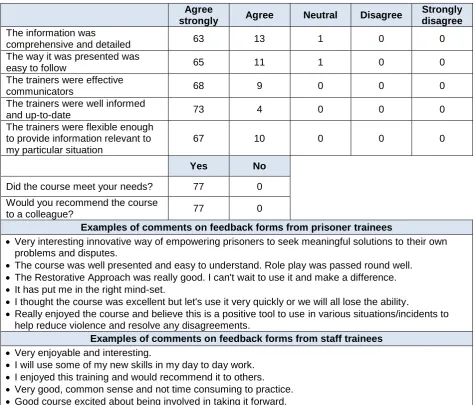
Feedback from both staff and prisoners who undertook the training was highly positive, as shown in Table 2.1. This is based on feedback received from 77 of the total of 84 who were
16 Adjudication ‘awards’ include, for example, loss of privileges for a specified period or time in the segregation
10
[image:18.595.66.542.139.544.2]trained17 (counting those who completed the practitioner as well as the foundation training twice, as separate feedback was sought for each course).
Table 2.1: Summary of feedback on RA training, Buckley Hall
Agree
strongly Agree Neutral Disagree
Strongly disagree
The information was
comprehensive and detailed 63 13 1 0 0
The way it was presented was
easy to follow 65 11 1 0 0
The trainers were effective
communicators 68 9 0 0 0
The trainers were well informed
and up-to-date 73 4 0 0 0
The trainers were flexible enough to provide information relevant to my particular situation
67 10 0 0 0
Yes No
Did the course meet your needs? 77 0
Would you recommend the course
to a colleague? 77 0
Examples of comments on feedback forms from prisoner trainees
Very interesting innovative way of empowering prisoners to seek meaningful solutions to their own problems and disputes.
The course was well presented and easy to understand. Role play was passed round well.
The Restorative Approach was really good. I can't wait to use it and make a difference.
It has put me in the right mind-set.
I thought the course was excellent but let's use it very quickly or we will all lose the ability.
Really enjoyed the course and believe this is a positive tool to use in various situations/incidents to help reduce violence and resolve any disagreements.
Examples of comments on feedback forms from staff trainees Very enjoyable and interesting.
I will use some of my new skills in my day to day work.
I enjoyed this training and would recommend it to others.
Very good, common sense and not time consuming to practice.
Good course excited about being involved in taking it forward.
2.1.3 Buckley Hall restorative interventions
The Buckley Hall log of RA interventions shows that between 4 January (date of the first referral form) and 30 November 2017 (end of the evaluation period), 28 referrals had been received for formal RA, of which 11 resulted in a meeting. In all 11 cases, an outcome agreement resulted from the meeting. In five of the 11 cases, an adjudication was held as well as the restorative meeting.
Buckley Hall’s RA log also shows that 32 reports about informal RA were received, and that in 15 of these cases a restorative intervention was completed, with an outcome agreement achieved in six of them. Six of the informal (completed) cases had also involved an
17 Individuals who completed the practitioner as well as the foundation training are counted twice within the
11
adjudication. While the trained restorative facilitators have been encouraged to record all informal as well as formal interventions, those which are highly informal – that is, where conflict is addressed on the spot through application of restorative techniques – may not always be recorded if they are regarded by the facilitator as a part of routine interaction. Therefore the actual level of informal activities may be much higher than is shown in the prison’s RA log, and is necessarily difficult to quantify.
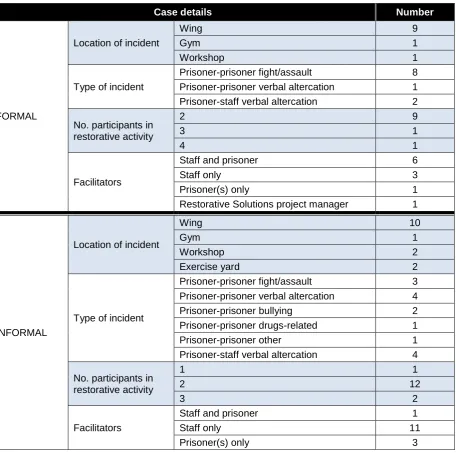
Table 2.2 provides an overview of the completed RA interventions. The table reveals that 20
out of 26 incidents subject to a completed (formal or informal) activity involved conflict between prisoners, and that most of this conflict took the form of an assault or fight. A majority of the formal restorative meetings were jointly facilitated by prisoner and staff
[image:19.595.62.519.299.752.2]facilitators, while staff alone facilitated most of the informal interventions.
Table 2.2: Breakdown of completed restorative interventions, Buckley Hall
Case details Number
FORMAL
Location of incident
Wing 9
Gym 1
Workshop 1
Type of incident
Prisoner-prisoner fight/assault 8
Prisoner-prisoner verbal altercation 1
Prisoner-staff verbal altercation 2
No. participants in restorative activity
2 9
3 1
4 1
Facilitators
Staff and prisoner 6
Staff only 3
Prisoner(s) only 1
Restorative Solutions project manager 1
INFORMAL
Location of incident
Wing 10
Gym 1
Workshop 2
Exercise yard 2
Type of incident
Prisoner-prisoner fight/assault 3
Prisoner-prisoner verbal altercation 4
Prisoner-prisoner bullying 2
Prisoner-prisoner drugs-related 1
Prisoner-prisoner other 1
Prisoner-staff verbal altercation 4
No. participants in restorative activity
1 1
2 12
3 2
Facilitators
Staff and prisoner 1
Staff only 11
12
In most (formal and informal) cases where a restorative activity was not completed, a reason for the lack of completion is included on the RA log. A summary of the reasons given is
[image:20.595.89.467.150.303.2]provided in Table 2.3.
Table 2.3: Reasons for lack of completion of formal and informal RA, Buckley Hall
Reason for non-completion of RA Number
Participant(s) unwilling to engage 9
Participant(s) deemed unsuitable for RA
(e.g. because of hostility, drug use, mental health problem) 6
Conflict already resolved 4
Participant(s) not named 3
Staff unavailable (for facilitation or participation) 2
Prisoner (participant) transferred out 2
Case not allocated to facilitator 2
Pending police investigation 1
2.2
Work initiated and discontinued in Featherstone
Work on the RA pilot in Featherstone was initiated in June 2016, at which time the Governor originally determined that responsibility for managing the project should lie with the Reducing Reoffending department. Following an incident of disorder at the prison in August, and apparently slow progress on developing the RA work, the Governor decided to involve the Offender Management Unit and Safer Custody in project management alongside Reducing Reoffending.
A similar referral process to that devised in Buckley Hall was developed at Featherstone, and presented in the form of a flow chart. The plan was that the Safer Custody and
Reducing Reoffending Departments should share responsibility for receiving and screening referrals; the specific role of the OMU was not clearly defined.
In September 2016, seven Featherstone prisoners received the Restorative Solutions foundation training over two days; they were among 12 who had originally been identified as suitable for training by the Violence Diagnostic and Disruption Meeting chaired by the head of Safer Custody. In early October, five of the prisoners went on to do the three-day
practitioner training, and at the end of the month nine staff completed the one-day
13
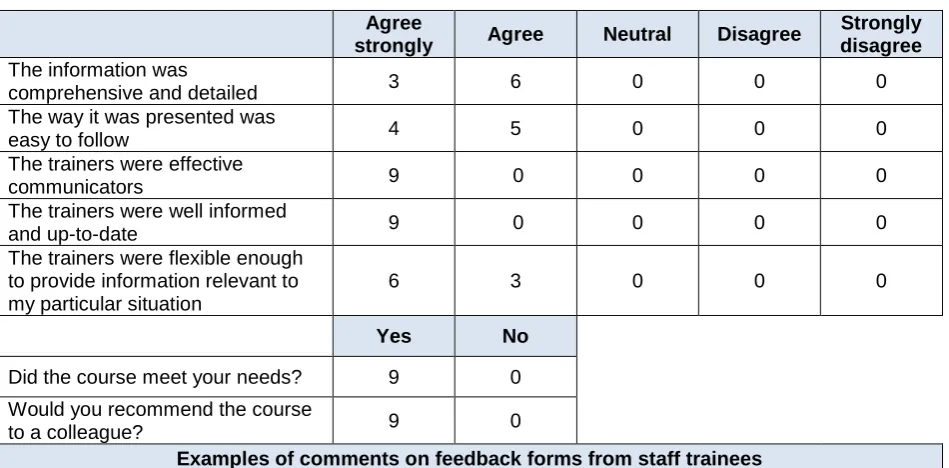
Table 2.4: Summary of staff feedback on RA training, Featherstone
Agree
strongly Agree Neutral Disagree
Strongly disagree
The information was
comprehensive and detailed 3 6 0 0 0
The way it was presented was
easy to follow 4 5 0 0 0
The trainers were effective
communicators 9 0 0 0 0
The trainers were well informed
and up-to-date 9 0 0 0 0
The trainers were flexible enough to provide information relevant to my particular situation
6 3 0 0 0
Yes No
Did the course meet your needs? 9 0
Would you recommend the course
to a colleague? 9 0
Examples of comments on feedback forms from staff trainees New skills that can be transferred into my job have been learnt.
Very informative and useful to my day to day work.
The course gave good information about the process although it raised a few questions about prisons in particular. I will use the techniques.
There are practices that I hope will be of use within the prison but also home life. I hope that time is allowed for it to be implemented as required.
By December 2016, there was evidence of only one intervention having been carried out: this involved shuttle RA between two prisoners who had had a fight and had been subject to an adjudication, and was facilitated by one of the trained prisoners. The proposed RA referral system in Featherstone lacked detail, and no processes were in place for recording and monitoring RA interventions. There was also a lack of clarity over the specific remit of each of the three departments involved in managing the project. These difficulties suggested a lack of focus on the project, at a time when the prison was under pressure to produce rapid improvements in light of the recent disturbance and a forthcoming inspection report which was known to be poor. Given the limited funding and time scale for the project, in January 2017 Restorative Solutions made the decision to withdraw from Featherstone and to invest the remaining resources in an establishment that would be well-placed to make rapid progress.
2.3
Progress to date in Peterborough
Following the decision to discontinue the project at Featherstone, work started in
Peterborough in February 2017. The first foundation training session for staff was held in March, with the first cohort of prisoners being trained in June.
2.3.1 Peterborough project governance and referrals
14
the victim-offender restorative work that is being undertaken within the prison. The Rehabilitation department, and the work of the restorative pilot, cross-cuts the men’s and women’s sections of the prison.
The pilot adopted a similar referral process to Buckley Hall, and produced a paper-based
referral form which has been made available across the prison to both staff and prisoners.18 Referrals can also be submitted via the electronic ‘kiosk’ system, through which prisoners access information and submit applications for a range of services. Referrals are received by
the Restorative Justice Co-ordinator, who logs, screens and allocates cases, and maintains a record of interventions on an Excel spreadsheet. In an effort to increase referrals and to embed RA in the establishment’s existing process and systems, a new section has been added to the form on which violent incidents are recorded, in which the incident’s suitability for an RA intervention can be noted. Additionally, RA is on the agenda of team meetings throughout the prison, and staff are encouraged proactively to identify cases that can be
referred to the Restorative Justice co-ordinator.
Work to publicise the pilot among both prisoners and staff has encompassed various
activities, including the production of leaflets and posters which have been distributed throughout the prison; and provision of information on RA on screens in the gatehouse and visitor reception area and in the internal prison bulletin. A ‘restorative awareness day’ was held in November 2017, which provided information about the RA pilot and the prison’s restorative work more generally, and was attended by 160 prisoners. Another recent development has been the introduction of a Restorative Families initiative, which involves
restorative meetings between prisoners and their family members. Six staff have been selected and trained to deliver this work: three from the prison’s Family Matters team and three from elsewhere in the prison. Five family restorative meetings had been held as of end
November 2017.
2.3.2 Peterborough training
Staff were initially selected for the RA foundation training through an expressions of interest process, to which 102 responses were received. 75 staff undertook the foundation training in March to April 2017, of whom 16 completed the practitioner training in May and a further nine in July. Twelve staff members received foundation training in November. (Over the course of 2017, some other planned training for staff was rescheduled to allow the RA training to be prioritised.)
Twelve female prisoners undertook one-day foundation training in June 2017, with ten proceeding to the practitioner course the following week. On the male side, nine prisoners did the one-day foundation course in July 2017, of whom eight completed the practitioner training within a fortnight.
18 The practice at Peterborough is to refer to prisoners as ‘residents’; however, for the sake of consistency and
15
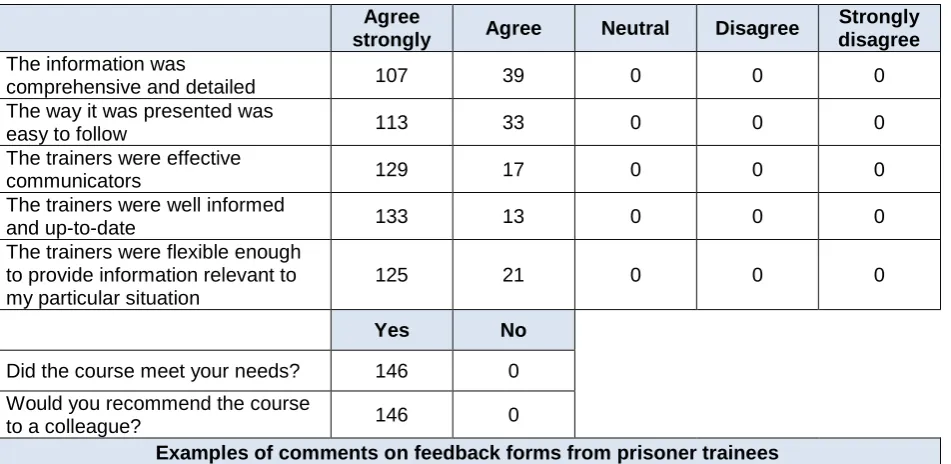
Like in the other prisons, both staff and prisoners evaluated the training they received very
[image:23.595.69.545.172.404.2]highly (feedback was received from 146 of the total 151 trained19); this is summarised in Table 2.5.
Table 2.5: Summary of feedback on RA training, Peterborough
Agree
strongly Agree Neutral Disagree
Strongly disagree
The information was
comprehensive and detailed 107 39 0 0 0
The way it was presented was
easy to follow 113 33 0 0 0
The trainers were effective
communicators 129 17 0 0 0
The trainers were well informed
and up-to-date 133 13 0 0 0
The trainers were flexible enough to provide information relevant to my particular situation
125 21 0 0 0
Yes No
Did the course meet your needs? 146 0
Would you recommend the course
to a colleague? 146 0
Examples of comments on feedback forms from prisoner trainees
I really enjoyed the course. I have learned many things that I will be able to use in the future in here but even after my release. Thank you very much for the opportunity.
A big thank you to Dave for his patience. The course was brilliant and something I am looking forward to using in the future. I feel privileged I was chosen for this opportunity. Thanks.
I found the course very informative and interesting. Role play was an integral part of the course and in many ways helped us to understand better. I will use this knowledge in my life inside and out.
The course tutor was very communicative and explained what was required really well. Everyone got on and great atmosphere. Delivery of course was spot on.
Opened my eyes and really got my mind going.
Examples of comments on feedback forms from staff trainees Course content was good but more use of visual media could be better.
All staff would benefit from this training and buying into the approach.
Easy to follow very informative and constructive.
Interesting and challenged perspectives and looking forward to seeing this in action.
Challenging, exciting, nerve-wracking but thoroughly worthwhile.
Very good course and plenty of realistic role plays. It made you realise the benefits to all parties. Good way of enhancing interpersonal skills.
Since May 2017, the one-day RA foundation course has been added to the Initial Training Course undertaken by all newly recruited prison staff, who by 30 November numbered 85. In early December, shortly after the end of the evaluation period, training in restorative families work was delivered to six staff members.
19 As in Buckley Hall, this total counts those who participated in both foundation and practitioner training
16 2.3.3 Peterborough interventions
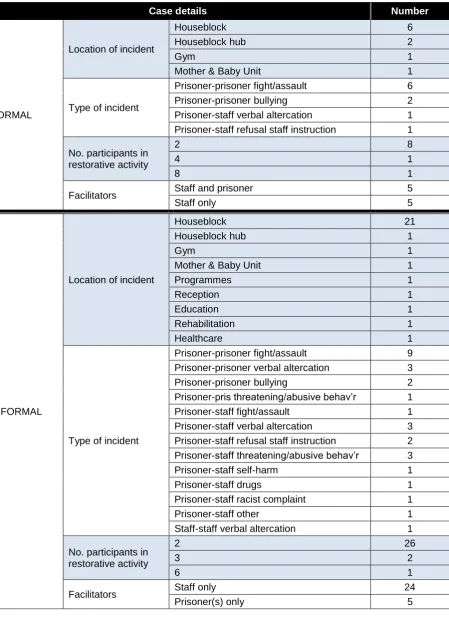
Peterborough’s log shows that 42 referrals were received for formal RA over the period 14 April to 30 November 2017, of which ten resulted in meetings. In at least nine of the cases in which a formal meeting was held, an outcome agreement was produced (in the tenth case, the log does not specify whether or not there was an outcome agreement). There was an
adjudication hearing as well as a formal RA meeting in five of the ten cases. Informal
referrals to the end of November numbered 36. In 29 of these cases, there was a completed restorative intervention; in three of the cases restorative work did not proceed, and there is
no information on the progression of the remaining four. All completed informal interventions resulted in an outcome agreement, and five of the cases involved an adjudication hearing in addition to the restorative work.
Several staff in Peterborough were of the view that RA would work better in the female than in the male section of the prison, because the female population is less transitory and there was said to be more of a ‘community’ among the women prisoners. The figures appear to back this up: proportionately (that is, taking into account the smaller population), more completed interventions – four of the ten formal, and 11 of the 29 informal – took place in the female than in the male section of the prison. An inspectorate report on the women’s section of the prison, based on a visit conducted in September 2017, refers to the ‘well-managed Restorative Approaches project’ and notes that it ‘was developing well, but needed to be better promoted’.20
The respective figures for Buckley Hall and Peterborough indicate a higher rate of referrals
and completed interventions in the latter, especially with respect to informal interventions. However, as noted above, figures for informal work should be treated with caution.
Details on the completed formal and informal cases are provided in Table 2.6; here we can see that, as in Buckley Hall, violence between prisoners was the type of conflict most
commonly addressed through restorative interventions. Staff were responsible for the bulk of
facilitation of informal interventions, while half of the formal interventions were facilitated by staff and half by staff and prisoners together.
20 HM Chief Inspector of Prisons (2018), Report on an unannounced inspection of HMP & YOI Peterborough
17
Table 2.6: Breakdown of completed restorative interventions, Peterborough
Case details Number
FORMAL
Location of incident
Houseblock 6
Houseblock hub 2
Gym 1
Mother & Baby Unit 1
Type of incident
Prisoner-prisoner fight/assault 6
Prisoner-prisoner bullying 2
Prisoner-staff verbal altercation 1
Prisoner-staff refusal staff instruction 1
No. participants in restorative activity
2 8
4 1
8 1
Facilitators Staff and prisoner 5
Staff only 5
INFORMAL
Location of incident
Houseblock 21
Houseblock hub 1
Gym 1
Mother & Baby Unit 1
Programmes 1
Reception 1
Education 1
Rehabilitation 1
Healthcare 1
Type of incident
Prisoner-prisoner fight/assault 9
Prisoner-prisoner verbal altercation 3
Prisoner-prisoner bullying 2
Prisoner-pris threatening/abusive behav’r 1
Prisoner-staff fight/assault 1
Prisoner-staff verbal altercation 3
Prisoner-staff refusal staff instruction 2 Prisoner-staff threatening/abusive behav’r 3
Prisoner-staff self-harm 1
Prisoner-staff drugs 1
Prisoner-staff racist complaint 1
Prisoner-staff other 1
Staff-staff verbal altercation 1
No. participants in restorative activity
2 26
3 2
6 1
Facilitators Staff only 24
18
The reasons for non-completion of (formal or informal) interventions, where noted on the RA log, are summarised in Table 2.7.
Table 2.7: Reasons for lack of completion of formal and informal RA, Peterborough
Reason for non-completion of RA Number
Participant(s) unwilling to engage 4
Participant(s) deemed unsuitable for RA
(e.g. because not admitting guilt or gave conflicting accounts) 3 Prisoner (participant) transferred out or released 3
Case allocated but not arranged 2
19
3. Challenges and opportunities
Following Chapter Two’s descriptive account of progress to date on the pilot, this chapter looks in closer detail at how RA has been implemented and experienced in the pilot prisons. We discuss the concept of RA as it has evolved over the course of the pilot; the practical and logistical difficulties that have arisen; the challenges and opportunities associated with
prisoner facilitation of RA; staff receptiveness to the project; and, finally, issues of ownership, leadership and sustainability. In addressing these issues, we hope to make clear the many complexities intrinsic to the task of introducing RA in the prison setting, and the ways in which different facets of the project have simultaneously posed both challenges and opportunities for those individuals who are directly involved in its implementation.
3.1
Fluid parameters and implementation of Restorative Approaches
In the early stages of implementation of the pilot, its scope and parameters were deliberately left open, in order that the prisons could themselves determine how exactly they wished to put it into practice. While this usefully permitted flexible approaches to the range of types of conflict that occur in the prison setting (see 3.1.5), it also gave rise to differing and
sometimes competing expectations about what the pilot was seeking to achieve, and how. There were four aspects of project design which merit further exploration:
What types of conflict were within the scope of the pilot;
How the distinction between ‘harmer’ and ‘harmed’ should be drawn;
Where the lines should be drawn between an informal and formal RA, and between informal RA and restorative styles of interaction;
How the restorative work should operate in relation to the adjudications process.
3.1.1 Types of conflict
Some prison staff were of the view that RA would be most valuable in dealing with conflict stemming from drug use and relating to debt, as these posed particular threats to safety and good order. For example, use of ‘Spice’ by prisoners frequently caused significant disruption and necessitated ambulance call-outs, and it was argued that restorative discussions could help to hold prisoners accountable for the repercussions of their drug use. Some of the trained prisoner facilitators also strongly felt that RA had a part to play in addressing
problems relating to drugs in the prison. On the other hand, others involved in the project felt that restorative interventions should be more closely focused on incidents of conflict between individuals, and this has been the usual practice to date.
Conflicts relating to debt can cause severe distress to prisoners, but resolution through restorative means may be difficult to achieve because of their complexity and the sensitivity of the issues involved, for example where a debt arises from purchase of drugs. One
20
kinds of conflict for informal RA were largely coming down to an individual facilitator’s discretion, which begs the question of whether there should be some broad guidance on
how such decisions should be taken.
It was generally accepted in the prisons that conflict between staff members, and not just
prisoner-staff or prisoner-prisoner conflict, was potentially suitable for RA. In practice there was only one recorded intervention involving staff-staff conflict: this was an informal intervention in Peterborough (outlined in Case Study 1).
Case Study 1: Informal RA for staff-staff conflict
A series of miscommunications between a middle manager and two Senior Officers in the prison led to the officers having to work late, which they were upset about. A senior manager brought them together for an informal RA at which both sides explained their points of view. The middle manager apologised for the misunderstandings which had stemmed from the instructions he had received from his superior officer and had not been relayed clearly. Both sides agreed that they needed to communicate better, and the middle manager said he would be more supportive of the SOs in future.
3.1.2 Defining conflict
As we note in the introduction to this report, RA is about bringing into dialogue those who have been harmed and those who have caused the harm. But it is in the nature of much of the conflict that occurs in prison that there is not necessarily a distinct ‘harmer’ and ‘harmed’. In many cases, two or more individuals may become involved in a verbal or physical
altercation for which all may bear some degree of responsibility and in which all may suffer harm. Furthermore, which of the party to a conflict is the ‘harmer’ may depend on an observer’s perspective: for example, it was suggested that when a fight results from a prisoner having jumped a queue, a staff member would be likely to view the individual who started the fight as the ‘harmer’, while a fellow-prisoner might argue that the queue-jumper was most culpable.
Many felt that there was sufficient flexibility in the RA process to permit participants’ differing levels of culpability to be probed, and for the parties to a conflict to acknowledge their shared responsibility for it. This offers a clear point of contrast with conventional restorative justice, in which the distinction between ‘victim’ and ‘offender’ is rarely questioned. This also
maintains a clear contrast with mediation, since RA remains focused on harms and how they have been perpetrated and experienced. In cases where it is simply not possible to identify a harmer, these should be deemed unsuitable for RA.
3.1.3 Defining informal RA
In the Buckley Hall Practitioner Guidance, informal RA is defined as that which is ‘used
21
progressed too quickly to an informal intervention. There may thus be a need for clearer criteria for deciding whether a formal or informal intervention is appropriate in any given
situation.
As part of the pilot, facilitators are encouraged not simply to think of RA in terms of specific
(formal or informal) interventions, but as something that should shape the way in which they conduct all their interactions with others. Staff and prisoner facilitators told us that restorative techniques have indeed infused the ways in which they communicate. This is a highly
positive development, although it inevitably poses questions about what level of input merits the submission of a completed referral form (a problem likely to be compounded by a natural reluctance on the part of both staff and prisoners to do a great deal of ‘form-filling’), and whether alternative methods of recording routine or casual use of restorative techniques might be introduced. The current expectation that informal interventions should be recorded is likely to result, as noted in Chapter Two, in significant under-counting in the RA logs
maintained by the prisons.
3.1.4 RA and the adjudications process
A matter of continued debate in the pilot sites was how exactly RA interventions should feed into and/or follow from the adjudications process. A number of options were considered:
The adjudicating governor’s use of ‘restorative questions’ as an integral part of the adjudication hearing;
Adjournment of adjudication hearing to allow a restorative meeting to take place – in which case the adjudicating governor has the discretion to take the prisoner’s participation in RA into account in the adjudication that follows;
Adjournment of adjudication award to allow a restorative meeting to take place – in which case the adjudicating governor has the discretion to take the RA into account in making the award;
Award made but suspended pending the holding of a restorative meeting;
Restorative meeting held subsequent to award being made.
There was a perception on the part of some staff that adjournment/suspension of
22
At the end of the evaluation period, policy on RA and adjudications was still under development in both Buckley Hall and Peterborough. One proposal under discussion in Peterborough – which had come from the prisoner facilitators – was that the following text should be added to the standard the adjudication charge sheet given to prisoners attending a hearing:
HMP Peterborough uses Restorative Approaches in the adjudication process. If you have made a guilty plea, or been found guilty, an award will be made and you can be
referred to explore a restorative process with the person(s) you have harmed. This is a voluntary process but you can ask to meet with a trained resident [prisoner] who will explain the process to you.
For examples of how restorative interventions have been used alongside the adjudications process, see Case Studies 2 and 3.
Case Study 2: Formal RA following adjournment of adjudication award
Adam, a prisoner, shouted at fellow prisoner Brian, who only has one eye, ‘Oi, Popeye, get me on the pool table.’ 21 Brian told Adam to leave him alone, but Adam continued to call him Popeye. Brian lost his temper and hit Adam. The case went to an adjudication and the adjudicating governor adjourned the award to allow a formal RA to take place. During the RA Brian explained that, shortly before the altercation, he had learnt that his son had died of an overdose. Adam immediately apologised, and revealed that his mother had cancer so he understood Brian’s distress. As a result of the RA, the adjudicating governor gave both prisoners a lesser award.
Case Study 3: Formal RA following adjudication award
Two young prisoners, Jane and Yasmin, were involved in a violent incident in which Jane sprayed cleaning fluid in Yasmin’s face, and Yasmin retaliated by hitting Jane with a mop. The case went to an adjudication during which both showed remorse for their actions. The adjudicating governor asked if they would be willing to participate in an RA and both agreed. The governor then took this agreement into consideration when giving the award. The formal RA subsequently took place and was co-facilitated by two staff members. Both Jane and Yasmin accepted that they had hurt each other and apologised. There have been no incidents between them since.
3.1.5 Positive aspects of flexibility
Conflict in prisons takes a wide range of forms. We were frequently told, particularly by the prisoner facilitators, that in the prison’s closed and highly pressurised environment what might appear to be trivial disagreements, misjudgements or miscommunication can readily develop into entrenched conflict, and can escalate from there to serious violence. Examples of such incidents include disagreements over who takes the first turn at playing pool, a
21
23
television being on at high volume, or a chance remark or look which is taken to be insulting when not intended in that way.
The advantage of a fluid conception of RA, as developed by this pilot, is that it can be used in a highly flexible manner: tailored to different types of conflict, whether big or small,
involving prisoners and/or staff, and arising in a wide variety of circumstances. While posing some risks, as noted above, informal RA offers the considerable benefit of being a rapid response to conflict, which can therefore pre-empt escalation and the involvement of others.
Case Studies 4, 5 and 6 illustrate just some of the wide range of diverse ways in which RA has been effectively applied over the course of the evaluation period.
While, as noted above, there were mixed views in the pilot sites about the potential application of RA to problems such as drugs and debt, the project as currently conceived allows scope for its extension to complex and sensitive issues. This is demonstrated, for
example, by the work already under way in Peterborough on restorative interventions with prisoners and their family members. Whether some of the most severe problems faced by prisons, such as gang-related conflict, would ever be suitable for RA interventions remains
an open question.
Case Study 4: RA in the context of tensions between two groups of prisoners
At a time when tensions were already high between a number of black prisoners and some prisoners who were Travellers, in the aftermath of a fight between the two groups, a further incident occurred. Henry, a Traveller, asked Solomon and George, who are black and were serving in the servery, for an extra carton of milk for his son, Luke. Solomon said that prisoners were only allowed one carton each and refused to give him any more. Henry racially abused Solomon, threw hot porridge in his face and then punched him. Some of the porridge hit George who instinctively lashed out at Henry with the ladle he was holding (which he subsequently described as ‘a fucking massive spoon’).
The case was reported to the police who eventually decided not to prosecute, so Henry and George were referred to an internal adjudication, but this did not proceed because of the length of time that had passed since the incident. However, relations between the black and Traveller prisoners remained tense.
Hassan, a trained prisoner facilitator, conducted an informal RA between Henry (the ‘harmer’) and Solomon (the ‘harmed’), at which Henry immediately accepted he was in the wrong and
apologised. Solomon accepted the apology. A few days later, Hassan and a member of staff facilitated a formal RA meeting with Solomon, George, Henry and Henry’s son Luke (who had spent much of his time alone in his cell since the incident for fear of retribution). At the meeting Henry opened up about previous trauma he had experienced which affects his actions; as a result he was referred for counselling. Solomon revealed that he had received some bad news on the day of the incident which was why he had been abrupt with Henry when asked for the extra milk.
24
Case Study 5: RA with a workshop instructor as the ‘harmer’
Graham, an instructor, was put in charge of a prison workshop which was in a state of disorder with no routine. He immediately began imposing discipline, against which a group of prisoners rebelled, including by spitting at Graham and putting faeces on the door handles. A fellow staff member suggested to Graham that RA could help the situation. Graham and four of the prisoners agreed to participate. A formal meeting was co-facilitated by the Restorative Solutions project manager and a staff facilitator. Graham was presented as the ‘harmer’ because of grievances raised against him by the prisoners. At the meeting, the prisoners explained that they didn’t like the way Graham spoke to them and felt they had been treated badly. One prisoner said he felt that Graham was bullying him. In response, Graham explained that he had been trying to establish order in the workshop but accepted that his methods may have been heavy handed. Since the RA, Graham has changed the way he deals with the prisoners and the workshop runs smoothly with very few incidents.
Case Study 6: RA for conflict in the Mother and Baby Unit
A number of prisoners in Peterborough’s Mother and Baby Unit had been getting on badly with one of their peers, Tanya. During an argument Tanya went to pick her child up and accidentally knocked another child over, leading to a further heated altercation. Staff intervened and the case was referred for a formal RA meeting. The meeting took place between Tanya and Rebecca, who was considered the ‘ringleader’ of the other prisoners on the unit. It was co-facilitated by two staff members. During the meeting Tanya apologised for knocking over the child but Rebecca said she didn’t believe Tanya was really sorry. Tanya then told Rebecca that the reason she was ‘all over the place’ was that she was waiting for the results of tests to determine whether she had a serious illness and was scared she was going to die and leave her child alone. Rebecca was
immediately contrite and said she felt Tanya’s admission changed everything. There have been no further incidents since.
3.2
Practical and logistical challenges
Previous evaluations have found that implementation of restorative justice initiatives tends to pose multiple practical challenges and, as a result, interventions are delivered more slowly, and in much lower numbers, than is anticipated at the outset of a project. This pilot was no exception: while the original plan was that it would run over a year from summer 2016, and training started in Buckley Hall and Featherstone in September, the first RA referrals were not received in Buckley Hall until January 2017, and Featherstone only saw one intervention before the pilot was pulled from that prison in January. As shown in Chapter Two, the total number of completed formal meetings achieved in Buckley Hall by the end of November 2017 was 11, while the equivalent number in Peterborough – achieved over a shorter time-scale – was ten.