© 2015, IRJET.NET- All Rights Reserved
Page 209
Improvement in Large Signal Stability Using PSO Algorithm
M.Divya Sanjana
1, T.R.Jyothsna
2PG Student [Power Systems], Dept. of EEE, Andhra University, Visakhapatnam, India
1Professor, Dept. of EEE, Andhra University, Visakhapatnam,
India
2---
Abstract
Transient stability of power systems becomes a major factor in planning and day-to-day operations and there is a need for fast on-line solution of transient stability to predict any possible loss of synchronism and to take the necessary measures to restore stability. Recently various controller devices are designed to damp these oscillations and to improve the system stability, which are found in modern power systems, but power system stabilizer (PSS) still remains an attractive solution.
These PSS are local controllers on the generators. Thus local controllers are used to mitigate system oscillation modes. In multi machine system with several poorly damped modes of oscillations, several stabilizers have to be used and the problem of synthesis of PSS parameters becomes relatively complicated. Population based optimization techniques have been applied for PSS design. Studies have revealed that these optimization techniques have improved the system stability.
A population based algorithm called Particle Swarm Optimization (PSO) has been proposed in this thesis for optimal tuning of the power system stabilizer (PSS) for a single machine infinite bus (SMIB) system and 3-machine 10 bus system. Recent studies in artificial intelligence demonstrated that the PSO optimization technique is a powerful intelligent tool for complicated stability problems. This algorithm is based on intelligent behavior of honey bee swarm. The PSS parameters of an SMIB system and 3 machine 10 bus system are tuned to improve large signal stability and eigen values of the system. It is relevant from the results that the proposed PSO algorithm is superior to any conventional technique.
Key Words
:Particle Swarm Optimization (PSO), Single Machine Infinite Bus (SMIB).
---***---I.INTRODUCTION
1.1
POWER SYSTEM STABILIZER
Power System stabilizers have been in use for many years as a solution to the problem of oscillatory instability. The PSS, which acts as supplementary modulation controller in the excitation system of generator, produce a component of electrical torque on the rotor Speed. As the objective of PSS is to introduce a damping torque component, the most appropriate signal is the speed deviation. For any input signal, the transfer function of the stabilizer must compensate for the gain and phase characteristics of the excitation, the generator, the power system, which collectively determine the transfer function from stabilizer output to the component of electrical torque which can be modulated via excitation control. This transfer function is strongly influenced by voltage regulator gain, generator power level, and AC system Strength [3].
The control signals for PSS must satisfy the following requirements [4]:
The signal must be easily synthesized from the locally available measurements.
To avoid the introduction of filters, the noise content in chosen signal must be minimal.
The design based on a particular signal must be robust and reject noise.
The basic function of PSS is to add damping to both local and inter – area modes without compromising the stability of other modes.
II.
Particle Swarm Optimization
© 2015, IRJET.NET- All Rights Reserved
Page 210
called lbest. when a particle takes all the population as itstopological neighbours, the best value is a global best and is called gbest.The particle swarm optimization concept consists of, at each time step, changing the velocity of (accelerating) each particle toward its pbest and lbest locations (local version of PSO). Acceleration is weighted by a random term, with separate random numbers being generated for acceleration toward best and lbest locations. In past several years, PSO has been successfully applied in many research and application areas. It is demonstrated that PSO gets better results in a faster, cheaper way compared with other methods.
In PSO, each single solution is a particle in the search space. Each individual in PSO flies in the search space with a velocity, which is dynamically adjusted according to the flying experience of its own and its companions. PSO is initialized with a group of random particles. Each particle is treated as a point in a D-dimensional space. The ith particle is represented as xi = (xi1, xi2, . . ., xiD). The best previous position of the ith particle that give the best fitness value is represented as pi = (pi1, pi2, . . ., piD). The best particle among all the particles in the population is represented by pg = (pg1, pg2, . . ., pgD). Velocity, the rate of the position change for particle i is represented as vi = (vi1, vi2, . . . , viD). In every iteration, each particle is updated by following the two best values. After finding the aforementioned two best values, the particle updates its velocity and positions according to the following equations:
viD(new)=viD(old) + c1 r1(piD − xiD) + c2 r2(pgD − xiD) (3.12)
xiD(new)=xiD(old) + viD(new) (3.13)
where c1 and c2 are two positive constants named as learning factors, r1 and r2 are random numbers in the range of (0,1). _ is a restriction factor to determine velocity weight. Eq. (3.12) is used to calculate the particle’s new velocity according to it’s previous velocity and the distances of its current position from its own best position and the group’s best position. Then, the particle flies toward a new position according to Eq. (3.13). Such an adjustment of the particle’s movement through the space causes it to search around the two best positions. If the minimum error criterion is attained or the number of cycles reaches a user-defined limit, the algorithm is terminated.
2.2 Parameter selection
1.
Range of the particles
The ranges of the particles depend on the problem to be optimized. One can specify different ranges for different dimension of the particles
2.
Maximum velocity vmax
The maximum velocity vmax determines the maximum change one particle can take during one iteration. Usually, the range of the particle is set as vmax. In this work, a
vmax = 4 is chosen for each particle as this gives better optimal results.
3.
The inertia parameter
The inertia parameter is introduced by Shi and Eberhart and provides improved performance in a number of applications. It has control over the impact of the previous history of velocities on current velocity and influences the balance between global and local exploration abilities of the particles. A larger inertia weight favors a global optimization and a smaller inertia weight favors a local optimization.
It is suggested to range w in a decreasing way from 1.4 to 0 adaptively. In this work, a constant value of the inertia parameter w = 0.75 is chosen as it facilitates reaching a better optimal value in lesser number of iterations.
4. The parameters c1 and c2
The acceleration constants c1 and c2 indicate the stochastic acceleration terms which pull each particle towards the best position attained by the particle or the best position attained by the swarm. Low values of c1 and c2 allow the particles to wander far away from the optimum regions before being tugged back, while the high values pull the particles toward the optimum or make the particles to pass through the optimum abruptly. If the constants c1 and c2 are chosen equal to 2 corresponding to the optimal value for the problem studied. In the same reference, it is mentioned that the choice of these constants is problem dependent. In this work, c1 = 1 and c2 = 1 are chosen which give better optimal results in lesser iterations.
In a PSO algorithm, multiple candidate solutions called particles coexist and collaborate simultaneously, where each particle denotes a solution X = [x1,x2, . . . ,xN]T. Different from other evolutionary algorithms where the populations are updated by some evolutionary operations, such as cross-over and mutation, each particle in PSO adjusts its position according to its own experience as well as the experience of neighboring particles. Tracking and memorizing the best position encountered build particle’s experience, PSO possesses a memory (every particle remembers the best position it has reached during the past). Especially, PSO combines local search method (through self-experience) with global search methods (through neighboring experience).
III. Implementation of PSO
In this project, PSO with the procedure is summarized as follows:
Step 1: Initialize a population of particles with random positions and velocities, where each particle contains N
© 2015, IRJET.NET- All Rights Reserved
Page 211
Step 2: Evaluate the objective values of all particles, letpbest of each particle and its objective value equal to its
current position and objective value, and let gbest and its objective value equal to the position and objective
value of the best initial particle.
Step 3: Update the velocity and position of every particle according to Eqs. (3.12) and Eqs (3.13).
Step 4: Evaluate the objective values of all particles. Step 5: For each particle, compare its current objective value with the objective value of its pbest. If current value
is better, then update pbest and its objective value with the current position and objective value.
Step 6: Determine the best particle of current whole population with the best objective value. If the objective value
is better than the objective value of gbest, then update gbest and its objective value with the position and
objective value of the current best particle.
Step 7: If a stopping criterion is met, then output gbest and its objective value; otherwise go back to step (3).
Flow chart
IV. SYSTEM MODEL
In this thesis, the performance of PSS and PSOPSS is compared and analyzed for Single machine infinite bus system (SMIB) and 3-machine system. The gain of the PSS is set by applying particle swarm optimization (PSO) optimization technique. This can enhance the angle stability and provide the voltage regulation at the generator terminals. Transient stability analysis is used to investigate the stability of a power system under sudden and large disturbances with PSS and PSOPSS
3
.1SYSTEM MODEL
3.1.1
Generator Equations
3.1.1.1 Rotor Equations:The rotor mechanical dynamics for each machine is represented by the swing equations in per unit (p.u) as:
e m 2
2
T
T
dt
dδ
D
dt
δ
d
M
(3.1)
Where M= 2H/ωB, Tm is the mechanical torque acting on
the rotor, Te is the electrical torque and ωB is the base
synchronous speed. Equation (3.1) can be expressed as two first order equations as:
)
(
m moB
S
S
ω
dt
dδ
(3.2)
H
T
T
S
D(S
dt
dS
m m mo m e2
)
)
(
(3.3)
where Sm is generator slip given by
B B m
ω
ω
ω
S
(3.4)
D is p.u damping given by
D
D
'ωB
. Since the normal operating speed is same as the rated speed, Smo can be
taken as zero.
© 2015, IRJET.NET- All Rights Reserved
Page 212
damper coil on q-axis. Hence, two electrical circuits areconsidered on the rotor-a field winding on the d-axis and one damper winding on the q-axis. The resulting equations are:
d fd
' d d ' q ' d0 ' q
E
i
x
x
E
T
dt
dE
)
(
1
(3.5)
q
' q q ' d ' q 0 ' d
i
x
x
E
T
dt
dE
)
(
1
(3.6) Where q d ' q ' d d ' d q ' qe
E
i
E
i
x
x
i
i
T
(
)
(3.7)
Model (1.0) can be handled by letting q ' q
x
x
and0
' q o
T
. WithE
'd remaining zero as long asT
qo'
0
,the RHS of equation (3.6) is zero. Hence for model (1.0) equations (3.2), (3.3) and (3.5) apply.
3.1.1.2
Stator equations:
The stator equations in p.u in the d-q reference frame, neglecting the stator transients and variations in the rotor speed, are given by:
d d a q
mo
ψ
R
i
υ
S
(1
)
(3.8)q q a d
mo
ψ
R
i
υ
S
)
(1
(3.9)where, Smo is the initial operating slip, q + j d is the
generator terminal voltage and iq + j id is the armature
current, ψqand ψd are the flux linkages in d-q reference
frame. For the 1.1 model of the generator (field circuit with one equivalent damper on the q-axis) the flux linkages are given by:
d ' d ' q d
E
x
i
ψ
(3.10)' q q ' q q
x
i
E
ψ
(3.11)Substituting equations (3.10) and (3.11) in (3.8) and (3.9) and letting Smo = 0 we get:
q q a d ' d '
q
x
i
R
i
υ
E
(3.12)d d a q ' q '
q
x
i
R
i
υ
E
(3.13)E'd, E'q are equivalent voltage sources for flux linkages
along d i.e. field axis and q axis.
x'd and x'q are transient reactance along d and q axis
respectively.
Equations (3.12) and (3.13) can be combined into a single complex equation as:
d q d q ' a ' d '
q
j
E
R
j
x
i
j
i
v
j
v
E
(
)(
)
(3.14)
3
.2.2
Excitation System
The main objective of the excitation system is to control the field current of synchronous machine. The field current is controlled to regulate the terminal voltage of the machine. As field current time constant is high, field current requires forcing. Thus exciter ceiling voltage should be 5-6 times normal. AVR also results in negative damping thus making the system unstable. The instability is due to exciter mode, is called oscillatory instability. The Automatic Voltage Regulator (AVR) with single time constant is considered. Vg is the terminal voltage, Vs is the
output of the PSS. The state equations for the excitation system is given by
(
)
1
s g ref A fd A fdV
V
V
K
E
T
dt
dE
fdmax fd
fdmin
E
E
E
(3.15)Where
V
g
υ
q2
υ
d23.2
DESIGN OF PSS
3.2.1 PSS Model
Power system stabilizers are supplementary controllers in the excitation system meant to provide damping for generator rotor oscillations. This is necessary as high gain AVRs can contribute to oscillatory instability in the power systems, which are characterized by low frequency oscillations (0.2 to 2.0 Hz). Figure 3.2 shows the block diagram of dynamic compensator of PSS. The washout circuit is provided to eliminate the steady bias in the output of the PSS. The time constants T1 and T2 of the
dynamic compensator; mp denotes the number of stages of
© 2015, IRJET.NET- All Rights Reserved
Page 213
Washout circuit Dynamic compensator smax
V
Smin V w W sT sT 1 p m 1 1 2 1 S sT sT K [image:5.595.35.222.474.579.2] ΔVpss
Figure 3.2: Block diagram of PSS
The overall PSS transfer function including the washout circuit is p m 2 1 w w pss
sT
1
sT
1
sT
1
sT
K
s
PSS
)
(
(3.19)The time constant Tw of the washout circuit can be chosen
in the range of 1 to 2 secs,
3.2.2 Objective function
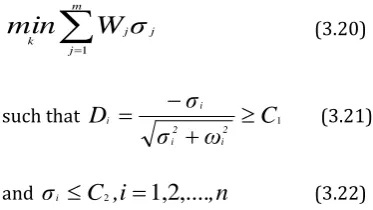
The appropriate value of the PSS gain Ks is obtained by applying nonlinear constrained optimization method. The design of PSS is carried out in two steps. In the first step, independent design of the dynamic
compensators of PSS is accomplished by the method of residues and in the second step, the tuning of the gain of PSS is achieved by the application of nonlinear
constrained optimization algorithm as defined below:
j m
j j
k
W
σ
min
1
(3.20)
such that
C
1ω
σ
σ
D
2 i 2 i i i
(3.21)and
σ
i
C
2,
i
1,2,....
,
n
(3.22)where m = total number of modes of interest,
n = total no. of eigenvalues,
σi = real part of the ith eigenvalue,
ωi= imaginary part of the ith eigenvalue,
Di = Damping ratio of the ith eigenvalue,
Wj = positive weight associated with the jth swing mode,
k = vector of control parameters, where each of the elements of the vector is greater than zero.
SMIB system data:
Generator data: Base 1000MVA, 400 KV
Bus 1
Ra 0.00327
xd 1.7572
xd’ 0.4245
Tdo’ 6.66
xq 1.5845
xq’ 1.04
Tqo’ 0.44
H 3.542
D 0
Network data:R1 = 0.04296,Xl = 0.40625,Bc = 0.1184,
Xt = Xbr = 0.13636
AVR data:Ka = 200,Ta = 0.05,Efdmax = 6.0,Efdmin = -6.0
Initial operating point:Pg= 0.6,Qg= 0.02224,Vg= 1.05,θ =
21.65o ,Eb= 1.0
3 machine 10 bus systems:
Generator data:B u s R a x d x d’ T d o’ x q x q’ T q o’
H D K
A
T
A
1 0 0
. 1 4 6 0 0 . 0 6 0 8 8 . 9 6 0 0 0 . 0 9 6 9 0 . 0 9 6 9 0 . 3 1 0 0 2 3 . 6 4 0 0 0 . 0 0 0 0 2 0 0 0 . 0 5 0 0
2 0 0
© 2015, IRJET.NET- All Rights Reserved
Page 214
5 8 9 8 0 0 4 5 6 9 5 0 0 0 0 0 0 03 0 1
. 3 1 2 5 0 . 1 8 1 3 5 . 8 9 0 0 1 . 2 5 7 8 0 . 2 5 0 0 0 . 6 0 0 0 3 . 0 1 0 0 0 . 0 0 0 0 2 0 0 0 . 0 5 0 0
Network data
: Data given below is are p.u on a common base of 100MVABus
Nos
Resistance Reactance Shunt
Susceptance
(total)
1 4 0.0000 0.0576 0.0000
4 6 0.0170 0.0920 0.1580
6 9 0.0390 0.1700 0.3580
9 3 0.0000 0.0536 0.0000
9 8 0.0119 0.1008 0.2090
8 7 0.0085 0.0720 0.1490
7 2 0.0000 0.0625 0.0000
10 5 0.0160 0.0805 0.1530
7 10 0.0160 0.0805 0.1530
5 4 0.0100 0.0850 0.1760
Load flow data:
Bu s Volta ge Angle (degre Genera ted Genera ted Load Real Load Reacti
es) Real
Power Reactiv e Power Pow er ve Power
1 1.040
0
0.0000 2.9328 0.9792 0.00
00
0.000
0
2 1.025
3
-1.8240
2.2109 0.5317 0.00
00
0.000
0
3 1.025
3
-8.4708
1.1232 0.3589 0.00
00
0.000
0
4 0.999
0
-9.3571
0.0000 0.0000 0.00
00
0.000
0
5 0.970
2
-16.803
9
0.0000 0.0000 2.25
00
0.750
0
6 0.948
2
-16.916
1
0.0000 0.0000 1.90
00
0.600
0
7 1.002
0
-9.5538
0.0000 0.0000 0.00
00
0.000
0
8 0.969
1
-15.441
1
0.0000 0.0000 2.00
00
0.650
0
9 1.006
8
-12.126
4
0.0000 0.0000 0.00
00
0.000
0
V. RESULT AND DISCUSSION
© 2015, IRJET.NET- All Rights Reserved
Page 215
critically dependent upon the magnitude, nature and thelocation of fault and to a certain extent on the system operating conditions. The stability analysis of the system under such conditions, normally termed as ‘transient-stability’ analysis is generally attempted using mathematical models involving a set of non-linear differential equations.
4.3
Transient Stability
analysis
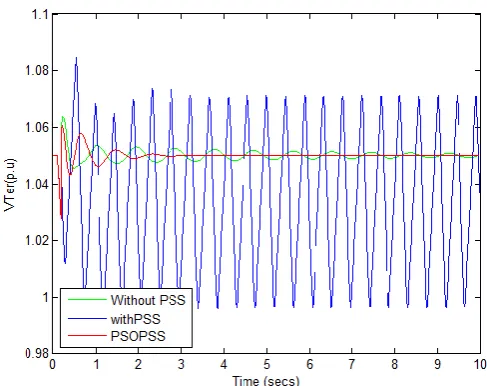
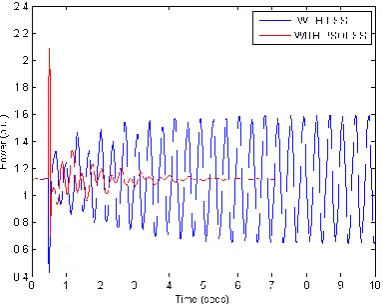
The system behavior is analyzed for three phase fault. The three phase fault is created on the critical bus 7 with a line outage. The fault is initiated at 0 sec and is cleared within 2.5 sec. The output of PSS can regulate the exciter voltage as a result of which the real power output of the machines and also the bus voltage variation at the critical buses have also reduced as shown in Figures. From the results it is clear that oscillations are damped and the system is stabilized at a faster rate compared to the conventional PSS. Here, PSS is placed at third generator.
4.3.1 Results for transient stability:
Fig 4.1: Variation rotor angle without PSS, with PSS and
with PSOPSS for SMIB
Fig 4.1: Variation rotor angle without PSS, with PSS and
with PSOPSS for 3machine systems
Fig 4.2: Variation in terminal voltage without PSS, with
[image:7.595.323.552.110.295.2] [image:7.595.313.557.361.554.2] [image:7.595.47.269.443.619.2]© 2015, IRJET.NET- All Rights Reserved
Page 216
Fig 4.2: Variation in terminal voltage without PSS, withPSS and with PSOPSS for 3machine systems
Fig 4.3: Variation in torque for SMIB system without PSS,
with PSS and with PSOPSS
Fig 4.4: Variation in power for 3machine system without
PSS, with PSS and with PSOPSS
VI.CONCLUSION
This chapter has presented the Particle Swarm Optimization Algorithm for the design of power system stabilizers. The performance evaluation of the proposed stabilizer on a single machine system shows that increased robustness could be achieved by application of PSO to stabilizer design. The design procedure using PSO is also simple and can be used for particle implementation. The performance of the PSOPSS is compared with CPSS. PSOPSS gives better performance compared to CPSS.
R
EFERENCES[1] P.Kundur, Power System Stability and Control,
McGraw-Hill Press 1994.
[2] P.M.Anderson and A.A.Fouad Power System Control
and Stability, Iowa State University Press, Ames, Iowa,
1977.
[3] E.V Larsen and D.A. Swann, “Applying power system
stabilizers: Parts I, II, III, “IEEE Transactions on power
apparatus and systems, vol. PAS-100, PP.
3017-3046’1981.
[4] K.R. Padiyar, Power System Dynamic-Stability and
Control, BS Publications, Hyderabad, India, 2006.
[5] K. R. Chowdhury, M. Di Felice, “Search: a routing
protocol for mobile cognitive radio ad hoc networks,”
Computer Communication Journal, vol. 32, no. 18, pp.
1983-1997, Dec.20
[6] K. M. Passino, “Biomimicry of bacterial foraging for
distributed optimization,” IEEE Control Systems
Magazine, vol. 22, no. 3, pp. 52-67, 2002.
[7] Q. Wang, H. Zheng, “Route and spectrum selection in
dynamic spectrum networks,” in Proc. IEEE CCNC
2006, pp. 625-629, Feb. 2006.
[8] R. Chen et al., “Toward Secure Distributed Spectrum
Sensing in Cognitive Radio Networks,” IEEE Commun.
Mag., vol. 46, pp. 50–55, Apr. 2008.
[9] H. Khalife, N. Malouch, S. Fdida, “Multihop cognitive radio networks: to route or not to route,” IEEE Network, vol. 23, no. 4, pp. 20-25, 2009.
[image:8.595.45.292.351.466.2] [image:8.595.49.241.529.681.2]