© 2016, IRJET | Impact Factor value: 4.45 | ISO 9001:2008 Certified Journal | Page 1365
Fuzzy controlled mine drainage system
based on embedded system
Deepak BAssistant Professor,Department of Mechatronics,PPG institute of Technology, Coimbatore, India
---***---Abstract— In mines, proper drainage should be provided to improve stability, ensure safety to workers, reduce corrosion of mining equipments. But in mines, the variables to be controlled are varies in a random manner and they are not linear and certain. Because of the unpredictable nature of the variables it is not possible to design the empirical model accurately. This proposed system is a combination of fuzzy logic control and the electronics embedded system. Fuzzy logic deals with the uncertainties in the system and the embedded system provide the better control, flexibility, compactness and user-friendliness to the system.
Keywords- Fuzzy control; Embedded system; Mine drainage.
INTRODUCTION
In general terms, mining operations below a particular level changes the hydraulic gradient, thus affecting the groundwater and surface water flow. As a consequence, flow of water may be induced from the surrounding rock mass towards the mining excavations which may necessarily require pumping of large quantities of water from mines.
The presence of water in mining sites creates a range of operational and stability problems and requires drainage to be carried out from the mine workings in order to improve slope stability, avoid oxidation of metallic sulphides and reduce corrosion of mining plant and equipment. It may affect the safety of workers also. The quality and quantity of the drainage water depends on a series of geological, hydro geological and mining factors which can vary significantly from one mine to another.
In mine drainage control system, the numbers of working pumps are defined according to parameters such as water level and its change rate. But it is difficult
to establish the empirical model precisely, because the variables mentioned above are non-linear variable parameters. Classical control has not been able to satisfy the high accuracy of the control request. So in this, combination of the intelligent control with the microcontrollers is proposed. The fuzzy control transforms the control policy indicated by the human natural language into the digital or mathematical function through the fuzzy set and the fuzzy inference, and then uses the computer to realize the predetermined control.
Combination of fuzzy control theory with embedded system and applying it into mine drainage control system not only solves the difficult problem that the water drainage system is difficult to establish the mathematical model but also raises the control system's automated level. Since the embedded system is reactive and real time constrained it gives better control on drainage system.
Since the mines are also sensitive to different parameters like temperature, humidity and pressure etc. these parameters are continuously monitored using the respective sensors and the collected data is send to the remote operator through a gsm modem for further analysis.
FUZZY
LOGIC
CONTROL
THEORY
© 2016, IRJET | Impact Factor value: 4.45 | ISO 9001:2008 Certified Journal | Page 1366 The basic idea behind fuzzy logic control is to
incorporate the ‘expert experience’ of a human operator in the design of a controller in controlling a process whose input-output relationship is described by a collection of fuzzy control rules (e.g. IF-THEN rules) involving linguistic variables. This utilization of linguistic variables, fuzzy control rules, and approximate reasoning provides a means to incorporate human expert experience in designing the controller.
Fuzzy logic is not the answer to all technical problems, but for control problems where simplicity and speed of implementation is important then fuzzy logic is a strong candidate. It combines the computer based on control policies that are summarized by operator experience and are expressed by using human language as well as the control rules which are summarized through massive actual operational data.
Useful cases of fuzzy logic are:
-The control processes are too complex to analyze by conventional quantitative techniques.
-The available sources of information are interpreted qualitatively, inexactly, or uncertainly.
The advantages which make the fuzzy control a better choice are:
Flexible
Convenient user interface.
Easy computation.
Combine regulation algorithms and logic reasoning allowing for integrated control schemes.
Can use multiple inputs and outputs sources.
Very quick and cheaper to implement and can be easily modified.
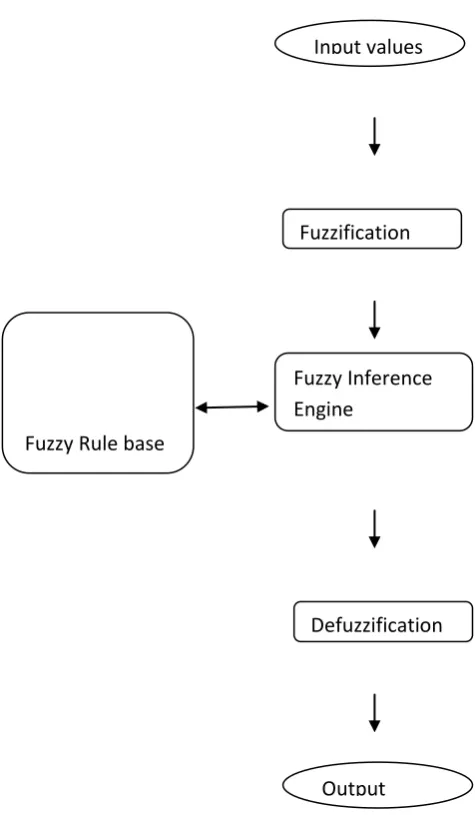
Main components of fuzzy controller are shown in Fig. 1.
The fuzzification interface: transforms input crisp values into fuzzy values.
The fuzzy rule base: contains knowledge of the application domain and the control goals.
The fuzzy inference engine: performs inference for fuzzy control actions.
[image:2.595.307.545.166.574.2] The defuzzification interface.
Figure 1. Components of fuzzy controller
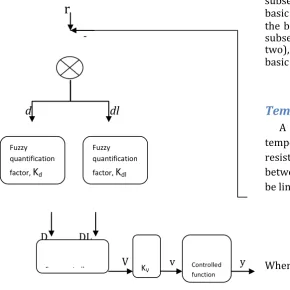
The input values of the drainage control system are deviation (d) of water level and rate of change of deviation (dl). The general structure of a fuzzy controller is given in Fig.2.
The controller given in Fig.2 is a double input single output fuzzy controller. It has two inputs and can reflect the dynamic characteristics of the output variable accurately in the control process. The fuzzy controller includes the input value fuzzy, the fuzzy inference and the third part clarifying processing.
Fuzzy Inference Engine
Fuzzification
Defuzzification Input values
© 2016, IRJET | Impact Factor value: 4.45 | ISO 9001:2008 Certified Journal | Page 1367 In Fig.2 the d and dl are the two input values which denote
the deviation and rate of change of deviation respectively. D and DL are the fuzzy quantity after the fuzzification process of
d and dl respectively. V is the fuzzy control quantity and v is the precise quantity of V after clarifying process. Kd and Kdl are the fuzzy quantification factor of the d and dl respectively and KV is the proportionality factor of v.
r
-
d
dl
D DL
[image:3.595.41.332.206.497.2]V v y y
Figure 2 . General structure of a fuzzy controller
Design procedure of fuzzy controller consists of following steps
Identify the inputs and their ranges and name them.
Identify the outputs and their ranges and name them.
Construct the rule base that the system will operate under.
Decide how the action will be executed by assigning strengths to the rules.
Combine the rules and defuzzify the output.
Water level d and rate of change of water level dl are the input language variable to the fuzzy controller. The
output language variable is the number of water pumps that are going to run which is denoted as v.
We select [0,2] as the basic range of argumentation of
d
and five 5 fuzzy subsets: AL (very low), BL ( low), CL (middle), DL (high), EL (very high) to cover the basic range of argumentation ofd
. We select [0, 0.1] as the basic range of argumentation ofdl
and three fuzzy subsets: DR (drop), ST (stable), RS (rise) to cover the basic range of argumentation ofdl
. We select [0, 3] as the basic range of argumentation ofu
and five fuzzy subsets: APN (all stop), SPN (open one), DPN (open two), TPN (open three) , APN(open four) to cover the basic range of argumentation ofv
.ADDITIONAL
SYSTEMS
Temperature monitoring sysytem
A thermistor is made use of in measuring the temperature changes, relying on the change in its resistance with changing temperature. The relationship between the resistance and temperature is assumed to be linear with
ΔR = kΔT
Where
ΔR = change in resistance
ΔT = change in temperature
k = first-order temperature coefficient of resistance
Humidity monitoring sysytem
To ensure safe working environment in mines the humidity content must be within the specified limit prescribed by the industrial standards. So a humidity sensors and monitoring system is included within the proposed solution.
Pressure monitoring system
The pressure variations may also cause various hazards in mines. So a pressure sensor is also incorporated in the proposed system.
Fuzzy quantification factor, Kd
Controlled function
KV
© 2016, IRJET | Impact Factor value: 4.45 | ISO 9001:2008 Certified Journal | Page 1368
BLOCKDIAGRAM
To all sections
REALIZATION ON EMBEDDED
SYSTEM
In the past, several chips in separate packages where required to configure a system. Now, just one system on-chip can replace all of these, dramatically reducing the packaging cost. Embedded system is any electronic equipment built in intelligence and dedicated software.
It has several advantages than the current systems. The integration of various ICs shortens the traveling route and time of data to be transmitted resulting in higher performance and also eliminates buffers and other interface circuits. As the number of components is reduced, less power will be consumed. It is very
Micro Controller Amplifier
Float Sensor
Temperature Sensor
Humidity Sensor
Amplifier
Amplifier
LCD Display
Driver & Relay Circuit
Driver & Relay Circuit
Driver & Relay Circuit
P u m p
P u m p
P u m p
POWER SUPPLY
GSM Modem Pressure
© 2016, IRJET | Impact Factor value: 4.45 | ISO 9001:2008 Certified Journal | Page 1369 reactive, real time constrained, slimmer and more
compact: Housed in a single separate package, the chip is smaller in size and therefore occupies less space on the PCB. Hence products using embedded system are slimmer and more compact.
Embedded system along with the Fuzzy logic provides an efficient drainage system for mines. It has more control on the drainage process in mines. It makes the system more automatic. Embedded system gives a better control scheme for the system.
CONCLUSION
Since the coal mine water control system are non-linear, complex and difficult to establish the mathematical model this article applies the fuzzy control theory into the system and successful solves the problem which the traditional control cannot. Meanwhile combining embedded system and the fuzzy control, realizing the fuzzy control strategy through the software, thus obtaining the water level ideal control.
REFERENCE
[1]‘STUDY OF THE MINE DRAINAGE FUZZY CONTROL SYSTEM BASED ON MATLAB’ BY GUIMEI WANG AND HUI SONG , HEBEI UNIVERSITY OF ENGINEERING, CHINA.
[2] ‘Mine drainage and water resources’ by roger james, national association of mining history organization at darely dale.
[3] ‘ADAPTIVE NEUROFUZZY CONTROLLER TO REGULATE UTSG WATER LEVEL IN NUCLEAR POWER PLANTS’ BY SUDATH R. MUNASINGHE, MEMBER, IEEE, MIN-SOENG KIM, STUDENT MEMBER, IEEE, AND JU-JANG LEE, SENIOR MEMBER, IEEE - IEEE TRANSACTIONS ON NUCLEAR SCIENCE, VOL.52, NO.1, FEBRUARY 2005
[4] ‘Water level forecasting through fuzzy logic and artificial neural network approaches’ by s. Alvisi, g. Mascellani, m. Franchini, and a. Bardossy. University of stuttgart, deutschland. Paper published in hydrology and earth system sciences, 2005.
[5]. ‘Liquid level control by using fuzzy logic controller’
dharamniwas , aziz ahmad, varun redhu and umesh gupta. Al-falah school of engineering & technology, dhauj, faridabad. International journal of advances in engineering & technology, july 2012.
[6]. ‘Control of groundwater in surface mining’ by c.o brawner,
consulting geographical engineer and professor, mining dept. University of b.c. , canada.
[7]. ‘Water level control by fuzzy logic and neural networks’ by daniel wu, fakhreddine karrayand insop song . University of waterloo, waterloo.
[8] ‘Designing a fuzzy system with the fuzzy system designer’ in pid and fuzzy logic toolkit user manual.
Deepak B received the BTech degree from the Department of Electronics and Communication Engineering in MEA Engineering College(Calicut University) Kerala, India in 2010 and ME degree from the Department of Mechatronics in Karpagam College of Engineering (Anna University) Coimbatore , India in 2013.