http://dx.doi.org/10.4236/jgis.2013.56054
A Multidisciplinary Approach to Mapping Potential Urban
Development Zones in Sinai Peninsula, Egypt Using
Remote Sensing and GIS
Hala A. Effat1, Mohamed N. Hegazy2
1Environmental Studies and Land Use Department, National Authority for Remote Sensing and Space Sciences, NARSS, Cairo, Egypt
2Division of Geological Applications and Mineral Resources, National Authority for Remote Sensing and Space Sciences, NARSS, Cairo, Egypt
Email: [email protected]
Received November 1, 2013; revised December 1, 2013; accepted December 8,2013
Copyright © 2013 Hala A. Effat, Mohamed N. Hegazy. This is an open access article distributed under the Creative Commons At-tribution License, which permits unrestricted use, disAt-tribution, and reproduction in any medium, provided the original work is prop-erly cited.
ABSTRACT
One of the main concerns of physical planning is the proper designation of suitable sites for feasible and sustainable land use. A main importance of such issue is that it withdraws attention to the necessity of adopting a multidisciplinary approach to the zoning and site selection problem. Egypt has a top priority objective to develop Sinai Peninsula and to create new sustainable and attracting communities that should ensure a stable, economic and sustainable environment in vast desert zones. Due to the difficulty in solving a zoning problem in a desert, the use of remote sensing and Geo-graphic Information System (GIS) was to explore the desert potentials in the region. Five sub-models were created for five themes using Spatial Multicriteria Analysis (SMCA) and used as inputs to the final suitability model. These themes are: land resources, land stability, accessibility, cost of construction and land protection. A GIS-based model was de-signed following a sustainable development approach. Economic, social and environmental factors were introduced in the model to identify and map land suitable zones for urban development using Analytical Hierarchy Process (AHP). The suitability index map for urban development was produced by weighted overlay of the five sub-models themes. The most suitable zones for urban development in Sinai Peninsula amounted to 5327 square kilometers representing 17% of total area, whereas high suitable zones reached 40% indicating a high suitability of Sinai Peninsula lands for residing new urban communities.
Keywords: Urban Development; Remote Sensing; GIS; Site Selection; Themes; Analytical Hierarchy Process; Sinai;
Egypt
1. Introduction
Sustainable development is becoming a popular concept among planners and researchers because it guides re-source use in a way that aims to meet the needs of to-day’s populations without compromising the ability for future populations to meet their needs [1]. Using the principle of sustainable development, the environmental, social and economic impacts can be managed to maxi-mize positive impacts while minimizing negative effects. Urban planners use Geographic Information Systems (GIS) in sustainable development research and decision- making [2].
Land use suitability assessment is an important
applications of GIS for planning and management is the landuse suitability mapping and analysis [5-8]. Broadly defined, land-use suitability analysis aims at identifying the most appropriate spatial pattern for future land uses according to specify requirements, preferences, or pre-dictors of some activity [6,8]. The GIS-based land-use suitability analysis has been applied in a wide variety of situations including ecological approaches for defining land suitability/habitat for animal and plant species [9, 10], geological favorability [11], suitability of land for agricultural activities [12,13], landscape evaluation and planning [14], environmental impact assessment [15] selecting the best site for the public and private sector facilities [16,17], and regional planning [18].
In the present study, remote sensing and GIS tech-niques have been applied to explore the potentials of Si-nai Peninsula, Egypt for urban development. The main objective of this work is to identify and delineate the optimum locations for developing new urban communi-ties in such vast desert area. To achieve this objective, several factors influencing the suitability of the land for the required development are investigated, and the main five effective factors include: accessibility, land stability, natural resources, costs of construction, and protection of natural protectorates and archaeological sites. For each of these themes, a special sub-model was prepared based on analysis and interpretation of high resolution satellite images. Then, all of the sub-models were integrated, as layers, in a GIS environment, in order to create an overall model to depict the most suitable zones for urban devel-opment in Sinai Peninsula.
2. Description of the Study Area
Sinai is a triangular peninsula covering an area of 61,000 sq km in the northeastern Egypt and joining the great continental land masses of Africa and Asia within the geographic location falling between latitudes 27˚43' and 31˚19' North and longitude 32˚19' and 34˚54' East The Peninsula is situated between the Gulf of Aqaba and Gulf of Suez, and is bounded from north by the Mediterranean Sea. (Figure 1(a)). It comprises two administrative
gov-ernorates, North Sinai covering an area of about 27,564.0 square kilometers and South Sinai covering an area of about 31,272.0 square kilometers. North and South Sinai Governorates population reach 395,271 and 159,029 re-spectively as of 2012 estimates [19](Central Agency for Public Mobilization and Statistics). The Peninsula also covers portions of three governorates; namely Port Saied, Ismailya and Suez Governorates (Figure 1(b)). The
physical geography includes desert plains, sand dunes and sea coasts, plateaus and mountainous zones. The Mediterranean Sea borders the Peninsula from the north with a shoreline reaching 205 km. The region is rich in mines, where kaolin, manganese, zircon, coal and
feld-spar exist. Quarrying activities such as gypsum, glass sand, marble, granite, dolomite and limestone are being extracted [20] (Center of Housing and Building Re-searches, 2007). The Peninsula is popular for its unique protectorates and historical and religious sites such as St. Catherine Monastery and Mount Moses. Despite its rich resources, the peninsula is among the least governorates in population density in Egypt. The Egyptian Govern-ment has put Sinai’s developGovern-ment plan in its top priori-ties in the previous years.
3. Materials
3.1. Remotely Sensed Data
Remote sensing is an important data acquisition means, it plays a vital role in land use suitability assessment. In the present study, land use, cultivated land, urban distribu-tion, water bodies, ecological elements are all obtained from the analysis and interpretation from satellite images including:
1) Landsat ETM satellite images, acquired in 2013, for regional investigation of the whole Sinai Peninsula.
2) SPOT4 satellite images acquired in 2011, for more de tailed analysis of some particular areas.
3) Shuttle Radar Topography Mission (SRTM) [21] data for extraction of Digital Elevation Model (DEM), slope, aspect and stream network.
The data were digitally processed in ESRI Spatial Analyst.
3.2. Maps
Various thematic maps covering Sinai Peninsula at dif-ferent scales have been collected from the specialized agencies. They include the following:
1) Topographic maps at scale 1:500,000 published by the Egyptian Military Survey Department, 1995 [22].
2) Geologic maps scale 1:500,000 obtained from the Egyptian general Petroleum Corporation, 1987 [23].
3) The protected areas map was obtained from the Egyptian Environmental Affairs Agency, [24].
4) The Hydro-geologic map, scale 1:200,000 was ob-tained from the Research Institute for Groundwater (RIGW) [25].
5) The mineral resources map was obtained from the Center of Housing and Building Researches, 2007 [20].
All maps were obtained in hard copies, scanned, recti-fied, digitized in ESRI ArcGIS10 and saved as feature classes in a geographic database for further analysis.
4. Methodology
(a) (b)
Figure 1. (a) Location of Sinai Peninsula; (b) Administrative divisions of Sinai Peninsula.
are attained. The following general overlay analysis steps were followed based on ESRI Spatial Analyst, [26]:
1) Define the problem.
2) Break the problem into sub-models. 3) Determine significant layers.
4) Transform the data within a layer into a common scale (normalize).
5) Weight the input layers. 6) Combine the layers. 7) Analyze.
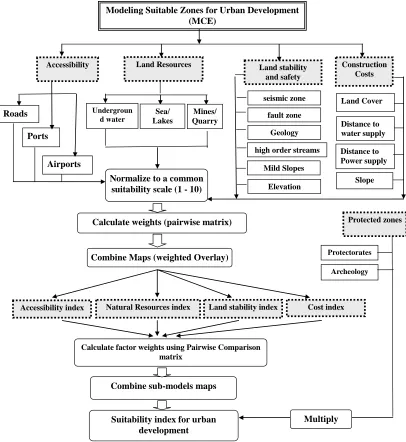
A conceptual diagram of the applied analysis is shown in Figure 2.
4.1. Define the Problem
In this step, the overall objective was identified. All as-pects of the remaining steps of the overlay modeling process must contribute to this overall objective. Ensur-ing geological safety, resources, least costs, accessibility and protection of natural and archeological assets are the objectives of this study.
4.2. Break the Problem into Sub-Models
Most overlay problems are complex, and it is recom-mended to break them down into sub-models for clarity, to organize thoughts, and to more effectively solve the
overlay problem. For this study, several factors that con-tribute to the suitability of the lands for accommodating new urban communities were identified. Such factors were then grouped into five main sets or rather themes. For each of the five themes a Multicriteria Evaluation sub-model was created These themes are: 1) accessibility, 2) natural resources, 3) land stability and 4) construction costs and 5) natural and cultural values protection.
4.3. Determine Significant Layers and Defining the Related Themes
[image:3.595.66.535.84.398.2]Distance to water supply
Slope Distance to Power supply Land Cover seismic zone
fault zone
Geology
high order streams
Mild Slopes
Elevation
Accessibility Land stability
and safety
Land Resources Construction
Costs
Modeling Suitable Zones for Urban Development (MCE)
Combine sub-models maps Ports
Airports Roads
Natural Resources index
Accessibility index Land stability index Cost index
Protected zones
Protectorates
Archeology Undergroun
d water
Sea/ Lakes
Mines/ Quarry
Normalize to a common suitability scale (1 - 10)
Calculate weights (pairwise matrix)
Combine Maps (weighted Overlay)
Calculate factor weights using Pairwise Comparison matrix
Suitability index for urban development
[image:4.595.95.501.86.528.2]Multiply
Figure 2. A conceptual model for the applied methodology.
4.3.1. Natural Resources Theme
Potential land resources are the backbone for job creation and therefore it should take first priority and considera-tion in development of new urban zones. Factor maps used for modeling the land resources (Table 1) theme
include the following: groundwater, sea/lakes and min-eral resources.
1) Ground Water
Groundwater is one of the most important natural re-sources for the development in such areas of severe arid-ity as North Sinai. There are two main types of ground-water; the Quaternary aquifer in wadi alluvium and coastal sand dunes, and the deep fracture zone aquifers in Lower Cretaceous sandstone formations Hydro-geologic units were digitized from the available hydro-geologic
map (Institute for groundwater, 1999) [24]. 2) Sea/Lakes
Sea water can be desalinated and provide the water needs of urban communities in Sinai Peninsula. Lake Bardawil provides an aqua culture resource and fisheries for the natives. Proximity of a site from a shoreline is considering a benefit factor. Shorelines were digitized from the Landsat ETM image acquired in 2013.
3) Mineral Resources
Table 1. Standardization of suitability factors: natural resources.
Factors for resources Suitability scale
Ground water (aquifers) Distance to sea shorelines (m) Distance to mines (m) Distance to quarry (m)
0 0 - 500 0 - 1000 0 - 2000
1 Non-aquifers clays and shale. 106,013 - 117,791 100,895 - 112,105 93,382 - 103,756
2 Local groundwater occurrences in fissured and weathered zone in hard rocks 94,234 - 106,012 89,685 - 100,894 83,006 - 93,381
3 - 82,454 - 94,233 78,474 - 89,684 72,630 - 83,005
4 Local and moderately to low productive. 70,675 - 82,453 67,264 - 78,473 62,255 - 72,629
5 Local and highly to moderately productive. 58,896 - 70,674 56,053 - 67,263 51,879 - 62,254 6 Extensive and moderately to low productive. 47,117 - 58,895 44,843 - 56,052 41,504 - 51,878
7 - 35,338 - 47,116 33,632 - 44,842 31,128 - 41,503
8 Extensive and highly to moderately productive. 23,559 - 35,337 22,422 - 33,631 20,752 - 31,127
9 - 11,780 - 23,558 11,211 - 22,421 10,377 - 20,751
10 Extensive and highly productive, continuous. 500 - 11,779 1000 - 11,210 2000 - 10,376
amount of raw materials for cement industry (limestone, shale and gypsum) are also available. Mineral resources map was obtained as a shape file from the Center of Housing and Building Researches, 2007[25].
4.3.2. Land Stability Theme
Land stability sub-model aims at avoiding the land col-lapse vulnerable lands. Avoiding such vulnerable zones is crucial in selecting lands that would be developed as urban residential and new communities. For this purpose, a vulnerability map for land collapse hazards in Sinai was created. Such map identifies the highly vulnerable lands that should be avoided from the selection for new urban settlement. To produce the land stability map, the inverse of such map was used.
Land stability index map = 1/land vulnerability index map
The vulnerability index map was modeled using the following factors:
1) Elevation
Higher elevation zones are more vulnerable to land collapse due to the force of gravity. Thus the highest elevation sites are least suitable.
2) Slope
Lands having steeper slope angles are more vulnerable to land collapse. Slope greater than 25 degree has been classified as unsuitable.
3) Lithology
Different rock types have different response to land collapse. The lithology was reclassified according to the suitability scale
4) Seismic Intensity Zones
Zones prone to high magnitude seismic activity are more vulnerable to land collapse.
5) Stream Density
The higher the stream density, the more vulnerable to
land collapse.
6) Active Faults Zones
Zones with active faults are more vulnerable to land collapse.
7) Faults Density
Zones with high density of faults are vulnerable.
4.3.3. Accessibility Theme
Accessibility is a main factor that defines the decisions of people; accessibility to a site can be a main factor for polarization for a new location. Factors used to model the accessibility theme are defined as follows:
1) Roads
Roads are the main arteries for a development site. They provide accessibility and link remote areas, consti-tuting the main arteries for residential needs. Main cor-ridors, paved roads and desert tracks were considered. All roads were digitized from the topographic map, up-dated from SPOT-4 images and a road distance map was created.
2) Ports
The proximity to existing ports is an important factor for exchanging goods and providing jobs. A distance function was used to create a distance to ports map.
3) Airports
Airports are crucial in serving a site providing accessi-bility and linking its remote areas. The airports sites were digitized from the topographic map and a distance map was created.
4.3.4. Costs of Construction Theme
The cost of construction is a main economic factor for decision making in site selection. Factors used to model the cost of construction theme are defined as follows:
1) Land Cover/Land Use
plan-ning; the distribution of various land-use types gives considerable constraints to urban planning. For example natural protectorates, cultivated lands, urban areas are not liable to change. The land cover layer was derived by supervised classification of SPOT4 images. Six classes were identified namely: sabkha and wetlands, water bod-ies, cultivated land, natural vegetation, desert, urban and roads.
2) Water Supply
Provision of a water resource is a main factor for de-veloping an area. Underground water and sea water (for desalinization) were considered a possible water resource. Proximity from sea shore and underground water layers were produced using the distance module.
3) Power Supply
The proximity of the site to a power supply facility such as high electric lines or power stations is an eco-nomic factor. The high electric lines and power stations were mapped from the topographic map.
4) Slope
The slope was delineated using SRTM digital eleva-tion model (DEM) in ESRI ArcGIS 9.2 spatial analyst.
4.3.5. Land Protection Theme
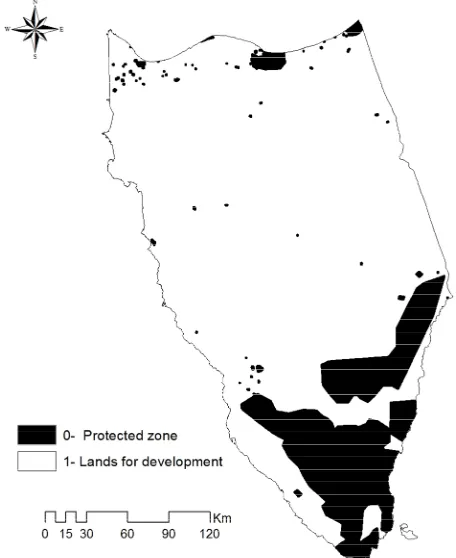
The investigated is unique in ecological and archaeo-logical values. The protectorates and the archeoarchaeo-logical sites should be protected from any changes in land use. The protected zones were obtained from the Egyptian Environmental Affairs Agency, EEAA, 2007 [24]. The archaeology sites were obtained from the Egyptian Gen-eral Organization for Physical Planning, GOPP, 2007 [27]. A binary function was used to classify the lands giving a zero value for the national protectorates and 500 meters buffer zone around the archaeological sites was given a zero value and masked out.
4.4. Transformation of Criteria Attributes to a Common Scale (Normalization)
Criteria attributes have different measuring scales. In order to perform analysis, a standardization has to be performed through transformation of attributes into a common suitability. For each factor, the attributes were rated in reference to a common scale. Thus for each sub- model, the criteria attributes were transformed from the original values to a common suitability scale ranging from 1 - 10. The higher value being more favorable. A value of zero was given to unsuitable pixels (Tables 1-6).
4.5. Combining the Theme Factors (Layers)
Equal weights were used for the factors within a theme. The theme maps were created by combining such factors using the following equation:
j ij
S
W X (1) [29] where: S = composite suitability score, Wj= weightsas-signed to each factor j, Xij= attribute score i of factor j.
4.6. Calculation of the Theme Weights
Certain factors may be more important to the overall goal than others. If this is the case, the factors can be weighted based on their relative importance. Analytical Hierarchy Process [30]was used to assign weights to each criterion, factor, and thus determine their relative importance in the final decision adopted within the model. The method is based on pair-wise comparison within a reciprocal matrix, in which the number of rows and columns is defined by the number of criteria. Accordingly, it is necessary to establish a comparison matrix between pairs of criteria, contrasting the importance of each pair with all the others. Subsequently, a priority vector is computed to establish weights (Wj). These weights are a quantitative measure of
the consistency of the value judgments between pairs of factors [31].Satty’s scale of measurement is used as fol-lows:
S = {1/9, 1/8, 1/7, 1/6, 1/5, 1/4, 1/3, 1/ 2, 1, 2, 3, 4, 5, 6, 7, 8, 9}.
A pairwise comparison matrix was designed. The comparison ratings are provided on a nine-point con-tinuous scale, which was proposed by (Eastman, 1995) [29]. The comparisons ratings and factors were discussed with experts and a pairwise comparison matrix was con-structed based on (Table 3). If we call that weight aij,
and use that scale of comparison and if the relative weighting is a23 = 3/1, then the relative importance of attribute 3 with regard to 2 is its reciprocal a32 = 1/3. This process generated an auxiliary matrix in which the value in each cell is the result of the division of each value judgment (aij) by the sum of the corresponding column. Finally, the average of the normalized values of rows was obtained, which corresponds to the priority vector (Wj). This was normalized by dividing each vector
value by n (the number of vectors), thus obtaining the normalized overall priority vector, representing all factor weights (Wj).
1) Determination of the weighted sum vector by mul-tiplying matrix of comparisons on the right by the vector of priorities to get a new column vector. Then divide first component of new column vector by the first component of priorities vector, the second component of new col-umn vector by the second component of priorities vector, and so on. Finally, sum these values over the rows.
The calculation of CI is based on the observation that λ
is always greater than or equal to the number of criteria under consideration (n) for positive, reciprocal matrices and λ = n, if the pairwise comparison matrix is consistent matrix. Accordingly, λ-n can be considered as a measure of the degree of inconsistency. This measure can be normalized as follows:
approximating random indices using a sample size of 500 [31], Table 3 shows the value of RI sorted by the order
of matrix.
4.7. Combining the Four Themes
In overlay analysis, it is desirable to establish the rela-tionship of all the input factors together in order to iden-tify the desirable locations that meet the goals of the model. If a weighted summation is used, the higher the value on the resulting output raster, the more desirable the location will be. A weighted overlay was used to combine the criteria maps and to produce the final suit-ability index for suitable urban zones.
CI n n 1 (2) The term CI, referred to as consistency index, provides a measure of departure from consistency. To determine the goodness of CI. The Analytical Hierarchy Process (AHP) compares it by Random Index (RI), and the result is what we call CR, which can be defined as:
i ij
lS
W X c (4) [28,29]CR CI RI (3)
where: S = composite suitability score, Wj = weights
as-signed to each factor j, Xij = attribute score i for factor j,
[image:7.595.53.539.325.465.2]Random Index (RI) is the CI of a randomly generated pairwise comparison matrix of order 1 to 10 obtained by
Table 2. Saaty’s nine-point weighting scale [31].
Intensity of importance Description Suitability class
1 Equal importance Lowest suitability
2 Equal to moderate importance Very low suitability
3 Moderate importance Low suitability
4 Moderate to strong importance Moderately low suitability
5 Strong importance Moderate suitability
6 Strong to very strong importance Moderate high suitability
7 Very strong importance High suitability
8 Very to extremely strong importance Very high suitability
[image:7.595.58.538.336.733.2]9 Extremely importance Highest suitability
Table 3. Random index (RI) (Saaty, 1980) [32].
Order Matrix 1 2 3 4 5 6 7 8 9 10
[image:7.595.56.538.546.735.2]R.I. 0.00 0.00 0.58 0.9 1.12 1.24 1.32 1.41 1.45 1.49
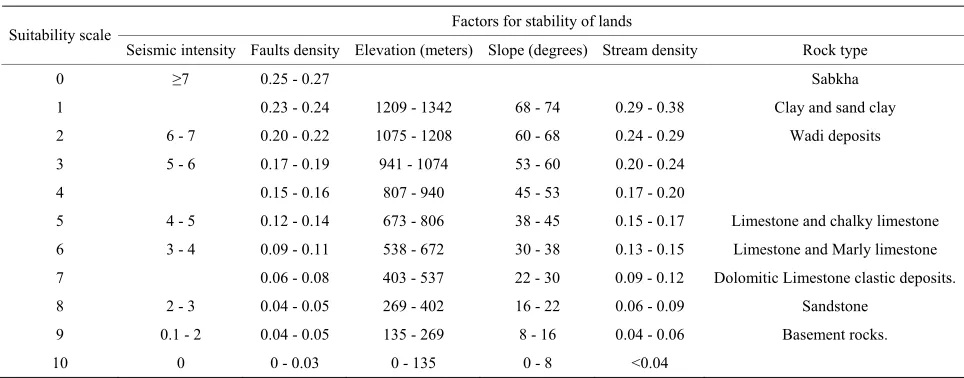
Table 4. Standardization of the suitability factors; land stability.
Factors for stability of lands Suitability scale
Seismic intensity Faults density Elevation (meters) Slope (degrees) Stream density Rock type
0 ≥7 0.25 - 0.27 Sabkha
1 0.23 - 0.24 1209 - 1342 68 - 74 0.29 - 0.38 Clay and sand clay 2 6 - 7 0.20 - 0.22 1075 - 1208 60 - 68 0.24 - 0.29 Wadi deposits 3 5 - 6 0.17 - 0.19 941 - 1074 53 - 60 0.20 - 0.24
4 0.15 - 0.16 807 - 940 45 - 53 0.17 - 0.20
5 4 - 5 0.12 - 0.14 673 - 806 38 - 45 0.15 - 0.17 Limestone and chalky limestone 6 3 - 4 0.09 - 0.11 538 - 672 30 - 38 0.13 - 0.15 Limestone and Marly limestone 7 0.06 - 0.08 403 - 537 22 - 30 0.09 - 0.12 Dolomitic Limestone clastic deposits.
Table 5. Standardization of the suitability factors: accessibility.
Factors for accessibility Suitability scale
Distance to roads (meters) Distance to ports (meters) Distance to airports (meters)
0 0 - 200 0 - 1000 0 - 1000
1 17,420 - 19,355 308,493 - 342,769 84,933 - 94,369 2 15,489 - 17,419 274,217 - 308,492 75,496 - 84,932 3 13,549 - 15,484 239,940 - 274,216 66,060 - 75,495 4 11,614 - 13,548 205,663 - 239,939 56,623 - 66,059
5 9678 - 11,613 171,386 - 205,662 47,186 - 56,622
6 7743 - 9677 137,109 - 171,385 37,749 - 47,185
7 5807 - 7742 102,832 - 137,108 28,312 - 37,748
8 3872 - 5806 68,555 - 102,831 18,875 - 28,311
9 1936 - 3871 34,278 - 68,554 9437 - 18,874
10 201 - 1935 1000 - 34,277 0 - 1000
Table 6. Standardization of the suitability factors: cost of construction.
Factors for cost of construction Suitability
scale Land cover Distance to power supply (meters) Distance to water supply (meters) Slope (degrees)
0 Water bodies, built-up, sabkha 0 - 200 0 - 200 >30 1 Natural vegetation 103,523 - 115,025 142,945 - 159,937
2 Agriculture 92,021 - 103,522 127,951 - 143,944 24 - 30
3 80,518 - 92,020 111,957 - 127,950
4 Sand dunes 49,016 - 80,517 95,963 - 111,956
5 57,513 - 69,015 79,970 - 95,962
6 46,011 - 57,512 63,976 - 79,969 15 - 23
7 34,508 - 46,010 47,982 - 63,975
8 23,006 - 34,507 31,988 - 47,981 8 - 15
9 11,503 - 23,005 15,995 - 31,987
10 Desert lands 200 - 11,502 200 - 15,994 0 - 8
Πclis the constraint binary map description of symbols.
5. Results and Discussion
In this section, the resultant factors maps that were cre-ated using ESRI Spatial Analyst various functions are presented. Factors constituting each theme are grouped together for each of the five criteria themes as follows:
5.1. Factor Maps and Standardization Tables
Factor maps for Themes are depicted in the following figures; land resources (Figure 3), land stability (Figure 4), accessibility (Figure 5) and construction costs ( Fig-ure 6) Such maps are the preliminary results which were
further processed to produce the sub-models themes in-dex maps:
Figure 3 shows the factors of the land resources theme
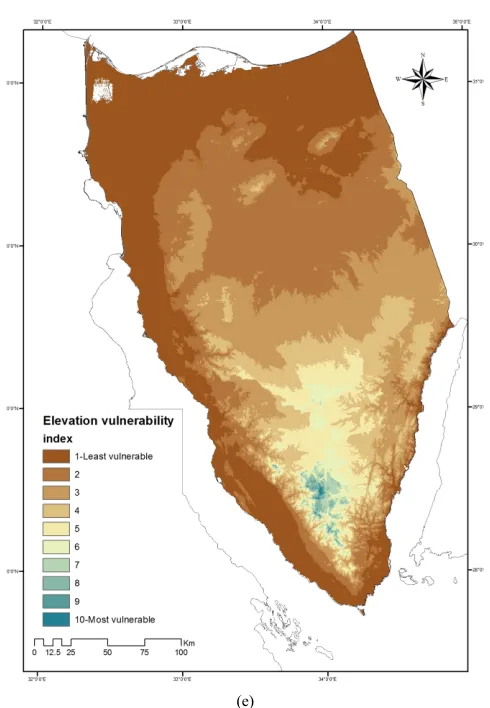
and the spatial distribution of potential land resources in the North, middle and southern zones. Figure 4 shows
the spatial distribution of geologic stable and less stable lands. Figure 5 shows the factors of the accessibility theme
and spatial distribution of most and least accessible zones based on the road networks. Factors for the least cost theme are shown in Figure 6. Standardization of the cri-
teria maps are also presented in Tables 1, 4 and 5.
5.2. Deriving the Factor Weights
Tables 7(a)-(c) depict the Analytical Hierarchy Process
AHP used to calculate the factor weights. Table 7(d)
depicts the calculation of the consistency ratio (CR).
5.3. Deriving the Sub-Models for Each Theme
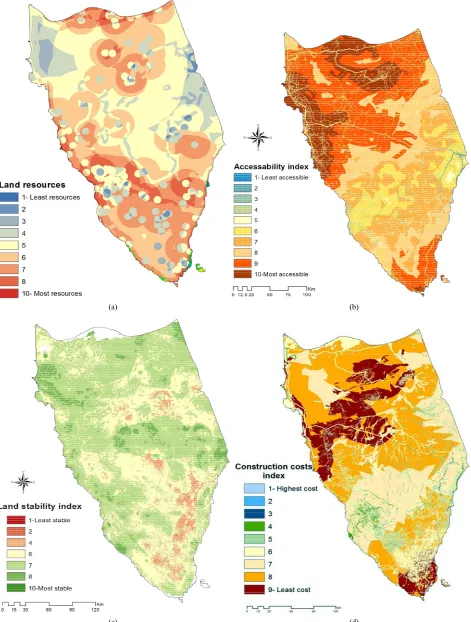
The four sub-models themes (Figures 7(a)-(d)) were de-
rived by running Multlicriteria evaluation model Equa- tion (1) using equal factor weights. Land Protection theme binary sub-model is shown in Figure 8.
(a) (b)
[image:9.595.60.535.81.699.2](c) (d)
(a) (b)
(e)
Figure 4. Standardized factors maps for land stability theme: (a) Seismic magnitudes zones; (b) Stream density; (c) Slope; (d) Fault density; (e) Elevation zones.
tial urban development lands in Sinai Peninsula. The model output explains that most of the lands in Sinai Peninsula is suitable for new urban communities (Table 8). Zones with highest suitability values (with grid value
10) amounted to 5326 square kilometers equivalent to 8.9% of the total study area Figure 9. These zones were
selected as the most suitable sites. They are the most suit-able zones for urban development fulfilling the suitability criteria used in the five themes. The spatial distribution shows potential zones distributed in North Sinai, middle zones and South Sinai. Such zones are high in accessibil-ity, with safe geology and have potential land resources and low cost of construction within the studied criteria. Such zones avoid the protected zones of natural and cul-tural values. The most suitable zones for urban develop-ment are distributed among the administrative divisions of the Peninsula. They are described as follows:
In North Sinai Governorate, the most suitable zones amounted to 2081 square kilometers. In South Sinai Governorate, the most suitable zones amounted to 3015 square kilometers. In the portion of land falling in the Suez Governorate, most suitable zones amounted to 163
square kilometers In portion of lands falling in Ismailia Governorate, the most suitable zones amounted to 66 sq. km. For the portion of lands falling in Port Saied Gover-norate the most suitable sites amounted to 1.0 square kilometers.
6. Conclusion
(a)
[image:12.595.62.533.84.711.2](b) (c)
(a) (b)
[image:13.595.59.535.79.705.2](c) (d)
(a) (b)
[image:14.595.64.535.87.709.2](c) (d)
Figure 7. Themes sub-models index maps: (a) Land resource ; (b) Accessibility; (c) Land stability; (d) Construction costs. s
Table 7. (a)-(c) depicts the analytical hierarchy process AHP used to calculate the factor weights. (d) depicts the calculation of the consistency ratio (CR). (a) Pairwise com-parison matrix; (b) Normalized pairwise comcom-parison ma-trix and computation of weights; (c) Normalized pairwise comparison matrix and calculated weights; (d) Calculation of the consistency ratio (CR).
(a)
Land safety
Land resources
Construction
costs Accessibility Land safety 1 9/7 9/5 9/4 Land resources 7/9 1 7/5 7/4
Construction
costs 5/9 5/7 1 5/4
Accessibility 4/9 4/7 4/5 1
(b)
Land safety
Land resources
Construction
costs Accessibility Land safety 1 1.28 1.8 2.25 Land resources 0.77 1 1.4 1.75
Construction
costs 0.55 0.71 1 1.25
Accessibility 0.44 0.57 0.80 1
Total 2.77 3.57 5 6.25
[image:15.595.58.286.88.367.2](c) Figure 8. The land protection theme binary sub-model.
Land
safety resources Land Construction costs Accessibility Land safety 0.360 0.359 0.360 0.360 Land resources 0.279 0.280 0.280 0.280
Construction
costs 0.199 0.200 0.200 0.200 Accessibility 0.159 0.159 0.159 0.160
Total 1.000
(d)
Criterion Weighted sum vector Consistency vector
Land safety 1 (0.36) + 9/7 (0.28) + 9/5 (2) + 9/4 (0.16) 1.44/0.36 = 4
Land resources 7/9 (0.36) + 1 (0.28) + 7/5 (0.20) + 7/4 (0.16) 1.12/0.28 = 4
Construction costs
5/9 (0.36) + 5/7 (0.28) + 1 (0.20)
+ 5/4 (0.16) 0.80/0.20 = 4
[image:15.595.307.539.171.613.2]Accessibility 4/9 (0.36) + 4/7 (0.28) + 4/5 (0.20) + 1 (0.16) 0.64/0.16 = 4
Table 8. Area under different suitability categories.
Suitability categories Area in sq. km Area in % Most suitable 5327 8.9 More suitable 29,980 50.0
Suitable 12,630 21.0 Marginally suitable 1590 2.60
Least suitable 76 0.12 Not suitable 10223.9 17.0 Figure 9. Most suitable zones for urban development in
Sinai Peninsula.
[image:15.595.61.285.397.673.2] [image:15.595.306.538.642.736.2]issue is quite valuable especially in developing countries.
REFERENCES
[1] D. F. Brown, “Back to Basics: The Influence of Sustain- able Development on Urban Planning with Special Ref- erence to Montreal,” Canadian Journal of Urban Re- search, Vol. 15, No. 1, 2006, pp. 99-117.
[2] I. Bystron, C. MacDonald and J. Stansfield, “Department of Geography,” University of Guelph, Canada, 2013. http://www.uoguelph.ca/geography/research/geog4480_w 2013/index.html
[3] L. J. Luo, Z. He and Y. Hu, “Study on Land Use Suitabil- ity Assessment of Urban-Rural Planning Based on Re- mote Sensing—A Case Study of Liangping in Chong- qing,” The International Archives of the Photogrammetry,
Remote Sensing and Spatial Information Sciences, Vol. 37, Part B8, Beijing, 2008.
[4] M. Cerreta and P. De Toro, “Urbanization Suitability Maps: A Dynamic Spatial Decision Support System for Sustainable Land Use,” Earth System Dynamics, Vol. 3, 2012, pp. 157-171.
http://dx.doi.org/10.5194/esd-3-157-2012
[5] I. L. McHarg, “Design with Nature,” Wiley, New York, 1969.
[6] L. Hopkins, “Methods for Generating Land Suitability Maps: A Comparative Evaluation,” Journal of American Institute, Vol. 34, 1977, pp. 19-29.
[7] R. K. Brail and R. E. Klosterman, “Planning Support Sys- tems,” ESRI Press, Redlands, 2001.
[8] M. G. Collins, F. R. Steiner and M. J. Rushman, “Land- Use Suitability Analysis in the United States: Historical Development and Promising Technological Achievements,”
Environmental Management, Vol. 28, No. 5, 2001, pp. 611-621. http://dx.doi.org/10.1007/s002670010247 [9] J. M. C. Pereira and L. Duckstein, “A Multiple Criteria
Decision-Making Approach to GIS-Based Land Suitabil- ity Evaluation,” International Journal of Geographical Information Systems, Vol. 7, No. 5, 1993, pp. 407-424. http://dx.doi.org/10.1080/02693799308901971
[10] R. Store and J. Kangas, “Integrating Spatial Multi-Crite- ria Evaluation and Expert Knowledge for GIS-Based Ha- bitat Suitability Modeling,” Landscape and Urban Plan- ning, Vol. 55, No. 2, 2001, pp. 79-93.
http://dx.doi.org/10.1016/S0169-2046(01)00120-7 [11] G. F. Bonham-Carter, “Geographic Information Systems
for Geoscientists: Modeling with GIS,” Pergamon Press, New York, 1994.
[12] J. C. Cambell, J. Radke, J. T. Gless and R. M. Whirt-shafter, “An Application of Linear Programming and Geographic Information Systems: Cropland Allocation in Antigue,” Environment and Planning A, Vol. 24, No. 4, 1992, pp. 535-549. http://dx.doi.org/10.1068/a240535 [13] S. Kalogirou, “Expert Systems and GIS: An Application
of Land Suitability Evaluation,” Computers, Environment and Urban Systems, Vol. 26, No. 2-3, 2002, pp. 89-112. http://dx.doi.org/10.1016/S0198-9715(01)00031-X [14] W. Miller, W. M. G. Collins, F. R. Steiner and E. Cook,
“An Approach for Greenway Suitability Analysis,” Land- scape and Urban Planning, Vol. 42, No. 2-4, 1998, pp. 91-105.
http://dx.doi.org/10.1016/S0169-2046(98)00080-2 [15] R. Gunasekera, “Use of GIS for Environmental Impact
Assessment in Interdisciplinary Approach,” Interdisci- plinary Science Reviews, Vol. 29, No. 1, 2004, pp. 37-48. http://dx.doi.org/10.1179/030801804225012473
[16] J. R. Eastman, P. A. K. Kyem, J. Toledano and W. Jin, “GIS and Decision Making,” UNITAR, Geneva, 1993. [17] R. L. Church, “Geographical Information Systems and
Location Science,” Computers and Operations Research, Vol. 29, No. 6, 2002, pp. 541-562.
http://dx.doi.org/10.1016/S0305-0548(99)00104-5 [18] R. Janssen and P. Rietveld, “Multicriteria Analysis and
Geographical Information Systems: An Application to Agricultural Land Use in the Netherlands,” Geographical Information Systems for Urban and Regional Planning, Kluwer Academic Publishers, Dordrecht, 1990, pp. 129- 139.
[19] Central Agency for Public Mobilization and Statistics, CAPMAS, National Information Center (NIC), Nasr City, Cairo, 2013.
[20] Center of Housing and Building Researches, Ministry of Housing, Utilities and Urban Development, “Egypt, Mines and quarry map of Egypt,” 2007.
[21] Shutle Radar Topography Mission, United States Geo- logical Survey (USGS), 2000. http://seamless.usgs.gov [22] Egyptian Military Survey Department, “The Topographic
Map of Egypt,” 1995.
[23] Egyptian General Petroleum Corporation, CONOCO- Coral, “The Geological Map of Egypt, Scale 1:500,000,” Egypt, Cairo, 1987.
[24] Ministry of State for the Environment, Egyptian Envi- ronmental Affairs Agency (EEAA), Department of Na- ture Conservation, National Biodiversity Unit, Egypt: “National Strategy and Action Plan for Biodiversity Con- servation,” 1998.
[25] Research Institute for groundwater (RIGW), National Water Research Center (NWRC), The “Hydro-Geological Map of Egypt, Scale 1:200,000,” 1999.
[26] ESRI, “Working with the ArcView Spatial Analyst,” Environmental Systems Research Institute, Inc., Redlands, 1996.
[27] General Organization for Physical Planning, GOPP, “The Environmental Vision of the Strategy of Urban Develop- ment in Egypt,” Unpublished Report, GOPP, Cairo, 2007. [28] J. R. Eastman, W. Jin, P. A. K. Kyem and J. Toledano,
“Raster Procedures for Muli-Criteria/Multi-Objective De- cisions,” Photogrammetric Engineering & Remote Sens- ing, Vol. 61, No. 5, 1995, pp. 539-547.
[29] D. T. Bailey, “Development of an Optimal Spatial Deci- sion-Making Using Approximate Reasoning,” Ph.D. Dis- sertation, Queensland University of Technology, 2005. [30] T. Saaty, “A Scaling Method for Priorities in Hierarchical
http://dx.doi.org/10.1016/0022-2496(77)90033-5
[31] T. A. Saaty, “Decision-Making for Leaders,” 2nd Edition, RWS Publication, Pittsburgh, 1992.