Multiple Dispatching Reactive Power and Voltage
Coordinated Control Method
Ting Yu1, Tianjiao Pu1, Wei Wang2, Zhaoyu Jin3, Ning Yang4 1
China Electric Power Research Institute, Beijing, China
2
Gansu Electric Power Corporation, Lanzhou, China
3
North China Electric Power University, Beijing, China
4
Northeast China Grid Company, Shenyang, China
Email: [email protected], [email protected], [email protected], [email protected], [email protected]
Received January, 2013
ABSTRACT
This paper studies the reactive power and voltage coordinated control scheme. According to the characteristics of Hu-nan power grid, the coordinated schemes about HuHu-nan power grid with Central China Power Grid, as well as Changsha power grid are proposed. At the same time, this paper builds a two-way interactive and multiple dispatching reactive power and voltage coordinated control mode, and can be successfully applied in Hunan power grid. The operation re-sults show that this control scheme fulfills the ability of large power grids in optimal allocating of resources, effectively integrates the reactive power resources of the entire grid, achieves the purpose of reducing power grid loss, improving voltage quality, reducing the operating numbers of the reactive power equipment.
Keywords: Coordinated Control; Power Grid Loss; Voltage Quality; Operating Numbers
1. Introduction
In recent years, the scale of state grid is gradual expand-ing, but each dispatching center (area dispatchexpand-ing, pro- vincial dispatching, regional dispatching) only adminis- ters a local part of the entire power grid. If these dis- patching control centers are independent in the imple- mentation of voltage and reactive power control, it will not take full advantage of the power grid in resource op- timal allocation, resulting in unnecessary waste of energy and the overall optimal control result is not satisfactory. Even may be appearing the situation which the regulated effect is contrary between the interconnected grids, re- sulting in repeated adjustment of the control device. It not only affects the life of the equipment, but also can not ensure the quality of the voltage. Therefore, it need coordinated control of reactive power and voltage through the exchange of information between different dispatching control centers and different power grid at all levels, to ensure the whole grid voltage and reactive power integrated operation, to achieve optimal distribu- tion of voltage and reactive power, to meet the requests of bus voltage qualified, the gateway power factor rea- sonable, power grid loss minimum and so on [1-6].
This paper is aimed at the provincial grid, studies the coordinated control method of reactive power and volt- age among provincial grid, regional grid, area grid. Then,
taking Hunan power grid for example, verifying the ef- fectiveness of the coordinated control according to this method.
2. Province and Region Coordinated Control
here the medium-voltage side reactive power and me-dium-voltage side bus voltage of 330 kV gateway substa- tion are chosen as coordinated variables. In other areas, provincial dispatching administers the 220 kV power plants and the high-voltage side bus of substations, while regional dispatching administers the 110 kV substation and the reactive power device of the 220 kV substation, so the high-voltage side reactive power and high-voltage side bus voltage of the 220 kV gateway substation are chosen as coordination variables.
Due to regional dispatching administering discrete re- active devices which include capacitors, reactors and transformers tap and so on, it is unable to achieve the precise regulation of the gateway reactive power, so pro- vincial dispatching needs issue the gateway reactive power range to regional dispatching, rather than the ga-teway reactive power precise value. In order to further clarify the coordinated goals of provincial dispatching, and avoid frequently regulating the discrete devices of regional grid, provincial dispatching needs also issuing compensation direction instruction to regional dispatch- ing at the same time. Specific coordinated method as follows:
Based on the information provided by regional dis- patching, provincial dispatching implements the reactive power optimal calculation of the whole grid, issues the gateway exchanging reactive power range and the de- sired regulate direction of reactive power compensation to regional dispatching.
Regional dispatching provides information to provin- cial dispatching including that the AVC system operation state, the compensation capacity of the gateway, the de- sired gateway voltage range and so on. On the premise of meeting the control requirements of provincial dispatch- ing, based on its own security and economic needs, re- gional dispatching calculates the control strategy, adjusts the capacitors, reactors and transformer taps and other equipment.
Provincial dispatching gets the coordinated time from the information supplied by regional dispatching, and calculates the difference between coordinated time and current time. If the time difference is more than 15 min- utes, it is judged that the information exchange is inter- rupted, and exits the online coordination with regional dispatching. When the time difference is less than 15 minutes, provincial dispatching resumes the online coor- dination with regional dispatching.
Regional dispatching obtains the command time from issued information supplied by provincial dispatching, and calculates the difference between this time and the current time. If the time difference is more than 15 min- utes, it is judged that the information exchange is inter- rupted, exits on-line coordination. When the time differ- ence is less than 15 minutes, regional dispatching
resumes the online coordination with provincial dis-patching.
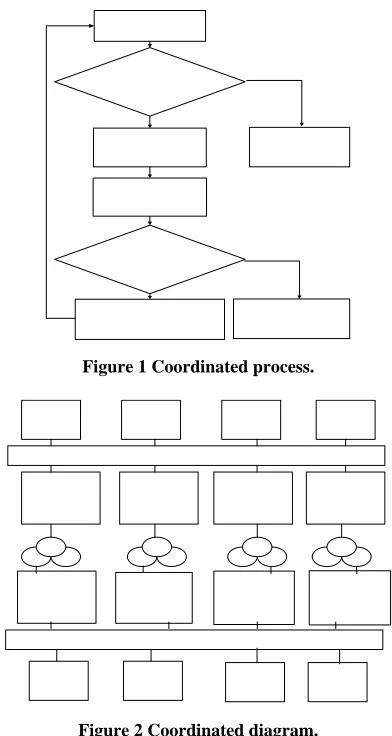
The coordinated process is shown in Figure 1.
3. Area and Province Coordinated Control
[image:2.595.324.520.340.708.2]This coordinated control means that the optimal coordi- nated control of the reactive power and voltage between area power grid and provincial power grid. Addition to Northwest area of China (area dispatching administers 750 kV power grid, provincial dispatching administers the 330 kV power grid), area dispatching administers the 500 kV power grid, provincial dispatching administers the 220 kV power grid, so the essence of coordination is the optimal control between the 500 kV power grid and the 220 kV power grid, to realize the local equilibrium of reactive power. However, many provincial dispatching still administers a part of 500 kV plant or station, so the specific coordinated program depends on the provincial dispatching whether administers the 500 kV plant and station. The coordinated example is shown in Figure 2.
Figure 1 Coordinated process.
Figure 2 Coordinated diagram.
power grid, area dispatching AVC system selects the high-voltage side reactive power and high-voltage side bus voltage of the 500 kV gateway substation as coordi- nated variables. In the side of area dispatching, through the AVC system, calculates the optimum distribution of the voltage and reactive power of the entire 500 kV grid, and sends the optimal range of the coordinated variables to provincial dispatching AVC system. Provincial dis- patching AVC system calculates the 500 kV power grid and 220 kV power grid together, taking coordinated vari- ables optimum range issued by area dispatching as con- straints, and implementing the optimal computation, to ensure the optimal distribution of voltage and reactive power of 220 kV grid is matched with the optimal distri- bution of 500 kV grid that area dispatching desired.
When provincial dispatching does not administer 500kV grid, area dispatching AVC system selects me- dium-voltage side reactive power and the medium-volt- age side bus voltage of 500 kV gateway substation as coordinated variables. Thus area dispatching gets the voltage and reactive power optimal distribution of the entire 500 kV grid through optimal calculation, and then issues the optimal range of the coordinated variables to the provincial dispatching AVC system. Provincial dis- patching AVC system controllable range only covers 220 kV grid, taking the optimal range of coordinated vari-ables issued by area dispatching as constraints, to ensure the optimal distribution of voltage and reactive power of 220 kV grid is matched with the optimal distribution of 500 kV grid that area dispatching desired, in order to achieve the objective of coordination between 220 kV power grid and 500 kV power grid.
In short, regardless of provincial dispatching whether administers the 500 kV grid or not, the responsibility of area dispatching is achieving the optimal distribution of voltage and reactive power of the entire 500 kV grid. And set this as goals, one side area dispatching directly controls its own plants and stations, at the same time it needs issuing the desired target value of the coordinated variables to provincial dispatching. The responsibility of provincial dispatching is matched with area dispatching, realizes the optimal distribution of voltage and reactive power of 220 kV grid, and ensures that the 500 kV grid and 220 kV grid can be synchronously optimized [10-12].
4. Coordinated Method
Taking Hunan power grid for example, the control bound- ary of Hunan provincial power grid and regional power grid is 220 kV substation, while the control boundary with central China power grid is 500 kV substation. So the 220 kV gateway high-voltage side reactive power and high-voltage side bus voltage are chosen as coordinated
variables between Hunan power grid and regional power grid, while the 500 kV gateway medium-voltage side re- active power and medium-voltage side bus voltage are chosen as coordination variables between Hunan power grid and central China power grid.
4.1. The Information Supplied by Regional Dispatching
During the process of coordinated control, regional dis- patching should periodically supply information to pro- vincial dispatching. If 220 kV bus bars are parallel oper- ating, regional dispatching sends the whole substation station data to provincial dispatching, while 220 kV bus bars are separated operating, regional dispatching sends the main transformer data to provincial dispatching, the illustrations are as follows:
Coordinated time: the time of regional dispatching supplies the data to provincial dispatching;
Coordinated symbol: if regional dispatching partici-pates in coordinated control, AVC system marks “1”, else AVC system marks “0”;
Available symbol: if regional dispatching AVC system is available marks “1”, else marks “0”;
Real compensation capacity: the reactive power com- pensation capacity below the main transformer of substa- tion;
Total maximum compensation capacity: the total ca- pacity of the capacitive reactive compensation below the main transformer of substation;
Total minimum compensation capacity: the total ca- pacity of the inductive reactive power compensation be- low the main transformer of substation;
Security compensation capacity upper limit: the max- imum available compensation capacity below the main transformer of substation in the conditions that 10 kV bus voltage is qualified;
Security compensation capacity lower limit: the mini- mum available compensation capacity below the main transformer of substation in the conditions that 10kV bus voltage is qualified;
Voltage coordinated requests: when the regulation ca-pacity of regional dispatching is insufficient, making an application to provincial dispatching, to expect that pro-vincial dispatching regulates 220 kV bus voltage at a certain range.
4.2. The Command Issued by Provincial Dispatching
According to the information supplied by regional dis- patching, provincial dispatching implements the whole grid reactive power optimal calculation, and gives the real-time coordinated command as follows:
Command time: the time of provincial dispatching is- sues command to regional dispatching;
220 kV bus voltage: the lower and upper limit of 220 kV bus voltage;
Gateway substation high-voltage side reactive power: the lower and upper limit of the gateway substation high- voltage side reactive power;
Compensation direction: provincial dispatching re- quires for reactive power compensation switching direc- tion of regional dispatching power grid;
Increase compensation: exiting the inductive reactive compensation equipment, or putting into capacitive reac- tive compensation equipment;
Maintain compensation: neither putting into nor exit- ing the reactive power compensation equipment;
Reduce compensation: exiting the capacitive reactive compensation equipment, or putting into the inductive reactive compensation equipment.
When the online coordination of provincial dispatch- ing and regional dispatching is exited more than 15 min- utes, regional dispatching will automatically cancel the coordination with provincial dispatching, and imple- ments local control. When communication is normal, regional dispatching will automatically restore online coordination with provincial dispatching.
4.3. The Information Supplied by Provincial Dispatching
This coordination is similar to the above process, provin- cial dispatching should periodically supply the following information to the area dispatching:
Available status signal: it indicates that whether or not provincial dispatching AVC system is available, when more than one generator of provincial power grid par- ticipate in closed-loop control, AVC system is available, otherwise is unavailable;
Remote/local signal: it indicates that provincial dis- patching whether or not adopts area dispatching coordi- nated control command, remote indicates adopting, oth- erwise is not;
Supplying data time: it indicates the time which pro- vincial dispatching AVC system sends information to area dispatching, according to this time, area dispatching determines provincial dispatching information is whether or not available;
Controllable generator information: it includes the generator reactive power measurement, active power
measurement, reactive power upper limit, reactive power lower limit;
Gateway voltage information: it includes the gateway voltage measurement, voltage upper limit, voltage lower limit.
4.4. The Command Issued by Area Dispatching
In the process of this coordination, area dispatching needs to issue command to provincial dispatching as fol- lows:
Command time: it indicates the time which area dis- patching issues command to provincial dispatching, ac- cording to this time, provincial dispatching determines area dispatching command is whether or not available;
Gateway reactive power command: it includes that gateway substation medium-voltage side reactive power upper and lower limit;
Gateway voltage command: it includes that gateway substation medium-voltage side voltage upper and lower limit.
5. Practical Application
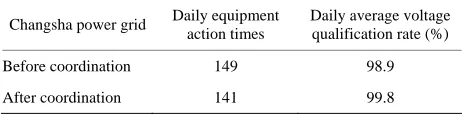
[image:4.595.307.538.580.639.2]Hunan power grid AVC system has been successfully put into closed-loop operation in August 2009, and realized the control of all directly dispatched power plants. With AVC systems of Central China Power Grid and Hunan regional grid are on-line operating, it has provided the conditions of implementing the reactive power and volt- age coordinated control. Hunan Power Grid, Central China Power Grid and Changsha power grid are selected to implement coordinated control, and the power grid loss and voltage fluctuation rate of area dispatching, the power grid loss and voltage qualification rate of provin- cial dispatching, the equipment action numbers and vol-tage qualification rate of regional dispatching are re- coded before and after coordinated control, and the data is shown in Tables 1-3:
Table 1. The coordinated control results of central china power grid.
Central China power grid
Daily average power grid loss(MW)
Daily average voltage fluctuation rate (%)
Before coordination 773.5 4.8
After coordination 771.9 3.3
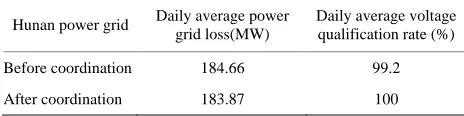
Table 2. The coordinated control results of hunan power grid.
Hunan power grid Daily average power grid loss(MW)
Daily average voltage qualification rate (%)
Before coordination 184.66 99.2
[image:4.595.306.538.679.737.2]Table 3. The coordinated control results of changsha power grid.
Changsha power grid Daily equipment action times Daily average voltage qualification rate (%)
Before coordination 149 98.9
After coordination 141 99.8
In the view of the comparative results, the coordinated control scheme can fulfill the capability of the large power grid in the resources optimal allocation, effect- tively reduce power grid loss, improve voltage qualifica- tion rate, reduce equipment action numbers and reduce the voltage fluctuation rate.
6. Conclusions
This paper studies the reactive power and voltage coor- dinated control scheme among area power grid, provin- cial power grid and regional power grid. And according to the characteristics of Hunan power grid, proposed the detailed coordinated control method. The actual coordi- nated control effect shows that: implementing reactive power and voltage online coordinated control among area grid, provincial grid and regional grid can fully integrate the reactive power resources of the entire network, stabi- lize voltage fluctuations, improve voltage quality and reduce power grid loss according to this scheme. And it has great significance to achieve secure, stable, graceful and economic operation of state grid.
REFERENCES
[1] G. Radman, A. Pama, J. Powell, et al., “Ynamic Voltage Stability Improvement Using Coordinated Control of Dynamic Var-sources,” P Symposium-Bulk Power System Dynamics and Control, Revitalizing Operation Reliability, Charleston, SC, USA, 2007.
[2] S. Coris, M. Pozzi, C. Sabelli, et al., “The Coordinated Automatic Voltage Control of the Itanlian Transmission Grid,” IEEE Trans on Power Systems, Vol. 19, No. 4,
2004, pp. 367-371.
[3] C. Sandro, P. Massimo, S. Carlo, et al. “The Coordinated Automatic Voltage Control of the Italian Transmission Grid—Part I: Reasons of the Choice and Overview of the Consolidated Hierarchical System,” IEEE Trans on Power Systems, Vol. 19, No. 4, 2004, pp. 1723-1732.
doi:10.1109/TPWRS.2004.836185
[4] T. Yu and W. Wang, “Coordinated Scheme for Automatic Voltage Control of Hunan Power Grid,” Power System Technology, Vol. 35, No. 4, 2011, pp. 82-86.
[5] J. X. Su, H. L. Liao, W. Q. Yuan and J. H. Chen, “Muti-layer United Controlling by the Region and County’s AVC,” Relay, Vol. 36, No. 10, 2008, p. 36239.
[6] X. Y. Wei, “Study on Large-scale Power Networks Real-time Reactive Power Optimal Control Method,” Zhejiang University, 2010.
[7] X. Y. Wei, “Study on Large-scale Power Networks Real-time Reactive Power Optimal Control Method,” Zhejiang University, 2010.
[8] T. Yu and R. P. Guo, “Control Scheme for Voltage Reac-tive Power of Regional Power Grid Based Load Fore-cast,” Power System Protection and Control, Vol. 40, No. 12, 2012, pp. 121-124.
[9] G. H. Zou, Y. J. Guo, Z. X. Yao, et al., “Study on the Implement of Coordinated Automatic Voltage Con-trol(AVC),” Electric Power, Vol. 41, No. 12, 2008, pp. 6-9.
[10] Q. L. Guo, B. Wang Bei, W. Y. Ning, et al., “Application of Automatic Voltage Control System in North China Power Grid,” Automation of Electric Power System, 2008, Vol. 32, No. 5, pp. 95-107.
[11] B. Wang, Q. L. Guo, H. B. Sun, B. M. Zhang and W. C. Wu, “Automation Voltage Control Among Muti Control Centers,” Power System Technology, Vol. 34, No. 12, 2010, pp. 53-57.